
Key takeaways
- If you are a US citizen or green card holder, you file a US return for every year you meet the filing threshold, even while living in India. Since April 1, 2026, India taxes you under the Income-tax Act, 2025, which replaced the 1961 Act.
- India's tax year runs from April to March. Residence depends on day counts (182 days, or 60 days plus 365 days over the four prior years). Most newcomers, including Indian-Americans who move back, are "not ordinarily resident" for their first two years, sometimes three.
- The 1989 US-India treaty keeps the US saving clause. It has no special re-sourcing rule for US citizens, and the two countries have no social security agreement. For most Americans in India, the foreign tax credit does more than the treaty.
- In India, interest on NRE and FCNR deposits is tax-free for non-residents. In the US it is ordinary taxable income. Indian mutual funds are PFICs.
- When you sell Indian property as a non-resident, the buyer withholds Indian tax, the US taxes the gain in dollars, and RBI rules cap how much you can send abroad each year.
Do Americans living in India still file US taxes?
Yes. The United States taxes citizens and green card holders on worldwide income wherever they live. IRS Publication 54 applies the ordinary filing rules to Americans abroad. For 2026, Revenue Procedure 2025-32 sets the standard deduction at $16,100 for single filers and $32,200 for married couples filing jointly. For most people under 65, the gross income filing threshold equals the standard deduction. If you have $400 or more of net self-employment income, you must file whatever your total income is. If you are married to an Indian national and file separately, the threshold drops to $5 of gross income.
Deadlines. The return is due April 15. If you live and work outside the United States on that date, you get an automatic two-month extension to June 15 by attaching a statement to the return. Interest on any unpaid tax still runs from April 15. Form 4868 extends the filing date to October 15.
Foreign earned income exclusion (FEIE). For 2026, you can exclude up to $132,900 of foreign earned income per person on Form 2555. You qualify through bona fide residence in India for a full calendar year, or through 330 full days in a foreign country or countries within 12 consecutive months. The exclusion covers wages and self-employment income. It does not cover interest, dividends, rent, pensions or capital gains.
Foreign tax credit (FTC). Form 1116 credits Indian income tax against US tax on the same foreign-source income. India's top slab rate is 30 percent before surcharge and cess, so Indian tax on a professional salary often covers the US tax on it, and the excess credit carries forward. See our line-by-line Form 1116 guide and FEIE vs. foreign tax credit. If you are leaving a US state, read state taxes after moving abroad as well.
When does India treat you as a tax resident, and what does it tax?
Which law applies. The Income-tax Act, 2025 received presidential assent on August 21, 2025 and took effect on April 1, 2026. The Income-tax Rules, 2026 were notified on March 20, 2026. The new Act governs "tax year" 2026-27 (April 1, 2026 to March 31, 2027) onward. Income earned up to March 31, 2026 stays under the 1961 Act. This guide cites the 2025 Act first and the 1961 number in parentheses.
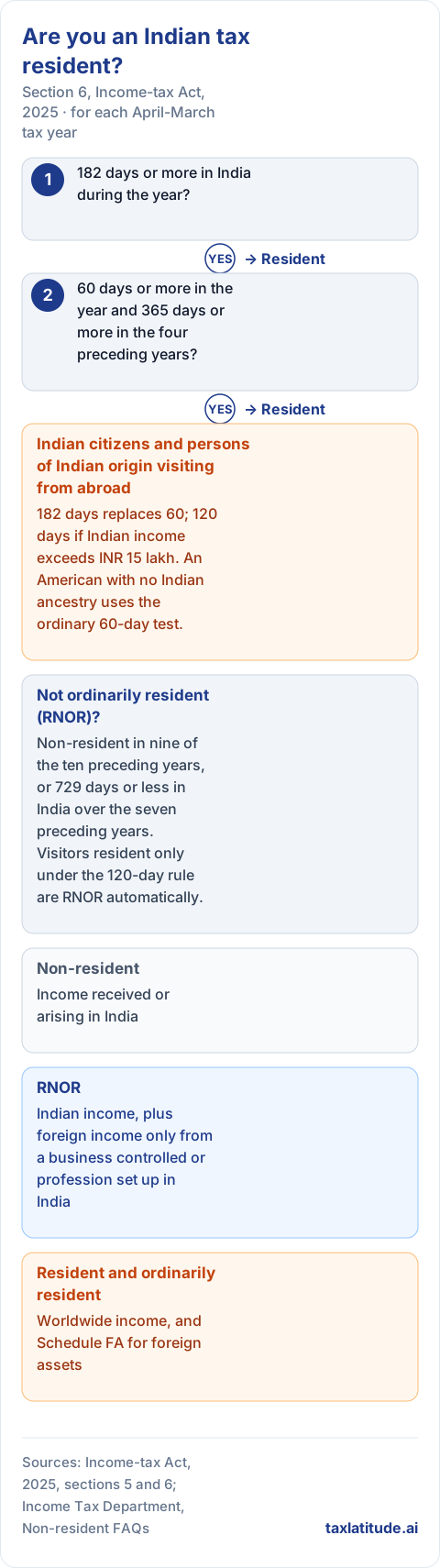
The day-count tests. Under Section 6(2) of the 2025 Act (formerly 6(1)), you are resident for a tax year if you spend either:
- 182 days or more in India during that year, or
- 60 days or more in that year and 365 days or more in the four preceding years.
Exceptions for people of Indian origin. Indian citizens and "persons of Indian origin" who live abroad and come to India on a visit use 182 days in place of 60. A person of Indian origin is someone who was born in undivided India, or whose parent or grandparent was. Many OCI cardholders meet this definition. If such a visitor's Indian income (other than income from foreign sources) exceeds INR 15 lakh, the second test applies with 120 days in place of 60, still combined with 365 days over the four prior years (Sections 6(4) and 6(5) of the 2025 Act, previously Explanation 1(b) to Section 6(1)). One lakh is 100,000 rupees and one crore is 10 million rupees. An American with no Indian ancestry uses the ordinary 60-day test.
Deemed residence. Section 6(7) (formerly 6(1A)) applies only to Indian citizens with more than INR 15 lakh of Indian income who are not liable to tax in any other country. It does not reach a US citizen with an OCI card, who is not an Indian citizen, or a green card holder with an Indian passport, who is liable to US tax.
Not ordinarily resident (RNOR). Under Section 6(13) (formerly 6(6)), a resident is "not ordinarily resident" if they were non-resident in nine of the ten preceding years, or spent 729 days or less in India over the seven preceding years. Visitors who are resident only under the 120-day rule are RNOR automatically.
| Status | Typical American | What India taxes (Section 5) | Foreign asset schedule |
|---|---|---|---|
| Non-resident | Short stays, or visitor of Indian origin under 182 days (120 days if Indian income exceeds INR 15 lakh) | Income received or arising in India | No |
| Resident but not ordinarily resident | Newcomer in the first two or three years, including Indian-Americans moving back | Indian income, plus foreign income only from a business controlled or profession set up in India | No |
| Resident and ordinarily resident | Long-term resident | Worldwide income | Yes, Schedule FA |
Rates and returns. The new regime is the default, and its top slab rate is 30 percent above INR 24 lakh, plus surcharge and a 4 percent cess. Under the return-filing rule (section 139(1) of the 1961 Act, carried into the 2025 Act), individuals with salary and investment income file by July 31, so the return for tax year 2026-27 is due July 31, 2027. The Finance Act, 2026 moved the date for non-audit business and professional income to August 31 (secondary source). Once you are resident and ordinarily resident, you report foreign assets on Schedule FA for the calendar year. Sections 42 and 43 of the Black Money Act impose a penalty of INR 10 lakh for failing to file or for leaving assets off the schedule. Since October 1, 2024, that penalty does not apply when foreign assets other than real estate total INR 20 lakh or less. For an American, a US brokerage account and a 401(k) count as foreign assets. A US home is real estate, so the INR 20 lakh threshold never covers it.
Is there a US-India tax treaty?
Yes. The convention was signed in New Delhi on September 12, 1989, together with a protocol and exchanges of notes. It generally took effect for US taxes on January 1, 1991. India publishes the same text on its Income Tax Department site. The articles that matter most to Americans in India:
US-India Convention (1989)
Download the Convention (PDF, 77 pages)
Local copy for convenience, downloaded from IRS.gov on November 14, 2026. This single PDF already includes the related protocol, exchanges of notes and memorandum of understanding — no amendment has been published since 1989. Always confirm at the IRS's own India tax treaty documents page before relying on it.
- Saving clause, Article 1(3). The US keeps the right to tax its citizens and residents as if the treaty did not exist. Article 1(4) lists the exceptions: Article 9(2), Article 20(2) and 20(6), Article 25 (relief from double taxation), Article 26 and Article 27. A further set of exceptions in Articles 19, 21, 22 and 29 applies only to people who are neither US citizens nor green card holders.
- Tie-breaker, Article 4(2). For someone resident in both countries under their domestic laws, residence goes to the country where the person has a permanent home. If that does not settle it, the tests are center of vital interests, then habitual abode, then nationality. For a US citizen, the tie-breaker changes nothing on the US side, because the saving clause still applies. A green card holder who claims to be an Indian resident under the treaty, however, can be treated under IRC Section 7701(b)(6) as having given up resident status, which can trigger the expatriation tax. Our tie-breaker tool walks through the order.
- Gains, Article 13. Each country taxes capital gains under its own domestic law. The treaty does not reduce Indian tax on sales of Indian property or shares.
- Private pensions, Article 20(1). Private pensions and annuities are taxable only in the recipient's country of residence. For a US citizen, the saving clause lets the US tax them anyway.
- Social security, Article 20(2). Social security benefits and other public pensions paid by one country are taxable only in that country, including when the recipient is a US citizen. This paragraph is excluded from the saving clause, so India cannot tax your US Social Security.
The Treasury's technical explanation gives the US reading of each article. See also how to read a US tax treaty and US retirement accounts abroad.
How do you avoid paying tax twice?
Income India taxes first. India generally has the first claim on salary for work done in India, rent from Indian property and gains on Indian assets. The US then credits the Indian tax on Form 1116, limited to the US tax on that foreign-source income, with a one-year carryback and a ten-year carryforward.
Income the US taxes first. Once you are resident and ordinarily resident, India taxes your US dividends, interest and retirement distributions. Under Article 25(2), India gives a credit for US tax, but only on income the treaty allows the US to tax. Article 25(3) treats income as arising in the US only where the treaty lets the US tax it "other than solely by reason of citizenship". It also yields to US domestic source rules. Unlike some newer US treaties, the India treaty has no rule that makes the US credit Indian tax on US dividends and interest that the US taxes above the treaty rate. A US citizen who is ordinarily resident in India can therefore be taxed twice on the difference. For 401(k) and IRA distributions, which Article 20(1) assigns to the country of residence, the interaction between the saving clause and Article 25(3) is unsettled. The planning tools are timing, the type of account, and RNOR years.
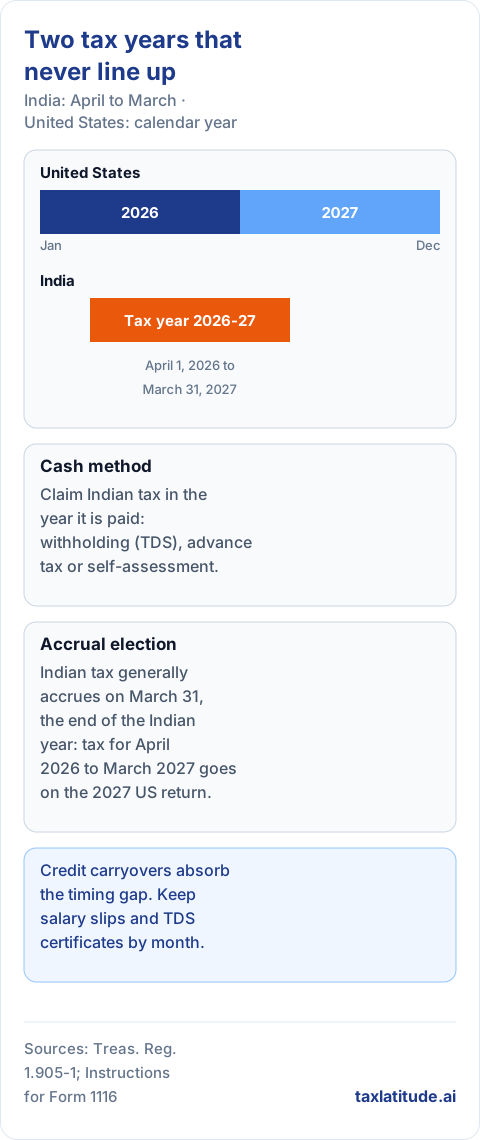
The calendar mismatch. India taxes April to March and the US taxes the calendar year. On the cash method, you claim Indian tax in the year it is paid through withholding (TDS), advance tax or self-assessment. With the accrual election under Section 905(a), Treas. Reg. 1.905-1 generally treats Indian tax as accruing on March 31, the end of the Indian year. Tax for April 2026 to March 2027 then goes on the 2027 US return, and credit carryovers absorb the timing gap. Under either method, keep salary slips and TDS certificates by month.
India's own credit form. A resident claiming credit in India for US tax files a separate statement. From tax year 2026-27 this is Form 44 under Rule 76 of the Income-tax Rules, 2026. It replaces Form 67 (Rule 128), which still applies to income up to March 31, 2026. The relief itself comes from the treaty-relief provision (section 90 of the 1961 Act, carried into the 2025 Act).
| Deadline | Country | What is due |
|---|---|---|
| June 15, September 15, December 15, March 15 | India | Advance tax installments for the April-March year |
| April 15 | US | Form 1040 and FBAR (FBAR extended automatically to October 15) |
| June 15 | US | Form 1040 for Americans abroad (automatic extension) |
| July 31 | India | Return for the year ended March 31 (salary and investment income) |
| August 31 | India | Return for non-audit business or professional income |
| October 15 | US | Form 1040 extended with Form 4868, and extended FBAR |
Social security: will you pay both?
Possibly. India does not appear on the Social Security Administration's list of totalization agreements, so no agreement assigns your contributions to one country.
Employees of Indian employers. A foreign national working for an establishment covered by the Employees' Provident Fund rules is an "international worker". International workers contribute on their full salary, with no wage ceiling. Those from countries without a social security agreement with India cannot make a final withdrawal before age 58, according to an EPFO circular dated April 27, 2022. The Karnataka High Court struck these rules down in 2024 and the Delhi High Court upheld them in 2025 (secondary source), so check your employer's current practice.
Employees of US employers. US citizens working abroad for an "American employer" remain subject to FICA under IRC Section 3121. An employee seconded to an Indian subsidiary can owe both FICA and EPF if the US company keeps them on its payroll, or if it has a Section 3121(l) agreement covering the subsidiary.
Self-employed Americans. US self-employment tax under IRC Section 1402 applies to net earnings even when the FEIE wipes out the income tax. See self-employed abroad and totalization.
How the US treats EPF. No IRS guidance classifies EPF. Employer contributions and growth may be taxable each year, foreign trust status is unsettled, and it is unclear whether Article 20(2) covers EPS pensions. Any position on EPF needs professional review.
Which US forms apply to accounts and assets in India?
FBAR (FinCEN Form 114). You file an FBAR if your foreign accounts together exceed $10,000 at any time in the year. That includes signature authority over a parent's account. Demat accounts, NRO, NRE and FCNR accounts, PPF and the cash value of life insurance all count. See our FBAR guide.
Form 8938. Taxpayers living abroad file Form 8938 when specified foreign financial assets exceed $200,000 on the last day of the year or $300,000 at any time. The figures are $400,000 and $600,000 for joint filers. Indian banks report the accounts of US persons to the IRS under India's FATCA agreement with the United States. See FATCA, CRS for the exchanges between other countries, and our Form 8938 vs. FBAR guide for how the two compare.
| Account | Who may hold it | Indian tax on interest | US treatment |
|---|---|---|---|
| NRO (rupee) | Any person resident outside India | Taxable, with withholding | Taxable. FBAR and 8938 |
| NRE (rupee, repatriable) | NRIs and OCI cardholders | Exempt for non-residents (Schedule IV, formerly Section 10(4)(ii)) | Fully taxable. FBAR and 8938 |
| FCNR(B) (foreign currency deposits) | NRIs and OCI cardholders | Exempt for non-residents and RNORs | Fully taxable. FBAR and 8938 |
| Resident savings account | Residents of India | Taxable | Taxable. FBAR and 8938 |
Under the RBI's account rules, an American with no Indian origin and no OCI card is limited to an NRO account while living abroad.
PPF and life insurance. NRIs and OCI holders cannot open a Public Provident Fund account, but one opened while resident can run to maturity under the PPF Scheme, 2019. Indian endowment policies may fail the US definition of life insurance, making their inside growth taxable.
Form 3520 for gifts and inheritances. You must file Form 3520 if you receive more than $100,000 in a year from a nonresident alien individual or foreign estate, counting gifts from related persons together. A parent in India transferring a flat, or an inheritance from a grandparent's estate, often crosses this line. No US tax is due on the gift, but the late-filing penalty is 5 percent of the gift per month, up to 25 percent; our Form 3520 penalty guide works through a full example and the routes to fix a missed filing. For wider planning, see estate planning abroad.
Did a parent in India just transfer you a flat, or are you expecting an inheritance? Receiving more than $100,000 from a nonresident alien relative triggers Form 3520 — miss it and the penalty is 5% of the gift per month, up to 25%. See if your gift crosses the threshold →
How are local pensions, retirement accounts and investment funds treated?
EPF, PPF and NPS. The US treatment of all three is uncertain. None is a qualified plan under US law. The treaty does not defer US tax on contributions or growth, and the saving clause blocks residence-based relief. Revenue Procedure 2020-17 exempts certain "tax-favored foreign retirement trusts" from Forms 3520 and 3520-A. Whether an Indian scheme meets its conditions has to be tested case by case. Defensible approaches range from taxing growth each year to deferring tax until withdrawal with full disclosure. OCI cardholders can join the National Pension System on the same terms as NRIs under a PFRDA circular of October 29, 2019, but the US reporting that follows is complex.
Indian mutual funds are PFICs. An Indian mutual fund or ETF is a passive foreign investment company. Each fund requires a separate Form 8621. See our Form 8621 guide. Under the default Section 1291 regime, gains and "excess distributions" are spread over your holding period. The amounts assigned to earlier years are taxed at the highest ordinary rate, plus an interest charge. Indian fund houses generally do not provide the annual statements needed for a QEF election. A mark-to-market election is possible for funds that count as marketable. The annual report is waived for Section 1291 funds when your total PFIC holdings are $25,000 or less ($50,000 on a joint return) and there was no excess distribution or sale. See PFICs explained and capital gains and crypto.
Own Indian mutual funds or ETFs? Each one needs its own Form 8621, and the default §1291 regime taxes earlier years' gains at the highest ordinary rate plus an interest charge — not your actual bracket. Check your PFIC exposure →
What happens if you run a business or company in India?
Private limited company. An Indian "public limited company" is a per se corporation under Treas. Reg. 301.7701-2(b)(8). A private limited company is an eligible entity that defaults to corporate treatment, because all of its members have limited liability. Form 5471 is generally due in the year you acquire 10 percent or more. It is due every year once you control the company, or once it is a controlled foreign corporation, meaning US shareholders own more than 50 percent. For tax years beginning after December 31, 2025, GILTI has been renamed "net CFC tested income" under IRC Section 951A. Individual shareholders are taxed on it at ordinary rates unless they make a Section 962 election or the high-tax exception applies. See our Form 5471 guide and owning a company abroad.
LLP. An Indian limited liability partnership also defaults to a corporation for US purposes. It can elect partnership treatment on Form 8832, in which case Form 8865 generally replaces Form 5471. India taxes the LLP itself as a firm, so model how its Indian tax will be credited to you under each classification before you elect. See our Form 8865 guide.
Sole proprietor or freelancer. You report on Schedule C, pay US self-employment tax, and file an Indian return, due August 31 for non-audit professional income, as a resident or non-resident depending on your days. Indian clients may withhold tax on your fees. Keep the certificates, because they support the credit against your Indian tax and the FTC on your US return.
What happens when buying, renting and selling property?
Who may buy. Under the Foreign Exchange Management (Non-debt Instruments) Rules, 2019, NRIs and OCI cardholders may buy any immovable property except agricultural land, farmhouses and plantation property, and may inherit any property. A foreign national of non-Indian origin living outside India may only lease for up to five years or inherit from a resident. One who lives in India may buy, but should expect to need RBI permission to repatriate the sale proceeds after leaving.
Renting. India taxes the rent. A tenant paying a non-resident landlord must withhold tax under the non-resident withholding rules (section 195 of the 1961 Act, now part of the 2025 Act's consolidated withholding provisions). On the US side you report the rent on Schedule E and depreciate a foreign residential rental placed in service after 2017 over 30 years under the alternative depreciation system.
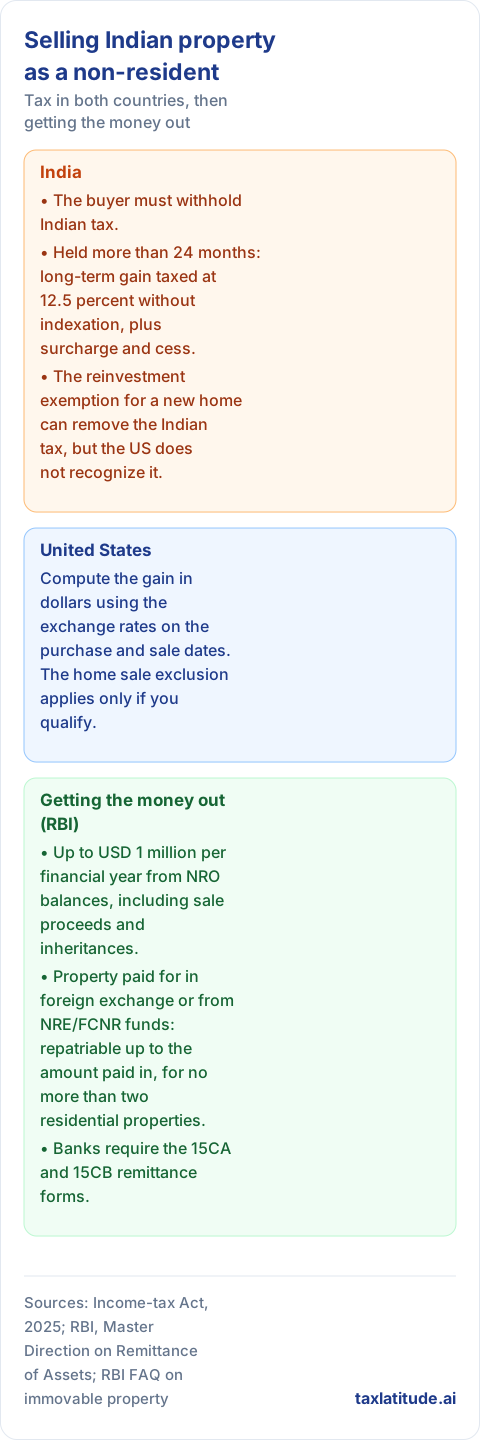
Selling. Property held more than 24 months produces long-term gain taxed at 12.5 percent without indexation under Section 197 (formerly 112), plus surcharge and cess. Resident individuals selling land or buildings bought before July 23, 2024 can instead use 20 percent with indexation if that gives less tax (secondary source). When the seller is a non-resident, the buyer must withhold tax under the same non-resident withholding rules. In practice buyers withhold on the full sale price unless the seller obtains a lower-withholding certificate first. India's reinvestment exemption for a new home (section 54 of the 1961 Act, carried into the 2025 Act) can remove the Indian tax, but the US does not recognize it. In that case the full gain is taxed in the US with no Indian tax to credit, unless the home sale exclusion under Section 121 applies. You compute the US gain in dollars using the exchange rates on the purchase and sale dates. Repaying an Indian rupee mortgage can also produce a separate currency gain.
Using India's Section 54 reinvestment exemption to avoid Indian tax on a property sale? The US doesn't recognize it — the full gain can still be taxed in the US with no Indian tax left to credit against it. Model the US side before you rely on it →
Getting the money out. Under the RBI's Master Direction on Remittance of Assets, NRIs and persons of Indian origin may remit up to USD 1 million per financial year from NRO balances, including sale proceeds and inheritances. Proceeds from property originally paid for in foreign exchange or from NRE/FCNR funds can be repatriated up to the amount paid in, for no more than two residential properties. The rest goes through the USD 1 million route. Banks require the remittance forms known as 15CA and 15CB under the 1962 Rules, renumbered under the 2026 Rules, for these remittances. See US taxes under currency controls.
What happens with employment, equity compensation and remote work for a US employer?
Indian employer. The employer withholds Indian tax monthly on salary (section 192 of the 1961 Act, carried into the 2025 Act) and, if it is covered by the EPF rules, enrolls you in EPF. On the US side you claim the FEIE or the FTC. Wages are sourced where you do the work, so salary for days worked in India is foreign-source.
Remote work for a US employer. India taxes salary earned for work performed in India even when a US company pays it into a US account. A US employer with no Indian entity usually runs no Indian payroll, so you pay advance tax yourself. The employer keeps withholding FICA and can reduce income tax withholding if you give it Form 673 for the FEIE. Long-term remote work can also create an Indian taxable presence for the employer.
Stock options and RSUs. India taxes ESOPs as a salary perquisite at exercise, measured as the fair market value on the exercise date minus the price paid, under Section 17(1)(d) (formerly 17(2)(vi)). It taxes RSUs when the shares are allotted. The US taxes nonqualified options at exercise and RSUs at vesting, so the timing usually matches. Incentive stock options create no regular US tax at exercise while India taxes them, which can leave Indian tax uncreditable. If you moved during the vesting period, the US sources the income by workdays between grant and vesting, while India taxes the part it treats as earned in India. The two allocations do not always match, which affects the FTC. Foreign shares held through a US plan go on Schedule FA once you are ordinarily resident.
What happens when leaving India?
Accounts. Under the RBI rules, resident accounts are redesignated as NRO when you leave India for a long period, and NRIs and OCI cardholders can then open NRE or FCNR accounts. On a return, NRE balances become resident or Resident Foreign Currency (RFC) accounts, and FCNR deposits convert at maturity.
Residence in the year you leave. The day-count tests apply to the whole April-March year. India has no split-year rule. An American without Indian ancestry who spends April to July in India, leaves in August and has 365 days in India over the prior four years is resident for the entire tax year. If they are also ordinarily resident, India can tax the salary they earn abroad for the rest of that year. The relief for visiting persons of Indian origin applies to people visiting from abroad, not to people leaving.
Money and benefits. India has no exit tax. You file a final return and remit savings with the 15CA and 15CB forms, as renumbered under the 2026 Rules. EPF balances of an American international worker generally stay locked until 58. On the US side, the FEIE is prorated to your last qualifying day. See retiring abroad if you are moving to a third country instead.
Mistakes Americans commonly make in India
- Treating NRE or FCNR interest as tax-free on the US return.
- Buying Indian mutual funds, ELSS or SIPs without knowing they are PFICs.
- Leaving NRO, PPF, EPF, demat accounts or parents' accounts with signature authority off the FBAR.
- Missing Form 3520 after receiving an inheritance or a flat from family in India.
- Claiming India's Section 82 reinvestment exemption and assuming the US gain disappears too.
- Using Indian TDS certificates for the wrong US year, or claiming the FEIE and the FTC on the same salary.
- Becoming ordinarily resident without starting Schedule FA, which then has to list the US 401(k) and brokerage accounts.
- Assuming the treaty shelters a US citizen's 401(k) or IRA withdrawals from US tax. The saving clause prevents that. See dual tax residency.
If earlier years were missed, the Streamlined Filing Compliance Procedures may let you catch up without penalties.
Checklist
Before moving
- Count your past days in India and determine whether you will be RNOR. Our residency tool helps.
- Plan sales of appreciated US investments for before the move or during your RNOR years, because India taxes worldwide gains once you are ordinarily resident.
- Get a PAN and decide which Indian bank accounts you are allowed to hold.
First 90 days
- Redesignate or open the correct accounts (resident, NRO, RFC).
- Ask your employer about EPF status and FICA continuation.
- Start a day-count log for both the FEIE and Indian residence.
Every year
- FBAR by April 15 (October 15 at the latest), and the US return by June 15 with Forms 8938, 8621 and 3520 as needed.
- Indian advance tax and the return by July 31 (August 31 for non-audit business income), with Form 44 for any foreign tax credit.
- Match each TDS certificate to the right US year.
Before leaving
- Redesignate accounts to NRO and plan remittances within the USD 1 million limit.
- Settle EPF and PPF positions and keep the withdrawal records.
- Confirm your residence status for the departure year in both countries.
Frequently asked questions
Does India tax my US Social Security? No. Article 20(2) of the treaty gives the US the sole right to tax it, including for US citizens resident in India.
Do I need to file in India if I only have NRE interest? A non-resident with only exempt NRE interest generally has no Indian taxable income, but the US return still reports it.
Is an OCI card enough to make me a person of Indian origin? Not automatically. The tax test asks whether you, a parent or a grandparent was born in undivided India.
Can I use the FEIE on Indian salary? Yes, if you meet the bona fide residence or physical presence test, but because Indian rates are high, the FTC often works better.
Are Indian stocks PFICs? Shares of an operating Indian company held directly are generally not. Mutual funds and ETFs are.
Which Indian form numbers do I use this year? From tax year 2026-27 (April 1, 2026), use the numbers of the Income-tax Rules, 2026: for example, Form 44 replaces Form 67 for the foreign tax credit. For income up to March 31, 2026, the 1962 Rules numbers still apply.
When was the US–India tax treaty signed, and is it still in force? Yes. The convention was signed in New Delhi on September 12, 1989, together with a protocol and exchanges of notes, and generally took effect for US taxes on January 1, 1991.
When to hire a professional
- US expat tax preparer (CPA or enrolled agent). For PFICs, Forms 5471 and 3520, EPF or NPS balances, and the FEIE or FTC choice.
- Indian Chartered Accountant. For Indian returns, advance tax, Form 44, lower-withholding certificates and the 15CA and 15CB remittance forms.
- Cross-border tax attorney. For treaty positions (Form 8833), green card residency, inheritances, or years of missed filings.
- FEMA specialist or your bank's authorized dealer. For property rules, repatriation limits and RBI approvals.
- Indian property lawyer. For title, inheritance documents and sale deeds.
Sources
Primary sources, accessed October 30, 2026.
| Source | URL | Used for | Date of page |
|---|---|---|---|
| Revenue Procedure 2025-32 | https://www.irs.gov/pub/irs-drop/rp-25-32.pdf | 2026 standard deduction and inflation-adjusted figures | October 9, 2025 |
| IRS, Figuring the foreign earned income exclusion | https://www.irs.gov/individuals/international-taxpayers/figuring-the-foreign-earned-income-exclusion | 2026 FEIE of $132,900 | Not stated |
| IRS Publication 54 | https://www.irs.gov/publications/p54 | Filing rules for Americans abroad, self-employment tax | Current edition |
| IRS, Automatic 2-month extension for citizens abroad | https://www.irs.gov/individuals/international-taxpayers/us-citizens-and-resident-aliens-abroad-automatic-2-month-extension-of-time-to-file | June 15 extension, interest from April 15 | Not stated |
| Instructions for Form 2555 | https://www.irs.gov/instructions/i2555 | FEIE qualification tests | Current revision |
| Instructions for Form 1116 | https://www.irs.gov/instructions/i1116 | Foreign tax credit, carryback and carryforward | Current revision |
| Treas. Reg. 1.905-1 (Cornell LII) | https://www.law.cornell.edu/cfr/text/26/1.905-1 | When foreign taxes accrue | Not stated |
| US-India income tax convention (IRS) | https://www.irs.gov/pub/irs-trty/india.pdf | Treaty text | Signed September 12, 1989 |
| Treasury technical explanation, US-India treaty | https://www.irs.gov/pub/irs-trty/inditech.pdf | Articles 1(3), 1(4), 4(2), 13, 20(2), effective date | Not stated |
| US-India treaty, Income Tax Department of India | https://incometaxindia.gov.in/DTAA/108690000000000099.htm | Treaty text, saving clause exceptions | Not stated |
| US-India treaty Article 25, Income Tax Department of India | https://incometaxindia.gov.in/DTAA%20Articles/USA/108020000000007117.htm | Relief from double taxation, sourcing rule | Not stated |
| IRC Section 7701 (Cornell LII) | https://www.law.cornell.edu/uscode/text/26/7701 | Green card holders claiming treaty residence | Not stated |
| SSA, U.S. International Social Security Agreements | https://www.ssa.gov/international/agreements_overview.html | No US-India totalization agreement | Not stated |
| IRC Section 3121 (Cornell LII) | https://www.law.cornell.edu/uscode/text/26/3121 | FICA for American employers abroad | Not stated |
| IRC Section 1402 (Cornell LII) | https://www.law.cornell.edu/uscode/text/26/1402 | Self-employment tax | Not stated |
| FinCEN, Report Foreign Bank and Financial Accounts | https://www.fincen.gov/report-foreign-bank-and-financial-accounts | FBAR threshold and deadlines | Not stated |
| IRS, Do I need to file Form 8938 | https://www.irs.gov/businesses/corporations/do-i-need-to-file-form-8938-statement-of-specified-foreign-financial-assets | Form 8938 thresholds for taxpayers abroad | Not stated |
| IRS, Gifts from foreign person | https://www.irs.gov/businesses/gifts-from-foreign-person | Form 3520 $100,000 threshold | Not stated |
| IRC Section 6039F (Cornell LII) | https://www.law.cornell.edu/uscode/text/26/6039F | Form 3520 gift penalty | Not stated |
| Revenue Procedure 2020-17 | https://www.irs.gov/pub/irs-drop/rp-20-17.pdf | Tax-favored foreign retirement trusts | 2020 |
| Instructions for Form 8621 | https://www.irs.gov/instructions/i8621 | PFIC reporting and $25,000 exception | Current revision |
| Treas. Reg. 301.7701-2 (Cornell LII) | https://www.law.cornell.edu/cfr/text/26/301.7701-2 | Per se corporations, entity classification | Not stated |
| Instructions for Form 5471 | https://www.irs.gov/instructions/i5471 | Reporting Indian companies | Current revision |
| IRC Section 951A (Cornell LII) | https://www.law.cornell.edu/uscode/text/26/951A | Net CFC tested income | Not stated |
| CBDT press release, Income-tax Act, 2025 comes into force | https://www.incometaxindia.gov.in/documents/d/guest/press-release-income-tax-act-2025-comes-into-force-from-01-april-2026-pdf | Effective date of new Act and 2026 Rules | April 1, 2026 |
| Income Tax Department, Non-resident FAQs | https://www.incometax.gov.in/iec/foportal/help/all-topics/e-filing-services/non-resident | Section 6 residence tests, 6(7), 6(13), Schedule IV | Not stated |
| Income Tax Department, Residence chart | https://incometaxindia.gov.in/Charts%20%20Tables/Residence-in-India-for-the-purpose-of-Income-Tax-Act.htm | RNOR rules, 120-day visitors (1961 Act version) | Not stated |
| Income-tax Act, 2025, Section 5 | https://www.incometaxindia.gov.in/w/section-5-256 | Scope of total income by status | Not stated |
| Income-tax Act, 2025, Section 17 | https://www.incometaxindia.gov.in/w/section-17-225 | ESOP perquisite | Not stated |
| Income-tax Act, 2025, Section 197 | https://www.incometaxindia.gov.in/w/section-197-78 | Long-term capital gains rate | Not stated |
| Income-tax Rules, 2026, Rule 76 | https://www.incometaxindia.gov.in/w/rule-76-3 | Foreign tax credit in India | Uploaded 08/01/2026 |
| Black Money Act, Section 43, Income Tax Department | https://www.incometaxindia.gov.in/w/section-43-114 | Schedule FA penalty and INR 20 lakh threshold | Not stated |
| Black Money Act, India Code | https://www.indiacode.nic.in/bitstream/123456789/2147/1/A201522.pdf | Sections 42 and 43 | As on July 1, 2026 |
| RBI, FAQs on non-resident accounts | https://rbi.org.in/scripts/FS_FAQs.aspx?Id=52&fn=5 | NRO, NRE, FCNR eligibility and redesignation | As on February 12, 2020 |
| RBI, FCNR(B) Scheme, Deposit Regulations 2016 | https://website.rbi.org.in/documents/d/rbi/SCH0404161_2 | FCNR eligibility and conversion | Not stated |
| RBI, FAQ on acquisition of immovable property | https://rbi.org.in/scripts/FAQView.aspx?Id=117 | Who may buy, repatriation of sale proceeds | Updated April 6, 2023 |
| RBI, Master Direction on Remittance of Assets | https://rbi.org.in/scripts/BS_ViewMasDirections.aspx?id=10197 | USD 1 million per financial year | Updated June 29, 2026 |
For your own situation, such as whether you will be RNOR or how the FEIE and the FTC compare for you, you can work through the details with the TaxLatitude assistant.
This guide is educational and is not personalized tax advice.