In short: a foreign trust with a U.S. owner must file Form 3520-A every year by the 15th day of the 3rd month after its year ends (March 15 for a calendar-year trust). When the trustee does not file, which is the norm for foreign pension providers, family trustees and insurers, the U.S. owner must prepare a substitute Form 3520-A and attach it to their own Form 3520 by the Form 3520 due date. Miss both, and the U.S. owner faces a penalty of the greater of $10,000 or 5% of the year-end gross value of the trust assets they are treated as owning, for every year.
Key takeaways
- The trust is the filer, but you carry the penalty. Under §6048(b) the foreign trust is legally responsible for filing Form 3520-A — but §6677(b) makes the U.S. owner liable for the penalty if it isn't filed, which is why the real work falls on you.
- When the trustee won't file — the norm for foreign pensions, family trustees and insurers — you must prepare a substitute Form 3520-A yourself, check the "Substitute Form 3520-A" box, sign it with your own name and TIN, and attach it to your own Form 3520 by the Form 3520 due date, not the trust's earlier deadline.
- The penalty is steep and assessed without a day in Tax Court first. It is the greater of $10,000 or 5% of the trust assets treated as owned by you, charged every year the failure continues, and the $10,000 floor alone can be close to 10% of a modest $100,000 account.
- Rev. Proc. 2020-17 can exempt a tax-favored foreign pension or savings trust from Form 3520-A entirely — but every condition must be tested (tax-favored status, local reporting, contribution limits, withdrawal restrictions), and it changes nothing for income tax, FBAR or Form 8938.
- Being an owner doesn't switch off the beneficiary rules. In Wilson v. United States (2021), a sole owner-beneficiary who missed reporting a distribution faced the 35% distribution penalty on top of the 5% owner penalty.
- Most "foreign trusts" are never labeled that way. A self-funded foreign pension, a family settlement, or certain life insurance and investment wrappers can all be trusts for U.S. tax purposes regardless of their local name — the product's marketing name never decides the question.
What Form 3520-A is, who is supposed to file it, and why you usually end up doing the work
Form 3520-A, Annual Information Return of Foreign Trust With a U.S. Owner (Under section 6048(b)), is the foreign trust's own annual return to the IRS. It is filed in the trust's name, under the trust's own employer identification number (EIN), and signed by the trustee. In practice, though, the trustee of a foreign pension, a family settlement or an insurance wrapper almost never files it, and U.S. law then shifts the work to you as the U.S. owner.
This guide covers only the trust-level return. Your own reporting of transfers to, ownership of and distributions from foreign trusts, and of large foreign gifts and bequests, happens on Form 3520, which our separate guide covers in full: our Form 3520 guide. The two forms are linked, and that link is the core of this section, but they have different filers, different due dates and different penalty computations.
1.1 The statutory basis: §6048(b)
Section 6048(b)(1) applies to any U.S. person who, at any time during the year, is treated as the owner of any portion of a foreign trust under the grantor trust rules of subpart E (§§671–679). That person has two duties:
- To submit the information the IRS prescribes about the trust for that year. This duty was added by the HIRE Act (Pub. L. 111-147, §534(a)) for taxable years beginning after March 18, 2010. You meet it on Part II of your own Form 3520.
- To ensure that the trust files an annual return. That return must set out a full and complete accounting of all trust activities and operations for the year, name the trust's U.S. agent (if any), and include other prescribed information. The trust must also furnish prescribed information to each U.S. owner and to each U.S. person who receives a distribution. That annual return is Form 3520-A.
The wording matters. The statute does not say the U.S. owner files the trust's return. It makes the owner responsible to ensure that the trust files it. The trust is the filer; the owner carries the obligation and, under §6677(b), the penalty. The Instructions for Form 3520-A put it the same way: a foreign trust with a U.S. owner must file Form 3520-A so that the owner can meet the §6048(b) reporting requirements, and each U.S. owner is responsible for ensuring that the trust files and furnishes the required statements.
1.2 What the trust-filed return contains
A complete Form 3520-A has five pages and several attachments:
- Page 1, Part I (General information): the trust's name, EIN, address, creation date and country; whether the trust has appointed a U.S. agent; the trustee's details; and the number of owner and beneficiary statements attached.
- Page 2, Part II (Foreign Trust Income Statement) and Part III (Foreign Trust Balance Sheet): the trust's full-year income, expenses and distributions, and its assets, liabilities and net worth at the beginning and end of the year.
- Pages 3 and 4, Foreign Grantor Trust Owner Statement: one for each U.S. owner, showing the owner's portion and the trust income attributable to it.
- Page 5, Foreign Grantor Trust Beneficiary Statement: one for each U.S. beneficiary who received a distribution during the year.
The instructions are explicit that only a complete Form 3520-A counts as timely filed, and that the form is complete only if every required attachment is included. Section 5 walks through each part line by line.
1.3 Why the obligation sits with the trust in principle
Congress built §6048(b) around the trust because the trust holds the records. The trustee keeps the books, holds legal title to the assets and knows what was earned and distributed. The design also explains the U.S. agent provision in §6048(b)(2). A trust that appoints a U.S. person as its limited agent for IRS examinations and summonses (under §§7602–7604) gives the IRS a way to reach the trust's books. A trust that does not appoint one exposes its U.S. owner to an IRS determination of the amounts the owner must report.
The result is a filing duty addressed to a foreign person the IRS cannot easily compel, enforced through a penalty on a U.S. person the IRS can reach. Knowing that structure helps explain everything else on the form.
1.4 The practical reality: most foreign trustees will not file
Foreign trustees, especially those who never asked for U.S. clients, very often have never heard of Form 3520-A. Three kinds account for most of the cases this guide's readers face:
- Pension and retirement plan administrators. A local pension trustee, or the provider of a personal pension product, runs thousands of accounts under local law. It has no reason to produce a U.S. income statement on U.S. tax principles for a single member, and often a policy of not doing so.
- Family trust trustees. A trust company, lawyer or relative administering a family settlement abroad may be willing to help but has no idea what the form is. They may also be unwilling to sign a U.S. return, or to appoint a U.S. agent and submit to IRS summons authority.
- Foreign insurers. Where an insurance or investment wrapper is classified as a trust for U.S. purposes (see Section 3), the insurer will rarely accept that characterization, let alone file a trust return.
The IRS's position is that none of this excuses you. Neither the trustee's reluctance nor trust terms that prohibit disclosure count as reasonable cause, and neither does a foreign law that would penalize disclosure (§6677(d) and the instructions' Penalties section). Section 7 covers the penalty.
1.5 The mechanism that shifts the work to you: the substitute Form 3520-A
When the trust does not file, the instructions require the U.S. owner to prepare a substitute Form 3520-A and attach it to the owner's own Form 3520. The current mechanics, checked against the December 2025 instructions for both forms, are these:
- What you prepare. You complete Form 3520-A for the trust to the best of your ability. That includes the trust's income statement (Part II), balance sheet (Part III), the Foreign Grantor Trust Owner Statement (pages 3 and 4), and the Foreign Grantor Trust Beneficiary Statement (page 5) for any U.S. beneficiary who received a distribution.
- How you mark it. You check the "Substitute Form 3520-A" box at the top of page 1.
- Who signs. You sign it as the U.S. owner, entering your own name and taxpayer identification number on the "Title" line of the signature box. A paid preparer still completes the preparer section.
- Where it goes. You attach it to your Form 3520 rather than filing it separately. On Form 3520, line 22 (in Part II) asks whether the trust filed Form 3520-A. You answer "No" and attach the substitute. If the trust did file, you answer "Yes" and attach the owner statement it gave you. The IRS's reminder page adds that you should not also file a duplicate Form 3520-A separately.
- When it is due. By the due date of your Form 3520, not the trust's Form 3520-A due date. The Reminders section of the December 2025 instructions states this directly. Section 6 explains why this is later than the trust's own deadline, and what it does and does not fix.
- Who receives copies. You must furnish copies of the owner statement and the beneficiary statement to the U.S. owners and U.S. beneficiaries by the Form 3520 due date.
- What it protects. A substitute completed to the best of your ability and attached to a timely filed Form 3520 is considered timely, and avoids the penalty for the trust's failure to file. The instructions illustrate this with a substitute attached to the owner's Form 3520 by the Form 3520 due date.
Two features of this mechanism deserve emphasis.
First, the "best of your ability" standard comes from the IRS instructions, not from the Code. Section 6677 itself contains no such phrase; its relief valve is reasonable cause (§6677(d)). The instructions' treatment of a best-efforts substitute as timely is the IRS's own administrative position, and it is the most practical protection available. It is also why documenting what you asked the trustee for, and what you received, matters so much (Sections 5.7 and 7.4).
Second, the substitute fixes the trust's failure to file, not an inaccurate filing. Section 6677(a) applies when a return is not filed on time or does not include all required information or includes incorrect information. A substitute that is badly wrong, rather than incomplete despite real efforts, remains exposed.
1.6 Is this mechanism in the regulations? Not yet
You may see the substitute rule attributed to "Reg. §1.6048-3." As of the research date there is no final Treasury regulation §1.6048-3. Section 1.6048-3 exists only in the proposed regulations published May 8, 2024 (REG-124850-08, 89 FR 39440). In that proposal, §1.6048-3 is the rule for U.S. owners of foreign trusts under §6048(b).
The proposed rule would codify the current mechanics with only minor changes. The U.S. owner would have to ensure the trust files Form 3520-A and furnishes the owner and beneficiary statements by the 15th day of the 3rd month after the trust's year ends (extendable by up to six months). If the trust does not comply, the owner would have to file Part II of Form 3520 by the owner's Form 3520 due date, prepare a substitute Form 3520-A with the related statements, file them with that Form 3520, and furnish the beneficiary statements. The proposal also covers consistent reporting (with Form 8082 for inconsistencies) and the U.S. agent rules.
Under the proposal, the §1.6048-3 rules would apply to taxable years beginning after final regulations are published. The IRS's December 2025 instructions still refer to the 2024 rules as proposed. We found no final regulations as of the research date. Until they appear, the operative rules are the statute, the form instructions, Notice 97-34 and the revenue procedures discussed in Section 4. The proposed regulations may be relied on only under the conditions described in Section 4.8.
Why you are treated as the "owner" at all: the grantor trust rules
Form 3520-A applies only if a U.S. person is treated as the owner of some portion of a foreign trust under §§671–679. Title to the assets does not matter; U.S. tax ownership does. For Americans abroad, §679 is the provision that most often creates ownership, followed by §677 (for self-funded arrangements) and §678 (for beneficiaries with withdrawal powers).
2.1 The framework in one paragraph
Under §671, when a person is treated as the owner of a portion of a trust, the income, deductions and credits of that portion go on that person's own return as if the trust did not exist for income tax purposes. Sections 673 through 677 treat a grantor as owner when the grantor keeps certain interests or powers. Section 678 treats a non-grantor, typically a beneficiary, as owner when they hold certain powers. Section 679 is a special rule for foreign trusts that treats a U.S. transferor as owner whenever the trust has a U.S. beneficiary. Section 672 holds the definitions and the foreign-grantor limitation in §672(f).
| Provision | Who it makes an owner | Typical trigger for Americans abroad |
|---|---|---|
| §673 | Grantor with a reversionary interest worth more than 5% of the portion | Rare in practice |
| §674 | Grantor (or nonadverse party) controlling beneficial enjoyment | Family trusts where the U.S. settlor keeps broad discretion |
| §675 | Grantor with certain administrative powers | Self-dealing, borrowing or substitution powers |
| §676 | Grantor who can revoke | Revocable "living trust" set up under foreign law |
| §677 | Grantor whose income may be paid or accumulated for grantor or spouse | Self-funded personal pension or savings trusts where you are the beneficiary |
| §678 | Non-grantor with a power, exercisable solely by that person, to vest corpus or income in themselves | Beneficiary of a relative's trust with an unrestricted withdrawal right |
| §679 | U.S. transferor to a foreign trust that has a U.S. beneficiary | Any gratuitous transfer by a U.S. person into a foreign trust that could benefit a U.S. person |
2.2 Section 679: the foreign-trust rule that does most of the work
Section 679(a)(1) provides that a U.S. person who directly or indirectly transfers property to a foreign trust is treated as the owner of the portion attributable to that property, for any taxable year in which the trust has a U.S. beneficiary. The consequence is that you are taxed currently on that portion's income whether or not anything is distributed. It also makes you a U.S. owner for §6048(b), so Form 3520-A applies.
Five features of §679 explain why it catches so many ordinary arrangements:
- "Has a U.S. beneficiary" is defined broadly. Under §679(c)(1), a trust has a U.S. beneficiary for the year unless both (A) no part of the income or corpus may be paid or accumulated to or for a U.S. person during the year, and (B) no part could be paid to or for a U.S. person if the trust terminated during the year. Contingent interests count.
- Discretion is enough. Under §679(c)(4), if any person has discretion to make distributions to any person, the trust is treated as having a U.S. beneficiary unless its terms specifically identify the class of eligible persons and none of them is a U.S. person during the year.
- Side agreements and uses count. Under §679(c)(5), any written, oral or other agreement or understanding that may result in a payment to a U.S. person is treated as a term of the trust. Under §679(c)(6), a loan of cash or marketable securities, or the use of any other trust property, by a U.S. person is treated as a payment to a U.S. person. The exception is a loan repaid at a market interest rate, or a use for which fair market value is paid within a reasonable period.
- Indirect beneficiaries count. Under §679(c)(2), amounts paid to or accumulated for a foreign corporation that is a controlled foreign corporation, a foreign partnership with a U.S. partner, or a foreign trust or estate with a U.S. beneficiary are treated as benefiting a U.S. person.
- The IRS can presume a U.S. beneficiary. Under §679(d), for a transfer by a U.S. person, the IRS may treat the trust as having a U.S. beneficiary unless the transferor provides the information the IRS requests and shows that both tests in §679(c)(1) are met.
The exceptions are narrow. Under §679(a)(2), the rule does not apply to transfers by reason of the transferor's death, or to transfers in exchange for consideration of at least fair market value. In applying the fair-value exception, §679(a)(3) disregards certain obligations of the trust or of related persons. Under the last sentence of §679(a)(1), the rule also does not apply to transfers to a trust described in §6048(a)(3)(B)(ii): deferred compensation trusts described in §402(b), §404(a)(4) or §404A, and certain charitable trusts. That exception matters a great deal for employer pension plans (Section 3.1).
Three timing rules also matter to people who move:
- Pre-immigration trusts (§679(a)(4)). If a nonresident alien becomes a U.S. resident within 5 years after directly or indirectly transferring property to a foreign trust, the transfer is treated as made on the residency starting date. This is how a new green card holder can become a §679 owner of a trust funded before the move.
- Outbound trust migration (§679(a)(5)). If a domestic trust becomes a foreign trust while a U.S. transferor is alive, the transferor is treated as having transferred the trust's assets to a foreign trust on that date.
- Trusts that acquire a U.S. beneficiary (§679(b)). If a foreign trust with no U.S. beneficiary later acquires one, the U.S. transferor is treated as having additional income in the first year the trust has a U.S. beneficiary. That income equals the trust's undistributed net income, at the close of the prior year, attributable to the transferred portion.
One exclusion cuts the other way. Under §679(c)(3), a beneficiary who first became a U.S. person more than 5 years after the date of a transfer is not treated as a U.S. person for that transfer. This mostly matters for trusts funded by U.S. persons long before a foreign-born beneficiary moved to the United States.
2.3 The foreign-grantor limitation (§672(f)) and why relatives' trusts are different
Section 672(f) generally prevents a foreign person from being treated as the owner of a trust. The main exceptions are trusts revocable by the grantor alone (or with a related or subordinate party who is subservient to the grantor) and trusts whose only possible distributees during the grantor's life are the grantor and spouse.
The practical effect is that a trust settled by a non-U.S. relative is usually a foreign nongrantor trust once that relative has died, or even during their life if neither exception applies. A U.S. person who simply receives distributions from such a trust is a beneficiary, not an owner. They report the distributions on Form 3520 under §6048(c), and Form 3520-A does not apply. That is covered in our Form 3520 guide.
Form 3520-A comes back into play when the U.S. beneficiary becomes an owner in their own right. The two common routes are:
- Becoming a §678 owner. If the trust terms give you a power, exercisable solely by you, to vest the corpus or income in yourself, §678(a)(1) treats you as owner of the portion subject to that power. An unrestricted right to withdraw capital is the classic example. Section 678(a)(2) can continue that treatment after you partially release or modify the power while keeping control that would make a grantor an owner. Section 672(f) does not block this, because it limits only the treatment of foreign persons as owners. On the owner statement (line 7) you then explain that you are an owner under §678, not the trust's grantor; the instructions' definition of "grantor" does not cover §678 owners.
- Becoming a §679 transferor. If you add money or property to the relative's trust, directly or indirectly, you are a U.S. transferor to a foreign trust that has a U.S. beneficiary (you). The portion attributable to your transfer becomes yours under §679. The "grantor" definition in Treas. Reg. §1.671-2(e) reaches indirect gratuitous transfers too, and §679(c)(6) can treat uncompensated use of trust property as a distribution. Paying the trust's expenses, guaranteeing its borrowing or transferring assets below value can all create a transferor portion.
2.4 Section 677: self-funded arrangements
Section 677(a) treats a grantor as owner of any portion whose income may be distributed to, or held or accumulated for future distribution to, the grantor or spouse without the approval of an adverse party. A self-funded foreign personal pension or savings trust, where you are both the contributor and the beneficiary, often fits this description independently of §679. For Form 3520-A purposes, it rarely matters which section applies: either way you are a U.S. owner under §6048(b).
2.5 Who signs and attaches what, by type of owner
| Your position | Owner provision | Your Form 3520 | Form 3520-A |
|---|---|---|---|
| You funded a foreign trust that can benefit you or another U.S. person | §679 (often also §§673–677) | Part I for the year of each transfer; Part II every year you are an owner | Trust files; otherwise you attach a substitute and sign it with your name and TIN on the "Title" line |
| You hold a sole-exercisable withdrawal power over a relative's trust | §678 | Part II every year you are an owner; Part III for any distribution | Same substitute obligation as above for your portion |
| You added assets to a relative's trust | §679 for the transferred portion only | Part I for the transfer year; Part II for your portion | Owner statement covers only your portion; any distributions from the nongrantor portion are reported separately |
| Two or more U.S. owners of portions | Each owner's own provision | Each owner files their own Form 3520 | One owner statement per U.S. owner; each owner carries their own §6677 exposure |
Two cautions apply to the last row. Each U.S. owner has an independent duty under §6048(b) and an independent penalty under §6677(b). In practice, each owner of a non-filing trust therefore attaches a substitute to their own Form 3520, and the figures should match across the family. Also, the IRS treats owners who are also beneficiaries as having both sets of obligations. In Wilson v. United States, 6 F.4th 432 (2d Cir. 2021), the Second Circuit held that a sole owner-beneficiary who failed to report a distribution on time could face the 35% distribution penalty, not only the 5% owner penalty. The distribution side belongs to Form 3520, but remember that being an owner does not switch off the beneficiary rules.
Why ordinary foreign arrangements turn out to be "foreign trusts"
Most people who owe Form 3520-A have never thought of themselves as owning a trust. The trigger is usually a pension, a savings plan, a family arrangement or an investment wrapper that U.S. law classifies as a trust. The classification follows the arrangement's legal substance under its governing law and documents, never its marketing name. There is no blanket rule that pensions, insurance policies or government savings schemes are never trusts, so the question has to be asked for each arrangement.
3.0 The two questions to ask every time
Question 1: is it a trust for U.S. tax purposes? Under Treas. Reg. §301.7701-4(a), an "ordinary trust" is an arrangement, created by will or by inter vivos declaration, in which trustees take title to property to protect or conserve it for the beneficiaries under the ordinary rules applied in chancery or probate courts. Section 301.7701-4(b) adds that an arrangement whose real purpose is to carry on a profit-making business is a business entity, not a trust, even if local law calls it one. The arrangement could therefore be:
- a trust (ordinary, investment or employees' trust);
- a business entity, classified as a corporation or partnership under §§301.7701-2 and -3;
- a contract, such as an insurance or annuity contract, with no separate entity at all;
- a custodial or nominee account, in which case you own the underlying assets directly.
What decides this is the governing law and documents: who holds legal title, what fiduciary duties exist, whether there are beneficiaries whose rights a court enforces, and whether there is a business purpose. The name of the product does not.
Question 2: if it is a trust, is it foreign, and are you an owner? Under §7701(a)(30)(E) and Treas. Reg. §301.7701-7, a trust is domestic only if a U.S. court can exercise primary supervision over its administration and one or more U.S. persons control all substantial decisions. Virtually every arrangement discussed here is therefore foreign. Ownership then turns on the rules in Section 2: §679 for your transfers, §677 for income that can come back to you, §678 for withdrawal powers, and the special employee-trust rules below.
If the answer to both questions is yes, ask a third: does an exception remove the §6048 reporting? The main ones are Rev. Proc. 2020-17 (Section 4), Rev. Proc. 2014-55 for certain Canadian plans, and, if you elect to rely on them, the 2024 proposed regulations.
3.1 Foreign pension and retirement plans
This is the largest category in practice, and the one where blanket statements in either direction are most dangerous.
Employer (occupational) plans funded by the employer. Many employer plans abroad are set up as trusts under local law. When an employer contributes to an employees' trust that is not tax-exempt under U.S. law (§501(a)), the trust is generally a nonexempt employees' trust described in §402(b). Two rules then usually keep the employee from being a grantor trust owner of the employer-funded part:
- Under §402(b)(3) and Treas. Reg. §1.402(b)-1(b)(6), a beneficiary of a nonexempt employees' trust is not treated as owner under subpart E of the portion attributable to employer contributions, or to incidental employee contributions.
- Under the last sentence of §679(a)(1), §679 does not apply to transfers to trusts described in §6048(a)(3)(B)(ii), which include §402(b) trusts.
The employee's own contributions are where risk returns. The regulation provides that if your contributions are not incidental, you can be treated as owner of the portion attributable to them, provided the subpart E requirements (usually §677) are met. Contributions are not incidental if, as of any date, your total contributions exceed the employer's total contributions made on your behalf. An IRS private letter ruling, PLR 201749007, applied this framework to a foreign retirement fund organized as a trust. The IRS concluded the fund was a §402(b) nonexempt employees' trust for members whose employer contributions exceeded their own. The ruling binds only the taxpayer who requested it, but it shows the analysis the IRS uses.
Personal and self-invested plans. A plan you fund yourself, such as a personal pension, a self-invested pension wrapper or a voluntary retirement savings account set up as a trust, has no employer. The §402(b) protections do not apply, and you are a U.S. person transferring property to a foreign trust whose beneficiary is you. Absent an exception, you are an owner under §679 (and usually §677). These plans are the ones that most often need either a Form 3520-A or a tested exemption under Rev. Proc. 2020-17.
Mixed and changing plans. Plans change character over time. Employer plans that let you add voluntary contributions, plans you take with you after leaving an employer, and transfers or rollovers between plans can shift the employee-to-employer contribution balance or move funds into a personal plan. Because the "not incidental" test is measured as of any date, the analysis can change during your membership.
Treaty deferral elections are a separate question. Several U.S. income tax treaties let you defer U.S. tax on undistributed income in a foreign pension. A treaty election affects income tax. Unless an IRS procedure says so, it does not by itself remove the §6048 information-reporting duty. The one long-standing procedure that does both is Rev. Proc. 2014-55, which exempts certain Canadian retirement plans, including RRSPs and RRIFs, from §6048 reporting subject to its conditions. Our country guides' pension sections cover treaty treatment and how Rev. Proc. 2020-17 applies to specific plans: see our UK, Canada, Australia and Switzerland guides.
What decides the answer for a pension: the plan's legal form under local law (trust, contract, mutual fund, insurance policy or statutory scheme); who contributes, and in what proportions over time; whether employer contributions make it a §402(b) trust; whether you can direct investments or access funds; and whether Rev. Proc. 2020-17 or Rev. Proc. 2014-55 applies. Worked example 2 in Section 9 runs this analysis end to end.
3.2 Foreign life insurance and investment wrappers
Unit-linked bonds, single-premium "investment bonds," private placement life insurance and similar wrappers (including products marketed as assurance-vie) raise a classification question that is genuinely unsettled, and the IRS has issued no specific guidance on it.
The usual starting point is that the product is a contract between you and an insurer, not a trust. The U.S. analysis then runs through other rules:
- §7702. Is it a "life insurance contract" for U.S. purposes? A contract that is life insurance under local law qualifies only if it also meets either the cash value accumulation test, or both the guideline premium and cash value corridor tests. If it fails, §7702(g) generally taxes the income on the contract to the policyholder each year.
- Investor control and §817(h). If you control the underlying investments too directly, you may be treated as owning them, which can bring the PFIC rules into play.
- The foreign insurance excise tax on premiums paid to foreign insurers, reported on Form 720.
The trust question arises at the edges. Some practitioners take the position that a wrapper with a dedicated account managed at your direction, little or no insurance risk, and an "insurer" that acts in substance as a custodian could be treated as a trust, or as a nominee arrangement under which you own the assets directly. Others treat such products as contracts subject to §7702 and the PFIC rules, without trust reporting. Practitioner commentary reflects both views. Our reading is that you cannot resolve the question from the product's name or its local insurance license. You resolve it from the contract terms, who holds title to the assets, whether there is real risk transfer, and how much control you have. If the wrapper is a trust you own, Form 3520-A applies with full force, and a foreign insurer is the least likely of all trustees to file one.
3.3 Family trusts and settlements set up by relatives abroad
A trust settled by a non-U.S. parent, grandparent or other relative is the most common way a U.S. person becomes connected to a foreign trust without having created anything. The typical progression is:
- While the foreign settlor is alive, the trust is a foreign grantor trust owned by the settlor only if §672(f)(2) applies (revocable by the settlor alone, or distributable only to the settlor and spouse during life). Otherwise it is a foreign nongrantor trust.
- After the settlor dies, it is almost always a foreign nongrantor trust as to the settlor's contributions. A U.S. beneficiary who receives distributions reports them on Form 3520 Part III and faces the throwback and accumulation-distribution rules. That is Form 3520 territory, not Form 3520-A.
- Form 3520-A becomes relevant when you become an owner. That happens if the trust deed gives you a power exercisable solely by you to take capital or income (§678), or if you add property, directly or indirectly (§679). Loans to you that are not on arm's-length terms and rent-free use of trust property can also make you a deemed transferee or create a §679 portion (§§643(i) and 679(c)(6)).
What decides the answer: the trust deed and any letters of wishes; who holds which powers (yours alone, or jointly with a trustee or protector who is an adverse party); whether you or any U.S. person ever added assets; and how loans and use of property have been handled. Civil-law foundations (Stiftungen, fondations) need a separate threshold analysis under §301.7701-4, because some are classified as trusts and others as business entities. Worked example 1 in Section 8 follows a beneficiary who becomes a §678 owner.
3.4 Education, disability, health and similar statutory savings vehicles
Many countries offer tax-favored accounts for education, disability or medical costs, and some are structured as trusts under local law. Canada's RESP and RDSP are frequently discussed examples. Where the vehicle is a trust and you fund it, §679 and §677 can make you an owner, typically as the subscriber or holder.
These vehicles are the main target of the non-retirement savings trust category in Rev. Proc. 2020-17, discussed in Section 4.4. That category has its own conditions: medical, disability or educational purpose; tax-favored status; annual reporting to the local tax authority; contributions of no more than $10,000 a year or $200,000 lifetime; and withdrawals conditioned on the qualifying purpose or penalized. A vehicle that fails any condition is not exempt.
What decides the answer: whether local law creates a trust or a contract-based account; who contributes; whether government grants or matching contributions are paid in (they count as a tax benefit for the "tax-favored" test); the contribution limits converted at the year-end Treasury rate; and the withdrawal rules.
3.5 A checklist before you conclude "not a trust"
Before you decide that an arrangement is not a trust, or that you are not its owner, make sure you have:
- the governing documents: trust deed or plan rules, policy conditions, statute or regulations;
- a statement of who holds legal title and in what capacity;
- a contribution history showing who contributed, how much and when (needed for the §402(b) "not incidental" test and the Rev. Proc. 2020-17 limits);
- the withdrawal, loan and investment-direction rules;
- any local tax-authority reporting the provider makes (needed for Rev. Proc. 2020-17);
- a written note of your conclusion and reasoning, kept with your return records.
That note does real work later. A documented, reasoned classification is the foundation of any reasonable-cause position if the IRS disagrees (Section 7.6).
Rev. Proc. 2020-17: the exemption for tax-favored foreign retirement and savings trusts
Rev. Proc. 2020-17 (2020-12 I.R.B. 539) exempts an eligible individual's transactions with, and ownership of, an applicable tax-favored foreign trust from all §6048 reporting, which means both Form 3520 and Form 3520-A. Because the reporting is not required, the §6677 penalties do not apply either. The exemption applies only if the individual and the trust meet every condition, and it changes nothing about income tax, FBAR or Form 8938.
The IRS relied on its authority in §6048(d)(4) to suspend or modify a §6048 requirement where the United States has no significant tax interest in obtaining the information. Its reasoning was that these trusts are already subject to written restrictions under local law, such as contribution limits, withdrawal conditions and local tax reporting, that make them unsuitable vehicles for tax evasion.
4.1 Who is an "eligible individual" (section 5.02)
All three conditions must be met:
- The individual is, or was, a U.S. citizen or resident within the meaning of §7701(a)(30)(A). Trusts, estates and entities are not eligible.
- The individual is compliant, or has come into compliance, with all federal income tax return filing requirements for every period in which they were a U.S. citizen or resident, for every year still within the §6501 assessment period. That period is determined without regard to §6501(c)(8), so the open-statute rule in Section 7.5 does not by itself widen the years that count.
- To the extent U.S. law requires, the individual has reported as income any contributions to, earnings of, or distributions from the trust on the applicable return, including an amended return.
Condition 3 is easy to overlook. If a trust is a grantor trust you own and no treaty deferral applies, its earnings are your income every year. If you have not reported them, you are not an eligible individual until you amend, so the exemption is not available to you yet.
4.2 What is an "applicable tax-favored foreign trust" (section 5.01)
It is either a tax-favored foreign retirement trust (section 5.03) or a tax-favored foreign non-retirement savings trust (section 5.04). Both start from the same threshold: the arrangement must be a foreign trust for U.S. tax purposes, established under the laws of a foreign jurisdiction. The revenue procedure does not decide whether an arrangement is a trust. If it is not a trust (Section 3.0), you never needed the exemption.
4.3 Tax-favored foreign retirement trusts (section 5.03)
The trust must be established and operated exclusively or almost exclusively to provide, or to earn income for the provision of, pension or retirement benefits and ancillary or incidental benefits. It must then meet all six of the following requirements under the laws of the jurisdiction where it is established or operated:
- Tax-favored status. The trust is generally exempt from income tax, or otherwise tax-favored. A trust is tax-favored if it meets at least one of these:
- (i) contributions are deductible or excludible from income, taxed at a reduced rate, give rise to a tax credit, or receive another tax benefit such as a government subsidy or contribution; or
- (ii) taxation of the trust's investment income is deferred until distribution, or the income is taxed at a reduced rate.
- Local information reporting. Annual information reporting about the trust, or about its participants or beneficiaries, is provided or otherwise available to the tax authorities of the jurisdiction.
- Earned-income contributions only. Only contributions of income earned from the performance of personal services are permitted.
- Contribution limits. Contributions are limited by one of the following:
- a percentage of earned income;
- an annual limit of $50,000 or less; or
- a lifetime limit of $1,000,000 or less.
- Withdrawal conditions. Withdrawals, distributions or payments are conditioned on reaching a specified retirement age, disability or death, or penalties apply to withdrawals made before those conditions are met. Allowing in-service loans, or withdrawals for hardship, education or the purchase of a primary residence, does not disqualify the trust.
- Nondiscrimination (employer-maintained trusts only). If an employer maintains the trust, it must be nondiscriminatory in three respects. A wide range of employees, including rank-and-file employees, must be eligible to contribute or accrue benefits. The trust must actually provide significant benefits to a substantial majority of eligible employees. And the benefits it provides must be nondiscriminatory. The first two can be met by the trust alone or in combination with other comparable plans.
Rollovers. A trust that otherwise qualifies does not fail merely because it can receive a rollover from another tax-favored foreign retirement trust established and operated under the laws of the same jurisdiction, as long as that transferring trust also meets section 5.03.
4.4 Tax-favored foreign non-retirement savings trusts (section 5.04)
The trust must be established and operated exclusively or almost exclusively to provide, or to earn income for the provision of, medical, disability or educational benefits. It must meet all four of these requirements:
- Tax-favored status, applying the same test as section 5.03, condition 1.
- Local information reporting about the trust, or its beneficiaries or participants, provided or available to the local tax authorities annually.
- Contribution limits of $10,000 or less per year, or $200,000 or less on a lifetime basis.
- Withdrawal conditions: withdrawals, distributions or payments are conditioned on the provision of medical, disability or educational benefits, or penalties apply to withdrawals made before those conditions are met.
The same-jurisdiction rollover rule applies, between qualifying non-retirement savings trusts.
4.5 The currency rule, and why qualification can drift
The dollar limits ($50,000 and $1,000,000; $10,000 and $200,000) are measured in U.S. dollars, using the U.S. Treasury Bureau of the Fiscal Service foreign currency conversion rate on the last day of the tax year. The limits are not indexed for inflation. A plan whose annual cap is fixed in local currency can therefore meet the $50,000 test one year and fail it the next with no change to the plan, purely because the exchange rate moved. Plans that limit contributions by a percentage of earned income avoid this problem, because that alternative has no dollar figure. Worked example 2 shows the effect.
4.6 What the exemption does, and what it does not do
| Area | Effect of Rev. Proc. 2020-17 |
|---|---|
| Form 3520 reporting of transfers, ownership and distributions for the trust | Exempt |
| Form 3520-A (trust-filed or substitute) | Exempt |
| §6677 penalties for those forms | Do not apply |
| U.S. income tax on contributions, earnings and distributions | Unchanged. You must still report income U.S. law requires; doing so is part of being an eligible individual |
| Form 8938 (§6038D) | Unchanged: the revenue procedure says so expressly |
| FBAR (31 U.S.C. 5314) | Unchanged: the revenue procedure says so expressly |
| Earlier exceptions: Notice 97-34 section V (certain compensatory trust distributions), Rev. Proc. 2014-55 (certain Canadian plans), §6048(a)(3)(B)(ii) (transfers to compensatory trusts) | Unaffected; they continue to apply on their own terms |
Effective date and look-back. The procedure was effective on its publication in the Internal Revenue Bulletin (March 16, 2020) and applies to all prior open taxable years. Refund and abatement claims are subject to §6511.
Penalty relief for past assessments (section 6). An eligible individual who was assessed, or paid, a §6677 penalty for failing to report an applicable tax-favored foreign trust may request abatement or a refund on Form 843, Claim for Refund and Request for Abatement. The request is subject to §§6402 and 6511. Relief is available whether or not the failure was due to reasonable cause. On line 7 of Form 843 you write "Relief pursuant to Revenue Procedure 2020-17" and explain how you meet each relevant requirement of section 5.02 and how the trust meets each relevant requirement of section 5.03 or 5.04. The procedure directs these claims to Internal Revenue Service, Ogden, UT 84201-0027.
4.7 The real-world limits of the exemption
Rev. Proc. 2020-17 resolved a lot of cases, but it did not resolve all foreign pensions, and practitioners are cautious about relying on it where the facts are borderline. The recurring problem areas are:
- Occupational plans with no dollar cap. Many employer plans limit contributions by plan formula rather than by statute. If the formula is expressed as a percentage of salary, condition 4 is generally met. If it is not, and there is no annual or lifetime cap within the dollar limits, the plan can fail.
- Plans that accept non-earned contributions. Condition 3 requires that only earned-income contributions be permitted. Plans that accept third-party contributions, transfers in from non-qualifying sources, or contributions by non-earners can fail on the plan's terms even if your own contributions were all from salary. Read the plan rules, not just your own history.
- Withdrawal flexibility. Plans that allow early access without penalty beyond the listed exceptions (loans, hardship, education, primary residence) can fail condition 5.
- Executive and top-hat arrangements. Employer plans for a narrow group of senior staff are the most likely to fail the nondiscrimination requirement in condition 6.
- "Exclusively or almost exclusively" for retirement. Hybrid savings products that let you withdraw for general purposes may not be retirement trusts at all.
- Evidence of local reporting. Condition 2 is a factual requirement. You should be able to show that the provider reports to the local tax authority, or that the information is available to it.
- Your own compliance. If you have not filed, or have not reported income U.S. law requires, you are not an eligible individual. The exemption does not shelter a non-compliant taxpayer.
The exemption is self-assessed: nothing is filed to claim it. That is convenient, but it also means nobody checks your conclusion until the IRS does, possibly years later and with §6501(c)(8) keeping the years open (Section 7.5). Keep a written analysis that tests each numbered condition against the plan documents, with the year-end exchange rate used.
Country-specific applications are covered in our UK, Canada, Australia and Switzerland country guides.
4.8 The 2024 proposed regulations: a wider exemption you may elect to rely on
The May 2024 proposed regulations (REG-124850-08) would move the exemption into proposed §1.6048-5(b) and widen it. As summarized in KPMG's analysis and confirmed against the proposed text:
| Feature | Rev. Proc. 2020-17 | Proposed §1.6048-5(b) |
|---|---|---|
| Retirement trust: annual contribution limit | $50,000 | $75,000, indexed for inflation |
| Retirement trust: lifetime limit | $1,000,000 | $1,000,000, indexed |
| Retirement trust: percentage-of-earned-income limit | Allowed | Allowed |
| Retirement trust: value alternative | None | Qualifies if aggregate value is no more than $600,000, indexed |
| Contributions by non-earners | Not permitted | Limited contributions permitted |
| Non-retirement savings trust limits | $10,000 a year or $200,000 lifetime, not indexed | Same amounts, indexed |
| De minimis savings trust | No category | New category: tax-favored, locally reported, aggregate value no more than $50,000 at any time in the year, indexed |
| Dual-resident taxpayers using a treaty tie-breaker | No special rule | Generally not treated as U.S. persons for the period they are treated as nonresidents |
Reliance conditions. The Instructions for Form 3520 and Form 3520-A confirm that you may rely on the proposed regulations for taxable years ending after May 8, 2024, and beginning on or before the date final regulations are published. Reliance is all-or-nothing: you and every related person (under §§267(b) and 707(b)(1)) must apply the proposed regulations in their entirety and consistently for every year from the first year of reliance until final regulations apply. You cannot rely on the $75,000 limit and ignore provisions you dislike, such as the proposed rules on foreign gifts, loans from foreign trusts or uses of trust property.
The proposed exemption does not reach back before 2024 tax years, so it cannot cure earlier years. Final rules could also differ from the proposal. As of the research date, we found no final regulations.
The form, part by part
Form 3520-A is short on paper but demanding in substance. It asks for a full-year U.S.-principles income statement and a fair-market-value balance sheet of the whole trust, plus one statement per U.S. owner and per U.S. beneficiary who received a distribution. The line numbers below follow Form 3520-A (Rev. December 2023), the current continuous-use revision. The instructions require every entry in English and every amount in U.S. dollars.
Form 3520-A (Rev. December 2023)
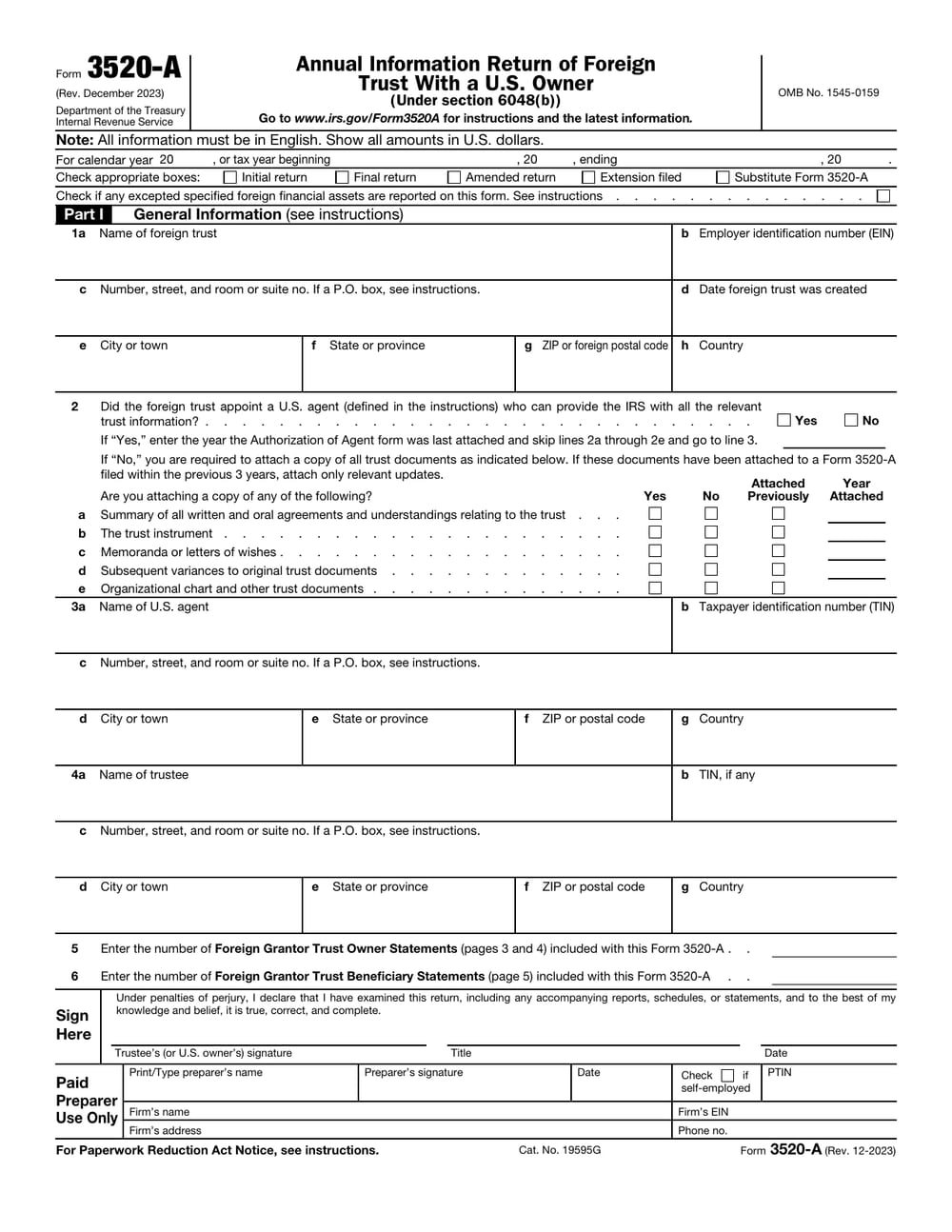
Download Form 3520-A (PDF) · Instructions for Form 3520-A (PDF)
Local copies for convenience, downloaded from IRS.gov on November 14, 2026. Always confirm you have the current revision at irs.gov/form3520a before filing.
5.1 The header
- Tax year. Enter the trust's tax year on the form and on every statement. For a fiscal-year trust, the instructions say to use the calendar year in which the fiscal year begins.
- Checkboxes: Initial return; Final return; Amended return; Extension filed (check it if a Form 7004 was filed for the trust); and Substitute Form 3520-A, which you must check when you prepare the return as U.S. owner.
- Excepted specified foreign financial assets. A separate checkbox indicates that assets reported on this form are being treated as excepted from Form 8938 reporting. Section 10.2 explains when that exception actually applies; with a substitute it is not straightforward.
5.2 Part I: General information (page 1)
| Line | What it asks | Practical note for a substitute |
|---|---|---|
| 1a–1h | Trust's name, EIN, street address, date created, city, state or province, postal code, country | Line 1b must be the trust's own EIN, never your SSN or ITIN. The IRS warns that a Form 7004 for a foreign trust cannot be processed if it carries the owner's SSN. If the trust has no EIN, apply on Form SS-4. A trust without a U.S. legal residence, principal place of business or principal office cannot apply online; the IRS directs it to call 267-941-1099 (not toll-free) or to submit Form SS-4 by fax or mail |
| 2 | Did the foreign trust appoint a U.S. agent? | For most substitutes the answer is "No." A "No" answer requires the attachments in 2a–2e |
| 2a–2e | If "No": (a) a summary of all written and oral agreements and understandings relating to the trust; (b) the trust instrument; (c) memoranda or letters of wishes; (d) subsequent variances to the original trust documents; (e) organizational chart and other trust documents | For each item you either attach it or enter the year it was previously attached. Gather these early: a deed of variation or a letter of wishes held by the trustee is often the hardest document to obtain |
| 3a–3g | U.S. agent's name, TIN and address | Completed only if line 2 is "Yes" |
| 4a–4g | Trustee's name, TIN (if any) and address | Use the trustee of record, even if it will not cooperate |
| 5 | Number of Foreign Grantor Trust Owner Statements attached | One per U.S. owner |
| 6 | Number of Foreign Grantor Trust Beneficiary Statements attached | One per U.S. beneficiary who received a distribution during the year |
| Signature | Trustee's signature, title, date; paid preparer section | On a substitute, you sign, and your name and TIN go on the "Title" line |
The U.S. agent. Under §6048(b)(2), a trust avoids an IRS determination of its U.S. owner's income only by appointing a U.S. person as its limited agent for IRS requests and summonses under §§7602–7604. The instructions require a binding contract between the trust and the agent. The trustee signs with title, date, TIN and address, and the agent then signs to accept. The authorization must be in effect by the time Form 3520-A is filed and remain in effect while the statute of limitations is open. If the agency ends, the instructions require an amended Form 3520-A within 90 days. The agent's role is limited by statute: appearing or producing records as agent does not subject the agent to other legal process for the trust, and does not by itself give the trust a U.S. office or trade or business.
If there is no agent, §6048(b)(2)(A) lets the IRS determine the amounts you must take into account under the grantor trust rules, and the instructions repeat that warning. This is why line 2 and its attachments matter even on a substitute. Without an agent, the trust documents you attach are the IRS's main window into the trust.
5.3 Part II: Foreign Trust Income Statement (page 2)
Part II reports the totals for the whole trust, not just your portion, "from books and records of foreign trust." The instructions require that it reasonably reflect the trust's income under U.S. income tax principles, from all U.S. and non-U.S. sources. The trust's local-law accounts are a starting point, not the answer.
| Line | Item |
|---|---|
| 1 | Interest |
| 2 | Dividends |
| 3 | Gross rents and royalties |
| 4 | Income (loss) from partnerships and fiduciaries |
| 5a / 5b | Net short-term / long-term capital gain (loss) |
| 6 | Ordinary gains (losses) |
| 7 | Other income (attach statement) |
| 8 | Total income (lines 1–7) |
| 9 | Interest expense |
| 10a | Foreign taxes (attach statement) |
| 10b | State and local taxes |
| 11 | Amortization and depreciation (depletion) |
| 12 | Trustee and advisor fees |
| 13 | Charitable contributions |
| 14 | Other expenses (attach statement) |
| 15 | Total expenses (lines 9–14) |
| 16 | Net income (loss) (line 8 minus line 15) |
| 17a | Fair market value of total distributions from the trust to all persons during the year, whether U.S. or foreign (attach statement) |
| 17b | Distributions to U.S. owners: name, TIN, date, FMV on date of distribution |
| 17c | Distributions to U.S. beneficiaries: name, TIN, date, FMV on date of distribution |
The instructions' U.S.-principles points include these. Capital gains are computed as on Schedule D and Form 8949, using U.S. basis and holding periods. Depreciation is a reasonable amount. Interest expense is allocated under Temp. Reg. §1.163-8T. Amortizable bond premium reduces interest income. Where local accounts use accrual-basis fair value accounting, unrealized gains in the local profit-and-loss statement are not U.S. income, unless a U.S. regime such as a mark-to-market PFIC election makes them so.
A PFIC warning. Foreign trusts commonly hold foreign mutual funds and ETFs. When you are the grantor-trust owner, you are treated under §671 as owning the trust's assets, so funds inside the trust can be PFICs held by you, with Form 8621 consequences. The trust's income statement does not resolve those PFIC computations; they belong on your own return.
5.4 Part III: Foreign Trust Balance Sheet (page 2)
Part III shows beginning-of-year and end-of-year figures. The instructions call for assets and liabilities at fair market value, and they do not require a reconciliation of book and tax basis for Part III.
- Assets (lines 1–11): 1 cash (certificates of deposit go here); 2 accounts receivable; 3 mortgages and notes receivable; 4 inventories; 5 government obligations; 6 other marketable securities; 7 other nonmarketable securities; 8a depreciable (depletable) assets less 8b accumulated depreciation; 9 real property; 10 other assets (attach statement); 11 total assets.
- Liabilities (lines 12–16): 12 accounts payable; 13 contributions, gifts, grants and similar amounts payable; 14 mortgages and notes payable; 15 other liabilities (attach statement); 16 total liabilities.
- Net worth (lines 17–21): 17 contributions to trust corpus; 18 accumulated trust income; 19 other (attach statement); 20 total net worth; 21 total liabilities and net worth.
Valuation. The instructions tie "gross value" to the principles of §2512 (gift tax valuation) applied without regard to restrictions on the interests. Formal appraisals are generally not required, but you should keep records of how you arrived at good-faith estimates. This value also drives the penalty: under §6677(c)(2), the base for the 5% computation is the gross value, at the close of the year, of the portion of the trust's assets treated as owned by the U.S. person (Section 7).
Currency translation. The instructions require U.S. dollars but do not prescribe translation rules for Form 3520-A. Because §671 attributes the owned portion's items to you, a sensible approach is to translate them as you would if you held the assets directly. Use the rate on the date of each transaction (or a permitted average where your own reporting uses one) for income items, and year-end spot rates for the balance sheet. Use a consistent, documented source, such as the Treasury Bureau of the Fiscal Service rates the IRS uses for Form 8938 and Rev. Proc. 2020-17. Whatever you use, apply it the same way on Form 3520-A, your Form 1040 and Form 8938, so the figures reconcile.
5.5 Foreign Grantor Trust Owner Statement (pages 3 and 4)
The trustee, or you on a substitute, prepares a separate statement for each U.S. owner, attaches a copy of each to Form 3520-A, and furnishes it to that owner by the due date.
Page 3 repeats the trust and trustee identification (lines 1a–4g) and adds:
- Line 5: first and last day of the trust's tax year;
- Lines 6a–6g: the U.S. owner's name, TIN and address;
- Line 7: an explanation of the facts and law (including the specific Code section) that establish that the U.S. person is treated as owner. On a substitute this is where you state, for example, "§679: U.S. transferor of [property] on [date]; trust has a U.S. beneficiary under §679(c)(1)" or "§678(a)(1): power exercisable solely by the owner to withdraw corpus under clause [x] of the deed";
- Line 8: if no U.S. agent was appointed, the trust documents attached, or the years they were previously attached;
- Line 9: the gross value of the portion of the trust treated as owned by this U.S. owner. This is the §6677 base, so get it right;
- Line 10: distributions to the U.S. owner during the year.
Page 4, the Statement of Foreign Trust Income Attributable to U.S. Owner, breaks the owner's share into lines that map to the owner's own return:
| Line | Item |
|---|---|
| 1a / 1b | Taxable interest / tax-exempt interest |
| 2a / 2b | Total ordinary dividends / qualified dividends |
| 3 | Gross rents and royalties |
| 4 | Income from partnerships and fiduciaries |
| 5 | Capital gains (losses) |
| 6 | Ordinary gains (losses) |
| 7 | Other income (attach statement) |
| 8 | Total income |
| 9–15 | Expenses mirroring Part II: interest expense; foreign taxes (attach statement); state and local taxes; amortization and depreciation; trustee and advisor fees; charitable contributions; other expenses; total expenses |
The instructions also note that the trust may need to give the owner more information than the statement shows, so the owner can report correctly on their own return.
Consistency. Under §6048(d)(5), you must report items consistently with the trust's statement, or notify the IRS of the inconsistency, generally on Form 8082. On a substitute, the statement and your return come from the same hand, so they should match.
5.6 Foreign Grantor Trust Beneficiary Statement (page 5)
A statement is required for each U.S. beneficiary who received a distribution during the year. It is not used for U.S. owners, who receive the owner statement instead. It shows:
- trust, agent and trustee identification (lines 1a–4g); if there is no U.S. agent, whether the trust has agreed to let the IRS or the beneficiary inspect and copy its books and records;
- line 5, the trust's tax year;
- lines 6a–6g, the U.S. beneficiary's identification;
- line 7, distributions, loans and uses of trust property by U.S. persons;
- line 8, an explanation of the facts and law establishing that the trust (or the distributed portion) is owned by another person;
- line 9, whether the owner is an individual, partnership or corporation.
This statement matters to the beneficiary's Form 3520 Part III. A distribution from the portion of a trust owned by someone else generally comes out of that owner's property. Without the statement, the beneficiary may be unable to show this, and §6048(c)(2) default rules can treat the distribution as an accumulation distribution. The beneficiary side is covered in our Form 3520 guide.
5.7 The substitute Form 3520-A in practice: what you can and cannot complete
The substitute is the same form with the same lines. What changes is the quality of your information and how you document its limits.
| Part | What an owner can usually build without trustee cooperation | What is typically missing | How to handle it |
|---|---|---|---|
| Part I | Trust name, country, creation date, trustee details; often the deed | EIN (you apply for it yourself); letters of wishes and variances held by the trustee | Apply for an EIN; attach what you have; describe in an attached statement what you requested and were refused |
| Part II | Interest, dividends and realized gains from custody and bank statements | Trustee fees charged at trust level, foreign tax detail, look-through income from underlying entities | Reconstruct from statements; mark estimates as estimates; attach a statement explaining the method |
| Part III | Year-end and opening balances from statements | Values of nonmarketable assets, receivables and liabilities | Use good-faith estimates under the instructions' valuation rules and keep the workpapers |
| Owner statement | Your portion and its income, computed from Parts II and III | Detail on your share if the trust has several portions | Explain the allocation method on line 7 or an attachment |
| Beneficiary statements | Usually knowable within the family | Distributions to other U.S. relatives you do not know about | Ask each relative; disclose the limits |
Three habits protect you most:
- Write to the trustee early and in writing. Ask specifically for the deed, any variances, letters of wishes, annual accounts, custody statements, fee schedules and a list of distributions, and ask whether the trustee will appoint a U.S. agent or file Form 3520-A itself. Keep the correspondence.
- Attach a short statement to the substitute. Say what you requested, when, what you received and what you did not, and describe the methods you used for estimates. This is the evidence that the substitute was completed "to the best of your ability."
- Don't leave lines blank without explanation. An unexplained blank looks like an incomplete return, which is a separate §6677(a) failure. A blank with a note ("information requested from trustee on [date]; refused; see attached statement") shows effort.
The due-date mismatch: the most-missed point about this form
Form 3520-A is due by the 15th day of the 3rd month after the end of the trust's tax year: March 15 for a calendar-year trust. That is a month before your own Form 1040 and Form 3520 are due. The trust can extend to the 15th day of the 9th month (September 15) only by filing Form 7004 under the trust's own EIN by that March 15 deadline. Nothing you file for yourself extends it. The IRS states this flatly: an extension of time to file an income tax return does not extend the time to file Form 3520-A.
6.1 Where the dates come from
The Surface Transportation and Veterans Health Care Choice Improvement Act of 2015 (Pub. L. 114-41, §2006(b)(9) and (10)) directed the current schedule. Form 3520-A is due on the 15th day of the 3rd month after the trust's year ends, with a maximum six-month extension. Form 3520 for calendar-year filers is due April 15, extendable to October 15. The 2024 proposed regulations' preamble describes the same history, and the instructions for both forms implement it.
6.2 The five filings and their deadlines
For a calendar-year 2026 trust and a calendar-year individual owner (returns filed in 2027):
| Filing | Who files | Original due date | How it is extended | Extended due date |
|---|---|---|---|---|
| Form 3520-A (trust-filed) | Trustee, under the trust's EIN | March 15, 2027 | Form 7004 filed by the trust, under its EIN, by March 15, 2027 | September 15, 2027 |
| Owner and beneficiary statements (trust-filed return) | Trustee, to each U.S. owner and beneficiary | March 15, 2027 | Same Form 7004 | September 15, 2027 |
| Form 1040 | You | April 15, 2027 | Automatic 2 months if you live abroad on the due date; Form 4868 for 6 months | June 15, 2027 (abroad); October 15, 2027 (Form 4868) |
| Form 3520, with any substitute Form 3520-A attached | You | April 15, 2027 | Follows your income tax extension: the abroad rule (June 15) or a granted extension (October 15) | June 15 or October 15, 2027 |
| FBAR (FinCEN Form 114) | You | April 15, 2027 | Automatic | October 15, 2027 |
In 2027 none of these dates falls on a weekend. In years when one does, the general weekend and holiday rule of §7503 moves the deadline to the next business day.
6.3 How Form 3520's own deadline works for Americans abroad
The Instructions for Form 3520 set the following rules:
- Normal due date: the 15th day of the 4th month after the end of your tax year (April 15), generally the same day as your income tax return.
- Living abroad: U.S. citizens and residents living outside the United States and Puerto Rico (or on military duty outside them) get until the 15th day of the 6th month (June 15). You check box 1j and include a statement showing that you qualify.
- Extended: if you are granted an extension of time to file your income tax return, Form 3520 is due no later than the 15th day of the 10th month (October 15). You check box 1k and enter the form number of the return the extension applies to (for example, "1040").
Two consequences follow:
- There is no separate extension form for Form 3520. It rides on your income tax extension. You must actually obtain an income tax extension, typically on Form 4868, and check box 1k.
- The cap is October 15. Because the instructions cap the extended due date at the 15th day of the 10th month, a longer income tax extension (for example, a Form 2350 extension running past October 15 while you wait to meet a foreign earned income test) does not carry Form 3520, or your substitute Form 3520-A, past October 15.
6.4 Putting the two clocks together
The interaction is the heart of this section.
The trust's clock. If the trustee is going to file, it must file by March 15, or request a Form 7004 extension by March 15 and file by September 15. A trust return filed after its deadline is late, whatever your own extensions say.
Your clock. If the trust does not file, you attach a substitute to your Form 3520. The instructions say the substitute is due by the due date of your Form 3520, and not by the Form 3520-A due date. Your deadline is therefore April 15, June 15 (abroad), or October 15 (extended), depending on your own situation.
This produces three situations that often catch people out:
- "I extended my return, so I'm fine." You are fine only for the substitute, and only if it is attached to a Form 3520 you file by your own extended deadline. You have not extended the trust's own return. If the trustee is planning to file, your extension does nothing for it.
- "The trustee said they'd file; I'll rely on that." If the trustee misses March 15 (or September 15 with a Form 7004) and you have not attached a substitute to your timely Form 3520, you are exposed: §6677(b) makes you liable for the trust's failure. If you are not confident the trustee will file on time and correctly, attach a substitute anyway. The IRS asks you not to file a separate duplicate Form 3520-A yourself when you attach a substitute.
- "The trustee filed late, after my substitute deadline." A late trust filing does not cure your exposure for that year. The safe approach is to treat your substitute deadline as the real deadline every year and decide by then whether the trustee has, in fact, filed.
Extended your own tax return and think your foreign trust is covered too? An income tax extension only moves your Form 3520 deadline — it does nothing for the trust's separate March 15 filing, and if the trustee misses it, the penalty still falls on you. Ask TaxLatitude which deadline actually applies to your situation →
A planning rule of thumb. Each year, by early March, ask the trustee in writing whether it will file Form 3520-A or a Form 7004 by March 15, and ask for a copy of whatever it files. If you have not received confirmation by your own Form 3520 deadline, attach a substitute. If the trustee does file on time, attach the owner statement it gave you and answer "Yes" on Form 3520, line 22.
6.5 Form 7004 mechanics for the trust
- Who files it: the trust, under its EIN. The IRS warns that a Form 7004 for a foreign trust cannot be processed if it carries the U.S. owner's SSN.
- When: by the 15th day of the 3rd month after the trust's year ends.
- What it gives: an automatic 6-month extension of time to file Form 3520-A, including the statements on pages 3 through 5.
- How: on paper to the Internal Revenue Service Center, P.O. Box 409101, Ogden, UT 84409, or electronically. The IRS's reminder page notes that Form 7004 can be e-filed to extend Form 3520-A, and refers to IRS.gov/efile7004. Enter the form code for Form 3520-A shown in the current Form 7004 instructions.
- What it does not do: extend your Form 3520 or substitute, or excuse an incomplete return. Only a complete Form 3520-A counts as timely filed.
6.6 Where things are filed
- Trust-filed Form 3520-A and Form 7004: Internal Revenue Service Center, P.O. Box 409101, Ogden, UT 84409.
- Your Form 3520, with any substitute attached: as directed in the Instructions for Form 3520. The December 2025 instructions give the same Ogden address. Form 3520 is filed separately from your Form 1040, even when you e-file the 1040. Check IRS.gov/Form3520 for any electronic filing option before relying on paper.
The trust's own deadline (March 15, or September 15 with a Form 7004) always comes before your matching deadline. Your extensions move only your Form 3520 and the substitute attached to it.
Penalties: the §6677 structure for Form 3520-A
For a Form 3520-A failure, the U.S. owner owes the greater of $10,000 or 5% of the gross value of the trust assets treated as owned by that U.S. owner at the close of the year. That amount is assessed per year. An additional $10,000 applies for each 30-day period that the failure continues more than 90 days after the IRS mails a notice, and the total is capped at the gross reportable amount. Each element below was checked against the current text of 26 U.S.C. §6677 and the December 2025 instructions.
7.1 How the statute is built
- §6677(a), the general penalty. If any notice or return required by §6048 is not filed on time, or does not include all the information required, or includes incorrect information, the person required to file owes the greater of $10,000 or 35% of the "gross reportable amount." The $10,000 floor was added by the HIRE Act (Pub. L. 111-147, §535(a)) for notices and returns required to be filed after December 31, 2009.
- §6677(b), the special rules for §6048(b) returns. For a return required under §6048(b), which includes Form 3520-A, (1) the United States person referred to in §6048(b), meaning the U.S. owner, is liable for the penalty; and (2) the rate is 5% instead of 35%. The $10,000 floor in §6677(a) still applies.
- §6677(c)(2), the base. For a failure relating to §6048(b), the gross reportable amount is the gross value of the portion of the trust's assets, at the close of the year, treated as owned by the U.S. person.
- §6677(a), continuation penalty and cap. If the failure continues for more than 90 days after the IRS mails notice of it, an additional $10,000 applies for each 30-day period, or fraction of one, during which it continues. Once the gross reportable amount is determined, the IRS must reduce penalties so the total does not exceed it, and refund any excess. (Before the HIRE Act, the statute simply said the penalty could not exceed the gross reportable amount.)
- §6677(d), reasonable cause. No penalty applies to a failure shown to be due to reasonable cause and not willful neglect. The fact that a foreign jurisdiction would penalize disclosure is not reasonable cause.
- §6677(e), no deficiency procedures. The penalty is an assessable penalty, so the IRS can assess it without first issuing a notice of deficiency, and you cannot petition the Tax Court before assessment. You can challenge it through IRS Appeals, in a collection due process hearing where available, or by paying and suing for a refund.
7.2 How this differs from the penalties on Form 3520
Form 3520 and Form 3520-A share §6677, but the computations differ. The Form 3520 side, including the gift penalty, is covered in our Form 3520 guide; this table is just for orientation.
| Failure | Statute | Who is liable | Rate and floor | Base |
|---|---|---|---|---|
| Form 3520-A not filed, late, incomplete or incorrect | §6677(a) as modified by §6677(b) | U.S. owner | Greater of $10,000 or 5% | Year-end gross value of the owned portion |
| Form 3520 Part II (owner's own §6048(b) information) | §6677(a) and (b) | U.S. owner | Greater of $10,000 or 5% | Same |
| Form 3520 Part I (transfers to foreign trusts, §6048(a)) | §6677(a) | Transferor | Greater of $10,000 or 35% | Gross value of property transferred |
| Form 3520 Part III (distributions, §6048(c)) | §6677(a) | Recipient | Greater of $10,000 or 35% | Gross amount of distributions |
| Form 3520 Part IV (large foreign gifts, §6039F) | §6039F(c) | Recipient | 5% per month, up to 25%; no $10,000 floor | Amount of the gift |
Two interactions matter for owners.
Form 3520-A and Form 3520 Part II can be penalized separately. Both are §6048(b) obligations and both carry the 5% rate. Commentary after Wilson noted that two separate penalties, each 5% of the trust's value with a $10,000 minimum, may be imposed for failing to report ownership information on Form 3520-A and on Form 3520 (EY Tax News, July 30, 2021). A missed year can therefore cost close to 10% of the trust's value before any distribution issue.
Owner-beneficiaries can also face the 35% distribution penalty. In Wilson v. United States, 6 F.4th 432 (2d Cir. 2021), the court held that a U.S. person who was both sole owner and beneficiary of a foreign trust was liable for the 35% §6048(c) penalty for failing to report a distribution on time. The 5% owner rate did not replace it.
7.3 What "failure" covers
The instructions list three ways the U.S. owner becomes liable: the trust (a) does not file a timely Form 3520-A, (b) does not furnish all the information required, or (c) furnishes incorrect information. Each is a separate failure. Because only a complete Form 3520-A counts as timely, a return missing its owner statement, beneficiary statements or Part I attachments can be treated as not timely filed at all.
7.4 How a timely substitute changes the exposure
The instructions say that if the trust fails to file, the U.S. owner avoids the penalty for that failure by completing a substitute Form 3520-A to the best of their ability and attaching it to a timely filed Form 3520. In practice:
- Trust's failure to file: a timely, best-efforts substitute removes the exposure under the IRS's administrative position.
- Incompleteness: gaps you could not fill despite documented efforts are within the "best of ability" protection. Gaps you could have filled but did not are outside that protection; for those you must rely on reasonable cause.
- Incorrectness: a substitute does not protect a return that is wrong. Estimates labeled and explained as estimates are not "incorrect information" in the same sense as a figure you knew or should have known was wrong. Keep your workpapers.
- Late substitute: a substitute attached to a late Form 3520 does not get the timeliness protection. Your remaining defenses are reasonable cause and, where eligible, the streamlined procedures (Section 11).
The IRS's 2023 Nationwide Tax Forum presentation on Forms 3520 and 3520-A (IRS slides) puts it in one line: the U.S. owner, rather than the foreign trust, is liable under §6677(b) if Form 3520-A or a substitute is not timely filed, or is inaccurate or incomplete.
7.5 The open statute of limitations: §6501(c)(8)
This consequence often outweighs the penalty itself. Section 6501(c)(8)(A) covers information required under §1295(b), §1298(f), §6038, §6038A, §6038B, §6038D, §6046, §6046A or §6048. If that information is not furnished, the time to assess any tax for any tax return, event or period to which the information relates does not expire until 3 years after the date the IRS is furnished the information.
Section 6048 is on that list, so the whole-return / related-items framework explained in our Form 5471, Form 8865 and Form 8621 guides applies here in the same way:
- Default: the whole return stays open. Absent reasonable cause, the extended period applies to the entire tax return for the year to which the missing information relates, not just the trust items. That has been the statutory rule since the 2010 amendments. An IRS Chief Counsel memorandum (CCA 1147030, 2011) explains how the IRS's earlier, narrower reading was displaced for the affected years.
- With reasonable cause: only related items stay open. Under §6501(c)(8)(B), if the failure to furnish the information is due to reasonable cause and not willful neglect, the extension applies only to the item or items related to the failure.
- The clock starts when the information arrives. Filing the missing Form 3520-A (or substitute) and Form 3520 starts the 3-year period running.
The Form 3520 instructions restate the point: if a complete Form 3520 is not filed by the due date, including extensions, the time to assess related tax does not end until 3 years after the required information is reported. For an owner who has missed several years of Form 3520-A, every one of those years' Form 1040s may still be open, in full, until three years after the catch-up filings. The same risk arises for any year in which a substitute was so incomplete that the IRS could argue the information was never "furnished."
7.6 Reasonable cause: what it takes
The statute requires that the failure be shown to be due to reasonable cause and not willful neglect. In practice the general standard applies: whether you exercised ordinary business care and prudence. The 2024 proposed §1.6677-1(d) would adopt the familiar reasonable-cause framework of §1.6664-4 and §301.6651-1(c), applied case by case, and would require a statement signed under penalties of perjury.
What does not count (from §6677(d) and the instructions): a foreign country's penalties for disclosure; a foreign fiduciary's reluctance to provide information; and trust terms that prohibit disclosure.
What a credible reasonable-cause statement usually contains:
- A factual timeline. When the arrangement started; when and how you learned it might be a foreign trust; what you did next.
- Why you did not know. For example, the arrangement was marketed as a pension or policy, you relied on local advisers, and nothing in the documents mentioned U.S. trust reporting. Ignorance of the law alone is weak. Ignorance combined with a reasonable, documented belief about the arrangement's character is stronger.
- Reliance on a professional, if any. Who advised you, what they knew, what they said, and why it was reasonable to rely on them. Courts generally require that the adviser was competent, that you gave them complete and accurate information, and that you relied on their advice in good faith.
- Efforts to obtain trust information. Letters and emails to the trustee, its responses or refusals, and what you reconstructed yourself. This evidence supports both reasonable cause and the "best of ability" standard for substitutes.
- Prompt correction. What you did once you learned of the obligation, and how quickly.
- Income reporting. Whether the trust income was reported on your return. A taxpayer who reported all the income but missed the information return has a far better story than one who did not.
For Forms 3520 and 3520-A filed late, the IRS's delinquent international information return submission procedures page (last updated April 19, 2026) says the IRS will consider reasonable cause statements before assessing a penalty. Write "Reasonable Cause Statement attached" at the top of the first page of the form. For other international information returns the same page warns that penalties may be assessed during processing without considering the statement. The difference makes a careful statement worth the effort for 3520-A filers.
7.7 Other penalties to keep in view
- Accuracy-related penalty. An underpayment of tax attributable to an undisclosed foreign financial asset understatement, including income from assets that should have been reported on Form 3520-A, can carry a 40% penalty under §6662(j) instead of the usual 20%. The instructions flag this.
- Criminal penalties under §§7203, 7206 and 7207 may apply in willful cases.
- Form 8938 and FBAR penalties are separate regimes, covered in our Form 8938 and FBAR guides.
Worked example 1: missed Forms 3520-A for an inherited family trust
In this example, five missed years produce a base Form 3520-A penalty exposure of $289,500, keep five Form 1040s open, and could have been avoided almost entirely by timely substitutes. All names and figures are hypothetical, and exchange-rate effects are ignored to keep the arithmetic visible.
8.1 The facts
- Maya is a U.S. citizen who has lived in Lisbon since 2014. She files Form 1040 every year, claims the foreign earned income exclusion, and files FBARs for her Portuguese bank accounts.
- In 2012 her great-aunt Ingrid, a Swiss national who was never a U.S. person, settled a discretionary trust governed by Jersey law with a Jersey trust company as trustee. Ingrid was the life beneficiary. After her death the trust holds the fund for Maya.
- Ingrid died in March 2020. Under clause 7 of the deed, from Ingrid's death Maya may, by written notice to the trustee, "call for the whole or any part of the capital of the Trust Fund to be paid to her absolutely." No trustee or protector consent is required.
- Maya made no withdrawals and no transfers to the trust. The trustee invests in a portfolio of bonds and global equity funds. It sends Maya a short annual summary in local accounting format and has never mentioned U.S. filings.
- In November 2026 a new U.S. preparer reads the deed and flags the issue.
8.2 The ownership analysis
- Foreign trust: yes. No U.S. court supervises it and no U.S. person controls substantial decisions.
- Ingrid as owner before her death: no grantor trust treatment matters here. Ingrid was a foreign person, and §672(f) generally prevents foreign persons from being owners unless the trust was revocable by her or distributable only to her and her spouse during her life. Either way, nothing about the pre-2020 period makes Maya an owner.
- Maya after March 2020: clause 7 gives her a power, exercisable solely by herself, to vest the corpus in herself. Under §678(a)(1) she is treated as owner of the whole trust (corpus and, through it, the income) from that date. Section 672(f) does not prevent this, because Maya is a U.S. person.
- Result: from 2020 Maya is a U.S. owner under §6048(b). The trust must file Form 3520-A each year, Maya must file Form 3520 Part II, and the trust's income is Maya's income under §671.
Think a power in a trust deed you've never used doesn't affect you? Maya made no withdrawals and no transfers — but a single clause giving her the right to call for the capital at any time made her the full owner from the day her great-aunt died. Ask TaxLatitude whether a clause like this already applies to you →
To keep the example simple, we treat 2021 to 2025 as the five missed years and leave 2020 (a part year) aside.
8.3 The penalty computation for the missed years
The §6677(c)(2) base is the gross value at year-end of the portion Maya is treated as owning, here 100% of the trust. Each year's penalty is the greater of $10,000 or 5% of that value.
| Tax year | Year-end gross value of owned portion | 5% of value | Penalty (greater of $10,000 or 5%) |
|---|---|---|---|
| 2021 | $1,180,000 | $59,000 | $59,000 |
| 2022 | $1,060,000 | $53,000 | $53,000 |
| 2023 | $1,120,000 | $56,000 | $56,000 |
| 2024 | $1,190,000 | $59,500 | $59,500 |
| 2025 | $1,240,000 | $62,000 | $62,000 |
| Total | $289,500 |
Three observations follow.
- The $10,000 floor did not bite because the trust is large. For a trust worth $150,000, 5% is $7,500, so the floor would make the penalty $10,000 a year, an effective rate of 6.7%. For small trusts, the floor is what makes the penalty disproportionate.
- Form 3520 Part II can add a second 5% penalty for each year (Section 7.2), doubling the theoretical exposure to $579,000. Because Maya took no distributions, the 35% distribution penalty that applied in Wilson is not in play. If she had made withdrawals, it would be.
- Continuation penalties are in addition. Suppose the IRS mails a notice for 2023 and the failure continues for 200 days after mailing. The 90-day grace period leaves 110 days, which is three full 30-day periods plus a fraction, so four periods. That adds 4 × $10,000 = $40,000 for 2023. The total for 2023 is capped at the gross reportable amount of $1,120,000, which is not binding here.
8.4 The comparison: a timely substitute with incomplete records
Now suppose Maya had understood her position in 2021. Each year, the trustee refused to file Form 3520-A or appoint a U.S. agent, and gave her only its annual summary and custody statements. Maya, with her preparer:
- obtained an EIN for the trust on Form SS-4;
- wrote to the trustee each January asking for the full accounts, fee schedule, letters of wishes and any variances, and kept its refusals;
- built Parts II and III from custody statements, translating realized gains on U.S. principles and estimating trustee fees from the debits shown;
- answered "No" on line 2, attached the deed she held, and noted that the letter of wishes had been requested and refused;
- completed the owner statement, including line 7 ("§678(a)(1): sole power to call for capital under clause 7"), checked "Substitute Form 3520-A," signed with her name and SSN on the Title line, and attached it to her Form 3520, filed by June 15 each year under the abroad rule;
- attached a one-page statement listing what she had requested and not received, and the estimation methods she used;
- reported the trust income on her Form 1040, with Form 8621 for the equity funds.
The comparison:
| Missed every year (8.3) | Timely best-efforts substitute (8.4) | |
|---|---|---|
| Penalty for the trust's failure to file Form 3520-A | $289,500 base exposure; relief depends on reasonable cause | Avoided under the instructions' substitute rule |
| Exposure for incomplete information | Not separately relevant; nothing was filed | Limited to gaps she could have filled but did not; documented refusals support the "best of ability" standard and reasonable cause |
| Form 3520 Part II penalty | Up to another $289,500 | None: Part II filed on time |
| §6501(c)(8) | Each Form 1040 for 2021–2025 open in full until 3 years after the information is furnished, unless reasonable cause narrows it | Information furnished each year; normal assessment periods run |
| Income tax | Unreported trust income plus interest, and 20% or 40% accuracy penalties at risk | Reported each year |
The substitute did not need to be perfect. It needed to be timely, made in good faith, documented, and consistent with her own return.
8.5 The statute-of-limitations consequence
Assume Maya files all missing Forms 3520 (with substitutes) and amended Forms 1040 on December 15, 2026, without using the streamlined procedures. Under §6501(c)(8):
- the assessment period for each of her 2021 to 2025 returns cannot expire before December 15, 2029, three years after the information is furnished, even though 2021 would otherwise have closed in 2025;
- if she cannot show reasonable cause, the extension covers each of those returns in full, so an unrelated issue such as a rental property, a foreign earned income exclusion claim or a foreign tax credit computation could still be adjusted;
- if she can show reasonable cause, §6501(c)(8)(B) limits the extension to the items related to the trust failure.
Because the trust income was never reported, Maya also failed to report income from a foreign financial asset. That makes her a candidate for the Streamlined Foreign Offshore Procedures, provided her conduct was non-willful and she meets the non-residency test. Under those procedures she would file three years of amended returns with Forms 3520 and substitutes attached, six years of FBARs (which should also cover the trust's accounts if, as sole beneficiary, she has a financial interest in them; see Section 10.3) and a Form 14653 certification. The IRS states that eligible taxpayers who comply are not subject to information return penalties for the covered submissions (Section 11.2). The streamlined procedures do not require the earlier years (2021 and 2022 in this example) to be filed. Discuss with your adviser how you will handle the §6501(c)(8) status of years outside the streamlined window.
Worked example 2: a foreign pension plan that is, or might be, a trust
The same person can hold one pension that needs no Form 3520-A and another that needs one every year. The difference can be a single sentence in the plan rules, or the exchange rate on December 31. The plans and the country below are hypothetical, so that the analysis tests the rules rather than any real product. Our UK, Australia and Switzerland country guides cover real plans.
9.1 The facts
Daniel is a U.S. citizen living and working in "Country X," whose currency is the "unit." He files Form 1040 each year and reports his salary. He holds two plans, both organized under Country X law as trusts with a licensed corporate trustee.
- Plan A: occupational fund. His employer contributes 8% of salary and Daniel contributes 5%, deducted from payroll. Members are fully vested. Benefits are payable from age 60, or earlier on disability or death; early withdrawals are not allowed except for documented hardship. The fund covers all employees of the employer. Contributions are deductible locally, and the fund's investment income is exempt.
- Plan B: personal retirement trust. Daniel alone contributes. He gets a local deduction, and investment income is exempt until withdrawal. Withdrawals before age 60 attract a 20% surcharge. The provider reports each member's contributions and balance to the Country X tax authority annually. At the end of 2025 the balance is 90,000 units.
We test Plan B under three versions of its contribution rules, because that is where the answer changes:
- Version 1: contributions limited to 20% of the member's net earned income.
- Version 2: contributions limited to 45,000 units a year, with no link to earned income, but only earned income may be contributed.
- Version 3: contributions of up to 45,000 units a year "from any source," including investment income and contributions by third parties.
The Treasury Bureau of the Fiscal Service rate at December 31, 2025 is assumed to be 1 unit = $1.15 (so 45,000 units = $51,750). For the comparison year, December 31, 2024, it is assumed to be 1 unit = $1.08 (45,000 units = $48,600).
9.2 Plan A: occupational fund
Step 1: is it a trust? Yes. A trustee holds legal title to protect and conserve the assets for members under local trust law (§301.7701-4(a)), and the fund carries on no business beyond investing. It is foreign.
Step 2: is Daniel an owner?
- Employer contributions to a trust not exempt under §501(a) make it a §402(b) nonexempt employees' trust. Under §402(b)(3) and Treas. Reg. §1.402(b)-1(b)(6), Daniel is not treated as owner under subpart E of the portion attributable to employer contributions.
- His own contributions are incidental: at every date his cumulative contributions (5% of salary) are less than the employer's (8%). So the exception that would make him owner of his own portion does not apply.
- Section 679 does not apply to transfers to trusts described in §6048(a)(3)(B)(ii), which include §402(b) trusts.
Result: Daniel is not a U.S. owner of any portion of Plan A, so §6048(b) and Form 3520-A do not apply. Two points still need watching. First, if he makes large voluntary contributions, or if the employer's share falls, his cumulative contributions could exceed the employer's "as of any date" and the answer would change. Second, the plan's income tax treatment (§402(b) taxation of vested employer contributions, and any treaty relief) is a separate question covered in our country guides. Plan A would probably also meet Rev. Proc. 2020-17, but Daniel does not need that exemption for Form 3520-A because he is not an owner.
9.3 Plan B: personal retirement trust
Step 1: is it a trust? Yes, and it is foreign.
Step 2: is Daniel an owner? Yes. Daniel, a U.S. person, transfers money to a foreign trust that has a U.S. beneficiary (himself), so §679 applies. There is no employer, so the §402(b) exclusion is not available, and §677 independently treats him as owner because the income is held for his future benefit. Unless an exemption applies, Plan B needs Form 3520-A every year, and because the provider will not file one, that means a substitute attached to his Form 3520, plus Form 3520 Part II.
Step 3: does Rev. Proc. 2020-17 apply? First the eligible-individual test (section 5.02). Daniel is a U.S. citizen and has filed his returns. But because Plan B is a grantor trust he owns, its investment income is his U.S. income each year unless a treaty provision defers it. If he has not reported that income where U.S. law requires it, he is not an eligible individual until he amends. Assume he has reported it, or that Country X's treaty defers it and he has made any required election.
Next, the threshold: the plan is a foreign trust, established under foreign law and operated exclusively for retirement benefits. Then the six section 5.03 conditions for each version:
| Condition (Rev. Proc. 2020-17, §5.03) | Version 1: 20% of net earned income | Version 2: 45,000-unit cap, earned income only | Version 3: 45,000-unit cap, any source |
|---|---|---|---|
| 1. Tax-favored (deduction, or deferral of investment income) | Met | Met | Met |
| 2. Annual information reporting to the local tax authority | Met (provider reports) | Met | Met |
| 3. Only earned-income contributions permitted | Met | Met | Not met: plan rules permit non-earned and third-party contributions |
| 4. Contributions limited by % of earned income, or ≤ $50,000 a year, or ≤ $1,000,000 lifetime | Met (percentage limit; no currency test) | 2024: met ($48,600). 2025: not met ($51,750) | Not met in 2025 ($51,750), and condition 3 already fails |
| 5. Withdrawals conditioned on retirement age, disability or death, or penalized | Met (20% surcharge) | Met | Met |
| 6. Nondiscrimination (employer-maintained only) | Not applicable | Not applicable | Not applicable |
| Exempt under Rev. Proc. 2020-17? | Yes, every year | 2024 yes; 2025 no | No |
Step 4: what about the 2024 proposed regulations? If Daniel elects to rely on them for 2025 (Section 4.8), the annual limit becomes $75,000, indexed. Version 2's $51,750 cap passes, and so does Version 2's balance under the $600,000 value alternative. Version 3 is harder. The proposed rules relax the earned-income condition only to allow limited contributions by non-earners, not contributions "from any source," so Version 3 likely still fails. Reliance is all-or-nothing and binds related persons too, so it is a decision to make with an adviser rather than a convenient patch for one year.
9.4 What the answer means in practice
| Outcome | Version 1 | Version 2 (2025, Rev. Proc. only) | Version 3 |
|---|---|---|---|
| Form 3520-A (substitute) and Form 3520 Part II | Not required | Required for 2025 | Required every year |
| §6677 exposure if missed (gross value 90,000 units = $103,500) | None | Greater of $10,000 or 5% ($5,175), so $10,000 for Form 3520-A, with a possible second $10,000 for Form 3520 Part II | $10,000 per form per year on the same facts |
| §6501(c)(8) | Not triggered | 2025 return held open until the information is furnished | Every missed year held open |
| Income tax on Plan B income | Unchanged by the exemption | Unchanged | Unchanged |
| Form 8938 and FBAR | Still apply | Still apply | Still apply |
The $10,000 floor is the striking number. On a modest balance of about $100,000, a missed Form 3520-A costs $10,000, close to 10% of the account, before the Form 3520 Part II penalty. For small pensions that fail Rev. Proc. 2020-17, the floor rather than the 5% rate drives the exposure, which is why testing the conditions carefully matters even for small accounts.
Wondering if your foreign pension already qualifies for the Rev. Proc. 2020-17 exemption? In the worked example, the exact same plan passes the test in 2024 and fails it in 2025 — nothing about the plan changed, only the year-end exchange rate did. Ask TaxLatitude to retest your plan against the six conditions →
9.5 Lessons from the example
- The plan rules decide, not your own behavior. In Version 3, Daniel contributed only salary, but the plan permitted other contributions, and condition 3 asks what is permitted.
- A percentage-of-earnings limit is the most robust way to meet condition 4, because it involves no currency conversion.
- Fixed local-currency caps can pass one year and fail the next. Retest every year using the Fiscal Service rate on the last day of the tax year.
- Employer plans and personal plans start from different places. The §402(b) rules can make an employer plan irrelevant to Form 3520-A before Rev. Proc. 2020-17 is even reached. A personal plan needs the exemption or the filing.
- The eligible-individual test can quietly disqualify you. Unreported plan income means no exemption until you fix it.
- Write it down. A one-page memo testing each condition, with the plan rules and the year-end rate, is the record that shows a deliberate, reasonable position if the IRS disagrees.
How Form 3520-A interacts with your other filings
Owning a foreign grantor trust usually means up to five separate filings for the same assets: Form 3520-A (trust-level), Form 3520 (yours), your Form 1040 (the income), Form 8938 and the FBAR. Each has its own statute, threshold, deadline and penalty. Filing one never satisfies another.
10.1 Form 3520
- Part II reports your ownership every year you are a U.S. owner, even in years with no transactions. Line 22 asks whether the trust filed Form 3520-A. If it did, attach the owner statement it gave you. If it did not, attach the substitute.
- Part I reports transfers you make to the trust, which may be what made you an owner under §679.
- Part III reports distributions you receive. Wilson is a reminder that owners who receive distributions can have Part III obligations too.
- Deadline: your income tax due date (April 15, June 15 abroad, or October 15 extended), not March 15.
10.2 Form 8938
An owner of a foreign grantor trust is generally treated as holding the trust's specified foreign financial assets for Form 8938 purposes. The duplicative-reporting regulation, Treas. Reg. §1.6038D-7(a)(2), relieves you of listing the trust's assets on Form 8938 only if all three of these are true:
- you report the trust on a timely filed Form 3520 for the year;
- the trust timely files Form 3520-A for the year; and
- your Form 8938 reports that Forms 3520 and 3520-A were filed (the Part IV count of forms filed, the cross-reference pattern described in our other guides).
Condition 2 is the catch for substitute filers. The regulation's text speaks of the trust timely filing Form 3520-A, and we found no IRS guidance stating that a substitute attached to the owner's Form 3520 satisfies it. The conservative course when you file a substitute is to list the trust's assets on Form 8938 as well, rather than rely on the exception. Don't check the "excepted specified foreign financial assets" box on the substitute unless you have concluded that the exception applies.
Remember also that Rev. Proc. 2020-17 expressly leaves Form 8938 untouched. An exempt pension still goes on Form 8938 if you are over the threshold.
10.3 FBAR
The FBAR is a Title 31 filing with its own definitions. Under the FinCEN regulations at 31 CFR 1010.350(e)(2), a U.S. person can have a financial interest in accounts held by a trust in several situations. These include being the trust's grantor with an ownership interest under the U.S. grantor trust rules, and holding a present beneficial interest in more than 50% of the trust's assets or income. Separately, any signature or other authority you hold over a trust account (for example, as co-trustee or with a power of attorney) is reportable. If the aggregate maximum value of your foreign financial accounts, including trust accounts you must count, exceeds $10,000 at any time in the year, you file. Rev. Proc. 2020-17 does not change FBAR obligations.
10.4 Form 1040: the income is yours, not the trust's
A grantor trust is not a separate taxpayer for U.S. income tax. Under §671 you report the owned portion's income, deductions and credits on your own return, as if you held the assets directly:
- interest and dividends on Schedule B, including the Part III questions about foreign accounts and foreign trusts;
- capital gains on Form 8949 and Schedule D;
- foreign taxes paid by the trust, which may be creditable on your Form 1116;
- PFIC holdings inside the trust on Form 8621;
- foreign corporations or partnerships held by the trust, which can trigger Form 5471 or Form 8865 obligations for you as an indirect or constructive owner.
The trust income is unearned income, so it is never eligible for the foreign earned income exclusion. There is no separate trust-level U.S. income tax on the owned portion. The owner statement's page 4 is designed to feed these lines. Your return must be consistent with it, or you must disclose the inconsistency (§6048(d)(5)).
10.5 The full picture for one owned trust
| Filing | Statute | Filer | Deadline (calendar year) | Penalty for failure |
|---|---|---|---|---|
| Form 3520-A | §6048(b) | Trust; substitute by owner | March 15 (trust), extendable to September 15; substitute with Form 3520 | Greater of $10,000 or 5% of owned portion (§6677) |
| Form 3520, Part II | §6048(b) | Owner | Form 3520 due date | Greater of $10,000 or 5% (§6677) |
| Form 1040 | §§671, 61 | Owner | April 15 / June 15 / October 15 | Ordinary failure-to-file, failure-to-pay and accuracy penalties; 40% under §6662(j) where applicable |
| Form 8938 | §6038D | Owner, if over the threshold | With Form 1040 | $10,000, plus continuation penalties after notice |
| FBAR | 31 U.S.C. 5314 | Owner, if over $10,000 aggregate | April 15, automatically extended to October 15 | Non-willful and willful civil penalties under Title 31 |
Options if you have missed Forms 3520-A
Which route fits depends mainly on two facts: whether you also failed to report income, and whether your conduct was non-willful. If you reported all the trust's income and only missed the information returns, the delinquent submission route with a reasonable cause statement is usually the fit. If income went unreported and you were non-willful, the streamlined procedures usually fit. Willful cases need a different process, flagged at the end.
11.1 Delinquent international information return submission procedures
The IRS page (last updated April 19, 2026) applies to taxpayers who need to file delinquent international information returns, are not under civil examination or criminal investigation, and have not already been contacted by the IRS about the returns.
- How to file Forms 3520 and 3520-A: according to their own instructions. Unlike most other international information returns, they are not attached to an amended Form 1040. In practice you file each missed year's Form 3520 with the substitute Form 3520-A attached, at the address in the Form 3520 instructions. If the trust is now willing to file its own late Form 3520-A, it files under its EIN at the Ogden address.
- Reasonable cause statement: attach one to each delinquent return for which you assert reasonable cause, and write "Reasonable Cause Statement attached" at the top of the first page of the form.
- Special treatment for 3520/3520-A: the IRS says it will consider reasonable cause statements for Forms 3520 and 3520-A before assessing a penalty. For other forms it warns that penalties may be assessed during processing without considering the statement.
- No guarantee: penalties may still be assessed under existing procedures. If a penalty notice arrives, you respond and, if needed, go to Appeals.
This route suits an owner who reported the trust income correctly on every Form 1040 (or whose trust income was exempt or deferred) and missed only the information returns. Section 7.6 lists what the statement should contain.
11.2 Streamlined Foreign Offshore Procedures
The Streamlined Foreign Offshore Procedures page (last updated July 11, 2026) is the main route for Americans abroad who failed to report income from a foreign financial asset and pay the tax, and who may also have failed to file FBARs and information returns, where all of those failures were non-willful. The IRS defines non-willful as negligence, inadvertence, mistake, or conduct resulting from a good-faith misunderstanding of the law.
- Non-residency test (citizens and green card holders): in at least one of the most recent three years for which the return due date has passed, you had no U.S. abode and were physically outside the United States for at least 330 full days. Both spouses must meet it on a joint return.
- What you file: delinquent or amended returns for the most recent three years, with all required information returns attached to each return, even if they would normally be filed separately. The IRS's examples are Forms 3520, 5471 and 8938. Form 3520-A is not named, but a substitute is an attachment to Form 3520 and goes with it. You also file six years of FBARs electronically and an original signed Form 14653 certification of non-willfulness, and write "Streamlined Foreign Offshore" in red on each return and information return.
- What it gives you: a taxpayer who is eligible and complies is not subject to failure-to-file, failure-to-pay, accuracy-related, information return or FBAR penalties. The exceptions are a later finding of fraud or willfulness, penalties already assessed (which are not abated), and new deficiencies found on audit.
Two cautions specific to Form 3520-A. First, the streamlined procedures cover the three-year window. The §6501(c)(8) status of earlier years for which no Form 3520-A was ever furnished is not addressed by the procedures, so discuss it with your adviser. Second, the procedures require that the failures were non-willful. A long-standing, documented awareness of a trust you chose not to report undermines the certification.
11.3 Reasonable cause outside a formal program
If you are already in contact with the IRS, or a penalty has been assessed, the delinquent procedures are no longer available, but reasonable cause remains a statutory defense under §6677(d). Raise it in response to the notice, then in Appeals. Because §6677 penalties are assessable, contesting one in court generally means paying it and suing for a refund. If the plan qualifies under Rev. Proc. 2020-17, the Form 843 route in Section 4.6 provides relief whether or not there was reasonable cause.
11.4 Willful cases (out of scope)
If your failure to report was willful, the streamlined procedures are not available. The IRS Criminal Investigation Voluntary Disclosure Practice is the usual route, and it is outside this guide's scope. Talk to a tax attorney before filing anything.
11.5 The practical wrinkle: reconstructing the trust's books
The hardest part of catching up on Form 3520-A is usually not the IRS procedure. It is producing, for every missed year, a full-year income statement on U.S. principles and a fair-value balance sheet for a trust run by someone else. Typical obstacles and what to do about them:
- An uncooperative trustee. Ask in writing and specifically, citing your rights as a beneficiary or owner under the trust's governing law, which in many jurisdictions include a right to accounts. Keep every exchange; refusals are evidence.
- A defunct or replaced trustee, or a closed plan. Ask the successor trustee, the plan regulator or the custodian bank. Custody and bank statements are often available directly to you as beneficiary or account holder.
- Old records in another currency and another accounting framework. Rebuild realized income from transaction histories, convert at documented rates, and keep the workpapers.
- Missing documents for Part I line 2. If the deed, variances or letters of wishes cannot be obtained, describe what exists, who holds it and what you requested.
- Several U.S. owners in a family. Coordinate so every owner's substitute uses the same trust-level figures.
Start this work first. Everything else in a catch-up submission, from the penalty position to the streamlined certification, depends on numbers you can stand behind.
Common mistakes
- Assuming a pension can never be a trust. There is no such rule. Self-funded personal plans organized as trusts are the classic case where §679 or §677 makes you an owner. Employer plans usually escape ownership through §402(b), but only while your own contributions stay incidental (Sections 3.1 and 9).
- Confusing the trust's March 15 deadline with your own. Form 3520-A is due on the 15th day of the 3rd month after the trust's year ends. Your Form 3520 is due April 15, June 15 abroad, or October 15 extended. Being on time with your return says nothing about whether the trust's return was on time (Section 6).
- Thinking your Form 4868 extended the trust's return. It did not. Only a Form 7004 filed by the trust, under its own EIN, by March 15 extends Form 3520-A, to September 15. Your extension carries only your Form 3520 and any substitute attached to it.
- Assuming Form 3520 alone covers the obligation. Form 3520 Part II is your own §6048(b) report. Form 3520-A is the trust's return. When the trust does not file, you must attach a substitute. Answering "No" on line 22 without attaching one leaves the Form 3520-A failure, and its separate 5% penalty, in place.
- Relying on a trustee's promise to file. If the trustee misses its deadline, §6677(b) makes you liable. If you have not seen the trust's Form 3520-A (or its Form 7004) by your own Form 3520 deadline, attach a substitute.
- Assuming Rev. Proc. 2020-17 applies without testing the conditions. Every retirement-trust condition must be met: tax-favored status, local reporting, earned-income-only contributions, contribution limits converted at the year-end Fiscal Service rate, withdrawal restrictions and, for employer plans, nondiscrimination. You must also be an eligible individual who has reported any income U.S. law requires (Sections 4 and 9).
- Forgetting that Rev. Proc. 2020-17 changes nothing else. It removes Forms 3520 and 3520-A only. Income tax, Form 8938 and FBAR obligations are unchanged.
- Not realizing a relative's trust can make you an owner. A sole withdrawal power over capital (§678), or any money you add to the trust (§679), turns a beneficiary into a U.S. owner with a Form 3520-A obligation. So can uncompensated use of trust property (§679(c)(6)) (Sections 2.3 and 8).
- Filing under the wrong number. Form 3520-A and Form 7004 must carry the trust's EIN on line 1b, never your SSN or ITIN. The IRS cannot process a Form 7004 for a foreign trust that carries the owner's SSN.
- Filing an incomplete substitute with no record of your efforts. "To the best of your ability" is something you have to be able to show. Without your written requests to the trustee, its refusals and an attached statement of methods and gaps, an incomplete substitute looks like an incomplete return (Sections 5.7 and 7.4).
- Using the trust's local accounts as Part II. Part II must reasonably reflect income under U.S. income tax principles. Unrealized fair-value gains, local tax adjustments and fund accounting conventions often have to be reversed or recomputed, and PFIC holdings belong on your own Form 8621.
- Checking the Form 8938 exception box on a substitute. The §1.6038D-7(a)(2) exception requires that the trust timely file Form 3520-A. With only a substitute, the conservative position is to list the trust's assets on Form 8938 (Section 10.2).
Frequently asked questions
Who is supposed to file Form 3520-A: me or the foreign trust?
The foreign trust files Form 3520-A, under its own EIN and signed by the trustee. Under §6048(b), though, each U.S. owner is responsible for ensuring the trust files, and §6677(b) makes the U.S. owner, not the trust, liable for the penalty. If the trust does not file, you must prepare a substitute Form 3520-A, check the "Substitute Form 3520-A" box, sign it with your name and TIN on the Title line, and attach it to your own Form 3520.
When is Form 3520-A due, and does my own extension cover it?
A trust-filed Form 3520-A is due by the 15th day of the 3rd month after the trust's tax year ends: March 15 for a calendar-year trust. The trust can extend it to September 15 by filing Form 7004 under its own EIN by March 15. Your own income tax extension does not extend it. A substitute you attach to your Form 3520 is due with your Form 3520: April 15, June 15 if you live abroad, or October 15 if you have an income tax extension.
What is the penalty for not filing Form 3520-A?
The U.S. owner owes the greater of $10,000 or 5% of the gross value, at the close of the year, of the trust assets treated as owned by that owner. That amount applies for each year. If the failure continues more than 90 days after the IRS mails a notice, an additional $10,000 applies for each 30-day period or part of one, with total penalties capped at the gross reportable amount. No penalty applies if the failure was due to reasonable cause and not willful neglect, but foreign disclosure penalties, a reluctant trustee and trust terms that forbid disclosure do not count.
Does a timely substitute Form 3520-A protect me if the trustee won't give me full records?
The IRS instructions treat a substitute that is completed to the best of your ability and attached to a timely filed Form 3520 as timely filed, which avoids the penalty for the trust's failure to file. Document your written requests to the trustee and its responses, label estimates, and attach a statement explaining what you could not obtain. The protection covers incompleteness you could not avoid. It does not cover information that is incorrect, or gaps you could have filled.
My foreign pension is a trust. Does Rev. Proc. 2020-17 mean I don't need Form 3520-A?
Only if you are an eligible individual and the plan meets every condition. As a retirement trust, the plan must be tax-favored, reported annually to the local tax authority, limited to earned-income contributions, limited by a percentage of earned income or to $50,000 a year or $1,000,000 lifetime (converted at the Treasury Fiscal Service rate on the last day of the year), and restricted or penalized on early withdrawal. Employer plans must also be nondiscriminatory. The exemption removes Forms 3520 and 3520-A only. Income tax, Form 8938 and FBAR obligations are unchanged.
If I have missed several years, how long can the IRS reassess my returns?
Section 6048 is listed in §6501(c)(8). For each year in which the required information was not furnished, the time to assess tax on the related return does not expire until 3 years after the IRS receives the information. Without reasonable cause, that covers the whole return. With reasonable cause, it covers only the items related to the failure.
Sources
All sources were accessed and checked on November 10, 2026. Primary sources are official government publications, statutes, regulations and IRS guidance. Secondary sources are commentary by third parties, labeled as such, and used only for context.
Primary sources: IRS forms, instructions and guidance
- Instructions for Form 3520-A (Rev. December 2025), used with Form 3520-A (Rev. December 2023)
- Instructions for Form 3520-A (Rev. December 2025), PDF
- Form 3520-A (Rev. December 2023), line layout, IRS draft dated June 28, 2023, used for line numbering
- Instructions for Form 3520 (Rev. December 2025)
- IRS: Reminder to U.S. owners of a foreign trust
- IRS: Foreign trust reporting requirements and tax consequences
- IRS: Delinquent international information return submission procedures (last updated April 19, 2026)
- IRS: Streamlined Foreign Offshore Procedures, U.S. taxpayers residing outside the United States (last updated July 11, 2026)
- IRS 2023 Nationwide Tax Forum: Foreign gift and trust reporting on Forms 3520 and 3520-A
- Rev. Proc. 2020-17, 2020-12 I.R.B. 539 (official text in the Internal Revenue Bulletin; also at irs.gov/pub/irs-drop/rp-20-17.pdf)
- Rev. Proc. 2014-55, 2014-44 I.R.B. 753 (Canadian retirement plans), as described in the Instructions for Form 3520-A
- Chief Counsel Advice 1147030 (2011) on §6501(c)(8)
- PLR 201749007 (foreign retirement fund as a §402(b) trust) (summary; private letter rulings are not precedent)
Primary sources: Internal Revenue Code (Cornell LII)
- 26 U.S.C. §6048: Information with respect to certain foreign trusts
- 26 U.S.C. §6677: Failure to file information with respect to certain foreign trusts
- 26 U.S.C. §679: Foreign trusts having one or more United States beneficiaries
- 26 U.S.C. §6501: Limitations on assessment and collection (§6501(c)(8))
- 26 U.S.C. Subpart E, §§671–679: Grantors and others treated as substantial owners
Primary sources: Treasury regulations (Cornell LII)
- Treas. Reg. §301.7701-4: Trusts (Cornell LII)
- Treas. Reg. §1.6038D-7: Exceptions from the reporting of certain assets under §6038D (Cornell LII)
- Treas. Reg. §1.672(f)-1: Foreign persons not treated as owners (Cornell LII)
- Treas. Reg. §1.402(b)-1: Treatment of beneficiary of a trust not exempt under §501(a)
- Proposed regulations REG-124850-08, 89 FR 39440 (May 8, 2024), including proposed §§1.6048-3, 1.6048-5 and 1.6677-1 (proposed only; not final as of the research date)
Primary sources: Case law
- Wilson v. United States, 6 F.4th 432 (2d Cir. 2021), case record
Secondary sources (commentary, for context only)
- KPMG Flash Alert 2024-104: proposed regulations on foreign trusts and Rev. Proc. 2020-17 comparison
- EY Tax News, July 30, 2021: Second Circuit holds foreign trust owner/beneficiary liable for 35% penalty
- Greenback Tax Services: status of the proposed foreign trust regulations
- Hodgen Law Group: Foreign Grantor Trusts, Taxation, Tax Compliance and Use Cases (January 2025)
- Greenback Tax Services: assurance-vie, PFIC or foreign trust? (illustrates the divergence among practitioners on insurance wrappers)
- Taxes for Expats: Private placement life insurance for U.S. expats
This article is general information about U.S. reporting rules for foreign trusts with a U.S. owner, not tax or legal advice for your situation. It is based on Form 3520-A (Rev. December 2023) and the Instructions for Form 3520-A and Form 3520 (Rev. December 2025), together with the Internal Revenue Code, Treasury regulations and IRS guidance in force as of November 10, 2026. Form 3520-A and its instructions are not revised every year, and the proposed regulations discussed in this guide may become final or change, so check IRS.gov/Form3520A for changes before you rely on any detail for a later return.