If you have read our guide to FBAR filing rules for Americans abroad, you already know the $10,000 line. Form 8938 is the other half of the foreign-asset reporting puzzle, and it is the half that causes more confusion. It has six different thresholds instead of one. It covers assets the FBAR ignores and ignores some accounts the FBAR covers. It goes to a different agency, under a different law, through a different channel. And filing one of the two forms does nothing to satisfy the other.
This guide is built in two parts. The first is a practical walk-through of Form 8938 itself: who files, the thresholds, what counts as a "specified foreign financial asset," how the form is laid out, and what happens if you skip it. The second is a side-by-side comparison of Form 8938 and the FBAR, with a worked example showing how the same person can be well over the FBAR line and still wrestle with whether Form 8938 applies.
Every threshold, dollar figure, and rule below is tied to a primary source: the Internal Revenue Code, the Treasury Regulations, the IRS's own form instructions and comparison chart, and FinCEN for the FBAR side. The full list is at the end.
Key takeaways
- Form 8938 (Statement of Specified Foreign Financial Assets) is an IRS form you attach to your income tax return. It exists because of Internal Revenue Code §6038D, added by the FATCA provisions of the HIRE Act of 2010.
- For a single U.S. taxpayer who qualifies as living abroad, the filing threshold is more than $200,000 on the last day of the tax year or more than $300,000 at any time during the year. For a married couple living abroad and filing jointly, it is $400,000 / $600,000. Thresholds are much lower if you live in the United States.
- The FBAR (FinCEN Form 114) is a separate report filed electronically with the Financial Crimes Enforcement Network under the Bank Secrecy Act. It is triggered once your foreign financial accounts exceed $10,000 in aggregate at any time during the calendar year, regardless of where you live or your filing status.
- The IRS states plainly that the Form 8938 requirement does not replace or otherwise affect your obligation to file the FBAR. Many expats with meaningful savings abroad have to file both.
Part 1: Form 8938, explained
Where Form 8938 comes from
Form 8938 implements IRC §6038D. The statute says that any individual who holds an interest in a "specified foreign financial asset" during the tax year must attach information about those assets to their income tax return if their aggregate value exceeds $50,000, "or such higher dollar amount as the Secretary may prescribe" (IRC §6038D(a)). Treasury used that authority to set higher thresholds for joint filers and for people living abroad, which is why the regulations at Treas. Reg. §1.6038D-2 contain thresholds well above the statutory $50,000.
Two practical consequences follow from the fact that Form 8938 lives in the tax code rather than the Bank Secrecy Act:
- It is attached to your annual return (Form 1040, 1040-SR, 1040-NR, and certain entity returns) and filed by that return's due date, including extensions. The IRS instructions say not to send Form 8938 on its own; it must be attached to an annual return or an amended return.
- Its penalties, statute-of-limitations rules, and reasonable-cause defense are tax rules, administered by the IRS.
One note on versions: Form 8938 and its instructions were converted from annual revisions to "continuous use." The current versions are both dated Rev. November 2021 and are updated only as needed, so you will not find a "2025" or "2026" Form 8938. Check IRS.gov/Form8938 each filing season for any change.
Who has to file: "specified individuals"
Form 8938 applies to "specified persons," a category that includes specified individuals and certain specified domestic entities. According to the Form 8938 instructions and Treas. Reg. §1.6038D-1, a specified individual is:
- a U.S. citizen;
- a resident alien of the United States for any part of the tax year (under the green card test or the substantial presence test);
- a nonresident alien who elects to be treated as a resident in order to file a joint return; or
- a nonresident alien who is a bona fide resident of American Samoa or Puerto Rico.
Specified domestic entities are closely held domestic corporations and partnerships that are mostly passive (at least 50% of gross income passive, or at least 50% of assets producing or held to produce passive income), plus certain domestic trusts. They use the same thresholds as individuals living in the U.S. This guide focuses on individuals.
There is one important exit: if you are not required to file an income tax return for the year, you do not have to file Form 8938, even if your foreign assets exceed the threshold. That comes straight from the "Who Must File" section of the instructions. The FBAR has no equivalent exception, and that asymmetry matters for retirees and low-income expats.
The six thresholds
Your threshold depends on two things: your filing status and whether you qualify as living abroad. The figures below come from the Form 8938 instructions and Treas. Reg. §1.6038D-2, and they match the IRS's comparison chart. You must file if the total value of your specified foreign financial assets is more than either figure in your row.
| Filing status | Living in the U.S.: last day of tax year | Living in the U.S.: any time during year | Living abroad: last day of tax year | Living abroad: any time during year |
|---|---|---|---|---|
| Unmarried | $50,000 | $75,000 | $200,000 | $300,000 |
| Married filing jointly | $100,000 | $150,000 | $400,000 | $600,000 |
| Married filing separately | $50,000 | $75,000 | $200,000 | $300,000 |
Two things to notice. First, filing separately does not give each spouse the joint threshold. A married person filing separately uses the same figures as a single filer, which are exactly half of the joint figures, and tests only their own assets (with the joint-ownership rules described below). Second, the "any time" test and the "last day" test are alternatives: crossing either one triggers the filing requirement. A large balance that you spent down before December 31 can still put you over the "any time" figure.
These are fixed dollar amounts written into the regulations. Unlike the FBAR penalty amounts, they are not adjusted for inflation each year.
Do you count as "living abroad"?
The higher thresholds are only available if you meet the presence-abroad test in the instructions and in Treas. Reg. §1.6038D-2. Your tax home must be in a foreign country, and you must also meet one of these:
- you are a U.S. citizen who has been a bona fide resident of a foreign country or countries for an uninterrupted period that includes an entire tax year; or
- you are a U.S. citizen or resident who was present in a foreign country or countries at least 330 full days during any period of 12 consecutive months that ends in the tax year being reported.
If these tests sound familiar, it is because they closely track the bona fide residence and physical presence tests for the foreign earned income exclusion. They are not identical, though. For the exclusion, the 330-day window can be any 12-month period, including one that runs into the following year. For Form 8938, the 12-month period must end in the tax year you are reporting. That difference matters most in the year you move. Someone who relocated abroad in September 2025 may eventually qualify for a prorated exclusion on their 2025 return using a 12-month period that ends in 2026, but for Form 8938 they meet neither test for 2025 and fall back to the domestic thresholds of $50,000 / $75,000. The year you move back to the U.S. can go either way: if you were abroad for at least 330 full days in a 12-month period ending in that year, you may still pass the physical presence test, but it depends on your dates.
What counts as a "specified foreign financial asset"
Under IRC §6038D(b) and Treas. Reg. §1.6038D-3, specified foreign financial assets fall into two buckets.
1. Financial accounts maintained by a foreign financial institution. This covers foreign deposit accounts (checking, savings, term deposits), foreign custodial accounts (brokerage and investment accounts), and certain foreign cash-value life insurance and annuity contracts.
2. Other foreign assets held for investment and not held in an account at a financial institution. The instructions describe these as stock or securities issued by someone other than a U.S. person, interests in foreign entities, and financial instruments or contracts with a non-U.S. issuer or counterparty. Examples the IRS gives include:
- stock issued by a foreign corporation that you hold directly (not through a brokerage account);
- a capital or profits interest in a foreign partnership;
- a note, bond, or other debt instrument issued by a foreign person;
- an interest in a foreign trust or foreign estate;
- swaps, options, and similar contracts with a foreign counterparty.
The instructions say an asset, including a partnership interest, is held for investment if you do not use it in the conduct of a trade or business.
Foreign pensions. An interest in a foreign pension plan or foreign deferred compensation plan is a specified foreign financial asset. The instructions tell you to report your interest in the plan itself in Part VI rather than listing the plan's underlying investments. For valuation, you use the fair market value of your beneficial interest at year end or, if you do not know or have reason to know that value from readily accessible information, the value of the distributions you received during the year (Treas. Reg. §1.6038D-5(f)(3)).
What does not count
Just as important is what you can leave off. Based on the instructions and the IRS comparison chart:
- Accounts maintained by a U.S. payer. This includes U.S. banks and brokerages, U.S. mutual funds, IRAs, and 401(k)s, and, notably, accounts at a foreign branch or foreign subsidiary of a U.S. financial institution. Those are excluded from Form 8938 (though, as we will see, not from the FBAR).
- Accounts at a U.S. branch of a foreign bank. Not reportable on Form 8938 or the FBAR.
- Foreign real estate you hold directly, such as your apartment in Lisbon held in your own name. If the property is held through a foreign entity, the entity is reportable and its value includes the property.
- Foreign currency, precious metals, and personal property held directly: art, antiques, jewelry, cars, collectibles.
- Foreign social security-type benefits, the foreign equivalent of U.S. Social Security.
- Accounts over which you have signature authority but no other interest. If you can sign on your employer's foreign account but the money isn't yours, it doesn't belong on your Form 8938.
- U.S. mutual funds that invest in foreign securities. What matters is the fund's issuer, not its holdings.
When you have an "interest" in an asset
Form 8938 uses a tax-return test of ownership. According to the instructions, you have an interest in a specified foreign financial asset if any income, gains, losses, deductions, credits, gross proceeds, or distributions from holding or disposing of it are or would be required to be reported on your return. It does not matter whether anything actually shows up on the return that year. A foreign account that paid no interest is still an asset you have an interest in.
This is narrower than the FBAR's concept of "financial interest or signature authority," which is why signature-only accounts drop out of Form 8938.
Joint ownership
Jointly held assets are where people double-count or under-count. The rules in the instructions and Treas. Reg. §1.6038D-2(c)-(d):
- Married, filing jointly: a jointly owned asset is counted once, at its full value, toward the couple's combined threshold. You file a single Form 8938.
- Married, filing separately, both spouses are specified individuals: to decide whether you cross your threshold, each spouse counts one-half of the value of the jointly owned asset. But once you know you have to file, both of you report the maximum value of the entire asset on your separate Forms 8938.
- Joint ownership with someone who is not your spouse, or with a spouse who is not a specified individual (for example, a non-American spouse who is not a U.S. tax resident): you count the entire value of the asset toward your threshold.
That last rule hits a lot of mixed-nationality couples abroad. If your non-American spouse and you share a €150,000 joint account, the whole balance counts toward your threshold, not half.
Married to a non-American, with foreign accounts held jointly? Which rule applies depends on exactly who your co-owner is and whether they count as a US tax resident — get it wrong and you can miss the filing requirement entirely. Ask TaxLatitude to check your own threshold →
How to value assets
Valuation rules are in Treas. Reg. §1.6038D-5 and the instructions:
- Use fair market value, and for each asset report the maximum value during the tax year.
- Financial accounts: you can rely on periodic account statements to determine maximum value unless you know they don't reasonably estimate the maximum.
- Other assets: in most cases you can use the value on the last day of the tax year, unless you know or have reason to know, based on readily accessible information, that it doesn't reflect the maximum.
- Negative values are treated as zero.
- Currency conversion: determine the value in the foreign currency, then convert to U.S. dollars using the U.S. Treasury Bureau of the Fiscal Service exchange rate (the Treasury Reporting Rates of Exchange) on the last day of the tax year. You use that year-end rate even if you sold or closed the asset earlier in the year. If no Treasury rate exists for the currency, use another publicly available rate and disclose its source on the form. The instructions also let you rely on a conversion rate shown on a periodic account statement issued at least annually.
For the "any time during the year" test, the simplest and safest approach is to add up each asset's maximum value for the year, even though the peaks may have occurred on different dates. That is the approach used in the example below. If that total puts you just over the line and you are tempted to argue for a lower figure, get professional advice first: the cost of filing an unnecessary Form 8938 is a few hours of work, while the cost of skipping a required one starts at $10,000.
Assets already reported on another form
To avoid duplication, Treas. Reg. §1.6038D-7(a) lets you skip reporting an asset in detail on Form 8938 if you timely report it on one of these forms for the same year:
- Form 3520 (foreign trusts and large foreign gifts)
- Form 3520-A (foreign trust with a U.S. owner)
- Form 5471 (certain foreign corporations)
- Form 8621 (passive foreign investment companies)
- Form 8865 (certain foreign partnerships)
You still must tell the IRS you are doing this, in Part IV of Form 8938, by entering how many of each form you filed. And for specified individuals, the value of those excepted assets still counts toward your threshold (Treas. Reg. §1.6038D-2(a)). Leaving a foreign corporation off the threshold calculation because you filed Form 5471 for it is a common error.
The form, part by part
Form 8938 (Rev. November 2021) has a header and six parts. Here is what each one asks for and where people tend to stumble.
Form 8938 (Rev. November 2021)
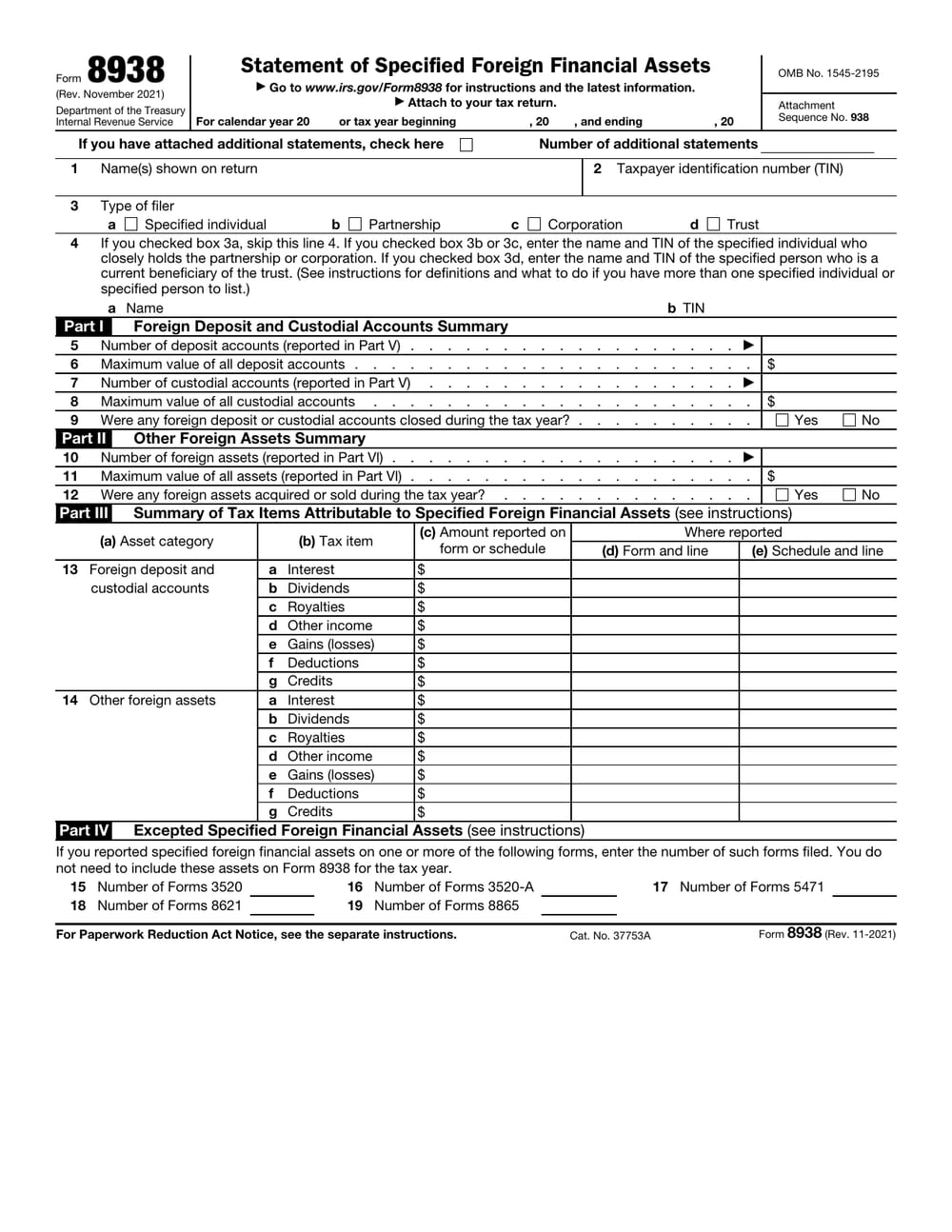
Download Form 8938 (PDF) · Instructions for Form 8938 (PDF)
Local copies for convenience, downloaded from IRS.gov on November 14, 2026. The FBAR (FinCEN Form 114) is filed separately, online only, through the BSA E-Filing System — the IRS does not publish a filable paper version. Always confirm you have the current Form 8938 revision at irs.gov/form8938 before filing.
Header and identifying information
Your name, taxpayer identification number, and the tax year. Box 3 identifies the filer type (individual, partnership, corporation, or trust). If you have more accounts or assets than fit on the form, you attach continuation statements and check the box on page 1.
Part I: Foreign Deposit and Custodial Accounts Summary
Lines 5 and 6 ask for the number of foreign deposit accounts and their total maximum value. Lines 7 and 8 do the same for foreign custodial accounts. Line 9 asks whether any of those accounts were closed during the year. These are summary totals of what you list in detail in Part V.
Part II: Other Foreign Assets Summary
Lines 10 and 11 ask for the number and total maximum value of "other foreign assets": everything from bucket 2 above, foreign pension interests, and generally any reportable asset that is not a deposit or custodial account, such as a foreign cash-value insurance contract. Line 12 asks whether you acquired or disposed of any during the year. The detail goes in Part VI.
Part III: Summary of Tax Items Attributable to Specified Foreign Financial Assets
This part ties the assets to your return. For each type of tax item (interest, dividends, royalties, other income, gains or losses, deductions, and credits), you show the amount and where on your tax return or schedule it is reported. It is a cross-check: an IRS examiner can see that the dividends from your foreign brokerage account actually made it onto Schedule B.
Part IV: Excepted Specified Foreign Financial Assets
Lines 15 through 19 ask for the number of Forms 3520, 3520-A, 5471, 8621, and 8865 you filed that report assets you are leaving out of Form 8938 under the duplicative-reporting exception.
Part V: Detailed Information for Each Foreign Deposit and Custodial Account
One block per account (lines 20 to 28): type of account, account number, whether it was opened or closed during the year, whether it was held jointly with your spouse, the maximum value during the year, whether you used a foreign currency exchange rate (and if so, which currency, which rate, and its source if not the Treasury rate), and the name, GIIN (the Global Intermediary Identification Number that institutions registered under FATCA receive), and address of the financial institution.
Part VI: Detailed Information for Each "Other Foreign Asset"
One block per asset (lines 29 to 36): a description, an identifying number if there is one, the date you acquired or disposed of it if that happened during the year, whether it was held jointly with your spouse, whether you are reporting income from it on your return, the maximum value (you check a value-range box, or enter the exact figure if it is more than $200,000), the exchange rate used, and identifying details (name and address) for the issuer, counterparty, or foreign entity.
When and how to file
Attach Form 8938 to your annual return and file it by the return's due date, including extensions. For calendar-year individuals, that means April 15. U.S. citizens and residents whose tax home and abode are outside the United States and Puerto Rico get an automatic two-month extension to June 15 under Treas. Reg. §1.6081-5, and an extension on Form 4868 takes the return (and Form 8938 with it) to October 15. If you discover after filing that you should have included Form 8938, it goes with an amended return; the instructions allow Form 8938 to be attached to either an original or an amended return.
Penalties for not filing Form 8938
The penalty structure comes from IRC §6038D(d) through (g), with the details in Treas. Reg. §1.6038D-8:
- $10,000 failure-to-file penalty if you don't file a complete and correct Form 8938 by the due date (§6038D(d)(1)).
- Continuing-failure penalty: if you still haven't filed 90 days after the IRS mails you a notice, an additional $10,000 for each 30-day period (or part of one) that the failure continues, capped at $50,000 (§6038D(d)(2)). That makes the maximum failure-to-file exposure $60,000, the figure the IRS uses in its comparison chart.
- Joint filers are treated as a single person for these penalties, and the liability is joint and several.
- Presumption of value: if the IRS determines you have an interest in specified foreign financial assets and you don't give it enough information to show their aggregate value, the value is presumed to exceed the threshold for penalty purposes (§6038D(e)). You can't argue your way out of the penalty by staying silent about the numbers.
- 40% accuracy-related penalty on any underpayment of tax attributable to a transaction involving an undisclosed foreign financial asset (IRC §6662(j)), double the usual 20% rate.
- Fraud can bring a 75% civil fraud penalty on the underpayment, and criminal penalties may apply for willful failures.
Reasonable cause. No §6038D penalty applies if you show the failure was due to reasonable cause and not willful neglect (§6038D(g)). The burden is on you to set out the facts. The statute specifically says that the fact that a foreign country would penalize you for disclosing the information is not reasonable cause.
Statute of limitations. Two rules make an unfiled Form 8938 more dangerous than it looks:
- If you fail to provide the information Form 8938 requires, the period for the IRS to assess tax for that year generally doesn't close until three years after you finally provide it (IRC §6501(c)(8)). In other words, the return can stay open indefinitely.
- If you omit more than $5,000 of gross income attributable to specified foreign financial assets, the assessment period is six years instead of three (IRC §6501(e)(1)(A)(ii)). The instructions note that this applies even if you were below the Form 8938 reporting threshold.
Part 2: FBAR vs. Form 8938
The FBAR and Form 8938 ask overlapping questions for different reasons. The FBAR is a Bank Secrecy Act report designed in 1970 to give law enforcement visibility into foreign accounts. Form 8938 is a tax return disclosure designed in 2010 to help the IRS match foreign assets to foreign income. That difference in purpose explains nearly every difference in the rules. For the mechanics of the FBAR itself (filing on the BSA E-Filing System, line-by-line entries, and corrections), see our full FBAR guide. Here we focus on how the two compare.
Side-by-side comparison
| Form 8938 | FBAR (FinCEN Form 114) | |
|---|---|---|
| Legal basis | IRC §6038D (FATCA); Treas. Reg. §§1.6038D-1 to -8 | Bank Secrecy Act, 31 U.S.C. §5314; 31 CFR §1010.350 |
| Filed with | IRS, attached to your income tax return | FinCEN, electronically through the BSA E-Filing System; not filed with your tax return |
| Who files | Specified individuals (U.S. citizens, resident aliens, certain nonresident aliens) and specified domestic entities | U.S. persons: citizens, residents, and domestic entities, trusts, and estates |
| Threshold, unmarried, living in the U.S. | More than $50,000 on the last day of the year or $75,000 at any time | More than $10,000 aggregate at any time during the calendar year |
| Threshold, married filing jointly, living in the U.S. | More than $100,000 on the last day or $150,000 at any time | $10,000 aggregate, tested for each spouse |
| Threshold, unmarried (or married filing separately), living abroad | More than $200,000 on the last day or $300,000 at any time | $10,000 aggregate |
| Threshold, married filing jointly, living abroad | More than $400,000 on the last day or $600,000 at any time | $10,000 aggregate, tested for each spouse |
| If you're not required to file a tax return | No Form 8938 required | FBAR still required if over $10,000 |
| What gives you a reportable connection | An "interest": income, gains, etc. from the asset are or would be reported on your return | A financial interest in the account or signature or other authority over it |
| What is reported | Maximum value of specified foreign financial assets, including non-account investments | Maximum value of financial accounts at institutions located in a foreign country |
| Reporting period | Your tax year | The calendar year |
| Currency conversion | Treasury rate on the last day of the tax year | Treasury rate on the last day of the calendar year |
| Joint accounts | Married filing jointly: counted once at full value. Other joint owners: see joint-ownership rules above | Each U.S. owner reports the full value of the account |
| Due date | With your return, including extensions | April 15, with an automatic extension to October 15 |
| Civil penalties | $10,000, plus up to $50,000 more for continued failure after IRS notice (max $60,000); 40% accuracy-related penalty on related underpayments | Non-willful: up to $16,536 per report. Willful: up to the greater of $165,353 or 50% of the account balance (amounts for penalties assessed on or after January 17, 2025) |
| Criminal penalties | May apply | May apply |
Which assets go where
This is the table most people actually need. It reproduces the asset categories from the IRS's comparison chart.
| Asset or account | Form 8938? | FBAR? |
|---|---|---|
| Deposit and custodial accounts at foreign financial institutions | Yes | Yes |
| Account at a foreign branch of a U.S. financial institution | No | Yes |
| Account at a U.S. branch of a foreign financial institution | No | No |
| Foreign account where you have signature authority only | No, unless you otherwise have an interest | Yes, subject to exceptions |
| Foreign stocks or securities held inside a foreign financial account | The account is reported; its contents need not be listed separately | The account is reported; its contents need not be listed separately |
| Foreign stocks or securities held directly, outside any account | Yes | No |
| Foreign partnership interests | Yes | No |
| Indirect interests in foreign accounts held through an entity | No | Yes, if you have a sufficient ownership interest (generally more than 50%) |
| Foreign mutual funds | Yes | Yes |
| U.S. mutual fund investing in foreign securities | No | No |
| Foreign life insurance or annuity contract with a cash value | Yes | Yes |
| Foreign hedge funds and private equity funds | Yes | No |
| Assets held by a grantor trust you created | Yes, both accounts and non-account assets | Yes, accounts only |
| Foreign real estate held directly | No | No |
| Foreign real estate held through a foreign entity | The entity is reported; its value includes the property | No |
| Foreign currency, precious metals, personal property held directly | No | No |
| Foreign social security-type benefits | No | No |
Foreign pensions deserve their own sentence. They are clearly reportable on Form 8938 (in Part VI, as described above). On the FBAR side, the regulatory exemption for retirement plans in 31 CFR §1010.350(g) covers participants in U.S. tax-qualified plans and owners and beneficiaries of IRAs, not foreign plans. Whether a given foreign pension is an FBAR-reportable "account" depends on how the plan is structured, which is why it is worth getting a specific answer for your plan rather than assuming either way.
The three differences that cause the most trouble
1. The thresholds aren't remotely close. The FBAR threshold is $10,000, full stop. For an unmarried American abroad, the Form 8938 threshold is twenty times higher at year end. That gap is why the most common situation for expats is "FBAR yes, Form 8938 no," and why people who learn about one form tend to assume the other works the same way.
2. They define "foreign" differently. The FBAR looks at where the account is physically located. An account at a foreign branch of a U.S. bank is in a foreign country, so it is an FBAR account. Form 8938 looks at who maintains the account. A foreign branch of a U.S. institution is a "U.S. payer," so the account is excluded. The reverse also happens: shares in a foreign company held directly, or an interest in a foreign partnership, are not "accounts" at all and never appear on the FBAR, but they are squarely within Form 8938.
3. They define "your" differently. The FBAR reaches accounts where you have signature authority even if you own nothing in them, and accounts held through entities you control. Form 8938 cares only whether income from the asset would be reported on your return.
File one, the other, or both?
Run through the two tests separately. They don't depend on each other.
- FBAR only. Your foreign accounts exceeded $10,000 in aggregate at some point, but your specified foreign financial assets stayed below your Form 8938 threshold. This is the most common outcome for Americans abroad with ordinary savings.
- Form 8938 only. Less common, but it happens. Picture someone living in the U.S. who holds $90,000 of shares in a foreign company directly through the company's share register and has no foreign accounts. Nothing to put on an FBAR, but over the $50,000 domestic threshold for Form 8938.
- Both. Your foreign accounts exceeded $10,000 and your specified foreign financial assets exceeded your Form 8938 threshold. Many accounts will then appear on both forms. That duplication is expected; the IRS has said the requirements are separate.
- Neither. Your foreign accounts never exceeded $10,000 in aggregate and your specified foreign financial assets are below your threshold.
Keep in mind that not having to file a tax return removes Form 8938 from the picture but never the FBAR. Someone with no return filing requirement and $25,000 in a foreign savings account still files an FBAR.
One more connection worth knowing: even though the FBAR isn't filed with your tax return, Schedule B, Part III of Form 1040 asks whether you had a financial interest in or signature authority over a foreign account. Answering "no" there while holding reportable foreign accounts creates an inconsistency an examiner will notice.
A worked example: over the FBAR line, close to the Form 8938 line
Sarah is a single U.S. citizen who has lived and worked in Lyon, France, since 2019. Her tax home is in France and she is a bona fide resident there for all of 2025, so she qualifies for the "living abroad" thresholds: Form 8938 is required if her specified foreign financial assets exceed $200,000 on December 31 or $300,000 at any time during the year.
Her foreign holdings during 2025 were:
- a checking account at a French bank: highest balance €14,000; balance on December 31 €9,000;
- a savings account at the same bank: €20,000 all year;
- a French brokerage account (a custodial account): highest value €128,000; value on December 31 €121,000;
- a French assurance-vie contract, a life insurance policy with a cash surrender value: €42,000 at its highest and at year end;
- shares in a friend's French startup, held directly through the company's share register (not in any brokerage account), bought as an investment: valued at €15,000 at year end.
Both forms require the same conversion rate here, because Sarah's tax year is the calendar year: the U.S. Treasury Reporting Rate of Exchange for the euro as of December 31, 2025, which is 0.8510 euros per U.S. dollar (Bureau of the Fiscal Service, Treasury Reporting Rates of Exchange as of December 31, 2025, "Euro Zone-Euro"). Because the rate is quoted in euros per dollar, you divide each euro amount by 0.851 to get dollars. That same year-end rate applies to every balance, including peaks that occurred months earlier.
Step 1: The FBAR test
The FBAR looks only at financial accounts, and the threshold is based on the aggregate of each account's maximum value. FinCEN's instructions say to report maximum values in U.S. dollars rounded up to the next whole dollar.
| Account | Maximum value (EUR) | Maximum value (USD, rounded up) |
|---|---|---|
| Checking | €14,000 | $16,452 |
| Savings | €20,000 | $23,502 |
| Brokerage | €128,000 | $150,412 |
| Assurance-vie (cash value) | €42,000 | $49,354 |
| Aggregate | €204,000 | $239,720 |
The startup shares are not an account, so they stay off the FBAR. Sarah is roughly 24 times over the $10,000 FBAR threshold. She files an FBAR listing all four accounts. That part is not close.
Step 2: The Form 8938 year-end test
Now the Form 8938 calculation. (Form 8938 doesn't use the FBAR's round-up convention, so the dollar figures below are rounded to the nearest dollar.) Here is how Sarah first did it, counting only her bank and brokerage accounts:
| Asset | Value on Dec. 31 (EUR) | Value on Dec. 31 (USD) |
|---|---|---|
| Checking | €9,000 | $10,576 |
| Savings | €20,000 | $23,502 |
| Brokerage | €121,000 | $142,186 |
| Total | €150,000 | $176,264 |
At $176,264, she is under the $200,000 year-end threshold, and she concludes she doesn't need Form 8938. That conclusion is wrong, because she left out two specified foreign financial assets:
| Asset | Value on Dec. 31 (EUR) | Value on Dec. 31 (USD) |
|---|---|---|
| Checking, savings, and brokerage (from above) | €150,000 | $176,264 |
| Assurance-vie (cash-value insurance contract) | €42,000 | $49,354 |
| Startup shares held directly | €15,000 | $17,626 |
| Total | €207,000 | $243,244 |
The correct year-end total is $243,244, which is more than $200,000. Sarah must file Form 8938. The assurance-vie alone would have pushed her over ($176,264 + $49,354 = $225,618). The startup shares, which never appear on an FBAR, add to the margin.
Think you're safely under the Form 8938 threshold? Sarah thought so too — until two assets she'd left out of her count (a life insurance contract, shares held directly) pushed her $67,000 over the line. Ask TaxLatitude to go through your full asset list →
Step 3: The "any time" test
For completeness: adding every asset's peak value (and using the year-end value for the startup shares, as the instructions generally allow for assets that are not accounts), Sarah's total is $257,344 (€219,000), below the $300,000 "any time" threshold. So it is the year-end test, not the "any time" test, that triggers her filing requirement. She only needs to cross one.
Step 4: What she reports
- Part I: two deposit accounts (checking and savings) and one custodial account (brokerage), with their total maximum values.
- Part II: two other foreign assets, the startup shares and the assurance-vie. The insurance contract counts as a specified foreign financial asset, but Parts I and V are reserved for deposit and custodial accounts, and a cash-value insurance contract is neither. It is therefore generally reported with the other assets; her preparer should confirm the treatment against the instructions for her specific contract.
- Part III: the interest from her savings account and any dividends or gains from the brokerage account, with the lines on her return where each appears.
- Parts V and VI: one detailed block for each account and asset, with the maximum value in dollars, the exchange rate used, and the institution's or issuer's details.
One flag for Sarah's preparer: French investment funds held in her brokerage account may be passive foreign investment companies, which can bring a separate Form 8621 requirement. Filing Form 8621 does not take the brokerage account off Form 8938: the account is the reported asset, and its contents are not listed separately anyway. The duplicative-reporting exception becomes relevant mainly when PFIC shares are held directly, outside an account, and even then their value still counts toward the threshold.
How the answer changes with her circumstances
- If Sarah were married to a U.S. citizen and filed jointly, the threshold would be $400,000 at year end or $600,000 at any time. On these numbers alone, no Form 8938, but she (and her spouse, if he has his own accounts) would still file FBARs.
- If Sarah had moved to Lyon in September 2025, she wouldn't meet either presence-abroad test for 2025. The domestic thresholds of $50,000 / $75,000 would apply, and she would be far over them.
- If Sarah had no assurance-vie and no startup shares, she would be at $176,264 at year end: FBAR yes, Form 8938 no.
- If Sarah's income were low enough that she had no U.S. tax return filing requirement, Form 8938 would drop away entirely. Her FBAR obligation would not.
Common mistakes
Assuming one form covers the other
The single most expensive misconception. The IRS states that the Form 8938 requirement does not replace or otherwise affect the obligation to file an FBAR. Filing a complete Form 8938 does not protect you from FBAR penalties, and filing an FBAR does not satisfy Form 8938. They go to different agencies through different systems.
Counting only bank accounts
People who learned the rules from the FBAR side think in terms of "accounts." Form 8938 is broader. Directly held foreign shares, interests in foreign partnerships, foreign pension interests, interests in foreign trusts and estates, and foreign hedge and private equity funds all count. Sarah's startup shares are a typical case. Foreign cash-value life insurance and annuities are reportable on both forms and are easy to forget because they don't look like savings.
Using the wrong thresholds
Typical errors include applying the abroad thresholds in the year of a move when neither the bona fide residence test nor the 330-day test (with its 12-month window ending in the tax year) is met; assuming that because you qualify for the foreign earned income exclusion you automatically qualify for the abroad thresholds; assuming each spouse filing separately gets the full joint threshold; and mixing up the FBAR's $10,000 with Form 8938's figures.
Miscalculating the aggregate value
- Using the exchange rate on the date of the peak balance rather than the Treasury rate on the last day of the tax year.
- Counting only half of an account held jointly with a non-American spouse. For Form 8938, you count the entire value if your co-owner is not a specified individual.
- Leaving assets reported on Forms 3520, 5471, 8621, or 8865 out of the threshold calculation. They are excepted from detailed reporting, not from the threshold.
- Using December 31 balances only and forgetting the "any time" test.
Reporting accounts that don't belong on Form 8938
Over-reporting is less dangerous than under-reporting, but it creates confusion and invites questions. Accounts at foreign branches of U.S. banks, signature-only accounts, U.S. brokerage accounts holding foreign stocks, and foreign real estate held in your own name do not go on Form 8938.
Treating "no tax due" as "nothing to file"
Plenty of Americans abroad owe no U.S. tax thanks to the foreign earned income exclusion or foreign tax credits. That doesn't change anything about Form 8938: if you have to file a return and you are over your threshold, the form is required. The penalty is for not filing the form, not for underpaying tax.
Thinking a closed account doesn't count
An account you closed in March still had a maximum value during the year. It counts toward the "any time" threshold, it is reported (with the "closed" box checked), and you convert it using the year-end Treasury rate, not the rate on the day you closed it.
Frequently asked questions
Do I need to file both FBAR and Form 8938?
If you meet both thresholds, yes. They are separate requirements under separate laws, and the IRS says filing Form 8938 does not affect your FBAR obligation. For a single American living abroad, that typically means you file both once your specified foreign financial assets exceed $200,000 at year end or $300,000 during the year, and your foreign accounts exceed $10,000 (which they usually will at that point, unless most of your foreign assets are held outside accounts).
What is the Form 8938 threshold for Americans living abroad?
More than $200,000 on the last day of the tax year or more than $300,000 at any time during the year if you are unmarried or married filing separately; more than $400,000 on the last day or more than $600,000 at any time if you are married filing jointly. You must meet the bona fide residence or 330-day physical presence test to use these figures.
Is my foreign pension reportable on Form 8938?
Yes. An interest in a foreign pension or deferred compensation plan is a specified foreign financial asset. You report your interest in the plan in Part VI, not the plan's underlying investments. Foreign government social security-type benefits are not reportable.
Does foreign real estate go on Form 8938?
Not if you hold it directly. If you hold it through a foreign company or other foreign entity, your interest in the entity is reportable, and its value includes the property.
I don't owe any U.S. tax. Do I still have to file Form 8938?
If you are required to file a U.S. income tax return and your assets exceed your threshold, yes; owing no tax doesn't matter. If you are not required to file a return at all, you don't have to file Form 8938, but you may still owe an FBAR.
What happens if I missed Form 8938 in prior years?
The penalty starts at $10,000 per year, with more after an IRS notice, and the assessment period for those years can stay open until three years after you finally file the information. The penalty doesn't apply if the failure was due to reasonable cause and not willful neglect, but you have to show the facts. Because the right fix depends on whether the failures were willful and what tax may be owed, it is worth talking to a professional familiar with the IRS's current options for late international information returns before filing anything.
Sources
- Internal Revenue Service, Instructions for Form 8938, Statement of Specified Foreign Financial Assets (Rev. November 2021): https://www.irs.gov/instructions/i8938
- Internal Revenue Service, Form 8938, Statement of Specified Foreign Financial Assets (Rev. November 2021): https://www.irs.gov/pub/irs-pdf/f8938.pdf
- Internal Revenue Service, Comparison of Form 8938 and FBAR Requirements (page last reviewed or updated September 19, 2026): https://www.irs.gov/businesses/comparison-of-form-8938-and-fbar-requirements
- 26 U.S.C. §6038D, Information with respect to foreign financial assets: https://www.law.cornell.edu/uscode/text/26/6038D
- 26 U.S.C. §6662(j), Undisclosed foreign financial asset understatement: https://www.law.cornell.edu/uscode/text/26/6662
- 26 U.S.C. §6501(c)(8) and (e)(1)(A)(ii), Limitations on assessment: https://www.law.cornell.edu/uscode/text/26/6501
- 26 CFR §§1.6038D-1 through 1.6038D-8 (Treasury Regulations under §6038D): https://www.ecfr.gov/current/title-26/chapter-I/subchapter-A/part-1 (sections 1.6038D-1 to 1.6038D-8)
- 26 CFR §1.6081-5, Extensions of time for certain taxpayers outside the United States: https://www.law.cornell.edu/cfr/text/26/1.6081-5
- 31 U.S.C. §5314 and §5321 (Bank Secrecy Act reporting and civil penalties): https://www.law.cornell.edu/uscode/text/31/5314 and https://www.law.cornell.edu/uscode/text/31/5321
- 31 CFR §1010.350, Reports of foreign financial accounts: https://www.law.cornell.edu/cfr/text/31/1010.350
- 31 CFR §1010.306(c), Filing of reports (FBAR filing date): https://www.law.cornell.edu/cfr/text/31/1010.306
- 31 CFR §1010.821, Penalty adjustment and table; Financial Crimes Enforcement Network, Inflation Adjustment of Civil Monetary Penalties, 90 Fed. Reg. 5629 (January 17, 2025): https://www.federalregister.gov/documents/2025/01/17/2025-01374/financial-crimes-enforcement-network-inflation-adjustment-of-civil-monetary-penalties
- Financial Crimes Enforcement Network, Reporting Maximum Account Value: https://www.fincen.gov/reporting-maximum-account-value
- Financial Crimes Enforcement Network, FinCEN FBAR Help: General Instructions (due date and automatic extension): https://bsaefiling.fincen.treas.gov/docs/FinCENFBARHelp.pdf
- Bittner v. United States, 598 U.S. 85 (2023) (non-willful FBAR penalty applies per report, not per account): https://www.supremecourt.gov/docket/docketfiles/html/public/21-1195.html
- U.S. Department of the Treasury, Bureau of the Fiscal Service, Treasury Reporting Rates of Exchange as of December 31, 2025 (Euro Zone-Euro: 0.8510): https://fiscaldata.treasury.gov/static-data/published-reports/exchange-rates/Rates_of_Exchange_12312025.pdf
- U.S. Department of the Treasury, Bureau of the Fiscal Service, Treasury Reporting Rates of Exchange dataset (all quarters and currencies): https://fiscaldata.treasury.gov/datasets/treasury-reporting-rates-exchange/treasury-reporting-rates-of-exchange
This article is general information about U.S. reporting rules, not tax or legal advice for your situation. Rules and inflation-adjusted penalty amounts change; check the primary sources above before you file.