Who has to file Form 8865, how the four filer categories work, what each schedule asks for, when the form is due if you live abroad, and what happens if you file late, with two fully worked examples.
Key takeaways
- Form 8865 is the single IRS form for three separate reporting statutes: IRC §6038 (annual reporting on controlled foreign partnerships), §6038B (contributions of property to a foreign partnership), and §6046A (acquisitions, dispositions and changes in foreign partnership interests).
- Whether you file depends on your category. Category 1 means you hold more than 50%. Category 2 means you hold at least 10% of a partnership controlled by US 10% partners. Category 3 is triggered by contributing property. Category 4 is triggered by crossing or moving through 10% thresholds.
- Ownership is measured by capital, profits, or deductions and losses, and it includes interests you are treated as owning through family members and entities. A nonresident spouse's stake can count as yours.
- The form is attached to your Form 1040 and is due when the return is due, including extensions. Americans whose tax home and abode are abroad get an automatic extension to June 15.
- The basic penalty is $10,000 per partnership per year. It rises by up to $50,000 more if you do not file after an IRS notice. Separate penalties apply to unreported contributions (10% of the property's value, generally capped at $100,000) and to unreported acquisitions and dispositions ($10,000 plus up to $50,000).
- Until a required Form 8865 is filed, the IRS's time to assess tax on the whole return generally stays open under §6501(c)(8). If the failure was due to reasonable cause, only the related items stay open.
- Whether a foreign entity files Form 8865 or Form 5471 depends on how US tax law classifies it, not on its local name. A UK LLP, for example, is a corporation for US purposes by default.
What Form 8865 is and why it exists
Form 8865, Return of U.S. Persons With Respect to Certain Foreign Partnerships, is an information return. It does not compute tax. It tells the IRS that a US person has a significant connection to a foreign partnership and gives the IRS the partnership's financial information. In most cases it also gives the IRS the partner-level figures that drive the US person's own tax. The IRS instructions describe the form as the vehicle for information required under three Code sections:
| Statute | What it requires | Filer category | Main regulation |
|---|---|---|---|
| §6038 | Annual information about a foreign partnership that a US person controls, or in which a US person holds a 10% interest when US 10% partners together control it | Categories 1 and 2 | Treas. Reg. §1.6038-3 |
| §6038B | Notice of property contributed to a foreign partnership in a §721 contribution, above set thresholds | Category 3 | Treas. Reg. §1.6038B-2 |
| §6046A | A return when a US person acquires or disposes of a foreign partnership interest, or when the person's proportional interest changes substantially, measured against a 10% threshold | Category 4 | Treas. Reg. §1.6046A-1 |
Why it exists. A US partnership files Form 1065 and gives each partner a Schedule K-1, so the IRS sees the partnership's income and each partner's share. A foreign partnership usually has no US filing obligation of its own. Under §6031(e), a foreign partnership generally has to file Form 1065 only if it has income effectively connected with a US business or US-source income. Without Form 8865, a US person could hold a foreign partnership that the IRS would never see.
The Taxpayer Relief Act of 1997 addressed this by moving annual reporting on US-controlled foreign partnerships from the partnership level to the partner level. It rewrote §6038 to cover partnerships as well as corporations, extended §6038B to contributions to foreign partnerships, and narrowed §6046A to interests that cross a 10% threshold. The Treasury preambles from that period describe the change. See REG-118966-97 (63 FR 48154, 1998) and the final §6046A regulations in T.D. 8850 (64 FR 72555, 1999).
What the form is not. Form 8865 does not replace the tax rules for partnership income. If you are a partner in a foreign partnership, your distributive share of its income is taxable to you each year whether or not it is distributed. You report it on your own return, typically on Schedule E (Form 1040), Part II. Form 8865 and its Schedule K-1 document that share. Your foreign earned income exclusion or foreign tax credit planning then works from those numbers. For those mechanics, see our Form 2555 guide and Form 1116 guide.
One form per partnership, per year. The instructions require a separate Form 8865, with its own schedules, for each foreign partnership. The regulations say the same (§1.6038-3(a)(3)). One Form 8865 can cover several categories for the same partnership. You check every box that applies in item A.
Who counts as a "US person"
Only a "United States person" files Form 8865. The instructions use the §7701(a)(30) definition. A US person is a US citizen or resident, a domestic partnership, a domestic corporation, or an estate or trust that is not a foreign estate or trust.
For readers of this site, this means:
- US citizens are US persons wherever they live. Living abroad for decades, holding another nationality, or having no US income does not change this.
- Green card holders are US residents under §7701(b) until their status ends for tax purposes, even if they live abroad.
- A nonresident alien spouse is not a US person and has no Form 8865 obligation of their own. As explained below, however, the spouse's interest can be attributed to the US spouse and change the US spouse's category.
- Your US LLC or US partnership is a US person. If it holds the foreign partnership interest, it may be the filer. You may then qualify for the constructive-owner exception rather than filing separately.
The four categories of filers
Your category determines whether you file at all and how much of the form you complete. The four categories are defined in the instructions under "Categories of Filers" and come from three statutes. You can be in more than one category in the same year. This is common in the year a partnership is formed.
First: how ownership is measured
All four categories turn on ownership thresholds, and they share the same definitions, which come from §6038(e)(3) and Treas. Reg. §1.6038-3(b):
- A 50% interest is an interest equal to 50% of the partnership's capital, 50% of its profits, or an interest to which 50% of its deductions or losses are allocated. Any one of the three is enough. If you contributed 40% of the capital but the agreement gives you 55% of the profits, you hold more than a 50% interest.
- A 10% interest is the same test with "10%" in place of "50%" (§6038(e)(3)(C)). Section 6046A(d) adopts this definition for Category 4.
- Control means owning, directly or indirectly, more than a 50% interest (§6038(e)(3)(A); Reg. §1.6038-3(b)(1)). Exactly 50% is not control.
- Percentages are fixed by the partnership agreement, determined each year (Reg. §1.6038-3(b)(5)).
Constructive ownership. Section 6038(e)(3)(B) applies rules "similar to" the constructive ownership rules of §267(c), except §267(c)(3), treating partnerships as if they were corporations. In practice:
- Entity attribution (§267(c)(1)). An interest owned by a corporation, partnership, estate or trust is treated as owned proportionately by its owners or beneficiaries. If you own 40% of a foreign company that owns 20% of a foreign partnership, you are treated as owning 8% of the partnership.
- Family attribution (§267(c)(2)). You are treated as owning interests held by your family. Family means only your spouse, brothers and sisters (including half-siblings), ancestors and lineal descendants. In-laws, nieces and nephews are not family for this purpose.
- The nonresident-alien rule. Under Reg. §1.6038-3(b)(4) and the instructions, an interest held by a nonresident alien family member is attributed to you only if you own an interest yourself, directly or through an entity under §267(c)(1) or (5). An American who owns nothing is not deemed to own a nonresident spouse's stake. An American who owns 1% is deemed to own all of it.
The nonresident-alien rule is the attribution rule that most often catches expats. An American with a 30% interest whose nonresident spouse holds another 30% is treated as owning 60%. That makes the American a Category 1 filer, not a Category 2 filer or a non-filer. Worked example 2 below walks through this.
Your spouse isn't American and holds a stake in the same foreign partnership? Their interest can be added to yours for the attribution test — a 30%/30% split between spouses can make you a controlling partner with the fullest filing burden, not a minor one. Ask TaxLatitude to check which category you're actually in →
Category 1: control of the partnership (more than 50%)
Who. A US person who controlled the foreign partnership at any time during the partnership's tax year. Control is ownership, directly or constructively, of more than a 50% interest, measured as described above.
Authority. IRC §6038(a)(1) requires every US person to furnish information "with respect to any foreign business entity which such person controls." Section 6038(e)(1) defines "foreign business entity" to include a foreign partnership. Section 6038(e)(3)(A) defines control of a partnership. Treas. Reg. §1.6038-3(a)(1) calls these filers "controlling fifty-percent partners."
Period covered. The information covers the partnership's tax year that ends with or within your tax year (§6038(a)(2); Reg. §1.6038-3(f)). The partnership's tax year for this purpose is determined under §706 (Reg. §1.6038-3(b)(8)). This matters if the foreign partnership keeps its books on a non-calendar accounting year.
What a Category 1 filer completes. Almost the whole form: the identifying information on pages 1 and 2, Schedules A, A-1, A-3, B, D (if there are capital gains), K, K-1, K-2, K-3, L, M-1, M-2 and N. Schedules L, M-1 and M-2 can be skipped if the partnership meets the small-partnership test in item H11 (see "The form and its schedules, part by part" below).
More than one controlling partner. Two US persons can both be Category 1 filers. One person might hold more than 50% of capital while another, through family attribution, is treated as holding the same interest. The regulations then allow one of them to file a single Form 8865. Each of the others attaches a "Controlled Foreign Partnership Reporting" statement to their own return (Reg. §1.6038-3(c)(1)). A person whose control rests only on deductions or losses cannot be the designated filer if another US person controls through capital or profits.
Category 2: 10% interest in a US-controlled partnership
Who. A US person who at any time during the partnership's tax year owned a 10% or greater interest while the partnership was controlled by US persons each owning at least 10%. If any US person was a Category 1 filer at any time during that tax year, no one is a Category 2 filer.
Authority. IRC §6038(a)(5) allows the Treasury to require information from each US 10% partner in a foreign partnership "which is controlled by United States persons holding at least 10-percent interests (but not by any one United States person)." Treas. Reg. §1.6038-3(a)(2) calls these filers "controlling ten-percent partners." It turns the requirement off for any year in which the partnership had a controlling fifty-percent partner.
The test in practice. Add up the interests of the US persons who each hold at least 10%. If that total is more than 50%, and no single US person exceeds 50%, each of those US persons is a Category 2 filer. One of the regulation's examples has US partners with 40% and 15%. Neither controls alone, but together they hold 55%, so both are controlling ten-percent partners. US persons with less than 10% are not counted toward the total.
What a Category 2 filer completes. Much less than a Category 1 filer: pages 1 and 2, Schedules A and A-3, Schedule K-1 for the filer's own direct interest, Schedule K-3 if the partnership has items of international tax relevance, and columns (a) through (c) of Schedule N. A Category 2 filer does not complete Schedules B, D, K, K-2, L, M-1 or M-2, and does not complete column (d) of Schedule N.
Category 3: contributing property to a foreign partnership
Who. A US person who, during that person's own tax year, contributed property to a foreign partnership in exchange for a partnership interest (a §721 contribution), if either of these is true:
- immediately after the contribution, the person owned, directly or constructively, at least a 10% interest in the partnership; or
- the fair market value of the property contributed, together with other property the person or a related person contributed to the partnership or a related partnership during the 12-month period ending on the date of the transfer, exceeds $100,000.
Authority. IRC §6038B(a)(1)(B) requires notice of contributions "described in section 721" to foreign partnerships. §6038B(b)(1) limits the requirement to the 10%-after and $100,000 cases. Treas. Reg. §1.6038B-2(a)(1) implements both tests. Its examples apply the 10% test on its own, so either test is enough.
Points that are easy to miss:
- Cash counts. The regulation lists "cash" as one of the categories of property to be described (Reg. §1.6038B-2(c)). A cash capital contribution to a foreign partnership is a §721 contribution. It is reportable if either threshold is met.
- The $100,000 test applies at any percentage. An American who contributes $150,000 to a foreign investment fund organized as a limited partnership within a 12-month period (for example, by meeting capital calls) is a Category 3 filer for that year, even with a 0.5% interest. A capital commitment that has not yet been called is not a contribution.
Put cash into a foreign partnership or fund this year? Crossing $100,000 in contributions over 12 months triggers filing no matter how small your actual stake is — even a 0.5% interest counts. Ask TaxLatitude to add up your contributions →
- The test runs on your own tax year, not the partnership's. Schedule A is completed using the filer's tax year for Category 3.
- Contributions through a US partnership. If a domestic partnership contributes property to a foreign partnership, its partners are treated as having contributed their proportionate shares. If the domestic partnership files Form 8865 and properly reports the contribution, the partners do not have to (Reg. §1.6038B-2(a)(2)).
- Later dispositions. If the foreign partnership later disposes of appreciated property you contributed and reported, you report that disposition on Schedule O while you remain a partner (Reg. §1.6038B-2(a)(4)).
- Section 721(c). Special rules apply when a US transferor contributes appreciated property to a partnership with related foreign partners and uses the "gain deferral method." These rules involve Schedules G and H and, for some domestic partnerships, treatment as a foreign partnership. They are rarely relevant to individuals running small businesses abroad and are not covered further here.
Category 4: acquisitions, dispositions and changes in interest
Who. A US person who had a "reportable event" under §6046A during the tax year. The regulations define three kinds (Treas. Reg. §1.6046A-1(b)(1)):
- Acquisition. You did not own a 10% or greater direct interest, and after the acquisition you do. Or, compared with your interest at your last reportable event, your direct interest has increased by at least 10 percentage points.
- Disposition. You owned a 10% or greater direct interest before the disposition and less than 10% after. Or your direct interest has decreased by at least 10 percentage points since your last reportable event.
- Change in proportional interest. Your direct proportional interest has risen or fallen by the equivalent of at least a 10% interest since your last reportable event, without your having acquired or disposed of anything. This can happen when another partner joins or withdraws, or when a profit-sharing ratio changes under the agreement.
The instructions give two examples: moving from 9% to 10% is an acquisition, and moving from 21% to 11% is a disposition.
Authority. IRC §6046A(a) applies acquisitions and dispositions only if the person holds at least a 10% interest "either before or after" the event, and changes only if the change "is equivalent to at least a 10-percent interest." Section 6046A(d) imports the §6038(e)(3)(C) definition of a 10% interest.
Direct interests only. The statute speaks of interests held "directly or indirectly." The final regulations, however, measure reportable events by direct interests, and the preamble explains that indirect changes are not reportable under §6046A. Unlike Categories 1 and 2, Category 4 can apply to any foreign partnership, whether or not US persons control it.
Overlap with Category 3. If your acquisition results from a §721 contribution that you properly report as a Category 3 filer, you do not report it again as a Category 4 acquisition. It still counts as a reportable event for measuring later changes. If the contribution is not properly reported, penalties under both §6038B and §6046A can apply (Reg. §1.6046A-1(f)(1)).
The four categories at a glance
| Category | Trigger | Threshold | Statute / regulation | Main schedules |
|---|---|---|---|---|
| 1 | Control at any time during the partnership's tax year | More than 50% of capital, profits, or deductions/losses, including constructive ownership | §6038(a)(1), (e)(3); Reg. §1.6038-3(a)(1) | Nearly all: A, A-1, A-3, B, D, K, K-1, K-2, K-3, L, M-1, M-2, N |
| 2 | 10% interest while US 10% partners together control | At least 10%; US 10% partners together more than 50%; no Category 1 filer that year | §6038(a)(5); Reg. §1.6038-3(a)(2) | A, A-3, K-1, K-3, N (cols. a–c) |
| 3 | §721 contribution of property (including cash) | At least 10% immediately after, or more than $100,000 contributed in 12 months (with related persons) | §6038B(a)(1)(B), (b)(1); Reg. §1.6038B-2(a) | A, A-1, A-3, O |
| 4 | Acquisition, disposition or change in proportional interest | Crossing 10% (direct), or a 10-percentage-point move since the last reportable event | §6046A(a), (d); Reg. §1.6046A-1(b) | A, A-3, P |
Identifying information on page 1 and Schedules A and A-3 are required in every category. Schedules G and H apply only under the §721(c) gain deferral method.
Exceptions that reduce or remove the filing requirement
The exceptions are narrow, and several require you to attach a statement to your return in place of the form. If you rely on an exception and skip the statement, you may still be treated as having failed to file.
| Exception | What it does | What you still have to do | Source |
|---|---|---|---|
| Multiple Category 1 filers | Only one controlling partner files the full Form 8865 | Each other Category 1 filer attaches a "Controlled Foreign Partnership Reporting" statement. A Category 1 filer that is also a Category 3 or 4 filer must still file its own Form 8865 for that reporting | Reg. §1.6038-3(c)(1); instructions |
| Constructive owners | An indirect partner need not file if the person through whom the interest is owned files and reports the required information | Attach the required statement. The exception fails if its conditions are not met | Reg. §1.6038-3(c)(2); instructions |
| Consolidated groups | The common parent can file one Form 8865 for all members | Not relevant to most individuals | Reg. §1.6038-3(c)(3) |
| Partnership files Form 1065 | Category 1 and 2 filers may substitute copies of the partnership's Form 1065 schedules for the matching Form 8865 schedules. Category 2 filers may attach the Form 1065 Schedules K-1 and K-3 they receive | Still file Form 8865 with the remaining items | Reg. §1.6038-3(j); instructions |
| Contribution by a domestic partnership | Partners need not report a contribution the domestic partnership reports properly | Confirm that the domestic partnership actually files | Reg. §1.6038B-2(a)(2) |
| Category 3 / Category 4 overlap | A properly reported contribution need not also be reported as an acquisition | The event still counts for future Category 4 comparisons | Reg. §1.6046A-1(f)(1) |
| Certain trusts | Trusts relating to state and local government employee retirement plans are exempt | Not relevant to most individuals | Reg. §§1.6038-3(d), 1.6038B-2(b), 1.6046A-1(f)(2) |
| Excluded partnerships | Partnerships validly electing out of subchapter K under §1.761-2 are not subject to §6038 or §6046A reporting | A narrow election for certain investing or operating arrangements | Reg. §§1.6038-3(e), 1.6046A-1(f)(3) |
There is no de minimis exception for small partnerships. Being small changes only how much you complete, through the item H11 test for Schedules L, M-1 and M-2. It does not change whether you file. There is also no exception for a partnership that lost money or had no activity, and none for one whose income you already reported on your Form 1040.
What counts as a foreign partnership, and Form 8865 vs Form 5471
Form 8865 applies only if two things are true. The arrangement must be a partnership for US federal tax purposes, and it must be foreign. Neither depends on what the arrangement is called locally.
Step 1: Is there a separate entity at all?
Under Treas. Reg. §301.7701-1(a)(2), a joint venture or other contractual arrangement can create a separate entity for tax purposes if the participants carry on a trade, business, financial operation or venture and divide the profits. The same paragraph says that mere co-ownership of property that is maintained, kept in repair and rented or leased does not by itself create a separate entity. A joint undertaking merely to share expenses is also not a partnership, as the Form 8865 instructions note. Two common expat situations illustrate the difference:
- Co-owning a rental flat abroad with a spouse or sibling and simply renting it out is generally co-ownership, not a partnership. You report your share of rent and expenses directly on Schedule E, with no Form 8865. The answer can change if the co-owners provide significant services to tenants or run the property as a business (for example, a guesthouse with daily services).
- Running a shop, café, consultancy or practice with a business partner is a partnership if there is no corporation, whether or not you signed a written partnership agreement or registered anything.
Step 2: Is the entity a partnership or a corporation?
Business entities are classified under the "check-the-box" regulations, Treas. Reg. §301.7701-2 and §301.7701-3.
- Per se corporations. Entities on the list in §301.7701-2(b)(8) are always corporations and cannot elect otherwise. Examples include a UK public limited company, a German or Swiss Aktiengesellschaft, a French société anonyme, a Spanish or Mexican sociedad anónima, a Portuguese sociedade anónima, a Dutch naamloze vennootschap, a Japanese kabushiki kaisha, and a Canadian corporation. A per se corporation is never reported on Form 8865.
- Eligible entities: default rules. Any other business entity is an "eligible entity." Under §301.7701-3(b)(2)(i), unless it elects otherwise, a foreign eligible entity is:
- a partnership if it has two or more members and at least one member does not have limited liability;
- an association, which is taxed as a corporation, if all members have limited liability; or
- disregarded if it has a single owner who does not have limited liability.
- Elections. An eligible entity with two or more members can choose partnership or corporate treatment by filing Form 8832. The effective date can be up to 75 days before the filing date and up to 12 months after it. After a change, the entity generally cannot change again for 60 months (§301.7701-3(c)(1)(iii), (iv)).
Applying the default rules to common entity types gives the results below. This is general information only. Classification turns on the specific local statute and on any Form 8832 election that has been filed, so confirm it for your own entity.
| Entity | Members' liability under local law (general rule) | Default US classification | Form |
|---|---|---|---|
| UK general partnership; English limited partnership (with a general partner) | At least one partner has unlimited liability | Partnership | 8865 |
| UK limited liability partnership (LLP) | All members have limited liability | Corporation (association), even though UK tax law treats an LLP as transparent | 5471, unless an election to be a partnership is made |
| UK private limited company (Ltd) | All members limited | Corporation; can elect partnership if two or more members | 5471, or 8865 if elected |
| UK public limited company (plc) | n/a | Per se corporation | 5471 |
| German GbR, OHG; KG including GmbH & Co. KG | At least one partner has unlimited liability | Partnership | 8865 |
| German GmbH; French SARL; Spanish SL; Portuguese Lda | All members limited | Corporation; can elect partnership if two or more members | 5471, or 8865 if elected |
| French SNC (société en nom collectif) | Partners have unlimited liability | Partnership | 8865 |
| Single-member entity with limited liability (e.g., one-person Ltd or GmbH) | Limited | Corporation by default; can elect to be disregarded | 5471, or 8858 if disregarded |
Two things follow. First, the local name is not a guide. "Partnership" in a UK LLP's name does not make it a partnership for US purposes, and a GmbH that has elected partnership treatment is reported on Form 8865 even though everyone in Germany calls it a company. Second, an entity can be treated differently in each country. A UK LLP is transparent in the UK but a corporation in the US by default. A German GmbH that has elected partnership treatment pays German corporate tax but is a partnership in the US. In these hybrid cases, foreign taxes paid at the entity level and the source and category of its income become important. They are reported to you on Schedule K-3. Item 9 of the foreign-partnership questions on page 2 asks how the partnership is classified under the law of its country of organization.
Step 3: Is the partnership foreign?
A partnership is domestic if it is created or organized in the United States or under the law of the United States or of any state, and foreign otherwise (§7701(a)(4), (5)). Where the partners live and where the business operates do not matter. A Delaware LLC taxed as a partnership is domestic even if all its members and all its business are in Portugal. It files Form 1065, not Form 8865, though it may itself have Form 8865 obligations for any foreign partnership it holds. (The instructions treat a domestic §721(c) partnership as foreign for Form 8865 purposes if the gain deferral method applies. This is a narrow rule.)
Form 8865 vs Form 5471: a direct comparison
Once the entity is classified, the choice of form follows. Foreign entities classified as partnerships are reported on Form 8865. Foreign entities classified as corporations, whether per se, by default or by election, are reported on Form 5471. A foreign entity can move from one form to the other when a Form 8832 election changes its classification. The election is itself a deemed transaction, which can have tax consequences and reporting of its own. For the corporate side, see our Form 5471 and CFC guide and our guide to owning a company abroad.
| Form 8865 (foreign partnership) | Form 5471 (foreign corporation) | |
|---|---|---|
| Entities covered | Foreign business entities classified as partnerships | Per se foreign corporations and foreign eligible entities classified as associations |
| Statutes | §6038, §6038B (contributions), §6046A (acquisitions/dispositions) | §6038 and §6046 (organization, reorganization and stock acquisitions); contributions are reported separately on Form 926 under §6038B |
| How ownership is measured | Interest in capital, profits, or deductions/losses | Stock, by vote or value |
| Control | More than 50% interest (§6038(e)(3)) | More than 50% of total combined voting power or total value of stock (§6038(e)(2)) |
| Attribution rules | §267(c) rules except (c)(3), with the nonresident-alien family limit in Reg. §1.6038-3(b)(4) | Corporate attribution rules built on §318, as modified for each category |
| US tax on the entity's income | Flow-through: each US partner is taxed annually on their distributive share, whether or not distributed. Character and source carry through to the partner | Generally deferred until distribution, unless the corporation is a CFC with Subpart F or §951A inclusions, or a PFIC, for its US owners |
| Foreign taxes paid by the entity | Pass through to partners for the foreign tax credit (reported on Schedules K-2/K-3) | Creditable by individuals only in limited cases (e.g., a §962 election); otherwise not directly creditable |
| Reporting of contributions | Schedule O (Category 3) | Form 926 |
| Transactions with related parties | Schedule N | Schedule M |
| Basic late-filing penalty | $10,000 per year per partnership under §6038(b), plus up to $50,000 after notice; §6038B and §6679 penalties for Categories 3 and 4 | $10,000 per year per corporation under §6038(b), plus up to $50,000 after notice; §6679 for §6046 categories |
| Statute of limitations if missing | §6501(c)(8) | §6501(c)(8) |
| When due | With your income tax return, including extensions | With your income tax return, including extensions |
Why classification is worth checking every year. For an American running a small business abroad with local partners, classification often affects more than which form to file. A partnership's profits are taxed to you in the US currently. Depending on your situation, the foreign earned income exclusion may shelter some of that income, or a foreign tax credit may offset it. A foreign corporation's profits may be deferred, or may be swept into a CFC inclusion that is harder to offset with credits. The reporting form follows from that classification decision, not the other way round.
The form and its schedules, part by part
For several schedules, the Form 8865 instructions tell you to use the line-by-line instructions for the corresponding Form 1065 schedule. This applies to Schedule B (Form 1065, page 1), Schedules K and K-1, Schedule K-3, Schedule L, and Schedules M-1 and M-2. Capital gains and losses are reported on Schedule D (Form 1065). Two general rules apply throughout. All information must be in English and all amounts in US dollars. The regulations add that you state the exchange rates used (Reg. §§1.6038-3(h), 1.6038B-2, 1.6046A-1(g)).
Form 8865 (2025)
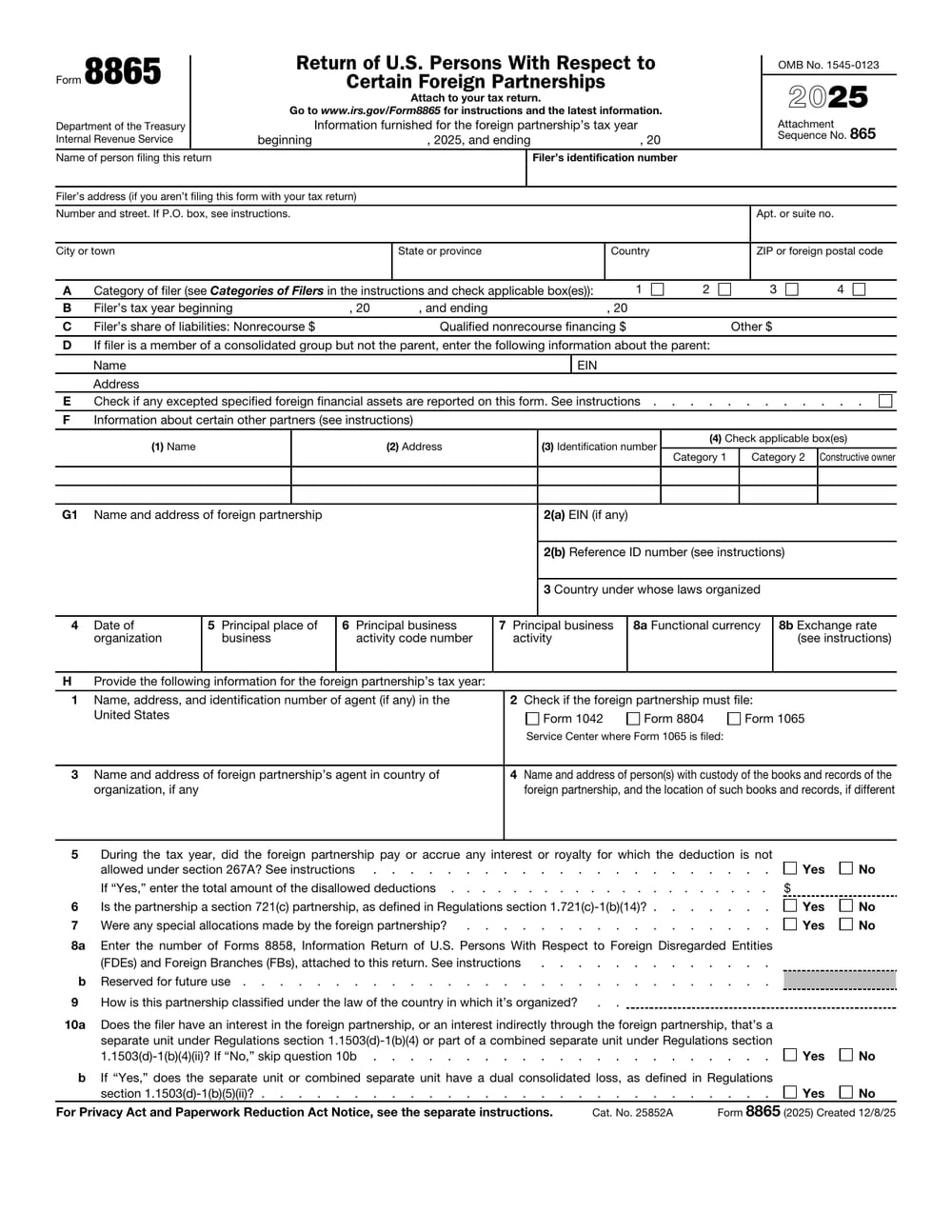
Download Form 8865 (PDF, 6 pages) · Instructions for Form 8865 (PDF)
Local copies for convenience, downloaded from IRS.gov on November 14, 2026. Schedules that reuse the Form 1065 schedules (K, K-1, K-3, L, M-1, M-2) and Schedule D are not included in this PDF. Always confirm you have the current revision at irs.gov/form8865 before filing.
Pages 1 and 2: identifying information and questions
- Item A, category of filer. Check every category that applies to you for this partnership.
- Item B, filer's tax year. For individuals, normally the calendar year.
- Item C, filer's share of liabilities. Nonrecourse, qualified nonrecourse financing, and other.
- Item D applies to members of consolidated groups.
- Item E is a checkbox for whether any excepted specified foreign financial assets are reported on this form. It links Form 8865 to Form 8938 (see "How Form 8865 interacts with your other filings" below).
- Item F asks for information about certain other partners: name, address, identification number, and whether each is a Category 1 filer, a Category 2 filer or a constructive owner. The instructions specify whom to list. This item is where filings made under the multiple-filer and constructive-owner exceptions are connected.
- Items G1–G8 describe the partnership: name and address; US EIN, if any (G2a); a reference ID number (G2b), which, once assigned, must be used consistently from year to year (see the instructions for when it is required); country of organization; date of organization; principal place of business; business activity code and description; functional currency (G8a); and the exchange rate used (G8b). The instructions ask for exchange rates in a "divide-by" convention, meaning units of foreign currency per one US dollar, rounded to at least four decimal places. The functional currency is determined under §§985–989. A partnership with multiple qualified business units attaches a statement.
- The questions on page 2 cover, among other things: interest or royalties for which a deduction is disallowed under §267A (hybrid arrangements); whether the partnership made special allocations; the number of Forms 8858 attached for foreign disregarded entities; how the partnership is classified under local law; dual consolidated loss questions; the small-partnership test (item H11); §250 deduction information; the number of foreign partners subject to §864(c)(8); and disclosures under Reg. §1.707-8.
The small-partnership test (item H11). Only Category 1 filers answer this question. It asks whether the partnership meets both of these requirements: its total receipts for the tax year were less than $250,000, and its total assets at the end of the tax year were less than $1 million. If both are met, you do not complete Schedules L, M-1 and M-2. "Total receipts" is defined in the instructions as gross receipts or sales (Schedule B, line 1a) plus several other income items. It is not net profit.
Schedule A: Constructive Ownership of Partnership Interest
Every filer completes Schedule A. Check box a if you own a direct interest, box b if you own a constructive interest, or both. Category 1 and 2 filers then list the US and foreign persons whose interests they constructively owned during the partnership's tax year. Category 3 filers do this for their own tax year. This is where family members whose interests are attributed to you (including a nonresident spouse, when the attribution rule applies) and entities whose interests are attributed to you are listed. Schedule A is how the IRS checks that your category is right, so it should match the ownership-measurement rules explained above.
Schedule A-1: Certain Partners of Foreign Partnership
Category 1 and Category 3 filers complete Schedule A-1. Category 1 filers list US persons who held a 10% or greater direct interest during the partnership's tax year. Category 3 filers list US persons with a 10% or greater direct interest during the filer's tax year, plus related direct partners. There is an exception for a Category 3 filer who transferred only cash and held less than a 10% interest afterwards (see also Reg. §1.6038B-2(c)). The schedule identifies the other US partners whose own Form 8865 obligations the IRS may want to check.
Schedule A-2: Foreign Partners of Section 721(c) Partnership
Schedule A-2 applies only to partnerships subject to the §721(c) rules. Most expat filers leave it blank.
Schedule A-3: Affiliation Schedule
Every filer completes Schedule A-3. It lists the partnerships, foreign or domestic, in which the foreign partnership holds a direct interest or an indirect 10% interest. Only Category 1 filers complete the "total ordinary income or loss" column for each listed partnership. If the partnership holds no interests in other partnerships, there is nothing to list.
Schedule B: Income Statement—Trade or Business Income
Category 1 filers complete Schedule B, which follows page 1 of Form 1065. It shows gross receipts or sales, returns and allowances, cost of goods sold, other income, deductions (salaries and wages, guaranteed payments to partners, repairs, rent, taxes and licenses, interest, depreciation, retirement plans, employee benefits and others), and ordinary business income or loss. A caution on the form says to include only trade or business income and expenses on these lines. Portfolio income such as interest, dividends and capital gains, and rental activity, go on Schedule K instead. Foreign accounts must be recast to US tax principles. Local book depreciation, for example, is replaced by US tax depreciation. This adjustment is often the most time-consuming part of a first-year filing.
Schedule D (Form 1065): Capital Gains and Losses
If the partnership has capital gains or losses, a Category 1 filer attaches Schedule D (Form 1065) as instructed. It is not a separate Form 8865 schedule.
Schedule K: Partners' Distributive Share Items
Schedule K totals, for all partners combined, the items each partner must account for separately: ordinary business income, net rental income, guaranteed payments, interest, dividends, royalties, capital gains, §1231 gain, other income, the §179 deduction, other deductions, credits, self-employment earnings, distributions and other information. Only Category 1 filers complete it. As on Form 1065, Schedule K has a checkbox showing whether the partnership has items of international tax relevance, which determines whether Schedules K-2 and K-3 are required. Total foreign taxes paid or accrued by the partnership are reported on Schedule K, and the detail needed for the credit goes on Schedule K-2.
Schedule K-1 (Form 8865): Partner's Share of Income, Deductions, Credits, etc.
Category 1 and Category 2 filers complete Schedule K-1 for their own direct interest. Category 1 filers must also complete a Schedule K-1 for each US person that directly owns a 10% or greater interest. The K-1 shows your share of each Schedule K item, your capital account and your share of liabilities. It is the document from which you report your share of income on your own return. The instructions under the multiple Category 1 filers exception note that each Category 1 filer needs its own Schedules N, K-1 and K-3.
Schedule K-2 (Form 8865): Partners' Distributive Share Items—International
Schedule K-2 extends Schedule K and reports the partnership's items of international tax relevance for all partners combined. Only Category 1 filers complete it, and only the parts that apply. The 2025 schedules have eight parts:
- Part I covers other current-year international information, such as checkboxes for gain on personal property sales, foreign oil and gas taxes, and Forms 5471, 8865 and 8621 the partnership files.
- Part II is the foreign tax credit limitation section. It reports income and deductions by source (US and foreign country) and by foreign tax credit category.
- Part III gives other information for Form 1116 or 1118: expense apportionment factors, foreign taxes paid or accrued, and related details.
- Part IV gives information for the partner's §250 deduction (Form 8993).
- Part V covers distributions from foreign corporations to the partnership.
- Part VI covers §951(a)(1) and §951A inclusions from CFCs owned through the partnership.
- Part VII gives information to complete Form 8621 for PFICs owned through the partnership.
- Part VIII gives information for the base erosion and anti-abuse tax (Form 8991).
The separate Instructions for Schedules K-2 and K-3 (Form 8865) say that only the relevant parts need to be completed. Parts V and VI are not required if the partnership owns no foreign corporation. Parts II and III are not required if no direct or indirect partner can claim a foreign tax credit, or if no such partner would need to file Form 1116 or 1118. For an expat partner who claims the credit, Parts II and III are usually the important ones.
Schedule K-3 (Form 8865): Partner's Share of Income, Deductions, Credits, etc.—International
Schedule K-3 is to Schedule K-2 what Schedule K-1 is to Schedule K: each partner's share of the international items. Category 1 and Category 2 filers complete it for their own direct interest when the partnership has items of international tax relevance. Category 1 filers also complete it for each US 10% direct partner for whom they complete a K-1. Partners use Parts II and III to complete Form 1116. For how those figures feed the foreign tax credit limitation, see our Form 1116 guide.
Schedule L: Balance Sheets per Books
Category 1 filers complete Schedule L, unless the item H11 test is met. It shows beginning and end-of-year assets, liabilities and partners' capital, following Form 1065. The instructions say Schedule L should be prepared and translated into US dollars under US generally accepted accounting principles. Partnerships using the dollar approximate separate transactions method (DASTM) follow Reg. §1.985-3(d).
Schedule M-1: Reconciliation of Income (Loss) per Books With Income (Loss) per Return
Category 1 filers complete Schedule M-1, unless the item H11 test is met. It reconciles book income to income on the return: book-tax depreciation differences, non-deductible expenses, tax-exempt income and similar items.
Schedule M-2: Analysis of Partners' Capital Accounts
Category 1 filers complete Schedule M-2, unless the item H11 test is met. It reconciles beginning to ending partners' capital: contributions, income, distributions and other changes.
Schedule N: Transactions Between Controlled Foreign Partnership and Partners or Other Related Entities
Schedule N reports, in US dollars, the dealings between the foreign partnership and the people and entities around it. The columns are:
- (a) the US person filing the return;
- (b) any domestic corporation or partnership controlling or controlled by the filer;
- (c) any other foreign corporation or partnership controlling or controlled by the filer; and
- (d) any US person with a 10% or more direct interest in the controlled foreign partnership, other than the filer.
The lines are:
- Income received by the partnership: sales of inventory (line 1); sales of property rights such as patents and trademarks (2); compensation for technical, managerial, engineering, construction or like services (3); commissions (4); rents, royalties and license fees (5); distributions received (6); interest (7); other (8); total (9).
- Amounts paid by the partnership: purchases of inventory (10); purchases of tangible property other than inventory (11); purchases of property rights (12); compensation paid for services (13); commissions (14); rents, royalties and license fees (15); distributions paid (16); interest (17); other (18); total (19).
- Loans: amounts the partnership borrowed (20) and amounts it loaned (21), each stated as the maximum loan balance during the year.
All Category 1 filers complete Schedule N and report all transactions of the partnership. Category 2 filers complete columns (a), (b) and (c) only. There is no dollar threshold. If the partnership paid you a $60,000 distribution, that goes on line 16, column (a).
Schedule O (Form 8865): Transfer of Property to a Foreign Partnership (under section 6038B)
Only Category 3 filers complete Schedule O (current revision October 2021).
- Part I reports each contribution: the type of property, the date of transfer, fair market value on the date of transfer, cost or other basis, and gain recognized on the transfer. You also state the §704(c) allocation method used for built-in gain (traditional, traditional with curative allocations, or remedial), gain recognized under §§721(b) and 904(f)(3), and your interest in the partnership before and after the transfer. Under Reg. §1.6038B-2(c), appreciated property subject to §704(c), and intangible property, are described individually with estimated fair market value and adjusted basis. Other property can be grouped by category: stock in trade, tangible business property, cash, securities, and other property.
- Part II reports later dispositions by the partnership of property you contributed: the date, the gain recognized, depreciation recapture, and the amounts allocated to you.
- Part III covers gain recognition under §904(f)(3) or §904(f)(5)(F), which recapture foreign losses.
Schedule P (Form 8865): Acquisitions, Dispositions, and Changes of Interests in a Foreign Partnership (under section 6046A)
Only Category 4 filers complete Schedule P (current revision December 2019).
- Part I, Acquisitions: the name, address and identification number of the person from whom you acquired the interest; the date; the fair market value of the interest acquired; your basis; and your direct percentage interest before and after.
- Part II, Dispositions: the same information for the person to whom you disposed of the interest.
- Part III, Change in proportional interest: the event that caused the change, the date, fair market value, basis, and percentage before and after.
- Part IV: supplemental information required by the instructions.
Schedules G and H (Form 8865)
Schedule G (Statement of Application of the Gain Deferral Method Under Section 721(c)) and Schedule H (Acceleration Events and Exceptions Reporting Relating to Gain Deferral Method Under Section 721(c)) apply only to US transferors using the §721(c) gain deferral method. They are mentioned here only so that you know they are not part of an ordinary Form 8865.
Who completes what
| Item / schedule | Cat. 1 | Cat. 2 | Cat. 3 | Cat. 4 |
|---|---|---|---|---|
| Identifying information (page 1) | ✓ | ✓ | ✓ | ✓ |
| Page 2 questions | ✓ | ✓ (some items, e.g. H10–H11, are Cat. 1 only) | Only the items the instructions assign to these categories | |
| Schedule A | ✓ | ✓ | ✓ | ✓ |
| Schedule A-1 | ✓ | ✓ | ||
| Schedule A-3 | ✓ | ✓ | ✓ | ✓ |
| Schedule B | ✓ | |||
| Schedule D (Form 1065) | ✓ | |||
| Schedule K | ✓ | |||
| Schedule K-1 (direct partners) | ✓ | ✓ | ||
| Schedule K-2 | ✓ | |||
| Schedule K-3 | ✓ | ✓ | ||
| Schedules L, M-1, M-2 | ✓ (unless H11 test met) | |||
| Schedule N | ✓ (all columns) | ✓ (columns a–c) | ||
| Schedule O | ✓ | |||
| Schedule P | ✓ | |||
| Schedules G and H (§721(c) only) | Only where the gain deferral method applies | |||
If you are in more than one category, you complete everything required for each. A filer who is both Category 2 and Category 3, for example, completes the Category 2 schedules plus Schedules A-1 and O.
Filing deadline for Americans abroad
The basic rule. You attach Form 8865 to your income tax return and file both by the return's due date, including extensions. The instructions say this, and so do all three regulations (Reg. §1.6038-3(i); §1.6038B-2; §1.6046A-1(d)). Form 8865 has no deadline or extension of its own. It moves with your Form 1040.
| Situation | Due date | Basis |
|---|---|---|
| Living in the US | April 15 | §6072(a) |
| US citizen or resident whose tax home and abode are outside the US and Puerto Rico on the regular due date (or on military duty abroad) | June 15, automatically. Attach a statement to the return showing that you qualify | Treas. Reg. §1.6081-5(a)(5), (a)(6), (b)(1); IRS IR-2026-52 |
| Extension requested on Form 4868 | October 15. For someone abroad, the six-month extension runs concurrently with the June 15 extension and is not added to it | Treas. Reg. §1.6081-4 |
| Additional discretionary extension for taxpayers abroad | December 15, if requested by letter by October 15 and granted | Described in IRS Publication 54; not automatic |
When a due date falls on a weekend or legal holiday, it moves to the next business day (§7503). For 2025 returns, June 15, 2026 and October 15, 2026 both fell on weekdays. An extension of time to file is not an extension of time to pay. Interest on unpaid tax runs from April 15 in every case.
What "late" means. If your Form 1040 is late, the Form 8865 attached to it is late too, even if the partnership's figures were ready months earlier. A Form 8865 omitted from a timely return is also late, even if you file it later on an amended return. Both situations can trigger the penalties in Section 8.
If you do not have to file an income tax return. Some Americans abroad have gross income below the filing threshold and so have no Form 1040 obligation. Owing no tax does not remove the obligation: the filing requirement depends on gross income, and the foreign earned income exclusion and foreign tax credit can only be claimed on a filed return. If you are not required to file an income tax return, the instructions say to file Form 8865 separately, at the time and place you would have filed the return. A Form 8865 filed on its own must be signed. A Form 8865 attached to a return is not signed separately.
Fiscal-year partnerships. For Categories 1 and 2, you report the partnership's tax year that ends with or within your tax year. If the partnership's US tax year ends on March 31, 2025, that year goes on the Form 8865 attached to your 2025 Form 1040. For Categories 3 and 4, you file with your return for the tax year in which the contribution or reportable event occurred.
Category 4 and the 90-day rule in the statute. Section 6046A(c) says the return is due on the 90th day after the person becomes liable "or on or before such later day as the Secretary may by regulations prescribe." The regulations prescribe a later day: with your timely filed income tax return for the year of the event (Reg. §1.6046A-1(d)). In practice, Category 4 is filed with your Form 1040 like the other categories.
Penalties, the foreign tax credit reduction and the open statute of limitations
Each statute behind Form 8865 has its own penalty. One failure can therefore attract more than one of them. In the year a partnership is formed, for example, a missing form can be at once a Category 1, a Category 3 and a Category 4 failure. A "failure" includes filing late, not filing, and filing a form that is incomplete or contains false or inaccurate information (Reg. §1.6038-3(k)(2); §1.6038B-2(h)).
Categories 1 and 2: the §6038(b) dollar penalty
- Initial penalty: $10,000 "for each annual accounting period with respect to which such failure exists" (§6038(b)(1)). The penalty applies per partnership and per year. Two partnerships missed for three years each is six failures and $60,000 in initial penalties.
- Continuation penalty: If the failure continues for more than 90 days after the day the IRS mails you notice of it, an additional $10,000 applies for each 30-day period, or fraction of one, during which the failure continues after the 90-day period. The increase is capped at $50,000 (§6038(b)(2)).
- Maximum per partnership per year: $10,000 + $50,000 = $60,000.
- Not indexed for inflation. The $10,000 and $50,000 figures are written into the statute, and no inflation adjustment applies to them.
Categories 1 and 2: the §6038(c) reduction of foreign tax credits
The Form 8865 instructions describe this as a 10% reduction of the foreign taxes "available for credit under sections 901 and 960." For an individual, the operative rule is §6038(c)(1)(A). In applying §901 to the person for the taxable year, the taxes paid or deemed paid to any foreign country for that year are reduced by 10%. The reduction applies to all of the person's creditable foreign taxes for the year, not just taxes connected with the partnership. The details matter:
- Escalation. If the failure continues 90 days or more after IRS notice, the reduction becomes 10% plus an additional 5% for each three-month period, or fraction of one, during which the failure continues after the 90-day period (§6038(c)(1), flush language).
- Cap. The reduction for each failure cannot exceed the greater of $10,000 or the income of the foreign partnership for the accounting period in which the failure occurs (§6038(c)(2)).
- Coordination with the dollar penalty. The reduction for an accounting period is itself reduced, but not below zero, by the §6038(b) dollar penalty imposed for that period (§6038(c)(3)). For most individuals this cancels the reduction entirely. A 10% reduction exceeds the $10,000 initial penalty only if the person's foreign taxes for the year exceed $100,000. Worked example 1 below shows the arithmetic.
- Once per failure. No taxes are reduced more than once for the same failure (§6038(c)(4)(A)).
Reasonable cause under §6038
Section 6038 handles reasonable cause in an unusual way. Section 6038(c)(4)(B) treats the deadline, and the start of the 90-day post-notice period, as not earlier than the last day on which reasonable cause existed for the failure. The regulation turns this into a defense. The dollar penalty and the credit reduction do not apply if you show that the failure was due to reasonable cause and not willful neglect, by a written statement made under penalties of perjury (Reg. §1.6038-3(k)(4)). In practice, the IRS weighs whether you exercised ordinary business care and prudence, for example by relying in good faith on a competent adviser to whom you gave the full facts. Not knowing that the form existed is rarely enough on its own.
Category 3: the §6038B penalty
If you fail to report a contribution as required (§6038B(c); Reg. §1.6038B-2(h)):
- the penalty is 10% of the fair market value of the property at the time of the contribution;
- it is capped at $100,000 per exchange, unless the failure was due to intentional disregard, in which case there is no cap;
- in addition, you recognize gain as if the contributed property had been sold at fair market value at the time of the contribution. The regulation reduces this by any gain you recognized on the property after the transfer. For a cash contribution there is no built-in gain, so in practice only the 10% penalty applies; and
- neither consequence applies if you show reasonable cause and not willful neglect. Under Reg. §1.6038B-2(h)(3), the showing must be made in a timely way, generally by filing an amended return with the missing information and an explanation promptly after you discover the failure.
Category 4: the §6679 penalty
Failures under §6046A fall under §6679:
- $10,000 for failing to file on time, or for filing a return that does not show the required information, unless you show reasonable cause (§6679(a)(1));
- a continuation penalty of $10,000 for each 30-day period, or fraction of one, during which the failure continues more than 90 days after IRS notice, capped at $50,000 (§6679(a)(2)); and
- no deficiency procedures, so the penalty is assessed without a notice of deficiency (§6679(b)).
Criminal penalties
The instructions note that §§7203 (willful failure to file), 7206 (fraud and false statements) and 7207 (fraudulent returns and statements) may apply. These are for willful conduct and are outside the scope of this guide.
The statute of limitations: §6501(c)(8)
Normally the IRS has three years after you file a return to assess additional tax (§6501(a)). Section 6501(c)(8)(A) overrides this for missing international information. It covers information required to be reported under §§6038, 6038A, 6038B, 6038D, 6046, 6046A and 6048, and elections under §§1295(b) and 1298(f). For "any tax return, event, or period to which such information relates," the time to assess any tax "shall not expire before the date which is 3 years after the date on which the Secretary is furnished the information."
How this applies to Form 8865 specifically. All three statutes behind Form 8865 (§6038, §6038B and §6046A) are on the list. Whatever your category, a required but missing Form 8865 keeps the assessment period open for the return to which it relates. The period ends three years after you furnish the information. A Form 8865 that is filed but materially incomplete raises the same issue for the missing information.
Whole return or only related items? Section 6501(c)(8) was amended in 2010, starting with the HIRE Act of March 18, 2010. The amended version applies to returns filed after that date, and to earlier returns whose assessment period was still open on that date. Subparagraph (B) provides that if the failure is due to reasonable cause and not willful neglect, the extension applies only to the "item or items related to such failure." The result is:
- Without reasonable cause: the entire return stays open, including items unrelated to the partnership, such as your US-source interest, a home sale or a stock option.
- With reasonable cause: only items related to the missing information stay open, such as your distributive share from the partnership and transactions with it. The rest of the return closes on the normal schedule.
An IRS Chief Counsel email released as CCA 201432020 applies these rules to a missing Form 5471. It is not precedent, but it reflects the IRS approach. A missing information return keeps the whole return open. If the form is filed and reasonable cause is established, the assessment period runs for three years from the filing of the form, but only for the related items. Any longer period under another provision (for example, the six-year rule for substantial omissions) still applies. The same reasoning applies to Form 8865.
The same rule as Form 8938, a different rule from the FBAR. Section 6038D, which requires Form 8938, is on the same list, so a missing Form 8938 extends the assessment period in the same way. The FBAR is different. It is required by the Bank Secrecy Act (31 U.S.C. §5314 and 31 CFR §1010.350) in Title 31, not by the Internal Revenue Code. It is not one of the listed information requirements in §6501(c)(8), and failing to file an FBAR does not by itself extend the assessment period for your income tax return. FBAR penalties have their own limitations period under Title 31.
Can the IRS assess the §6038(b) penalty directly? Where the litigation stands
Since 2023, taxpayers have argued that the IRS cannot simply assess the §6038(b) penalty and must instead sue in federal district court to collect it. As of the research date:
- In Farhy v. Commissioner, 160 T.C. 399 (2023), the Tax Court held that the IRS lacked authority to assess the §6038(b) penalty. The D.C. Circuit reversed in Farhy v. Commissioner, 100 F.4th 223 (D.C. Cir. 2024), holding the penalty assessable.
- In Mukhi v. Commissioner, 163 T.C. No. 8 (2024), a reviewed opinion, the Tax Court reaffirmed its own position for cases appealable to circuits that had not ruled.
- In Safdieh v. Commissioner, No. 25-501 (2d Cir. Feb. 27, 2026), the Second Circuit sided with the D.C. Circuit and held that the Commissioner may assess §6038(b) penalties. In September 2026 the taxpayer applied to the Supreme Court for more time to file a petition for certiorari (No. 26A314).
Three practical points. First, the dispute is only about how the IRS collects the §6038(b) penalty. Whether the penalty applies is not in question. Second, the dispute concerns §6038(b). It does not affect the §6679 penalty, which sits among the assessable penalties of Chapter 68, the §6038(c) credit reduction, or §6501(c)(8). Third, both appellate courts to decide the issue have held the penalty assessable. Planning a Form 8865 position around the Farhy argument is not a sound strategy.
Penalty summary
| Category | Initial | After IRS notice | Other consequences | Reasonable-cause relief |
|---|---|---|---|---|
| 1 and 2 (§6038) | $10,000 per partnership per year | +$10,000 per 30 days (or part) after 90 days; max +$50,000 | 10% foreign tax credit reduction (+5% per 3 months after notice), offset by the dollar penalty; §6501(c)(8) | Yes (§6038(c)(4)(B); Reg. §1.6038-3(k)(4)) |
| 3 (§6038B) | 10% of FMV of property contributed; max $100,000 unless intentional disregard | No continuation penalty | Gain recognized as if property sold at FMV; §6501(c)(8) | Yes (§6038B(c)(2); Reg. §1.6038B-2(h)(3)) |
| 4 (§6046A) | $10,000 | +$10,000 per 30 days (or part) after 90 days; max +$50,000 | §6501(c)(8) | Yes (§6679(a)(1)) |
Worked example 1: a 60% owner (Category 1) with two missed years
The people, the business and all figures in this example are hypothetical. They were chosen to illustrate the rules. Amounts are shown in US dollars, already translated at the rates the partnership would report in item G8b. The tax figures are deliberately simplified and are not a computation of UK or US tax.
The facts
- Dana is a US citizen who has lived in Bristol, England since 2019. Her tax home and abode are in the UK. She files a Form 1040 every year, relying on the automatic June 15 extension, and claims a foreign tax credit on Form 1116 for her UK income tax.
- On January 2, 2023, Dana and Oliver, a UK national who is not a US person and is not related to her, set up a café as an English general partnership. Their written agreement splits capital, profits and losses 60% Dana / 40% Oliver. Dana contributed $90,000 in cash and Oliver $60,000.
- For US tax purposes the partnership uses a calendar year, and it holds no interests in other entities.
- The partnership's figures:
Partnership figures (hypothetical, USD) 2023 2024 Gross receipts $310,000 $420,000 Ordinary business income (US tax basis) $95,000 $150,000 Dana's 60% distributive share $57,000 $90,000 Cash distributed to Dana $40,000 $60,000 Loan from Dana to the partnership (maximum balance) $0 $15,000 Total assets at year end $185,000 $210,000 UK income tax Dana paid on her share $14,500 $22,000 - Dana reported her share of the café's profit on Schedule E each year, using the UK accounts, and claimed her UK tax as a credit. To keep the example focused, assume the profit figures she reported match the US tax-basis amounts shown above. She did not file Form 8865 for 2023 or 2024, because she did not know it existed. She discovers the requirement in August 2026.
Step 1: Is this a foreign partnership?
The café is a business carried on by two people who divide the profits, so it is an entity, not mere co-ownership (Reg. §301.7701-1(a)(2)). An English general partnership is not on the per se corporation list. It has two members, and partners in a general partnership have unlimited liability under English law, so under Reg. §301.7701-3(b)(2)(i)(A) it defaults to a partnership. It was organized under English law, not US law, so it is foreign (§7701(a)(5)). Form 8865 is the right form.
Had Dana and Oliver used a UK LLP, the default answer would be a corporation, and the form would be Form 5471, unless they had filed Form 8832.
Step 2: Which categories apply?
| Category | 2023 (formation year) | 2024 |
|---|---|---|
| 1: control | Yes. 60% of capital and profits is more than 50% | Yes, same |
| 2 | No. A Category 1 filer exists, so no one is a Category 2 filer | No |
| 3: contribution | Yes. A $90,000 cash §721 contribution, and 60% immediately afterwards meets the 10% test. The $100,000 test is not met, but only one test is needed | No new contribution |
| 4: acquisition | Dana acquired a 60% direct interest, a reportable acquisition. It is excused if the contribution is properly reported under Category 3 (Reg. §1.6046A-1(f)(1)). Because nothing was filed, it was not properly reported | No change in interest |
Oliver is not a US person and has no Form 8865 obligation.
Step 3: What the 2024 Form 8865 contains
For 2024, Dana is a Category 1 filer only. The H11 small-partnership test asks whether receipts were under $250,000 and assets were under $1 million. Receipts were $420,000, so the test is failed and Schedules L, M-1 and M-2 are required.
| Part | What Dana reports |
|---|---|
| Item A | Category 1 box checked |
| Items G1–G8 | The partnership's name and address; a reference ID number, since it has no US EIN, to be used consistently in later years; country "United Kingdom"; date organized January 2, 2023; business activity code for a café; functional currency GBP; the exchange rate in units of GBP per USD, to at least four decimal places |
| Page 2 questions | Classification under local law (a general partnership, transparent for UK tax); no special allocations; no Forms 8858; H11 answered "No" |
| Schedule A | Box a (direct interest). No constructive interests, because Oliver is unrelated |
| Schedule A-1 | US persons with a 10% or greater direct interest. Dana is the only US partner, and Oliver is not listed because he is not a US person |
| Schedule A-3 | Nothing to list. The partnership holds no other partnership interests |
| Schedule B | Gross receipts $420,000 on line 1a, through to ordinary business income of $150,000, using US tax depreciation rather than UK book depreciation |
| Schedule K | Ordinary business income $150,000; distributions $100,000 ($60,000 to Dana and $40,000 to Oliver); international-items box checked |
| Schedule K-1 | Dana's own K-1: ordinary business income $90,000; distributions $60,000; beginning and ending capital account; share of liabilities. No other US 10% partners need a K-1 |
| Schedules K-2 / K-3 | Parts II and III, which give the source and separate category of the partnership's income and the apportionment information Dana needs for Form 1116. The UK tax was paid by Dana personally, not by the partnership, so the partnership reports no foreign taxes paid at its level |
| Schedules L, M-1, M-2 | Balance sheets translated under US GAAP; reconciliation from UK book profit to the $150,000; capital account roll-forward: beginning capital, plus 2024 income, minus distributions |
| Schedule N | Column (a), Dana: line 16 distributions paid $60,000; line 20 amounts borrowed (maximum balance) $15,000; line 17 interest paid on the loan, if any. Columns (b)–(d): none |
| Schedules O, P | Not required for 2024 |
The 2023 form has the same structure, using 2023 figures. It also has the Category 3 box checked in item A and a Schedule O showing the contribution: property type "cash," date of transfer January 2, 2023, fair market value $90,000, basis $90,000, no gain recognized, interest 0% before and 60% after. Schedule A-1 is required for both Category 1 and Category 3 in that year. If the Category 3 reporting is complete, Dana does not file Schedule P for the acquisition.
Step 4: Penalty exposure, three scenarios
Assume Dana has no reasonable cause defense the IRS accepts. That is a conservative assumption, and reasonable cause can eliminate all of the penalties below. Her exposure then depends on when she files relative to any IRS notice.
Scenario A: Dana files both years' Forms 8865 on September 15, 2026, before any IRS contact
| Penalty | Computation | 2023 | 2024 |
|---|---|---|---|
| §6038(b)(1) initial penalty (Category 1) | $10,000 × 1 partnership × 1 year | $10,000 | $10,000 |
| §6038B(c) contribution penalty (Category 3) | 10% × $90,000 FMV of cash contributed (below the $100,000 cap) | $9,000 | n/a |
| §6679(a)(1) penalty (Category 4), potential | The acquisition was not excused because the contribution was not properly reported, so a $10,000 penalty may apply | $10,000 | n/a |
| §6038(c) foreign tax credit reduction | See below | $0 | $0 |
| Total per year | $29,000 | $10,000 | |
| Total exposure, both years | $39,000 | ||
The foreign tax credit reduction, worked out. Under §6038(c)(1), Dana's creditable foreign taxes for each year are reduced by 10%. Under §6038(c)(3), that reduction is then offset by the §6038(b) dollar penalty for the same period:
- 2023: 10% × $14,500 = $1,450. Then $1,450 − $10,000 dollar penalty is below zero, so the reduction is $0.
- 2024: 10% × $22,000 = $2,200. Then $2,200 − $10,000 is below zero, so the reduction is $0.
The reduction would bite only if 10% of Dana's foreign taxes for a year exceeded the dollar penalty, which means foreign taxes above $100,000. For contrast, a partner with $150,000 of foreign taxes would face 10% × $150,000 = $15,000, minus the $10,000 penalty, for a $5,000 credit reduction on top of the penalty.
Scenario B: the IRS mails a notice first, and Dana files late after the 90-day window
Now change the facts. Suppose that, instead of Dana discovering the problem herself, the IRS mails her a notice about both missing Forms 8865 on March 2, 2026, and she files them on September 15, 2026.
- The 90-day period. It runs for 90 days after the mailing date: March 3–31 (29 days) + April (30) + May (31) = 90 days, ending May 31, 2026.
- Time the failure continued afterwards. From June 1 to September 15, 2026: 30 + 31 + 31 + 15 = 107 days.
- 30-day periods or fractions. 107 ÷ 30 = 3.57, which rounds up to 4 periods. That gives 4 × $10,000 = $40,000 continuation penalty per year, which is under the $50,000 cap.
- Three-month periods or fractions for the credit reduction. June 1–August 31 is one period, and September 1–15 is a fraction of a second, so 2 periods. The reduction rate becomes 10% + 2 × 5% = 20%.
| Penalty | 2023 | 2024 |
|---|---|---|
| §6038(b)(1) initial | $10,000 | $10,000 |
| §6038(b)(2) continuation (4 periods × $10,000) | $40,000 | $40,000 |
| §6038B(c) contribution penalty (no continuation penalty exists) | $9,000 | n/a |
| §6679(a)(1) initial, potential | $10,000 | n/a |
| §6038(c) credit reduction: 20% × $14,500 = $2,900 and 20% × $22,000 = $4,400, each minus that year's $50,000 dollar penalty, so $0 | $0 | $0 |
| Total per year | $69,000 | $50,000 |
| Total, both years | $119,000 | |
If the IRS notice also covered the §6046A failure for 2023, the §6679(a)(2) continuation penalty could add up to another $40,000, using the same four 30-day periods. The total would then be $159,000.
Scenario C: Dana never files, even after IRS notices
Once the failure has continued long enough after notice, the §6038(b) penalty reaches its statutory maximum of $10,000 + $50,000 = $60,000 for each year, so $120,000 for both years. Add the $9,000 §6038B penalty, and up to $60,000 under §6679 for 2023 if the notice covered that failure. Under §6501(c)(8), the assessment period for both returns never closes. Assuming the income Dana reported was correct, none of this exposure comes from unpaid tax. It comes entirely from the missing information returns.
Step 5: The statute of limitations
Dana filed her 2023 Form 1040 on June 14, 2024, and her 2024 Form 1040 on June 13, 2025. Ordinarily, the IRS would have until June 14, 2027 and June 13, 2028 to assess more tax for those years. Under §6501(c)(8)(A), assessment for each return cannot close before three years after the missing information is furnished. If she furnishes both Forms 8865 on September 15, 2026, both returns stay open until at least September 15, 2029. For 2023, that is more than two years beyond the normal date.
Whether the whole return stays open depends on reasonable cause:
- If Dana establishes reasonable cause, §6501(c)(8)(B) limits the extension to items related to the partnership, such as her distributive share and her transactions with it.
- If she does not, the extension covers every item on both returns.
Step 6: The other filings this exposes
- FBAR. Dana owns more than 50% of the partnership's profits and capital. She therefore has a financial interest in the partnership's UK bank accounts for FBAR purposes (31 CFR §1010.350(e)(2)(ii)). If her aggregate foreign account balances exceed $10,000, those accounts belong on her FBAR along with her personal accounts. FBAR penalties are a separate Title 31 regime.
- Form 8938. Her partnership interest is a specified foreign financial asset. Because she reports it on Form 8865, she does not list it again on Form 8938. She still counts its value toward the Form 8938 threshold and identifies the Form 8865 in Part IV (see "How Form 8865 interacts with your other filings" below).
- Form 1116. Her foreign tax credit computation should use the source and category information from Schedule K-3. If her original Forms 1116 were built from UK accounts alone, the K-3 figures may change them.
The next section covers the procedures available to Dana for filing the missing forms.
Worked example 2: a 30% owner (Category 2)
Hypothetical facts, for illustration only.
The facts
- Emily, a US citizen living in Singapore, owns 30% of a design studio organized as a Singapore general partnership. Its partners have unlimited liability, so it is a partnership by default for US purposes.
- Mark, also a US citizen, owns 25%.
- Wei Ling, a Singaporean citizen who is not a US person and is not related to either of them, owns 45%.
- Capital, profits and losses are shared in these percentages. Nobody contributes property during the year, and nobody's interest changes.
The category analysis
- Is there a Category 1 filer? No US person holds more than 50%, directly or constructively. Emily and Mark are not related, so neither is attributed the other's interest.
- Is the partnership controlled by US 10% partners? Both US partners hold at least 10%. Their combined interest is 30% + 25% = 55%, which is more than 50%.
- Result: Emily and Mark are both Category 2 filers, and each files a separate Form 8865. The single-filer exception in Reg. §1.6038-3(c)(1) applies only to multiple Category 1 filers.
What Emily files compared with what Dana filed
| Item | Emily (Category 2) | Dana (Category 1) |
|---|---|---|
| Pages 1–2 | Yes. Category 2 filers do not answer the Category 1-only questions such as H11 | Yes |
| Schedule A | Yes, direct interest | Yes |
| Schedule A-1 | No | Yes |
| Schedule A-3 | Yes (nothing to list if the studio holds no partnership interests) | Yes |
| Schedules B, D, K, K-2 | No | Yes |
| Schedule K-1 | Her own direct interest only | Her own, plus any other US 10% direct partner |
| Schedule K-3 | Her own, if the studio has items of international tax relevance (it will if she claims a foreign tax credit) | Yes |
| Schedules L, M-1, M-2 | No | Yes, unless the H11 test is met |
| Schedule N | Columns (a)–(c): her own transactions with the studio, and those of entities she controls | All columns, including column (d) for other US 10% partners |
| Penalty for not filing | $10,000 per year, plus up to $50,000 after notice (§6038(b)); credit reduction (§6038(c)); §6501(c)(8) | Same |
The penalty is the same in both categories. A Category 2 filer completes far fewer schedules but faces the same $10,000 per year and the same open statute of limitations. In practice, Emily needs the studio to give her a K-1 and K-3 prepared on US tax principles, plus the information for her Schedule N. Agreeing this with the local partner and accountant early is usually the hardest part.
Three variations that change the answer
Variation 1: Wei Ling is Emily's husband. Wei Ling is a nonresident alien, but Emily owns a direct interest herself, so his 45% is attributed to her under the family rule (§267(c)(2), as limited by Reg. §1.6038-3(b)(4)). Emily is treated as owning 30% + 45% = 75%. That makes her a Category 1 filer, and she must complete the full set of schedules. Because a Category 1 filer now exists, Mark is not a Category 2 filer for that year. Unless another category applies to him, he files no Form 8865 for this partnership. Emily's Form 8865, however, must include a Schedule K-1 (and, where required, a K-3) for Mark as a US 10% direct partner, and report his transactions with the partnership in column (d) of Schedule N. One fact about Emily's family changes the reporting for both Americans.
Variation 2: Mark sells part of his interest mid-year. Suppose that on July 1, Mark sells 10 percentage points to Wei Ling and drops from 25% to 15%.
- For that tax year, the partnership was controlled by US 10% partners until July 1 (55% combined). Category 2 asks about control "at any time" during the year, so Emily and Mark are both still Category 2 filers.
- Mark's interest fell by 10 percentage points from his last reportable event. This is a Category 4 disposition (Reg. §1.6046A-1(b)(1)(ii)), so he also completes Schedule P, Part II.
- In the following year, the US 10% partners hold 30% + 15% = 45%, so the partnership is not US-controlled. Neither files under Category 2, unless another event triggers a category.
Variation 3: Emily contributes more capital. If Emily contributes $120,000 of cash to fund an expansion, she is also a Category 3 filer that year. Both tests are met: she holds at least 10% afterwards, and the contribution exceeds $100,000. She adds Schedules A-1 and O to her Category 2 filing. Failing to report the contribution would expose her to a §6038B penalty of 10% × $120,000 = $12,000, separate from the §6038(b) penalty.
How Form 8865 interacts with your other filings
- Form 1040, Schedule E. Your distributive share from Schedule K-1 (Form 8865) is reported on your return. Form 8865 does not replace that reporting.
- Form 2555 or Form 1116. Partnership income can be foreign earned income, foreign-source income for the credit, or both, depending on your role in the business and the nature of the income. Schedule K-3 provides the source and category detail. See our Form 2555 guide and Form 1116 guide.
- Form 8938. An interest in a foreign partnership is a specified foreign financial asset. If you report it on Form 8865 (or another listed form) for the year, you do not report it again on Form 8938. You must still identify on Part IV of Form 8938 which forms, and how many, report your assets, and you still count the asset's value toward the Form 8938 threshold (IRS: "Do I need to file Form 8938?"; Reg. §1.6038D-7). Item E on page 1 of Form 8865 is the matching checkbox. See our Form 8938 guide.
- FBAR (FinCEN Form 114). Form 8865 does not satisfy the FBAR. A US person who owns, directly or indirectly, more than 50% of the profits or capital of a partnership has a financial interest in the partnership's foreign accounts (31 CFR §1010.350(e)(2)(ii)). Those accounts go on the FBAR if the aggregate threshold is exceeded. Partners at 50% or below are not covered by that rule, but they may still have signature authority over the accounts, which is separately reportable. See our FBAR guide.
- Form 8858 and Form 5471. If the foreign partnership owns a foreign disregarded entity, Category 1 filers may need Form 8858. If it owns stock in a foreign corporation, you may have Form 5471 obligations as an indirect owner. The page 2 questions and Schedule K-2 Parts V–VII anticipate this.
- Form 8832. If an election changed the entity's classification in a year, the instructions tell you to check the Form 8832 instructions on whether a copy must be attached to the return that carries Form 8865.
- Form 8833. If you take a treaty-based return position, the separate Form 8833 disclosure rules and the §6712 penalty ($1,000 for individuals) apply.
Options if you have missed Forms 8865
The right route depends on whether the IRS has contacted you, whether income was also unreported, and whether your conduct was non-willful. In outline:
| Route | When it fits | Penalty treatment | Source |
|---|---|---|---|
| Delinquent international information return submission procedures | You are not under civil examination or criminal investigation, the IRS has not contacted you about the delinquent returns, and the only problem is the missing information returns. Your income was fully reported | File the Forms 8865 with an amended return (Form 1040-X), following the amended-return instructions. You may attach a reasonable cause statement to each one. The IRS states that penalties may be assessed during processing without considering the statement, and you may need to respond to IRS correspondence | IRS page (last reviewed April 19, 2026) |
| Streamlined Foreign Offshore Procedures | Individuals who meet the non-residency test (in at least one of the three most recent years for which the return due date has passed, no US abode and at least 330 full days outside the US), whose failures were non-willful, and who failed to report income from foreign financial assets (and, often, to file FBARs and information returns). The procedures are not designed for cases where only information returns are missing | An eligible taxpayer who follows the procedures is not subject to failure-to-file, failure-to-pay, accuracy-related, information return or FBAR penalties. You certify non-willfulness on Form 14653 | IRS page |
| Reasonable cause request | Any case, including after a penalty notice | Penalty relief if the failure was due to reasonable cause and not willful neglect. A written statement under penalties of perjury is required for §6038 (Reg. §1.6038-3(k)(4)) | §§6038(c)(4)(B), 6038B(c)(2), 6679(a)(1) |
| IRS Criminal Investigation Voluntary Disclosure Practice | Willful non-compliance | Outside the scope of this guide. Get legal advice first | IRS |
Two practical points. First, filing late but voluntarily, before an IRS notice, prevents the continuation penalties, which make up most of the difference between Scenarios A and B in Example 1. Second, if the IRS accepts a reasonable cause statement, it also limits §6501(c)(8) to related items. It is worth preparing carefully even if you expect the dollar penalties to be waived anyway.
Common mistakes
- Taking the local legal form at face value. A UK LLP is a partnership for UK tax and a corporation for US tax by default. A GmbH or SARL that elected partnership treatment years ago is reported on Form 8865, even though everyone locally calls it a company. Check the entity's US classification, and whether a Form 8832 was ever filed, before choosing between Form 8865 and Form 5471.
- Ignoring a nonresident spouse's or relative's interest. If you own any direct interest, a nonresident alien spouse's, parent's, child's or sibling's interest is attributed to you (Reg. §1.6038-3(b)(4)). A 30% + 30% couple is a Category 1 filer with a 60% deemed interest, not a Category 2 filer, and certainly not a non-filer.
- Measuring only capital. Control and the 10% thresholds are met by capital, profits, or deductions and losses. An agreement that gives you 40% of capital but 60% of profits, or that allocates most early-year losses to you, can make you a Category 1 filer.
- Missing the formation-year categories. In the year a partnership is set up, a founding US partner is often a Category 1 filer, a Category 3 filer (cash contributions count), and, unless the contribution is properly reported, a Category 4 filer. Filing only the annual Category 1 schedules and omitting Schedule O leaves the §6038B penalty, 10% of what you contributed, exposed.
- Overlooking the $100,000 contribution test for small stakes. Investors in foreign limited partnership funds often assume Form 8865 needs 10%. A contribution of more than $100,000 in a 12-month period, aggregated with related persons, makes you a Category 3 filer at any percentage.
- Forgetting exits and dilutions. Selling down from 25% to 15%, dropping below 10%, or being diluted by 10 percentage points when a new partner joins is a Category 4 event requiring Schedule P. This applies even in a year when you are not a Category 1 or 2 filer and even if you received nothing.
- Reporting only distributions. A partner is taxed on the distributive share of income, not on cash received. Reporting the $60,000 Dana received rather than her $90,000 share would understate her income. That is an income tax problem separate from the Form 8865 penalties.
- Using local accounts unadjusted. Schedules B and K must be on US tax principles: US depreciation, US rules on deductibility, and the partnership's §706 tax year. Schedule L follows US GAAP. Local statutory accounts are a starting point, not the answer.
- Treating Form 8865 as a substitute for the FBAR or Form 8938. Form 8865 can replace the detailed Form 8938 listing of the partnership interest, but Part IV must still be completed. It never replaces the FBAR. A more-than-50% partner also has an FBAR financial interest in the partnership's own accounts.
- Relying on another partner's filing without the statement. The multiple Category 1 filers exception and the constructive-owner exception both require statements from the people who do not file. A filing by one US partner does not cover a Category 2 co-partner. Each Category 2 filer files their own form.
- Filing the Form 1040 late and assuming Form 8865 has its own deadline. There is no separate deadline. A late return means a late Form 8865, which means the $10,000 penalty can apply even if the partnership's numbers were ready on time.
- Treating Farhy as a defense. Two federal appeals courts, the D.C. Circuit in 2024 and the Second Circuit in February 2026, have held that the IRS can assess the §6038(b) penalty. The litigation was never about whether the filing requirement exists.
Frequently asked questions
Do I have to file Form 8865 if I own less than 10% of a foreign partnership?
Usually not, but there are three important exceptions. Categories 1, 2 and 4 all turn on 10% thresholds, measured by capital, profits, or deductions and losses. First, if your interest crossed 10% during the year (for example, it fell from 15% to 5%), that is a Category 4 event, reported on Schedule P. Second, the measurement includes interests attributed to you from family members and entities. A small direct stake can therefore become a 10% or larger interest once a spouse's, parent's or company's holding is added. Third, Category 3 has a separate test. If you contribute property, including cash, worth more than $100,000 to a foreign partnership in a 12-month period, together with related persons' contributions, you must file Form 8865 for that year at any ownership percentage (IRC §6038B(b)(1); Treas. Reg. §1.6038B-2(a)(1)).
My business abroad is called a "partnership" or an "LLP" locally. Does that mean I file Form 8865?
Not necessarily. The form depends on how US tax law classifies the entity, not on its local name. Under the US entity classification rules, a foreign entity with two or more members is a partnership by default only if at least one member has unlimited liability. If every member has limited liability, the entity is a corporation by default and is reported on Form 5471 (Treas. Reg. §301.7701-3(b)(2)). A UK general partnership is therefore normally a partnership for US purposes, while a UK LLP is normally a corporation unless it has filed Form 8832 to be treated as a partnership. Some entities, such as a UK plc or a German AG, are always corporations. Check whether a Form 8832 election was ever filed for your entity.
When is Form 8865 due if I live outside the United States?
Form 8865 has no deadline of its own. You attach it to your federal income tax return and file it by the return's due date, including extensions. A US citizen or resident whose tax home and abode are outside the US and Puerto Rico gets an automatic extension of the Form 1040 due date to June 15 (Treas. Reg. §1.6081-5), with a statement attached to the return. Form 4868 extends the deadline to October 15, and a further discretionary extension to December 15 can be requested by letter. If you are not required to file an income tax return, you file Form 8865 on its own, signed, at the time and place you would have filed the return. If your return is late, the Form 8865 attached to it is late too.
What is the penalty for not filing Form 8865?
It depends on your category. For Category 1 and 2 filers, the penalty is $10,000 per partnership for each year, plus $10,000 for each 30-day period (or part) that the failure continues more than 90 days after an IRS notice, up to $50,000 more (IRC §6038(b)). Your foreign tax credits can also be reduced, though that reduction is offset by the dollar penalty. For an unreported contribution (Category 3), the penalty is 10% of the property's value, generally capped at $100,000, and you may have to recognize gain on the property (§6038B(c)). For an unreported acquisition or disposition (Category 4), the penalty is $10,000 plus up to $50,000 after notice (§6679). In every category, the IRS's time to assess tax on the related return does not close until at least three years after the information is filed (§6501(c)(8)). Penalties can be avoided if the failure was due to reasonable cause and not willful neglect.
If I file Form 8865, do I still need to file Form 8938 and an FBAR?
For Form 8938, you do not list the partnership interest again in detail. You still complete Part IV of Form 8938 to show how many Forms 8865 you filed, and the interest's value still counts toward the Form 8938 filing threshold. For the FBAR, yes. Form 8865 does not replace FinCEN Form 114, which is a separate Title 31 requirement. If you own more than 50% of a partnership's profits or capital, you are treated as having a financial interest in its foreign bank and financial accounts (31 CFR §1010.350(e)(2)(ii)). Those accounts must be included on your FBAR if your aggregate foreign account balances exceed $10,000 at any time during the year.
I missed Form 8865 for past years. Can I file late without penalties?
Often, yes, if you act before the IRS contacts you and your non-compliance was not willful. If your income was fully reported and only the information returns are missing, you can file the missing Forms 8865 with amended returns and attach a reasonable cause statement to each. These are the IRS's delinquent international information return submission procedures. The IRS warns that penalties may still be assessed during processing and that you may have to respond with your reasonable cause explanation. If you live abroad, also failed to report income from foreign financial assets, and can certify that your failures were non-willful, the Streamlined Foreign Offshore Procedures provide that eligible taxpayers who follow them are not subject to information return penalties. Filing before any IRS notice also prevents the much larger continuation penalties. Get professional advice before choosing a route.
Sources
All sources were accessed on November 10, 2026. Primary sources are official government publications, statutes, regulations and court decisions. Secondary sources are commentary or summaries by third parties. They are labeled as such and used only for context or for the status of litigation.
Primary sources: IRS forms, instructions and guidance
- IRS, Instructions for Form 8865 (2025), including the Categories of Filers, Exceptions to Filing, Filing Requirements chart, When and Where To File, Penalties, and schedule-specific instructions. Also the same instructions, main contents.
- IRS, About Form 8865 (IRS.gov/Form8865): the current form, Schedules K-1, K-2, K-3, O and P, and updates.
- IRS, Instructions for Schedules K-2 and K-3 (Form 8865) (2025).
- IRS, Forms, instructions and publications search: "8865", showing current revision dates (Form and Instructions 2025, posted January 6, 2026; Schedule O, October 2021; Schedule P, December 2019).
- IRS, Delinquent international information return submission procedures (page last reviewed April 19, 2026).
- IRS, U.S. taxpayers residing outside the United States (Streamlined Foreign Offshore Procedures).
- IRS, Do I need to file Form 8938, Statement of Specified Foreign Financial Assets? (reporting assets on other forms, including Form 8865).
- IRS, IR-2026-52: If you need more time to file, request an extension (automatic two-month extension for taxpayers abroad).
- IRS, Chief Counsel Advice 201432020 (application of §6501(c)(8), as amended in 2010, to a missing Form 5471). Written determinations are not precedent (§6110(k)(3)).
Primary sources: Internal Revenue Code (via Cornell LII)
- 26 U.S.C. §6038: information reporting with respect to certain foreign corporations and partnerships, including (a)(1), (a)(5), (b), (c) and (e)(3).
- 26 U.S.C. §6038B: notice of certain transfers to foreign persons, including (a)(1)(B), (b)(1) and (c).
- 26 U.S.C. §6046A: returns as to interests in foreign partnerships.
- 26 U.S.C. §6679: failure to file returns with respect to foreign corporations or foreign partnerships.
- 26 U.S.C. §6501: limitations on assessment and collection, including (c)(8). Text also checked against the GPO edition.
- 26 U.S.C. §267 (constructive ownership in §267(c)); §721; §706; §6031; §7701.
Primary sources: Treasury regulations (via Cornell LII)
- 26 CFR §1.6038-3: information returns with respect to controlled foreign partnerships (Categories 1 and 2, constructive ownership, exceptions, penalties).
- 26 CFR §1.6038B-2: reporting of certain transfers to foreign partnerships (Category 3).
- 26 CFR §1.6046A-1: reportable events (Category 4).
- 26 CFR §301.7701-1, §301.7701-2 and §301.7701-3: entity classification, the per se corporation list and the foreign default rules.
- 26 CFR §1.6081-5 and §1.6081-4 (eCFR): extensions for taxpayers abroad.
- 31 CFR §1010.350: reports of foreign financial accounts (FBAR), including the definition of financial interest. Also on eCFR.
- Treasury preambles: REG-118966-97, 63 FR 48154 (Sept. 9, 1998); T.D. 8850, 64 FR 72555 (Dec. 28, 1999).
Primary sources: court decisions
- Farhy v. Commissioner, 160 T.C. 399 (2023), rev'd, 100 F.4th 223 (D.C. Cir. 2024).
- Mukhi v. Commissioner, 163 T.C. No. 8 (Nov. 18, 2024) (U.S. Tax Court Reports, vol. 163).
- Safdieh v. Commissioner, No. 25-501 (2d Cir. Feb. 27, 2026); opinion on CourtListener.
- Supreme Court of the United States, Safdieh v. Commissioner, No. 26A314, application for extension of time to file a petition for certiorari (Sept. 2026).
Secondary sources (commentary, used for context only)
- Secondary. The Tax Adviser, "Tax Court again holds Sec. 6038(b)(1) penalties not assessable" (Feb. 2025).
- Secondary. Current Federal Tax Developments, "Assessability of Section 6038(b) Penalties: An Analysis of Safdieh v. Commissioner" (Feb. 27, 2026).
- Secondary. The Tax Adviser, "Penalty relief for Forms 5471, 5472, and 8865" (July 2021).
- Secondary. Tax Notes, Rev. Proc. 2002-22 text, quoting Treas. Reg. §301.7701-1(a)(2) on co-ownership of rental property.
This article is general information about U.S. reporting rules for foreign partnerships, not tax or legal advice for your situation. It is based on the 2025 Instructions for Form 8865 (posted by the IRS on January 6, 2026) and the Internal Revenue Code, Treasury regulations and court decisions in force as of November 10, 2026. The IRS usually revises the form and its instructions each winter, so check IRS.gov/Form8865 for changes before you rely on any detail for a later return.