If you're a U.S. citizen paying income tax in another country, the foreign tax credit is usually what keeps you from paying twice on the same income. The credit itself is simple in principle: foreign income tax reduces your U.S. income tax dollar for dollar. The form you use to claim it is not simple. Form 1116 runs two pages, has seven income categories, borrows numbers from at least four other parts of your return, and caps your credit with a ratio that surprises almost everyone the first time they see it.
This guide is about the form itself. If you're still deciding between the Foreign Earned Income Exclusion and the foreign tax credit, start with our FEIE vs. Foreign Tax Credit guide, then come back here. What follows assumes you've decided to claim at least some foreign tax as a credit and want to know exactly how Form 1116 works: who has to file it, how to sort your income into categories, how the limitation is calculated line by line, what happens to credits you can't use this year, and how the form fits with everything else on your return, including Form 2555.
Everything here is based on the 2025 Instructions for Form 1116 and the 2025 form (the latest final versions as of this writing), the Internal Revenue Code and the Treasury regulations. Where a rule or threshold comes from a specific provision, we name it.
Key takeaways
- What it does: calculates how much of the foreign income tax you paid or accrued you can actually use as a credit against U.S. income tax this year.
- Who files it: U.S. citizens and resident aliens (and estates and trusts) claiming a foreign tax credit, unless they qualify for the small-amount exemption of $300, or $600 on a joint return.
- The core rule: your credit can't exceed the share of your U.S. tax that's attributable to your foreign-source taxable income. That cap is the "limitation" in IRC §904(a).
- The structural rule: you file a separate Form 1116 for each category of income. Wages and investment income almost always go on different forms, and excess credit in one category can't be used in another.
- Unused credit: foreign tax above the limitation can be carried back one year and forward ten (IRC §904(c)), tracked on Schedule B (Form 1116).
- FEIE interaction: you can't take a credit for foreign tax on income you excluded on Form 2555 (IRC §911(d)(6)). Line 12 of Form 1116 is where you strip that tax out.
- Where the result goes: the final credit flows to Schedule 3 (Form 1040), Part I, line 1.
What Form 1116 actually does (and what it doesn't)
The foreign tax credit exists because the United States taxes its citizens on worldwide income, while the country you live in usually taxes you too. Under IRC §901(a), if you choose the credit, your U.S. income tax is reduced by qualifying foreign income taxes, "subject to the limitation of section 904." Form 1116 is the worksheet the IRS uses to apply that limitation. It's titled "Foreign Tax Credit (Individual, Estate, or Trust)"; corporations use a different form, Form 1118.
Three limits are worth knowing up front:
- It doesn't reduce self-employment tax or the 3.8% net investment income tax. The line 20 instructions limit the offset to your "regular tax liability" under section 26(b)(1) and explicitly exclude the section 1411 tax. Self-employment tax sits in a different chapter of the Code, outside §901(a), which credits only "the tax imposed by this chapter." For social security double taxation, the tool is a totalization agreement, not Form 1116.
- It doesn't let foreign tax wipe out U.S. tax on U.S. income. That's the whole point of the limitation.
- It doesn't decide whether a foreign levy is an income tax. You make that call before anything goes on the form.
Credit or deduction: an all-or-nothing annual choice
Instead of a credit, you can deduct foreign income taxes on Schedule A, but not both in the same year: the IRS says you must choose one or the other for all foreign taxes paid or accrued during the year, and the choice is annual (IRS: Choosing to Take Credit or Deduction). For almost every expat paying real foreign tax, the credit wins: a deduction saves your marginal rate times the tax, a credit saves the tax itself, up to the limitation.
Per Publication 514, you can choose or change to the credit within 10 years from the regular due date of the return (without extensions). Switching from credit to deduction has a shorter window: 3 years from filing or 2 years from paying the tax, whichever is later.
What changed on the 2025 form
- Part IV is now mandatory even with one form. The 2025 form says lines 25 through 32 in Part IV must now be completed even when you file only one Form 1116. Previously, a single-form filer could skip most of Part IV.
- The new senior deduction is backed out of taxable income. P.L. 119-21 (the July 2025 tax law often called the One Big Beautiful Bill Act) created a $6,000 deduction for taxpayers 65 and older for 2025 through 2028, reported on Schedule 1-A, line 37. The instructions tell you to add it back when computing line 18, because §904(b)(1) computes taxable income for this purpose without personal exemption deductions under section 151.
- A 10% haircut on certain CFC-related taxes. New section 960(d)(4) disallows the credit for 10% of certain foreign taxes tied to distributions of previously taxed earnings from section 951A inclusions (amounts excluded under section 959(a)) after June 28, 2025. This matters only if you own a controlled foreign corporation.
Who has to file Form 1116, and who can skip it
The general rule from the instructions' "Purpose of Form" section: individuals, estates and trusts file Form 1116 to claim a credit for foreign income taxes. U.S. citizens and resident aliens can claim it. Nonresident aliens generally can't, with narrow exceptions for certain Puerto Rico residents and for tax on income effectively connected with a U.S. trade or business. Taxes paid to the U.S. Virgin Islands don't go on Form 1116 at all; they go on Form 8689.
The $300 / $600 exemption (the "de minimis" election)
You can claim the credit directly on Schedule 3 without filing Form 1116 if you meet all three of these conditions, which come from IRC §904(j) and the section of the instructions titled "Election To Claim the Foreign Tax Credit Without Filing Form 1116":
- All of your foreign-source gross income was passive category income (interest, dividends and the like). A couple of technical items, such as passive income that would otherwise be reclassified as high-taxed, still count as passive for this test.
- All of that income and the foreign tax on it were reported to you on a qualified payee statement: Form 1099-DIV, Form 1099-INT, Schedule K-1 (Form 1041), Schedule K-3 (Form 1065 or 1120-S), or a similar substitute statement.
- Your total creditable foreign taxes were not more than $300 ($600 if married filing jointly).
To make the election, you simply enter on Schedule 3, Part I, line 1 the smaller of your total foreign tax or your regular tax. The trade-offs, per the instructions and §904(j): the limitation doesn't apply, but you still have to meet all the normal creditability rules; you can't carry any of that year's foreign tax to another year; and no carryovers from other years can be used in the election year. The election isn't available to estates or trusts. Treasury's implementing regulation is Treas. Reg. §1.904(j)-1.
For expats, the takeaway is simple: the moment you have foreign wages, you're out, because wages are general category income. The exemption is built for U.S.-based investors whose funds pass through a little foreign withholding on a 1099-DIV.
| Your situation | Form 1116 needed? |
|---|---|
| Foreign wages or self-employment income with foreign tax, any amount | Yes. Wages are general category, so the exemption isn't available. |
| Only foreign tax shown on 1099-DIV/1099-INT, total $300 or less ($600 MFJ) | No, if you elect the exemption. You can skip the election and file Form 1116 if you'd rather keep carryovers in play. |
| Only passive income, but foreign tax above $300/$600 | Yes. |
| Passive income from a foreign bank or broker that doesn't issue a U.S. payee statement | Yes. The income isn't reported on a qualified payee statement. |
| All foreign earned income excluded on Form 2555, no other foreign tax | No credit to claim. Tax on excluded income isn't creditable. |
| FEIE plus foreign wages above the exclusion limit, or foreign investment income | Usually yes, for the non-excluded income. |
Which foreign taxes can go on the form
Before you fill in a single line, sort your foreign taxes into creditable and non-creditable. According to the instructions, eligible taxes are income, war profits and excess profits taxes paid or accrued during the year to a foreign country or U.S. territory (or one of its political subdivisions, so state, regional and municipal income taxes count), plus taxes imposed "in lieu of" an income tax.
The instructions then list 13 categories of foreign tax that are not eligible. The ones expats run into most often:
- Tax you don't legally owe, including amounts you could get refunded. If your employer over-withheld and you'll get money back when you file your local return, only your final liability is creditable. This also covers tax above what a treaty allows. If a treaty caps dividend withholding at 15% and 25% was withheld, the extra 10% isn't creditable; the route for it is a refund claim with the foreign tax authority.
- Tax on income you excluded under the FEIE or the foreign housing exclusion. Publication 514 is blunt about it: you can't take a credit or a deduction for foreign taxes paid on income you exclude under either exclusion. The legal basis is IRC §911(d)(6).
- Dividend withholding where you didn't meet the holding period: you must have held the stock for at least 16 days within the 31-day window around the ex-dividend date. A similar 16-day rule applies to other withholding taxes on income from property.
- Taxes paid to certain sanctioned countries (section 901(j) countries).
- Interest and penalties on foreign tax, which are never creditable.
Some levies simply aren't income taxes: VAT, sales tax, property tax and customs duties never qualify. Foreign social security contributions aren't creditable if they're paid under a totalization agreement the U.S. has with that country, even when they look like an income tax. That rule comes from section 317(b)(4) of the Social Security Amendments of 1977, as described by the D.C. Circuit in Eshel v. Commissioner (2016). One notable exception for readers in France: the IRS has said it will no longer challenge foreign tax credits for France's CSG and CRDS on the basis of the U.S.–France totalization agreement (IRS: Totalization Agreements).
Paid or accrued: pick one, and know that accrual sticks
Part II has two checkboxes, "Paid" and "Accrued," and you must check one. Most individuals claim foreign tax in the year it's actually paid. You can elect to claim it when it accrues instead, matching the credit to the year the income was earned, which helps when your foreign tax year doesn't match the calendar year or the balance is settled the following year.
The catch: the accrual election sticks. Per the IRS, once you make that choice you must follow it in all later years, and it applies to all of your foreign taxes; you can't use paid for some and accrued for others (IRS: Choosing to Take Credit or Deduction). The legal basis is IRC §905(a).
Converting foreign currency to dollars
The exchange rate depends on your method (IRC §986(a); Treas. Reg. §1.986(a)-1; Publication 514):
- Paid method: the rate on the date you paid. Wage withholding uses the rate on each withholding date, so in practice you convert each payroll month separately.
- Accrued method: generally the average rate for the tax year the taxes relate to, if the tax was paid no earlier than the start of that year, no later than 24 months after it ended, and not in an inflationary currency; otherwise, the payment-date rate. You can also elect the payment-date rate for accrued taxes, by the extended due date of the first year it applies.
Keep your conversion workpapers. The IRS's examiner training on this is its practice unit on foreign currency translation for the FTC.
The separate category rule: one category, one Form 1116
This is the part of Form 1116 most people underestimate. Right above Part I, the form says to use a separate Form 1116 for each category of income and to check only one box on each form. The categories come from IRC §904(d), and the 2025 form lists seven:
- a. Section 951A category income: GILTI inclusions from controlled foreign corporations you own. No carryovers are allowed in this category.
- b. Foreign branch category income: business profits of a U.S. person attributable to a foreign "qualified business unit." For individuals, this can come up if you run a business abroad through a unit with its own books and records; see Treas. Reg. §1.904-4(f). Most freelancers and sole proprietors without that kind of separate unit end up in general category, but this is worth confirming with a preparer if your business is substantial.
- c. Passive category income: dividends, interest, royalties, rents, annuities and certain gains.
- d. General category income: everything that isn't in another category. For expats, that's wages, overseas allowances and active business income.
- e. Section 901(j) income: income from sanctioned countries. The credit is disallowed, but the income still has to be tracked.
- f. Certain income re-sourced by treaty: income that's U.S.-source under the Code but treated as foreign-source under a tax treaty so you can credit the foreign tax on it. Under IRC §904(d)(6) and the instructions, you use a separate Form 1116 for each amount of re-sourced income from a treaty country. One exception matters a lot for expats: the instructions say this rule doesn't apply to income re-sourced under a treaty's double-tax relief rules that apply only to U.S. citizens resident in the treaty country (the provision many expats use to credit foreign tax on U.S. dividends and interest). The instructions point to Treas. Reg. §1.904-4(k) and related provisions for how that income is grouped. This is an area where a preparer who knows your treaty is worth paying for.
- g. Lump-sum distributions: foreign tax on certain lump-sum retirement distributions that use the special averaging on Form 4972.
Why the categories matter so much
Each category gets its own limitation, and the categories are walled off from each other. Excess foreign tax in the general category (common for anyone working in a high-tax country) can't use spare limitation in the passive category, even in the same year and the same country. In the first worked example below, our expat ends up with $12,812 of unusable general category tax and $91 of unused passive limitation, and the two don't offset. That's deliberate: it stops people from averaging heavily taxed wages with lightly taxed interest.
Passive vs. general: the practical sorting
| Type of income | Usual category | Notes |
|---|---|---|
| Salary, bonus, overseas allowances | General | Sourced by where you physically worked (time basis). |
| Self-employment / freelance income earned abroad | General | Possibly foreign branch if run through a qualified business unit. |
| Foreign bank interest | Passive | Unless high-taxed (see below). |
| Dividends from foreign companies | Passive | Watch the 16-day holding period for withholding taxes. |
| Rental income from a foreign property you don't actively manage as a business | Passive | Rents from an active rental business can be general. |
| Capital gains on stocks and other investments | Passive | Check the source first. Under IRC §865, gain on personal property sold by a U.S. citizen is U.S.-source unless you have a foreign tax home and a foreign income tax of at least 10% of the gain was paid on it. If the gain is U.S.-source, the foreign tax on it may only be creditable through a treaty. |
| Foreign tax shown on a U.S. 1099-DIV from a mutual fund or ETF | Passive | The fund reports foreign-source income and foreign tax paid. |
The high-tax kickout
Passive income has a twist. If the foreign tax on an item of passive income, after allocating expenses to it, is higher than the highest U.S. rate that could apply to it, the income is "high-taxed" and gets moved to the general category (IRC §904(d)(2)(F); the 2025 instructions' "High-taxed income" discussion). For individuals, the highest rate in section 1 is 37%. So foreign interest taxed at, say, 40% after expenses would be kicked out of passive and into general, along with its tax. Line 13 of each form, "Taxes reclassified under high tax kickout," is where the tax moves between forms.
It rarely triggers on interest and dividends, which are often taxed abroad at flat or treaty-reduced rates well below 37%. It's more likely with rental income, once expenses shrink the net figure.
Filling out Form 1116, part by part
Here's what each section asks for and where the numbers come from. Line references are to the 2025 form.
Form 1116 (2025)
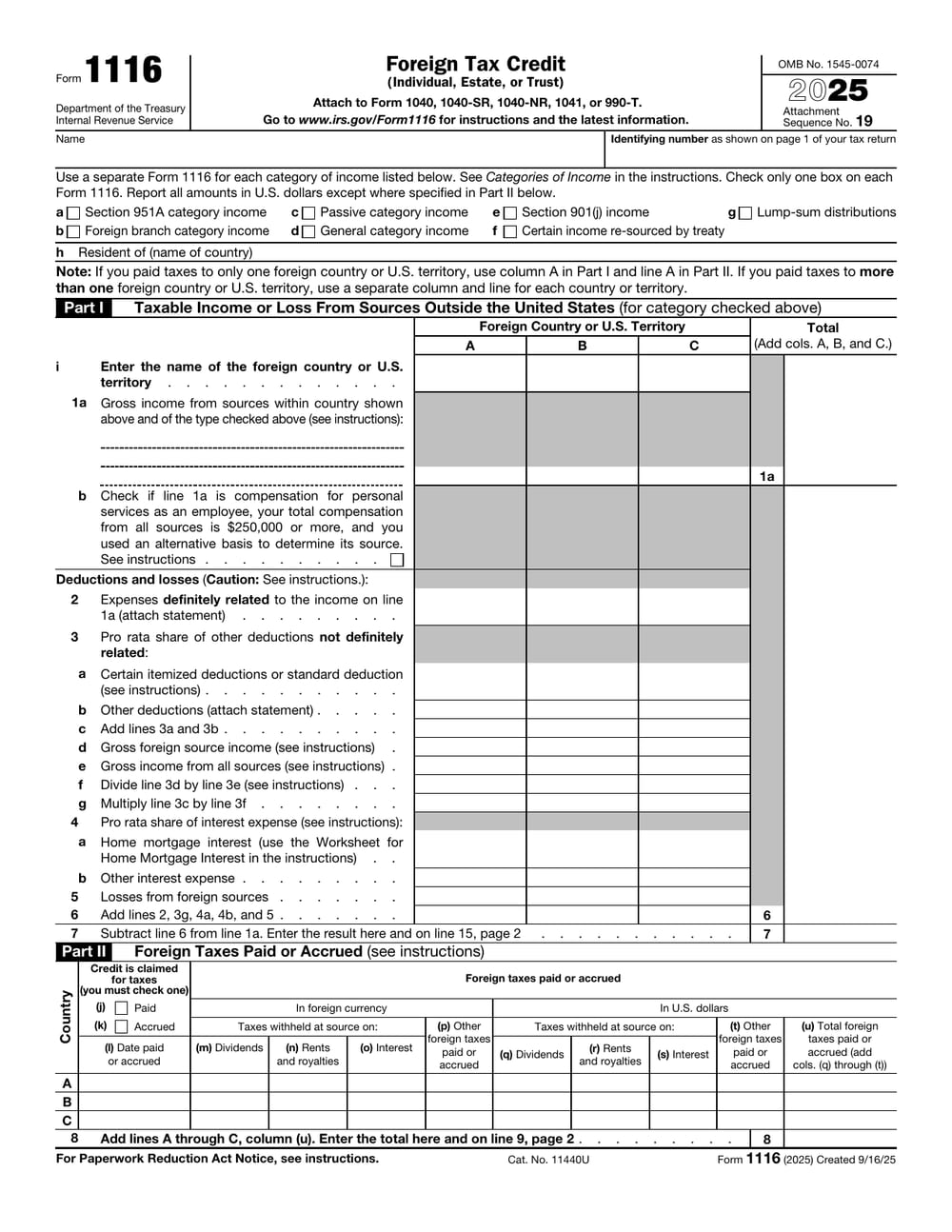
Download Form 1116 (PDF) · Instructions for Form 1116 (PDF)
Local copy for convenience, downloaded from IRS.gov on November 14, 2026. Always confirm you have the current revision at irs.gov/form1116 before filing.
The header: category, residence, countries
Check exactly one category box (a through g). On line h, enter your country of residence. On line i, enter the name of each foreign country or U.S. territory involved, in columns A, B and C. For the common categories (passive and general), you don't file a separate Form 1116 per country; countries share a form within a category, one country per column. If you earned wages in two countries in the same year, both go on the same general category Form 1116 in different columns. The exceptions are section 901(j) income and income re-sourced by treaty, which need a separate form for each country.
Part I (lines 1a–7): your foreign-source taxable income in this category
Part I works out the numerator of the limitation fraction: how much of your taxable income is foreign-source income in this category.
Line 1a, gross income. Income in the checked category that's taxable by the United States and sourced in the country on line i, even if that country didn't tax it. Two rules matter most for expats: don't include earned income you excluded on Form 2555, and remember that compensation (other than fringe benefits) is sourced on a time basis, while fringe benefits like housing and education allowances are sourced geographically. If 20 of your 230 workdays were spent on business trips to the U.S., about 20/230 of your salary is U.S.-source and stays off line 1a.
Line 1b. Check this box only if all of the following apply: the line 1a income is employee compensation, your total compensation from all sources was $250,000 or more, and you used an alternative basis (not time basis) to source it. You'll need to attach a statement.
Line 2, definitely related expenses. Deductions directly tied to the foreign income on line 1a, such as expenses of a foreign rental property or a foreign business. Don't include interest here. Most salaried employees leave this blank, since unreimbursed employee expenses aren't deductible for federal purposes.
Lines 3a–3g, apportioning your other deductions. This block spreads deductions that don't relate to any particular income across U.S. and foreign income in proportion to gross income. Line 3a takes certain itemized deductions, or your standard deduction if you don't itemize; 3b takes other unrelated deductions such as Schedule 1 adjustments (but not the senior deduction from Schedule 1-A, line 37); 3c adds them. Line 3d is gross foreign-source income in this category, and 3e is gross income from all sources and categories, the same number on every Form 1116 you file. Line 3f divides 3d by 3e, rounded to at least four decimal places and capped at 1; 3g multiplies 3c by 3f.
The counterintuitive bit for FEIE users: on lines 3d and 3e, the instructions tell you to include foreign earned income you excluded on Form 2555, even though it's not on line 1a. Excluded income therefore pulls part of your standard deduction to the foreign side, shrinking line 7 and your limitation. It's a big reason the credit often comes out smaller than expected when you combine it with the FEIE.
Combining the FEIE with the foreign tax credit on your remaining income? Your excluded income still pulls part of your standard deduction over to the foreign side — quietly shrinking the credit you can claim on what's left. Ask TaxLatitude to model both together →
Lines 4a and 4b, interest expense. Home mortgage interest goes on 4a, apportioned by gross income using the Worksheet for Home Mortgage Interest. Other interest (investment, business, passive activity, student loan and qualified vehicle loan interest) goes on 4b, apportioned by an asset method. There's a simplification: if your gross foreign-source income including income excluded on Form 2555 doesn't exceed $5,000, you can allocate all your interest expense to U.S. sources (for line 4b, the instructions limit this to U.S. citizens, resident aliens and domestic estates). Because excluded income counts toward the $5,000, almost no working expat qualifies.
Line 5, losses from foreign sources. Foreign-source losses in this category. If they're capital losses, see the qualified dividend and capital gain adjustments described next.
Lines 6 and 7. Line 6 adds lines 2, 3g, 4a, 4b and 5. Line 7 subtracts line 6 from line 1a. That's your foreign-source taxable income (or loss) in this category, and it carries to line 15.
A detour: foreign qualified dividends and capital gains
Because qualified dividends and long-term gains are taxed at lower U.S. rates, putting the full amount in the limitation fraction would overstate the U.S. tax attributable to them. When an adjustment is required, the instructions have you multiply foreign-source qualified dividends and capital gain distributions by 0.4054 if they're taxed at 15%, or by 0.5405 if taxed at 20% (those factors are 15/37 and 20/37). Income taxed at 0% is left off line 1a entirely. The Worksheet for Line 18 makes the matching adjustment to your worldwide figure.
Most people can skip all of that thanks to the "adjustment exception." For 2025, an individual qualifies if both of these are true:
- Line 5 of the Qualified Dividends and Capital Gain Tax Worksheet is no more than $394,600 (married filing jointly or qualifying surviving spouse) or $197,300 (single, head of household, or married filing separately); and
- foreign-source capital gain distributions plus foreign-source qualified dividends total less than $20,000.
If you use the exception, you don't adjust any foreign-source qualified dividends or capital gain distributions. (Source: 2025 Instructions for Form 1116, "Foreign Qualified Dividends and Capital Gains (Losses).")
Part II (line 8): the foreign taxes you paid or accrued
Part II has one row per country, with the tax split into withholding on dividends, rents and royalties, and interest, plus "other foreign taxes paid or accrued" (where wage tax and tax paid with your local return go), in both foreign currency and dollars, with the date paid or accrued. Column (u) totals each row in dollars; line 8 adds column (u) and carries to line 9.
Enter only creditable taxes that belong to this category: wage tax on the general form, tax on foreign bank interest on the passive form. If one foreign tax covers income in two categories (common with a single annual return in your residence country), you allocate it between categories based on the income each tax was imposed on; the detailed rules are in Treas. Reg. §1.904-6.
Part III (lines 9–24): the limitation
This is the heart of the form. Lines 9 to 14 settle how much foreign tax is available; lines 15 to 23 figure the cap; line 24 picks the smaller.
| Line | What it asks for | What to watch |
|---|---|---|
| 9 | Foreign taxes from line 8 | This category only. |
| 10 | Carryover from Schedule B, line 3, column (xiv), plus any carryback to this year | Attach Schedule B if you use or create a carryover. Leave blank for section 951A category. |
| 11 | Lines 9 + 10 | |
| 12 | Reduction in foreign taxes | This is where tax on FEIE-excluded income comes out (formula below). |
| 13 | Taxes reclassified under high-tax kickout | Negative on the passive form, positive on the general form. |
| 14 | Lines 11, 12 and 13 combined | Total foreign tax available for credit. |
| 15 | Line 7 from Part I | Foreign-source taxable income in this category. |
| 16 | Adjustments to line 15 | Loss allocations and recaptures; attach a statement. |
| 17 | Lines 15 + 16 | Net foreign-source taxable income. |
| 18 | Worldwide taxable income | 2025: Form 1040, line 11b minus line 14, plus Schedule 1-A, line 37. |
| 19 | Line 17 ÷ line 18 | Enter 1 if line 17 is more than line 18; 0 if line 18 is zero. |
| 20 | U.S. tax against which the credit is allowed | 2025: Form 1040, line 16, plus Schedule 2, line 1z. |
| 21 | Line 20 × line 19 | The maximum credit (the limitation). |
| 22 | Increase in limitation under section 960(c) | CFC owners only. |
| 23 | Lines 21 + 22 | |
| 24 | Smaller of line 14 or line 23 | Your credit for this category. |
A few of these lines deserve more than a table cell.
Line 12 and the FEIE. If you excluded all of your foreign earned income, you simply can't credit any foreign tax on it. If you excluded only part of it, the instructions (following Treas. Reg. §1.911-6(c)) have you reduce your foreign taxes by:
Foreign taxes paid or accrued on foreign earned income × (excluded foreign earned income and housing amounts − deductible expenses allocable to that excluded income) ÷ (total foreign earned income − deductible expenses allocable to it).
The numerator's expenses exclude the foreign housing deduction; the denominator's include it. If your country taxes earned and other income together in a way you can't separate, the denominator becomes total income subject to foreign tax, minus allocable expenses. Line 12 also carries rarer reductions, such as the 10% cut for failing to file Form 5471 or 8865. The IRS's examiner guidance on the FEIE reduction is its practice unit on the foreign earned income exclusion adjustment.
Line 16 adjustments. Usually blank. If any category shows a loss, or you have a net U.S. loss, this is where losses are allocated (a loss on one Form 1116 first reduces income on your other Forms 1116 proportionally) and where prior foreign losses are recaptured. If you see a loss anywhere, read the line 16 instructions in full.
Line 18, taxable income. For 2025: Form 1040, line 11b minus line 14, plus the senior deduction from Schedule 1-A, line 37. For most people under 65 that's simply taxable income (line 15), after any FEIE. If you have qualified dividends or capital gains and don't meet the adjustment exception, run the Worksheet for Line 18 first.
Line 20, U.S. tax. Form 1040, line 16 plus Schedule 2, line 1z, less any Form 4972 tax. If you file Form 2555, line 16 was figured with the Foreign Earned Income Tax Worksheet in the Form 1040 instructions, which applies the "stacking" rule of IRC §911(f), added in 2006 (see IRS Notice 2007-16): your remaining income is taxed at the rates that would apply if the excluded income were still included. That raises line 20 relative to line 18, as the second example shows.
Line 24, the credit. If line 14 is bigger than line 23, the difference is unused foreign tax you can carry back or forward. If line 23 is bigger, you have "excess limitation," which can't be carried anywhere; it can only absorb carryovers coming in from other years in the same category.
Part IV (lines 25–35): pulling the categories together
If you file more than one Form 1116, you complete Part IV on only one of them, the one with the largest line 24, and attach the others. Lines 25 to 31 list the line 24 credit from each category (25: section 951A; 26: foreign branch; 27: passive; 28: general; 29: section 901(j); 30: re-sourced by treaty; 31: lump-sum). Line 32 adds them. Line 33 is the smaller of line 20 or line 32; according to the instructions, line 32 will generally exceed line 20 only if you have U.S. capital gains or qualified dividends subject to the rate differential. Line 34 is a reduction for international boycott operations, which almost no individual will have. Line 35 is your foreign tax credit, and it goes on Schedule 3 (Form 1040), Part I, line 1.
Remember the 2025 change: even if you file only one Form 1116, Part IV now has to be filled in.
Worked example 1: a salaried expat in a high-tax country
Sarah is a U.S. citizen working as a software engineer in Munich. She's single, under 65, takes the standard deduction, and has decided to use the foreign tax credit on her salary rather than the FEIE. All figures are for tax year 2025, converted to dollars and rounded to keep the arithmetic readable. The German figures are illustrative, not a German tax calculation.
- Salary from her German employer: $140,000. Every working day in 2025 was spent in Germany, so all of it is foreign-source.
- German income tax plus solidarity surcharge on the salary: $36,000. This is her final liability for 2025 after she filed her German return, not just what was withheld. She isn't a church member, so there's no church tax. Her German social security contributions are left out because they're covered by the U.S.–Germany totalization agreement and aren't creditable.
- Interest from a German savings account: $2,000, with $240 of German withholding tax and solidarity surcharge (her final liability on it).
- Interest from a U.S. high-yield savings account: $5,000. U.S.-source; no foreign tax.
- Method: she claims foreign taxes when paid.
Step 1: her U.S. return before the credit
Her gross income is $147,000 ($140,000 + $2,000 + $5,000), and with no adjustments that's also her AGI. Subtracting the 2025 single standard deduction of $15,750 (the amount printed in the standard deduction box beside line 12 of the 2025 Form 1040, after the July 2025 tax law raised it from $15,000) gives taxable income of $131,250.
Using the 2025 single brackets from IR-2024-273 (10% up to $11,925; 12% to $48,475; 22% to $103,350; 24% to $197,300), her regular tax is:
| Bracket | Income in bracket | Tax |
|---|---|---|
| 10% | $11,925 | $1,192.50 |
| 12% | $36,550 | $4,386.00 |
| 22% | $54,875 | $12,072.50 |
| 24% | $27,900 | $6,696.00 |
| Total | $131,250 | $24,347.00 |
She has no Schedule 2 additions, so line 20 on each Form 1116 will be $24,347. Her income is below the $200,000 single-filer threshold for the net investment income tax (IRC §1411), so that doesn't come into play.
Step 2: two forms, not one
Sarah has two categories of foreign income: wages (general) and German interest (passive). So she files two Forms 1116. Note that she can't use the $300 exemption for the $240 of tax on the interest, because her foreign income isn't all passive.
Her German interest also has to pass the high-tax test to stay in the passive basket. After expense allocation (below), the net interest is $1,786 and the tax is $240, an effective rate of about 13.4%, well under 37%. It stays passive.
Step 3: Form 1116 #1, general category (wages)
| Line | Description | Amount |
|---|---|---|
| 1a | Gross foreign-source wages (Germany) | $140,000 |
| 2 | Definitely related expenses | $0 |
| 3a | Standard deduction | $15,750 |
| 3b | Other deductions | $0 |
| 3c | 3a + 3b | $15,750 |
| 3d | Gross foreign-source income, general category | $140,000 |
| 3e | Gross income from all sources | $147,000 |
| 3f | 3d ÷ 3e (rounded to four decimals) | 0.9524 |
| 3g | 3c × 3f ($15,750 × 0.9524 = $15,000.30) | $15,000 |
| 4a–5 | Interest expense, losses | $0 |
| 6 | Total deductions allocated | $15,000 |
| 7 | Foreign-source taxable income (1a − 6) | $125,000 |
| 8 / 9 | German tax on wages | $36,000 |
| 10 | Carryover / carryback | $0 |
| 11–14 | Foreign tax available for credit | $36,000 |
| 15–17 | Net foreign-source taxable income | $125,000 |
| 18 | Worldwide taxable income | $131,250 |
| 19 | 17 ÷ 18 | 0.9524 |
| 20 | U.S. regular tax | $24,347 |
| 21 | Limitation (20 × 19 = $23,188.08) | $23,188 |
| 22–23 | No section 960(c) increase | $23,188 |
| 24 | Smaller of 14 or 23 | $23,188 |
Sarah paid $36,000 to Germany but can only use $23,188 this year. The other $12,812 ($36,000 − $23,188) is unused general category foreign tax.
Step 4: Form 1116 #2, passive category (German interest)
| Line | Description | Amount |
|---|---|---|
| 1a | Gross foreign-source interest (Germany) | $2,000 |
| 3c | Standard deduction | $15,750 |
| 3d | Gross foreign-source income, passive category | $2,000 |
| 3e | Gross income from all sources (same as on the other form) | $147,000 |
| 3f | 3d ÷ 3e (0.013605…, rounded) | 0.0136 |
| 3g | 3c × 3f ($15,750 × 0.0136 = $214.20) | $214 |
| 7 | Foreign-source taxable income ($2,000 − $214) | $1,786 |
| 9–14 | German tax on interest | $240 |
| 17 | Net foreign-source taxable income | $1,786 |
| 18 | Worldwide taxable income | $131,250 |
| 19 | 17 ÷ 18 | 0.0136 |
| 20 | U.S. regular tax | $24,347 |
| 21 | Limitation (20 × 19 = $331.12) | $331 |
| 24 | Smaller of 14 or 23 | $240 |
Here the limitation ($331) is bigger than the tax ($240), so the full $240 is creditable and there's $91 of excess limitation. That $91 can't soak up any of the $12,812 stuck in the general category. Different baskets.
Paying high tax on your salary and light tax on savings interest? The two don't mix — excess credit from one category can never offset US tax owed from the other, even in the same country, the same year. Ask TaxLatitude which basket your income falls into →
A note on rounding: we've rounded line 19 to four decimal places for readability. If your software carries more precision, line 21 comes out at $23,187.62 and $331.30, which round to the same whole dollars.
Step 5: Part IV (completed on the general form, since its line 24 is larger)
| Line | Description | Amount |
|---|---|---|
| 27 | Credit, passive category | $240 |
| 28 | Credit, general category | $23,188 |
| 32 | Total of lines 25–31 | $23,428 |
| 33 | Smaller of line 20 ($24,347) or line 32 | $23,428 |
| 34 | International boycott reduction | $0 |
| 35 | Foreign tax credit → Schedule 3, line 1 | $23,428 |
Step 6: what it all means
Sarah's U.S. income tax goes from $24,347 to $919. That isn't a mistake or a leak. It's the limitation working as designed. Roughly $828 of it is the U.S. tax on her U.S.-source interest: $24,347 × ($131,250 − $125,000 − $1,786) ÷ $131,250 = $24,347 × $4,464 ÷ $131,250 ≈ $828. The remaining $91 is the unused passive limitation, which exists because Germany taxed her interest at a lower effective rate than the U.S. average rate applied to it. Foreign tax can only offset U.S. tax on foreign income, category by category.
The $12,812 of excess German tax goes onto Schedule B (Form 1116) for the general category. It carries back to 2024 if she had unused general category limitation that year, and otherwise forward through 2035. Realistically, if Sarah stays in Germany, she'll create a new excess every year and rarely use the old ones. Carryovers pay off when something changes, such as a move to a lower-tax country while still earning foreign-source general category income. Watching them expire in a high-tax country is normal.
Worked example 2: combining the FEIE with Form 1116
The second example shows the FEIE interaction, which is where the most expensive mistakes happen. Mark is a U.S. citizen working in London. He's single, under 65, qualifies for the FEIE for all of 2025 (so no proration), and doesn't claim the housing exclusion.
- Salary (all UK workdays): $180,000
- UK income tax on the salary (final liability): $60,000 (illustrative). In real life the UK tax year runs April to April, so a real return has to match UK tax to calendar 2025 under the paid or accrued method; we've skipped that step to keep the example on Form 1116 itself.
- No other income.
Mark excludes the 2025 maximum of $130,000 on Form 2555 (the 2025 limit per the IRS FEIE page and the Instructions for Form 2555), leaving $50,000 of salary taxable. He uses Form 1116 for the tax on that $50,000.
Line 12: removing the tax on excluded income
He has no deductible expenses allocable to his wages, so the formula is just:
$60,000 × $130,000 ÷ $180,000 = $43,333 of UK tax that is disallowed.
Line 14 is therefore $60,000 − $43,333 = $16,667 of creditable UK tax.
The stacking rule raises line 20
Mark's taxable income after the exclusion is $50,000 − $15,750 = $34,250 (line 18). If that were taxed on its own, the tax would be $3,871.50. But under the stacking rule, his tax is the tax on $34,250 + $130,000 = $164,250, minus the tax on $130,000:
- Tax on $164,250: $1,192.50 + $4,386 + $12,072.50 + ($60,900 × 24%) = $32,267
- Tax on $130,000: $1,192.50 + $4,386 + $12,072.50 + ($26,650 × 24%) = $24,047
- Line 16 of Form 1040 and line 20 of Form 1116: $32,267 − $24,047 = $8,220
His Form 1116 (general category)
| Line | Description | Amount |
|---|---|---|
| 1a | Foreign wages not excluded ($180,000 − $130,000) | $50,000 |
| 3c | Standard deduction | $15,750 |
| 3d | Gross foreign-source income, including excluded income | $180,000 |
| 3e | Gross income from all sources, including excluded income | $180,000 |
| 3f | 3d ÷ 3e | 1.0000 |
| 3g | 3c × 3f | $15,750 |
| 7 | Foreign-source taxable income | $34,250 |
| 9 / 11 | UK tax on wages | $60,000 |
| 12 | Reduction for tax on excluded income | ($43,333) |
| 14 | Foreign tax available for credit | $16,667 |
| 17 | Net foreign-source taxable income | $34,250 |
| 18 | Taxable income after exclusion | $34,250 |
| 19 | 17 ÷ 18 | 1.0000 |
| 20 | U.S. tax (stacked) | $8,220 |
| 21 / 23 | Limitation | $8,220 |
| 24 | Smaller of 14 or 23 | $8,220 |
Mark's U.S. income tax is zero, and he has $16,667 − $8,220 = $8,447 of general category carryover.
Because Mark has no U.S. income, every dollar of his gross income is foreign, so 3f is exactly 1. If he'd had U.S.-source income too, remember that lines 3d and 3e both include his excluded $130,000, which would push most of his standard deduction to the foreign side and shrink line 7.
Would Mark be better off skipping the FEIE?
| FEIE + Form 1116 | Form 1116 only | |
|---|---|---|
| Taxable income (line 18) | $34,250 | $164,250 |
| U.S. tax before credit (line 20) | $8,220 | $32,267 |
| Creditable UK tax (line 14) | $16,667 | $60,000 |
| Credit (line 24) | $8,220 | $32,267 |
| U.S. income tax due | $0 | $0 |
| Carryover created | $8,447 | $27,733 |
Either way Mark owes nothing this year. The credit-only route builds a much larger carryover, which only has value if he later has foreign income taxed below U.S. rates. Two other factors usually decide it. Filing Form 2555 rules out the refundable additional child tax credit (the 2025 Schedule 8812 says so directly), which matters for parents. And if Mark has used the FEIE before and now wants to stop, revoking it means he can't choose it again within 5 tax years without IRS approval, which requires a private letter ruling (IRS: Revoking Your Choice to Exclude Foreign Earned Income). You don't need a formal statement to trigger this: per the IRS, taking a credit for tax on income you could have excluded counts as revoking the exclusion from that year on (IRS: Choosing the Foreign Earned Income Exclusion). Model both before you switch.
Carrybacks and carryforwards in practice
The statutory rule is short. Under IRC §904(c), foreign tax that exceeds the limitation in a category is deemed paid in the first preceding year and in any of the first 10 succeeding years. The line 10 instructions and Publication 514 fill in how that works:
- Back one year first, then forward. Unused tax is applied to the earliest eligible year first. Under the regulations (Treas. Reg. §1.904-2), it can only be absorbed in a year where you have excess limitation in the same category.
- The period can't be extended. Not even if you couldn't take a credit in an intervening year.
- Carryovers stay in their category. General category excess can only be used against future general category limitation.
- A carryback requires an amended return. To carry 2025 excess back to 2024, you file Form 1040-X for 2024 with a revised 2024 Form 1116.
- Don't skip the carryback. If you could have carried back and didn't, Publication 514 says you must still reduce the amount you carry forward by what the carryback would have absorbed.
- Deduction years eat carryovers too. You can't carry a credit to a year in which you deducted foreign taxes, and the Form 1116 instructions have you reduce the carryover by what you would have used if you had claimed the credit that year.
- The $300/$600 election blocks carryovers. In a year you elect the exemption, nothing carries in or out, and the 10-year clock keeps running.
- No carryovers in section 951A category. Leave line 10 blank on that form.
Schedule B (Form 1116)
Schedule B is the reconciliation schedule for carryovers, and line 10 of Form 1116 pulls its number from Schedule B, line 3, column (xiv). Per the 2025 instructions, you attach a Schedule B for each category if you enter a carryover on line 10 or create a new carryover this year. You don't need it for 2025 if the only thing on line 10 is a carryback into 2025 and you don't otherwise need the schedule; in that case, check the box on line 10.
In practice, Schedule B is where people lose money. If you change preparers or software, the carryover history often doesn't come along. Keep your own year-by-year record of each category's carryovers, the year each arose, and how much has been used, and check it against Schedule B every year.
When your foreign tax changes after you file: redeterminations and Schedule C
Foreign tax bills move. Your local tax office issues an assessment months after you filed your U.S. return, you get a refund, or an audit adds tax. Under IRC §905(c) these are "foreign tax redeterminations," and they generally require you to adjust the U.S. credit for the year it was claimed. Schedule C (Form 1116), currently the December 2025 revision for continuous use, is the form used to identify and report them; check the Schedule C instructions linked from IRS.gov/Form1116 to see whether you need it.
If the change goes your way (you paid more foreign tax than you originally claimed), you have time to claim it. Publication 514 gives you 10 years to file a claim for refund, beginning the day after the regular due date of the return for the year the tax was paid or accrued (see also IRC §6511(d)(3)).
How Form 1116 fits with the rest of your return
Form 1116 sits downstream of almost everything else. The order runs: Form 2555 (if you claim the FEIE), which affects lines 1a, 3d, 3e, 12, 18 and, through the stacking worksheet, 20; then Form 1040 through line 16 and Schedule 2, Part I, which feed lines 18 and 20; then one Form 1116 per category, with Schedule B where carryovers exist; and finally Schedule 3, Part I, line 1, which receives line 35. A few more interactions:
- Joint returns: per Publication 514, if you file jointly you claim the credit based on the total foreign income taxes paid or accrued by you and your spouse, and the limitation is computed on your combined taxable income (Treas. Reg. §1.904-1). If you file separately and a foreign tax was assessed on combined income, Publication 514 has you split it in proportion to each spouse's share of that income.
- Alternative minimum tax: the Form 1116 instructions note that you may owe AMT on top of regular tax, and the AMT foreign tax credit is figured separately; the Form 6251 instructions explain how. If you're subject to AMT, the line 18 instructions also flag special capital gain rules in Treas. Reg. §1.904(b)-1(b)(3).
- Self-employment tax and NIIT: neither can be reduced by Form 1116, as noted above.
- Treaties: a treaty can re-source income so you can credit foreign tax on it (category f), but U.S. citizens generally can't use a treaty to get out of U.S. tax entirely, because of the "saving clause" in most U.S. treaties. Treaty-based positions may also need to be disclosed on Form 8833.
Common Form 1116 mistakes
1. Putting everything on one form
Wages and investment income on one Form 1116 average a high-taxed salary with lightly taxed interest and overstate the credit. If your software shows a single Form 1116 and you have both foreign wages and foreign investment income, something's wrong.
2. Claiming withholding instead of actual liability
If you get a refund on your local return, the refunded part was never creditable. Same for dividend withholding above the treaty rate. Use your final assessed liability, and treat later changes as redeterminations.
3. Taking a credit on income you excluded with the FEIE
The classic double dip, prohibited by §911(d)(6). A return with both Form 2555 and Form 1116 and nothing on line 12 is a red flag.
4. Leaving excluded income out of lines 3d and 3e
The opposite mistake. Excluded income stays off line 1a but goes into 3d and 3e. Leaving it out under-allocates deductions to foreign income and overstates the limitation.
5. Skipping the form when you don't qualify for the exemption
Entering wage-related foreign tax directly on Schedule 3 as if the $300/$600 exemption applied. It requires all foreign income to be passive and reported on a payee statement.
6. Ignoring U.S. workdays
Business trips, remote weeks at your parents' house in Ohio, and conference days in the U.S. create U.S.-source wages that don't belong on line 1a, even though your foreign employer paid them and your country of residence taxed them.
7. Crediting taxes that aren't income taxes
VAT, property tax, wealth tax, social contributions under a totalization agreement, and interest or penalties on foreign tax don't go on Form 1116.
8. Losing track of carryovers
Not filing Schedule B, mixing categories, skipping the carryback, or losing the history when you change preparers. A carryover you can't document is hard to defend.
9. Mixing methods or using the wrong exchange rate
Once you elect accrual, all foreign taxes are accrued, every year. Paid taxes use the payment-date rate; accrued taxes generally use the yearly average.
10. Expecting the credit to cover self-employment tax
It doesn't. Where a totalization agreement exists, a certificate of coverage is the fix for social security double taxation.
Form 1116 FAQ
Can I claim the foreign tax credit without filing Form 1116?
Only if all your foreign income is passive, all of it and the foreign tax were reported on a qualified payee statement like a 1099-DIV, and your total creditable foreign tax is $300 or less ($600 on a joint return). Then you can enter the credit directly on Schedule 3, line 1. Anyone with foreign wages has to file the form.
Can I use the FEIE and Form 1116 in the same year?
Yes, just not on the same income. A common setup is to exclude wages up to the limit ($130,000 for 2025) and use Form 1116 for the tax on wages above the limit and on foreign investment income. Line 12 removes the tax attributable to the excluded portion.
Do I need one Form 1116 per country?
For wages and investment income, no: you need one per income category, and each form has columns for up to three countries (A, B, C) on line i. Section 901(j) income and treaty re-sourced income are the exceptions, with a separate form per country. Someone with wages in two countries and interest from one would typically file two forms: general (two columns) and passive (one column).
What happens to the foreign tax I can't use this year?
It carries back one year and then forward up to ten, within the same category, tracked on Schedule B. It can only be used in a year where that category has more limitation than current-year foreign tax. In high-tax countries, carryovers often expire unused.
Why do I still owe U.S. tax when my foreign tax rate is higher than the U.S. rate?
Usually because you have U.S.-source income (U.S. interest, dividends, rental income, or U.S. workdays), which foreign tax can't offset. Sometimes it's because one category, often passive, was taxed abroad at a lower rate than the U.S. average rate and has leftover limitation that the excess in another category can't use.
I deducted my foreign taxes in a prior year. Can I switch to the credit?
Yes, by amending. Publication 514 allows you to choose or change to the credit within 10 years from the regular due date of the return for that year. Remember that the choice covers all foreign taxes for that year, so you'd move all of them from Schedule A to Form 1116.
Sources
- IRS, Instructions for Form 1116 (2025), Foreign Tax Credit (Individual, Estate, or Trust): https://www.irs.gov/instructions/i1116
- IRS, Instructions for Form 1116 (2025), PDF: https://www.irs.gov/pub/irs-pdf/i1116.pdf
- IRS, Form 1116 (2025), PDF: https://www.irs.gov/pub/irs-pdf/f1116.pdf
- IRS, About Form 1116 (links to Schedules B and C and their instructions): https://www.irs.gov/form1116
- IRS, Publication 514 (2025), Foreign Tax Credit for Individuals: https://www.irs.gov/publications/p514
- IRS, Foreign Tax Credit – Choosing to Take Credit or Deduction: https://www.irs.gov/individuals/international-taxpayers/foreign-tax-credit-choosing-to-take-credit-or-deduction
- IRS, Figuring the Foreign Earned Income Exclusion: https://www.irs.gov/individuals/international-taxpayers/figuring-the-foreign-earned-income-exclusion
- IRS, Instructions for Form 2555 (2025) (PDF): https://www.irs.gov/pub/irs-pdf/i2555.pdf
- IRS, Choosing the Foreign Earned Income Exclusion: https://www.irs.gov/individuals/international-taxpayers/choosing-the-foreign-earned-income-exclusion
- IRS, Revoking Your Choice to Exclude Foreign Earned Income: https://www.irs.gov/individuals/international-taxpayers/revoking-your-choice-to-exclude-foreign-earned-income
- IRS, Totalization Agreements: https://www.irs.gov/individuals/international-taxpayers/totalization-agreements
- IRS, IR-2024-273, IRS Releases Tax Inflation Adjustments for Tax Year 2025 (brackets, FEIE amount): https://www.irs.gov/newsroom/irs-releases-tax-inflation-adjustments-for-tax-year-2025
- IRS, Form 1040 (2025), including the standard deduction amounts on line 12e: https://www.irs.gov/pub/irs-pdf/f1040.pdf
- IRS, Instructions for Form 1040 (2025), including the Foreign Earned Income Tax Worksheet (PDF): https://www.irs.gov/pub/irs-pdf/i1040gi.pdf
- IRS, Schedule 8812 (Form 1040) (2025): https://www.irs.gov/pub/irs-pdf/f1040s8.pdf
- IRS International Practice Unit, Foreign Earned Income Exclusion Adjustment (Form 1116, line 12): https://www.stayexempt.irs.gov/pub/fatca/int_practice_units/foreign-earned-income-exclusion-adjustment.pdf
- IRS International Practice Unit, Foreign Currency Translation for the Foreign Tax Credit: https://www.irs.gov/pub/fatca/int_practice_units/int_p_223.pdf
- 26 U.S.C. §901, Taxes of foreign countries and of possessions of United States: https://www.law.cornell.edu/uscode/text/26/901
- 26 U.S.C. §904, Limitation on credit (incl. (a), (b)(1), (c), (d), (j)): https://www.law.cornell.edu/uscode/text/26/904
- 26 U.S.C. §865, Source rules for personal property sales: https://www.law.cornell.edu/uscode/text/26/865
- IRS Notice 2007-16 (section 911 changes, including the stacking rule): https://www.irs.gov/pub/irs-drop/n-07-16.pdf
- 26 U.S.C. §905, Applicable rules (paid/accrued, redeterminations): https://www.law.cornell.edu/uscode/text/26/905
- 26 U.S.C. §911, Citizens or residents of the United States living abroad (incl. (d)(6), (f)): https://www.law.cornell.edu/uscode/text/26/911
- 26 U.S.C. §986, Determination of foreign taxes and foreign corporation's earnings and profits: https://www.law.cornell.edu/uscode/text/26/986
- 26 U.S.C. §1411, Imposition of tax (net investment income tax): https://www.law.cornell.edu/uscode/text/26/1411
- 26 U.S.C. §6511, Limitations on credit or refund: https://www.law.cornell.edu/uscode/text/26/6511
- Treas. Reg. §1.904-1, Limitation on credit for foreign taxes: https://codes.findlaw.com/cfr/title-26-internal-revenue/cfr-sect-26-1-904-1/
- Treas. Reg. §1.904-2, Carryback and carryover of unused foreign tax: https://www.law.cornell.edu/cfr/text/26/1.904-2
- Treas. Reg. §1.904-4, Separate application of section 904 with respect to certain categories of income: https://www.ecfr.gov/current/title-26/chapter-I/subchapter-A/part-1/subject-group-ECFReb01a6628c28b2c/section-1.904-4
- Treas. Reg. §1.904-6, Allocation and apportionment of foreign income taxes: https://www.law.cornell.edu/cfr/text/26/1.904-6
- Treas. Reg. §1.904(j)-1, Certain individuals exempt from foreign tax credit limitation: https://www.law.cornell.edu/cfr/text/26/1.904(j)-1
- Treas. Reg. §1.911-6, Disallowance of deductions, exclusions, and credits (eCFR text reproduced by CustomsMobile): https://www.customsmobile.com/regulations/26/1.911-6
- Treas. Reg. §1.986(a)-1, Translation of foreign income taxes for purposes of the foreign tax credit: https://www.law.cornell.edu/cfr/text/26/1.986(a)-1
- Eshel v. Commissioner, No. 14-1215 (D.C. Cir. 2016) (foreign social taxes under a totalization agreement): https://media.cadc.uscourts.gov/opinions/docs/2016/08/14-1215-1628770.pdf
This article explains general rules for tax year 2025 based on the IRS's 2025 forms and instructions. It isn't tax advice for your situation. Foreign tax credit calculations depend heavily on facts like where you worked each day, how your foreign country assesses tax, and your history of carryovers, so have a qualified preparer review your return if your situation goes beyond the examples here.