Research date: November 7, 2026. All dollar amounts are for tax year 2026, the return most families will file in 2027. They come from Rev. Proc. 2025-32 and the current text of Internal Revenue Code §24, as amended by Public Law 119-21. Statutory and form citations are given inline. Primary sources are listed at the end. This article is general information, not tax or legal advice.
Key takeaways
- Living abroad doesn't disqualify a child from the credit — what matters is citizenship, not location. The abode test just requires the child to live with you for more than half the year, anywhere; a child in Lisbon or Singapore qualifies the same as one in Ohio.
- The refundable part (up to $1,700 per child in 2026) is paid in cash even at zero US tax — as long as earned income exceeds $2,500 and Form 2555 isn't on the return. Electing the FEIE is the one thing that blocks it outright.
- A missing Social Security number is the most common way the credit is lost — and it can't be fixed retroactively. The SSN must be issued before the return's due date; arriving even one day late loses that year's credit for good.
- A citizen child can never substitute an ITIN. The W-7 instructions tell anyone eligible for an SSN not to apply for one, so a citizen child without an SSN gets nothing until the number itself comes through.
- Filing Form 4868 by June 15 can save a pending application. The deadline that matters is the due date including extensions, so requesting the automatic extension while an SSN application is in process can preserve the year instead of losing it.
- Dropping the FEIE to recover one year's credit can cost you the next five years. Revoking the §911 exclusion bars re-electing it for five years without a paid IRS ruling request — a fix for 2023 can reach 2024 and 2025 returns too.
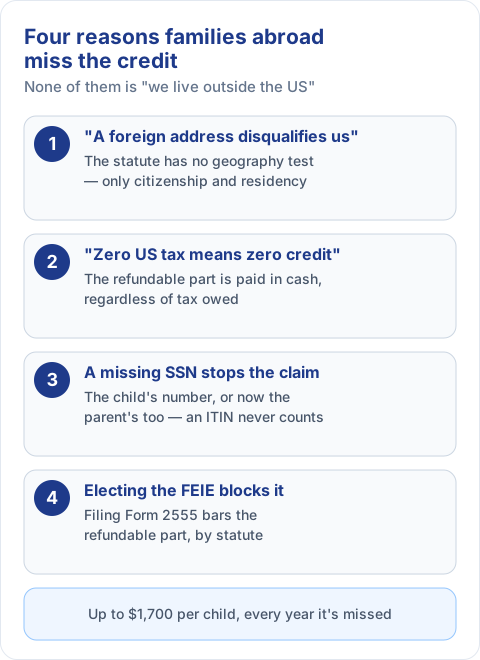
Nothing in the child tax credit excludes families who live outside the United States. The statute doesn't ask where you live. It asks whether the child is a U.S. citizen, national, or resident with a Social Security number, whether the child lived with you, and, for the refundable part, how you handled your foreign income. Many expat parents still leave it off the return. Some assume a foreign address disqualifies them. Others have zero U.S. tax after the foreign tax credit and conclude that a credit against tax is worthless. A third group gets as far as the return and is stopped by a missing number.
The best-known way to lose the money is electing the foreign earned income exclusion. Under IRC §24(d)(3), the refundable part of the credit is unavailable for any year in which you exclude income under §911. The Schedule 8812 instructions say it directly: if you file Form 2555, you can't claim the additional child tax credit. We work through a full numerical comparison, with and without the exclusion, in our guide to U.S. taxes for digital nomads (section "Children and the refundable credit"), so it isn't repeated here. This article covers the other reasons families miss the credit, and how to recover what is still recoverable.
What is the child tax credit worth for 2026?
For taxable years beginning in 2026, the maximum credit under §24(a) is $2,200 per qualifying child, and up to $1,700 of it can be refunded (Rev. Proc. 2025-32, §4.05). The refundable portion is called the additional child tax credit, or ACTC. It equals 15% of earned income above $2,500 (§24(d)(1)(B)(i), §24(h)(6)) and is capped at $1,700 per child. It also can't exceed the part of the $2,200 that your tax liability didn't absorb. The credit begins to phase out at modified AGI of $400,000 on a joint return and $200,000 for every other filing status (§24(h)(3)). Modified AGI adds back any income excluded under §911 (§24(b)(1)), so the exclusion doesn't help you stay under the threshold.
For an American abroad who pays foreign income tax and claims the foreign tax credit, the refundable portion is usually where the value lies. If foreign taxes bring U.S. tax to zero, the nonrefundable $2,200 has nothing to offset. The ACTC is still paid out in cash, as long as there is earned income above $2,500 and Form 2555 isn't on the return.
What are the eligibility tests, and what changes abroad?
Section 24(c)(1) defines a qualifying child as a "qualifying child" under §152(c) who has not reached age 17 by the end of the year. The child must also be claimed as your dependent. Section 152(c)(1) then lists the tests. The child must:
- Be your son, daughter, stepchild, eligible foster child, sibling, step-sibling, or a descendant of one of them (§152(c)(2), §152(f)(1)). A legally adopted child, or one lawfully placed with you for adoption, counts as a child by blood.
- Share your principal place of abode for more than half the year (§152(c)(1)(B)).
- Be younger than you (§152(c)(3)(A)) and, for this credit, under 17 on December 31.
- Not have provided more than half of their own support.
- Not have filed a joint return, other than solely to claim a refund.
The abode test has no geographic requirement for this credit. The IRS's qualifying-child FAQ draws the contrast: for the earned income credit, the child must live with you in the United States, while for the child tax credit the child must simply live with you. A child living with you in Lisbon or Singapore meets the test the same way a child in Ohio does. A child born during the year is treated as having lived with you for more than half of it, provided your home was the child's home for more than half the time the child was alive.
The test that actually matters abroad is citizenship. Under §24(c)(2), the child must be a U.S. citizen, U.S. national, or U.S. resident. The general dependency rule in §152(b)(3)(A) also accepts residents of Canada and Mexico, but §24(c)(2) removes that allowance for this credit. Three situations come up often:
- A child born abroad to a U.S. citizen isn't automatically a citizen. Citizenship passes at birth only if the parent meets the transmission requirements of the Immigration and Nationality Act, which turn on prior physical presence or residence in the United States. The Consular Report of Birth Abroad (CRBA) documents that the requirements were met. Without it, both the child's status and the SSN application stall.
- A non-citizen stepchild, such as your spouse's child from an earlier relationship living with you in France, isn't a qualifying child. Under §152(b)(3)(A), that child isn't even a dependent.
- A non-citizen child you have legally adopted, and who lived with you all year, does pass the citizenship test. The adopted-child exception in §152(b)(3)(B) survives the §24(c)(2) cross-reference, and IRS Publication 972 confirms that such a child meets the citizenship condition for the child tax credit. The obstacle comes next: the child needs an SSN. A child who is neither a citizen nor admitted for permanent residence or U.S. employment generally isn't eligible for one (Form W-7 instructions). In that case, the $500 credit described below is what remains.
Why is the SSN requirement the most common reason the credit is lost?
The child's Social Security number has been required since 2018. It must be valid for employment and issued before the return's due date (§24(h)(7); §24(e)(1)). Starting with tax year 2025, Public Law 119-21 added a second requirement to §24(h)(7): the taxpayer also needs an SSN valid for employment, and on a joint return at least one spouse must have one. The Schedule 8812 instructions spell out the consequence: without the required SSN, you can't claim the credit on either your original return or an amended return for that year.
Two consequences catch families off guard. First, an ITIN doesn't count. A child with only an ITIN or an adoption number (ATIN) can't qualify for the $2,200 credit. Second, a U.S. citizen child can't get an ITIN anyway. The Form W-7 instructions tell anyone who has an SSN, or is eligible for one, not to apply, and citizens are eligible. So a citizen child without an SSN gets neither the child tax credit nor the $500 credit for other dependents. The only fix is the SSN itself.
The parent's number matters too. Some U.S. citizens born and raised abroad, including many "accidental Americans" catching up on filings, never received an SSN. They can't substitute an ITIN, for the same reason their children can't. According to the joint SSA, IRS, State, and Treasury FAQ, anyone 12 or older applying for a first SSN needs an in-person interview. Embassy pages also ask adult applicants for additional evidence of residence abroad. Start early.
For a child born abroad, the sequence matters, because each document supports the next one:
- Apply for the CRBA. The State Department takes applications online at most embassies and consulates. Form DS-5507 is required when one parent isn't a U.S. citizen, which is common for these families.
- Assemble proof of identity. SSA requires original evidence of citizenship, age, and identity. The CRBA covers citizenship. For identity, a signed passport is the usual document. The London FBU, for example, accepts a U.S. or U.K. passport.
- File Form SS-5-FS with SSA. Under 20 CFR §422.103(b)(1), applicants outside the United States can apply at any U.S. Foreign Service post or military post. SSA handles these applications through Federal Benefits Units (FBUs) at designated embassies, and children under 12 can apply by mail. Many countries don't have their own FBU. SSA's directory assigns them to a regional unit; residents of Algeria, for instance, are served by the Paris FBU.
SSA publishes no single processing time for applications made abroad; each unit gives its own estimate. As of November 2026, the London FBU's page quotes about 8 to 10 weeks for SSN applications. The Jerusalem page quotes 7 to 10 weeks from receipt of a mailed application to return delivery. Add the time to get the CRBA first, and a child born in the fall can easily reach tax season without a number.
The deadline, however, can be moved. The requirement is tied to the due date including extensions. Americans who live abroad and whose main place of business or post of duty is outside the United States on April 15 get an automatic extension to June 15. Form 4868, filed by June 15, takes the deadline to October 15. What counts is the date the SSN is issued, compared with the due date that applies to your return. If you don't extend and the number arrives after June 15, that year's credit is gone, and amending won't bring it back. When an application is pending, file Form 4868 by June 15 and submit the return once the number is issued. The extension covers filing, not payment: interest on any balance due still runs from April 15.
Still waiting on your child's Social Security number? Missing the due date by even one day loses that year's credit for good, with no fix after the fact — but the right extension filed in time can save it. Ask TaxLatitude whether you need to file Form 4868 now →
What does the §6013(g)/(h) choice change if you're married to a non-citizen?
The non-citizen spouse's own identification number, and whether an ITIN is enough for the joint-filing election, are covered in our guide to marriage with a non-American spouse. For the child tax credit specifically, the election affects four things:
- Which SSN satisfies §24(h)(7). On a joint return, one spouse with an SSN is enough. The other may have an SSN or an ITIN issued by the due date (Schedule 8812 instructions). If you file separately or as head of household, only your own SSN counts, and your spouse's number doesn't matter for the credit.
- Your filing status. If you don't make the election, the IRS treats you as unmarried for head of household purposes whenever your spouse was a nonresident alien at any time during the year. Your spouse can't be your qualifying person, but your child can, provided the child lived with you more than half the year and you paid more than half the cost of keeping up the home. Head of household brackets are wider than those for married filing separately.
- The phase-out threshold. A joint return gets the $400,000 threshold, but the election brings your spouse's worldwide income into modified AGI. Head of household and separate returns use $200,000 and count only your own income. Many families come nowhere near either figure.
- The refundable calculation. On a joint return, both spouses' earned income counts toward the 15%-over-$2,500 formula. Both spouses' foreign taxes also feed the foreign tax credit, which determines how much of the $2,200 is absorbed by tax and how much is left to refund.
The election has limits. It doesn't change any child's status: a non-citizen stepchild remains excluded even when the spouse is treated as a resident. And it doesn't create a competing claim. A nonresident spouse who files no U.S. return claims no one, so the §152(c)(4) tie-breaker rules never come into play, and the U.S. parent claims the child.
How far back can you claim a missed credit?
Under §6511(a), a refund claim must be filed within three years of when the return was filed or two years of when the tax was paid, whichever is later. A return filed before its regular due date is treated as filed on that date. The claim is made on Form 1040-X, one per year, with the revised Schedule 8812 attached. Form 1040-X can be e-filed for the current year and the two prior years; older years are amended on paper. The amount refunded is also capped: under §6511(b)(2)(A), it can't exceed what you paid in the three years before the claim, plus any filing extension you had.
As of this writing:
- A 2023 return filed early or on April 15, 2024 can be amended until April 15, 2027.
- A 2023 return filed on extension can be amended until three years after the date it was actually filed.
- Timely 2024 and 2025 returns are therefore also still open.
- A 2022 return filed by its regular or extended due date is now past the three-year window. A 2022 return filed late, on or after November 7, 2023, has its own window running from that filing date.
For years you never filed, the late original return serves as the claim. In its March 2026 release on unclaimed 2022 refunds, the IRS said taxpayers usually have three years to file and claim, after which the money goes to the Treasury. For a multi-year catch-up filing, this means the oldest year may already be outside the refund window. The return still has to be filed for compliance, but the ACTC on it may never be paid.
Before amending, check two limits. First, an amended return can't fix a late SSN. If your child's number was issued after that year's due date, including any extension you actually had, the year is lost for both the $2,200 credit and the $500 credit. Second, if you excluded income under §911 that year, claiming the ACTC means amending to drop Form 2555. The IRS treats that as revoking the election, made by statement on the return or amended return for the first year you no longer want the exclusion. Under §911(e)(2), you then can't elect it again for five taxable years without IRS approval, which requires a paid ruling request. Revoking for 2023 therefore reaches 2024 and 2025 as well, including returns you may already have filed with Form 2555. Model every affected year before giving up the exclusion to recover one year's credit.
Considering dropping Form 2555 to recover one year's credit? Revoking the exclusion can lock you out of re-electing it for five years, reaching returns you've already filed — worth modeling every affected year first. Ask TaxLatitude to check whether it's worth it in your case →
What is the $500 credit for other dependents?
Section 24(h)(4) allows a $500 credit for each dependent who isn't a qualifying child for the $2,200 credit. Unlike the main credit, it isn't adjusted for inflation: §24(i) indexes only the $2,200 and $1,700 figures. Abroad, the cases that typically qualify are:
- Children aged 17 or 18 at the end of the year, and full-time students under 24.
- Children of any age who are permanently and totally disabled.
- A qualifying relative under §152(d), such as a U.S. citizen parent, whose gross income is below the annual limit and for whom you provide more than half of the support.
- A child shut out of the $2,200 credit only for lack of an SSN, which §24(h)(4)(C) converts into a $500 dependent. The typical case abroad is the non-citizen adopted child described earlier, identified with an ITIN.
The identification rule is looser. The dependent can have an SSN, ITIN, or ATIN issued by the due date, and an ITIN or ATIN applied for by the due date and issued afterward still counts as timely. The citizenship requirement stays, though: §24(h)(4)(B) excludes residents of Canada and Mexico, as §24(c)(2) does for the main credit. For adopted children, the Schedule 8812 instructions apply the same §152(b)(3)(B) exception as for the main credit.
The limitation is that this credit is nonrefundable. A family whose U.S. tax is already zero after the foreign tax credit gets nothing from it. It's still worth claiming correctly, because it reduces tax in years with residual U.S. liability, for example from U.S.-source investment income or a low foreign tax rate. But it never produces cash the way the ACTC can.
Common situations at a glance
| Situation | $2,200 credit | Refundable part (up to $1,700) | $500 credit | Controlling rule |
|---|---|---|---|---|
| U.S. citizen child under 17 with an SSN issued before the due date; parent claims the foreign tax credit | Yes | Yes, if earned income exceeds $2,500 | Not applicable | §24(a), (d)(1) |
| Same child; parent files Form 2555 | Yes, against tax only | No | Not applicable | §24(d)(3) |
| U.S. citizen child whose SSN was issued after the due date, including extensions | No | No | No; a citizen can't get an ITIN | §24(e)(1), (h)(7); Form W-7 instructions |
| U.S. citizen child aged 17 at year-end, with an SSN | No | No | Yes | §24(c)(1), (h)(4) |
| Non-citizen stepchild living with you outside North America | No | No | No; not a dependent | §152(b)(3)(A) |
| Non-citizen child adopted by a U.S. citizen, living with you all year, with no SSN | No; citizenship test met, SSN missing | No | Yes, with an ITIN | §152(b)(3)(B); §24(h)(7), (h)(4)(C) |
| Non-citizen child living in Canada or Mexico | No | No | No | §24(c)(2), (h)(4)(B) |
| U.S. citizen parent with no SSN, filing separately or as head of household | No | No | No; a citizen taxpayer can't use an ITIN either | §24(h)(7); Schedule 8812 instructions |
Common mistakes
- Leaving the credit off because U.S. tax is zero. The refundable portion is paid regardless of tax owed, provided Form 2555 isn't on the return and earned income exceeds $2,500.
- Filing by June 15 without an extension while the child's SSN application is still pending. The number has to be issued by the due date that applies to your return, and Form 4868 is what moves that date to October 15.
- Assuming a CRBA is enough. It establishes citizenship, but SSA issues the number, and only after a separate SS-5-FS application.
- Claiming a non-citizen stepchild, or a child whose citizenship was never documented. If a claim is disallowed for any reason other than a math or clerical error, Form 8862 must be attached to future claims. A finding of reckless or intentional disregard of the rules bars the credit for two years; fraud bars it for ten.
- Amending to drop Form 2555 without checking what the five-year re-election bar under §911(e)(2) does to the following years.
- Letting the three-year window close on 2023 while waiting to catch up on every year at once.
- Assuming the non-citizen parent's lack of an SSN blocks the credit. On a joint return, one spouse's SSN satisfies §24(h)(7). On a separate or head-of-household return, only your own number counts.
Checklist before you file
- For each child: U.S. citizenship documented by a CRBA, U.S. birth certificate, or certificate of citizenship.
- For each child: an SSN valid for employment, with the issue date confirmed to fall before the due date you will file under.
- For yourself, or at least one spouse on a joint return: an SSN valid for employment.
- Child under 17 on December 31 for the $2,200 credit. Older dependents go to the $500 credit if they meet the dependency tests.
- The child lived with you for more than half the year, or was born during the year and your home was the child's home for most of the time since birth. The country doesn't matter.
- Filing status settled: joint with the §6013(g) or (h) election, head of household, or married filing separately.
- Foreign earned income exclusion versus foreign tax credit decided for this year, with the effect on the refundable portion and on future years understood.
- Earned income above $2,500, if you are relying on the refundable portion.
- Form 4868 filed by June 15 if any SSN is still pending.
- Prior years reviewed: 2023, 2024, and 2025 checked for a missed credit, with each SSN issue date compared to that year's due date before preparing Form 1040-X.
FAQ: the child tax credit for Americans abroad
Does living abroad disqualify my child from the child tax credit?
No. Nothing in the statute requires the child to live in the United States. The abode test for this credit just requires the child to live with you for more than half the year, anywhere, unlike the earned income credit, which does require a US home. A child in Lisbon or Singapore meets the test the same way a child in Ohio does; what actually matters abroad is the child's citizenship status, not location.
Can I still get the child tax credit if my US tax is already zero after the foreign tax credit?
Yes, for the refundable portion. Up to $1,700 per child for 2026 is paid out in cash as the additional child tax credit, as long as earned income exceeds $2,500 and Form 2555 is not on the return, regardless of whether foreign tax credits already brought US tax to zero. The nonrefundable $2,200 credit, by contrast, has nothing to offset once tax is zero and produces no cash.
Does claiming the foreign earned income exclusion (Form 2555) affect the child tax credit?
Yes. Under IRC §24(d)(3), electing the foreign earned income exclusion blocks the refundable part of the credit entirely for that year. The nonrefundable $2,200 credit remains available, but only against tax actually owed, which is often little or nothing once the exclusion has already reduced taxable income.
What happens if my child's Social Security number arrives after the filing deadline?
That year's credit is lost, for both the $2,200 credit and the $500 credit, and an amended return cannot fix a late SSN. The number has to be issued by the due date that actually applies to your return, including any extension, which is why filing Form 4868 by June 15 while an SSN application is pending can preserve the year rather than lose it.
Can a non-citizen stepchild or a child with only an ITIN qualify?
A non-citizen stepchild generally cannot — under §152(b)(3)(A), that child is not even a dependent. A legally adopted child who is not a citizen can pass the citizenship test under a specific adopted-child exception, but without a Social Security number such a child is limited to the $500 nonrefundable credit for other dependents, identified with an ITIN, rather than the $2,200 child tax credit.
How far back can I claim a child tax credit I missed in an earlier year?
Generally three years from when the return was filed, or two years from when the tax was paid, whichever is later, claimed on Form 1040-X with a revised Schedule 8812. The refund is also capped at what was paid in the three years before the claim. Each year still needs its child's SSN issue date checked against that year's actual due date before amending, since a late SSN cannot be cured retroactively.
Sources
Primary sources (accessed November 7, 2026)
- 26 U.S.C. §24, Child tax credit (Office of the Law Revision Counsel, current through Pub. L. 119-136)
- 26 U.S.C. §152, Dependent defined (GovInfo, 2019 edition)
- 26 U.S.C. §6511, Limitations on credit or refund (GovInfo)
- Internal Revenue Bulletin 2025-45, Rev. Proc. 2025-32, §4.05 (2026 child tax credit amounts)
- IRS, Instructions for Schedule 8812 (Form 1040), 2025
- IRS, Publication 972, Child Tax Credit (2015), "Adopted child"
- IRS, Instructions for Form W-7 (Rev. December 2024)
- IRS, Qualifying child rules (FAQ)
- IRS, U.S. citizens and residents abroad: head of household
- IRS, U.S. citizens and resident aliens abroad: automatic 6-month extension of time to file
- IRS, Revoking your choice to exclude foreign earned income
- IRS, Time you can claim a credit or refund
- IRS, IR-2026-37, March 20, 2026
- U.S. Department of State, Birth of U.S. citizens and non-citizen nationals abroad
- 20 CFR §422.103, Social Security numbers (SSA)
- Treasury, State, IRS, and SSA, Joint frequently asked questions for U.S. citizens abroad
- SSA, Office of Earnings and International Operations: Federal Benefits Unit directory
- U.S. Embassy and Consulates in the United Kingdom, Social Security numbers (SSN)
- U.S. Embassy Jerusalem, Social Security
A note on method: dollar amounts, thresholds and eligibility rules come from the Internal Revenue Code, Rev. Proc. 2025-32, and the 2025 Schedule 8812 instructions, the latest final version available when this was written. The 2025 instructions are the first to apply the taxpayer-SSN rule added by Public Law 119-21, and that rule continues unchanged into 2026. The adopted-child citizenship rule is cited from a 2015 IRS publication because current instructions refer readers to the Form 1040 dependency steps rather than restating it; the underlying statute is unchanged. SSN processing times are taken from embassy pages and vary by post and season. This article is general information about US federal tax law, checked on November 7, 2026, not advice for a specific return.