
Research date: November 7, 2026. This article reflects the Internal Revenue Code, Treasury regulations, IRS guidance and state agency guidance as of that date. Dollar figures are for tax year 2026; the IRS publications cited are the 2025 editions, the most recent available. This article is general information, not tax or legal advice. The starting point is that a US citizen married to a nonresident alien cannot file jointly by default: "no joint return shall be made if either the husband or wife at any time during the taxable year is a nonresident alien" (IRC §6013(a)(1)). A joint return requires an election, and that election brings the spouse into the US tax system on worldwide income, and once it ends it cannot be made again.
Key takeaways
- Marrying a non-citizen does not give you a joint return by default. IRC §6013(a)(1) bars a joint return if either spouse is a nonresident alien at any point in the year — the default is married filing separately, though head of household is often available and better.
- The §6013(g) election is a once-in-a-lifetime choice for that couple. Once it ends — by revocation, death, legal separation, or IRS termination — the IRS treats neither spouse as able to make it again, ever, even after remarriage to the same person.
- The election changes Form 8938 but not the FBAR. FBAR residence is determined without regard to the election, so an electing spouse is generally not an FBAR filer — but that spouse's accounts and assets do become reportable on the joint Form 8938.
- It helps when the spouse's income is small or already offset, and hurts when they hold investment income or foreign savings vehicles. A citizen at $100,000 taxable income stays in the 12% bracket jointly vs. 22% filing separately — but foreign funds can trigger PFIC/CFC questions, and the foreign tax credit is capped category by category.
- The election brings joint and several liability. Under §6013(d)(3), the IRS can collect tax on the spouse's under-reported income from the US citizen.
- State tax doesn't automatically follow the federal election. California requires matching the federal filing status; New York can tax the non-citizen spouse as a full-year resident if the couple opts into a joint New York return.
What happens without an election?
The default status is married filing separately (MFS). Head of household (HOH) is often the better option. Because the spouse is a nonresident alien, the citizen counts as unmarried for HOH purposes, provided no election is made. The spouse cannot be the qualifying person, so you need a child or another qualifying relative, and you must pay more than half the cost of maintaining the household (IRS, Nonresident spouse). Pub 501 says the unmarried treatment does not extend to "other purposes," such as the earned income credit. The 2026 standard deduction is $16,100 MFS, $24,150 HOH and $32,200 joint (IR-2025-103). The personal exemption is permanently $0, so a non-earning spouse produces no deduction.
How does the §6013(g)/(h) election work?
Both subsections treat the nonresident spouse as a US resident "for purposes of chapter 1 for all of such taxable year," and also for chapter 24 wage withholding (IRC §6013(g)(1), (h)(1)). The difference is the timing:
- §6013(g) applies when the spouse is still a nonresident alien at year-end. It applies "to the taxable year for which made and to all subsequent taxable years" (§6013(g)(3)) until it terminates. Couples living abroad use this election.
- §6013(h) applies to the year of arrival. The spouse is a nonresident on January 1 and a resident on December 31. The couple files jointly instead of filing a dual-status return. It is allowed once per couple (§6013(h)(2)).
The election reaches only chapters 1 and 24. Treas. Reg. §1.6013-6(a)(1) still mentions chapter 5, a reference the statute dropped after that chapter was repealed in 1997; read the regulation through the current statute. The IRS says that for Social Security and Medicare withholding, the spouse "may still be treated as a nonresident." Estate and gift tax are unchanged: a non-citizen spouse still gets no unlimited marital deduction, only a special annual exclusion. That topic, and Social Security spousal and survivor benefits, are covered in Retiring Abroad as an American. How a nonresident spouse's US dividends, interest and retirement income are withheld at source is covered in our guide to withholding, Form W-8BEN and Form 1042-S.
Making the election. There is no dedicated form. A statement is attached to a joint Form 1040 for the first year the election applies (Treas. Reg. §1.6013-6(a)(4)). It declares that on the last day of the year one spouse was a nonresident alien and the other a US citizen or resident, and that both choose resident treatment for the entire year. It gives each spouse's name, address and taxpayer identification number, and both spouses sign it. For 2025 returns, Form 1040 "added a checkbox in the Filing Status section" for this choice (Pub 519 (2025)). The box does not replace the signed statement; both are required.
ITIN. The spouse needs an SSN or an ITIN, which is requested on Form W-7. An existing ITIN may need to be renewed (Pub 54). For the child tax credit on a joint return, one spouse must have a valid SSN, and the other must have an SSN or ITIN issued by the return's due date (Schedule 8812 Instructions). The children's own SSNs are a separate, stricter requirement — see our full article on the child tax credit abroad.
Late election. A couple that filed separately can elect later on a joint amended return, Form 1040-X. The IRS deadline is three years from filing the original return or two years from paying the tax, whichever is later. Any later-year returns already filed must be amended as well. Section 6013(b)(2) separately limits a switch from separate to joint returns to three years from the original due date. Treat whichever ends first as the deadline, and do not assume a joint return can later be unwound into separate ones.
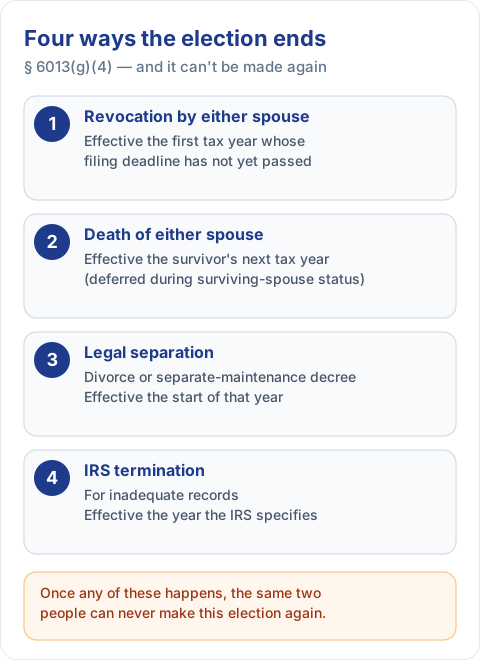
What four events end the election?
The election stays in force until one of the events in §6013(g)(4) occurs. Filing separately in a later year does not end it: Example 1 of Treas. Reg. §1.6013-6(c) allows joint or separate returns in later years, with worldwide income included each year until the election is terminated or suspended.
| Event | Authority | Effective |
|---|---|---|
| Revocation by either spouse | §6013(g)(4)(A); Treas. Reg. §1.6013-6(b)(1) | The first tax year whose statutory filing deadline has not yet passed |
| Death of either spouse | §6013(g)(4)(B); Treas. Reg. §1.6013-6(b)(2) | The start of the survivor's next tax year. Deferred while the survivor is entitled to surviving-spouse treatment under §2 |
| Legal separation under a divorce or separate-maintenance decree | §6013(g)(4)(C); Treas. Reg. §1.6013-6(b)(3) | The start of the year in which the separation occurs |
| IRS termination for inadequate records | §6013(g)(4)(D), (g)(5); Treas. Reg. §1.6013-6(b)(4) | The tax year the IRS specifies |
A revocation statement gives both spouses' names, addresses and TINs, and lists any community property jurisdictions in which either spouse is domiciled or owns real property producing income (Treas. Reg. §1.6013-6(b)(1)(iv)). The revoking spouse signs it and attaches it to their return or, if there is none, sends it to the service center that received the last joint return. Suspension, for a year in which neither spouse is a US citizen or resident, is not termination and does not trigger the bar below (§1.6013-6(a)(3)(i)).
Can the election be made again once it ends?
After a termination, §6013(g)(6) provides that "such two individuals shall be ineligible to make an election under this subsection for any subsequent taxable year." The statute refers to the couple. The IRS reads the bar more broadly. Its Nonresident spouse page and Pub 519 say "neither spouse can make this choice in any later tax year," and the IRS calls it a "once-in-a-lifetime choice." For the §6013(h) choice, Pub 519 adds "even if you are separated, divorced, or remarried." The statutory text may leave room for a new spouse, but relying on it means arguing against the IRS's published position. A couple that revokes when the spouse's income rises cannot elect again at retirement.
Thinking about revoking the election, even temporarily? It can never be made again for this couple, under any circumstances — worth modeling the long-term cost before deciding. Ask TaxLatitude to run the numbers before you revoke →
With and without the election compared
| Item | Without election | With election |
|---|---|---|
| Filing status | MFS, or HOH with a qualifying person other than the spouse | Joint. Separate returns are possible in later years, but the election remains in force |
| Standard deduction, 2026 | $16,100 (MFS) / $24,150 (HOH) | $32,200 |
| Top of the 12% bracket, 2026 | $50,400 (MFS) | $100,800 |
| Spouse's income | Not on the return | Worldwide income, in full |
| FEIE for spouse's foreign wages | Not applicable | Up to $132,900 if the spouse meets a qualifying test |
| Form 8938, spouse's own assets | Not reported. Assets held jointly with the spouse count at full value toward the citizen's threshold | Reported on one combined form |
| Form 8938 thresholds (end of year / any time) | $50,000 / $75,000 in the US; $200,000 / $300,000 abroad | $100,000 / $150,000 in the US; $400,000 / $600,000 abroad |
| FBAR, spouse's sole-name accounts | Not required | Generally still not required |
| Net investment income tax | Citizen at $125,000 (MFS) or $200,000 (HOH); spouse exempt | Citizen at $125,000; spouse exempt, unless the couple makes a further election ($250,000 combined) |
| Treaty residence claims | Not at issue for the spouse | Neither spouse can use a treaty to claim non-residence |
| Liability | Each spouse for their own return | Joint and several, §6013(d)(3) |
When does the election help, and when does it hurt?
It helps when the spouse's income is small or fully offset. In 2026, a citizen with $100,000 of taxable income stays in the 12% bracket on a joint return. On an MFS return, the same income is taxed at 22% above $50,400 (Rev. Proc. 2025-32). Pub 501 lists what MFS filers give up: the education credits, the student loan interest deduction, the dependent care and adoption benefits in most cases, and half the capital loss deduction ($1,500 instead of $3,000). The dependent care credit's maximum rate rises to 50% in 2026 (IRS, Working Families Tax Cuts).
The benefit is small if the citizen's income is already sheltered by the exclusion and foreign tax credit. With a qualifying child, HOH captures much of the gain without exposing the spouse.
It hurts when the spouse has income that the exclusion does not cover and foreign tax does not offset. The exclusion applies only to earned income. The credit is limited to the foreign tax actually owed and to the share of US tax attributable to foreign income (Pub 54) — a limitation that can strand real credit unused, as our foreign tax credit basket limitation article shows with a worked example. High-taxed foreign wages usually come out about even. Lightly taxed dividends or gains become new US tax. Section 911 sits in chapter 1, so an electing spouse is a resident alien for exclusion purposes: the $132,900 exclusion is generally available through the physical presence test, and through the bona fide residence test as well if the spouse is a citizen or national of a treaty country (Pub 54). Our FEIE vs. foreign tax credit guide compares the two in full.
It hurts when the spouse holds foreign savings vehicles, which now belong to a US person. Rev. Proc. 2020-17 removes the Form 3520 and 3520-A filings for certain tax-favored foreign retirement trusts, but not the Form 8938 or FBAR obligations (IRS foreign trust guidance) — for accounts that don't qualify for that relief, see our Form 3520 penalty trap article. Treaty relief that depends on residence in the other country is largely off the table: neither spouse may use a treaty to claim non-residence (Treas. Reg. §1.6013-6(a)(2)(v)) — see our dual tax residency article for how that tie-breaker normally works. Foreign funds and spouse-owned companies raise PFIC and CFC questions, including family attribution, which are covered in Owning a Company Abroad as an American, in our PFICs explained guide, and with a worked example in The PFIC Trap. Joint and several liability under §6013(d)(3) also lets the IRS collect tax on the spouse's under-reported income from the citizen.
The net investment income tax has a separate election. Under Treas. Reg. §1.1411-2(a)(2)(iii)(A), even on a §6013(g) joint return, the citizen is treated as filing separately for §1411. The citizen uses the $125,000 married-filing-separately threshold, and the spouse is not subject to the tax. Paragraph (iii)(B) allows a further election to combine both spouses' income and use the $250,000 joint threshold. That helps when the citizen's modified adjusted gross income falls between the two thresholds and the spouse has little investment income, and hurts when the spouse has a lot. The regulation ties the timing to the first year the US spouse is subject to §1411, so read the full timing rule before counting on a later year.
Spouse has foreign investment income, a pension, or a company abroad? Whether the election actually helps depends on the exact mix of income types, credits and exposures — not a general rule. Ask TaxLatitude to weigh your specific numbers →
Does the election change FBAR and FATCA reporting?
Contrary to a common assumption, the election does not make the spouse an FBAR filer. 31 CFR §1010.350(b)(2) defines a resident as "a resident alien under 26 U.S.C. 7701(b)," and a §6013(g) or (h) election is not a §7701(b) residence test. IRS examiner training material (LB&I Concept Unit INT-C-256) says FBAR residence is determined "without regard to elections under Internal Revenue Code (IRC) 6013(g) or 6013(h)," and that an electing spouse "is generally not subject to FBAR filing requirements." "Generally" covers a spouse who becomes a §7701(b) resident in fact: green card, substantial presence or a §7701(b)(4) first-year election. Treaty positions do not affect FBAR status (Pub 5569). For the threshold, the deadline and how penalties are counted, see our full FBAR guide.
The citizen's own FBAR obligations do not change. A filing is required when foreign accounts exceed $10,000 in aggregate at any time during the year. The FBAR is due April 15, extended automatically to October 15 (IRS, FBAR). For a joint account, each US person named on it has a financial interest (§1010.350(e)(1)) and reports the entire value. The Form 114a spousal shortcut presupposes a spouse who must also report, so it does not apply; the citizen files alone. If the citizen has signature authority over the spouse's account, that is reportable in its own right (§1010.350(a)). Under Bittner v. United States (2023), non-willful penalties accrue "on a per-report, not a per-account, basis."
Form 8938 works differently. The Form 8938 Instructions treat "a nonresident alien who makes an election to be treated as a resident alien for purposes of filing a joint income tax return" as a specified individual. One Form 8938 goes with the joint return, listing joint assets once (Treas. Reg. §1.6038D-2). The spouse's own accounts, pensions and policies become reportable. Because the joint thresholds apply to combined assets, the election can create a filing obligation or remove one. The higher thresholds for filers abroad require the presence-abroad test: bona fide residence for a citizen, or 330 full days abroad in a 12-month period. Penalties start at $10,000, with up to $50,000 more after IRS notice, and an unfiled form keeps the assessment period open until three years after it is finally furnished. The two regimes are independent (IRS comparison chart), so an electing spouse's sole-name accounts can correctly appear on Form 8938 and on no FBAR.
How does the election affect state income tax?
Our state taxes after moving abroad guide covers the general picture; here is how a nonresident alien spouse changes it. Without the election, the three states reviewed here follow federal MFS or HOH status. With it, residency rules take over. California requires the federal filing status (2025 Form 540 Booklet). FTB Legal Ruling 1995-1 concludes that, through R&TC §18521, California follows the federal head-of-household rules for a taxpayer married to a nonresident alien. After a joint federal return, the couple can file separately for California if one spouse was a nonresident for the whole year with no California-source income. The exception does not mention nonresident aliens, but a spouse who has never lived or earned in California fits its terms. On separate returns, community property rules divide the income according to the domicile of the spouse who earned it (FTB Pub 1031). Pub 1031's 546-day safe harbor for residents abroad under an employment contract is lost if intangible income exceeds $200,000 or the absence is mainly to avoid tax.
New York requires separate returns when one spouse is a resident and the other is not. The exception is when both elect to compute joint New York taxable income "as if both were residents" (NY Tax Law §651(b)(4)). In that case "both spouses' income will be taxed as full-year residents" (IT-203-I (2025)). A citizen abroad keeps New York domicile unless it is "clearly shown that such citizen intends to remain abroad permanently" (Nonresident Audit Guidelines). Under the 548-day rule in §605(b)(1)(A)(ii), you need at least 450 days abroad within 548 consecutive days, and no more than 90 days in New York. The spouse's days count toward the 90.
Virginia says that, as a general rule, "a resident and a nonresident cannot file a joint or combined Virginia return." After a joint federal return, the resident spouse uses Filing Status 3 (Virginia Tax). 23VAC10-110-190 also describes a joint computation option.
Moving abroad does not by itself end state residence: under Pub 1031, a Californian absent for a temporary purpose with intent to return remains a resident. A citizen whose last domicile is a state without an individual income tax avoids these questions; everyone else should also check whether their state honors the federal foreign earned income exclusion before assuming foreign wages are sheltered.
Still have ties to California, New York or Virginia? Your state's rules don't automatically follow your federal filing choice — and a joint New York return can tax your spouse as a full-year resident without you realizing it. Ask TaxLatitude to check your state's specific rule →
Common mistakes
- Checking the box without attaching a statement signed by both spouses.
- Revoking after one bad year and losing the election permanently.
- Assuming the spouse now files an FBAR, while omitting the spouse's assets from Form 8938.
- Treating a later separate return as a way out of the election.
- Prorating joint accounts on the FBAR.
- Expecting HOH status to unlock the earned income credit.
- Electing late without amending later years already filed.
- Choosing a joint New York resident return without noticing that it taxes the spouse as a full-year resident.
Checklist before deciding
- List the spouse's income by type, with the foreign tax paid on each item, and flag what the exclusion and credit won't cover.
- List the spouse's foreign accounts, pensions, policies, funds and company interests.
- Calculate the tax as MFS, as HOH if you qualify, and as a joint return. Include the credits lost under MFS.
- Decide on the net investment income tax election.
- Obtain or renew the spouse's ITIN before the due date.
- Check your state's domicile and filing-status rules.
- Project the spouse's income through retirement. Revocation is permanent.
- If the decision is unclear, file separately on time and use the amended-return window if the joint calculation turns out better.
FAQ: filing with a non-citizen spouse
Can I file a joint US tax return with my non-citizen spouse by default?
No. IRC §6013(a)(1) states that no joint return can be made if either spouse is a nonresident alien at any time during the year. Without a specific election, the default status is married filing separately, though head of household is often available and better if you have a qualifying child or relative.
What does the §6013(g) election actually do?
It treats the nonresident spouse as a US resident for income tax and wage withholding purposes, for the entire year and every subsequent year until the election ends. It brings the spouse's worldwide income onto the joint return in full, in exchange for the larger joint standard deduction and wider tax brackets.
Once we revoke the joint-filing election, can we make it again later?
No. The IRS treats it as a once-in-a-lifetime choice: after revocation, the death of either spouse, legal separation, or IRS termination for inadequate records, the same two people cannot make the election again for any later year. A couple that revokes when the spouse's income rises cannot elect again at retirement.
Does the election make my non-citizen spouse subject to the FBAR?
Generally no. FBAR residence is determined without regard to a §6013(g) or (h) election, so an electing spouse is generally not an FBAR filer unless they separately become a resident alien in fact, for example through a green card or substantial presence. Form 8938 works differently: the election does make the spouse a "specified individual," so their own accounts and assets become reportable on the joint Form 8938, even though nothing changes for the FBAR.
Does the election help or hurt if my spouse has foreign income?
It depends on the kind of income. It generally helps when the spouse's income is small or already fully offset by the foreign earned income exclusion. It can hurt when the spouse has investment-type income that the exclusion does not cover and that the foreign tax credit cannot fully offset, because the credit is capped category by category and can strand real credit unused.
If I make the election, am I liable for my spouse's tax errors?
Yes. A joint return under the election carries joint and several liability under §6013(d)(3), which lets the IRS collect tax on the spouse's under-reported income from the US citizen, in addition to bringing the spouse's foreign accounts and assets into US reporting obligations like Form 8938.
Sources
Primary sources (accessed November 7, 2026)
- 26 U.S. Code §6013, Joint returns of income tax by husband and wife (Cornell LII), accessed November 7, 2026
- U.S.C. Title 26, §6013 (GPO, 2023 edition), accessed November 7, 2026
- 26 CFR §1.6013-6, Election to treat nonresident alien individual as resident of the United States, accessed November 7, 2026
- IRS, Nonresident spouse, accessed November 7, 2026
- IRS Publication 519 (2025), U.S. Tax Guide for Aliens, accessed November 7, 2026
- IRS Publication 54 (12/2025), Tax Guide for U.S. Citizens and Resident Aliens Abroad, accessed November 7, 2026
- IRS Publication 501 (2025), Dependents, Standard Deduction, and Filing Information, accessed November 7, 2026
- IR-2025-103, IRS releases tax inflation adjustments for tax year 2026, including amendments from the One, Big, Beautiful Bill, accessed November 7, 2026
- Rev. Proc. 2025-32, accessed November 7, 2026
- Instructions for Schedule 8812 (Form 1040) (2025), accessed November 7, 2026
- IRS, Working Families Tax Cuts, accessed November 7, 2026
- IRS, Foreign trust reporting requirements and tax consequences, accessed November 7, 2026
- 26 CFR §1.1411-2 (GPO, April 1, 2025 edition), accessed November 7, 2026
- 31 CFR §1010.350, Reports of foreign financial accounts (eCFR), accessed November 7, 2026
- IRS LB&I Concept Unit, FinCEN Form 114, Report of Foreign Bank and Financial Accounts (FBAR), DCN INT-C-256, accessed November 7, 2026
- IRS Publication 5569, Report of Foreign Bank & Financial Accounts (FBAR) Reference Guide, accessed November 7, 2026
- IRS, Report of Foreign Bank and Financial Accounts (FBAR), accessed November 7, 2026
- IRS, Comparison of Form 8938 and FBAR requirements, accessed November 7, 2026
- Instructions for Form 8938, accessed November 7, 2026
- 26 CFR §1.6038D-2 (GPO, 2023 edition), accessed November 7, 2026
- Bittner v. United States, No. 21-1195 (U.S. Feb. 28, 2023), slip opinion, accessed November 7, 2026
- California FTB, 2025 Personal Income Tax Booklet (Form 540), accessed November 7, 2026
- California FTB Publication 1031, 2025 Guidelines for Determining Resident Status, accessed November 7, 2026
- California FTB Legal Ruling 1995-1, accessed November 7, 2026
- New York Tax Law §651 (NYS Open Legislation), accessed November 7, 2026
- New York, Instructions for Form IT-203 (2025), accessed November 7, 2026
- New York DTF, Nonresident Audit Guidelines (December 2021), accessed November 7, 2026
- Virginia Tax, Filing Status, accessed November 7, 2026
- 23VAC10-110-190, Nonresident spouse, accessed November 7, 2026
A note on method: this article is based on primary sources only — the Internal Revenue Code, Treasury and FinCEN regulations, IRS publications, form instructions and examiner training material, one Supreme Court opinion, and guidance from the California, New York and Virginia tax agencies — checked on November 7, 2026. Dollar figures are for tax years 2025 and 2026 as published by the IRS. Where the statute and IRS guidance differ, as they do on the one-time bar, the article presents both. State coverage is limited to the three states named and is not a fifty-state survey.