Research date: November 5, 2026. Every figure, statute citation and calculation below is stated and verified as of that date, including an August 31, 2026 Federal Circuit decision. This article is general information, not tax or legal advice.
Key takeaways
- Real foreign tax paid does not guarantee a matching US credit. The credit is capped separately for each "basket" of income, and the caps can't share — a Brussels employee pays about $90,404 in Belgian tax on her salary but still owes the IRS $4,952 net.
- Excess credit from one basket can never offset US tax from another basket, or US-source income. It can only be carried back 1 year and forward 10 within the same basket — then it expires.
- The §951A (GILTI/net CFC tested income) basket is the strictest of all: excess credit there can't be carried to any other year at all, not even within the same basket.
- Your standard deduction gets ratably apportioned against foreign income before the cap is even computed, which quietly shrinks the credit limitation — in the worked example, this one step alone costs about $2,960 of limitation.
- Capital gains and qualified dividends taxed at preferential rates are scaled down in the formula by a fixed factor (15/37 or 20/37), which can reach even your US-source gains through the denominator, not just your foreign income.
- The credit-vs-deduction choice is all-or-nothing each year. You either credit all your qualified foreign taxes on Form 1116, or deduct them all on Schedule A, and choosing to deduct doesn't protect your existing carryovers.
US citizens and green card holders abroad are usually told the foreign tax credit prevents double taxation. That is true only within limits that most people never see. Under IRC §904, the credit is capped at the US tax on your foreign-source income. The cap is figured separately for each category of income, and part of your deductions gets charged against foreign income before the cap is even computed. A credit that exceeds the cap in one category cannot be used in another category or against US-source income. It can be carried back one year and forward ten, in the same category only, and then it expires. In the worked example below, a single American employee in Brussels pays about $90,400 of Belgian income tax on her salary, which is far more than her total 2025 US tax of $50,800. She still owes $4,952 to the IRS: $3,368 of income tax plus $1,584 of net investment income tax. Meanwhile $43,048 of her Belgian tax goes unused. That unused credit is real and can be carried, but if her life stays as it is, the rules make it likely to expire unused after 2035.
Why is the credit elective, chapter-limited and capped from the start?
The statute grants the credit with a condition built in. Under IRC §901(a), if you choose the credit, the US income tax is reduced by your creditable foreign income taxes, and the grant is expressly subject to the limitation of section 904. §901(b)(1) gives citizens a credit for income taxes paid to any foreign country or US territory. §901(b)(3) gives resident aliens, including green card holders, the same credit for foreign-country taxes. The credit only offsets "the tax imposed by this chapter," which means the chapter 1 income tax. That wording matters later for the net investment income tax.
The credit is a choice. Each year you either credit your qualified foreign taxes on Form 1116 or deduct them as an itemized deduction on Schedule A, and the choice generally applies to all of that year's qualified foreign taxes (IRS Publication 514 (2025); Treas. Reg. §1.901-1(c)(1)). For nearly everyone abroad who pays meaningful foreign tax, the credit is worth much more than the deduction. The deduction still matters for one reason covered below: a year in which you deduct does not protect your carryovers.
The usual one-line summary is: "I paid foreign tax on this income, so I won't owe US tax on it too." That is accurate only when three things hold. The income has to be foreign-source under US rules, which are not the foreign country's rules. The foreign tax has to land in the same §904 category as the income. And the foreign tax on that category must not exceed the US tax the formula assigns to it. When any of these fails, you can pay a lot of foreign tax and still owe US tax. The reason is that the credit was never designed to offset all of your US tax. It offsets only the US tax on your foreign-source income, one category at a time.
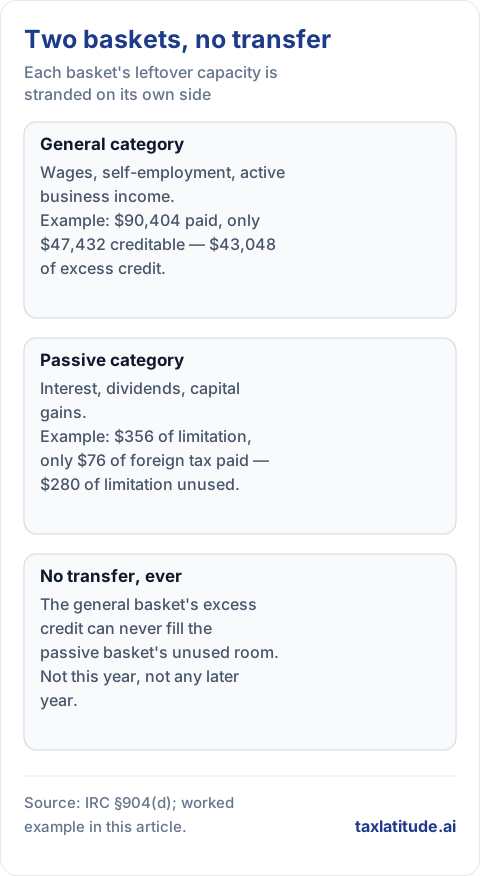
How does Section 904(d) split income into baskets that cannot share credit?
IRC §904(d) requires the limitation to be computed separately for each listed category, which practitioners call "baskets." The statute currently lists four:
- Amounts includible in income under §951A, other than passive income.
- Foreign branch category income.
- Passive category income.
- General category income.
Other provisions add more separate limitations. §901(j) denies the credit for taxes paid to sanctioned countries (for example, governments the US does not recognize or that the Secretary of State has designated as repeatedly supporting terrorism), and it requires income from those countries to be computed separately. §904(d)(6) and §865(h) give a separate limitation to income that a tax treaty re-sources as foreign. Form 1116 reflects all of this with seven category boxes: (a) section 951A, (b) foreign branch, (c) passive, (d) general, (e) section 901(j), (f) certain income re-sourced by treaty, and (g) lump-sum distributions. You file a separate Form 1116 for each category you have (2025 Instructions for Form 1116; draft 2026 Form 1116).
What is the passive category, and what is its high-tax exception?
Passive income is income of a kind that would be foreign personal holding company income under §954(c) (§904(d)(2)(B)(i)). For an individual that typically means interest, dividends, rents and royalties not earned in an active business, annuities, and gains on investment property such as stock. The regulations confirm that stock gains are included (Treas. Reg. §1.904-4(b)(2)). Rents and royalties earned in the active conduct of a trade or business are not passive.
The statute removes two things from passive income: export financing interest and "high-taxed income" (§904(d)(2)(B)(iii)). Passive income is high-taxed when the foreign tax on it exceeds the highest US rate multiplied by that income. For individuals that rate is the top §1 rate of 37%, which is the rate the regulation's own example uses (§904(d)(2)(F); Reg. §1.904-4(c)(1)). The test is not applied item by item. Passive income is first sorted into groups by level of withholding tax: 15% or more, more than zero but under 15%, no foreign tax, and no withholding but some other foreign tax. Deductions are allocated to each group, and the 37% test is then applied to each group (Reg. §1.904-4(c)(2)–(3)). A group that fails the test moves, along with its taxes, into the general category. On Form 1116 this shows up on line 13, entered as a negative amount on the passive form and a positive amount on the general form (2025 Instructions for Form 1116).
You may see older guidance mention a separate "high withholding tax interest" basket. That category no longer exists. The term now appears only in the historical amendment notes to §904. It dropped out of the operative statute when a 2004 amendment consolidated the baskets, effective from 2007 (26 USC §904, uscode.house.gov). Under current law, the high-taxed income kick-out described above is the only rule that moves heavily taxed investment income out of the passive basket.
What is the general category?
General category income is everything that is not §951A, foreign branch, or passive income (§904(d)(2)(A)). For most Americans abroad it holds the largest item on the return: wages for work performed outside the United States, plus self-employment and other active business income. Wages are sourced where the work is done (§861(a)(3); §862(a)(3)). A salary earned in Brussels, Paris or Munich is therefore foreign-source general category income, whoever pays it.
What are the other baskets?
The §951A category covers inclusions from controlled foreign corporations. The final 2025 Form 1116 labels box (a) "Section 951A category income" — the instructions mention in passing that this income is "otherwise referred to as 'global intangible low-taxed income (GILTI)'," but GILTI is not the box's official label (2025 Instructions for Form 1116). The 2025 budget law (P.L. 119-21, commonly called OBBBA) renamed the underlying regime "net CFC tested income" for taxable years after 2025, but that term does not appear in the 2025 instructions either, and §904(d)(1)(A) itself still just describes amounts includible under §951A (WilmerHale (secondary source)). Excess taxes in this basket cannot be carried to any other year at all (§904(c)).
Foreign branch income is business profit of a US person attributable to a qualified business unit in a foreign country (§904(d)(2)(J)). The rest of this article sets aside CFC owners and branch structures and concentrates on the two baskets nearly every individual filer actually uses: passive and general.
Own a foreign company with CFC income? The §951A basket is the strictest of all four — excess credit there can't be carried to any other year, not even within the same basket. Ask TaxLatitude how this basket affects your own structure →
What is the §904(a) formula, and how does the deduction step shrink it?
Section 904(a) caps the credit at the same share of your US tax that your foreign-source taxable income bears to your entire taxable income. Because §904(d) applies it category by category, the cap for each basket is:
Limitation for a basket = US tax × (foreign-source taxable income in that basket ÷ worldwide taxable income)
Two adjustments apply to individuals. First, worldwide taxable income in the denominator is computed without the §151 personal exemption deductions (§904(b)(1)). For 2025 through 2028, the IRS says this also removes the new $6,000 deduction for taxpayers age 65 or older, because Congress placed it in §151(d)(5)(C) (2025 Instructions for Form 1116; Pub. 514). Second, capital gains and qualified dividends taxed at preferential rates are scaled down, as explained below.
How is foreign-source taxable income built on Form 1116 Part I?
The numerator is not your foreign income. It is your foreign gross income in the basket minus the deductions the sourcing regulations charge against it. Part I of Form 1116 is built that way:
| Line | What goes there |
|---|---|
| 1a | Gross income from foreign sources in this category |
| 2 | Expenses definitely related to that income |
| 3a | Certain itemized deductions or, if you don't itemize, your standard deduction |
| 3b | Other deductions that are not definitely related to any income |
| 3c | Lines 3a + 3b |
| 3d | Gross foreign-source income in this category |
| 3e | Gross income from all sources and all categories (the same figure on every Form 1116) |
| 3f | Line 3d ÷ line 3e, to at least four decimal places |
| 3g | Line 3c × line 3f |
| 4a / 4b | Home mortgage interest and other interest expense, apportioned under the instructions' methods |
| 5 | Losses from foreign sources |
| 6 | Total deductions (lines 2, 3g, 4a, 4b and 5) |
| 7 | Line 1a minus line 6, carried to line 15 |
The line titles above are from the 2025 Instructions for Form 1116 and the draft 2026 Form 1116.
The legal basis is Treas. Reg. §1.861-8. Deductions that are definitely related to a class of gross income are allocated to that class. Deductions that are not definitely related to any gross income are apportioned ratably. Under §1.861-8(c)(3), each grouping, including each basket and the US-source residual, receives the share of the deduction equal to its share of total gross income. Section 1.861-8(e)(9) lists the deductions to be treated this way:
- certain interest;
- real estate taxes on a personal residence, and sales tax on personal-use purchases;
- medical expenses;
- alimony under former §215.
The standard deduction does not appear in that list. The rule that it is apportioned the same way comes from the Form 1116 instructions. Line 3a tells filers who don't itemize to enter the standard deduction there, and lines 3d through 3f spread it across categories by gross income (2025 Instructions for Form 1116). State and local income taxes are different. The regulation treats them as definitely related to the income they are imposed on (§1.861-8(e)(6)).
This step costs credit, and it helps to be precise about why. The denominator, worldwide taxable income, always reflects the whole deduction. If none of the deduction were charged to foreign income, the numerator would be the full foreign gross income and the basket's share of taxable income would be larger than its share of gross income. Ratable apportionment removes that advantage. With a ratable split, a basket that holds 85% of gross income ends up with roughly 85% of taxable income, not more.
The cost depends on your income mix:
- If nearly all your income is foreign wages, line 3f is close to 1. The limitation is then close to your whole US tax whether or not the deduction is apportioned, so this step costs little.
- If you also have meaningful US-source or other-category income, the step lowers the limitation. In the worked example below, charging the standard deduction ratably cuts the general category limitation by about $2,960, compared with leaving the whole deduction outside the basket.
What is the capital gain rate adjustment, and why does it reach US-source gains?
When the preferential §1(h) rates apply in a year, the code requires a "capital gain rate differential" adjustment (§904(b)(2)(B), (b)(3)(D)–(E)). The reason is that a dollar of long-term gain taxed at 15% carries far less US tax than a dollar of wages. Counting it at full value in the fraction would distort the result.
For 2025, the Form 1116 instructions apply this by multiplying foreign-source qualified dividends and gains taxed at 15% by 0.4054 and those taxed at 20% by 0.5405. Amounts taxed at 0% are left out (2025 Instructions for Form 1116). The factors are the preferential rate divided by the 37% top rate: 15/37 ≈ 0.4054 and 20/37 ≈ 0.5405. The IRS practice unit on this topic lists the same factors (IRS LB&I unit INT-P-217).
The same principle applies to the denominator, and there it covers your gains from all sources. Treas. Reg. §1.904(b)-1(c)(2) reduces net capital gain included in worldwide taxable income by the rate differential portion of each rate group, and the regulation's example applies it to US-source gain. The practice unit makes the same point: the adjustment limits how much worldwide capital gain enters the denominator. This is the line 18 adjustment on Form 1116.
There is an exception, and it is elective. Under Reg. §1.904(b)-1(b)(3), an individual may elect not to make any of the rate differential adjustments, including the denominator adjustment, if:
- the top rate on their ordinary income does not exceed the highest §1(h) rate;
- they meet an AMT condition;
- their foreign-source net capital gain plus foreign-source qualified dividends total less than $20,000.
The 2025 instructions turn the first condition into a dollar test. Line 5 of the Qualified Dividends and Capital Gain Tax Worksheet must not exceed $197,300 for single filers ($394,600 for joint filers), and the foreign qualified dividends and capital gain distributions must total under $20,000 (2025 Instructions for Form 1116). Eligible taxpayers are presumed to have elected the exception unless they actually apply the adjustments (Reg. §1.904(b)-1(b)(3)). Someone whose gains are mostly US-source and who qualifies for the exception may get a higher limitation by making the adjustments anyway. The worked example below avoids that question: the taxpayer's worksheet line 5 is above $197,300, so the exception is not available and the adjustment is required.
A worked 2025 example: Brussels salary, US brokerage, stranded credit
What are the facts and assumptions behind the example?
The taxpayer is a single US citizen. She lives and works in Brussels for all of 2025 and her tax home is in Belgium. She does not claim the foreign earned income exclusion and she takes the standard deduction. All figures are for tax year 2025. Her income:
- A gross salary of €200,000 from a Belgian employer.
- €1,500 of interest from a regulated Belgian savings account.
- A $40,000 long-term gain from selling US-listed shares held for several years in a US brokerage account.
She has no dividends. Dividends from US companies paid to a Belgian resident raise treaty-specific questions that would blur the point of the example.
Euros are converted at the IRS yearly average rate for 2025 of 0.886 euro per dollar. The IRS publishes these averages but notes that it has no official exchange rate (IRS yearly average currency exchange rates). Using the average for both income and taxes is a simplification. Filers should apply the conversion rules in the Form 1116 instructions for their own payment dates and accounting method.
The salary converts to €200,000 ÷ 0.886 = $225,733.63, rounded to $225,734. The interest converts to €1,500 ÷ 0.886 = $1,693. We also assume that Belgian withholding during 2025 equals her final Belgian liability for income year 2025.
What is the Belgian tax on the salary?
Belgium's 2025 federal brackets, applied to net taxable income, are:
- 25% up to €16,320
- 40% from €16,320 to €28,800
- 45% from €28,800 to €49,840
- 50% above €49,840
The cumulative tax at €49,840 is €18,540. Municipalities add a surcharge on the income tax, ranging from 0% to 9% and averaging 7% (PwC Worldwide Tax Summaries, Belgium (secondary source)). That gives a top combined marginal rate of 50% × 1.07 = 53.5% at the average surcharge.
Three further inputs come from the same publisher:
- Employee social security is 13.07% of gross pay with no cap (PwC (secondary source)).
- The standard deduction for employee professional expenses is 30% of earnings, capped at €5,930 (PwC (secondary source)).
- The basic tax-free allowance is €10,910 (same source).
PwC does not tag the last two figures to a specific income year, but independent Belgian tax-calculation sites (Dexxter, myfid.be, onyxe.be and others) all tie both figures specifically to assessment year 2026 (income year 2025), the year this example uses (Dexxter (secondary source)). The allowance is set against the lowest bracket, so it reduces tax by 25% of the allowance (same source).
| Step | Computation | Euros |
|---|---|---|
| Gross salary | 200,000.00 | |
| Employee social security | 200,000 × 13.07% | −26,140.00 |
| Professional expense deduction | 30% of 173,860 = 52,158, capped | −5,930.00 |
| Net taxable income | 200,000 − 26,140 − 5,930 | 167,930.00 |
| Tax on the scale | 18,540 + 50% × (167,930 − 49,840) | 77,585.00 |
| Tax-free allowance reduction | 25% × 10,910 | −2,727.50 |
| Tax after allowance | 74,857.50 | |
| Communal surcharge | 7% × 74,857.50 | 5,240.03 |
| Belgian income tax | 80,097.53 | |
| In dollars | 80,097.53 ÷ 0.886 | $90,404 |
That is an effective income tax rate of about 40% of gross salary.
The €26,140 of social security is not on the list. The IRS treats social security taxes paid to a country that has a social security (totalization) agreement with the United States as non-creditable (IRS, Foreign taxes that qualify for the foreign tax credit; IRS totalization agreements), and Belgium has one. Belgium's separate "special social security contribution" (at most €731.28 a year per household, per PwC (secondary source)) is left out for the same reason.
What is the Belgian tax on the interest and the gain?
Belgium exempts the first €1,050 of interest on ordinary savings accounts for 2025 and taxes the excess at 15% (PwC (secondary source)). Her Belgian tax on the interest is 15% × (€1,500 − €1,050) = €67.50, or $76. The full $1,693 of interest is still US taxable income, since the Belgian exemption has no effect on the US return. Interest paid by a Belgian bank is foreign-source, because the payer is not a US resident (§861(a)(1); §862). It is taxed by Belgium at an effective 4.5%, well under 37%, so it stays in the passive basket.
Belgium does not tax individuals' capital gains on shares realized in the normal management of private wealth (PwC, Belgium income determination (secondary source)). The $40,000 gain bears no Belgian tax.
That decides where the gain is sourced. Under §865(a), a gain on personal property sold by a "United States resident" is US-source. A citizen with a foreign tax home is normally treated as a nonresident for this rule. However, §865(g)(2) does not let that treatment apply unless foreign income tax of "at least 10 percent of the gain" is actually paid on it. Belgium charged nothing, so the gain is US-source. It is not in the passive basket or the general basket. It appears on no Form 1116 line 1a. It still enters gross income on line 3e and worldwide taxable income on line 18, and it draws real US tax.
This is why the brief description of the problem, "US-source or low-tax-country passive income," covers two different cases. Low-taxed foreign passive income, like the Belgian interest, lands in the passive basket, has its own small limitation, and leaves a small residual US tax. US-source income, like this gain or dividends from US companies, is in no foreign basket at all. A basket's limitation can only be built from foreign-source income in that basket. So no amount of excess credit in the general basket, or in any basket, can reach US tax on US-source income.
Holding US-listed shares or a US brokerage account while living abroad? Gains on them can be US-source even though you live overseas — meaning no foreign tax credit, however much you've paid locally, can ever offset the US tax on them. Ask TaxLatitude whether your US-source income is exposed →
The US tax computation
| Item | Computation | Amount |
|---|---|---|
| Wages | €200,000 ÷ 0.886 | $225,734 |
| Interest | €1,500 ÷ 0.886 | $1,693 |
| Long-term capital gain | US brokerage | $40,000 |
| Adjusted gross income | $267,427 | |
| Standard deduction (2025, single) | −$15,750 | |
| Taxable income | $251,677 |
The $15,750 standard deduction is the 2025 single amount after the 2025 legislation (2025 Form 1040 Instructions). Tax is figured with the Qualified Dividends and Capital Gain Tax Worksheet:
- Worksheet line 5, ordinary taxable income, is $251,677 − $40,000 = $211,677. That is above $197,300, which rules out the Form 1116 adjustment exception.
- Because ordinary income fills the 0% capital gain band (which runs to $48,350 for single filers), none of the gain is taxed at 0%.
- Taxable income of $251,677 is far below the $533,400 start of the 20% band, so the entire $40,000 is taxed at 15%, which is $6,000 (IRS Topic 409).
The ordinary $211,677 is taxed under the 2025 single brackets (IRS, Federal income tax rates and brackets):
| Bracket | Computation | Tax |
|---|---|---|
| 10% | $11,925 × 10% | $1,192.50 |
| 12% | ($48,475 − $11,925) × 12% | $4,386.00 |
| 22% | ($103,350 − $48,475) × 22% | $12,072.50 |
| 24% | ($197,300 − $103,350) × 24% | $22,548.00 |
| 32% | ($211,677 − $197,300) × 32% | $4,600.64 |
| Total ordinary tax | $44,799.64 |
Adding the $6,000 on the gain gives $50,799.64, rounded to $50,800 of regular tax. On a naive view the problem is solved before it starts: $90,404 of Belgian tax on wages plus $76 on interest makes $90,480 of foreign tax, against $50,800 of US tax. The basket rules produce a different answer.
What does Form 1116 look like for both baskets?
The taxpayer files two Forms 1116: one with box (d) for general category income and one with box (c) for passive category income. Line 3e is the same on both: $225,734 + $1,693 + $40,000 = $267,427 of gross income from all sources. The US-source gain is included at its full amount as gross income.
Line 18 is worldwide taxable income adjusted for the capital gain rate differential. The $40,000 of 15%-rate gain counts at 0.4054 of its value: $40,000 × 0.4054 = $16,216. Line 18 is therefore $251,677 − $40,000 + $16,216 = $227,893, a reduction of $23,784. Line 20 is the regular tax of $50,800. The table rounds ratios to four decimal places, as line 3f requires, and uses the same precision on line 19.
| Form 1116 line | General category (box d) | Passive category (box c) |
|---|---|---|
| 1a Gross foreign-source income | $225,734 (Belgian salary) | $1,693 (Belgian interest) |
| 2 Definitely related expenses | $0 | $0 |
| 3a Standard deduction | $15,750 | $15,750 |
| 3c Total of 3a and 3b | $15,750 | $15,750 |
| 3d Gross foreign-source income in category | $225,734 | $1,693 |
| 3e Gross income from all sources | $267,427 | $267,427 |
| 3f Line 3d ÷ 3e | 0.8441 | 0.0063 |
| 3g Line 3c × 3f | $13,295 | $99 |
| 6 Total deductions | $13,295 | $99 |
| 7 / 15 / 17 Net foreign-source taxable income | $212,439 | $1,594 |
| 8 / 9 Foreign taxes paid | $90,404 | $76 |
| 10 Carryover or carryback into 2025 | $0 | $0 |
| 12 Reduction in foreign taxes | $0 | $0 |
| 14 Foreign taxes available for credit | $90,404 | $76 |
| 18 Adjusted worldwide taxable income | $227,893 | $227,893 |
| 19 Line 17 ÷ line 18 | 0.9322 | 0.0070 |
| 20 US regular tax | $50,800 | $50,800 |
| 21 Limitation (line 20 × line 19) | $47,356 | $356 |
| 24 Credit allowed (smaller of line 14 or line 23; line 22 is $0, so line 23 equals line 21) | $47,356 | $76 |
| Excess foreign tax (line 14 − line 24) | $43,048 | $0 |
| Unused limitation (line 21 − line 24) | $0 | $280 |
Each line is computed as follows:
| Line | General category | Passive category |
|---|---|---|
| 3f | 225,734 ÷ 267,427 = 0.844096, entered as 0.8441 | 1,693 ÷ 267,427 = 0.006331, entered as 0.0063 |
| 3g | 15,750 × 0.8441 = 13,294.58, rounded to $13,295 | 15,750 × 0.0063 = 99.23, rounded to $99 |
| 7 | 225,734 − 13,295 = $212,439 | 1,693 − 99 = $1,594 |
| 19 | 212,439 ÷ 227,893 = 0.932187, entered as 0.9322 | 1,594 ÷ 227,893 = 0.006995, entered as 0.0070 |
| 21 | 50,800 × 0.9322 = 47,355.76, rounded to $47,356 | 50,800 × 0.0070 = $355.60, rounded to $356 |
The rest of the standard deduction, $15,750 − $13,295 − $99 = $2,356, falls on the US-source gain. That matches 15,750 × 40,000 ÷ 267,427 = $2,355.78.
Line 10 is shown as $0 to isolate 2025. If she had carryovers from earlier Belgian years, they would sit on line 10 and join the unused amount, because 2025 leaves no spare general limitation to absorb them.
The cost of the apportionment step can be read straight from these figures. Without it, general category line 7 would be the full $225,734, line 19 would be 225,734 ÷ 227,893 = 0.9905, and the limitation would be 50,800 × 0.9905 = $50,317. Ratable apportionment brings it down to $47,356, a reduction of $2,961.
In Part IV, line 27 (passive) is $76 and line 28 (general) is $47,356, so line 32 is $47,432. Line 33 takes the smaller of line 20 ($50,800) or line 32, which is $47,432. With no boycott reduction, the credit on line 35 is $47,432. Regular tax after the credit is $50,800 − $47,432 = $3,368.
Why does the net investment income tax sit outside the credit entirely?
The 3.8% net investment income tax under §1411 applies to the lesser of:
- net investment income: $40,000 + $1,693 = $41,693;
- modified AGI above the $200,000 single threshold: $267,427 − $200,000 = $67,427.
That is 3.8% × $41,693 = $1,584.33, or $1,584. The NIIT is in chapter 2A of the Code, not chapter 1, so the §901 credit, which reduces only chapter 1 income tax, cannot offset it (§901(a)).
Courts had been testing whether treaties change that result. On August 31, 2026, the Federal Circuit decided Christensen v. United States (US–France treaty) and Estate of Bruyea v. United States (US–Canada treaty) against the taxpayers. It reversed Court of Federal Claims decisions and held that neither treaty provides a credit against the NIIT independent of the Code's limits (PwC Tax Insight (secondary source); Eide Bailly (secondary source)). Those summaries note that rehearing or Supreme Court review was still possible. Neither case involved the Belgian treaty, and our taxpayer's NIIT is figured under the Code.
What the numbers show
| Result | Amount |
|---|---|
| Belgian income tax paid on salary | $90,404 |
| General category credit allowed in 2025 | $47,356 |
| General category excess, carried back then forward | $43,048 |
| US income tax after credit | $3,368 |
| Net investment income tax (no credit allowed) | $1,584 |
| Total US tax still owed for 2025 | $4,952 |
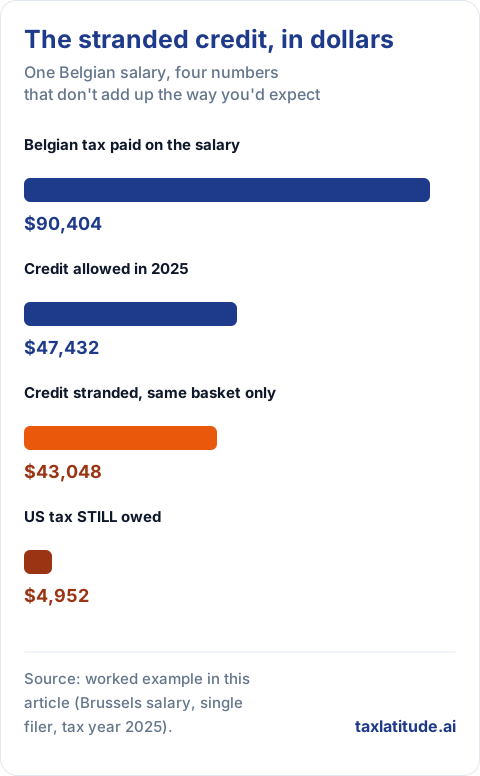
She paid Belgium about $90,400 on her salary and holds $43,048 of unused credit, which is almost nine times her remaining US bill. She still owes the IRS $4,952. The $3,368 of income tax is exactly what the formula leaves uncovered:
- The US-source gain, net of its $2,356 share of the standard deduction and counted at 0.4054 of its value, makes up $13,860 ÷ $227,893 = 6.08% of adjusted taxable income. That share times $50,800 is $3,089.56.
- The passive basket's limitation was $356 but only $76 of Belgian tax was available, leaving $280 uncovered.
- $3,089.56 + $280 = $3,369.56. The $1.56 difference from $3,368 comes from rounding the line 19 ratios to four decimal places.
The line 18 adjustment matters. If she skipped it and used unadjusted taxable income of $251,677 as the denominator, the ratios would be 0.8441 and 0.0063. The limitations would fall to $42,880 and $320, and her income tax after credit would be $7,844 instead of $3,368. Skipping it overstates her tax by $4,476.
Why does the conclusion hold even if her Belgian tax is wrong?
The Belgian figure depends on secondary-source inputs and an average municipal rate, so it is fair to ask how sensitive the result is. Her general category limitation of $47,356 equals about €41,957, or roughly 21% of her gross salary. Belgian income tax would have to be 47.6% lower than our estimate before her excess credit disappeared. Even with Belgian tax 30% below the estimate, about $15,900 of excess remains. The $4,952 she owes does not depend on the Belgian tax at all. It is the US tax that the formula assigns to US-source income and to low-taxed passive income, and no amount of Belgian wage tax changes it.
Why would Germany or France tell a different story?
Germany and France are also high-tax countries, but they tax investment gains, and that changes the result. Germany taxes private investors' gains on shares at a flat 25% plus the 5.5% solidarity surcharge, for 26.375% in total (PwC Worldwide Tax Summaries, Germany (secondary source)). France applies a flat levy of about 30% to securities gains for 2025, made up of 12.8% income tax and social levies. Commercial summaries report a higher figure for 2026, and at least one summary is internally inconsistent about the 2025 rate (Taxes for Expats (secondary source)).
Either rate is above the §865(g)(2) 10% threshold. An American with a German or French tax home who sells US shares therefore has a foreign-source gain in the passive basket, and the foreign tax on it, at 26–30% against a 15% US rate, usually creates excess passive credit rather than residual US tax. The leftover US exposure in those countries is mostly the NIIT, which is the issue litigated in Christensen. The Belgian result, where real US tax is owed on a gain while a large unused credit sits in another basket, depends on Belgium not taxing the gain.
Does Belgium's 2026 capital gains tax automatically change the answer?
Belgium enacted a capital gains tax on financial assets, approved by Parliament on April 3, 2026. It applies a 10% rate to gains realized from January 1, 2026 in the normal management of private wealth. The first €10,000 of gains each year is exempt. Gains accrued before 2026 are excluded by valuing assets at December 31, 2025, using the last 2025 closing price for listed assets (KPMG TaxNewsFlash (secondary source); OECCBB (secondary source)).
A 10% tax sounds as if it automatically meets the 10% test in §865(g)(2). It does not. The US test compares the Belgian tax actually paid with the gain from that sale, and we assume that means the gain measured under US rules, in dollars, from her original cost. Several features keep the Belgian tax below that mark in common cases:
- The annual exemption removes the tax on the first €10,000.
- The December 31, 2025 step-up removes pre-2026 appreciation from the Belgian base but not from the US gain.
- Belgium measures the gain in euros and the US measures it in dollars.
For a long-held position with large pre-2026 gains, the Belgian tax will usually be well under 10% of the US gain, which leaves the gain US-source. The opposite can also happen. Take shares bought after 2025, sold after that year's exemption is used up, where the euro and dollar gains are about the same. Belgian tax could then reach 10% of the US gain, and the statute treats exactly 10% as enough. Currency movements can push either way.
So the analysis has to be done sale by sale, and we found no IRS guidance on measuring the gain when the two countries' bases differ. Even when a gain does become foreign-source, it goes into the passive basket. The general basket's excess still cannot reach it.
Does the treaty rescue the general basket?
The 2006 US–Belgium treaty keeps the US right to tax its citizens under the saving clause. It also contains special foreign tax credit rules, in Article 22(4), for US citizens resident in Belgium (Treasury Technical Explanation, US–Belgium Convention). Re-sourcing provisions of this type deem income to arise in the residence country only to the extent needed to relieve double taxation. Because Belgium did not tax the 2025 gain, there was no double tax to relieve. This reading follows from the Technical Explanation's description of how Article 22(4) operates; the operative treaty article itself should be checked against the current, full treaty text before relying on this point for an actual return.
How do Section 904(c) carryovers work?
Under §904(c), foreign tax above the limitation is treated as paid in the first preceding year, and then in each of the first ten succeeding years, in that order. It can be used only as a credit, not as a deduction.
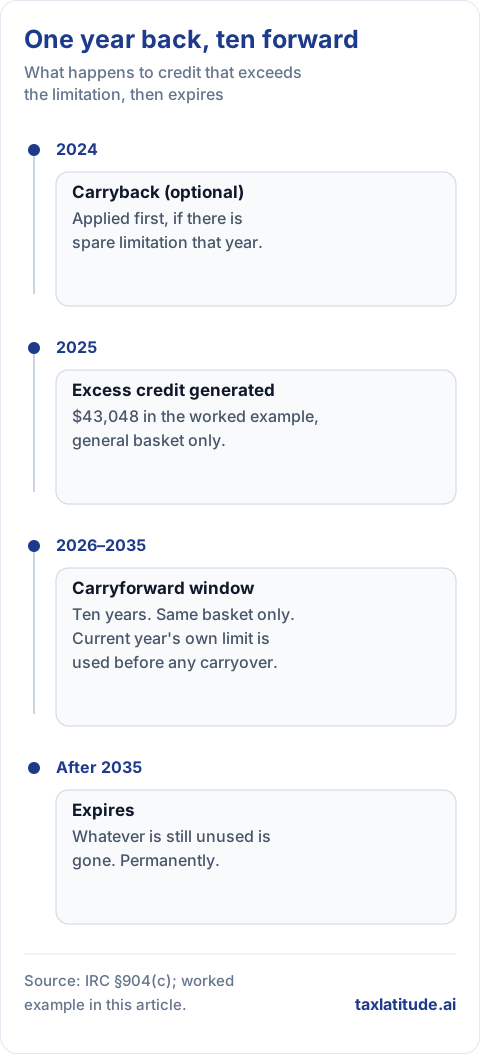
The regulations apply this category by category. Treas. Reg. §1.904-2(c)(1) defines unused foreign tax as the excess of creditable tax over the limitation for the separate category. Paragraph (c)(3)(i) defines "excess limitation" for a category as the amount by which that category's limitation exceeds the sum of that year's own creditable taxes and the carryovers already absorbed from earlier years. Under paragraph (d), the amount deemed paid in a carryover year is the smaller of the carryover or that year's excess limitation. One Schedule B is filed per category (Instructions for Schedule B (Form 1116)). A general category carryover can therefore only be absorbed by spare limitation in the general category, in some year within its window. It can never offset US tax on passive income or US-source income.
The ordering explains why credits expire even while new ones are piling up:
- Each year's own creditable taxes use up that year's limitation first.
- Only the limitation left over, if any, absorbs carryovers, oldest first. The instructions tell you to apply the excess to the earliest year it can be carried to, and Schedule B uses carryovers starting with column (i), the oldest year (2025 Instructions for Form 1116; Schedule B instructions).
- The window does not stretch. The instructions say: "The carryback-carryforward period can't be extended." That holds even in a year when you could not claim a credit.
The Code and regulations give no option to skip the carryback year. §904(c) says the excess "shall be deemed paid" in the preceding year first, and the regulation absorbs carryovers whether or not a credit is claimed in the carryback year. Claiming a carryback means filing Form 1040-X with a revised Form 1116 for that earlier year (2025 Instructions for Form 1116).
What happens to the Brussels excess through 2035?
Our taxpayer's $43,048 of general category excess from 2025 goes first to 2024. We assume that in 2024 she was also living in Belgium, with Belgian wage tax above her general limitation, so 2024 had no spare limitation and nothing is absorbed. The full amount then carries to 2026 and to each year through 2035. Whatever is left after the 2035 return expires. In 2035, 2025 is the tenth preceding year, and the expiring amount would appear on line 5 of that year's Schedule B.
If she stays in Belgium on a similar salary, her Belgian wage tax will exceed her general category limitation every year, just as it did in 2025. Under §1.904-2(c)(3)(i), each new year's Belgian tax fills that year's limitation before any carryover is touched. Her general basket will show no excess limitation, the 2025 carryover will not be used, and a new layer of excess will be added each year. Each layer will age out ten years after it arose. Her Schedule B will grow, and it will also start showing expirations on line 5 every year.
The 2026 Belgian capital gains tax does not change this, because a gain that becomes foreign-source lands in the passive basket. Belgian dividends taxed at 30% stay passive under the 37% high-tax test. Moving back to the United States usually does not help either. Wages for work performed in the US are US-source (§861(a)(3)), so they build no general category limitation.
What does absorb her carryover is foreign-source general category income taxed below the US rate. The clearest case is a move to a low-tax or no-tax country while claiming the credit rather than excluding the wages. Those foreign wages would generate general category limitation with little current foreign tax to fill it, so the old Belgian carryovers would be used, oldest first. This follows directly from the regulations above. Whether such a move makes sense is a life decision, not a tax trick. Anyone who might make one should know their carryovers' expiry years before they move.
Does deducting foreign taxes shelter carryovers?
Some taxpayers switch to deducting foreign taxes in a low-income year, assuming the carryovers are frozen until the credit is claimed again. They are not. Under Reg. §1.904-2(c)(3)(ii), excess limitation in a deduction year absorbs carryovers "regardless of whether the taxpayer chooses to claim a credit," computed as if the credit had been claimed. The instructions say the same: you cannot carry a credit into a deduction year, but you must still reduce the carryover by the amount that would have been used (2025 Instructions for Form 1116). A deduction year uses up carryovers without giving any credit for them, and it still counts toward the ten-year window.
What is the §904(j) de minimis election, and what does it forfeit?
Section 904(j) lets an individual claim the credit without Form 1116 if all of these are met:
- All foreign-source gross income is "qualified passive income," meaning passive income shown on a payee statement.
- All creditable foreign taxes are shown on payee statements and total no more than $300, or $600 on a joint return.
- The individual elects.
The 2025 instructions list Forms 1099-DIV, 1099-INT and Schedule K-3 as qualifying statements. You make the election by entering the credit directly on the return instead of attaching Form 1116 (2025 Instructions for Form 1116). Neither the statute nor Treas. Reg. §1.904(j)-1 indexes the $300 and $600 thresholds. The regulation also requires that all of the foreign taxes be creditable.
What the election gives up is set out in the regulation:
- No taxes paid in an election year can be carried to any other year.
- No carryovers from other years can be used in an election year (§1.904(j)-1(b)(1)).
- Election years are ignored in computing carryovers, but they still count toward the ten-year window. The regulation's example says: "The carryforward period established under section 904(c) is not extended" (§1.904(j)-1(c), Example 2).
The instructions repeat that taxes covered by the election cannot be carried to or from any other year. Form 6251 instructions apply the same rule to the AMT credit (2025 Instructions for Form 6251).
For most readers of this site the election is not available while they are working abroad. Foreign wages are not passive income on a payee statement, and Belgian payroll tax is not reported on a 1099. The trap comes in years when the election is available and you also hold passive category carryovers. One example is a year after moving back to the US when your only foreign tax is a couple of hundred dollars withheld on international funds. If that year's passive limitation would have had room to absorb older passive carryovers, the de minimis election gives up that absorption, and the carryovers lose another year of life anyway. The convenience of skipping Form 1116 can cost more than the $300 or $600 the election covers. The election can also cost something in a year when your total US tax is smaller than the foreign tax it covers, because the part of the foreign tax the credit cannot use that year cannot be carried anywhere.
How does the foreign earned income exclusion affect the credit?
The foreign earned income exclusion (FEIE) under §911 lets a qualifying individual exclude foreign earned income up to an annual cap. For 2025 the cap is the lesser of foreign earned income or $130,000; for 2026 it is $132,900 (IRS, Figuring the foreign earned income exclusion). Section 911(d)(6) denies any deduction, exclusion or credit properly allocable to excluded amounts, and that includes the foreign tax credit. For the full comparison between the two tools, including worked examples at different income levels, see TaxLatitude's FEIE vs. foreign tax credit guide.
How much foreign tax is disallowed?
Treas. Reg. §1.911-6(c)(1) sets the disallowed tax with a fraction:
Disallowed tax = foreign tax on foreign earned income × (excluded amounts − deductible expenses allocable to them) ÷ (foreign earned income − deductible expenses allocable to it)
The housing cost deduction is treated as related to the income that is not excluded, so it is subtracted only in the denominator. If the foreign tax falls on earned income and other income together and cannot be separated, the denominator becomes all income subject to the foreign tax, less related expenses. The disallowed amount goes on Form 1116 line 12, "Reduction in foreign taxes" (2025 Instructions for Form 1116).
Publication 514 gives an example. Foreign earned income is $175,000, unreimbursed business travel is $20,000, foreign tax is $30,000, and the exclusion plus housing is $130,000:
- Expenses allocated to the excluded income: $20,000 × 130/175 = $14,857.
- Numerator: $130,000 − $14,857 = $115,143.
- Denominator: $175,000 − $20,000 = $155,000.
- Disallowed tax: $30,000 × 115,143/155,000 = $22,286.
(Pub. 514 (2025)). This disallowed-tax computation is a side calculation that feeds line 12 of Form 1116 — it does not have its own line or form.
The disallowed tax is gone permanently. It is not a carryover, because the regulation treats it as a reduction in the tax considered paid (§1.911-6(c)(2)(iii)). Applied to our Brussels taxpayer, a $130,000 exclusion would make $90,404 × 130,000/225,734 = $52,064 of her Belgian tax permanently non-creditable. Without the exclusion, all of her Belgian tax is either credited in the current year or carried over, even if the carryover may well expire.
How does excluded income appear on lines 1a, 3d and 3e?
Excluded wages are left off line 1a, so they are not in the basket's foreign-source taxable income. The instructions for lines 2 through 5 also tell filers not to include deductions related to excluded income. Lines 3d and 3e are different: there the instructions tell filers to include foreign earned income excluded on Form 2555, but no other exempt income (2025 Instructions for Form 1116). Excluded income therefore counts when the standard deduction is spread across categories, even though it is not on line 1a.
The instruction follows the regulations. Reg. §1.861-8(d)(2)(ii)(A) generally treats excluded income as exempt income, which would normally keep it out of apportionment. However, §1.861-8(d)(2)(iii) lists foreign earned income as defined in §911 among the income not considered tax-exempt for this purpose. It leaves the question of which deductions are disallowed to §1.911-6.
Its effect is limited:
- If all your gross income is foreign general category earned income, excluded or not, line 3f is 1 either way and the instruction changes nothing.
- If you also have US-source or other-category income, the instruction raises the general category's share of the standard deduction. That lowers the general category's line 7 and its limitation.
In an illustration with $200,000 of foreign wages, a $130,000 exclusion and $20,000 of US-source interest (2025 single rates, standard deduction), the instruction lowers the general limitation from about $14,293 to $13,780, roughly $500. The figures are our computation, not an IRS example.
How does stacking raise the tax and the limitation together?
Under §911(f), tax on the income that is not excluded is computed as the tax on (taxable income + excluded amount) minus the tax on the excluded amount alone. The non-excluded income is therefore taxed at the rates that would apply if nothing had been excluded (Pub. 54). On Form 1116:
- Line 18 uses taxable income after the exclusion.
- Line 20 uses the stacked tax.
The limitation is therefore stacked tax × (non-excluded foreign taxable income ÷ post-exclusion taxable income). Take $200,000 of foreign wages, a $130,000 exclusion and nothing else. Taxable income is $54,250, and the stacked tax is $37,067 − $24,047 = $13,020, compared with $6,849 without stacking.
Stacking does not lower the limitation. It raises the US tax and the limitation in the same proportion. In a high-tax country, the creditable tax remaining after the line 12 reduction usually still covers it. In that illustration, foreign tax at 30% leaves $21,000 creditable against a $13,020 limitation.
Does revoking the exclusion have a long tail?
The FEIE election continues until revoked. A taxpayer who revokes it cannot elect it again without IRS consent until the sixth taxable year after the year of revocation (§911(e)(2); Treas. Reg. §1.911-7(b)). Among the factors the regulation lists for granting early consent is a move to a foreign country with different tax rates. In a high-tax country, the exclusion turns most of the foreign tax into permanently disallowed tax, while the credit-only approach keeps all of it creditable or carryable. Which approach is better depends on the income mix and the expected moves, and the five-year lock-out is part of that decision.
Does AMT bite for typical expats?
The alternative minimum tax has its own foreign tax credit:
- The AMT foreign tax credit is figured with the regular limitation rules applied to AMT amounts.
- You file a separate Form 1116 for each category, marked "AMT" with the category in the top margin, and the result flows to Form 6251 line 8.
- A simplified limitation election still exists. It lets you figure the AMT limitation using regular-tax foreign-source taxable income. It had to be made for the first tax year after 1997 in which an AMT foreign tax credit was claimed, and it can be revoked only with IRS consent (2025 Instructions for Form 6251).
For 2025, the AMT exemption is:
- $88,100 for single and head of household filers;
- $137,000 for joint filers;
- $68,500 for married filing separately.
The exemption phases out at 25% from $626,350 (single) and $1,252,700 (joint), and the 26% AMT rate covers the first $239,100 of the AMT base (same source). At those levels, an expat whose income is mainly wages and portfolio investments, with no large preference items such as incentive stock options, usually owes no AMT. Form 6251 is required only when the tentative minimum tax test in its instructions is met.
For our Brussels taxpayer, a rough check confirms this. AMT income is $267,427, since the standard deduction is not allowed for AMT. After the $88,100 exemption, the tentative minimum tax is 26% × $139,327 + 15% × $40,000 = $42,225. Applying the same basket fractions with AMT amounts gives an AMT foreign tax credit of about $39,197. That leaves about $3,028, below her regular tax after credit of $3,368, so she owes no AMT.
This may change for higher earners after 2025. For 2026, the 2025 legislation kept the higher exemptions but lowered the phase-out thresholds. KPMG reports a $90,100 single exemption, with phase-out starting at $500,000 for single filers and $1,000,000 for joint filers (KPMG summary of Rev. Proc. 2025-32 (secondary source)). High-income filers should run the AMT computation again rather than assume it does not apply.
What to actually do with your own return
How do you build your own basket map?
Start by listing every income item on your return, with four labels for each:
- whether it is US-source or foreign-source under US rules;
- its §904 category;
- the foreign tax actually paid on it;
- the country.
The sources for this are your foreign tax assessment notices and payroll statements, which show the income tax separately from social security. Then add your foreign bank and broker statements and the foreign-tax entries and country listed on any Form 1099-DIV, 1099-INT or Schedule K-3.
Three items need care:
- Gains. Note whether the foreign tax on each sale reached the 10% threshold. That decides whether the gain is foreign-source at all (§865(g)(2)).
- Heavily taxed passive income. Look for passive income taxed above 37%, because it belongs in the general category under the high-taxed income rule.
- Social security. Leave out social security paid to a country that has a totalization agreement with the United States.
Once the map is built, compare each basket's foreign tax with your estimate of the US tax on that basket's foreign-source income, after a share of your deductions. Two patterns show up. A basket with consistently more foreign tax than US tax will generate carryovers that may never be used. US-source income, or a basket with low foreign tax, will produce US tax that no credit can reach.
Why should you read your prior-year Schedule B?
Schedule B (Form 1116), first required for 2021, reconciles carryovers by year of origin, one schedule per category (Instructions for Schedule B (Form 1116); IRS changes page). The lines work like this:
| Line | What it shows |
|---|---|
| 1 | Last year's carryover by year of origin |
| 2 | Adjustments, such as corrections to an estimated carryback or foreign tax redeterminations |
| 3 | The adjusted total; its total column becomes Form 1116 line 10 |
| 4 | Carryover used this year, applied starting with column (i), the oldest year |
| 5 | Carryover that expires unused this year (only the tenth preceding year can expire) |
| 6 | This year's new excess |
| 7 | The part of line 6 carried back to the prior year |
| 8 | What carries forward |
On your most recent Schedule B, line 8 shows your carryovers by year of origin. The left-most columns are the oldest years and the next to expire: on a 2025 schedule, column (i) is 2015. Line 4 shows whether any limitation was spare enough to absorb anything, and line 5 shows what has already expired. If your returns show carryovers but no Schedule B, which is common before 2021 or when software handled the carryover without displaying it, ask for the carryover statement the regulations require (Reg. §1.904-2(f)) or rebuild the history from each year's Form 1116, line by line.
What are sensible next steps if credits are missing or aging out?
Claiming credits you missed. You can claim a credit you did not claim, or switch a deduction to a credit, within the special ten-year period in §6511(d)(3)(A) (Treas. Reg. §1.901-1(d)). Publication 514 measures the ten years from the regular due date of the return for the year the taxes were paid or accrued, and says the choice can be made or changed on an amended return. The regulation under §6511 limits the extended refund to the overpayment attributable to the credit (Reg. §301.6511(d)-3). Switching from a credit to a deduction is allowed only within the ordinary three-year period.
The accrual election. The election to claim foreign taxes when they accrue, rather than when paid, can only be made on a timely filed original return (Pub. 514). It helps when your foreign tax year differs from the US calendar year or when your foreign assessment arrives months later.
Undoing a de minimis election. No primary source says whether a §904(j) de minimis election can be withdrawn by filing an amended return with Form 1116. Neither §904(j), Reg. §1.904(j)-1, nor the 2025 Form 1116 instructions sets a deadline for making or revoking the election. The election only removes the limitation; it is separate from the choice between credit and deduction that §1.901-1(d) governs. Two things are clear:
- Years outside the §6511(d)(3)(A) ten-year window are closed for credit refunds.
- Within the window, whether you can replace a de minimis election with a full Form 1116 is not answered by the statute, the regulation or the instructions.
A preparer who says otherwise should be able to point to authority.
Carrybacks. The one-year carryback is not optional, and claiming it means filing Form 1040-X with a revised Form 1116 for the prior year (2025 Instructions for Form 1116).
Questions to take to your preparer. If your carryovers are growing every year, as they would for our Brussels taxpayer, ask about four things:
- whether some of your passive income should have been kicked out to the general category as high-taxed;
- whether any income qualifies for treaty re-sourcing (Form 1116 box f);
- whether the FEIE or the credit-only approach better fits your next few years, given the revocation rules;
- whether a planned move would create general category limitation in time to use the oldest layers.
FAQ: the foreign tax credit basket limitation
Can excess foreign tax credit in one category offset US tax in a different category?
No. IRC §904(d) requires the credit limitation to be computed separately for each category of income, commonly called a "basket" — passive, general, and others. Excess credit in one basket can never be used against US tax on income in another basket, and never against US-source income, no matter how large the excess is.
Does paying a lot of foreign tax guarantee I won't owe any US tax?
No. In the worked Brussels example, an American paid about $90,400 of Belgian tax on her salary yet still owed the IRS $4,952, because the credit only offsets US tax on foreign-source income in the same basket. Her general-basket excess could not reach the US tax on her US-source investment gain or on the net investment income tax, which the credit never offsets at all.
How long can excess foreign tax credit be carried forward?
One year back, then ten years forward, within the same basket only, and then it expires permanently. The carryback-carryforward period cannot be extended, even for a year in which the credit genuinely could not be used, and each year's own foreign tax uses up that year's limitation before any older carryover is absorbed.
Does choosing to deduct foreign taxes instead of crediting them protect my carryovers?
No. Under the regulations, a year in which you deduct foreign taxes still absorbs that year's excess limitation against your carryovers, computed as if you had claimed the credit, even though the deduction year itself gives you no credit for them. That year also still counts toward the ten-year carryforward window.
Does the foreign earned income exclusion affect my foreign tax credit?
Yes, and the effect is permanent. Section 911(d)(6) disallows any credit for foreign tax allocable to excluded income, computed with a proportional formula. Unlike an ordinary basket excess, this disallowed tax is not a carryover; it is gone for good, which is why combining the exclusion with large foreign tax on the same income can permanently waste a significant share of it.
Can the $300/$600 de minimis election to skip Form 1116 end up costing money?
Yes, in some situations. The election blocks any carryover into or out of the election year entirely, while that year still counts toward the ten-year window for other carryovers. Using the election in a year when older passive-category carryovers could otherwise have been absorbed can cost those carryovers a year of life for no benefit, so the convenience of skipping Form 1116 is not automatically free.
Sources
Primary sources (accessed November 5, 2026)
- IRC §901(a)
- IRS Publication 514 (2025)
- Treas. Reg. §1.901-1(c)(1)
- IRC §904(d)
- §865(h)
- 2025 Instructions for Form 1116
- draft 2026 Form 1116
- Treas. Reg. §1.904-4(b)(2)
- §904(d)(2)(B)(iii)
- §861(a)(3)
- §862(a)(3)
- 2025 Instructions for Form 1116
- Treas. Reg. §1.861-8
- Section 1.861-8(e)(9)
- IRS LB&I unit INT-P-217
- Treas. Reg. §1.904(b)-1(c)(2)
- IRS yearly average currency exchange rates
- IRS, Foreign taxes that qualify for the foreign tax credit
- IRS totalization agreements
- 2025 Form 1040 Instructions
- IRS Topic 409
- IRS, Federal income tax rates and brackets
- §1411
- Treasury Technical Explanation, US–Belgium Convention
- Treas. Reg. §1.904-2(c)(1)
- Instructions for Schedule B (Form 1116)
- Treas. Reg. §1.904(j)-1
- 2025 Instructions for Form 6251
- IRS, Figuring the foreign earned income exclusion
- Section 911(d)(6)
- Treas. Reg. §1.911-6(c)(1)
- Pub. 54
- Treas. Reg. §1.911-7(b)
- IRS changes page
- Reg. §301.6511(d)-3
Secondary sources
- WilmerHale (secondary source)
- PwC Worldwide Tax Summaries, Belgium (secondary source)
- PwC (secondary source)
- PwC (secondary source)
- Dexxter (secondary source)
- PwC, Belgium income determination (secondary source)
- PwC Tax Insight (secondary source)
- Eide Bailly (secondary source)
- PwC Worldwide Tax Summaries, Germany (secondary source)
- Taxes for Expats (secondary source)
- KPMG TaxNewsFlash (secondary source)
- OECCBB (secondary source)
- KPMG summary of Rev. Proc. 2025-32 (secondary source)
No general article can tell you how much of your own credit is usable or expiring. That depends on your basket-by-basket numbers, your carryover history by year of origin, and your mix of US-source and foreign-source income. Our Brussels example shows that a taxpayer can pay twice her US tax to a foreign government, owe the IRS anyway, and hold a five-figure credit that the rules make likely to expire unused. Whether that describes your return can only be answered from your own Forms 1116 and Schedules B.