Research date: November 6, 2026. Every figure, statute citation and case cited below is stated and verified as of that date. This article is general information, not tax or legal advice.
Key takeaways
- Form 3520 Part IV is purely informational — but filing it late can cost 5% of the gift per month, up to 25%. A $150,000 gift that triggers zero US income tax can still produce a $37,500 penalty for a late return.
- Two different thresholds apply, and only one is actually written into the statute. The statute itself sets $10,000; the $100,000 figure for gifts from individuals is only an administrative rule, while gifts from a foreign corporation or partnership fall back to the lower, inflation-adjusted figure ($20,573 for 2026).
- Gifts from related donors must be aggregated — a common trap. $80,000 from your mother and $70,000 from your father in the same year total $150,000 and trigger the filing requirement, even though neither alone crosses $100,000.
- Americans abroad get until June 15, or October 15 with an extension — but the form is mailed separately to Ogden, not e-filed with your return. A completed Form 3520 is the only safe harbor; an incomplete one is not considered timely filed.
- Reasonable cause is a real defense but thinly tested in court, and relying on someone else to mail the form generally doesn't qualify. The IRS abated 67% of assessed penalties from 2018-2021, but the case law so far is all at early procedural stages, not decided on the merits.
- First-Time Abate does not apply to Form 3520 at all — the IRS Manual explicitly excludes it — so a documented, sworn reasonable-cause statement is the only route once a filing is missed.
If you are a US citizen or US resident (including a green-card holder) and a parent, grandparent or other relative who is not a US person sends you more than $100,000 in a year, by gift or by inheritance, you almost certainly owe no US income tax on that money. You do owe the IRS a form. Form 3520, Part IV, is a purely informational return: nothing is computed on it and nothing is paid with it. But if you file it late, the Internal Revenue Code allows the IRS to charge 5% of the gift for every month it is late, up to 25% (26 U.S.C. §6039F(c)). On a $150,000 gift from your mother, that is up to $37,500 for a return that would have reported zero tax. The penalty does not apply if you show "reasonable cause" and no willful neglect, and in 2018–2021 the IRS abated most of the foreign-gift penalties it had assessed. Even so, we found no court decision that rules on the merits of a reasonable-cause defense to this specific penalty. And the two court decisions that have considered the "Farhy" argument against IRS assessment of this penalty both rejected it. This article explains the thresholds, the deadline that applies to Americans abroad, the penalty math, and the ways to fix a missed filing. It then works through one $150,000 example from start to finish.
Why is a gift not income, but still reportable?
Start with the good news. Under the Internal Revenue Code, gifts, bequests and inheritances are generally excluded from the recipient's gross income (26 U.S.C. §102(a)). Nothing in §6039F imposes a tax. The statute requires information about the gift and penalizes the failure to provide it; that is all it does (26 U.S.C. §6039F). Part IV of Form 3520 accordingly asks for dates, descriptions and values, and contains no line on which any tax is computed or paid (Instructions for Form 3520, Part IV). The exclusion covers the gift itself, not what the gift later earns. Interest, dividends or rent you earn on the money after you receive it is ordinary taxable income (26 U.S.C. §102(b)).
The reporting obligation comes from a separate statute, Internal Revenue Code §6039F, added to the Code by the Small Business Job Protection Act of 1996 (89 Fed. Reg. 39440 (May 8, 2024), background). It requires any "United States person" whose aggregate "foreign gifts" for the year exceed a threshold to furnish information about each gift (26 U.S.C. §6039F(a)). A "foreign gift" is any amount received from a person other than a US person that the recipient treats as a gift or bequest (§6039F(b)). The IRS collects that information on Part IV of Form 3520 (Instructions for Form 3520 (Rev. Dec. 2025)).
The rule follows the recipient, not where the recipient lives. "United States person" is defined in the Code to include every US citizen and resident, with no exception for those living abroad (26 U.S.C. §7701(a)(30); Instructions for Form 3520, Definitions). They also give a special, later due date to citizens and residents living and working outside the United States (Instructions for Form 3520, When and Where To File). That later due date only makes sense because people abroad are covered. A US citizen in Lisbon, Seoul or Buenos Aires is a US person for this purpose exactly as much as one in Ohio.
The rule also depends on who the giver is. The question is whether the giver is a US person, not where the giver lives. A gift from your American mother who also lives in Paris is not a "foreign gift" at all, because she is a US person. A gift from your French father, who lives in France and has never held US citizenship or a green card, is. Notice 97-34 adds that a gift is reportable only if you know or have reason to know that the donor is a foreign person (Notice 97-34, §VI).
Note the phrase "the recipient treats as a gift or bequest." The statute's trigger is an amount you treat as a gift, and the label you give a transfer is not the end of the story. The 2024 proposed regulations would let the IRS treat a "purported" loan as a foreign gift that should have been reported, if in substance it is a gift (89 Fed. Reg. 39440, preamble at 39450 (May 8, 2024)). Those rules are only proposed. But they signal where the IRS will look when a large family "loan" is never repaid.
What are the two thresholds, and which one is in the statute?
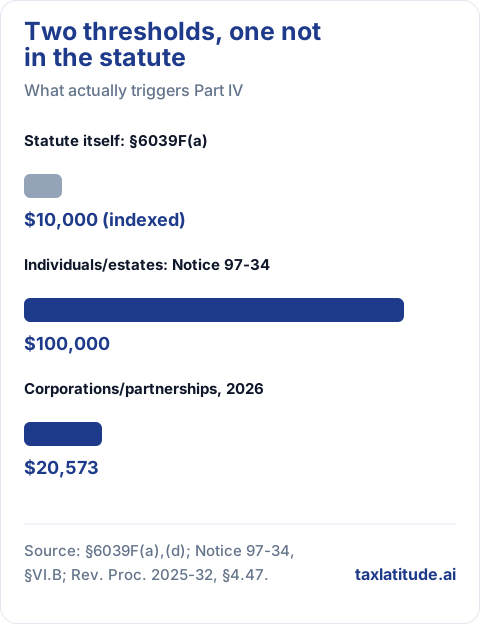
Most articles on this topic simply state that the threshold is $100,000. Strictly speaking, that is not what Congress wrote. The statute contains a single threshold: $10,000, indexed for inflation (§6039F(a), (d)). The much higher figure for gifts from individuals is an administrative rule. The IRS adopted it in Notice 97-34, which says reporting of gifts from a nonresident alien or a foreign estate is required only if the aggregate from that source "exceeds $100,000 during the taxable year" (Notice 97-34, §VI.B). The current Form 3520 instructions use the same structure (Instructions for Form 3520, Who Must File). In practice, then, two thresholds apply.
Gifts and bequests from nonresident alien individuals or foreign estates. You must file Part IV if you received more than $100,000 in the tax year, counting gifts from related foreign persons together (Instructions for Form 3520, Who Must File, item 4). The figure is flat, not indexed. The Taxpayer Advocate has recommended indexing it. The IRS, Chief Counsel and Treasury agreed, but as of the Advocate's latest status the change remained open (TAS 2023 Most Serious Problem #8). The 2024 proposed regulations would write in a "$100,000, as modified by cost-of-living adjustments" threshold (89 Fed. Reg. 39440, prop. §1.6039F-1(c)(2)(i)(A)). Until those regulations are final, the instructions' flat $100,000 is the operative number.
Gifts from foreign corporations or foreign partnerships. Here the statutory, inflation-adjusted figure applies. The IRS states that purported gifts from foreign corporations or partnerships are reportable when they exceed $20,116 for 2025 and $20,573 for 2026 (IRS, Gifts from foreign person). The instructions do not print the number. They point readers to the annual inflation-adjustment revenue procedure: Rev. Proc. 2024-40, section 2.48, for 2025, and Rev. Proc. 2025-32, section 4.47, for 2026 (Instructions for Form 3520; Rev. Proc. 2024-40; Rev. Proc. 2025-32). These "gifts" also carry a second risk. Under §672(f)(4), the IRS may recharacterize a transfer from a partnership or foreign corporation that the recipient treats as a gift, for example as a dividend or compensation (26 U.S.C. §672(f)(4); Instructions for Form 3520, line 55). If your father's company in Milan wires you €25,000 "as a present," you have a lower threshold and a characterization question.
Aggregation is where people get caught. For the $100,000 test, the instructions require you to aggregate gifts from different nonresident aliens and foreign estates that you know or have reason to know are related to each other, or are acting as nominees (Instructions for Form 3520, line 54). Notice 97-34 illustrates this with an example in which gifts from a foreign individual's relatives are added together (Notice 97-34, §VI.B, Ex. 14). So if your mother gives you $60,000 and your father gives you $50,000 in the same year, each gift is below $100,000, but together they total $110,000 and you must file. The test also covers the whole tax year, so several smaller wires during the year add up.
Receiving money from more than one relative abroad this year? Gifts from related donors have to be added together, even if none alone crosses $100,000 — easy to miss if each transfer looked small on its own. Ask TaxLatitude to check whether your gifts need to be aggregated →
Once you are over the threshold, larger gifts must be itemized. After the $100,000 test is met, you must separately identify each gift above $5,000. If no single gift exceeds $5,000, you write "No gifts or bequests exceed $5,000" instead of listing them (Instructions for Form 3520, line 54; Notice 97-34, §VI.B). Under Notice 97-34, the identity of an individual donor did not have to be disclosed. The proposed regulations would change that (Notice 97-34; 89 Fed. Reg. 39440).
Some transfers are not "foreign gifts" at all. The statute excludes "qualified transfers" under §2503(e)(2), meaning tuition paid directly to a school and medical expenses paid directly to a provider (§6039F(b)). A grandmother in Seoul who pays a US university directly for your daughter's tuition has not made a reportable foreign gift. The statute also excludes distributions properly reported under §6048(c), the foreign-trust rules. Those go in Part III of Form 3520, "rather than as a gift in Part IV" (Instructions for Form 3520, Part IV). If you have reason to believe the person giving you money is acting as a nominee for someone else, or that the real source is a foreign trust, line 56 of the form asks about it and sends you to Part III (Instructions for Form 3520, line 56).
Inheritances count the same way. The statute covers amounts treated "as a gift or bequest," and the instructions' threshold covers a foreign estate as well as a nonresident alien individual (§6039F(b); Instructions for Form 3520). An inheritance from your late father's estate in Germany is reported in Part IV. A distribution from a family trust he set up in Liechtenstein is a Part III trust distribution, with different rules.
One last wrinkle matters for some expat families. If the person giving you money is a former US citizen or long-term green-card holder who is a "covered expatriate," a separate transfer tax under §2801 may apply, and you may have to file Form 708 (Instructions for Form 3520, What's New and Part IV; IRS, Gifts from foreign person). That is a different regime from the one described here. If a parent renounced US citizenship, get specific advice.
When is the deadline for Americans abroad, and how is the form filed?
Form 3520 is due on the 15th day of the 4th month after the end of your tax year, which for most individuals is April 15 (Instructions for Form 3520, When and Where To File). Americans abroad get more time under two rules in the instructions.
The automatic June 15 date. US citizens or residents who live outside the United States and Puerto Rico and whose main place of business or post of duty is also outside them have until the 15th day of the 6th month (June 15 for calendar-year filers). Members of the military on duty abroad qualify as well. You "must include a statement" with Form 3520 showing that you qualify (Instructions for Form 3520, When and Where To File).
The October 15 extended date. If you get an extension of time to file your income tax return, Form 3520 is due no later than the 15th day of the 10th month (October 15). You check box 1k and enter the return you will be filing, for example "1040" if you used Form 4868 (Instructions for Form 3520, line 1k).
The instructions also say the due date "is not tied to" your income tax return (Instructions for Form 3520). The safe reading of the two passages together is that the income tax extension carries Form 3520 with it, but Form 3520 remains a separate return with its own envelope. If the due date falls on a weekend or legal holiday, the next business day applies (Instructions for Form 3520).
Form 3520 is filed separately, on paper, in Ogden. The current instructions direct filers to mail it to Internal Revenue Service Center, P.O. Box 409101, Ogden, UT 84409, and the IRS's foreign-gift page repeats that address (Instructions for Form 3520; IRS, Gifts from foreign person). The IRS has described the form as filed "separately from" the income tax return (IRS Nationwide Tax Forum 2023 presentation; IRM 20.1.9.10.1). If you e-file your Form 1040 through software, your Form 3520 does not go with it. The instructions mention only that e-signatures are accepted. We found no IRS statement that Form 3520 itself can be filed electronically (Instructions for Form 3520 (PDF)). International mail is slow, so give yourself margin, use a trackable method, and keep proof of when and how you sent the form. The instructions also warn that "only a complete Form 3520 is considered timely filed" (Instructions for Form 3520). A form missing required information is not a safe harbor.
Do not confuse Form 3520 with Form 3520-A. Form 3520-A is the annual information return of a foreign trust that has a US owner (see our Form 3520-A guide). That is the case, for instance, if you yourself set up and are treated as owning a foreign trust. Its penalty falls on the US owner under a different statute, §6677 (IRS Nationwide Tax Forum 2023 presentation). The initial §6677 penalty is the greater of $10,000 or a percentage of the reportable amount (89 Fed. Reg. 39440, preamble at 39443–44). If your only connection to anything foreign is that your aunt in Toronto wrote you a large check, Form 3520-A is not your form. Part IV of Form 3520 is.
Form 3520 (Rev. December 2023)
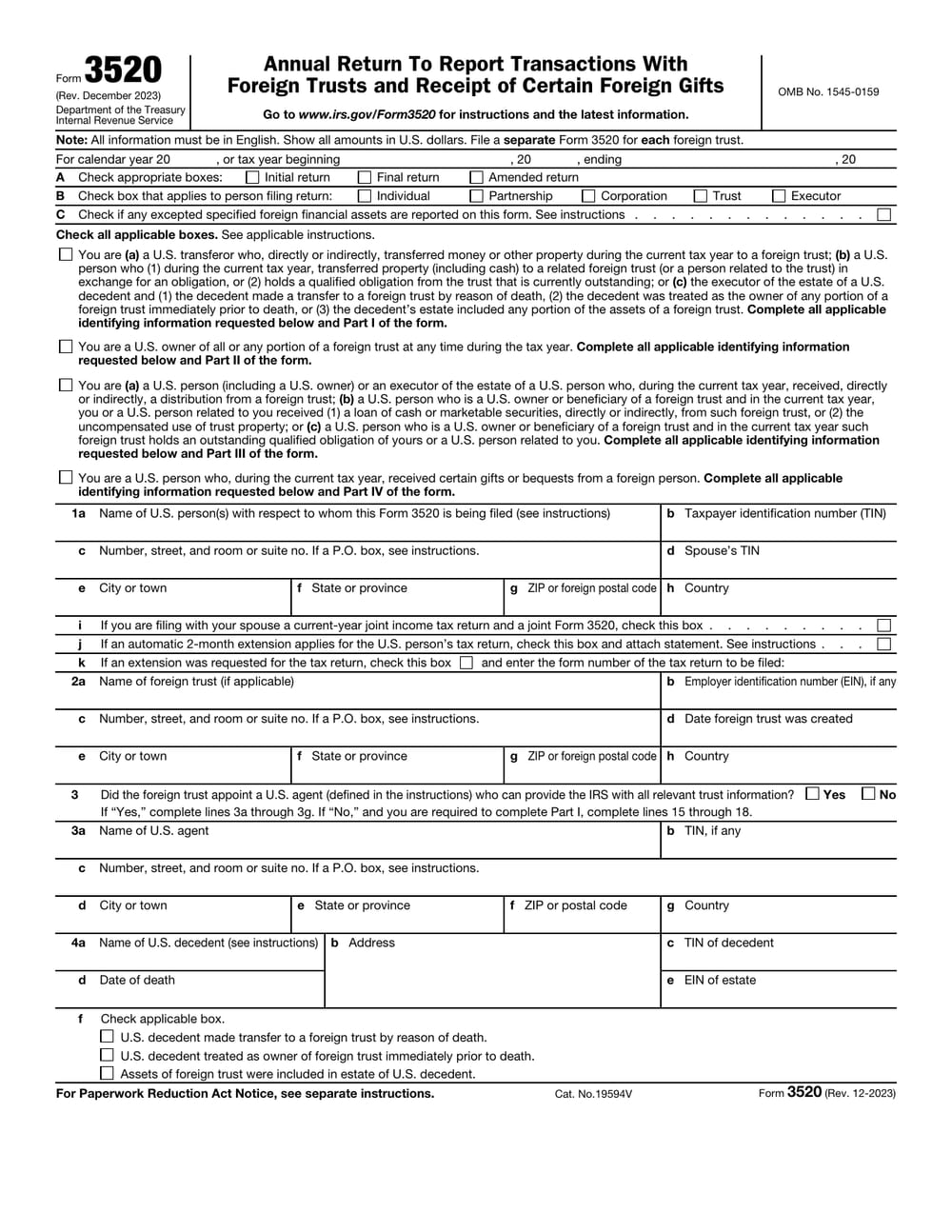
Download Form 3520 (PDF) · Instructions for Form 3520 (PDF)
Local copies for convenience, downloaded from IRS.gov on November 14, 2026. Always confirm you have the current revision at irs.gov/form3520 before filing.
How is the penalty measured?
Here is the core of the problem. The statute provides that if a US person fails to furnish the required information "within the time prescribed therefor (including extensions)," two things follow (§6039F(c)(1)).
First, the IRS determines the tax consequences of the gift (§6039F(c)(1)(A)). The IRS's own guidance says that if Form 3520 is late, incomplete or incorrect, the IRS may determine the income tax consequences of the receipt (IRS, Gifts from foreign person). In other words, an unreported "gift" can be scrutinized as possible income. The Internal Revenue Manual says that tax adjustment is subject to deficiency procedures (IRM 20.1.9.10.3). That means you get a notice and a right to go to Tax Court before you pay.
Second, you owe a penalty. It equals 5% of the amount of the foreign gift for each month the failure continues, not to exceed 25% in total. It is payable "upon notice and demand ... and in the same manner as tax" (§6039F(c)(1)(B)). The IRS describes the base as "the value of the unreported foreign gift(s)" (IRS, International information reporting penalties). Two features make this harsh. The penalty is computed on the whole gift, not on the amount above $100,000. And it has nothing to do with how much tax was at stake, which in the typical family-gift case is zero. Unlike a tax deficiency, the IRS treats the penalty itself as an assessable penalty that it can bill without first sending a notice of deficiency (IRM 20.1.9.1.5). Whether that treatment is correct is the Farhy question discussed below; so far, the courts that have addressed it for §6039F agree with the IRS. The IRS notice that usually carries it is a CP15 (IRM 20.1.9.10.2). Interest follows the penalty. The IRS says it cannot remove interest unless the penalty is removed or reduced (IRS, International information reporting penalties).
The one statutory escape is §6039F(c)(2): the penalty does not apply if the person "shows that the failure is due to reasonable cause and not due to willful neglect" (§6039F(c)(2)). The burden is on you to show it.
Time does not run out on its own. In Chief Counsel Advice 201402010, the IRS concluded that the limitations period for assessing the §6039F penalty "has not begun to run" when no Form 3520 has been filed. It relied on the rule in §6501(c)(3) for unfiled returns (CCA 201402010). Chief Counsel Advice is not binding precedent, but it shows the IRS's position. A gift you failed to report in 2015 is not "safe" simply because a decade has passed. The flip side, on the same reasoning, is that filing, even late, should generally start the clock. There is a separate, narrower point. Section 6501(c)(8), which holds open the assessment period for a related tax return when certain international information returns are missing (limited to the related items if the failure had reasonable cause), lists §6048 (the foreign-trust rules) but not §6039F (26 U.S.C. §6501(c)(8)). On the statute's face, then, a missing Part IV alone should not extend the limitations period for your entire Form 1040 under that provision. The IRS has not, to our knowledge, issued guidance confirming this reading. Treat it as a reasonable inference from the text, not settled law.
What happens to Sarah's $150,000 from her mother in São Paulo?
Sarah is a US citizen who has lived and worked in Lisbon since 2019. Her mother is a Brazilian citizen living in São Paulo who has never been a US citizen or green-card holder. In March 2025, Sarah's mother wires her the equivalent of US$150,000 to help her buy an apartment. Sarah files her 2025 Form 1040 electronically on June 10, 2026, using the automatic June 15 date for taxpayers abroad. She reports her salary and claims her foreign-earned-income and foreign-tax-credit positions correctly. She does not file Form 3520, because a friend told her that gifts are not taxable. The friend was right about the tax, and wrong about the paperwork.
Step 1: Is there a filing requirement?
Sarah is a US person. Her mother is a nonresident alien individual. The transfer is a gift, so it is a "foreign gift" under §6039F(b) (§6039F). The aggregate from her mother in 2025 is $150,000, which exceeds the $100,000 threshold for nonresident alien individuals. So Sarah must complete Part IV (Instructions for Form 3520, Who Must File). Because the $150,000 is a single gift above $5,000, it must be itemized (Instructions for Form 3520, line 54). The lower $20,116 threshold for 2025 does not apply, because the gift came from an individual, not a company (IRS, Gifts from foreign person).
Change the facts slightly to see how aggregation works. Suppose the money had come as $80,000 from her mother in March and $70,000 from her father in November. Neither parent alone exceeds $100,000, but Sarah knows they are related. The instructions require her to aggregate, so the total is again $150,000 and she must file (Instructions for Form 3520, line 54). Now suppose instead that her mother had sent only $95,000 all year. Then Sarah would have no Part IV filing requirement, assuming no other related foreign donors.
A practical note on currency: the money arrived in Brazilian reais or euros. The Form 3520 instructions we reviewed give no specific exchange-rate rule for Part IV. The proposed regulations would value a gift at the time of transfer (89 Fed. Reg. 39440, prop. §1.6039F-1(d)). The defensible practice is to convert at a documented rate on the date the money was received, and keep the bank records. When a gift is close to $100,000, the rate you choose can decide whether you have a filing requirement at all. That is one more reason to get advice.
Step 2: When was it due?
Because Sarah lives and works abroad and filed under the automatic extension, her 2025 Form 3520 was due Monday, June 15, 2026, with a statement attached confirming her eligibility (Instructions for Form 3520, When and Where To File). Had she filed Form 4868 to extend her income tax return, Form 3520 would have been due Thursday, October 15, 2026, with box 1k checked (Instructions for Form 3520, line 1k). That one decision moves the start of the penalty clock by four months.
Not sure if you'll make the June 15 deadline? Filing Form 4868 moves your Form 3520 deadline back four full months — a decision worth making deliberately, not by accident. Ask TaxLatitude whether you should extend →
Step 3: How fast does the penalty grow?
The statute charges 5% of the gift "for each month for which the failure continues" (§6039F(c)(1)(B)). The Manual describes the computation as 5% for each month after the due date, "not to exceed 25%" (IRM 20.1.9.10.4). Neither source we reviewed spells out how a partial month is treated. The table below takes the conservative approach and counts any started month as a full month. On a $150,000 gift, each month costs $7,500, and the cap of $37,500 is reached in the fifth month.
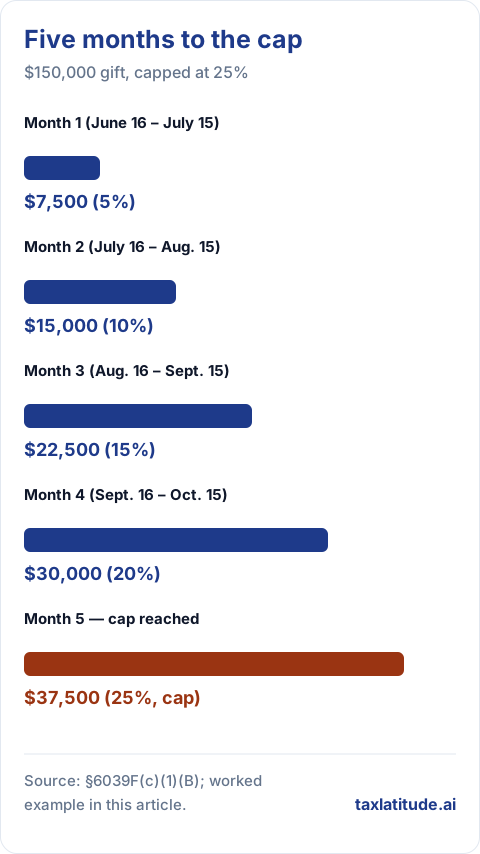
| Month of delay | Period after the June 15, 2026 due date | Cumulative rate | Cumulative penalty on $150,000 |
|---|---|---|---|
| 1 | June 16 – July 15, 2026 | 5% | $7,500 |
| 2 | July 16 – Aug. 15, 2026 | 10% | $15,000 |
| 3 | Aug. 16 – Sept. 15, 2026 | 15% | $22,500 |
| 4 | Sept. 16 – Oct. 15, 2026 | 20% | $30,000 |
| 5 | Oct. 16 – Nov. 15, 2026 | 25% (cap) | $37,500 |
| 6 and later | After Nov. 15, 2026 | 25% (cap) | $37,500 |
If Sarah is reading this in early November 2026 and still has not filed, she is already in the fifth month. In the worst case, the penalty has effectively reached its ceiling. Waiting longer does not raise the penalty further, but it does nothing to help her reasonable-cause story, and that story is now her main line of defense. If she had extended to October 15, she would be in only the first month, with a $7,500 exposure.
What are five ways the story can end?
The same $150,000 gift can produce outcomes ranging from $0 to $37,500. The difference depends almost entirely on timing, explanation and the procedural route.
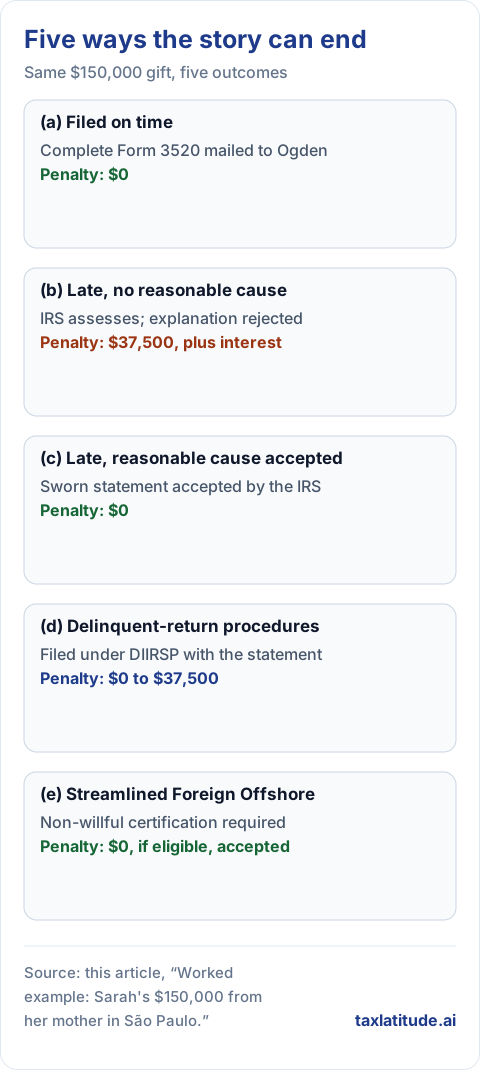
| Scenario | What Sarah does | US income tax on the gift | §6039F penalty |
|---|---|---|---|
| (a) Filed on time | Mails a complete Form 3520 to Ogden by June 15, 2026 (or Oct. 15 with an extension) | $0 | $0 |
| (b) Late, no reasonable cause | Files in late October 2026; IRS assesses and does not accept her explanation | $0, unless the IRS determines otherwise under §6039F(c)(1)(A) | $37,500, plus interest |
| (c) Late, reasonable cause accepted | Files late with a persuasive, sworn reasonable-cause statement; IRS accepts it before or after assessment | $0 | $0 |
| (d) Late via the delinquent-return procedures | Files under the IRS's Delinquent International Information Return Submission Procedures with a reasonable-cause statement | $0 | $0 to $37,500, depending on whether reasonable cause is accepted |
| (e) Streamlined Foreign Offshore | Also has unreported income and uses Streamlined, including Form 3520 | $0 on the gift; tax and interest on the unreported income | $0, if eligible and the IRS accepts the submission |
Scenario (a): filed on time. This is the boring outcome, and it is the whole point of this article. Sarah lists the gift in Part IV, attaches her statement of residence abroad, mails the form to Ogden, and owes nothing. The gift is excluded from her income under §102(a). Her mother's identity and the gift's value are now on record with the IRS. That record is useful later if the money is ever questioned, for example when Sarah moves funds to a US account or sells the apartment.
Scenario (b): late, no reasonable cause. If Sarah files in late October 2026 and the IRS assesses the penalty, the starting figure is $37,500 under the table above. If she cannot show reasonable cause, that figure stands. She can still ask Appeals to review it. The IRS told the Taxpayer Advocate that taxpayers "may request review by the Independent Office of Appeals before payment" (TAS 2023 Most Serious Problem #8). As the Huang case discussed below shows, administrative review can remove a large part of an assessed penalty, even when it does not remove all of it. There is also the second statutory consequence: the IRS may determine the tax consequences of the gift. If Sarah's records clearly show a gift from her mother, that should not change her tax. If the paper trail is weak, the question "was this really a gift?" becomes harder to answer years later.
Scenario (c): late, reasonable cause accepted. If the IRS accepts that her failure was due to reasonable cause and not willful neglect, the penalty is zero (§6039F(c)(2)). Whether she gets there depends on facts we discuss in the next section. Did she ask a qualified adviser? Was she told specifically that no filing was required? Did she act promptly once she learned of the rule? Has she complied in other years? Her current explanation ("a friend said gifts aren't taxable") is the kind of reason the Manual treats skeptically, as we explain below.
Scenario (d): late via the delinquent-return procedures. The IRS's Delinquent International Information Return Submission Procedures are the standard route for someone in Sarah's position. That means someone who has reported all her income and is not under examination. She files the late Form 3520 under its own instructions (to Ogden, not attached to an amended Form 1040). She writes "Reasonable Cause Statement attached" at the top of the first page and includes the statement. The IRS says that for Forms 3520 and 3520-A, "reasonable cause statements will be considered prior to a penalty being assessed" (IRS, Delinquent International Information Return Submission Procedures). The same page also warns that "penalties may be assessed in accordance with existing procedures." So DIIRSP is a way of presenting your case, not an amnesty. The outcome still ranges from $0 to $37,500.
Scenario (e): Streamlined Foreign Offshore. Now change the facts. Suppose Sarah parked the $150,000 in a Portuguese savings account for a year before buying, earned interest on it, and did not report that interest. She now has unreported income as well as a missing Form 3520. Under the Streamlined Foreign Offshore Procedures, an eligible taxpayer files three years of returns "together with all required information returns (e.g., Forms 3520, 5471, and 8938)." A taxpayer who complies is generally not subject to information-return penalties for those years, unless an examination finds fraud or a willful FBAR violation (IRS, U.S. taxpayers residing outside the United States). Eligibility requires meeting a non-residency test and certifying that the failures were non-willful, meaning due to "negligence, inadvertence, or mistake." Penalties already assessed for those years are not abated (same). For Sarah, this route trades the uncertainty of a reasonable-cause request for a certification and the tax and interest on her unreported income. If she also has foreign accounts, Streamlined filings typically bring other reporting, such as FBARs and Form 8938, into the same package. Those are separate topics.
What does the example show?
Notice what drives the numbers. The tax on the gift is zero in every scenario. The swing from $0 to $37,500 is driven by three things: the date the paper reaches Ogden, the quality of Sarah's explanation, and whether her broader tax situation qualifies her for a program with built-in penalty protection. The size of the gift sets the ceiling; those three things decide where under it Sarah lands. That is why a calculator cannot tell Sarah, or you, what she will actually pay.
Is reasonable cause a real defense, and how well-tested is it in court?
The statute does not define reasonable cause, and there are no final regulations under §6039F. The IRS's general penalty-relief rules fill the gap. The Manual says relief is generally granted when the taxpayer "exercised ordinary business care and prudence" (IRM 20.1.1.3.2). The 2024 proposed regulations would apply the same principles. Reasonable cause would be determined case by case under Treas. Reg. §1.6664-4 and §301.6651-1(c) and would require a statement signed under penalties of perjury (89 Fed. Reg. 39440, prop. §1.6039F-1(e)(2)). The proposed rules are not in force. But the sworn-statement requirement already applies in practice, because the Manual requires a written statement, signed under penalty of perjury, for relief from information-return penalties (IRM 20.1.1.3.1).
What the IRS says will not work on its own. The Manual's guidance is blunt in several places that matter to expats. "A first-time failure to comply does not by itself establish reasonable cause" (IRM 20.1.1.3.2.2). On ignorance of the law, "reasonable cause should never be presumed." The reviewer asks, among other things, whether you had previously been subject to the requirement (IRM 20.1.1.3.2.2.6). The international-penalty chapter says relief should not be granted "merely because" a foreign country would penalize disclosure, or because the taxpayer relied on another person to file (IRM 20.1.9.1.5). The Form 3520 instructions add that a foreign country's disclosure penalties are not reasonable cause (Instructions for Form 3520, Penalties). That sentence sits in the instructions' general, trust-focused penalty discussion. The parallel rule is written into the statute for the trust penalty (§6677), not for §6039F.
Reliance on an adviser is the most common argument, and the most misunderstood. The Supreme Court's decision in United States v. Boyle distinguishes between relying on an adviser's substantive advice about whether something must be filed, which can be reasonable, and delegating the mechanical task of filing on time, which generally is not (United States v. Boyle, 469 U.S. 241 (1985)). The Manual follows the same line. Advisor-reliance relief outside the accuracy penalty applies only in "very limited instances" and is "limited to issues generally considered technical" (IRM 20.1.1.3.3.4.3). An expat who gave a qualified US preparer full information about a $150,000 gift and was told no form was needed has a much stronger story than one who never mentioned the gift, or than one who knew about the form and simply left it to someone else to mail.
Other facts that help. The Manual recognizes that death, serious illness or unavoidable absence may establish reasonable cause (IRM 20.1.1.3.2.2.1). An inheritance that arrives in the chaos after a parent's death abroad may fit that description. It also recognizes that an inability to obtain records "may constitute reasonable cause in some instances" (IRM 20.1.1.3.2.2.3). The IRS's public penalty page frames the question around whether you "acted responsibly before and after the failure" (IRS, International information reporting penalties). Speed matters. So does consistency across years. Before an examiner considers reasonable cause, the Manual recommends checking whether the taxpayer received similar gifts in any other open year (IRM 20.1.9.10.5). If you missed 2023 and 2025, file both before asking for relief.
What First-Time Abate will not do. Many taxpayers have had a late-filing penalty removed under the IRS's First-Time Abate policy. It does not apply here. The Manual lists Form 3520 among the returns for which First-Time Abate "is NOT applicable" (IRM 20.1.1.3.3.2.1(8)). The IRS has also announced a new "Automatic Exemption from Penalty" to replace First-Time Abate for returns originally due on or after January 1, 2027. Its announcement says information returns and returns filed in response to infrequent events are generally not eligible (IR-2026-83). For Form 3520 gifts, reasonable cause remains the operative standard.
What have the courts actually decided?
Here we have to be candid. As of November 2026, we found no court decision that resolves a §6039F reasonable-cause defense on the merits, either for or against a taxpayer. We also found no private letter ruling on the question. We are not going to invent a body of precedent that does not exist. What does exist is instructive.
In Huang v. United States, Jiaxing Huang received gifts in 2015 and 2016 from her nonresident parents to help her relocate and buy a house. According to her complaint, TurboTax told her that money she received did not need to be reported; she learned of Form 3520 in April 2018 and filed promptly. The IRS automatically assessed penalties of $62,496.25 for 2015 and $28,742.50 for 2016, and denied reasonable cause in 2019. As the court recounts the allegations, the penalty then grew to more than $153,000 while her appeal was pending. In August 2023 the IRS abated $117,243.25 and sustained the remaining $36,495.50 for lack of reasonable cause. She paid it and sued for a refund (Huang v. United States, No. 24-cv-06298-RS (N.D. Cal. May 28, 2025), at 2–3). The court refused to dismiss her reasonable-cause claim. It held that the complaint plausibly alleged reasonable cause, noting that the Tax Court has accepted good-faith reliance on tax software as capable of supporting the defense, and concluded that it was "premature to dash her claim at the pleadings" (Huang, at 7–8). This is a pleading-stage ruling. It says her story was good enough to proceed, not that it wins.
In Jinming Zhang v. IRS, the plaintiff challenged a §6039F penalty assessed over 2017 gifts from family in China. In May 2026 the court sent her reasonable-cause claim, and a claim that the IRS lacked required supervisory approval under §6751(b), to discovery (Zhang v. IRS, No. 24-cv-08210-AMO (N.D. Cal. May 4, 2026), at 14). Again, there is no merits ruling yet. The same order rejected an argument that the penalty is an unconstitutionally excessive fine. It called tax penalties "remedial" and held that this one "is not a fine" (Zhang, at 13–14). In Huang, by contrast, the §6751(b) supervisory-approval claim was dismissed. The record showed a manager's approval of the assessment, and the claim was also held waived (Huang, at 10–11).
The closest thing to a reasoned decision is on the trust side of the same form. In James v. United States, a physician who had not filed Forms 3520 for contributions to a Nevis trust argued that he relied on his CPA. The court denied the government summary judgment, because whether the CPA advised that no filing was required, and whether reliance was reasonable, were genuine questions of fact. It applied the standard that reasonable cause exists when a taxpayer "exercises ordinary care and prudence." It expressly declined to reach the government's Boyle argument (James v. United States, No. 8:11-cv-271 (M.D. Fla. Aug. 14, 2012)). That case concerned §6677, not §6039F. It is an analogy, not authority for gifts.
The numbers behind the IRS's own practice are more encouraging than the case law. The Taxpayer Advocate reported that for 2018–2021, the IRS abated 67% of §6039F penalties assessed, representing 78% of the dollars, more than $179 million in total. It also reported that even taxpayers reporting $400,000 or less in income received an average penalty above $235,000 (National Taxpayer Advocate blog, Oct. 25, 2024). Read those figures carefully. They show that most assessed foreign-gift penalties were eventually removed. They do not tell you why, how long it took, or what it cost the taxpayer in professional fees to get there. Ms. Huang's case took from 2018 to a lawsuit in 2024.
Did the IRS stop automatic penalties?
Until recently, the most common way a foreign-gift penalty arrived was automatically. You filed a late Form 3520, and a CP15 penalty notice followed, often before anyone read your explanation. The Manual still authorizes the campus to assert the penalty on late-filed forms (IRM 20.1.9.10.3). That chapter's current revision dates from January 2021 (IRM 20.1.9).
In October 2024, that changed, at least as policy. The National Taxpayer Advocate reported that "the IRS has ended its practice of automatically assessing penalties at the time of filing for late-filed Forms 3520, Part IV." The change was announced by then-Commissioner Danny Werfel (NTA blog, Oct. 25, 2024). The IRS's delinquent-return page now says reasonable-cause statements on Forms 3520 will be considered before a penalty is assessed (IRS, DIIRSP).
There are two reasons not to treat this as a guarantee. First, we found no IRS news release, interim guidance or revised Manual text implementing the change. The source is the Advocate's account of the Commissioner's remarks. Second, a later Advocate page describes the commitment more narrowly. It says penalties are not automatically assessed "if there is a reasonable cause (RC) statement attached to the return and the RC is accepted" (TAS FY2025 Objective 8). Those two descriptions are not the same. The practical lesson is the same under either one: never file a late Form 3520 without a reasonable-cause statement attached. Under the narrower reading, the statement is what keeps the penalty from being assessed automatically.
How do you fix a missed Form 3520, and how do you contest a bill?
If you have read this far and realized you missed a filing, the order of operations matters more than the speed of your reaction. That said, speed helps.
If all your income was reported and you have not been contacted by the IRS, the delinquent-return procedures are the usual route. They are available to taxpayers who are not under civil examination or criminal investigation and who have not already been contacted by the IRS about the delinquent returns (IRS, DIIRSP). For Form 3520, the steps are as follows. File it according to its own instructions (to Ogden). Mark it "Reasonable Cause Statement attached." Attach a factual statement signed under penalties of perjury (IRS, DIIRSP; IRS, DIIRSP FAQ). The IRS's archived FAQ notes that the old automatic-relief rule for fully compliant taxpayers was eliminated in 2014. Penalties "may be imposed" under these procedures if the IRS does not accept the explanation (IRS, DIIRSP FAQ).
If you also have unreported income, compare DIIRSP with Streamlined. The FAQ says unreported income does not bar you from filing delinquent information returns (IRS, DIIRSP FAQ). But for expats who qualify, Streamlined Foreign Offshore offers what DIIRSP does not: a waiver of information-return penalties as part of the program (IRS, U.S. taxpayers residing outside the United States). The trade-off is a non-willfulness certification that must be true and that the IRS can test.
Already missed a filing, and not sure which program fits? DIIRSP and Streamlined have very different trade-offs, and the wrong choice can cost real money. Ask TaxLatitude which route fits your situation →
If you receive a penalty notice, the IRS says you can call or write explaining why it should reconsider. After paying, you can file Form 843 to claim a refund and request abatement (IRS, International information reporting penalties). Appeals review is available before payment (TAS 2023 Most Serious Problem #8). Going to court is harder. The penalty is not subject to deficiency procedures, so there is no ordinary prepayment Tax Court case (IRM 20.1.9.1.5). The litigated cases show two paths. The first is to pay in full, file a refund claim and sue in district court, as in Huang and Zhang, consistent with the full-payment rule of Flora v. United States (Flora v. United States, 362 U.S. 145 (1960)). The second is to raise the penalty in a Collection Due Process hearing when the IRS moves to collect, which is how Farhy and Mukhi reached the Tax Court. That route has a catch: in a CDP case you can generally contest the underlying liability only if you did not have a prior opportunity to dispute it, and the regulations say that such an opportunity "includes a prior opportunity for a conference with Appeals that was offered either before or after the assessment" (26 U.S.C. §6330(c)(2)(B); Treas. Reg. §301.6330-1(e)(3), Q&A-E2). The Tax Court upheld that regulation in Lewis v. Commissioner, 128 T.C. 48 (2007). In practice, once Appeals has heard the penalty, or merely offered to, the CDP route to contesting it on the merits is likely closed, and a refund suit is what remains. The Zhang court dismissed an attempt to use the Administrative Procedure Act instead, holding that a refund suit is an adequate remedy (Zhang, at 11–12). In Huang, the court dismissed claims the taxpayer had not raised in her administrative refund claim as waived (Huang, at 10). So what you put in writing to the IRS early can limit what you can argue in court later.
Does Farhy let you challenge the penalty? Not for Form 3520 so far
You may have read that a 2023 Tax Court case, Farhy, held that the IRS cannot assess international information-return penalties without going to court. That overstates it. The Tax Court's holding concerned one penalty, for Form 5471, not the Form 3520 gift penalty, and even that holding has since been rejected by two federal courts of appeals.
In Farhy v. Commissioner, the Tax Court held that the IRS "lacks statutory authority to assess" penalties under §6038(b), the penalty for failing to file Form 5471 for a foreign corporation. The court reasoned that §6038(b) provides for a penalty but not for an assessable one. It concluded that a penalty with no specified mode of collection must be recovered in a civil suit (Farhy v. Commissioner, 160 T.C. 399, 399, 407 (2023)). The D.C. Circuit reversed in 2024 (Farhy v. Commissioner, 100 F.4th 223 (D.C. Cir. 2024), as described in Safdieh v. Commissioner, slip op.). The Tax Court then reaffirmed its view in a reviewed opinion in Mukhi, for a case appealable to the Eighth Circuit, stating it was "not bound" to follow the D.C. Circuit (Mukhi v. Commissioner, 163 T.C. No. 8 (2024)). In February 2026 the Second Circuit sided with the D.C. Circuit. It held that "the Commissioner can assess penalties incurred under § 6038(b)," relying on decades of IRS practice, the statute's structure and congressional acquiescence (Safdieh v. Commissioner, 169 F.4th 102 (2d Cir. Feb. 27, 2026)). Mr. Safdieh asked the Supreme Court for more time to seek review, and on September 8, 2026 Justice Sotomayor extended his deadline to file a petition for certiorari to November 23, 2026. As of this writing, no petition appears on the docket (Supreme Court Docket No. 26A314). So for Form 5471 the question is genuinely split, and it may reach the Supreme Court.
None of those decisions addresses §6039F. The question for this article is whether the same argument works for the foreign-gift penalty. Two judges of the same federal district court have now answered it, and both said no.
In Huang, the court dismissed the claim that the IRS lacked authority to assess. It noted the D.C. Circuit's reversal of Farhy, observed that it "makes no sense" to treat a penalty placed within the tax code as outside the IRS's power to assess and collect, and, drawing on the D.C. Circuit's reasoning, pointed out that §6039F's reasonable-cause defense fits a post-assessment administrative process. It also held the argument waived because it had not been raised in the administrative refund claim (Huang, at 9–10). In Zhang, the court gave the fuller analysis. It read §6039F(c) together with §6201(a), which authorizes the IRS to assess "all taxes (including ... assessable penalties)." It found that by requiring payment "upon notice and demand ... and in the same manner as tax," Congress "clearly indicated its intent to treat this penalty as a 'tax'" (Zhang, at 8–10).
That statutory language is the key difference. Section 6038(b) has no comparable phrase, and the Tax Court in Farhy noted that §6038 contains only a cross-reference to a criminal penalty (Farhy, 160 T.C. at 406). Section 6039F says in so many words that the penalty is paid on notice and demand and in the same manner as tax (§6039F(c)(1)(B)). The Tax Court's own Farhy opinion described assessable penalties as those that must be paid upon notice and demand and collected in the same manner as taxes (Farhy, 160 T.C. at 410). Read literally, that suggests even the Tax Court's reasoning would treat §6039F as assessable. That is our inference; no Tax Court opinion has said so.
Keep the limits in view. Huang and Zhang are district court rulings from one federal district (the Northern District of California). They bind no other court. No court of appeals and no Tax Court opinion has decided §6039F assessability. A Supreme Court decision in Safdieh, if one comes, would address §6038(b), and its reasoning could cut either way for §6039F. But anyone telling you today that Farhy makes your Form 3520 gift penalty unenforceable is getting ahead of every court that has actually looked at the question.
What can't an article tell you about your own gift?
Everything above is the general framework. It cannot answer the questions that decide your bill. Is your parent actually a nonresident alien for US purposes? A parent who obtained a green card decades ago and never formally gave it up may still be a US resident for tax purposes, and a parent who renounced citizenship may be a covered expatriate. Are the different wires from your relatives related-party gifts that must be aggregated? Did money from a family company or a family foundation fall under the lower corporate and partnership threshold, or under the trust rules instead? What exchange rate puts you over or under $100,000? Which months of delay will the IRS count? And would your reason for missing the form satisfy a reviewer who reads it against "ordinary business care and prudence"? The IRS decides reasonable cause on all the facts and circumstances, case by case. It also tells its own examiners to look at your other open years before they decide. Two readers with identical $150,000 gifts can face a $0 bill and a $37,500 bill because of differences that never appear in a headline.
The honest conclusion is therefore narrower than "file Form 3520." If a gift or inheritance has not arrived yet, prevention is cheap: document it as a gift, put the due date in your calendar (June 15 if you qualify as living abroad, October 15 if you extend), and mail a complete form to Ogden. If you have already missed the deadline, you are making choices that are hard to undo. Those choices include which program to use, what to say under penalty of perjury, which years to include, and whether to raise arguments now that you may later need in court. They depend on your amounts, your donors' status, your country and your filing history. They are worth working through with someone who can see your actual facts before anything goes in the envelope.
FAQ: the Form 3520 foreign gift penalty
Do I owe tax on a gift from a foreign family member?
No. Gifts, bequests and inheritances are generally excluded from the recipient's gross income. The statute requiring Form 3520, IRC §6039F, imposes no tax of its own — it only requires information about the gift, and penalizes failing to provide it. Interest, dividends or rent the money later earns is separately taxable as ordinary income.
What is the real threshold for reporting a foreign gift on Form 3520?
The statute itself sets a single threshold of $10,000, indexed for inflation. In practice, two different figures apply: the IRS raised the threshold for gifts from nonresident alien individuals or foreign estates to $100,000 administratively, through Notice 97-34, while gifts from a foreign corporation or foreign partnership fall back to the statutory, inflation-adjusted figure, $20,573 for 2026.
How is the Form 3520 penalty for a late foreign gift report calculated?
5% of the value of the foreign gift for each month the failure continues, capped at 25% total. The penalty is computed on the entire gift, not just the amount above the threshold, and it has nothing to do with how much tax was actually at stake, which in a typical family gift is zero.
When is Form 3520 due for Americans living abroad?
The regular due date is the 15th day of the 4th month after the tax year ends, April 15 for most filers. US citizens or residents living outside the United States and Puerto Rico get an automatic extension to June 15, with a statement attached confirming eligibility, and the deadline moves to October 15 if you have an extension on your income tax return.
Can I e-file Form 3520?
There's no IRS confirmation that it can be filed electronically. The current instructions direct filers to mail a paper Form 3520 separately to the IRS Service Center in Ogden, Utah, even if the related Form 1040 is e-filed, and only a complete form is considered timely filed.
Is there any defense against the Form 3520 penalty?
The one statutory escape is showing "reasonable cause and not willful neglect," with the burden on the taxpayer to prove it. No court decision found rules on the merits of that defense for this specific penalty, and the two court decisions that have considered a separate challenge to how the IRS assesses the penalty (the "Farhy" argument) both rejected it for Form 3520.
Sources
Primary sources (accessed November 6, 2026)
- 26 U.S.C. §6039F (govinfo)
- 26 U.S.C. §102 (Cornell LII)
- 26 U.S.C. §672 (govinfo, 2019 ed.)
- 26 U.S.C. §6501 (govinfo, 2023 ed.)
- Farhy v. Commissioner, 160 T.C. 399 (2023)
- Safdieh v. Commissioner, Supreme Court Docket No. 26A314 (application for extension; granted Sept. 8, 2026)
- Huang v. United States, No. 24-cv-06298-RS (N.D. Cal. May 28, 2025)
- 26 U.S.C. §6330 (Cornell LII)
- 26 U.S.C. §7701(a)(30) (Cornell LII)
- Proposed regulations REG-124850-08, 89 Fed. Reg. 39440 (May 8, 2024)
- Treas. Reg. §301.6330-1(e)(3), Q&A-E2 (Cornell LII)
- Rev. Proc. 2024-40 (2025 inflation adjustments)
- Rev. Proc. 2025-32 (2026 inflation adjustments)
- Instructions for Form 3520 (Rev. December 2025), HTML
- IRS, Gifts from foreign person
- IRS, International information reporting penalties
- IRS, Delinquent International Information Return Submission Procedures
- IRS, DIIRSP Frequently Asked Questions
- IRS, U.S. taxpayers residing outside the United States (Streamlined Foreign Offshore)
- IRM 20.1.9, International Penalties
- IRM 20.1.1, Introduction and Penalty Relief
- Chief Counsel Advice 201402010
- IR-2026-83 (July 8, 2026)
- IRS Nationwide Tax Forum 2023, "Foreign Gift and Trust Reporting on Form 3520 and 3520-A"
- NTA blog, Oct. 25, 2024
- 2023 Annual Report, Most Serious Problem #8
- FY2025 Objectives Report, Objective 8
Secondary sources
- Mukhi v. Commissioner, 163 T.C. No. 8 (2024) (copy of opinion) (secondary source)
- Safdieh v. Commissioner, 169 F.4th 102 (2d Cir. Feb. 27, 2026) (secondary source)
- Zhang v. IRS, No. 24-cv-08210-AMO (N.D. Cal. May 4, 2026) (copy of order) (secondary source)
- James v. United States, No. 8:11-cv-271 (M.D. Fla. Aug. 14, 2012) (secondary source)
- United States v. Boyle, 469 U.S. 241 (1985) (secondary source)
- Flora v. United States, 362 U.S. 145 (1960) (secondary source)
- Notice 97-34 (copy filed with OMB) (secondary source)
This article explains US federal tax law as of November 2026 and is not tax advice for any individual situation. Anyone who has received or expects to receive a gift or inheritance from someone outside the United States should have their specific facts reviewed by a qualified US international tax professional before deciding what to file.