Key takeaways
- First-Time Abatement almost never applies to international information return penalties. The IRM explicitly excludes Forms 3520 and 5471 from FTA, which only covers failure-to-file/pay/deposit penalties — relief instead runs through the much stricter "reasonable cause" standard.
- FBAR penalties can't be fixed with Form 843 at all. FBAR arises under Title 31, not the tax code, and the IRS manual says "provisions of the IRC generally do not apply to FBARs" — a separate administrative appeal or refund suit is the only route.
- "My preparer forgot" doesn't count as reasonable cause — but a preparer's written legal advice can. Under the Supreme Court's Boyle decision, relying on an agent doesn't excuse a late filing, but relying on an accountant or attorney's substantive advice on a point of tax law can.
- A foreign country's own secrecy law is explicitly not a valid excuse. IRM 20.1.9 states this directly for international penalties — citing local confidentiality rules for missing a Form 3520 or 5471 will not succeed.
- The $10,000 Form 5471/5472/8938 penalty can balloon fast once the IRS sends a notice. A continuation penalty adds $10,000–$25,000 per 30-day period after a 90-day grace window, and for Forms 6038/6038A the IRM says this add-on has no reasonable cause exception at all.
- A 2026 replacement for First-Time Abatement won't help here either. The incoming "Automatic Exemption from Penalty," effective for returns due on or after January 1, 2027, still generally excludes information returns filed only in response to specific transactions or infrequent events — the same category that already excludes these penalties from FTA today.
Form 843, Claim for Refund and Request for Abatement, is the IRS form that US citizens and green card holders abroad most often end up using after a penalty notice arrives for a late or missing international information return: $10,000 for a Form 5471, $10,000 for a Form 8938, or a percentage of a foreign gift reported late on Form 3520. This article covers which of those penalties Form 843 can reach, the legal standard the IRS applies, how to complete and file the form, and how it fits next to the IRS's delinquent-filing and offshore compliance procedures.
The point most often missed comes first. First-Time Abatement (FTA), the IRS administrative waiver for first-time filing and payment penalties, generally does not apply to international information return penalties. The Internal Revenue Manual limits FTA to failure-to-file penalties under IRC 6651(a)(1), 6698(a)(1) and 6699(a)(1), failure-to-pay penalties under 6651(a)(2) and (a)(3), and failure-to-deposit penalties under 6656. It also names Forms 3520 and 5471 among the returns FTA does not cover (IRM 20.1.1.3.3.2.1). Relief for a Form 5471, 3520, 3520-A, 8938, 8865, 926 or 5472 penalty runs through reasonable cause instead. That is a stricter, fact-specific showing, made in writing under penalties of perjury, that you exercised ordinary business care and prudence and still failed to comply (IRM 20.1.9).
FBAR penalties are a separate track. They arise under Title 31, and the IRS's manual states that "Provisions of the IRC generally do not apply to FBARs" (IRM 4.26.16.5.1). A worked example follows the filing instructions: a US citizen in Lyon who missed two years of Form 5471 for his French company.
What Form 843 is, and what it is not
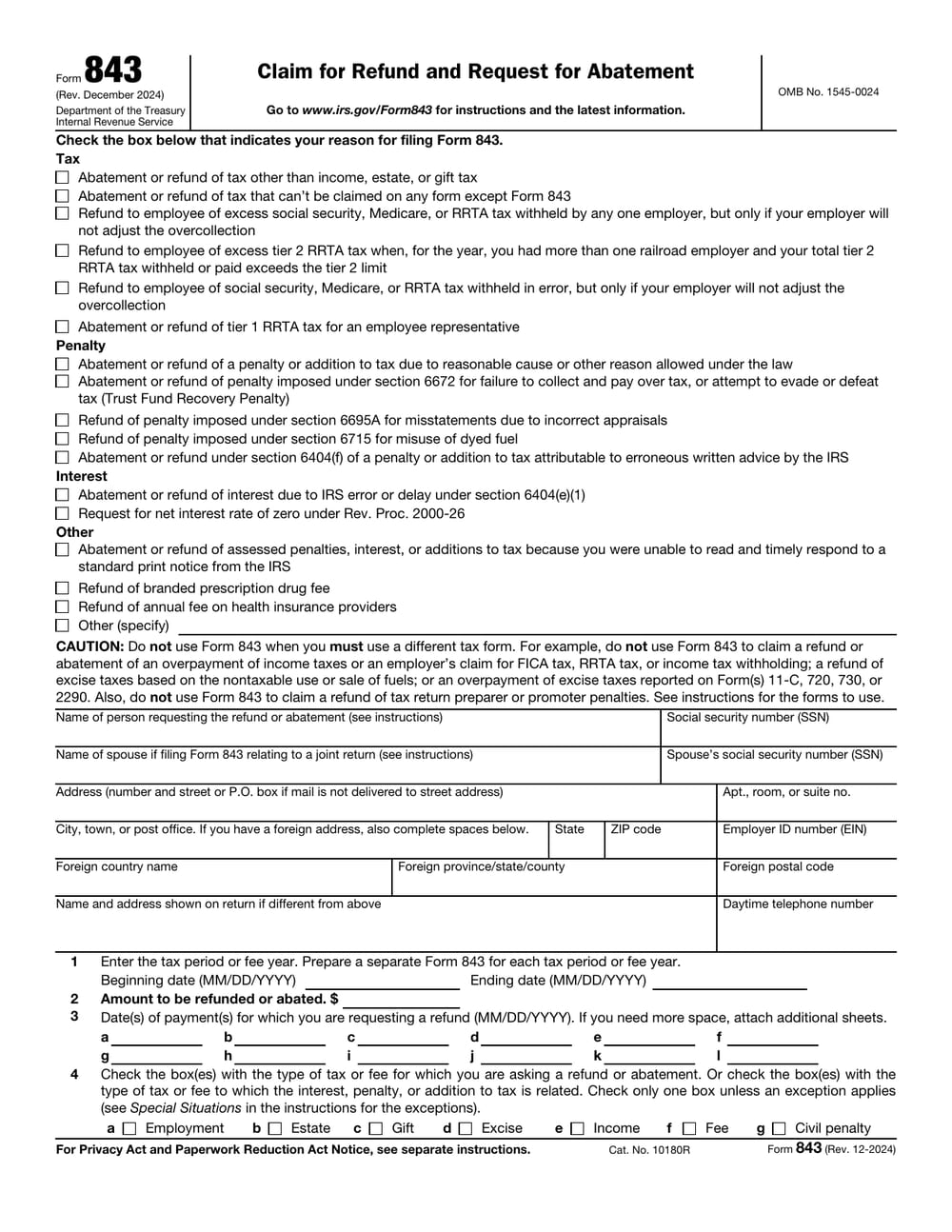
The current version is Form 843 (Rev. December 2024), a redesign of the form and its instructions (Instructions for Form 843, What's New). It is used to "claim a refund or request an abatement of certain taxes, penalties, additions to tax, interest, and fees." That includes "An abatement or refund of a penalty or addition to tax due to reasonable cause or other reason allowed under the law" (Instructions for Form 843, Purpose of Form). The lines that matter for a penalty request on the redesigned form are (Form 843):
Form 843 (Rev. December 2024)
Download Form 843 (PDF) · Instructions for Form 843 (PDF)
Local copies for convenience, downloaded from IRS.gov on November 14, 2026. Always confirm you have the current revision at irs.gov/form843 before filing.
- Reason box above the name block. Check the Penalty box for reasonable cause. The instructions say "Do not check more than one box."
- Line 1. The tax period. "Prepare a separate Form 843 for each tax period or fee year."
- Line 2. The amount to be refunded or abated.
- Line 3. Payment dates, only if you are claiming a refund.
- Line 4. Type of tax or fee. Box 4g is "Civil penalty."
- Line 5. Type of return. Box i is Form 1040, and box n is "Other (specify)."
- Line 6. The Internal Revenue Code section of the penalty, which the instructions say generally appears on the IRS notice.
- Line 7. Reason boxes a through d. Box c reads "Reasonable cause or other reason allowed under the law can be shown."
- Line 8. "Explain why you believe this claim or request should be allowed and show how you computed the amount shown on line 2."
The instructions also say what the form cannot do: "Do not use Form 843 to request an abatement of income, estate, or gift tax" (Instructions for Form 843). Section 6404(b) bars abatement claims for taxes imposed under subtitles A and B (26 USC 6404(b)). That bar does not block penalty requests: the IRS's own international penalties page points taxpayers to Form 843 for these penalties, as discussed below. Form 843 is also not used for income tax refunds, amended returns, installment agreement or offer-in-compromise fees, or preparer penalties, which go on Form 6118 (Instructions for Form 843).
Form 843 is filed on paper. The only electronic channel is limited to certain individuals claiming fully paid penalties and interest under Kwong v. United States (IRS, Kwong claims).
Form 843 is the formal claim. A signed request in another format is treated as an informal claim (IRM 20.1.1, Exhibit 20.1.1-8). Either way, the request must be in writing. The IRM limits oral requests to failure-to-file, failure-to-pay and failure-to-deposit penalties. For other penalties, information return penalties included, the taxpayer "must provide a written statement, signed under the penalty of perjury" (IRM 20.1.1.3.1). The IRS's international penalties page says "If you pay the penalty, you may file Form 843," with a letter, a copy of the notice and supporting documents (IRS, International information reporting penalties).
FBAR penalties are outside Form 843
When the IRS enforces the FBAR, the manual says it "is not acting under Title 26 but, instead, is acting under the authority of Title 31," and that IRC provisions generally do not apply (IRM 4.26.16.5.1). Form 843 never mentions the FBAR, and line 6 asks for an IRC section. FBAR penalties "may be appealed administratively" under IRM 8.11.6. After assessment, a filer may "pay the penalty and file a refund suit," or wait for the government's collection suit and contest the assessment there (IRM 8.11.6.2). FBAR basics are in our FBAR guide for Americans abroad.
Which international penalties Form 843 can address
The table draws on the statutes and the IRS penalty summary (IRS, International information reporting penalties). The Title 26 dollar amounts are not indexed for inflation in the statutory text. The FBAR amounts are adjusted for inflation by regulation.
| Form | Penalty statute | Base penalty | Continuation after IRS notice | Reasonable cause provision | Form 843 available? |
|---|---|---|---|---|---|
| 5471 | IRC 6038(b); credit reduction under 6038(c) | $10,000 per foreign corporation per annual period | $10,000 per 30 days (or fraction) after 90 days; add-on capped at $50,000 | 6038(c)(4)(B) and Reg. 1.6038-2(k)(3) shift the deadline; the IRM says the continuation penalty has no reasonable cause exception | Yes |
| 8865 (ownership) | IRC 6038 | $10,000 per failure | Same as 5471, up to $50,000 | Same as 5471 | Yes |
| 8865 (contributions) and 926 | IRC 6038B(c) | 10% of fair market value, capped at $100,000 unless the failure was due to intentional disregard | None stated | 6038B(c)(2): reasonable cause and not willful neglect | Yes |
| 3520 (trust parts) | IRC 6677(a) | Greater of $10,000 or 35% of the gross reportable amount | $10,000 per 30 days after 90 days; total capped at the gross reportable amount | 6677(d); a foreign disclosure penalty is not reasonable cause | Yes |
| 3520 Part IV (gifts) | IRC 6039F(c) | 5% of the gift per month, up to 25% | Built into the monthly rate | 6039F(c)(2), per IRM 20.1.9.10.5 | Yes |
| 3520-A | IRC 6677(b) | Greater of $10,000 or 5% of trust assets | $10,000 per 30 days; total capped at those assets | 6677(d) | Yes |
| 8938 | IRC 6038D(d) | $10,000 | $10,000 per 30 days after 90 days, capped at $50,000 | 6038D(g); Reg. 1.6038D-8(e) | Yes |
| 5472 | IRC 6038A(d) | $25,000 per taxable year | $25,000 per 30 days after 90 days; no statutory cap | 6038A(d)(3) shifts the deadline; the IRM says the continuation penalty has no reasonable cause exception | Yes |
| FBAR | 31 USC 5321(a)(5) | Non-willful: up to $16,536. Willful: greater of $165,353 or 50% of the balance | None | Non-willful only, and only if the balance was properly reported | No. It is a Title 31 penalty |
The FBAR maximums apply to penalties assessed on or after January 17, 2025, under 31 CFR 1010.821. The non-willful penalty "accrues on a per-report, not a per-account, basis" (Bittner v. United States).
Two side effects reach beyond the dollar penalty. First, if information required under sections including 6038, 6038A, 6038B, 6038D, 6046, 6046A or 6048 is missing, the assessment period for the related return stays open until three years after the IRS receives it. If the failure was due to reasonable cause, that extension is limited to the related items (26 USC 6501(c)(8)). Second, an underpayment tied to an unreported asset draws a 40% accuracy-related penalty instead of 20% (26 USC 6662(j)). Form 5471 filer categories are explained in our guide to owning a company abroad.
The reasonable cause standard behind every Form 843 request
The legal test
Reasonable cause exists "If the taxpayer exercised ordinary business care and prudence and was nevertheless unable to file the return" on time. The taxpayer must make "an affirmative showing of all facts alleged" in a written statement made under penalties of perjury (Treas. Reg. 301.6651-1(c)(1)). The international regulations repeat the affirmative-showing requirement (Reg. 1.6038-2(k)(3)(ii); Reg. 1.6038D-8(e)).
The IRM says reasonable cause "is based on all the facts and circumstances in each situation" (IRM 20.1.1.3.2). The factors it weighs are:
- whether the explanation matches the dates of the events;
- compliance history over "at least three" prior years;
- the time between the event and later compliance;
- whether the circumstances were beyond the taxpayer's control.
Two limits come with those factors: "a first-time failure to comply does not by itself establish reasonable cause," and reasonable cause ends if you do not comply within a reasonable period once the circumstances that explain the failure end (IRM 20.1.1.3.2 and 20.1.1.3.2.2).
Reliance on advisers: Boyle
In United States v. Boyle, the Supreme Court held that "The failure to make a timely filing of a tax return is not excused by the taxpayer's reliance on an agent." The Court distinguished substantive advice: "When an accountant or attorney advises a taxpayer on a matter of tax law," it is "reasonable for the taxpayer to rely on that advice" (United States v. Boyle, 469 U.S. 241 (1985)). So "my preparer forgot to attach Form 5471" fails, while "my preparer told me in writing that no Form 5471 was required" can succeed. The IRM still says reliance on another party generally is not a basis for reasonable cause (IRM 20.1.1.3.2.2.5), so a reliance argument needs documents showing what the adviser was told and what the adviser said.
Did your preparer simply miss a form, or actually give you written advice it wasn't required? Under Boyle, the first doesn't excuse a late filing — only documented substantive advice on the law can. Ask TaxLatitude whether your situation has a real reasonable-cause argument →
Ignorance of the law
The IRM's ignorance-of-the-law factors are:
- "The taxpayer's education";
- whether the taxpayer was previously subject to the requirement;
- whether the taxpayer "has been penalized before";
- recent changes in forms or law;
- the complexity of the issue.
It adds: "Reasonable cause should never be presumed, even in cases where ignorance of the law is claimed" (IRM 20.1.1.3.2.2.6).
International overlays in IRM 20.1.9
The international penalties chapter, which carries a January 29, 2021 transmittal, adds these rules (IRM 20.1.9):
- Penalties of perjury. Abatement requests "should contain a declaration that it is made under the penalties of perjury."
- Reliance on others. Relief should not be granted merely because the taxpayer "relied on another person to file returns."
- Foreign secrecy laws. A foreign country's disclosure penalty "is not reasonable cause" (26 USC 6677(d); Reg. 1.6038D-8(e)(3)).
- Foreign trustees. For Form 3520-A, "The U.S. owner is responsible for ensuring that Form 3520-A is filed timely." A trustee's failure is not reasonable cause for Forms 3520 or 3520-A.
- The Form 5471 deadline shift. Section 6038 does not simply excuse the penalty for reasonable cause. Instead, section 6038(c)(4)(B) treats the deadline, and the start of the 90-day period, as "not earlier than the last day on which (as shown to the satisfaction of the Secretary) reasonable cause existed" (26 USC 6038(c)(4)(B)). A Form 5471 statement must therefore cover the whole period up to the late filing. Section 6038A(d)(3) works the same way for Form 5472.
- Continuation penalties. For the section 6038 continuation penalty, "There is no reasonable cause exception for this penalty." The IRM says the same for section 6038A and for section 6679, the penalty for returns required under sections 6046 and 6046A (IRM 20.1.9.3.5, 20.1.9.5.5 and 20.1.9.15.5).
- Open years. For Forms 926 and 8938, the IRM recommends that reasonable cause "not be considered until the taxpayer has filed all open years." For foreign gifts, examiners first check other open years for similar gifts.
Why First-Time Abatement generally does not apply
FTA applies "the first time a taxpayer is subject to one or more of the referenced penalties," and the referenced penalties are those under sections 6651, 6698, 6699 and 6656 (IRM 20.1.1.3.3.2.1(1)-(2)). International information return penalties arise under other sections. The IRM also excludes them directly:
- Paragraph (7) rules out "Returns with an event-based filing requirement" and "Information reporting that is dependent on another filing, such as various forms that are attached."
- Paragraph (8) names Form 3520 and Form 5471 and says "The above items are not all inclusive" (IRM 20.1.1.3.3.2.1(7)-(8)).
Form 8938 is not named, but it is filed as an attachment to an income tax return, which is the kind of dependent filing paragraph (7) describes. IRM 20.1.9.3.5 adds that FTA provisions "do not apply to event-based filing requirements such as with Form 5471" (IRM 20.1.9.3.5). The IRS's public administrative relief page likewise excludes returns "filed once or infrequently" and information reporting that depends on another filing, though it does not name specific international forms (IRS, Administrative penalty relief).
The narrow back door
One exception exists. A Form 5471 penalty assessed systemically because the form was attached to a late Form 1120 or 1065 may be abated "using the same PRC" (penalty reason code) used for that return's failure-to-file penalty, FTA included, if there were no similar penalties in the three prior periods (IRM 20.1.9.3.5). Form 5472 penalties attached to a late Form 1120 get the same treatment (IRM 20.1.9.5.5). This relief follows the main return's abatement. The IRM describes it only for Forms 1120 and 1065, not for a Form 5471 filed with a Form 1040 or 1040-X.
Assuming your first Form 5471 or 3520 penalty gets waived automatically? First-Time Abatement almost never reaches these forms — the IRM names them specifically as excluded, so relief runs through the much stricter reasonable-cause standard instead. Ask TaxLatitude what actually applies to your penalty →
The 2026 Automatic Exemption from Penalty
In IR-2026-83 (July 8, 2026), the IRS announced the Automatic Exemption from Penalty (AEP). AEP "will replace First Time Abate for eligible returns with original due dates on or after Jan. 1, 2027." It covers failure-to-file, failure-to-pay and failure-to-deposit penalties, and "information returns and returns that are filed only in response to specific transactions or infrequent events" generally are not eligible (IR-2026-83). International information return penalties therefore remain a reasonable cause question.
How Form 843 fits alongside DIIRSP, Streamlined and other options
The IRS lists three options for past noncompliance: the Voluntary Disclosure Practice, the Streamlined Filing Compliance Procedures, and the Delinquent International Information Return Submission Procedures (DIIRSP) (IRS, Options available). Each option sets out how to come into compliance. Form 843 handles penalties that are assessed anyway.
DIIRSP
DIIRSP covers taxpayers who are not under civil examination or criminal investigation and "have not already been contacted by the IRS about the delinquent information returns." Under the current page:
- late information returns other than Forms 3520 and 3520-A "should be attached to an amended income tax return";
- "Penalties may be assessed in accordance with existing procedures";
- filers "may attach a reasonable cause statement," but penalties "may be assessed without considering the attached reasonable cause statement," and filers may need to "submit or resubmit reasonable cause information";
- for Forms 3520 and 3520-A, reasonable cause statements "will be considered prior to a penalty being assessed," and filers write "Reasonable Cause Statement attached" on top of the first page.
The page lists no mailing address and no required statement contents. The penalties-of-perjury requirement comes from the regulations quoted above and the IRM (IRM 20.1.9.2). When a penalty is assessed on a DIIRSP filing, the path is the penalty notice, a written abatement request and, if relief is denied, Appeals.
Forms 3520 and 3520-A since October 2024
According to the Taxpayer Advocate Service, the IRS "has ended its practice of automatically assessing penalties at the time of filing for late-filed Forms 3520, Part IV." TAS also reported that the IRS would review reasonable cause statements attached to late trust filings before assessing section 6677 penalties (NTA Blog, October 2024). TAS further reported that the IRS updated IRM 20.1.9.13.3 and 20.1.9.14.3 in November 2024 to that effect (TAS, Objective 8 (2025)).
Streamlined
Streamlined is for non-willful conduct, meaning "negligence, inadvertence, or mistake or conduct that is the result of a good faith misunderstanding of the requirements of the law." It is unavailable once the IRS "has initiated a civil examination of taxpayer's returns for any taxable year" (IRS, Streamlined).
The foreign version requires being "physically outside the United States for at least 330 full days" in at least one of the last three years, with no US abode. The filing package is three years of returns with information returns, six years of FBARs, and Form 14653. Eligible taxpayers face no information return or FBAR penalties, but penalties already assessed "will not be abated" (IRS, Streamlined Foreign Offshore; Streamlined Domestic Offshore). A penalty already assessed, for example on an earlier DIIRSP filing, therefore still needs its own abatement request.
Late FBARs
The IRS tells taxpayers who have not been contacted to "file late FBARs as soon as possible to keep potential penalties to a minimum," using FinCEN's late-filing instructions (IRS FBAR page). The standalone Delinquent FBAR Submission Procedures no longer appears on the IRS options list, though the domestic Streamlined FAQ still mentions it (SDOP FAQ). A TAS page last updated in April 2026 says "The IRS won't impose a penalty for failure to file delinquent FBARs if you reported your foreign income properly" and meet the related conditions (TAS, FBAR). The current IRS page does not repeat that statement.
VDP and former citizens
The Voluntary Disclosure Practice is for taxpayers who "willfully failed to comply" (IRS-CI VDP). Under the current IRM, a civil fraud or fraudulent failure-to-file penalty "will apply to at least one year of every voluntary disclosure," FBAR violations "are treated as willful," and information return penalties "will not be automatically imposed" (IRM 4.63.3). Proposed revisions announced in December 2025 (IR-2025-124) were still described as proposed on the IRS-CI page in July 2026. Eligible non-willful former citizens using the Relief Procedures for Certain Former Citizens get a statement that "the IRS will not assert any penalties" (IRS, Former citizens).
Rev. Proc. 2020-17
Rev. Proc. 2020-17 exempts certain tax-favored foreign retirement and savings trusts from section 6048 reporting. It tells eligible individuals assessed a section 6677 penalty to request abatement or a refund, subject to sections 6402 and 6511, on Form 843 mailed to the Internal Revenue Service, Ogden, UT 84201-0027. On "Line 7" they write "Relief pursuant to Revenue Procedure 2020-17" (Rev. Proc. 2020-17). That line reference predates the December 2024 redesign, under which line 8 is the explanation line. Separately, the IRS's foreign trust page says taxpayers may rely on proposed foreign trust regulations "for any tax year ending after May 8, 2024" (IRS, Foreign trust reporting).
How to file Form 843 for an international penalty
Where. If you are responding to a notice, mail the form to "the return address from which the notice was sent." Otherwise, penalty requests go to "the service center where you would be required to file a current year tax return for the tax to which your claim or request relates" (Instructions for Form 843, Where To File). There is no separate address for taxpayers abroad. For a foreign address, "Don't abbreviate the country name" (Instructions for Form 843).
What to attach.
- a copy of the notice;
- a reasonable cause statement signed under penalties of perjury;
- dated supporting documents, such as the hospital or court records or doctor's letter the IRS lists, "with start and end dates" (IRS, Penalty relief for reasonable cause);
- the late information return, if it has not been filed;
- Form 2848, if a representative files. The instructions require "the original or copy of Form 2848" (Instructions for Form 843).
Every extra sheet must show your name and taxpayer identification number. "Generally, you must file a separate Form 843 for each tax period" (Instructions for Form 843).
When. A refund claim for a paid penalty must be filed within 3 years from the return filing date or 2 years from payment, whichever is later, and refunds are limited to amounts paid within the lookback period (26 USC 6511). For unpaid assessed penalties, neither the instructions nor the Code provisions discussed here set a separate abatement deadline. Even so, "Many notice letters have a specified response period" (IRM 20.1.9.2), and delay after the explaining circumstances end undercuts reasonable cause.
Collection. These penalties are "paid upon notice and demand" (IRM 20.1.9.1.5). Neither the Form 843 instructions nor the IRM sections cited here say that filing Form 843 suspends collection. For audit and similar reconsiderations, the collection manual says to "Suspend collection only on the amount being considered for an adjustment" (IRM 5.1.15.3.1). If a penalty is removed, the IRS will "automatically reduce or remove the related interest" (IRS, Penalty relief).
Worked example: Form 843 for two missed Forms 5471
Daniel Moreau is a hypothetical US citizen living in Lyon since 2021. In early 2023 he formed a French SARL, which he owns 100%. Before forming it, he emailed his longtime US preparer a description of the company. The preparer replied in writing that a French company with no US income created no US filing obligation. Daniel filed his 2023 and 2024 Forms 1040 and FBARs on time, but without Form 5471.
In January 2026 a new preparer flagged the Form 5471 requirement. Daniel gathered and translated the SARL's French annual accounts, and in March 2026 filed Forms 1040-X for 2023 and 2024 under DIIRSP, with the Forms 5471 and signed reasonable cause statements attached. The example assumes the amended returns changed no tax. He filed his 2025 return on time with Form 5471. A CP 15 then assessed penalties without considering his statements, as the DIIRSP page warns can happen.
Step 1: The penalty
Section 6038(b)(1) imposes $10,000 "for each annual accounting period with respect to which such failure exists" (26 USC 6038(b)(1)). One corporation, two years: 2 x $10,000 = $20,000 ($10,000 for 2023 and $10,000 for 2024). Because he filed before any IRS notice, there is no continuation penalty. Under section 6501(c)(8), the assessment periods for 2023 and 2024 stay open until three years after the IRS received the forms, limited to related items if reasonable cause is shown.
Step 2: The continuation exposure he avoided
Suppose Daniel had ignored an IRS notice and the failure ran 200 days past the 90-day window. Section 6038(b)(2) adds $10,000 "for each 30-day period (or fraction thereof)," capped at $50,000:
| Item | Per form-year | Two form-years |
|---|---|---|
| Base penalty | $10,000 | $20,000 |
| 200 / 30 = 6.67, rounded up to 7 periods x $10,000 | $70,000 computed | $140,000 computed |
| Continuation penalty after the $50,000 cap | $50,000 | $100,000 |
| Total | $60,000 | $120,000 |
The cap is reached once the failure runs into the fifth 30-day period. A separate foreign tax credit reduction under section 6038(c) would be offset by the dollar penalty (26 USC 6038(c)(3)). The IRM says there is no reasonable cause exception for the continuation layer (IRM 20.1.9.3.5).
Step 3: Matching the facts to the test
- Substantive advice. The preparer's written answer on whether a filing obligation existed is the kind of advice Boyle protects. Because the IRM is skeptical of reliance, the statement attaches the email exchange.
- Ignorance-of-law factors. Daniel has no tax training, had never owned a foreign corporation, had never been penalized, and the Form 5471 rules are complex.
- History. He filed his returns and FBARs on time for the prior three years.
- Prompt cure. About eight weeks passed between discovery and filing. Because section 6038(c)(4)(B) shifts the deadline only to the last day reasonable cause existed, the statement explains that time (obtaining and translating the French accounts).
- Open years. All open years are now filed.
- What he leaves out. No foreign-secrecy argument, and no "my preparer forgot."
Step 4: No FTA
A section 6038 penalty is not on the FTA list, and Form 5471 is named as excluded. His forms were attached to Forms 1040-X, not to a late Form 1120 or 1065, so the derivative exception does not apply. AEP generally excludes information returns.
Step 5: The form, line by line
Daniel files two Forms 843, one per year. The 2023 form:
- Reason box: the Penalty reasonable cause box only.
- Address: Lyon, with "France" spelled out.
- Line 1: 01/01/2023 to 12/31/2023.
- Line 2: $10,000.
- Line 3: blank, since nothing has been paid.
- Line 4: box g, Civil penalty. The instructions also tell filers with a penalty claim to check the box for the type of tax the penalty relates to, and do not say which box fits a stand-alone information return penalty, so line 8 identifies the penalty exactly (Instructions, Line 4).
- Line 5: box i, 1040, because Form 5471 was filed with his individual return.
- Line 6: 6038(b).
- Line 7: box c.
- Line 8: "Penalty under IRC 6038(b)(1) assessed per CP 15 for failure to timely file Form 5471 for [SARL], tax year 2023. Failure was due to reasonable cause; see attached statement signed under penalties of perjury. Computation: 1 foreign corporation x 1 annual period x $10,000 = $10,000."
- Signature: his signature, plus Form 2848 if a representative files.
Each form attaches the CP 15, the statement, both preparer emails, and copies of the Forms 1040-X and 5471. Each goes to the return address on its notice.
Step 6: If Letter 854C arrives
Campuses generally deny requests with Letter 854C, "Penalty Waiver or Abatement Disallowed/Appeals Procedure Explained" (IRM 20.1.1.3.5.3). Publication 5 allows Form 12203 or a brief statement where tax and penalties are $25,000 or less per period, and requires a formal protest above that (Publication 5). At $10,000 per year, Daniel can use Form 12203 for each year. In the Step 2 scenario ($60,000 per year), he would need a formal protest. Either way, the appeal is due "within the time limit specified in the letter."
A second example: a late Form 3520 gift
Priya, a hypothetical US citizen in London, received $400,000 in 2024 from her mother, a nonresident alien. That is above the $100,000 threshold for such gifts (IRM 20.1.9.10.1). She filed Form 3520 eight months late. At 5% per month, "not to exceed a total of 25%" (Instructions for Form 3520), eight months would be 40%, so the cap applies: $400,000 x 25% = $100,000. She wrote "Reasonable Cause Statement attached" on the form, so under the DIIRSP page the IRS considers her statement before assessing. If it is rejected, Letter 854C "may be received prior to the issuance of CP 15" (IRM 20.1.1.3.5.1), and at $100,000 a formal protest applies. See our Form 3520 article.
What happens after you file Form 843
Appeals. Appeals review "is not automatic" and comes only after an IRS employee has denied relief (IRM 20.1.1.4.1). A post-assessment request must be in writing. For these penalties, "Appeals currently provides a prepayment, post assessment appeal process for all international penalties" (IRM 20.1.9.1.5). A formal protest needs the facts, the law, and a signed penalties-of-perjury declaration (Publication 5). There is no Tax Court deficiency route, because deficiency procedures "do not apply" to these penalties (IRM 20.1.9.2).
Refund suit. To sue in district court or the Court of Federal Claims, you generally pay and file a timely claim (Publication 5). Under section 6532(a), suit may not begin until 6 months after the claim, unless the IRS decides it sooner, and must begin within 2 years of a certified or registered notice of disallowance. IRS reconsideration does not extend that period (26 USC 6532(a)).
Collection Due Process and assessability. Collection Due Process (CDP) hearings on lien and levy have become a forum for arguing that section 6038(b) penalties cannot be assessed at all:
- The D.C. Circuit held that section 6038(b) penalties "are assessable" (Farhy, D.C. Cir. 2024).
- In a CDP case appealable to the Eighth Circuit, the Tax Court reaffirmed that the IRS lacks authority to assess the section 6038(b)(1) penalty (Mukhi, 163 T.C. 150 (2024)).
- On February 27, 2026, the Second Circuit held "the Commissioner can assess penalties incurred under § 6038(b)," agreeing with Farhy (Safdieh, 2d Cir. 2026).
- Safdieh later asked the Supreme Court to extend his deadline for a certiorari petition to November 23, 2026 (application). Justice Sotomayor granted the extension on September 8, 2026 (docket No. 26A314).
CDP is a limited second chance. Under the regulations, an opportunity to dispute a liability "includes a prior opportunity for a conference with Appeals that was offered either before or after the assessment of the liability" (Treas. Reg. 301.6330-1(e)(3), Q&A-E2). The National Taxpayer Advocate describes the same rule, under which a prior Appeals conference generally bars challenging the underlying liability at a CDP hearing, and has recommended that Congress change it (National Taxpayer Advocate, 2025 Purple Book, Recommendation 16). A taxpayer who has already taken the penalty to Appeals should not expect to re-argue it in CDP.
Both courts of appeals to rule agree, so the divide is between them and the Tax Court. Its relevance to a given expat depends on which circuit would hear the case, a venue question this article does not address.
FBAR. FBAR cases use Letter 3709, which allows "up to 30 days" to respond. Pre-assessment Appeals requires 365 days left on the statute, and Appeals needs Department of Justice approval to settle penalties over $100,000 (Publication 5970).
Common mistakes
- Requesting FTA for a Form 5471, 3520 or 8938 penalty. FTA does not reach these penalties. Relief depends on reasonable cause.
- Calling instead of writing. International penalties need a signed statement under penalties of perjury.
- "My preparer forgot." Boyle rejects reliance on an agent to meet a deadline. Documented substantive advice is a different argument.
- Citing foreign secrecy laws or a foreign trustee. Neither is reasonable cause.
- Requesting relief while years are still unfiled. The IRM recommends deferring reasonable cause until all open years are filed.
- Ignoring a 90-day notice. Continuation penalties can add $50,000 per form-year, and the IRM gives them no reasonable cause exception.
- Expecting Streamlined to erase assessed penalties. Streamlined does not abate penalties already assessed.
- Disputing an FBAR penalty on Form 843. FBAR penalties are Title 31 penalties.
- Putting two years on one form. File one Form 843 per tax period.
- Using pre-2024 line numbers. The explanation now goes on line 8.
- Treating Form 843 as a collection hold, or letting deadlines lapse. Collection is not automatically suspended, and the section 6511 and 6532 deadlines keep running.
Before you file
- Confirm the Code section, tax period and any response deadline on the notice.
- Confirm it is a Title 26 penalty, not an FBAR penalty.
- File every open year's information returns.
- Check for program-specific relief, such as Rev. Proc. 2020-17.
- Use the December 2024 Form 843, one per period: one reason box, 4g, the correct line 5 box, the Code section on line 6, 7c, and the explanation and computation on line 8.
- Sign a reasonable cause statement under penalties of perjury that addresses the IRM factors and, for Forms 5471 and 5472, the whole period up to filing.
- Attach the notice, dated evidence, the late return if needed, and Form 2848 if a representative files.
- Mail to the notice's return address and keep a full copy.
- Calendar the section 6511 and 6532 dates, and watch for collection notices.
Frequently asked questions
Can Form 843 get me First-Time Abatement of a Form 5471 or 3520 penalty?
Generally no. FTA covers only failure-to-file, failure-to-pay and failure-to-deposit penalties, and the IRM names Forms 3520 and 5471 as excluded. The narrow exception covers Form 5471 and 5472 penalties assessed systemically with a late Form 1120 or 1065. AEP generally excludes information returns.
Can I contest an FBAR penalty on Form 843?
No. FBAR penalties arise under Title 31, and the IRM states that IRC provisions generally do not apply to FBARs. They go through FBAR Appeals procedures or, after payment, a refund suit.
Do I have to pay before filing Form 843?
No. You can request abatement of an unpaid assessed penalty, and Appeals offers prepayment review for international penalties. A refund claim or refund suit requires payment. Filing does not automatically stop collection.
Will Streamlined remove a penalty already assessed?
No. Penalties previously assessed for the years involved "will not be abated." They need a separate reasonable cause request.
Where do I mail Form 843 from abroad?
To the return address on the notice. Without a notice, send it to the service center where you would file a current-year return for the related tax. Write the country name in full.
What if the IRS denies my request?
Letter 854C explains your appeal rights. Appeal in writing within the time limit stated in the letter, on Form 12203 if the amount is $25,000 or less per period, or by formal protest above that. After Appeals, the remaining route is to pay and sue for a refund within the section 6532 deadlines; a prior Appeals conference generally bars re-arguing the penalty in CDP.
This article is general information about US tax rules for Americans abroad, not tax or legal advice for your situation.
Sources
- IRS, Form 843 (Rev. December 2024)
- IRS, Instructions for Form 843 (HTML)
- IRS, Instructions for Form 843 (PDF)
- IRS, Filing Form 843 for claims citing Kwong v. United States
- IRM 20.1.1, Introduction and Penalty Relief
- IRM 20.1.9, International Penalties
- IRM 5.1.15, Abatements, Reconsiderations and Adjustments
- IRM 4.63.3, Offshore Voluntary Disclosure Program, Streamlined Filing Compliance Procedures and Voluntary Disclosure Practice
- IRM 4.26.16, Report of Foreign Bank and Financial Accounts (FBAR)
- IRM 8.11.6, FBAR Penalties (Appeals)
- IRS, International information reporting penalties
- IRS, Penalty relief
- IRS, Penalty relief for reasonable cause
- IRS, Administrative penalty relief (First Time Abate)
- IRS, IR-2026-83 (Automatic Exemption from Penalty)
- IRS, Delinquent International Information Return Submission Procedures
- IRS, Options available for U.S. taxpayers with undisclosed foreign financial assets
- IRS, Streamlined Filing Compliance Procedures
- IRS, Streamlined Foreign Offshore Procedures
- IRS, Streamlined Domestic Offshore Procedures
- IRS, Streamlined Domestic Offshore FAQ
- IRS-CI, Voluntary Disclosure Practice
- IRS, IR-2025-124 (VDP proposal)
- IRS, Relief procedures for certain former citizens
- IRS, Rev. Proc. 2020-17
- IRS, Foreign trust reporting requirements and tax consequences
- IRS, Instructions for Form 3520
- IRS, Report of Foreign Bank and Financial Accounts (FBAR)
- IRS, Publication 5, Your Appeal Rights and How to Prepare a Protest
- IRS, Publication 5970 (FBAR penalties)
- FinCEN, Filing late FBARs
- Taxpayer Advocate Service, NTA Blog on Form 3520 penalty changes (October 2024)
- Taxpayer Advocate Service, Objective 8 (2025)
- Taxpayer Advocate Service, Foreign bank and financial accounts
- National Taxpayer Advocate, 2025 Purple Book, Legislative Recommendation 16
- 26 USC 6404
- 26 USC 6511
- 26 USC 6532 (govinfo)
- 26 USC 6038
- 26 USC 6038A
- 26 USC 6038B
- 26 USC 6038D
- 26 USC 6677
- 26 USC 6501
- 26 USC 6662
- 31 USC 5321
- 26 CFR 301.6651-1
- 26 CFR 1.6038-2
- 26 CFR 1.6038D-8
- 26 CFR 301.6330-1
- 31 CFR 1010.821 (eCFR)
- United States v. Boyle, 469 U.S. 241 (1985)
- Bittner v. United States (2023)
- Farhy v. Commissioner (D.C. Cir. 2024)
- Mukhi v. Commissioner, 163 T.C. 150 (2024)
- Safdieh v. Commissioner (2d Cir. 2026)
- Safdieh v. Commissioner, application to extend time to file a certiorari petition (2026)
- Supreme Court docket No. 26A314 (Safdieh v. Commissioner)