Form 5472 is short compared with Form 5471, and it usually reports a handful of transactions. The penalty for missing it is not small: $25,000 per related party per year at minimum, and the statute of limitations on the related tax stays open until the information is filed. For Americans abroad it comes up in two ways. The first, and more common, is a U.S. LLC owned by a non-U.S. spouse or a local business partner. The second is an American who holds a stake in a U.S. company through a company formed where they live.
Key takeaways
- An LLC that owes no U.S. tax and files no U.S. income tax return can still owe Form 5472 every year. Since 2017, a U.S. single-member LLC wholly owned by one foreign person (for example, an American's non-U.S. spouse) is treated as a corporation for Form 5472 purposes only. It must file Form 5472 attached to a pro forma Form 1120, and the money its owner contributes to set it up already counts as a reportable transaction.
- A U.S. citizen is never the foreign person on Form 5472, wherever they live. Living abroad does not change this. An American becomes part of a Form 5472 situation in reverse only by holding the U.S. company through a foreign entity. In that case two different filers usually owe two different forms: the U.S. company files Form 5472 and the American files Form 5471.
- There is no general first-time abatement. IRS administrative first-time relief covers failure-to-file, failure-to-pay and failure-to-deposit penalties, not §6038A. The Internal Revenue Manual allows only a narrow piggyback route tied to the related Form 1120. The base penalty is $25,000 per related party per year; the continuation penalty has no cap.
- The statute of limitations does not start until the information is filed. Under §6501(c)(8), the assessment period for tax tied to the unreported information stays open until three years after the IRS receives it.
- A §6013(g) spousal election changes the answer. A non-U.S. spouse who has elected with their U.S. spouse to be treated as a U.S. resident is excluded from the definition of foreign person, so an LLC that spouse wholly owns is not a foreign-owned DE for that year.
- Form 5471 and Form 5472 cover ownership in opposite directions. Form 5471 is filed by U.S. persons about foreign corporations they own or control. Form 5472 is filed by U.S. corporations, or foreign corporations doing business in the U.S., about their dealings with foreign owners and other related parties. Penalties, thresholds and filers all differ.
What Form 5472 is and why it exists
Form 5472, Information Return of a 25% Foreign-Owned U.S. Corporation or a Foreign Corporation Engaged in a U.S. Trade or Business, collects the information required by two Code sections. The instructions say it provides the information required under sections 6038A and 6038C.
- Section 6038A applies to a domestic corporation that is 25-percent foreign-owned. It requires the corporation to report certain information and to keep records needed to determine the correct U.S. tax treatment of its transactions with related parties.
- Section 6038C applies the same type of reporting to a foreign corporation that is engaged in a trade or business within the United States at any time during a taxable year, and borrows §6038A's penalty provisions.
The policy reason is transfer-pricing enforcement. When a U.S. company deals with a foreign owner or affiliate, prices, interest rates, fees and royalties can be set to move profit out of the United States. Form 5472 gives the IRS a list of those related-party flows. §6038A also includes records and summons rules, and allows the IRS to make adverse adjustments if a company fails to produce related-party records.
The 2016 extension to foreign-owned single-member LLCs. A U.S. single-member LLC is disregarded for income tax purposes by default, so before 2017 a foreign-owned one often had no U.S. filing obligation at all. Treasury Decision 9796 (December 2016) closed that gap. It treats a domestic disregarded entity wholly owned by a foreign person as a corporation for the limited purposes of the reporting, record maintenance and associated compliance requirements of §6038A, with the stated goal of bringing the United States in line with international standards of transparency. This rule is the reason many expat families now have a Form 5472 obligation.
What it is not. Form 5472 does not compute tax. A foreign-owned disregarded entity remains disregarded for income tax purposes; the corporate treatment applies only for purposes of section 6038A. Whether the owner owes any U.S. income tax is a separate question, answered on the owner's own return, if one is required.
Penalty history. The Tax Cuts and Jobs Act raised the penalty from $10,000 to $25,000 for tax years beginning after December 31, 2017.
Who must file
The general rule from the instructions is that a reporting corporation must file Form 5472 if it had a reportable transaction with a foreign or domestic related party. That rule has three parts: (1) a reporting corporation, (2) a related party, and (3) a reportable transaction.
1. Reporting corporations: the two categories
The instructions define a reporting corporation as either a 25% foreign-owned U.S. corporation (including a foreign-owned U.S. disregarded entity) or a foreign corporation engaged in a trade or business within the United States.
Category A: a 25% foreign-owned U.S. corporation. Under §6038A(c)(1), a corporation is 25-percent foreign-owned if one foreign person owns, at any time during the taxable year, at least 25 percent of either the total voting power of its voting stock or the total value of all its stock. The regulation puts it as having at least one direct or indirect 25-percent foreign shareholder at any time during the taxable year. Three details matter:
- One person must reach 25%. Two unrelated foreign shareholders at 15% each do not make the company 25% foreign-owned. Attribution rules can combine holdings, however (see below).
- At any time during the taxable year. If a foreign person reaches 25% for even one day, the company is a reporting corporation for that year.
- Vote or value. Either test is enough.
Attribution. Ownership is measured with the constructive-ownership rules of §318, modified by §6038A(c)(5). That provision substitutes 10 percent for 50 percent in §318(a)(2)(C), and the modified rules do not treat a U.S. person as owning stock owned by a non-U.S. person. The regulations also apply the attribution rules of §267(c) for certain purposes. In practice, family attribution under §318(a)(1) can push a foreign individual over 25%. For example, a non-U.S. spouse who holds 20% directly and whose non-U.S. parent holds 10% is treated as owning 30%. Map the full family and entity chart before concluding that no one reaches 25%.
Not sure whether family or entity attribution pushes you over the 25% threshold? Spousal, parent-child and layered-entity ownership stack in ways that are easy to miscount by hand, and getting it wrong in either direction has real consequences. Ask TaxLatitude to map your ownership chain against the attribution rules →
Foreign person. The statute defines a foreign person as any person who is not a United States person. The instructions list non-citizen, non-resident individuals and any partnership, association, company, or corporation that is not created or organized in the United States, among others. They exclude individuals for whom an election under §6013(g) or (h) is in effect. A U.S. citizen is a U.S. person wherever they live, so an American abroad is not a foreign person for Form 5472 purposes.
A corollary for expat-owned companies. An S corporation cannot have a nonresident alien shareholder under §1361(b)(1)(C). A U.S. corporation with a non-U.S. individual shareholder is therefore a C corporation, and a C corporation with a 25% foreign individual shareholder is a reporting corporation.
Category B: a foreign corporation engaged in a U.S. trade or business. Under §6038C, a foreign corporation with a U.S. trade or business, such as a U.S. branch, an office or dependent agents, is a reporting corporation. It files Form 5472 with its Form 1120-F. A foreign corporation that has no permanent establishment in the United States under an applicable income tax convention is not a reporting corporation. The instructions turn this into a filing exception that requires a timely Form 8833 (see Exceptions).
2. The foreign-owned disregarded entity (single-member LLC)
This is the main trap for expat families. Under Treas. Reg. §301.7701-2(c)(2)(vi), a domestic entity wholly owned by one foreign person, and otherwise disregarded under §301.7701-3(b)(1)(ii), is treated as a separate domestic corporation, but only for purposes of §6038A. The instructions summarize this as a foreign-owned U.S. DE being a domestic DE that is wholly owned by a foreign person. All of the following must be true:
- The entity is domestic (formed under U.S. state law, such as a Delaware, Wyoming or Florida LLC).
- It has one owner, so its default classification is disregarded under §301.7701-3(b)(1)(ii).
- That owner is a foreign person: a non-U.S. individual without a §6013(g)/(h) election, or a foreign company, trust or estate.
Four rules apply specifically to these entities:
- Formation, contributions and distributions count as transactions. For such an entity, a reportable transaction includes any other transaction defined by §1.482-1(i)(7), such as amounts paid or received in connection with the formation, dissolution, acquisition and disposition of the entity, including contributions to and distributions from the entity. Simply funding the LLC triggers the filing.
- The usual relief provisions do not apply. These entities cannot use the small corporation exception, the de minimis safe harbor, the Form 5471 exception or the foreign sales corporation exception. The instructions' Exception 6 is also unavailable.
- Its tax year follows the owner's. These entities have the same taxable year as their foreign owner if the foreign owner has a U.S. return filing obligation; otherwise the calendar year applies, unless forms or guidance provide otherwise.
- Effective date. The rule applies to taxable years beginning after December 31, 2016, and ending on or after December 13, 2017.
3. Related parties
§6038A(c)(2) defines a related party as (A) any 25% foreign shareholder, (B) any person who is related within the meaning of section 267(b) or 707(b)(1) to the reporting corporation, and (C) any person related under §482. Corporations filing a consolidated return with the reporting corporation are excluded.
Related parties can be U.S. persons. For example, the U.S. citizen spouse of a foreign owner is generally related to the LLC through §267(c) family attribution. The instructions require a separate Form 5472 for each foreign or U.S. person who is a related party with which the corporation had a reportable transaction. Transactions with a U.S. related party, however, are not required to be specifically identified in Parts IV, V, and VI.
4. Reportable transactions
A reportable transaction is any transaction of the types listed in the form: monetary transactions in Part IV, Part V transactions for foreign-owned DEs, and nonmonetary or less-than-full-consideration transactions in Part VI. The list is broad: sales, rents, royalties, service fees, commissions, loans and interest, insurance premiums and more.
Quick reference: common expat structures
| Structure | Form 5472? | Why |
|---|---|---|
| U.S. single-member LLC owned 100% by a U.S. citizen living abroad | No | Owner is a U.S. person; not a foreign-owned DE |
| U.S. single-member LLC owned 100% by the American's non-U.S. spouse (no §6013(g) election) | Yes, in any year with a reportable transaction (formation funding counts) | Foreign-owned DE |
| Same LLC, but the couple has a §6013(g) election in effect for the year | No | Electing spouse is not a foreign person |
| U.S. LLC owned 50/50 by the American and the non-U.S. spouse, no election | No (partnership rules apply instead) | Default classification is partnership; Form 5472 applies to corporations |
| Same 50/50 LLC after electing corporate treatment (Form 8832) | Yes, with reportable transactions | 50% foreign shareholder ≥ 25% |
| U.S. C corporation, 30% held by a local (non-U.S.) business partner | Yes, with reportable transactions | 25% foreign-owned |
| U.S. corporation 40% held by a foreign company that the American owns | Yes, with reportable transactions | The foreign company is a foreign person (see Example 2) |
| U.S. single-member LLC owned by a foreign company that the American owns 100% | Yes | Foreign-owned DE; the Form 5471 exception does not apply to DEs |
| Foreign company (owned by the American) with a U.S. branch or office | Yes, with Form 1120-F, if reportable transactions | §6038C |
An unresolved case: spouses and community property. Rev. Proc. 2002-69 lets a married couple who own an entity as community property under the laws of a state, a foreign country, or a possession of the United States treat it as either a disregarded entity or a partnership. Many expat couples live under a community-property regime abroad. If a couple made up of a U.S. citizen and a nonresident alien treats a jointly owned U.S. LLC as a disregarded entity under this revenue procedure, the entity is not wholly owned by one foreign person in the ordinary sense, because one spouse is a U.S. person. We found no IRS guidance on how §301.7701-2(c)(2)(vi) applies in that situation. It should be analyzed with an advisor rather than assumed either way.
Own your U.S. LLC with a non-U.S. spouse under a community-property regime? Whether that makes the LLC a foreign-owned DE is a genuinely unsettled question, and we found no published IRS guidance on it. Ask TaxLatitude to walk through your specific community-property facts →
Form 5472 vs. Form 5471: how to tell them apart
The two forms are often confused. Their numbers are consecutive, both involve foreign corporations, and both carry large fixed-dollar penalties. They look at ownership from opposite directions.
- Form 5471 is filed by U.S. persons (citizens, residents, domestic entities) who are officers, directors or shareholders of a foreign corporation. It looks outward from the U.S. person to the foreign company.
- Form 5472 is filed by the corporation itself: a U.S. corporation with a 25% foreign owner (or a foreign-owned single-member LLC), or a foreign corporation doing business in the United States. It reports dealings between that company and its related parties, typically a foreign owner. It looks at the U.S. company from the foreign owner's side.
| Form 5471 | Form 5472 | |
|---|---|---|
| Statute | §§6038, 6046 | §§6038A, 6038C |
| Who files | The U.S. person (often an individual, attached to Form 1040) | The reporting corporation (attached to Form 1120, 1120-F or a pro forma 1120) |
| Direction | U.S. person → foreign corporation | Foreign person → U.S. corporation, or foreign corporation → U.S. business |
| Ownership threshold | 10% (U.S. shareholder); control means more than 50% of vote or value for Category 4 | 25% of vote or value held by one foreign person |
| What triggers a filing | Ownership or office in the foreign corporation itself (Categories 4 and 5 file annually) | A reportable transaction with a related party during the year |
| One form per | Foreign corporation | Related party, per year |
| Base penalty | $10,000 per failure; continuation up to $50,000 | $25,000 per related party per year; continuation with no maximum |
| Statute of limitations | §6501(c)(8) | §6501(c)(8) for §6038A (see the note on §6038C under Penalties) |
When both apply to the same family. In the inverse structure covered in Example 2, an American owns a company abroad, and that company owns 25% or more of a U.S. corporation. The American files Form 5471 for the foreign company. The U.S. corporation files Form 5472 because the foreign company is its 25% foreign shareholder. These are separate obligations of separate taxpayers, and each carries its own penalty.
The one link between them: Exception 2. Under Treas. Reg. §1.6038A-2(c), a reporting corporation does not have to file Form 5472 for a related foreign corporation if a U.S. person who controls that corporation files Form 5471 and its Schedule M already reports the transactions between them for that year. Three limits follow from the text:
- It never applies to foreign-owned single-member LLCs. The exception's own parenthetical carves out an entity that is a reporting corporation only because of §301.7701-2(c)(2)(vi).
- The U.S. person must control the foreign corporation. Under the Form 5471 instructions, control means more than 50% of vote or value.
- The Form 5471 must actually contain the transactions on Schedule M, which reports transactions between the CFC and the filer, any domestic corporation or partnership controlled by the U.S. person filing that return, and other listed persons. If the U.S. company is not controlled by the Form 5471 filer, its transactions with the CFC have no obvious column on Schedule M. That is the situation in Example 2.
A memory aid. Form 5471 asks what foreign companies a U.S. person owns. Form 5472 asks which foreign or related owners a U.S. company deals with, and how much money moved between them.
Exceptions and relief
The instructions list six situations in which a reporting corporation does not file Form 5472. Several of them do not apply to foreign-owned DEs.
| # | Exception (summarized from the instructions) | Available to a foreign-owned single-member LLC? |
|---|---|---|
| 1 | It had no reportable transactions of the types listed in Parts IV and VI of the form (and, for DEs, Part V) | Yes, but Part V includes formation, contributions and distributions, so few DEs qualify in practice |
| 2 | A U.S. person that controls the foreign related corporation reports the transactions on Schedule M of Form 5471 | No |
| 3 | The related corporation is a foreign sales corporation filing Form 1120-FSC | No |
| 4 | A foreign corporation with no U.S. permanent establishment under a treaty that timely files Form 8833 | Not relevant (DEs are domestic) |
| 5 | A foreign corporation whose gross income is all exempt under §883 and that complies with §§883 and 887 | Not relevant |
| 6 | Neither the reporting corporation nor the related party is a U.S. person, and there is no U.S.-source or effectively connected income or related deductions | No, this exception does not apply to foreign-owned U.S. DEs |
Regulatory relief from records requirements (not from filing).
- Small corporation exception. A reporting corporation with less than $10,000,000 in U.S. gross receipts for the year is exempt from the specific record-maintenance rules (§1.6038A-3) and the agent-authorization rules (§1.6038A-5). It remains subject to the information reporting requirements of §1.6038A-2 and to general recordkeeping under §6001. It still files Form 5472. The exception excludes an entity that is a reporting corporation only as a result of §301.7701-2(c)(2)(vi), so a foreign-owned DE cannot use it.
- De minimis safe harbor. A corporation whose gross payments to and from foreign related parties are not more than $5,000,000 and are less than 10 percent of its U.S. gross income is also relieved of those records rules. This safe harbor does not apply to an entity treated as a corporation under §301.7701-2(c)(2)(vi) either.
Not exceptions.
- The $50,000-or-less convention. Amounts that do not exceed $50,000 may be reported as $50,000 or less rather than as an exact figure. This is a reporting convenience; the transaction still has to be reported.
- No income, no tax, no U.S. customers. None of these removes the requirement for a foreign-owned DE that had any reportable transaction.
- Dormant years. If a DE had no transactions with its owner or any related party during a year, Exception 1 can apply. Watch for indirect transactions, though. In our reading, an owner who pays the LLC's state annual fee or registered-agent invoice from a personal account has made a contribution to the LLC, which is a reportable transaction for a DE under §1.6038A-2(b)(3)(xi). We have not seen IRS guidance on such small payments specifically.
The form, part by part
The current form is the December 2023 revision, used with the instructions revised in December 2024. Line numbers below are given only where we verified them against the instructions. Confirm others against the revision you file.
Form 5472 (Rev. December 2023)
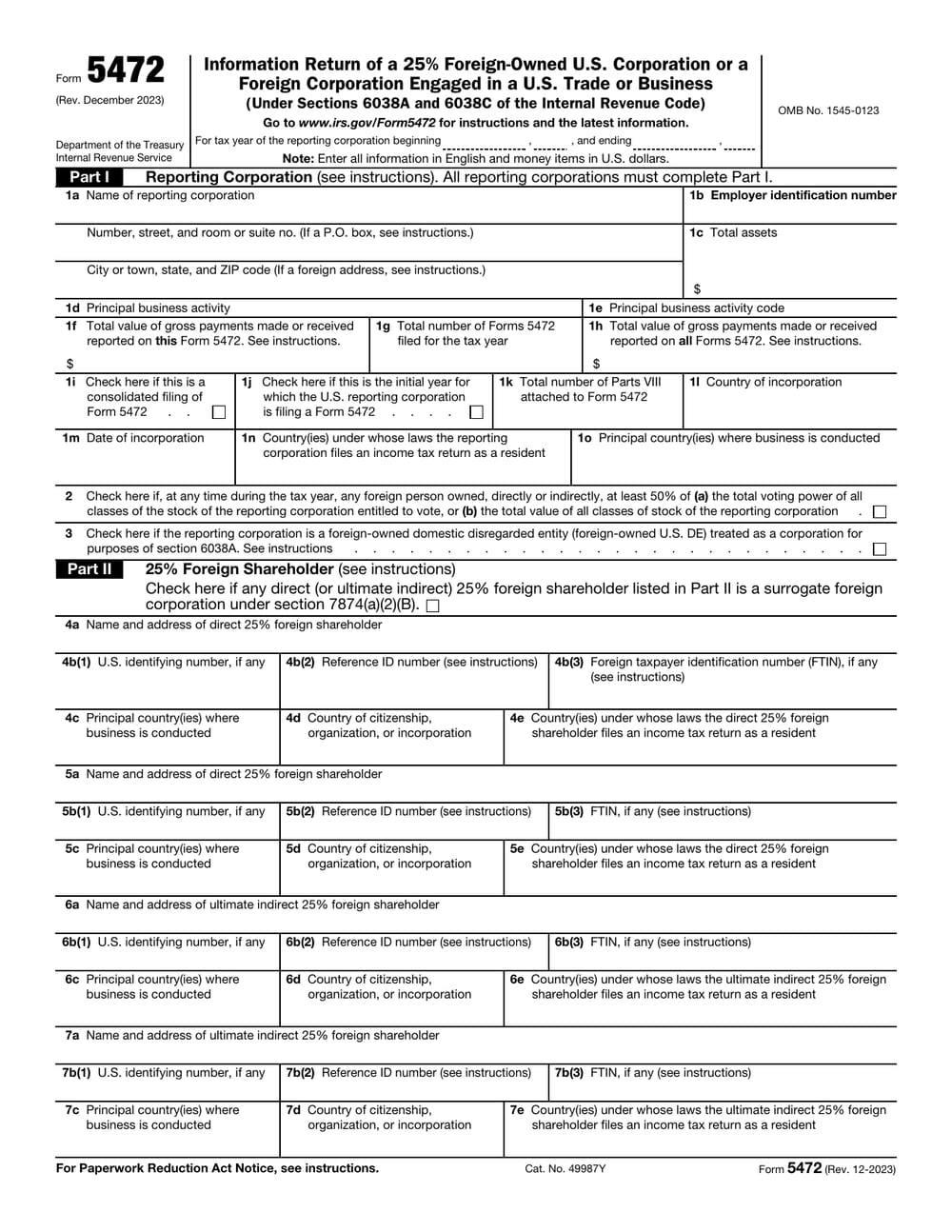
Download Form 5472 (PDF) · Instructions for Form 5472 (PDF)
Local copies for convenience, downloaded from IRS.gov on November 14, 2026. Always confirm you have the current revision at irs.gov/Form5472 before filing.
Part I — Reporting Corporation. Name, address, EIN, total assets, principal business activity and code, country of incorporation, and related totals. Line 1g gives the total number of Forms 5472 filed for the year, because one form is required per related party. A foreign-owned DE therefore needs an EIN before it can file. Part I also contains a first-year filer checkbox (line 1j) and the number of Part VIII attachments (line 1k).
Part II — 25% Foreign Shareholder. Completed only by 25% foreign-owned reporting corporations, including foreign-owned DEs. It identifies the direct 25% foreign shareholder(s) and the ultimate indirect 25% foreign shareholder(s). The ultimate indirect shareholder is a 25% foreign shareholder whose stock ownership is not attributed, under the principles of sections 958(a)(1) and (2), to any other 25% foreign shareholder. Individuals enter an SSN or ITIN; entities enter an EIN. A reference ID number is required only where no U.S. identifying number was entered. A foreign-owned DE must enter a foreign taxpayer identification number, if any, for each direct and ultimate foreign owner.
Part III — Related Party. Required for all filers. It identifies the related party covered by this particular Form 5472.
Part IV — Monetary Transactions Between Reporting Corporations and Foreign Related Parties. Amounts received and paid, where money was the only consideration. Categories include sales and purchases of inventory and other property, rents and royalties, payments for services, commissions, amounts borrowed and loaned, interest and insurance premiums, plus other lines. Any amount that does not exceed $50,000 may be reported as $50,000 or less. Larger amounts may be reasonable estimates: a reasonable estimate is any amount reported on Form 5472 that is at least 75% but not more than 125% of the actual amount.
Part V — Reportable Transactions of a Reporting Corporation That Is a Foreign-Owned U.S. DE. For DEs only. A foreign-owned DE must check the box in Part V if it had any other transaction, covering amounts paid or received in connection with the formation, dissolution, acquisition, and disposition of the entity, including contributions and distributions. Describe them on an attached statement. This is where the owner's capital contributions and the LLC's distributions to the owner are reported.
Part VI — Nonmonetary and Less-Than-Full Consideration Transactions. Transactions with a foreign related party that are not purely cash-for-value, such as property swaps, services provided free of charge or below-market terms. Attach a schedule describing each transaction and its estimated fair market value.
Part VII — Additional Information. Questions for all reporting corporations, including: lines 40a–40b on §267A, which disallows a deduction for certain interest or royalty paid or accrued pursuant to a hybrid arrangement; lines 41a–41d on the §250 FDII deduction; lines 42a–42b on safe-haven interest rates for related-party loans; and lines 43a–43b on §385 debt instruments (domestic corporations only). Part VII has other questions as well (for example, the line that sends cost-sharing participants to Part VIII); answer all of them on the revision you file.
Part VIII — Cost Sharing Arrangements. A separate Part VIII for each cost sharing arrangement in which the corporation was a controlled participant. Rare for small expat structures.
The pro forma Form 1120 (foreign-owned DEs only)
A foreign-owned DE has no income tax return to attach Form 5472 to, so the instructions require a pro forma Form 1120 as the carrier:
- Complete only the DE's name and address and items B and E on the first page of Form 1120.
- Write "Foreign-owned U.S. DE" across the top of the Form 1120.
- No e-filing. A foreign-owned U.S. DE cannot file Form 5472 electronically.
- Special address. Do not use the regular Form 1120 address. Fax (at 300 DPI or higher) to 855-887-7737, or mail to Internal Revenue Service, 1973 Rulon White Blvd., M/S 6112, Attn: PIN Unit, Ogden, UT 84201.
- Extensions. Form 7004 goes to the same fax number or address, and the DE must file it by the regular due date of the return.
The pro forma Form 1120 reports no income and computes no tax. Any U.S. income tax on the LLC's activity belongs to the owner and is reported (if at all) on the owner's own return.
Filing deadlines for Americans abroad
Form 5472 is due with the reporting corporation's income tax return, by its due date including extensions. The Internal Revenue Manual states that Form 5472 should no longer be filed independently; it should always be filed as an attachment to Form 1120.
| Reporting corporation | Unextended due date (calendar year) | Extension |
|---|---|---|
| U.S. C corporation (Form 1120) | 15th day of the 4th month: April 15 (§6072(a)) | Form 7004, six months: October 15 |
| Foreign-owned DE (pro forma Form 1120) | Same as Form 1120: April 15. The DE uses its owner's U.S. tax year, or the calendar year if the owner has no U.S. filing obligation | Form 7004, filed by the regular due date, by fax or mail to the Ogden PIN Unit |
| Foreign corporation with a U.S. office or place of business (Form 1120-F) | 15th day of the 4th month; automatic extension to the 15th day of the 6th month under §1.6081-5(a)(3) | Form 7004 |
| Foreign corporation without a U.S. office (Form 1120-F) | 15th day of the 6th month (§6072(c)) | Form 7004 |
For the 2026 calendar tax year, the April 15, 2027 deadline falls on a Thursday and the extended October 15, 2027 deadline falls on a Friday. When a due date falls on a weekend or legal holiday, it moves to the next business day.
The expat June 15 extension does not cover the company. U.S. citizens whose tax home and abode are outside the United States get an automatic extension to June 15 for their own Form 1040 under §1.6081-5(a)(5). That extension belongs to the individual. It does not extend a corporation's Form 1120 or a DE's pro forma Form 1120, even when the American runs the company from abroad.
A rule that may help a U.S. corporation run from abroad. §1.6081-5(a)(2) grants an automatic extension, to the 15th day of the 6th month, to domestic corporations that transact their business and keep their records and books of account outside the United States and Puerto Rico. A U.S. C corporation whose business and books are genuinely outside the United States may qualify. Whether a foreign-owned DE can rely on it is not addressed in the Form 5472 instructions, which instead say the DE must file Form 7004 by the regular due date. The conservative approach for a DE is to treat April 15 as the deadline and file Form 7004 if more time is needed.
Records. Reporting corporations must keep the permanent books of account or records required by section 6001, and §1.6038A-3 adds specific related-party records rules. Failure to maintain records is penalized like a failure to file (see Penalties).
Penalties, the open statute of limitations, and abatement
The base penalty
Under §6038A(d)(1), a reporting corporation that fails to furnish the required information or maintain the required records within the prescribed time owes $25,000 for each taxable year the failure occurs. The regulation adds a per-related-party rule: the penalty is imposed on a reporting corporation only once for a taxable year with respect to each related party. In practice, because one Form 5472 is required per related party, the exposure works out to $25,000 per missing or deficient form per year. The IRS's penalty page says the same thing in plain terms.
What counts as a failure:
- Not filing on time.
- Filing a substantially incomplete form, which the instructions treat as a failure to file.
- Not maintaining the required records.
Other points:
- Pre-2018 years. The penalty was $10,000 for tax years beginning before January 1, 2018.
- Consolidated groups. Each member is a separate reporting corporation subject to its own penalty, and members are jointly and severally liable.
- Foreign corporations. §6038C(c) applies the §6038A(d) penalty rules to foreign corporations engaged in a U.S. business.
- Criminal penalties. §§7203, 7206 and 7207 may also apply.
The continuation penalty
If the failure continues more than 90 days after the IRS mails a notice, an additional $25,000 applies for each 30-day period, or part of one, that the failure continues. It is computed per related party. The Internal Revenue Manual describes the continuation penalty as having no maximum limit; it can keep accruing until the failure is cured. Form 5471's continuation penalty, by contrast, is capped at $50,000.
Systemic assessment
Since January 1, 2013, the IRS has assessed the §6038A(d)(1) penalty automatically when a Form 5472 arrives attached to a late-filed Form 1120. The Internal Revenue Manual confirms that penalties may be asserted systemically during initial processing of a late-filed Form 5472 attached to a late-filed Form 1120. No human reviews the reasons before the notice goes out. A late pro forma Form 1120 for a DE can therefore produce a $25,000 notice with no prior contact.
Records and summons (§6038A(e))
Separate from the dollar penalty, if a reporting corporation does not substantially comply with an IRS summons for related-party records, the IRS may determine the tax treatment of the related-party transaction from the Secretary's own knowledge or other information, in the Secretary's sole discretion. This can include disallowing deductions. It rarely matters for small expat LLCs, but it is part of the regime.
The statute of limitations stays open
Under §6501(c)(8)(A), for information required under §6038A (among other listed sections), the time to assess any tax tied to the unreported information does not expire before three years after the Secretary is furnished the information.
- Reasonable-cause limit. Under §6501(c)(8)(B), if the failure was due to reasonable cause and not willful neglect, the extension applies only to the item or items related to the failure. Otherwise it reaches the whole return. Both halves of this rule date from the 2010 amendment of §6501(c)(8), which extended the rule to the entire return and added the reasonable-cause limit.
- Practical consequence. A missed Form 5472 from 2018 is not old in the usual sense. The assessment period for the related tax has not started to run.
- Uncertain point 1: §6038C. The list in §6501(c)(8)(A) names §6038A but not §6038C. On the statute's face, the open-statute rule is tied to the §6038A obligation (domestic reporting corporations, including foreign-owned DEs). We found no authority on whether or how it reaches a foreign corporation's Form 5472 under §6038C. Do not rely on the omission without advice.
- Uncertain point 2: DEs with no income tax return. A foreign-owned DE files only a pro forma return, so it is not obvious which tax return, event or period stays open. The most natural reading points to the owner's tax (if any) on the related transactions. We found no published guidance on this point.
Abatement: reasonable cause and the limits of first-time abate
Reasonable cause. §6038A(d)(3) works by moving the deadline. The time to furnish the information is treated as no earlier than the last day on which reasonable cause existed for the failure, as shown to the IRS's satisfaction. Relief therefore depends on filing promptly once the reason for the failure ends, for example as soon as the owner learns of the requirement. The regulations require an affirmative written showing, made under penalties of perjury, of the facts alleged. For small corporations, defined there as $20,000,000 or less in gross receipts for the year, the IRS is told to apply the reasonable cause exception liberally when the corporation lacked knowledge of §6038A, has limited U.S. presence and contact, and promptly complies once contacted. The IRS's penalty page asks whether you acted responsibly before and after the failure and whether the failure resulted from significant reasons or circumstances beyond your control, and notes that not all international information reporting penalties qualify for reasonable cause. The Internal Revenue Manual cautions that reasonable cause should not be granted merely because the taxpayer relied on another person to file.
First-time abate (FTA) generally does not apply. The IRS's list of penalties eligible for FTA covers failure to file (§§6651(a)(1), 6698(a)(1), 6699(a)(1)), failure to pay (§6651(a)(2), (a)(3)) and failure to deposit (§6656). §6038A is not on it. The Internal Revenue Manual is explicit that FTA relief does not apply to event-based filing requirements such as Form 5472.
The narrow piggyback route. IRM 20.1.9.5.5(3) covers only the penalty that was systemically assessed because Form 5472 was attached to a late Form 1120 (PRN 711):
- If the related Form 1120 late-filing penalty is abated for reasonable cause, the Form 5472 penalty may be abated using the same penalty reason code.
- If the Form 1120 penalty is abated under FTA (PRC 018), the Form 5472 penalty may also be abated with PRC 018, but only if the taxpayer had no similar penalties (PRNs 625 or 711) in the three prior periods and the related Form 1120 return was not filed late in the three prior periods.
- Otherwise, relief requires a reasonable-cause showing.
Two open questions for expat-owned structures:
- Pro forma returns. A pro forma Form 1120 shows no tax. It is unclear whether there is any Form 1120 failure-to-file penalty for the piggyback rule to attach to in the DE case. We found no IRS guidance on this.
- The FTA-to-AEP transition. The IRS states that FTA is transitioning to a new relief called Automatic Exemption from Penalty (AEP), starting summer 2026, covering the 2025 tax year onward. We found no published guidance on how IRM 20.1.9.5.5(3), which refers to FTA penalty reason codes, will operate under AEP.
Already missed a few years of Form 5472 for your LLC? First-time abate doesn't reach this penalty, and a reasonable-cause showing has to be made in writing, against your actual facts and timeline. Ask TaxLatitude to help build your reasonable-cause case →
Can the IRS assess these penalties at all? (unsettled litigation)
In Farhy v. Commissioner (2023), the Tax Court held that the IRS lacked authority to assess the §6038(b) penalty for Form 5471, as opposed to suing to collect it. The litigation since then:
- May 3, 2024: the D.C. Circuit reversed Farhy.
- November 18, 2024: in Mukhi v. Commissioner, 163 T.C. No. 8, the Tax Court reaffirmed its view for cases appealable to other circuits.
- February 27, 2026: in Safdieh v. Commissioner, the Second Circuit sided with the D.C. Circuit and held the §6038(b) penalty assessable.
- September 2026: an application was filed at the Supreme Court for more time to petition for certiorari in Safdieh. Check the docket for later developments before publishing.
These cases concern §6038(b) (Form 5471), not §6038A (Form 5472). Both appellate courts relied in part on §6038(c), a foreign tax credit reduction coordinated with the §6038(b) penalty. §6038A has no counterpart, so it is debated whether either side's reasoning carries over. The IRS continues to assess Form 5472 penalties. Treat the assessability question as an argument for a litigator, not a compliance strategy.
Worked example 1: a U.S. LLC owned 100% by an expat's non-U.S. spouse
Facts (tax year 2026).
- Mark (U.S. citizen) and Lucía (Spanish citizen, never a U.S. resident) live in Valencia.
- They file separately for U.S. purposes; no §6013(g) election is in effect.
- In March 2026, Lucía forms Atelier Lumen LLC in Wyoming, with herself as the sole member, to sell digital design templates worldwide through a U.S. payment processor. The LLC files no Form 8832.
- Transactions between the LLC and Lucía in 2026:
- March 2026: initial capital contribution of $15,000.
- July 1, 2026: Lucía lends the LLC $10,000 at 4% annual interest.
- December 31, 2026: the LLC repays $4,000 of principal and pays six months of interest.
- During the year: distributions to Lucía totaling $38,000.
- Mark has no transactions with the LLC.
Step 1: Is there a reporting corporation? Yes.
- The LLC is domestic and has one owner, so it is disregarded by default under §301.7701-3(b)(1)(ii).
- Its owner is a nonresident alien with no §6013(g) election, so she is a foreign person.
- It is therefore treated as an entity separate from its owner and classified as a domestic corporation for purposes of section 6038A.
- Its tax year: if Lucía has no U.S. return filing obligation, the LLC uses the calendar year. If she does have one (see the last paragraph of this example), it uses her U.S. tax year, which for an individual is normally the calendar year. Either way, the LLC's tax year here is 2026.
Step 2: Related parties and reportable transactions.
- Lucía is the 25% foreign shareholder (100%), so she is a related party.
- All four types of transactions are reportable: for a DE, contributions and distributions count under §1.6038A-2(b)(3)(xi), and the loan, interest and repayment are monetary transactions.
- Mark is very likely a related party too, through §267(c) family attribution and §267(b)(2). He had no transactions with the LLC, so no form is needed for him. If he had paid an LLC bill or lent it money, the instructions would call for a separate Form 5472 naming him in Part III, without itemizing the U.S.-party transactions.
Step 3: The arithmetic (recalculated).
| Item | Computation | Amount | Where reported |
|---|---|---|---|
| Capital contribution | given | $15,000 | Part V statement (formation/contribution) |
| Loan received | given | $10,000 | Part IV, amounts borrowed |
| Interest paid | $10,000 × 4% × 6/12 | $200 | Part IV, interest paid; may be shown as $50,000 or less |
| Principal repaid | given | $4,000 | Reflected in the loan balance |
| Loan balance at year end | $10,000 − $4,000 | $6,000 | Part IV, amounts borrowed (beginning balance $0, ending balance $6,000, or the monthly-average method the instructions allow) |
| Distributions | given | $38,000 | Part V statement (distributions) |
Every Part IV amount is below $50,000, so each may be entered as $50,000 or less. The Part V statement should describe each contribution and distribution with dates and amounts. If the loan had been interest-free, consider whether it also belongs in Part VI as a less-than-full-consideration transaction. The instructions do not address owner loans to DEs specifically.
Step 4: Filing mechanics.
- Number of forms: one Form 5472 (one related party).
- Carrier return: a pro forma Form 1120 with name, address and items B and E; "Foreign-owned U.S. DE" written across the top.
- EIN: the LLC must have one before filing.
- Delivery: fax to 855-887-7737 or mail to the Ogden PIN Unit. No e-file.
- Deadline: April 15, 2027, or October 15, 2027 with a Form 7004 sent to the same destination by April 15.
Step 5: Penalty exposure if the filings are missed (recalculated).
- Never filed for 2026, 2027 and 2028: 3 years × 1 related party × $25,000 = $75,000 in base penalties.
- Continuation penalty, 2026 year only. Suppose the IRS mails a notice about the 2026 year on October 1, 2029, and the complete filing reaches the IRS on March 15, 2030.
- Days from notice to filing: 165.
- Days beyond the 90-day grace period: 165 − 90 = 75.
- 30-day periods or fraction thereof: two full periods plus a partial one = 3.
- Continuation penalty: 3 × $25,000 = $75,000.
- Total for 2026 alone: $25,000 + $75,000 = $100,000.
- Statute of limitations: under §6501(c)(8), the assessment period for any related tax for 2026 would not start until March 15, 2030, and would run to March 15, 2033 at the earliest.
Variations.
- With a §6013(g) election for 2026, Lucía is treated as a U.S. resident and is not a foreign person for Form 5472, so the LLC is not a foreign-owned DE and no Form 5472 is due. The trade-off is significant: the election brings Lucía's worldwide income into the U.S. joint return, and an electing spouse may not claim treaty non-residence for U.S. income tax purposes. Decide on the election for its overall tax effect, not to avoid one information return.
- If Mark and Lucía each owned 50%, the LLC would be a partnership by default. Form 5472 would not apply, but the partnership rules would (Form 1065 and, depending on the income, foreign-partner rules).
- If that 50/50 LLC elected to be taxed as a corporation, it would be a 25% foreign-owned C corporation. It would file Form 1120, which can be e-filed with Form 5472 attached, plus a Form 5472 for each related party with reportable transactions.
What this example does not decide: whether Lucía owes U.S. income tax on the LLC's profits. That depends on whether the income is U.S.-source or effectively connected with a U.S. trade or business, which is a separate analysis. Form 5472 is required either way.
Worked example 2: an expat who becomes the foreign 25% owner through a local company
Facts (tax year 2026).
- Sarah is a U.S. citizen living in Munich. She owns 100% of Kessler Advisory GmbH, a German company classified as a corporation for U.S. purposes.
- On March 1, 2026, the GmbH buys 40% of the stock of Brightline Software Inc., a Delaware C corporation, from one of its founders for $400,000. The other 60% is held by two U.S.-resident founders (30% each).
- During 2026, the GmbH and Brightline have these transactions:
- Brightline pays the GmbH $120,000 in consulting fees.
- On July 1, 2026, the GmbH lends Brightline $200,000 at 6% annual interest. Brightline pays six months of interest on December 31, 2026; the principal stays outstanding.
Step 1: Sarah herself is not the foreign shareholder. She is a U.S. citizen, and a U.S. citizen is a U.S. person wherever they live. If Sarah had bought the 40% personally, Brightline would not be 25% foreign-owned because of her, and no Form 5472 would arise from her stake.
Step 2: The GmbH is.
- A company not created or organized in the United States is a foreign person.
- The GmbH owns 40% of the vote and value, which exceeds 25%, from March 1, 2026.
- Because the test applies at any time during the taxable year, Brightline is a reporting corporation for its whole 2026 tax year.
- The GmbH is a direct 25% foreign shareholder and therefore a related party.
Step 3: What goes on Brightline's Form 5472 (recalculated).
| Item | Computation | Amount | Treatment |
|---|---|---|---|
| Consulting fees paid to the GmbH | given | $120,000 | Part IV; above $50,000, so report the actual amount or a reasonable estimate between $90,000 (75%) and $150,000 (125%) |
| Interest paid | $200,000 × 6% × 6/12 | $6,000 | Part IV; may be shown as $50,000 or less |
| Amounts borrowed | beginning balance $0; ending balance $200,000 | $200,000 | Part IV |
| Monthly-average alternative | (6 months × $0 + 6 months × $200,000) ÷ 12 | $100,000 | If the monthly-average method is used for the loan lines |
| Share purchase ($400,000) | between the GmbH and a founder | — | Not a Brightline transaction, so not reported by Brightline |
Part II lists the GmbH as the direct 25% foreign shareholder. The owner above the GmbH is a U.S. citizen, not a foreign person, so no foreign shareholder further up the chain is shown. Practitioners differ on whether the GmbH should also be entered as the ultimate indirect 25% foreign shareholder in this kind of chain; the definition looks for attribution to another 25% foreign shareholder.
Is Sarah a related party of Brightline? Probably not:
- She is not a 25% foreign shareholder.
- Her indirect 40% does not exceed the 50% threshold of §267(b)(2).
- §482 common control is facts-dependent; 40% alone usually does not establish it.
If she were a related party (for example, through an additional direct stake), U.S.-party transactions would not need to be itemized, but a separate form could still be required.
Step 4: Can Brightline rely on Exception 2 (Sarah's Form 5471)? In our reading, no.
- Sarah controls the GmbH (100%), so she files Form 5471 as a Category 4 and 5a filer.
- The exception requires her Form 5471 to report the reportable transactions between the reporting corporation and the related corporation on Schedule M.
- Schedule M's columns cover the filer, any domestic corporation or partnership controlled by the U.S. person filing that return, and other specified persons.
- Sarah's indirect 40% of Brightline is not control (more than 50%), so Brightline does not fit that column.
- Separately, Brightline cannot control the content of another taxpayer's Form 5471. Brightline should file its own Form 5472.
Step 5: Who pays if it's missed? The penalty falls on Brightline, the reporting corporation: $25,000 for 2026 (one related party × one year). Its economic cost is shared by the two U.S. founders, who may not know the GmbH's presence created the obligation. A covenant in the shareholders' agreement requiring the foreign investor to provide ownership information, and the company to file, is a practical safeguard.
Step 6: Sarah's own filings, which are separate from Brightline's.
- Form 5471 for the GmbH (Categories 4 and 5a), attached to her Form 1040. Her Form 1040 is due June 15, 2027 under the automatic extension for taxpayers abroad. The GmbH's U.S. income inclusions (such as subpart F income or net CFC tested income) are covered in our Form 5471 guide.
- FBAR. She has a financial interest in the GmbH's foreign accounts because she owns more than 50% of it, and she has her own German accounts. She reports both if their aggregate value exceeds $10,000 at any time.
- Form 8938. Illustration: the GmbH stake is worth $650,000 and her personal accounts $120,000, for a total of $770,000. That exceeds the $300,000 at-any-time threshold for a single filer living abroad, so she files Form 8938. The GmbH, already reported on Form 5471, is not listed again in detail; she identifies the Form 5471 in Part IV, and its value still counts toward the threshold.
Variation: the GmbH buys 100% of a U.S. LLC instead. The LLC would be a foreign-owned DE (wholly owned by one foreign person, the GmbH). It would file a pro forma Form 1120 with Form 5472 regardless of Sarah's Form 5471, because Exception 2 does not apply to DEs.
How Form 5472 interacts with other filings
Pro forma Form 1120 vs. a real Form 1120.
- Foreign-owned DE: the pro forma Form 1120 only carries Form 5472. It is paper or fax only and computes no tax.
- 25% foreign-owned C corporation: Form 5472 is attached to the company's actual Form 1120, which reports income and tax and can be e-filed.
- Electing LLC: an LLC that elects corporate status on Form 8832 is in the second group, not the first.
FBAR (FinCEN Form 114). FBAR is a Bank Secrecy Act filing under Title 31, so U.S. tax classification does not control it. FinCEN's instructions define a U.S. person to include limited liability companies created or organized in the United States, and an entity that is disregarded for Title 26 purposes must still file an FBAR if otherwise required. Consequences for expat structures:
- A U.S. LLC with a non-U.S. bank account files its own FBAR when the aggregate value exceeds $10,000 at any time in the year, even if it is a foreign-owned DE and even though its owner is not a U.S. person.
- A U.S. citizen spouse with signature authority over that account generally has their own FBAR obligation for the signature authority.
- The FBAR is due April 15, with an automatic extension to October 15. It is filed electronically with FinCEN, not with the IRS return.
- Form 5472 does not replace the FBAR, and the FBAR does not replace Form 5472.
Form 8938 (FATCA). Form 8938 is filed by specified individuals, and by certain specified domestic entities, that hold specified foreign financial assets above the applicable thresholds.
- Foreign-owned DE (Example 1): a nonresident alien is generally not a specified individual for Form 8938, even if she files a U.S. return. The regulation covers U.S. citizens, resident aliens, nonresident aliens with a §6013(g) or (h) election in effect, and nonresident aliens who are bona fide residents of Puerto Rico or a §931 possession. The U.S. citizen spouse has no interest in the LLC to report, and in any case an interest in a U.S. entity is not a foreign financial asset.
- Inverse structure (Example 2): the American's interest in the foreign holding company is a specified foreign financial asset. If it is reported on Form 5471, it is not listed again on Form 8938. The filer instead identifies which and how many of those forms report the specified foreign financial assets in Part IV, and for individuals the value still counts toward the threshold.
- Thresholds for taxpayers living abroad: more than $200,000 on the last day of the year or $300,000 at any time (single or married filing separately), or $400,000 / $600,000 (married filing jointly).
Form 5471. As explained above, Form 5471 is the American's own return about a foreign company, while Form 5472 is the U.S. company's return about its foreign owner. Exception 2 links them only when the American controls the foreign company and Schedule M actually reports the U.S. company's transactions, and never for DEs.
Form 7004. One extension request covers the Form 1120 or pro forma Form 1120 and the attached Form 5472. For a DE it goes to the Ogden PIN Unit fax or address, not the regular Form 7004 address.
The owner's income tax return. A foreign owner of a DE may still have a U.S. income tax filing obligation (for example, Form 1040-NR if the LLC's income is effectively connected with a U.S. trade or business). That obligation is independent of Form 5472. If the foreign owner does have a U.S. return obligation, the DE uses the owner's tax year for Form 5472 purposes.
What to do if Forms 5472 were missed
1. Map the exposure before filing anything. For each year, identify:
- every reporting corporation (each U.S. company or DE in the structure);
- every related party with a reportable transaction (one form per related party per year);
- the dates and amounts of contributions, distributions, loans and payments.
Multiply the number of missing forms by $25,000 ($10,000 for years beginning before 2018) to see the base exposure.
2. Check eligibility for the delinquent procedures. The IRS's Delinquent International Information Return Submission Procedures are for taxpayers who are not under a civil examination or a criminal investigation by the IRS and have not already been contacted by the IRS about the delinquent information returns. If the IRS has already sent a notice, you are in penalty-response territory. Get professional help.
3. File through normal procedures, with a reasonable-cause statement on each form. Under the current version of the procedures, taxpayers file the delinquent returns through normal filing procedures and may attach a reasonable cause statement to each delinquent information return filed for which reasonable cause is being asserted.
- Foreign-owned DE: file a pro forma Form 1120 plus Form 5472 for each missed year, by fax or mail to the Ogden PIN Unit.
- C corporation that timely filed Form 1120 without Form 5472: the forms are typically submitted with an amended return (Form 1120-X).
- C corporation that never filed Form 1120: file the late returns with Form 5472 attached. Expect a systemic penalty notice.
4. Expect the penalty to be assessed anyway, then respond. During the processing of the delinquent information return, penalties may be assessed without considering the attached reasonable cause statement, and taxpayers may need to respond to specific correspondence and resubmit reasonable cause information. Plan to respond to the notice with the reasonable-cause package, and to go to Appeals if abatement is refused.
5. Build the reasonable-cause case on facts. The regulations require an affirmative written showing under penalties of perjury. Useful facts include:
- when and how the owner learned of the requirement;
- what advice was sought;
- how quickly the filings were made after discovery;
- the owner's limited U.S. presence;
- whether the corporation is small under the regulation's $20,000,000 gross-receipts test, which calls for liberal application.
Reliance on another person alone is not enough under the Internal Revenue Manual.
6. Don't assume the Streamlined procedures cover it. The Streamlined Filing Compliance Procedures are for individuals (including estates). A Form 5472 obligation belongs to the reporting corporation, not the individual owner. In the inverse structure (Example 2), the American's own missed Forms 5471, FBARs and Forms 8938 may fit Streamlined, but the U.S. company's missed Forms 5472 are a separate problem.
7. Don't just start filing from the current year. Filing the current year while leaving earlier years unfiled leaves those years' assessment periods open under §6501(c)(8). A current-year Form 5472 that reports a first-year date or a beginning loan balance can also point to prior years.
Common mistakes
- No income, no filing. A foreign-owned DE with zero revenue still files if it had a reportable transaction, and funding the LLC is one.
- Forgetting the formation year. The first year almost always has contributions, so it almost always requires a filing.
- Filing Form 5472 alone, or trying to e-file it. A DE must use a pro forma Form 1120 and fax or mail it to the Ogden PIN Unit. The Internal Revenue Manual says Form 5472 should not be filed independently.
- No EIN. Part I requires the reporting corporation's identifying number, so the DE needs its own EIN; the owner's ITIN is not a substitute.
- Treating the American abroad as the foreign owner. A U.S. citizen is a U.S. person wherever they live. The opposite mistake is missing that a foreign holding company owned by the American is a foreign person.
- Confusing Form 5471 with Form 5472. They have different filers, thresholds and penalties, and they cover ownership in opposite directions.
- Relying on Exception 2 for a DE, or without control. The exception never applies to foreign-owned DEs, and it requires the Form 5471 filer to control the foreign corporation and to report the transactions on Schedule M.
- One form for several related parties. The rule is one Form 5472 per related party, including U.S. related parties with reportable transactions.
- Owner pays LLC bills personally. For a DE, in our reading this is a contribution and therefore reportable.
- Counting on first-time abate. FTA does not cover §6038A, apart from the narrow systemic-penalty piggyback in IRM 20.1.9.5.5(3).
- Electing corporate status without considering the reporting cost. A 50/50 LLC between a U.S. citizen and a non-U.S. spouse is a partnership by default. A Form 8832 corporate election turns it into a reporting corporation.
- Getting the §6013(g) year wrong. The foreign person exclusion applies only while the election is in effect. Check each year separately.
- Ignoring records. Penalties apply to failures to maintain records as well as failures to file.
FAQ
My wife is not American and owns our U.S. LLC 100%. It made no money this year. Do we file?
If the LLC had any reportable transaction with her or another related party (contributions, distributions, loans, payments of its expenses), yes: a pro forma Form 1120 with Form 5472. If there were truly no such transactions, Exception 1 applies. Profit and tax owed are irrelevant to the test.
Does Form 5472 make the LLC a corporation for tax purposes?
No. The corporate treatment applies only for purposes of section 6038A. For income tax, the LLC remains disregarded.
I'm a U.S. citizen living in Portugal and own 30% of a U.S. startup. Does the startup file Form 5472 because of me?
No. You are a U.S. person regardless of residence. It would if you held the stake through a Portuguese company, or if another foreign person held 25% or more.
We made the §6013(g) election. Is my spouse still a foreign person?
Not while the election is in effect. The definition excludes individuals for whom a §6013(g) or (h) election is in effect. The election has much broader tax consequences, though.
Can I e-file?
A foreign-owned DE cannot file Form 5472 electronically. A C corporation can attach Form 5472 to an e-filed Form 1120.
Does the expat June 15 extension give the LLC more time?
No. That extension applies to the individual's own return. The DE's pro forma Form 1120 is due on the Form 1120 due date, and the DE extends with Form 7004 filed by that date.
Is there a dollar threshold below which I don't report?
No. The $50,000-or-less convention lets you skip exact figures for small amounts, but the transaction is still reported. The de minimis safe harbor in the regulations concerns records, not filing, and does not apply to DEs.
How many forms if my LLC dealt with my foreign spouse and my foreign mother-in-law?
One Form 5472 per related party per year, so likely two. Your mother-in-law is your spouse's parent. Under §267(c), an individual is treated as owning stock owned by her family, which includes her children, so your spouse's interest is attributed to her. That generally makes her a related party under §267(b)(2). Confirm the attribution analysis for the specific facts.
The LLC was dissolved this year. Anything special?
The dissolution year is reportable: Part V covers amounts connected with the formation, dissolution, acquisition, and disposition of the entity. File a final Form 5472.
How long can the IRS come back for missed years?
The assessment period for the related tax does not begin until the information is furnished, and then runs at least three years. If the failure was due to reasonable cause, the extension is limited to the related items.
Sources
All sources were accessed and checked on November 12, 2026. Primary sources are official government publications, statutes, regulations and court decisions. Secondary sources are commentary or summaries by third parties, used only for context.
Primary sources: IRS forms, instructions and guidance
- IRS, Instructions for Form 5472 (Rev. December 2024)
- IRS, About Form 5472
- Internal Revenue Manual, 20.1.9, International Penalties
- IRS, Administrative penalty relief (FTA and AEP)
- IRS, International information reporting penalties
- IRS, Delinquent international information return submission procedures
- IRS, Instructions for Form 5471 (Rev. December 2025)
- IRS, Schedule M (Form 5471)
- IRS, Do I need to file Form 8938, Statement of Specified Foreign Financial Assets?
- FinCEN, BSA Electronic Filing Requirements for the FBAR (FinCEN Form 114)
- Treasury Decision 9796, Treatment of Certain Domestic Entities Disregarded as Separate From Their Owners as Corporations for Purposes of Section 6038A (Dec. 13, 2016)
- Rev. Proc. 2002-69, 2002-45 I.R.B. 831
- National Taxpayer Advocate, 2020 Annual Report to Congress, Most Serious Problem #8 (international penalties)
- IRS, Chief Counsel Advice on amended §6501(c)(8)
Primary sources: Internal Revenue Code and Treasury regulations
- 26 U.S.C. §6038A: information with respect to certain foreign-owned corporations
- 26 U.S.C. §6038C: information with respect to foreign corporations engaged in U.S. business
- 26 U.S.C. §6501, including (c)(8): limitations on assessment and collection
- 26 U.S.C. §6072: time for filing income tax returns
- 26 U.S.C. §318 (constructive ownership), §267 (related-party rules) and §1361 (S corporation eligibility)
- 26 U.S.C. §6013(g) and Treas. Reg. §1.6013-6: the nonresident-spouse election
- Treas. Reg. §1.6038A-1: definitions
- Treas. Reg. §1.6038A-2: records and information
- Treas. Reg. §1.6038A-4: monetary penalty
- Treas. Reg. §301.7701-2, including (c)(2)(vi): business entities, foreign-owned disregarded entities
- Treas. Reg. §301.7701-3: classification of certain business entities
- Treas. Reg. §1.6081-5: extensions for certain taxpayers abroad
- Treas. Reg. §1.6038D-2: definition of specified individual (Form 8938)
Case law and secondary sources
- Mukhi v. Commissioner, 163 T.C. No. 8 (Nov. 18, 2024)
- Farhy v. Commissioner, 100 F.4th 223 (D.C. Cir. 2024) (secondary summary)
- Safdieh v. Commissioner, 169 F.4th 102 (2d Cir. Feb. 27, 2026)
- Supreme Court Application No. 26A314 (extension to file a certiorari petition in Safdieh, Sept. 2026)
- The Tax Adviser, "Penalty relief for Forms 5471, 5472, and 8865" (July 2021, secondary)
This article is general information about U.S. reporting rules for 25%-foreign-owned U.S. corporations and foreign-owned disregarded entities, not tax or legal advice for your situation. It is based on the Instructions for Form 5472 (Rev. December 2024) and the Internal Revenue Code, Treasury regulations and Internal Revenue Manual in force as of November 12, 2026, so check IRS.gov/Form5472 for changes before you rely on any detail for a later return.