Who has to file Form 5471, how the five filer categories work, how ownership and control are measured, what each schedule asks for, when the form is due if you live abroad, and what happens if you file late, with two worked examples.
Key takeaways
- Form 5471 is the IRS form for two reporting statutes: IRC §6038 (annual information about foreign corporations that US persons control, and about controlled foreign corporations, or CFCs) and §6046 (organizations, reorganizations, and acquisitions and dispositions of foreign corporate stock).
- Unlike Form 8865, Form 5471 is not mainly a disclosure form. If the company is a CFC, its schedules carry the figures behind current US tax on undistributed foreign earnings: Subpart F income under §951 and GILTI under §951A, which the One Big Beautiful Bill Act renamed net CFC tested income (NCTI) for tax years beginning after December 31, 2025.
- There are five categories of filers. Category 1 is a legacy category from the 2017 transition tax. Categories 2 and 3 are triggered by events: being an officer or director when a US person crosses 10%, or acquiring or disposing of stock across the 10% line. Category 4 is control (more than 50% of vote or value). Category 5 is being a 10% US shareholder of a CFC.
- Ownership is measured by voting power or value, and each is enough on its own. It includes stock you are treated as owning through family members and entities. Different attribution rules apply to different categories, and a nonresident spouse's shares are treated differently in each.
- There is no small-company or de minimis exception from filing. A dormant company may qualify for a one-page summary filing, but only if it meets all eight conditions of Rev. Proc. 92-70.
- The form is attached to your Form 1040 and is due when the return is due, including extensions. Americans whose tax home and abode are abroad get an automatic extension to June 15.
- The basic penalty is $10,000 per foreign corporation per year, plus up to $50,000 more if you do not file after an IRS notice. Your foreign tax credits can also be cut. Separate $10,000-plus-$50,000 penalties apply to Category 2 and 3 failures. Until a required Form 5471 is filed, the IRS's time to assess tax on the whole return generally stays open.
What Form 5471 is and why it exists
Form 5471, Information Return of U.S. Persons With Respect to Certain Foreign Corporations, is filed by US persons who are officers, directors or shareholders of certain foreign corporations. The instructions describe the form and its schedules as the way to satisfy the reporting requirements of §§6038 and 6046 and their regulations.
| Statute | What it requires | Filer categories | Main regulation |
|---|---|---|---|
| §6038 | Annual information about each foreign corporation that a US person controls (§6038(a)(1)). Section 6038(a)(4) lets the IRS require the same information from any US person treated as a US shareholder of a CFC for Subpart F purposes. The information includes the corporation's business, balance sheet, transactions with related persons, and its classes of stock and US shareholders | Categories 1, 4 and 5 | Treas. Reg. §1.6038-2 |
| §6046 | A return when a US citizen or resident becomes an officer or director of a foreign corporation in which a US person meets a 10% stock requirement; when a US person acquires stock that brings them to 10% or more; when a person becomes a US person while holding 10%; and, under the regulations, on certain reorganizations and on dispositions that take a holder below 10% | Categories 2 and 3 | Treas. Reg. §1.6046-1 |
The corporate counterpart to Form 8865. Section 6046 does for foreign corporations roughly what §6046A does for foreign partnerships: it captures the event of crossing a 10% threshold. Section 6038 is the annual statute for both kinds of entity. The main structural difference is that contributions of property to a foreign corporation are not reported on Form 5471 at all. They go on a separate return, Form 926, under §6038B. Our Form 8865 guide covers the partnership side, where contributions are reported on Schedule O of Form 8865 itself.
Why it exists. A foreign corporation generally has no US filing obligation unless it has US-source or US business income. Without Form 5471, the IRS would have no annual view of foreign companies owned or controlled by Americans, of the transactions between those companies and their owners, or of the earnings that the anti-deferral rules may tax.
What the form is not: purely an information return. This is the most important difference from Form 8865. A foreign partnership's income flows through to its partners every year anyway, so Form 8865 mostly documents numbers the partner already reports. A foreign corporation is a separate taxpayer, and its earnings are normally not taxed in the US until distributed. Two regimes override that deferral for a US shareholder of a CFC:
- Subpart F (§951(a)): a US shareholder includes in income each year its pro rata share of the CFC's Subpart F income, mainly passive income and certain related-party sales and services income, and amounts determined under §956 for investments in US property, whether or not anything is distributed.
- GILTI, now NCTI (§951A): a US shareholder includes a share of the CFC's "tested income," which is most of its active business income not already caught by Subpart F. For tax years beginning after December 31, 2025, the One Big Beautiful Bill Act (Pub. L. 119-21, enacted July 4, 2025) renamed the inclusion net CFC tested income and removed the exclusion for a deemed 10% return on the CFC's tangible assets. It also set the §250 deduction available to corporate shareholders, and to individuals who make a §962 election, at 40%. The deduction had been 50% and was scheduled to fall to 37.5% for those years.
The CFC-level figures for both regimes are reported on Form 5471: Subpart F and other inclusions on Schedule I (with Worksheet A in the instructions), tested income on separate Schedule I-1, and income, deductions, taxes and assets by income group on separate Schedule Q. The shareholder's own GILTI/NCTI calculation is then made on Form 8992. A Form 5471 for a CFC is therefore often part of a tax computation, not just a disclosure.
What this guide covers, and what it does not. This guide covers who must file, the category framework, how ownership is measured, the exceptions, what each schedule asks for and which filers complete it, deadlines, and penalties. It describes Schedules I, I-1 and Q at the level of what they report. It does not walk through computing Subpart F income, tested income, the GILTI/NCTI inclusion, the high-tax exception, the §962 election or deemed-paid foreign tax credits. Those calculations decide how much US tax a CFC shareholder owes. They are a separate topic and are not covered further here. Where the worked examples below show penalty figures, the shareholder's actual Subpart F or GILTI tax is a separate computation outside the example.
One form per corporation, per year. A separate Form 5471, with its applicable schedules, is required for each foreign corporation (Reg. §1.6046-1(e)(2); the instructions say the same for each category). One Form 5471 can cover several categories for the same corporation. You check the applicable category boxes in item B on page 1, subject to one rule covered in "The five categories of filers" above: if you are both a Category 4 and a Category 5a filer, you check only Category 4.
Who counts as a "US person"
Only a "United States person" files Form 5471. The instructions and Reg. §1.6038-2(d)(1) use the §7701(a)(30) definition. A US person is a US citizen or resident, a domestic partnership, a domestic corporation, or an estate or trust that is not a foreign estate or trust.
For readers of this site, this means:
- US citizens are US persons wherever they live. Living abroad for decades, holding another nationality, or having no US income does not change this.
- Green card holders are US residents under §7701(b) until their status ends for tax purposes, even if they live abroad. Becoming a US person while already holding 10% or more of a foreign company is itself a Category 3 event (see the Category 3 discussion below).
- A nonresident alien spouse is not a US person and has no Form 5471 obligation of their own. The spouse's shares can still be attributed to the US spouse for some categories but not others, as explained in "Constructive ownership: three different rule sets" below.
- Nonresident aliens who elect to be treated as residents. An individual for whom a §6013(g) or (h) election is in effect, typically a nonresident spouse who files jointly with a US spouse, is treated as a US person for §6038 and §6046 purposes (Reg. §§1.6038-2(d)(3), 1.6046-1(f)(3)). A joint-filing election can therefore create a Form 5471 obligation for the nonresident spouse's own company.
- Your US LLC, partnership or corporation is a US person. If it holds the foreign shares, it may be the filer, and you may qualify for the constructive-owner exception described in "Exceptions and relief" below.
The five categories of filers
Your category determines whether you file at all and which schedules you complete. The categories are defined in the instructions under "Categories of Filers." Categories 1 and 5 are divided into sub-categories (1a, 1b, 1c and 5a, 5b, 5c), so there are nine boxes in item B on page 1. You can be in several categories for the same corporation in the same year. This is normal in the year you buy or set up a company.
First: how ownership and control are measured
- Vote or value, each on its own. Every threshold is met by voting power or value. The 10% requirement in §6046 is 10% or more of the total combined voting power of all classes of voting stock, or 10% or more of the total value of all the stock (§6046(a)(2); Reg. §1.6046-1(c)(1)). "US shareholder" in §951(b) uses the same vote-or-value test. Control for Category 4 is more than 50% of total combined voting power or more than 50% of total value (§6038(e)(2); Reg. §1.6038-2(b)). A CFC is a foreign corporation in which US shareholders together own more than 50% of the vote or value on any day of its tax year (§957(a); Reg. §1.957-1). A person with 45% of the votes but 55% of the value through non-voting preference shares has control.
- Exactly 50% is not control. Control and CFC status both need more than 50%. The 10% thresholds, by contrast, are met at exactly 10%.
- Stock, not partnership interests. The Form 8865 measures (capital, profits, or deductions and losses) do not apply. Corporate voting arrangements count, though: the regulations disregard voting power that is only nominal and attribute votes to whoever actually exercises them (Reg. §1.957-1).
- Control passes down a chain. If you control a corporation that owns more than 50% of another corporation, you are treated as controlling the second one too (§6038(e)(2); Reg. §1.6038-2(b)).
Constructive ownership: three different rule sets
Each category counts stock you own directly, stock you own indirectly through entities, and stock you are treated as owning under constructive-ownership rules. The instructions point to three different sets of rules: Regulations §1.958-2, §1.6038-2(c) and §1.6046-1(i). They are not the same, and the differences matter most for families with a nonresident spouse.
| Purpose | Rule | Family members whose stock is attributed to you | Nonresident alien family members | Other features |
|---|---|---|---|---|
| Category 4 (control under §6038) | §318(a) as modified by §6038(e)(2); Reg. §1.6038-2(c) | Spouse, children, grandchildren, parents (§318(a)(1)) | Not excluded by the statute. But a person who owns no direct or indirect interest and would be a filer only because of attribution from nonresident aliens is excepted (Reg. §1.6038-2(l)). If you own any shares yourself, a nonresident spouse's shares count toward your control | No "downward" attribution that would treat a US person as owning stock of a non-US person. 10% substituted for 50% in §318(a)(2)(C) |
| Category 5 and CFC status (who is a US shareholder; is the company a CFC?) | §958(b), applying §318(a) with modifications; Reg. §1.958-2 | Spouse, children, grandchildren, parents | Excluded. Stock owned by a nonresident alien individual is not attributed to a US citizen or resident under the family rule (§958(b)(1)) | A more-than-50% owner is treated as owning 100% for upward attribution (§958(b)(2)); 10% substituted for 50% in §318(a)(2)(C) (§958(b)(3)); downward attribution from foreign persons: see below |
| Categories 2 and 3 (§6046) | Reg. §1.6046-1(i) | Brothers and sisters (whole or half blood), spouse, ancestors and lineal descendants. Stock attributed under the family rule is not re-attributed | The regulation does not exclude them | Stock owned by a foreign corporation or foreign partnership is treated as owned proportionately by its shareholders or partners |
| For comparison: Form 8865 | Rules similar to §267(c), other than §267(c)(3) (§6038(e)(3)(B)) | Brothers and sisters, spouse, ancestors and lineal descendants | Attributed only if you hold an interest yourself (Reg. §1.6038-3(b)(4)) | Partnership interests measured by capital, profits, or deductions and losses |
Two consequences are worth stating plainly. First, the family circle is wider for Categories 2 and 3 (and for Form 8865) than for Categories 4 and 5: a sibling's shares count toward your 10% under §6046 but not toward your control or US-shareholder status under §318. Second, a nonresident spouse's shares never make a company a CFC through the family rule, but they can give you Category 4 control. An American who owns 20% directly and whose nonresident spouse owns 35% is treated as controlling the company (55%) and is a Category 4 filer, even though the company may not be a CFC at all. Worked example 2 below walks through a version of this.
Indirect ownership under §958(a) is a different question. Section 958(a) counts stock you own directly and stock owned through foreign entities, proportionately, stopping at the first US person in the chain (Reg. §1.958-1). It decides who actually has an income inclusion and how much. Section 958(b) constructive ownership decides only status: whether you are a US shareholder and whether the company is a CFC. A person can be a US shareholder through §958(b) attribution while owning no §958(a) stock and having no inclusion. That gap is what Categories 1b, 1c, 5b and 5c deal with.
Downward attribution: 2018 to 2025, and from 2026. The Tax Cuts and Jobs Act repealed §958(b)(4) for 2018 and later years. That allowed stock owned by a foreign person to be attributed "downward" to a US person it owns, such as a US subsidiary, and turned many foreign-owned groups' foreign subsidiaries into CFCs. Rev. Proc. 2019-40 then reduced the reporting for people caught by this, which is why Categories 5b and 5c (and 1b and 1c) exist. The One Big Beautiful Bill Act restored §958(b)(4) for tax years of foreign corporations beginning after December 31, 2025, and added a new, narrower regime for "foreign controlled United States shareholders" of "foreign controlled foreign corporations" in §951B (Pub. L. 119-21, §70353). The December 2025 instructions, which govern 2025 returns, still describe Categories 1b, 1c, 5b and 5c. Expect the instructions for 2026 to change. For most individual Americans abroad who own a company with other individuals, downward attribution has never been the issue, and Category 5a (or Category 4) is the relevant box.
Category 1: US shareholders of a section 965 specified foreign corporation
Who. In general, a person who was a US shareholder of a foreign corporation that was a "section 965 specified foreign corporation" (SFC) at any time during the corporation's tax year ending with or within the shareholder's tax year, and who owned that stock on the last day in that year on which the corporation was a section 965 SFC. A section 965 SFC is a CFC, or any foreign corporation with one or more domestic corporations as US shareholders, excluding a passive foreign investment company that is not a CFC (§965(e); instructions).
Sub-categories. Category 1b is an unrelated section 958(a) US shareholder of a foreign-controlled section 965 SFC, and Category 1c is a related constructive US shareholder of one. Category 1a is any other Category 1 filer. A "foreign-controlled" SFC is one that would not be an SFC without downward attribution from a foreign person under §318(a)(3).
Why it still appears, and how often it applies now. Category 1 was created for the one-time transition tax under §965, which taxed accumulated foreign earnings in the last tax year of foreign corporations beginning before 2018. The category remains in the instructions because the §965 earnings and the previously taxed earnings it created have to be tracked until they are distributed. The instructions say a Category 1 filer must continue to file as long as the corporation has accumulated earnings and profits related to §965 reportable on Schedule J, or the filer has previously taxed earnings related to §965 reportable on Schedule P. In practice it applies now mainly to people, and their successors, who held 10% stakes in CFCs (or in foreign companies with domestic corporate shareholders) at the end of 2017 and whose §965 accounts are not yet fully distributed. Someone who bought or set up a foreign company after 2017, or who became a US resident after 2017, will rarely, if ever, be a Category 1 filer. Every schedule required of a Category 1a filer is also required of a Category 5a filer, so the category adds little work for a CFC shareholder who also has §965 history.
Authority. Category 1 information is §6038 information, so the §6038 penalty regime applies to it (the §6046 regime covers only Categories 2 and 3). The reduced reporting for Categories 1b and 1c extends to Category 1 the relief that Rev. Proc. 2019-40, section 8, gave certain Category 5 filers.
Category 2: US officers and directors
Who. A US citizen or resident who is an officer or director of a foreign corporation in which a US person has acquired, in one or more transactions, stock that meets the 10% requirement, or an additional 10% or more of the value or voting power of the stock (§6046(a)(1)(A); Reg. §1.6046-1(a)). Under the regulations and the instructions, the acquisition must happen while the person is an officer or director (Reg. §1.6046-1(a)(2)). The statute is worded slightly differently, around a US citizen or resident who "becomes" an officer or director when a US person meets the 10% requirement, but the regulations and instructions tie the obligation to acquisitions during the person's tenure, and this guide follows them. You do not have to own any stock yourself. The acquiring US person can be you, a family member, or an unrelated investor.
What it reports. Only the identity of the US persons who acquired stock and when: Schedule O, Part I, including the date each shareholder first acquired 10% or more and the date of any additional 10% acquisition. Under §6046(b), a person described only in §6046(a)(1)(A) is limited to furnishing names and addresses of the acquiring shareholders.
Who it catches. An American who sits on the board of a foreign company, or who is its managing director, when an American investor (including the officer personally) crosses 10%. Local titles do not decide the question. The regulations treat people who function as officers or directors as such, whatever they are called locally (Reg. §1.6046-1(d)).
Category 3: acquisitions and dispositions across 10%, and becoming a US person
Who. The instructions list five situations, which come from §6046(a)(1)(B)–(D) and Reg. §1.6046-1(c):
- A US person who acquires stock that, added to stock already owned, meets the 10% requirement.
- A US person who acquires stock that meets the 10% requirement on its own, without regard to stock already owned. Under the regulations this includes acquiring an additional 10% or more after already meeting the requirement.
- A person treated as a US shareholder under §953(c) (captive insurance) with respect to the corporation.
- A person who becomes a US person while meeting the 10% requirement, for example a foreign national with 30% of a company back home who gets a green card or meets the substantial presence test.
- A US person who disposes of enough stock to reduce their interest below 10%.
The regulations add one more: owning 10% or more when the foreign corporation is reorganized (Reg. §1.6046-1(c)(1)(ii)(b)). "Reorganization" here includes any transaction or series with the same effect as a §368(a)(1) reorganization (Reg. §1.6046-1(f)).
When you "acquire." A US person acquires stock when it has an unqualified right to receive it, even if the shares have not been issued (Reg. §1.6046-1(f)(1); instructions).
Contributions of property, including §351 exchanges. If you contribute property or cash to a foreign corporation in exchange for its stock, two separate things happen. The transfer of property is reported on Form 926 under §6038B, not on Form 5471. The stock you receive is an acquisition, so if it brings you to 10% or more, you are also a Category 3 filer and report the acquisition on Schedule O, Part II. Forming a company with cash is the common example: a founder typically files Form 926 and a Form 5471 that includes Schedule O for the formation year. If the shares you receive as a founder are subject to vesting, see also our guide to the §83(b) election for foreign startup founders.
Becoming, but not ceasing to be, a US person. The Category 3 list includes becoming a US person while holding 10%. It has no corresponding item for ceasing to be one. Whether a person who gives up citizenship or a green card has any Form 5471 obligation for the year of departure depends on whether they were a US person, and in which categories, during the relevant period.
One-time, not annual. Categories 2 and 3 are triggered by events. In a year with no qualifying event, a minority shareholder with, say, 20% of a company that is not a CFC has no Form 5471 obligation at all, even though they held 10% or more all year. Compare Category 5, which repeats every year the company is a CFC.
What a Category 3 filer completes. Considerably more than the event itself: the page 1 identifying information, Schedule A, Schedule B Parts I and II, Schedules C and F (the company's income statement and balance sheet), Schedule G, separate Schedule G-1 if relevant, and Schedule O, Part II. That is often hard for a minority shareholder, who may not have access to the company's accounts. The §6679 regulations recognize this: if a taxpayer exercises ordinary business care and prudence but still cannot furnish an item, the failure is treated as due to reasonable cause, and the percentage owned is considered in deciding whether the information was obtainable (Reg. §301.6679-1(a)(3)).
Category 4: control (more than 50%)
Who. A US person who had control of a foreign corporation during the annual accounting period of the foreign corporation. Under the instructions, a US person has control if, at any time during that person's tax year, it owns stock possessing more than 50% of the total combined voting power of all classes of voting stock, or more than 50% of the total value of shares of all classes of stock. The regulation phrases the timing as control "at any time during" the foreign corporation's annual accounting period (Reg. §1.6038-2(a), (b)).
No minimum holding period. Earlier versions of the CFC rules required a corporation to be a CFC for an uninterrupted period of 30 days before Subpart F applied. That requirement was repealed for 2018 and later years, and the current Category 4 definition has no holding-period requirement: control at any time is enough. If you buy 60% of a company in November and it has a calendar year, you are a Category 4 filer for that year.
Authority and attribution. §6038(a)(1) requires every US person to furnish information "with respect to any foreign business entity which such person controls," and §6038(e)(1) includes foreign corporations. Control is defined in §6038(e)(2) and Reg. §1.6038-2(b), with the §318 attribution rules as modified by §6038(e)(2) and Reg. §1.6038-2(c).
Period covered. The information covers the foreign corporation's annual accounting period ending with or within the filer's tax year (§6038(a)(2); Reg. §1.6038-2(e)). For a corporation that is a "specified foreign corporation" under §898, its tax year is its annual accounting period (§6038(e)(4)). Under the One Big Beautiful Bill Act, for an SFC tax year beginning after November 30, 2025, the SFC may no longer use a tax year beginning one month earlier than its majority US shareholder's year (the instructions' "What's New").
What a Category 4 filer completes. Almost everything, including Schedule M (transactions with related persons), which no other category files. If the corporation is also a CFC, see the Category 4 and 5a rule below.
Category 5: US shareholders of a CFC
Who. In general, a person who was a US shareholder that owned stock in a foreign corporation that was a CFC at any time during the foreign corporation's tax year ending with or within the US shareholder's tax year, and who owned that stock on the last day in that year on which the corporation was a CFC.
- US shareholder: a US person who owns, directly, indirectly or constructively, 10% or more of the total combined voting power, or 10% or more of the total value, of the foreign corporation's stock (§951(b), with §958 ownership rules). Before 2018 the test was voting power only. Section 953(c) has a special rule for captive insurance companies under which any US ownership can count.
- CFC: a foreign corporation in which US shareholders together own more than 50% of the total combined voting power or total value on any day of its tax year (§957(a)).
- Authority: §6038(a)(4) lets the IRS require the §6038(a)(1) information from any US person treated as a US shareholder of a CFC for any Subpart F purpose.
The sub-categories 5a, 5b and 5c. They do not divide controlling from non-controlling shareholders. They come from Rev. Proc. 2019-40, section 8, and deal with CFCs that are CFCs only because of downward attribution:
- Category 5b: an "unrelated section 958(a) US shareholder" of a "foreign-controlled CFC." That is, the person owns stock within the meaning of §958(a) but is not related (applying §954(d)(3) principles) to the foreign-controlled CFC. A foreign-controlled CFC is one that would not be a CFC if §318(a)(3)(A), (B) and (C) were not applied to treat a US person as owning stock owned by a foreign person.
- Category 5c: a "related constructive US shareholder" of a foreign-controlled CFC. The person owns no §958(a) stock but is related to the foreign-controlled CFC under §954(d)(3) principles.
- Category 5a: any Category 5 filer that is not 5b or 5c. This is the ordinary case.
An unrelated constructive US shareholder of a foreign-controlled CFC (no §958(a) stock and not related) is excepted from filing entirely. So is any Category 5 filer where no US shareholder owns §958(a) stock in a foreign-controlled CFC on the relevant last day (see "Exceptions and relief" below).
Controlling vs non-controlling shareholders. The real dividing line for workload is between Category 4 (more than 50%) and Category 5a without control. A 5a filer who does not control the CFC does not complete Schedules A, B Part I, C, F or M. A Category 4 filer completes all of them. A US shareholder with 25% of a CFC whose other 75% is held by two other Americans is typically a Category 5a filer only.
The Category 4 and 5a box rule. A person who owns more than 50% of a CFC is usually both a Category 4 and a Category 5a filer. The instructions say that in that case you check only the box for Category 4 and leave the box for Category 5a blank in item B. You still complete every schedule required of either category.
2026 and later: pro rata share changes. For tax years of foreign corporations beginning after December 31, 2025, the One Big Beautiful Bill Act changed §951(a): a US shareholder who owns CFC stock on any day of the CFC's year now includes its share of Subpart F income and tested income attributable to its period of ownership, rather than the last-day owner taking everything (Pub. L. 119-21, §70354; Notice 2025-75; proposed regulations published in 2026). The December 2025 instructions still define Category 5 by reference to ownership on the last day. Check the 2026 instructions for any change to the category definition before filing a 2026 return for a year in which you bought or sold CFC stock.
Summary table
| Category | Trigger | Threshold and timing | Authority | Main schedules |
|---|---|---|---|---|
| 1a, 1b, 1c | US shareholder of a section 965 SFC | 10% vote or value; owned stock on the last day the corporation was a section 965 SFC; continues only while §965-related E&P or PTEP remains on Schedule J or P | §6038 as applied by the instructions; §965(e); Rev. Proc. 2019-40, §8 (1b, 1c) | 1a: B Part II, E, E-1, J, P. 1b: E and E-1 only if claiming §960 credits; P. 1c: B Part II, E, G, G-1 |
| 2 | US citizen or resident officer or director when a US person acquires 10%, or an additional 10% | Event-based; officer or director at the time of the acquisition | §6046(a)(1)(A); Reg. §1.6046-1(a) | Page 1; Schedule O, Part I |
| 3 | Acquiring stock to reach 10%; acquiring 10% (or an additional 10%); §953(c); becoming a US person while holding 10%; disposing below 10%; owning 10% at a reorganization | Event-based; 10% vote or value, including §6046 attribution | §6046(a)(1)(B)–(D); Reg. §1.6046-1(c) | A, B Parts I and II, C, F, G, G-1, O Part II |
| 4 | Control | More than 50% vote or value at any time during the year; no holding period | §6038(a)(1), (e)(2); Reg. §1.6038-2(a)–(c) | Everything, including A, B, C, E, E-1, F, G, G-1, H, I, I-1, J, M, P, Q, R |
| 5a, 5b, 5c | US shareholder of a CFC | 10% vote or value; CFC at any time in the year; owned stock on the last day it was a CFC | §6038(a)(4); §§951(b), 957, 958; Rev. Proc. 2019-40, §8 (5b, 5c) | 5a: B Part II, E, E-1, G, G-1, H, I, I-1, J, P, Q, R. 5b: E and E-1 only if claiming §960 credits, I, I-1, P, Q. 5c: B Part II, E, G, G-1, I-1 |
The full chart, including footnotes, is reproduced in "Who completes what: the filing requirements chart" below.
Exceptions and relief
The exceptions are specific to each category and narrow. Before the list, one point that the instructions make by omission: there is no de minimis or small-company exception from filing Form 5471. A company's size, profit or activity level does not remove the obligation. What size can change, in limited cases, is how much of the form you complete. A dormant company may use a one-page summary filing, and the Subpart F computation has its own de minimis rule for foreign base company and insurance income (gross amounts below the lesser of 5% of gross income or $1 million; Worksheet A, line 10). That rule affects the tax computation, not whether you file.
Exceptions by category
| Category | Exception | Conditions | Statement required? |
|---|---|---|---|
| 1 | Certain constructive owners | (1) You own no direct interest; (2) you are a filer only because of constructive ownership from a US person; and (3) the US person through whom you own files Form 5471 reporting all the information required of you | No. The instructions say no statement is required for either constructive-ownership exception (Reg. §1.6038-2(j)(2), (j)(3), (l)) |
| 1 | No section 958(a) US shareholder | No US shareholder owns §958(a) stock of the foreign-controlled section 965 SFC on the relevant last day | No |
| 1 | Unrelated constructive US shareholder | The corporation is a foreign-controlled section 965 SFC, you own no §958(a) stock, and you are not related to it under §954(d)(3) principles | No |
| 2 | Three or fewer US persons own 95% | Immediately after the acquisition, three or fewer US persons own 95% or more in value of the outstanding stock, and the acquiring US person files a Form 5471 as a Category 3 filer for the acquisition | No |
| 2 | Constructive owner | The US person whose acquisition you would report owns no direct interest and meets the 10% requirement solely because of constructive stock ownership from a US person, and the person from whom ownership is attributed furnishes all the information you would have to provide | The instructions do not mention one |
| 3 | Constructive owner | All three conditions: no direct interest; required to file solely because of constructive ownership; and the US person through whom you constructively own files Form 5471 with all the required information | No. The instructions say no statement is required for this exception |
| 4 | Certain constructive owners | Same three-part test as Category 1 | No |
| 4 | Constructive ownership from a nonresident alien only | You own no direct or indirect interest in the corporation, and you would be a filer solely because of attribution from one or more nonresident aliens (Reg. §1.6038-2(l)) | No |
| 4 and 5 | Foreign sales corporations | Not required if the FSC filed Form 1120-FSC, unless you have §951(a) inclusions | No |
| 5 | Certain constructive owners | Same three-part test | No |
| 5 | No section 958(a) US shareholder | No US shareholder, including you, owns §958(a) stock in the CFC on the last day of its year on which it was a CFC, and the CFC is a foreign-controlled CFC (Notice 2018-13, §5.02) | No |
| 5 | Unrelated constructive US shareholder | The CFC is foreign-controlled, you own no §958(a) stock, and you are not related to it under §954(d)(3) principles (Rev. Proc. 2019-40, §8.04) | No |
Note what the nonresident-alien exception for Category 4 does not do. It protects an American who owns nothing at all. It does not help an American who owns even a small direct stake and whose nonresident spouse owns the rest. That person's control is measured with the spouse's shares included.
The multiple-filer exception
With respect to any category, one person may file Form 5471 and the applicable schedules for other persons if the filer has the same filing requirements as, or greater filing requirements than, those persons, and two or more persons may file a joint Form 5471 (Reg. §§1.6038-2(j), 1.6046-1(e)). The instructions give examples: a Category 5 filer may file jointly with a Category 4 filer or another Category 5 filer. One limit comes from the Rev. Proc. 2019-40 sub-categories: Category 5b and 5c filers cannot file a joint Form 5471 with each other.
The exception only works with paperwork from each person who does not file:
- The person who files lists, in item H on page 1, every person on whose behalf the form is filed.
- Each person named in item H must attach a statement to their own income tax return. The statement must give the name, address and EIN (or reference ID number) of the foreign corporation; state that the person's filing requirements have been or will be satisfied; give the name, address and identifying number of the taxpayer with whose return the information was or will be filed; and give the IRS service center where that return was or will be filed, or "e-file" if filed electronically. A spouse on a jointly filed Form 1040 does not need a separate statement.
- A Category 1a, 1b, 4, 5a or 5b person who relies on the exception must still complete their own separate Schedule P (previously taxed earnings) and attach it to the statement. Schedule P tracks each shareholder's own accounts, so one filer cannot complete it for another.
The instructions also warn that a person who agrees to have someone else file the form and schedules may be penalized if the other person does not file correctly. A co-shareholder's promise to "handle the 5471" protects you only if they actually file and you attach the statement.
Dormant foreign corporations: the Rev. Proc. 92-70 summary filing
The instructions refer filers to Rev. Proc. 92-70, 1992-2 C.B. 435, which remains the procedure for dormant companies. A foreign corporation is "dormant" only if, at all times during its annual accounting period, all eight conditions are met:
- it conducted no business and owned no stock in any corporation other than another dormant foreign corporation;
- no shares, other than directors' qualifying shares, were sold, exchanged or otherwise transferred, and it was not a party to a reorganization;
- no assets were sold, exchanged or otherwise transferred, except the de minimis amounts in conditions 4 and 5;
- it received or accrued no more than $5,000 of gross income or gross receipts;
- it paid or accrued no more than $5,000 of expenses;
- the value of its assets under US GAAP, not reduced by mortgages or other liabilities, did not exceed $100,000;
- it made no distributions; and
- it had no current or accumulated earnings and profits, other than de minimis changes from the items in conditions 4 and 5.
If it qualifies, you file only page 1 of Form 5471, labeled at the top margin "Filed Pursuant to Rev. Proc. 92-70 for Dormant Foreign Corporation," with the filer information (name, address, identifying number, filing category, stock ownership percentage and tax year) and the corporation's annual accounting period, name, address, EIN if any, country of incorporation and date of incorporation. A proper summary filing satisfies the obligations under §§6038(a)(1), 6038(a)(4) and 6046(a)(3), and the penalties under §§6038(b)(1), 6038(c), 6679 and 7203 do not apply. It does not affect any tax on income distributed or deemed distributed. A company that was dormant last year but not this year cannot use the procedure.
Dormancy is not an exemption. A company that exists only on paper still needs, at minimum, the summary page every year, and one transaction above the thresholds puts it back on the full form.
Other relief
- Treaty nonresidents. An individual US person who is entitled to, and claims, treatment as a nonresident under a tax treaty, where no other US person must furnish §6038 information for the corporation, may satisfy parts of the §6038 requirement by filing the corporation's audited foreign financial statements (Reg. §1.6038-2(j)(2)(ii)).
- Alternative information under Rev. Proc. 2019-40. Items F and G on page 1 let certain filers report that they used alternative information for a foreign-controlled CFC because they could not obtain the actual figures, with codes 01 to 08 showing the source used.
- Penalty waivers under Rev. Proc. 2019-40, section 7. The instructions note that certain §6038 and §6662 penalties may be waived for people affected by the downward-attribution rules.
- Domestic insurers. A foreign insurance company that has elected under §953(d) to be treated as a domestic corporation is not a foreign corporation for this purpose.
What counts as a foreign corporation, and Form 5471 vs Form 8865 vs Form 8858
Which form you file for a foreign business entity depends on how US tax law classifies it, not on its name under local law. A UK LLP, a German GmbH and a Singapore private limited company are all called different things locally. For US purposes, unless an election was filed, they are all corporations reported on Form 5471. The analysis has three steps.
Step 1: Is there a separate business entity?
US tax law first asks whether there is an entity separate from its owners. A local company or partnership set up to carry on a business usually is. Foundations and similar vehicles need case-by-case analysis. A trust usually is not a business entity and is reported under the foreign trust rules instead. Joint ownership of an investment property, without more, is usually not a separate entity (Reg. §301.7701-1).
Step 2: How is the entity classified?
- Per se corporations. Reg. §301.7701-2(b)(8) lists, country by country, foreign entity types that are always corporations. No election can change them. Examples include a UK public limited company, a German or Swiss Aktiengesellschaft, a French société anonyme, a Spanish or Mexican sociedad anónima, a Portuguese sociedade anónima, a Dutch naamloze vennootschap, a Japanese kabushiki kaisha and a Canadian corporation. A per se corporation is always reported on Form 5471.
- Eligible entities: default rules. Any other business entity is an "eligible entity." Under Reg. §301.7701-3(b)(2)(i), unless it elects otherwise, a foreign eligible entity is:
- an association, taxed as a corporation and reported on Form 5471, if all of its members have limited liability;
- a partnership, reported on Form 8865, if it has two or more members and at least one does not have limited liability; or
- disregarded, reported on Form 8858, if it has a single owner who does not have limited liability.
- Elections. An eligible entity can choose a different classification on Form 8832. A multi-member entity can elect partnership treatment; a single-owner entity can elect to be disregarded. An election can take effect up to 75 days before it is filed and up to 12 months after, and after a change the entity generally cannot change again for 60 months (Reg. §301.7701-3(c)(1)). A change in classification is itself treated as a transaction, such as a deemed liquidation or contribution, which can have tax and reporting consequences of its own.
Two practical points. First, find out whether a Form 8832 was ever filed for your company. Many Americans abroad have a "company" that an earlier adviser elected to treat as disregarded or as a partnership. That entity files Form 8858 or Form 8865, not Form 5471. Second, a hybrid entity can be a corporation in one country and transparent in the other. The classification for US purposes is the one that decides the form.
Step 3: Is the corporation foreign?
A corporation is domestic if it is created or organized in the United States or under the law of the United States or of any state, and foreign otherwise (§7701(a)(4), (5)). Where the shareholders live and where the business operates do not matter. A Delaware corporation run from Lisbon is domestic. It files Form 1120 and is not reported on Form 5471, though it may itself have Form 5471 obligations for foreign subsidiaries.
Form 5471 vs Form 8865 vs Form 8858
Once the entity is classified, use this table to find the form. Our guide to owning a company abroad covers the business choice between structures. The table covers the reporting.
| Form 5471 | Form 8865 | Form 8858 | |
|---|---|---|---|
| US classification of the entity | Corporation: per se, by default (all members have limited liability) or by election | Partnership: two or more members, by default (at least one member has unlimited liability) or by election | Disregarded entity: one owner, by default (owner has unlimited liability) or by election. Also used for foreign branches |
| Reporting statutes | §6038 (annual) and §6046 (organization, reorganization, acquisitions and dispositions) | §6038 (annual), §6038B (contributions), §6046A (acquisitions, dispositions and changes) | No statute of its own. The instructions apply the §6038(a) information requirement and penalties. Practitioners have questioned whether §6038 reaches an entity owned directly by a US individual, because §6038(e)(1) defines "foreign business entity" as a foreign corporation or partnership (see Sources) |
| How ownership is measured | Stock, by vote or value | Capital, profits, or deductions and losses | Tax ownership of the entity's assets |
| Attribution rules | §318 (as modified) for Category 4; §958(b) for Category 5 and CFC status; Reg. §1.6046-1(i) for Categories 2 and 3 | §267(c) rules (other than (c)(3)), with the nonresident-alien limit in Reg. §1.6038-3(b)(4) | Not generally relevant to a direct owner |
| Main US tax consequence | The corporation is a separate taxpayer. US tax on its earnings is generally deferred until distribution, except that a US shareholder of a CFC includes Subpart F and GILTI/NCTI amounts currently | Flow-through. Each US partner is taxed annually on their distributive share, whether or not distributed | Flow-through. The entity's income, deductions and taxes are the owner's own, reported directly on the owner's return |
| Contributions of property | Reported separately on Form 926 (§6038B), not on Form 5471. Penalty: 10% of the property's value, generally capped at $100,000 unless the failure was due to intentional disregard | Reported on Schedule O of Form 8865 (Category 3) | Not applicable: a contribution to your own disregarded entity is not a transfer for tax purposes |
| Statute of limitations if the form is missing | §6501(c)(8) applies: both §6038 and §6046 are on its list | §6501(c)(8) applies: §§6038, 6038B and 6046A are on its list | §6501(c)(8) applies to information required under §6038, for example a Form 8858 filed as part of the Form 5471 or 8865 reporting for an entity owned by a CFC or controlled foreign partnership. Whether it reaches a Form 8858 for an entity owned directly by an individual depends on the same unresolved §6038 question |
| Basic penalty | $10,000 per corporation per year for Categories 1, 4 and 5 (§6038(b)); $10,000 per failure for Categories 2 and 3 (§6679) | $10,000 per partnership per year (§6038(b)); other penalties under §§6038B and 6679 | The instructions describe the §6038(b) penalty of $10,000 per year |
Entities can also be nested. A CFC that owns a foreign disregarded entity attaches a Form 8858 for it to the Form 5471 (Schedule G asks how many). A CFC that is a partner in a foreign partnership reports its share of partnership items on the Form 5471 using the partnership's Schedule K-1 and K-3 information. Each layer needs its own analysis.
The form and its schedules, part by part
Form 5471 has six pages, which carry the identifying information and Schedules A, B, C, F, G and I. Most of the other schedules are separate forms attached to it: Schedules E (with E-1), G-1, H, H-1, I-1, J, M, O, P, Q and R. Three general rules run throughout. All information must be in English. Some schedules are in the corporation's functional currency and others in US dollars, as noted below. Exchange rates are reported in a "divide-by" convention: units of foreign currency per one US dollar, rounded to at least four decimal places.
Form 5471 (Rev. December 2025)
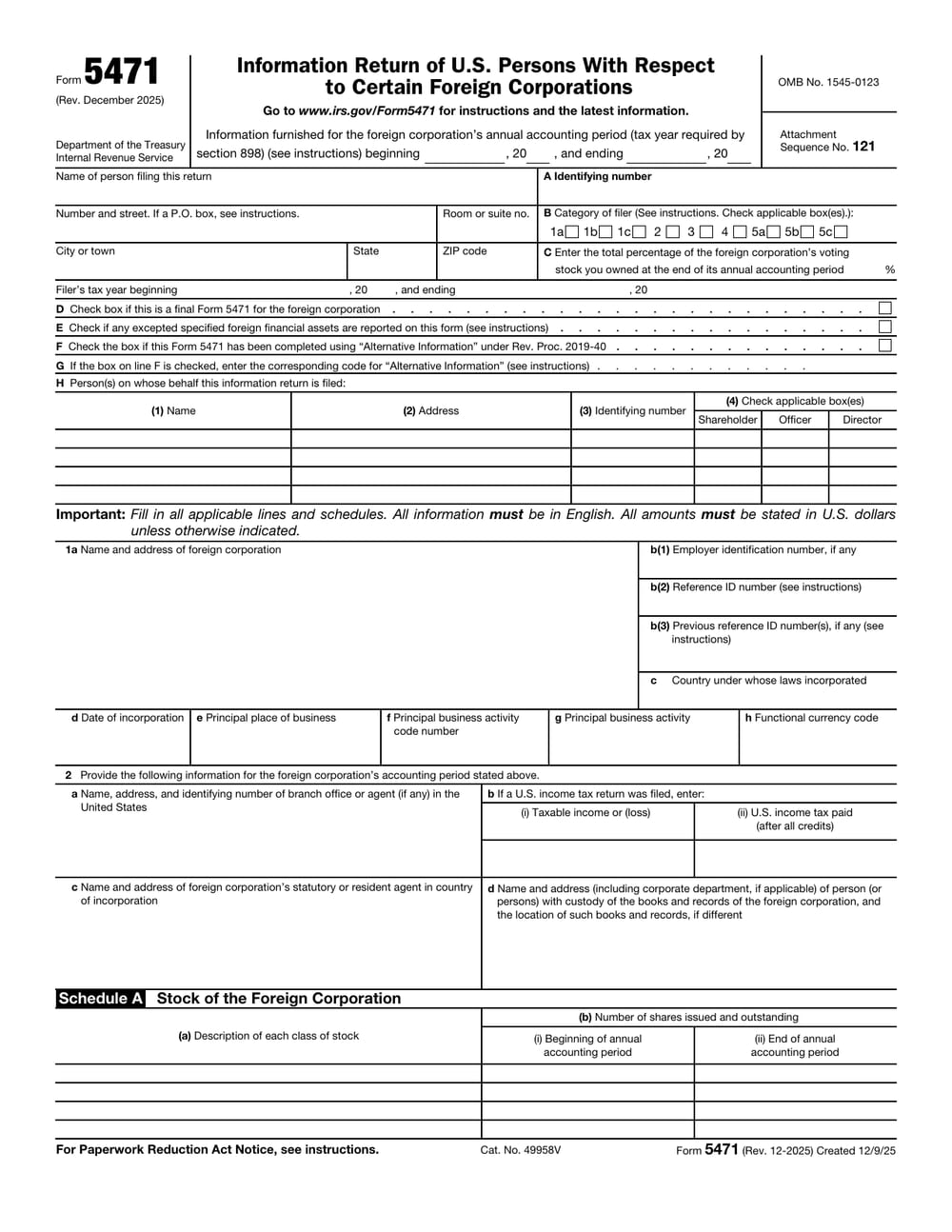
Download Form 5471 (PDF, 6 pages) · Instructions for Form 5471 (PDF)
Local copies for convenience, downloaded from IRS.gov on November 14, 2026. The schedules named above as separate forms are not included in this PDF. Always confirm you have the current revision at irs.gov/form5471 before filing.
Who completes what: the filing requirements chart
| Required information | 1a | 1b | 1c | 2 | 3 | 4 | 5a | 5b | 5c |
|---|---|---|---|---|---|---|---|---|---|
| Identifying information on page 1 | ✓ | ✓ | ✓ | ✓ | ✓ | ✓ | ✓ | ✓ | ✓ |
| Schedule A | ✓ | ✓ | |||||||
| Schedule B, Part I | ✓ | ✓ | |||||||
| Schedule B, Part II | ✓ | ✓ | ✓ | ✓ | ✓ | ✓ | |||
| Schedules C and F | ✓ | ✓ | |||||||
| Separate Schedule E | ✓ | ✓1 | ✓2 | ✓ | ✓ | ✓1 | ✓2 | ||
| Schedule E-1 (with Schedule E) | ✓ | ✓1 | ✓ | ✓ | ✓1 | ||||
| Schedule G | ✓ | ✓ | ✓ | ✓ | ✓ | ||||
| Separate Schedule G-1 | ✓ | ✓ | ✓ | ✓ | ✓ | ||||
| Separate Schedule H | ✓ | ✓ | |||||||
| Separate Schedule H-1 | ✓3 | ✓3 | ✓3 | ||||||
| Schedule I | ✓ | ✓ | ✓ | ||||||
| Separate Schedule I-1 | ✓ | ✓ | ✓ | ✓ | |||||
| Separate Schedule J | ✓ | ✓ | ✓ | ||||||
| Separate Schedule M | ✓ | ||||||||
| Separate Schedule O, Part I | ✓ | ||||||||
| Separate Schedule O, Part II | ✓ | ||||||||
| Separate Schedule P | ✓ | ✓ | ✓ | ✓ | ✓ | ||||
| Separate Schedule Q | ✓ | ✓ | ✓ | ||||||
| Separate Schedule R | ✓ | ✓ |
1 Schedules E and E-1 are required of an unrelated section 958(a) US shareholder (1b, 5b) only if the filer claims deemed-paid foreign income taxes under §960 for the year. 2 A related constructive US shareholder (1c, 5c) completes only Schedule E and may leave Schedule E-1 blank. 3 Schedule H-1 is required only of a US shareholder that is an "applicable corporation" for the corporate alternative minimum tax. It does not apply to individuals.
Reading the chart: Categories 4 and 5a are the full-computation categories. Their schedules carry the earnings and profits, the foreign taxes, the income inclusions, the previously taxed earnings and the distributions. Category 3 is a snapshot of the company (stock, shareholders, accounts and the stock event), with no earnings-and-profits or inclusion schedules. Category 2 is identification only: page 1 and Schedule O, Part I. Categories 1b, 1c, 5b and 5c carry the reduced Rev. Proc. 2019-40 requirements.
Page 1: identifying information
- Annual accounting period. Generally the foreign corporation's year ending with or within your tax year. Under §898, a specified foreign corporation may be required to use its majority US shareholder's year.
- Your name, address and identifying number. Item A is your SSN (individuals) or EIN. Prior names within the past three years are shown in parentheses.
- Item B, category of filer. Check each category box that applies, with one exception: if you are both a Category 4 and a Category 5a filer, check only Category 4.
- Item C is the percentage of the corporation's voting stock you owned at the end of its annual accounting period.
- Item D is checked if this is the final Form 5471 for the corporation. It requires Schedule O.
- Item E is checked if any excepted specified foreign financial assets are reported on this form. It is the link to Form 8938, Part IV (see "How Form 5471 interacts with your other filings" below).
- Items F and G are for filers using alternative information under Rev. Proc. 2019-40, with a code (01 to 08) for the source used.
- Item H lists persons on whose behalf the form is filed under the multiple-filer exception (see "The multiple-filer exception" above).
- Line 1 identifies the corporation: name and address (1a); EIN if any (1b(1)); a reference ID number of up to 50 letters and numbers, with no special characters, that you assign and must use consistently (1b(2)), and any previous reference ID (1b(3)); country under whose laws it is incorporated (1c); date of incorporation (1d); principal place of business (1e); principal business activity code and description (1f, 1g); and functional currency, as a three-letter ISO 4217 code (1h). The reference ID must match the one used for the same CFC on Form 8992.
- Line 2 asks for any branch office or agent in the US (2a), the corporation's taxable income and US tax paid if it filed a US return (2b), its statutory or resident agent in its country of incorporation (2c), and who has custody of its books and records and where they are kept (2d).
Schedule A: Stock of the Foreign Corporation
Who completes it: Categories 3 and 4. It describes each class of stock and the number of shares issued and outstanding at the beginning and end of the annual accounting period. This is where a class with unusual voting rights or preferences first shows up, which matters because the vote and value tests are applied separately.
Schedule B: Shareholders of Foreign Corporation
Part I, US Shareholders of Foreign Corporation. Who completes it: Categories 3 and 4. It lists each US person who owns, directly or indirectly, at least 10% of the voting power or value, with the classes and numbers of shares held at the beginning and end of the year, and each US shareholder's pro rata share of Subpart F income as a percentage.
Part II, Direct Shareholders of Foreign Corporation. Who completes it: Categories 1a, 1c, 3, 4, 5a and 5c. It lists the corporation's direct shareholders, including the owners of any foreign disregarded entity through which shares are held. Here you show the shareholders as they appear in the corporation's register, which may include your nonresident spouse or a holding company.
Schedule C: Income Statement
Who completes it: Categories 3 and 4. It is the corporation's income statement, prepared under US generally accepted accounting principles, in functional currency with a US dollar column. It includes foreign currency gains and losses (line 8) and income tax expense (line 21), and continues to other comprehensive income. Local statutory accounts are the starting point but must be adjusted to US GAAP where they differ.
Schedule E: Income, War Profits, and Excess Profits Taxes Paid or Accrued (with Schedule E-1)
Who completes it: Categories 1a, 4 and 5a; 1b and 5b only if they claim §960 deemed-paid credits; 1c and 5c complete Schedule E only. The instructions state that Schedule E must be completed even for noncorporate US shareholders.
- Part I, Section 1 reports the foreign income taxes the corporation itself paid or accrued, by payor entity, country and income category. It shows the tax in the local currency in which it is payable (column (j)), the exchange rate and US dollar amount (columns (k) and (l)), and the amount in functional currency (column (m)). For 2025, column (j) also asks for a statement on taxes allocated under guidance issued under the One Big Beautiful Bill Act.
- Part I, Section 2 reports taxes deemed paid by the corporation under §960(b) on distributions of previously taxed earnings from lower-tier foreign corporations.
- Part II asks whether an election has been made under §986(a)(1)(D) to translate taxes at the exchange rate on the date of payment.
- Part III reports taxes for which a credit is disallowed, for example under §§901(j), 901(k) and (l), 901(m) and 909.
- Schedule E-1, Taxes Paid, Accrued, or Deemed Paid on Accumulated Earnings and Profits (E&P) of Foreign Corporation, is a US dollar roll-forward of the corporation's foreign taxes by income group: Subpart F, tested income, residual, suspended taxes under §909, and the previously-taxed-earnings groups.
How this connects to your foreign tax credit. These are the corporation's taxes, not yours. Under §960, they can be deemed paid by a corporate US shareholder that has Subpart F or GILTI/NCTI inclusions. An individual shareholder generally cannot claim §960 credits unless they make a §962 election. Either way, Schedule E is the source of the numbers. An individual's own foreign taxes on salary or dividends are claimed on Form 1116, which our Form 1116 guide covers. The §6038(c) penalty, discussed in "Penalties, the foreign tax credit reduction and the open statute of limitations" below, can reduce both kinds of credit: an individual's credits under §901 and a corporate shareholder's deemed-paid credits under §960.
Schedule F: Balance Sheet
Who completes it: Categories 3 and 4. The balance sheet at the beginning and end of the year, in US dollars, prepared and translated under US GAAP. It includes separate lines for derivatives (lines 3 and 17) and for loans to and from shareholders and related persons.
Schedule G: Other Information
Who completes it: Categories 1c, 3, 4, 5a and 5c. A long set of yes/no questions, each of which can trigger a further statement or schedule. Among other things, it asks whether the corporation owned a 10% or greater interest in a foreign partnership; whether it owned interests in trusts; whether it owned foreign disregarded entities or operated foreign branches, and how many Forms 8858 are attached; new for 2025, whether it has qualified business units with a different functional currency and how many Forms 8964-TRA are attached (question 3b); hybrid arrangements; the §250 deduction; interest disallowed under §163(j); safe-haven interest rates on related-party loans; Pillar Two top-up taxes paid or accrued (questions 20a, 20b); and, new for 2025, changes in earnings attributable to §304 transactions (line 21). Line 14 uses codes to identify exceptions and exclusions from Subpart F income that the corporation relies on, such as the active rents and royalties exception or the same-country exceptions; for 2025, question 22b identifies dividends that may be subject to the One Big Beautiful Bill Act's pro rata share transition rule.
Schedule G-1: Cost Sharing Arrangement
Who completes it: Categories 1c, 3, 4, 5a and 5c, but only for a cost sharing arrangement in which the corporation was a controlled participant. One schedule per arrangement, in US dollars. Most small owner-managed companies have none.
Schedule H: Current Earnings and Profits
Who completes it: Categories 4 and 5a (5b filers need not file it for a foreign-controlled CFC). It starts from net income per the books (Schedule C, line 22) and makes adjustments to reach current-year earnings and profits under US tax principles, in functional currency. Earnings and profits, not accounting profit, drive the characterization of distributions and the Subpart F limitation. Separate Schedule H-1 applies only to corporate shareholders subject to the corporate alternative minimum tax.
Schedule I: Summary of Shareholder's Income From Foreign Corporation
Who completes it: Categories 4, 5a and 5b. This is where the shareholder's own income from the CFC appears. It reports, in US dollars, the shareholder's pro rata share of Subpart F income by type (line 1, with amounts carried from Worksheet A in the instructions), §956 amounts for earnings invested in US property (line 2), pro rata factoring income (line 4), dividends from the corporation classified by type, including §245A eligibility (lines 5a to 5e), foreign currency gain or loss on distributions of previously taxed earnings (line 6), and certain account balances for corporate shareholders. The shareholder then carries the inclusions to their own return. This guide does not cover how to compute the underlying Subpart F amounts on Worksheet A.
Schedule I-1: GILTI / net CFC tested income information
Who completes it: Categories 4, 5a, 5b and 5c. For 2025 it is titled Information for Global Intangible Low-Taxed Income. It reports CFC-level figures used in the shareholder's §951A calculation: gross income (line 1), exclusions such as Subpart F income and high-taxed income (lines 2a to 2e), gross tested income (line 4), allocable deductions (line 5), tested income or loss (line 6), tested foreign income taxes (line 7), qualified business asset investment (QBAI, line 8) and tested interest items (lines 9 and 10). The shareholder uses these figures on Form 8992. Because the One Big Beautiful Bill Act removed the QBAI-based return from §951A for tax years beginning after December 31, 2025, the IRS has posted a draft December 2026 revision of Schedule I-1 retitled Information for Net Controlled Foreign Corporation (CFC) Tested Income. Check its final form before filing a 2026 return. As with Schedule I, this guide describes what the schedule reports, not how to compute the inclusion.
Schedule J: Accumulated Earnings and Profits (E&P) of Controlled Foreign Corporation
Who completes it: Categories 1a, 4 and 5a. (Categories 1b, 1c, 5b and 5c do not file it for foreign-controlled corporations.) A functional-currency roll-forward of the CFC's accumulated earnings, split into the pools the Code requires: post-2017 earnings not previously taxed; post-1986 undistributed earnings; pre-1987 earnings; hovering deficits and suspended taxes; and the previously taxed earnings groups under §959(c)(1) and (c)(2), such as earnings already taxed under §965, §951A or §951(a)(1)(A). A separate Schedule J is required for each separate category of income, plus a "TOTAL" schedule if more than one applies. Mistakes here carry forward for years, because the pools decide whether a later distribution is taxable.
Schedule M: Transactions Between Controlled Foreign Corporation and Shareholders or Other Related Persons
Who completes it: Category 4 only. The instructions say every US person described in Category 4 must file Schedule M. It reports, in US dollars translated at the average exchange rate for the year (§989(b)), the corporation's transactions during its annual accounting period with you, with other entities you control, with other 10% US shareholders and with related persons: sales and purchases, rents, royalties, service fees, commissions, interest, dividends, loan guarantee fees and other amounts. For receivables, payables and loans it asks for the largest outstanding balance during the year (lines 31 to 34), not the year-end balance. For an owner-manager, salary, director's fees, management charges and shareholder loans all belong here.
Schedule O: Organization or Reorganization of Foreign Corporation, and Acquisitions and Dispositions of its Stock
This is the §6046 schedule.
- Part I. Who completes it: Category 2. It lists the US persons who acquired stock, the date each first acquired 10% or more of the value or voting power (column (d)), and the date of any additional 10% acquisition (column (e)).
- Part II. Who completes it: Category 3. Section A gives general shareholder information, including where the shareholder's most recent return was filed ("e-filed" if electronic). Section B identifies US persons who are officers or directors. Section C, filed by shareholders who acquired sufficient stock, reports each acquisition on a separate line: date, method of acquisition (column (d)), and shares acquired directly, indirectly (column (e)(2)) and constructively (column (e)(3)). Section D, filed by shareholders who disposed of stock in whole or in part, reports the date, method of disposition and shares disposed of. Section E covers the organization or reorganization of the corporation. Section F asks for additional information, including the date of any reorganization in the last four years while any US person held 10% or more, and, for chains of corporations, a list of the corporations in the chain.
Schedule O does not report property contributed to the corporation. That goes on Form 926 (see "How Form 5471 interacts with your other filings" below).
Schedule P: Previously Taxed Earnings and Profits of U.S. Shareholder of Certain Foreign Corporations
Who completes it: Categories 1a, 1b, 4, 5a and 5b, each separately. It tracks the shareholder's own previously taxed earnings accounts in the CFC: amounts already included under Subpart F, GILTI or §965, which can later be distributed without being taxed again. Part I is in functional currency and Part II shows the shareholder's US dollar basis in those earnings, which matters for foreign currency gain or loss on distribution. A separate Schedule P is completed for each applicable separate foreign tax credit category of income, other than the §951A category (the instructions say not to complete one for that category), and a "TOTAL" Schedule P is added if more than one applies. A shareholder who relies on another person's filing still completes their own Schedule P.
Schedule Q: CFC Income by CFC Income Groups
Who completes it: Categories 4, 5a and 5b. It breaks the CFC's gross income, deductions, foreign taxes and assets into the income groups used for the foreign tax credit under §960(a) and (d): Subpart F income groups (by type, such as passive or foreign base company sales), recaptured Subpart F income, the tested income group and the residual income group, by separate category (for example passive and general). It is the bridge between the CFC's accounts and both the inclusions and the deemed-paid credits. The IRS has posted a draft December 2026 revision.
Schedule R: Distributions From a Foreign Corporation
Who completes it: Categories 4 and 5a. It reports the basic facts of each distribution: description, date, amount in functional currency and the earnings and profits distributed, as required for §§245A, 959 and 986(c). The total must tie to the distributions shown on the "TOTAL" Schedule J. A dividend you received from your own company appears here, on Schedule M if you are a Category 4 filer, and on Schedule I, line 5.
Filing deadline for Americans abroad
The instructions are short: attach Form 5471 to your income tax return and file both by the due date, including extensions, for that return. Form 5471 has no deadline or extension of its own. It moves with your Form 1040.
| Situation | Due date | Basis |
|---|---|---|
| Living in the US | April 15 | §6072(a) |
| US citizen or resident whose tax home and abode are outside the US and Puerto Rico on the regular due date (or on military duty abroad) | June 15, automatically. Attach a statement to the return showing that you qualify | Treas. Reg. §1.6081-5(a)(5), (a)(6), (b)(1); IRS IR-2026-52 |
| Extension requested on Form 4868 | October 15. For someone abroad, the six-month extension runs concurrently with the June 15 extension and is not added to it | Treas. Reg. §1.6081-4 |
| Additional discretionary extension for taxpayers abroad | December 15, if requested by letter by October 15 and granted | Described in IRS Publication 54; not automatic |
When a due date falls on a weekend or legal holiday, it moves to the next business day (§7503). For 2025 returns, June 15, 2026 and October 15, 2026 both fell on weekdays. An extension of time to file is not an extension of time to pay. Interest on unpaid tax runs from April 15 in every case, and that includes any tax on Subpart F or GILTI inclusions.
What "late" means. If your Form 1040 is late, the Form 5471 attached to it is late too, even if the company's accounts were ready months earlier. A Form 5471 omitted from a timely return is also late, even if you file it later with an amended return. Either situation can trigger the penalties described below. A Form 5471 that is filed but incomplete can also be a failure (see below).
Categories 2 and 3: the 90-day rule in the statute. Section 6046(d) says a §6046 return is due on or before the 90th day after the person becomes liable to file it, "or on or before such later day as the Secretary may by forms or regulations prescribe." The regulations repeat this (Reg. §1.6046-1(j)(1)), and the Form 5471 instructions are that later day: Category 2 and 3 information goes on the Form 5471 attached to your return for the year of the event.
Fiscal-year companies. You report the corporation's annual accounting period that ends with or within your tax year. If a company's year ends on March 31, 2025, that year goes on the Form 5471 attached to your 2025 Form 1040. Under the One Big Beautiful Bill Act, for a specified foreign corporation's tax year beginning after November 30, 2025, the corporation may no longer use a year beginning one month earlier than its majority US shareholder's year. This mainly affects CFCs that used a November 30 year end to defer inclusions.
Corrected returns. To correct a Form 5471 already filed, file a corrected Form 5471 with an amended return, using the amended return instructions for the return with which you originally filed it. Write "Corrected" at the top of the form and attach a statement identifying the changes.
E-filing. Form 5471 is filed with the return. If you e-file your Form 1040, the Form 5471 and its schedules are part of the electronic submission.
Penalties, the foreign tax credit reduction and the open statute of limitations
Form 5471 has two penalty regimes, one for each statute. Information required by §6038, which is the information required of Category 1, 4 and 5 filers, is penalized under §6038(b) and (c). The instructions' heading for this penalty refers to "Form 5471 and Schedule M." Information required by §6046, which is the information required of Category 2 and 3 filers, is penalized under §6679. That heading refers to "Form 5471 and Schedule O," so it covers the whole Category 3 filing (Schedules A, B, C, F and G as well as Schedule O), not just Schedule O. A "failure" includes filing late, not filing, and filing a form that does not show the required information. The penalties apply even if no tax is due and the information would not change your tax (Reg. §1.6038-2(k)(4)). The amounts are fixed in the statutes and are not indexed for inflation.
Categories 1, 4 and 5: the §6038(b) dollar penalty
- Initial penalty: $10,000 "for each annual accounting period with respect to which such failure exists" (§6038(b)(1); Reg. §1.6038-2(k)(1)(i)). The penalty is per foreign corporation and per year. Two companies missed for three years each is six failures and $60,000 in initial penalties.
- Continuation penalty: if the failure continues for more than 90 days after the day the IRS mails you notice of it, an additional $10,000 applies for each 30-day period, or fraction of one, during which the failure continues after the 90-day period (§6038(b)(2)). The increase is capped at $50,000 for each failure (Reg. §1.6038-2(k)(1)(ii)).
- Maximum per corporation per year: $10,000 + $50,000 = $60,000.
Categories 1, 4 and 5: the §6038(c) reduction of foreign tax credits
Section 6038(c)(1) adds a second consequence for the same failure. For an individual, the operative rule is that in applying §901 to the person for the taxable year, the foreign taxes paid or deemed paid are reduced by 10% (§6038(c)(1)(A); Reg. §1.6038-2(k)(2)(ii)). The reduction applies to all of the person's creditable foreign taxes for the year, not just taxes connected with the corporation. For a corporate shareholder, the taxes deemed paid under §960 are also reduced (§6038(c)(1)(B)). The details matter:
- Escalation. If the failure continues 90 days or more after IRS notice, the reduction becomes 10% plus an additional 5% for each three-month period, or fraction of one, during which the failure continues after the 90-day period (§6038(c)(1), flush language; Reg. §1.6038-2(k)(2)(iv)(A)).
- Cap. The reduction for each failure cannot exceed the greater of $10,000 or the income of the foreign corporation for the annual accounting period in which the failure occurs (§6038(c)(2); Reg. §1.6038-2(k)(2)(v)).
- Coordination with the dollar penalty. The reduction for an accounting period is itself reduced, but not below zero, by the §6038(b) dollar penalty imposed for that period (§6038(c)(3); Reg. §1.6038-2(k)(2)(vi)). For most individuals this cancels the reduction entirely. A 10% reduction exceeds the $10,000 initial penalty only if the person's foreign taxes for the year exceed $100,000 ($10,000 ÷ 10%). A person with $140,000 of foreign taxes would face 10% × $140,000 = $14,000, minus the $10,000 penalty, for a $4,000 credit reduction on top of the penalty. Worked example 1 below shows the arithmetic for a more typical case.
- Once per failure. No taxes are reduced more than once for the same failure (§6038(c)(4)(A)).
Reasonable cause under §6038
Section 6038 handles reasonable cause in an unusual way. Section 6038(c)(4)(B) treats the time to furnish the information, and the start of the 90-day post-notice period, as not earlier than the last day on which, as shown to the satisfaction of the IRS, reasonable cause existed for the failure. In effect, the penalty clock does not start while reasonable cause continues, so a failure fully explained by reasonable cause leads to neither the dollar penalty nor the credit reduction. You must make an affirmative showing of all the facts alleged as reasonable cause in a written statement containing a declaration that it is made under penalties of perjury (Reg. §1.6038-2(k)(3)). In practice, the IRS weighs whether you exercised ordinary business care and prudence, for example by relying in good faith on a competent adviser to whom you gave the full facts. Not knowing that the form existed is rarely enough on its own.
Categories 2 and 3: the §6679 penalty
The citation is the same as for Form 8865's acquisition and disposition category. Section 6679 applies to "any person required to file a return under section 6046 or 6046A" who fails to file it on time or files a return that does not show the required information. The regulations under §6046 point to it (Reg. §1.6046-1(k)(2)), and the Form 5471 instructions apply it to the §6046 information on Form 5471 and Schedule O.
- Initial penalty: $10,000, unless the failure is shown to be due to reasonable cause (§6679(a)(1)). The instructions describe it as applying for each failure, per reportable transaction.
- Continuation penalty: if the failure continues for more than 90 days after the IRS mails notice, $10,000 for each 30-day period, or fraction of one, after the 90-day period, with the increase capped at $50,000 (§6679(a)(2)).
- No foreign tax credit reduction. Section 6038(c) applies only to §6038 failures.
- Assessable, with no deficiency procedures. Section 6679(b) says the deficiency procedures do not apply to the assessment or collection of this penalty, and Reg. §301.6679-1(b) says it may be assessed and collected without regard to them. Section 6679 sits among the assessable penalties of Chapter 68, subchapter B.
- Reasonable cause: a written statement under penalties of perjury setting out all the facts. If you exercised ordinary business care and prudence and still could not furnish an item, the failure is treated as due to reasonable cause, and the IRS considers how much of the stock you owned in judging whether you could have obtained the information (Reg. §301.6679-1(a)(3)). This is useful for minority Category 3 filers who cannot get the company's accounts.
A person who is both a Category 3 and a Category 4 or 5 filer for the same year, typically in the year of acquisition, can be exposed to both regimes: §6038 for the Category 4 and 5 information and §6679 for the Category 3 information, including Schedule O. The examples below label the §6679 amount "potential," because whether the IRS asserts both for the same Form 5471 depends on the facts.
Criminal penalties
Criminal penalties under §§7203 (willful failure to file or supply information), 7206 (fraud and false statements) and 7207 (fraudulent returns and documents) can apply to failures under §§6038 and 6046 (Reg. §§1.6038-2(k)(4), 1.6046-1(k)(1)). They require willfulness and are outside the scope of this guide.
The statute of limitations: §6501(c)(8)
Normally the IRS has three years after you file a return to assess additional tax (§6501(a)). Section 6501(c)(8)(A) overrides this for missing international information. It covers information required to be reported under §§6038, 6038A, 6038B, 6038D, 6046, 6046A and 6048, and elections under §§1295(b) and 1298(f). For "any tax return, event, or period to which such information relates," the time to assess any tax "shall not expire before the date which is 3 years after the date on which the Secretary is furnished the information."
How this applies to Form 5471 specifically. Both statutes behind Form 5471, §6038 and §6046, are on the list. Whatever your category, a required but missing Form 5471 keeps the assessment period open for the return to which it relates, until three years after you furnish the information. A Form 5471 that is filed but materially incomplete raises the same issue for the missing information. For a CFC shareholder, this is often the most expensive consequence: the open period covers any Subpart F or GILTI inclusion that should have been reported, as well as other items.
Whole return or only related items? Section 6501(c)(8) was amended in 2010, starting with the HIRE Act of March 18, 2010. The amended version applies to returns filed after that date, and to earlier returns whose assessment period was still open on that date. Subparagraph (B) provides that if the failure is due to reasonable cause and not willful neglect, the extension applies only to the "item or items related to such failure." The result is:
- Without reasonable cause: the entire return stays open, including items unrelated to the corporation, such as US-source interest, a home sale or a stock option.
- With reasonable cause: only items related to the missing information stay open, such as your Subpart F and GILTI inclusions from the corporation, dividends from it and your transactions with it. The rest of the return closes on the normal schedule.
An IRS Chief Counsel email released as CCA 201432020 applies these rules to a missing Form 5471. See also the Chief Counsel memorandum on the HIRE Act amendment, CCA 201104041. Neither is precedent, but they reflect the IRS approach.
The same rule as Form 8938 and Form 8865, a different rule from the FBAR. Section 6038D, which requires Form 8938, is on the same list. The FBAR is not. It is required by the Bank Secrecy Act (31 U.S.C. §5314 and 31 CFR §1010.350) in Title 31, not by the Internal Revenue Code, so failing to file an FBAR does not by itself extend the assessment period for your income tax return. FBAR penalties have their own limitations period under Title 31.
Can the IRS assess the §6038(b) penalty directly? Where the litigation stands
This is the same penalty, the same statute and the same line of cases our Form 8865 guide documents. Since 2023, taxpayers have argued that the IRS cannot simply assess the §6038(b) penalty and must instead sue in federal district court to collect it. Several of the cases are about Form 5471. As of the research date:
- In Farhy v. Commissioner, 160 T.C. 399 (2023), the Tax Court held that the IRS lacked authority to assess the §6038(b) penalty for unfiled Forms 5471. The D.C. Circuit reversed in Farhy v. Commissioner, 100 F.4th 223 (D.C. Cir. 2024), holding the penalty assessable.
- In Mukhi v. Commissioner, 163 T.C. No. 8 (2024), a reviewed opinion, the Tax Court reaffirmed its own position for cases appealable to circuits that had not ruled. The case is appealable to the Eighth Circuit. We found no Eighth Circuit decision in Mukhi as of the research date.
- In Safdieh v. Commissioner, No. 25-501 (2d Cir. Feb. 27, 2026), the Second Circuit sided with the D.C. Circuit and held that the Commissioner may assess §6038(b) penalties. It vacated the Tax Court's December 2024 order, which had applied Mukhi, and remanded. The Second Circuit denied rehearing en banc in June 2026. In September 2026 the taxpayer applied to the Supreme Court for more time to file a petition for certiorari (No. 26A314). On September 8, 2026, Justice Sotomayor granted the application and extended the deadline to November 23, 2026. As of the research date, the Supreme Court docket shows no later entry and no petition docketed.
Three practical points. First, the dispute is only about how the IRS collects the §6038(b) penalty. Whether the penalty applies is not in question. Second, the dispute concerns §6038(b). It does not affect the §6679 penalty for Categories 2 and 3, the §6038(c) credit reduction, or §6501(c)(8). Third, both appellate courts to decide the issue have held the penalty assessable. Planning a Form 5471 position around the Farhy argument is not a sound strategy. Because a petition could still be filed by November 23, 2026, recheck the docket before relying on this paragraph.
Penalty summary
| Category | Initial | After IRS notice | Other consequences | Reasonable-cause relief |
|---|---|---|---|---|
| 1, 4 and 5 (§6038) | $10,000 per corporation per annual accounting period | +$10,000 per 30 days (or part) after 90 days; max +$50,000 | 10% foreign tax credit reduction (+5% per 3 months, or part, after 90 days), capped at the greater of $10,000 or the corporation's income and offset by the dollar penalty; §6501(c)(8) | Yes (§6038(c)(4)(B); Reg. §1.6038-2(k)(3)) |
| 2 and 3 (§6046) | $10,000 per failure | +$10,000 per 30 days (or part) after 90 days; max +$50,000 | §6501(c)(8). No credit reduction | Yes (§6679(a)(1); Reg. §301.6679-1(a)(3)) |
| Any (criminal) | §§7203, 7206, 7207 for willful failures | Outside the scope of this guide | Not applicable | |
| Related: Form 926 (§6038B) | 10% of the fair market value of the property transferred; max $100,000 unless intentional disregard | No continuation penalty | §6501(c)(8) | Yes (§6038B(c)(2)) |
Worked example 1: a 60% owner (Categories 3, 4 and 5) with two missed years
The people, the company and all figures in this example are hypothetical. They were chosen to illustrate the filing rules and the penalty arithmetic. Amounts are in US dollars, already translated. The example deliberately does not compute the corporation's Subpart F income or GILTI, or Laura's US tax on them. That is a separate calculation outside this example.
The facts
- Laura is a US citizen who has lived in Munich since 2019. She is single and has no other foreign companies.
- On March 1, 2023, she bought 60% of the shares of Isarblick Design GmbH, a German interior-design firm, from its retiring founder. The GmbH has one class of shares, so her 60% is 60% of both the votes and the value. The other 40% belongs to Jonas, a German citizen and resident who is not related to her.
- Laura paid the founder for the shares. She did not contribute any cash or property to the GmbH itself.
- On April 1, 2023, after the purchase, she was appointed Geschäftsführerin (managing director).
- The GmbH uses the calendar year and the euro as its functional currency. Its net income per books was $85,000 in 2023 and $120,000 in 2024. It paid Laura a salary, made no distributions, and in 2024 lent her $20,000.
- Laura paid German income tax on her salary of $31,000 for 2023 and $36,500 for 2024.
- She filed her 2023 Form 1040 on June 14, 2024 and her 2024 Form 1040 on June 13, 2025, both within the automatic June 15 extension. She reported her salary and claimed a foreign tax credit on Form 1116 for her German income tax. She did not file Form 5471 for either year, because she did not know it existed.
Step 1: Which form?
A GmbH is not on the German per se list (the German per se entity is the Aktiengesellschaft), so it is an eligible entity. All of its shareholders have limited liability under German law. With no Form 8832 election, it is classified as a corporation by default (Reg. §301.7701-3(b)(2)(i)). It is organized in Germany, so it is foreign. Laura's form is Form 5471.
Step 2: Which categories, year by year?
| Category | 2023 | 2024 | Why |
|---|---|---|---|
| 1 | No | No | The GmbH had no US shareholders before 2023, so it has no §965-related earnings on Schedule J and Laura has no §965 previously taxed earnings on Schedule P |
| 2 | No | No | She became managing director after her own acquisition, and no US person acquired 10% while she was a director. Had she been appointed first, she would also be a Category 2 filer for 2023 and would add Schedule O, Part I. The "three or fewer US persons own 95%" exception would not help, because US persons own only 60% |
| 3 | Yes | No | On March 1, 2023 she acquired stock meeting the 10% requirement. There was no stock event in 2024 |
| 4 | Yes | Yes | She owned more than 50% of the vote and value at some time during each year. No minimum holding period applies |
| 5a | Yes | Yes | She is a US shareholder (10% or more). US shareholders owned more than 50% on at least one day of each year, so the GmbH is a CFC. She owned her shares on the last day of each year. The GmbH is not foreign-controlled, so 5b and 5c do not apply |
Boxes to check in item B: for 2023, Category 3 and Category 4. For 2024, Category 4. Because she is both a Category 4 and a 5a filer, she leaves the 5a box blank in both years, while completing every schedule required of either category.
Step 3: Which schedules?
| Schedule | 2023 (Categories 3, 4, 5a) | 2024 (Categories 4, 5a) |
|---|---|---|
| Page 1 identifying information | Yes | Yes |
| A, B Part I, C, F | Yes (Categories 3 and 4) | Yes (Category 4) |
| B Part II, G | Yes | Yes |
| E and E-1 | Yes (Categories 4 and 5a) | Yes |
| G-1 | Not needed: no cost sharing arrangement | Not needed |
| H, I, I-1, J, P, Q, R | Yes (Categories 4 and 5a). Schedule R shows no distributions | Yes |
| M | Yes (Category 4): salary paid to her | Yes: salary and the $20,000 loan (largest balance during the year) |
| O, Part II | Yes (Category 3): Sections A and C for the March 1 purchase, plus Section F | No |
| H-1 | No: she is not an applicable corporation for CAMT | No |
The figures on Schedules H, I, I-1, J, P and Q depend on the GmbH's earnings and profits and on how its income divides between Subpart F income, tested income and other income. For an active design business with no passive income, Subpart F income may well be nil. Tested income for GILTI may be positive, subject to the elections, such as the GILTI high-tax exclusion, that form part of that computation. The 2024 loan also needs attention: an obligation of a US person held by a CFC can be "United States property" under §956(c)(1)(C), reported on Schedule I, line 2. Those computations are outside this example. The penalties below do not depend on them.
Step 4: Penalty exposure in three scenarios
Laura has three separate failures: the §6038 information for 2023, the §6038 information for 2024, and the §6046 information required of her as a Category 3 filer for the 2023 acquisition (reported on Schedule O).
Scenario A: Laura files before the IRS contacts her
Laura learns about Form 5471 in summer 2026. On September 15, 2026, before any IRS contact, she files both Forms 5471 with amended returns, each with a reasonable cause statement. Which procedure fits depends on what the amended returns show (see "Options if you have missed Forms 5471" below). If they show no additional income, the delinquent international information return submission procedures apply. If the forms reveal Subpart F or GILTI inclusions she did not report, her income was not fully reported, and the Streamlined Foreign Offshore Procedures are the more likely route. Under those procedures an eligible, non-willful taxpayer is not subject to information return penalties, so the table below is the exposure outside them.
| Penalty | 2023 | 2024 |
|---|---|---|
| §6038(b)(1) initial | $10,000 | $10,000 |
| §6038(b)(2) continuation (no IRS notice, so none) | $0 | $0 |
| §6679(a)(1) initial, Schedule O, potential | $10,000 | n/a |
| §6038(c) credit reduction (see below) | $0 | $0 |
| Total per year | $20,000 | $10,000 |
| Total, both years | $30,000 | |
The credit reduction, worked. The reduction is 10% of Laura's creditable foreign taxes for each year: 10% × $31,000 = $3,100 for 2023, and 10% × $36,500 = $3,650 for 2024. The cap is the greater of $10,000 or the GmbH's income for the year ($85,000 and $120,000), so the cap does not bind. Under §6038(c)(3), each year's reduction is then reduced, but not below zero, by that year's §6038(b) penalty: $3,100 − $10,000 and $3,650 − $10,000 are both below zero, so the reduction is $0 in both years. It would bite only if her foreign taxes for a year exceeded $100,000.
If the IRS accepts her reasonable cause statements, all of these amounts fall away. If it assesses them anyway during processing, as the procedures warn it may, she can respond with the same explanation or request abatement.
Scenario B: the IRS mails a notice first, and Laura files after the 90-day window
Suppose instead that the IRS mails Laura a notice about the missing Forms 5471, including the Schedule O information, on February 2, 2026, and she files them on July 20, 2026.
- The 90-day period. It runs for 90 days after the mailing date: February 3–28 (26 days) + March (31) + April (30) + May 1–3 (3) = 90 days, ending May 3, 2026.
- Time the failure continued afterwards. From May 4 to July 20, 2026: May 4–31 (28 days) + June (30) + July 1–20 (20) = 78 days.
- 30-day periods or fractions. 78 ÷ 30 = 2.6, which rounds up to 3 periods. That gives 3 × $10,000 = $30,000 of continuation penalty per failure, under the $50,000 cap. Counting the filing day or not makes no difference: 77 days is still 3 periods.
- Three-month periods or fractions for the credit reduction. The first three-month period after the 90-day window runs from May 4 to August 3, 2026. July 20 falls within it, so there is 1 period. The reduction rate becomes 10% + 1 × 5% = 15%.
| Penalty | 2023 | 2024 |
|---|---|---|
| §6038(b)(1) initial | $10,000 | $10,000 |
| §6038(b)(2) continuation (3 periods × $10,000) | $30,000 | $30,000 |
| §6679(a)(1) initial, Schedule O, potential | $10,000 | n/a |
| §6679(a)(2) continuation (same 3 periods), potential | $30,000 | n/a |
| §6038(c) credit reduction: 15% × $31,000 = $4,650 and 15% × $36,500 = $5,475, each minus that year's $40,000 §6038(b) penalty, so $0 | $0 | $0 |
| Total per year | $80,000 | $40,000 |
| Total, both years | $120,000 | |
If the notice had not covered the Schedule O failure, the §6679 continuation penalty would not run, and the total would be $90,000. Either way, waiting past the 90-day window turned a $30,000 maximum into a $90,000 to $120,000 one, in under three months.
Already missed a Form 5471 and haven't heard from the IRS yet? Filing voluntarily before any notice can be the difference between roughly $30,000 of exposure and $90,000–$120,000. Ask TaxLatitude what filing now would look like →
Scenario C: Laura never files
For each year, the §6038(b) penalty reaches its statutory maximum of $10,000 + $50,000 = $60,000, so $120,000 for both years. Add up to $60,000 under §6679 for the 2023 Schedule O failure, for a potential $180,000. The credit-reduction rate keeps rising by 5% every three months, but each year's reduction is still offset by that year's $60,000 dollar penalty, so it stays at $0 for Laura. The assessment period for both returns never starts to run under §6501(c)(8). All of this is on top of whatever US tax she owes on the GmbH's Subpart F income and GILTI, plus interest and any accuracy-related penalties on that tax.
Step 5: The statute of limitations
Ordinarily the IRS would have until June 14, 2027 (2023 return) and June 13, 2028 (2024 return) to assess more tax. Under §6501(c)(8)(A), assessment for each return cannot close before three years after the missing information is furnished. In Scenario A, if Laura furnishes both Forms 5471 on September 15, 2026, both returns stay open until at least September 15, 2029. In Scenario B, filing on July 20, 2026 keeps them open until at least July 20, 2029.
- If Laura establishes reasonable cause, §6501(c)(8)(B) limits the extension to items related to the GmbH: her Subpart F and GILTI inclusions, any §956 amount for the loan, dividends, and her transactions with the company.
- If she does not, the extension covers every item on both returns.
Step 6: The other filings this exposes
- Subpart F and GILTI on her Form 1040. As a US shareholder of a CFC, Laura may have to include amounts in income for 2023 and 2024 even though nothing was distributed, using Form 8992 for GILTI. The foreign earned income exclusion does not cover these inclusions: §911 excludes foreign earned income, meaning pay for personal services (§911(b)(1)), and a CFC inclusion is not pay for services. Whether high-tax elections, a §962 election or other planning reduce the tax is a separate analysis.
- FBAR. Laura owns more than 50% of the GmbH's voting power and value, so she has a financial interest in its foreign accounts (31 CFR §1010.350(e)(2)(ii)). As managing director she also has signature authority over them. If the aggregate value of her foreign accounts, including the company's, exceeds $10,000 at any time in the year, they belong on her FBAR. See our FBAR guide.
- Form 8938. Her GmbH shares are a specified foreign financial asset. Because they are reported on Form 5471, she does not list them again on Form 8938, but she completes Part IV and checks item E on Form 5471 (see "How Form 5471 interacts with your other filings" below).
- Form 926. Not needed: she bought existing shares from the founder and transferred nothing to the GmbH. Had she instead subscribed for newly issued shares, Form 926 could apply if the transfer was one described in §6038B(a)(1)(A), such as a §351 exchange.
"Options if you have missed Forms 5471," later in this guide, covers the procedures available to Laura for filing the missing forms.
Worked example 2: a minority shareholder who crosses 10% (Category 3)
Hypothetical facts, for illustration only.
The facts
- Daniel is a US citizen living in Amsterdam. Since 2021 he has owned 6% of Lumen Analytics B.V., a Dutch software company he joined as an early employee. The B.V. has one class of shares.
- On September 1, 2025, he bought another 8% from a departing co-founder, bringing him to 14%.
- The other shareholders are two Dutch founders with 56% between them and a Dutch venture fund with 30%. None of them is a US person, and none is related to Daniel. Daniel is not an officer or director.
- Daniel is single, and no member of his family owns shares.
Step 1: Which form?
The Dutch per se entity is the naamloze vennootschap (N.V.). A besloten vennootschap (B.V.) is an eligible entity whose shareholders all have limited liability, so it is a corporation by default. Daniel's form, if he has to file one, is Form 5471.
Step 2: Which categories?
| Category | 2025 | Why |
|---|---|---|
| 1 | No | The B.V. is not a CFC and has no domestic corporate shareholders, so it is not a section 965 SFC |
| 2 | No | He is not an officer or director |
| 3 | Yes | He acquired stock which, when added to the 6% he already owned, meets the 10% requirement (§6046(a)(1)(B)(i)) |
| 4 | No | 14% is far below control |
| 5 | No | Daniel is a US shareholder (14% is at least 10%), but the only US shareholder owns 14%, so the B.V. is not a CFC |
Step 3: Which schedules, compared with Laura's
| Schedule | Daniel, 2025 | Laura, 2023 |
|---|---|---|
| Page 1 | Yes | Yes |
| A (stock), B Part I (US shareholders), B Part II (direct shareholders) | Yes | Yes |
| C (income statement), F (balance sheet) | Yes | Yes |
| G (other information); G-1 if a cost sharing arrangement exists | Yes | Yes |
| O, Part II | Yes: Section A and Section C (the September 1 purchase), plus Section F | Yes |
| E and E-1 (foreign taxes) | No | Yes |
| H (current E&P), J (accumulated E&P) | No | Yes |
| I (shareholder's income), I-1 (GILTI), Q (income groups) | No | Yes |
| M (related-party transactions) | No | Yes |
| P (previously taxed earnings), R (distributions) | No | Yes |
The difference is the difference between a snapshot and a tax computation. Daniel reports who owns the company, what it looks like financially and what he bought. He has no Subpart F or GILTI inclusion, because the company is not a CFC, so none of the earnings, inclusion and tax schedules apply.
The practical problem: the accounts. Daniel must still provide the B.V.'s income statement and balance sheet under US GAAP (Schedules C and F). As a 14% shareholder, he may get only the Dutch statutory accounts. He should ask the company for what he needs, keep a record of the request, and complete the schedules as fully as the information allows. If he exercised ordinary business care and still could not get an item, the §6679 regulations treat that as reasonable cause, taking into account how much of the stock he owns (Reg. §301.6679-1(a)(3)).
Step 4: Deadline and penalty exposure
- Due date: with his 2025 Form 1040. Living abroad, that was June 15, 2026 automatically, or October 15, 2026 with Form 4868.
- Penalty if missed: $10,000 under §6679(a)(1), plus up to $50,000 if the failure continues more than 90 days after an IRS notice. There is no §6038(b) penalty, because Daniel has no §6038 obligation, and no foreign tax credit reduction, because §6038(c) does not apply.
- Statute of limitations: §6046 is on the §6501(c)(8) list, so a missing Form 5471 keeps his 2025 return open until three years after he files it, for the whole return unless he shows reasonable cause.
- 2026 and later: no Form 5471 unless something happens. Laura files every year. Daniel files only in a year with a Category 3 (or other) event.
Variations that change the answer
- Daniel joins the supervisory board before the purchase. If Daniel were a director of the B.V. on September 1, 2025, his own acquisition would be an acquisition by a US person of stock meeting the 10% requirement while he was a director. He would also be a Category 2 filer and add Schedule O, Part I. The 95% exception does not apply, because US persons own only 14%.
- Daniel sells down in 2026. If he sold 5% in 2026, falling from 14% to 9%, that disposition would be another Category 3 event. He would file a 2026 Form 5471 with Schedule O, Part II, Section D, and Schedules A, B, C, F and G again.
- Daniel's nonresident wife owns 40%. Suppose instead that the founders held 36%, the venture fund 10%, and Daniel's wife, a Dutch citizen and nonresident alien, has held 40% since 2021. The answers diverge sharply by category:
- Category 4: yes. For control, §318 family attribution applies through §6038(e)(2), and it does not exclude a nonresident spouse. Daniel is treated as owning his 14% plus her 40%, or 54%, which is more than 50%. The nonresident-alien exception does not help, because it requires that he own no direct or indirect interest himself (Reg. §1.6038-2(l)). He becomes a Category 4 filer with the full set of Category 4 schedules, including Schedule M, and the §6038(b) and (c) penalties apply to that part of the filing.
- Category 5: still no. For CFC status, §958(b)(1) does not attribute a nonresident alien's shares to a US citizen. The B.V.'s US shareholders own only Daniel's 14%, so it is not a CFC and there are no Subpart F or GILTI inclusions.
- Category 3: the history changes. The §6046 attribution rules in Reg. §1.6046-1(i) count a spouse's shares, including a nonresident spouse's. With his wife's 40% attributed to him, Daniel already met the 10% requirement in 2021, so his Category 3 position for 2021 and for the 2025 purchase needs to be re-examined.
Do you or your spouse own part of a foreign company together? Even a small direct stake can become Category 4 control once a nonresident spouse's shares are added — without the company ever being a CFC. Ask TaxLatitude to check your actual filing category →
- Daniel subscribes for new shares instead. If Daniel had acquired his extra 8% by subscribing cash for newly issued shares, the stock acquisition would still be a Category 3 event on Schedule O. Whether he also files Form 926 depends on whether the transfer is described in §6038B(a)(1)(A), such as a §351 exchange, and, for cash, on the 10%-after-transfer and $100,000-in-12-months tests described in "How Form 5471 interacts with your other filings" below.
- The company is a passive investment vehicle. A foreign corporation that is not a CFC can be a passive foreign investment company (PFIC) if most of its income or assets are passive, with separate reporting on Form 8621. An operating software company is unlikely to be one, but the question should be asked. PFIC rules are outside the scope of this guide.
How Form 5471 interacts with your other filings
- Form 8938. Stock in a foreign corporation is a specified foreign financial asset. If you report it on Form 5471 (or another listed form) for the year, you do not report it again on Form 8938. You must still identify on Part IV of Form 8938 which forms, and how many, report your assets, and you still count the asset's value toward the Form 8938 threshold (IRS: "Do I need to file Form 8938?"; Reg. §1.6038D-7). Item E on page 1 of Form 5471 is the matching checkbox. Form 5471 does not cover the company's own bank accounts, which are not your assets for Form 8938. See our Form 8938 guide.
- FBAR (FinCEN Form 114). Form 5471 does not satisfy the FBAR. A US person who owns, directly or indirectly, more than 50% of a corporation's voting power or total value of shares has a financial interest in the corporation's foreign accounts (31 CFR §1010.350(e)(2)(ii)). Separately, an officer or employee with authority to control the disposition of money in a corporate account by direct communication with the bank has signature authority over it (§1010.350(f)(1)), which is also reportable. A 30% shareholder who is also managing director and can sign on the company's bank account has an FBAR obligation through signature authority, even without a financial interest. See our FBAR guide.
- Form 926: property contributed to the same corporation. A US person who transfers property to a foreign corporation in an exchange described in §6038B(a)(1)(A), mainly §351 contributions and certain reorganizations, reports it on Form 926, attached to the return for the year of the transfer. Cash is reportable if, immediately after the transfer, you hold at least 10% of the corporation's voting power or value, or if the cash you and related persons transferred to it in the 12-month period ending on the transfer date exceeds $100,000 (Reg. §1.6038B-1(b)(3); Instructions for Form 926). The penalty is 10% of the property's fair market value, capped at $100,000 unless the failure was due to intentional disregard (§6038B(c)). Form 926 reports the transfer of property. Schedule O reports the stock event. Forming a company with cash typically needs both.
- Form 8992 and the GILTI/NCTI computation. Schedule I-1 feeds Form 8992, on which a US shareholder of a CFC computes the GILTI (from 2026, NCTI) inclusion. A §250 deduction for corporate shareholders, and for individuals who make a §962 election, is claimed on Form 8993. These forms are part of the tax computation that this guide does not cover.
- Form 1116 and Form 2555. Your own foreign taxes, such as tax on your salary from the company, are claimed on Form 1116. The salary itself may qualify for the foreign earned income exclusion on Form 2555. Neither covers a Subpart F or GILTI inclusion: an inclusion is not earned income, and an individual cannot claim the corporation's taxes under §960 without a §962 election. See our Form 1116 guide and Form 2555 guide.
- Form 8833. If you take a treaty-based return position, for example to treat yourself as a treaty nonresident or to override a Code provision, the separate Form 8833 disclosure rules apply. The penalty for failing to disclose is $1,000 for an individual ($10,000 for a C corporation) under §6712.
- Form 8858 and Form 8865 for your other entities, and inside the company. Check every foreign entity you hold, not just the one you think of as "the company." A single-owner foreign entity that elected to be disregarded is reported on Form 8858, and a foreign partnership on Form 8865. If the corporation itself owns a foreign disregarded entity or branch, the Form 8858 is attached to its Form 5471. If it is a partner in a foreign partnership, its share of partnership items flows into the Form 5471. See our Form 8865 guide and guide to owning a company abroad.
- Form 8832. If a classification election was made or changed in the year, the deemed transactions it creates can have their own reporting. Form 5471 asks for the corporation's EIN where it has one, and an entity that files Form 8832 needs one.
Options if you have missed Forms 5471
The right route depends on whether the IRS has contacted you, whether income was also unreported, and whether your conduct was non-willful. For a CFC shareholder, missing Forms 5471 usually come with unreported Subpart F or GILTI income, which matters for the choice. In outline:
| Route | When it fits | Penalty treatment | Source |
|---|---|---|---|
| Delinquent international information return submission procedures | You are not under civil examination or criminal investigation, the IRS has not contacted you about the delinquent returns, and the only problem is the missing information returns. Your income was fully reported | File the Forms 5471 with an amended return (Form 1040-X), following the amended-return instructions. You may attach a reasonable cause statement to each one. The IRS states that penalties may be assessed during processing without considering the statement, and you may need to respond to IRS correspondence | IRS page (last reviewed April 19, 2026) |
| Streamlined Foreign Offshore Procedures | Individuals who meet the non-residency test (for example, no US abode and at least 330 full days outside the US in one of the last three years), whose failures were non-willful, and who also failed to report income from foreign financial assets or file FBARs. Unreported CFC inclusions are often what brings a shareholder here | An eligible taxpayer who follows the procedures is not subject to failure-to-file, failure-to-pay, accuracy-related, information return or FBAR penalties. You certify non-willfulness on Form 14653 | IRS page |
| Reasonable cause request | Any case, including after a penalty notice | Relief if the failure was due to reasonable cause and not willful neglect. A written statement under penalties of perjury is required (Reg. §§1.6038-2(k)(3), 301.6679-1(a)(3)) | §§6038(c)(4)(B), 6679(a)(1) |
| IRS Criminal Investigation Voluntary Disclosure Practice | Willful non-compliance | Outside the scope of this guide. Get legal advice first | IRS |
Three practical points. First, filing late but voluntarily, before an IRS notice, prevents the continuation penalties, which make up most of the difference between Scenarios A and B in Example 1. Second, a well-documented reasonable cause statement also limits §6501(c)(8) to related items, so it is worth preparing carefully even if you expect the dollar penalties to be waived. Third, a late Form 5471 for a CFC is rarely just a form: the Subpart F and GILTI figures on it may show tax that was not paid, so the amended returns need to deal with the income as well.
Common mistakes
- Taking the local legal form at face value. A GmbH, SARL, B.V., private limited company or UK LLP is a corporation for US purposes by default, whatever it is called locally and however it is taxed there. Conversely, a "company" that an adviser elected years ago to treat as disregarded or as a partnership is reported on Form 8858 or Form 8865, not Form 5471. Check the per se list, the default rules and whether a Form 8832 was ever filed before choosing the form.
- Missing that several categories apply at the same time. In the year you buy or set up a company, you are often a Category 3, 4 and 5a filer all at once. The Category 4 schedules already include everything a 5a filer completes, which is why the instructions tell you to check only Category 4 in item B. But Category 3 adds Schedule O, Part II, which no other category requires. A buyer who files only the annual Category 4 schedules for the purchase year leaves the Category 3 information missing and the §6679 penalty exposed. The opposite error also happens: checking the 5a box alongside Category 4, against the instructions.
- Measuring only votes. Control, US-shareholder status and the 10% requirement are each met by voting power or value. A shareholder with 40% of the votes but 55% of the value through non-voting or preference shares controls the company. Since 2018, a shareholder with 10% of the value but almost no votes is a US shareholder.
- Applying one attribution rule to every category. A nonresident spouse's shares do not count toward CFC status (§958(b)(1)) but do count toward Category 4 control if you own any shares yourself, and a sibling's shares count toward the §6046 10% requirement but not toward control. Run the analysis separately for each category.
- Confusing Form 926 with Schedule O. Contributing cash or property to a foreign corporation is reported on Form 926 under §6038B. The resulting stock acquisition, if it crosses 10%, is reported on Schedule O, Part II. A founder who files only one of them has a gap, and each has its own penalty.
- Assuming a dormant or inactive company is exempt. There is no small-company exception. A company that does nothing may qualify for the one-page Rev. Proc. 92-70 summary filing, but only if it meets all eight conditions for the whole year: no business, no share or asset transfers, no more than $5,000 of income and $5,000 of expenses, assets of no more than $100,000, no distributions and no meaningful earnings. A single year outside those limits needs the full form.
- Relying on another shareholder's filing without the statements. The multiple-filer exception requires every person named in item H to attach a statement to their own return, and Category 1a, 1b, 4, 5a and 5b filers must each attach their own Schedule P. Without them, the exception does not apply. Category 5b and 5c filers cannot file jointly with each other.
- Treating Form 5471 as a pure disclosure. For a CFC shareholder, the Subpart F and GILTI/NCTI inclusions are taxable income in the current year, whether or not anything is distributed. They are not foreign earned income, so the foreign earned income exclusion does not shelter them. Filing the form while leaving the inclusion off Form 1040 fixes the penalty problem and creates an income tax problem.
- Using local accounts unadjusted. Schedules C and F follow US GAAP. Schedules H and J are built on earnings and profits under US tax principles. Local statutory accounts are the starting point, not the answer, and errors in the Schedule J pools carry forward into the treatment of every later distribution.
- Forgetting one-time events. Selling down below 10%, buying up to 10%, a reorganization while you hold 10%, or getting a green card while holding 10% of a company back home are all Category 3 events. They require a Form 5471 even in a year when you have no annual Category 4 or 5 obligation.
- Filing the Form 1040 late and assuming Form 5471 has its own deadline. It does not. A late return means a late Form 5471, and the $10,000 penalty can apply even if the company's accounts were ready on time.
- Treating Farhy as a defense. Two federal appeals courts, the D.C. Circuit in 2024 and the Second Circuit in February 2026, have held that the IRS can assess the §6038(b) penalty. The litigation was never about whether the filing requirement exists, and it does not touch the §6679 penalty or the open statute of limitations.
Frequently asked questions
Do I have to file Form 5471 if I own less than 10% of a foreign company?
Usually not, but there are exceptions. The 10% tests in Categories 3 and 5 count shares you are treated as owning through family members and entities, so a small direct stake can become 10% or more once a spouse's, parent's or holding company's shares are added. For Categories 2 and 3, a sibling's shares count too (Treas. Reg. §1.6046-1(i)). Category 2 does not depend on your own ownership at all: a US citizen or resident who is an officer or director of a foreign corporation files when a US person acquires 10% or more of its stock. And for Category 4, if you own any shares directly, a nonresident spouse's shares are added to yours in testing for control (IRC §6038(e)(2); Treas. Reg. §1.6038-2(l)). There is no size-based exception.
My foreign company is very small or inactive. Do I still have to file?
Yes, if you meet a filing category. Form 5471 has no small-company or de minimis exception. A company that is genuinely dormant for its whole annual accounting period may use the summary procedure in Rev. Proc. 92-70, which requires only page 1 of Form 5471, labeled "Filed Pursuant to Rev. Proc. 92-70 for Dormant Foreign Corporation." To qualify, the company must have conducted no business, had no share or asset transfers, received no more than $5,000 of gross income, paid no more than $5,000 of expenses, held assets worth no more than $100,000, made no distributions, and had no current or accumulated earnings other than de minimis changes. A proper summary filing satisfies the §6038 and §6046 obligations for that company and avoids the related penalties.
When is Form 5471 due if I live outside the United States?
Form 5471 has no deadline of its own. You attach it to your federal income tax return and file it by the return's due date, including extensions. A US citizen or resident whose tax home and abode are outside the US and Puerto Rico gets an automatic extension of the Form 1040 due date to June 15 (Treas. Reg. §1.6081-5), with a statement attached to the return. Form 4868 extends the deadline to October 15, and a further discretionary extension to December 15 can be requested by letter. Although §6046 sets a 90-day deadline for Category 2 and 3 information, it allows a later date set by the form, and the instructions say to file it with the return. If your return is late, the Form 5471 attached to it is late too.
What is the penalty for not filing Form 5471?
For Categories 1, 4 and 5, the penalty is $10,000 per foreign corporation for each annual accounting period, plus $10,000 for each 30-day period (or part) that the failure continues more than 90 days after an IRS notice, up to $50,000 more (IRC §6038(b)). Your foreign tax credits can also be reduced by 10%, rising by 5% for each three months after the 90 days, though the reduction is offset by the dollar penalty and so rarely matters unless your foreign taxes exceed $100,000 a year (§6038(c)). For Category 2 and 3 information on Schedule O, the penalty is $10,000 plus up to $50,000 after notice (§6679). In every category, the IRS's time to assess tax on the related return does not close until at least three years after the information is filed (§6501(c)(8)). Penalties can be avoided if the failure was due to reasonable cause and not willful neglect.
Does filing Form 5471 mean I owe US tax on my company's profits?
Not always, but often if the company is a controlled foreign corporation. A foreign company is a CFC if US shareholders, each owning at least 10% by vote or value, together own more than 50% of it on any day of its tax year (IRC §957). A US shareholder of a CFC must include its share of the CFC's Subpart F income and GILTI each year, whether or not anything is distributed (§§951, 951A). For tax years beginning after December 31, 2025, GILTI is renamed net CFC tested income and no longer excludes a deemed return on the company's tangible assets. These inclusions are not earned income, so the foreign earned income exclusion does not cover them. If the company is not a CFC, as for most minority shareholders in foreign-owned companies, filing Form 5471 does not by itself create US tax.
If I file Form 5471, do I still need to file Form 8938 and an FBAR?
For Form 8938, you do not list the shares again in detail. You still complete Part IV of Form 8938 to show how many Forms 5471 you filed, and the shares' value still counts toward the Form 8938 filing threshold (Treas. Reg. §1.6038D-7). For the FBAR, yes. Form 5471 does not replace it. If you own more than 50% of the company's voting power or value, you have a financial interest in the company's foreign accounts (31 CFR §1010.350(e)(2)(ii)). If you can sign on the company's accounts, for example as managing director, you have signature authority over them. In either case those accounts go on your FBAR if the aggregate value of your foreign accounts exceeds $10,000 at any time during the year.
Sources
All sources were accessed and checked on November 10, 2026. Primary sources are official government publications, statutes, regulations, court decisions and court dockets. Secondary sources are commentary or summaries by third parties. They are labeled as such and used only for context, for the status of litigation, or where noted.
Primary sources: IRS forms, instructions and guidance
- IRS, Instructions for Form 5471 (Rev. December 2025), including What's New, Categories of Filers, Exceptions From Filing, Additional Filing Exceptions, the Filing Requirements for Categories of Filers chart, When and Where To File, Penalties, Other Reporting Requirements, and the specific instructions for page 1 and each schedule.
- IRS, About Form 5471 (IRS.gov/Form5471): the current form, separate schedules and their instructions, and updates.
- IRS, Recent Developments for Tax Products (daily summary), listing the draft December 2026 Schedule I-1 (Form 5471), Information for Net Controlled Foreign Corporation (CFC) Tested Income.
- IRS, Notice 2025-75 (pro rata share transition rule under §70354(c)(2) of the One Big Beautiful Bill Act).
- Rev. Proc. 92-70, 1992-2 C.B. 435 (dormant foreign corporations), text as published by Tax Notes.
- IRS, Instructions for Form 926 (Rev. November 2018) (transfers of property, including cash, to foreign corporations).
- IRS, Instructions for Form 8858 (2024 revision, IRS prior-year archive), Who Must File and Penalties. Check IRS.gov for the current revision.
- IRS, Delinquent international information return submission procedures (page last reviewed April 19, 2026).
- IRS, U.S. taxpayers residing outside the United States (Streamlined Foreign Offshore Procedures).
- IRS, Do I need to file Form 8938, Statement of Specified Foreign Financial Assets? (assets reported on other forms, including Form 5471).
- IRS, IR-2026-52: If you need more time to file, request an extension (automatic two-month extension for taxpayers abroad).
- IRS, Chief Counsel Advice 201432020 (§6501(c)(8) and a missing Form 5471) and written determination 201104041 (effect of the HIRE Act amendment to §6501(c)(8)). Written determinations are not precedent (§6110(k)(3)).
- Treasury, proposed regulations on pro rata shares under the One Big Beautiful Bill Act, Federal Register public inspection document 2026-17365.
Primary sources: Internal Revenue Code (via Cornell LII)
- 26 U.S.C. §6038: information reporting with respect to certain foreign corporations and partnerships, including (a)(1), (a)(4), (b), (c), (d) and (e)(1), (e)(2), (e)(4).
- 26 U.S.C. §6046: returns as to organization or reorganization of foreign corporations and as to acquisitions of their stock.
- 26 U.S.C. §6679: failure to file returns with respect to foreign corporations or foreign partnerships.
- 26 U.S.C. §6501: limitations on assessment and collection, including (c)(8).
- 26 U.S.C. §951 (Subpart F inclusions; US shareholder definition in (b)); §951A (GILTI / net CFC tested income); §951B (foreign controlled US shareholders); §957 (CFC definition); §958 (ownership rules); §965; §898.
- 26 U.S.C. §318 and §267 (constructive ownership); §6038B (Form 926); §6046A; §7701; §911.
Primary sources: Treasury regulations (via Cornell LII and eCFR)
- 26 CFR §1.6038-2: information returns with respect to foreign corporations (control, attribution, multiple filers, penalties, reasonable cause, nonresident-alien exception).
- 26 CFR §1.6046-1: returns as to organization or reorganization of foreign corporations and acquisitions of their stock (events, "acquires," constructive ownership, time for filing, penalties).
- 26 CFR §301.6679-1: the §6679 penalty, reasonable cause and assessment.
- 26 CFR §1.957-1, §1.958-1 and §1.958-2: CFC definition and direct, indirect and constructive ownership.
- 26 CFR §1.6038-5 (Form 8992) and §1.6038B-1 (Form 926).
- 26 CFR §301.7701-1, §301.7701-2 and §301.7701-3: entity classification, the per se corporation list and the foreign default rules.
- 26 CFR §1.6081-5 and §1.6081-4 (eCFR): extensions for taxpayers abroad.
- 31 CFR §1010.350: reports of foreign financial accounts (FBAR), including financial interest in (e)(2)(ii) and signature authority in (f). Text of (e)(2)(ii) also checked in the GPO edition.
Primary sources: court decisions and dockets
- Farhy v. Commissioner, 160 T.C. 399 (2023), rev'd, 100 F.4th 223 (D.C. Cir. 2024).
- Mukhi v. Commissioner, 163 T.C. No. 8 (Nov. 18, 2024) (U.S. Tax Court Reports, vol. 163).
- Safdieh v. Commissioner, No. 25-501 (2d Cir. Feb. 27, 2026); opinion on CourtListener.
- Supreme Court of the United States, docket for No. 26A314, Safdieh v. Commissioner (application docketed September 8, 2026; granted the same day, extending the time to file a petition for certiorari to November 23, 2026; no later entries as of the research date), and the application for extension of time (Sept. 3, 2026).
Secondary sources (commentary, used for context only)
- Secondary. Tax Notes, "Second Circuit Holds IRS Can Assess Foreign Reporting Penalties" (text of the Second Circuit opinion).
- Secondary. Luke Ryan, "The Assessability Defense Falls: Safdieh and Section 6038(b) Penalties" (reports the citation 169 F.4th 102 and the June 2026 denial of rehearing en banc).
- Secondary. Gordon Law Group, "Form 5471 Penalty Relief" (Nov. 5, 2026), status of Farhy, Mukhi and Safdieh.
- Secondary. EisnerAmper, "IRC Section 6038(b) Penalties" (Jan. 2025), on Mukhi and the Tax Court's December 2024 Safdieh order.
- Secondary. NYSSCPA Tax Stringer, "New CFC Rules for 2026: Section 958(b)(4) Restoration and the Foreign Controlled Corporation Provisions" (effective date under Pub. L. 119-21, §70353(d)).
- Secondary. EY Tax News, "International tax changes in final reconciliation legislation may affect privately held businesses and their stakeholders" (July 29, 2025) (GILTI renamed NCTI; §250 deduction; effective dates).
- Secondary. Phil Hodgen, "Form 5471 Category 1 rarely applies, and never for a new U.S. resident".
- Secondary. Phil Hodgen, "Is there a $10,000 penalty for failure to file Form 8858?" (the argument that §6038 does not reach a foreign disregarded entity owned directly by a US individual).
- Secondary. Taxes for Expats, "Form 5471 categories of filers" (states that the December 2025 instructions were still the current final instructions as of October 7, 2026).
This article is general information about U.S. reporting rules for foreign corporations, not tax or legal advice for your situation. It is based on the Instructions for Form 5471 (Rev. December 2025) and the Internal Revenue Code, Treasury regulations and court decisions in force as of November 10, 2026. The IRS revises Form 5471, its separate schedules and its instructions most years, and several changes made by the One Big Beautiful Bill Act take effect for foreign-corporation tax years beginning after December 31, 2025, so check IRS.gov/Form5471 for changes before you rely on any detail for a later return.