Form 2555 is the form that actually gets you the foreign earned income exclusion. Qualifying for the exclusion and claiming it are two separate things: you can live abroad for a decade and pass every test, but if Form 2555 isn't attached to your return, every dollar of your salary stays in your U.S. taxable income. The IRS says it plainly: the exclusion applies only if you are a qualifying individual and you file a return that reports the income.
This guide is about the form itself: who files it, how the two qualifying tests show up on its pages, how to work through the exclusion and housing calculations line by line, where the results land on Form 1040, and the mistakes that cost expats money. If you want the bigger-picture comparison of the exclusion and the foreign tax credit, read our FEIE vs. Foreign Tax Credit guide first. Here we stay close to the paperwork.
Key takeaways
- Qualifying for the exclusion and claiming it are two separate things. You can pass every test for years, but if Form 2555 isn't actually attached to your return, every dollar of foreign salary stays in your US taxable income.
- The 2026 maximum exclusion is $132,900 per qualifying person (up from $130,000 in 2025) — but it never reduces self-employment tax, since IRC §1402(a)(11) keeps the §911(a)(1) exclusion out of that computation entirely.
- Pay from the US government never qualifies, no matter how foreign the posting. IRC §911(b)(1)(B)(ii) excludes amounts the US or its agencies pay their own employees — the instructions say not to even file Form 2555 for that income.
- The physical presence test counts days mechanically, with traps that catch people by surprise. Your arrival day usually doesn't count, time over international waters doesn't count, and the reason you fall short — illness, family problems, your employer's orders — doesn't matter unless a specific war/civil-unrest waiver applies.
- Housing costs are calculated before the income exclusion, not after. The income exclusion is capped at your foreign earned income minus any housing exclusion you claim — get the order wrong and the numbers won't reconcile.
- High-cost cities get a much higher housing limit than the standard $39,870. Paris-area housing can be excluded up to $73,600 and London up to $68,600 under Notice 2026-25 — worth checking the full table for your specific city.
Which year this covers. The figures and line numbers below follow the final 2026 Form 2555 and its instructions, which the IRS posted on November 5, 2026. That is the version you'll use for the return you file in 2027. Where a 2025 number matters (for example, if you're amending a 2025 return), we say so. Before you file, check IRS.gov/Form2555 for any last-minute changes.
Key 2026 numbers at a glance
| Item | Tax year 2026 | Tax year 2025 | Source |
|---|---|---|---|
| Maximum foreign earned income exclusion (per qualifying person) | $132,900 | $130,000 | IR-2025-103 / Rev. Proc. 2025-32; IRS "Figuring the FEIE" |
| Base housing amount (16% of the maximum), full year | $21,264 ($58.26 per day) | $20,800 | IRC §911(c)(1); Notice 2026-25; 2026 Form 2555, line 32 |
| Standard limit on housing expenses (30% of the maximum), full year | $39,870 ($109.23 per day) | $39,000 | IRC §911(c)(2); Notice 2026-25; 2026 Form 2555 instructions |
| Higher housing limits for high-cost cities | Listed in Notice 2026-25 (e.g., Paris area $73,600; London $68,600) | Notice 2025-16 | Notice 2026-25, Section 3 |
| Physical presence test | 330 full days in a foreign country during any 12 consecutive months | IRC §911(d)(1)(B) | |
| Revocation lockout | Can't re-elect for 5 tax years without IRS consent | IRC §911(e)(2); Treas. Reg. §1.911-7(b) | |
The 2025 base housing amount of $20,800 is 16% of $130,000, computed under the formula in IRC §911(c)(1). The IRS states the $39,000 figure for 2025 directly on its "Figuring the foreign earned income exclusion" page.
What Form 2555 does (and what it doesn't)
Form 2555, Foreign Earned Income, figures three possible tax benefits under Internal Revenue Code §911:
- The foreign earned income exclusion (FEIE), which removes up to $132,900 of foreign earned income from your 2026 gross income.
- The foreign housing exclusion, for employees whose employer-provided compensation covers housing costs above a base amount.
- The foreign housing deduction, the self-employed version of the housing benefit, taken as an adjustment to income.
The form's instructions add a limit that's easy to overlook: you can't exclude or deduct more than your foreign earned income for the year.
What the form does not do:
- It doesn't touch investment income. Interest, dividends, capital gains, rents, pensions, annuities, and Social Security benefits are not foreign earned income, according to the IRS's list of what qualifies.
- It doesn't reduce self-employment tax. IRC §1402(a)(11) says the §911(a)(1) exclusion "shall not apply" when you compute net earnings from self-employment, and the IRS says the housing exclusion and deduction don't reduce self-employment tax either.
- It doesn't cover pay from the U.S. government. IRC §911(b)(1)(B)(ii) excludes amounts paid by the United States or its agencies to their employees, and the Form 2555 instructions say that because this pay doesn't qualify for either exclusion or the housing deduction, you shouldn't file Form 2555 for it.
- It doesn't stand alone. You attach it to Form 1040 or 1040-SR (or 1040-X if you're amending). The 2025 instructions also note that a paper return with Form 2555 attached goes to the special addresses for Form 2555 filers, not the regular address for your state of residence.
Who should file Form 2555
Nobody is required to file Form 2555. It's an election: you file it if you want the exclusion. You can claim the benefits if you meet all three of these conditions:
- You are a U.S. citizen or U.S. resident alien. Citizens can use either test. Resident aliens can always use the physical presence test, but the bona fide residence test is open to a resident alien only if they are a citizen or national of a country that has an income tax treaty with the United States (IRS bona fide residence test page).
- You have foreign earned income. That means wages, salaries, professional fees, and other pay for personal services you performed in a foreign country during your qualifying period, including noncash pay and allowances (2026 Form 2555 instructions).
- Your tax home is in a foreign country and you pass either the bona fide residence test or the physical presence test.
The tax home requirement
Your tax home is your regular or principal place of business, employment, or post of duty, regardless of where your family lives. If you have no regular place of business, it's your regular place of abode. The trap is the "abode" rule: if your abode stays in the United States, you don't have a foreign tax home, even if you work abroad. Abode is judged by your family, economic, and personal ties, and the instructions note that simply owning a house in the U.S. doesn't by itself put your abode there (Form 2555 instructions).
The two qualifying tests
You'll complete either Part II (bona fide residence) or Part III (physical presence) of the form, not both. The instructions tell you to fill out only one.
| Bona fide residence test (Part II) | Physical presence test (Part III) | |
|---|---|---|
| Statutory rule | Bona fide resident of a foreign country "for an uninterrupted period which includes an entire taxable year" (§911(d)(1)(A)) | Present in a foreign country "during at least 330 full days" in any 12 consecutive months (§911(d)(1)(B)) |
| What counts | Facts and intent: why you're there, what you do there, whether you set up a home. Length of stay is only one factor. | Only day counts. Intent and reasons for being abroad don't matter. |
| Who can use it | U.S. citizens; resident aliens who are citizens or nationals of a treaty country | U.S. citizens and resident aliens |
| U.S. visits | Brief or temporary trips don't break residence if you clearly intend to return | Every day not spent fully in a foreign country reduces your count |
| Typical fit | Long-term or indefinite moves, people with a home and life abroad | First year abroad, assignments with a fixed end date, people who move between countries |
Bona fide residence: what the IRS looks at
The calendar requirement is strict: your residence has to include one full tax year, January 1 through December 31 for calendar-year filers. Once you've met that, the IRS treats you as a bona fide resident from the day your residence began until the day you abandon it, so your qualifying period can cover a full tax year plus parts of one or two others (IRS bona fide residence test page).
Beyond the calendar, the test is about facts. The IRS's own guidance makes a few points worth knowing before you fill in Part II:
- Living abroad for a year doesn't make you a bona fide resident automatically.
- If you go abroad for an indefinite or extended period and set up permanent quarters for yourself and your family, you've probably established residence. If you go to work somewhere for a specified period, you ordinarily won't be treated as a bona fide resident.
- If you told the foreign country's tax authorities that you are not a resident there, and they treat you as not subject to their income tax as a resident, you are not a bona fide resident of that country for U.S. purposes. The same applies while that question is still pending with them.
- A treaty exemption from the foreign country's tax doesn't, by itself, prevent you from being a bona fide resident.
Part II asks about exactly these facts: your dates of residence, the type of living quarters you had, whether family lived with you, whether you submitted a nonresidence statement to the foreign authorities, and details of any time you spent in the U.S. The IRS has said it largely decides bona fide residence from what you report on Form 2555, and can't make that determination until you file it. Answer these questions carefully and consistently from year to year.
Physical presence: how to count days
The physical presence test is mechanical, which makes it reliable if you keep good records and unforgiving if you don't. The rules from the IRS's physical presence page:
- A full day is 24 consecutive hours, midnight to midnight, spent in a foreign country. Partial days don't count.
- The 330 days don't have to be consecutive, but the 12 months do.
- Your arrival day usually doesn't count. In the IRS's example, someone who leaves the U.S. on June 10 and lands in France at 9:00 a.m. on June 11 has June 12 as their first full day.
- Time on or over international waters when you leave or return to the U.S. doesn't count as time in a foreign country.
- Moving between foreign countries costs nothing if the trip outside any foreign country takes less than 24 hours. A flight from London to Stockholm leaving at 11 p.m. and landing at 5 a.m. loses no days. A sea crossing from Norway to Portugal that takes more than 24 hours loses the departure day, the day in transit, and the arrival day.
- A short U.S. layover between two foreign points doesn't count as being in the U.S. if you're in the U.S. for less than 24 hours.
- The reason you fall short doesn't matter. Illness, family problems, a vacation, or your employer's orders all cost you days, unless the war and civil unrest waiver applies.
- You choose the 12-month window. It can start on any day, and windows can overlap. You don't have to start on your first full day abroad, so pick the window that gives you the most qualifying days in the tax year.
Not sure you actually hit 330 full days, once travel days and layovers are counted properly? Arrival day, time over international waters, and the reason you fell short all work against you in ways that surprise people. Ask TaxLatitude to check your actual day count →
On the form, Part III asks for your 12-month period (line 16), your principal country of employment (line 17), and, if you traveled during that period, a table of every country you were in with arrival and departure dates and full days present (line 18). Column (e) of that table asks for days in the U.S. on business and column (f) for income earned in the U.S. on business. That income is not foreign earned income, so it can't be excluded.
If you had to leave: the waiver
If war, civil unrest, or similar adverse conditions forced you out of a country before you met either test, the minimum time requirement can be waived under IRC §911(d)(4). You have to show that you could reasonably have expected to meet the test otherwise, that your tax home was in that country, and that you were a resident or physically present there on or before the date the waiver period begins. The IRS publishes the eligible countries and dates each year. To claim it, attach a statement and write "Claiming Waiver" in the top margin of page 1 of Form 2555 (Form 2555 instructions; IRS physical presence page).
Filing deadlines and Form 2350
A 2026 calendar-year return is generally due April 15, 2027. If your home and tax home are outside the United States and Puerto Rico on that date, you get an automatic two-month extension to June 15, 2027. Attach a statement explaining that you qualify. The extension covers filing and paying, but interest still runs on any tax unpaid after April 15 (2026 Form 2555 instructions).
The common first-year problem is that you won't have passed either test by the time the return is due. Form 2350 exists for this: it's an extension specifically for people who expect to qualify for the exclusion after the due date. If the IRS grants it, the extension generally runs to 30 days after the date you expect to meet the test (Form 2350). File it on or before the due date of your return; if you're out of the country and get the automatic two-month extension, that means by June 15 (Form 2350, "When To File"). Form 2350 doesn't extend the time to pay.
Walking through Form 2555, part by part
The form has nine parts. Here's what each one does and where people go wrong.
Form 2555 (2026)
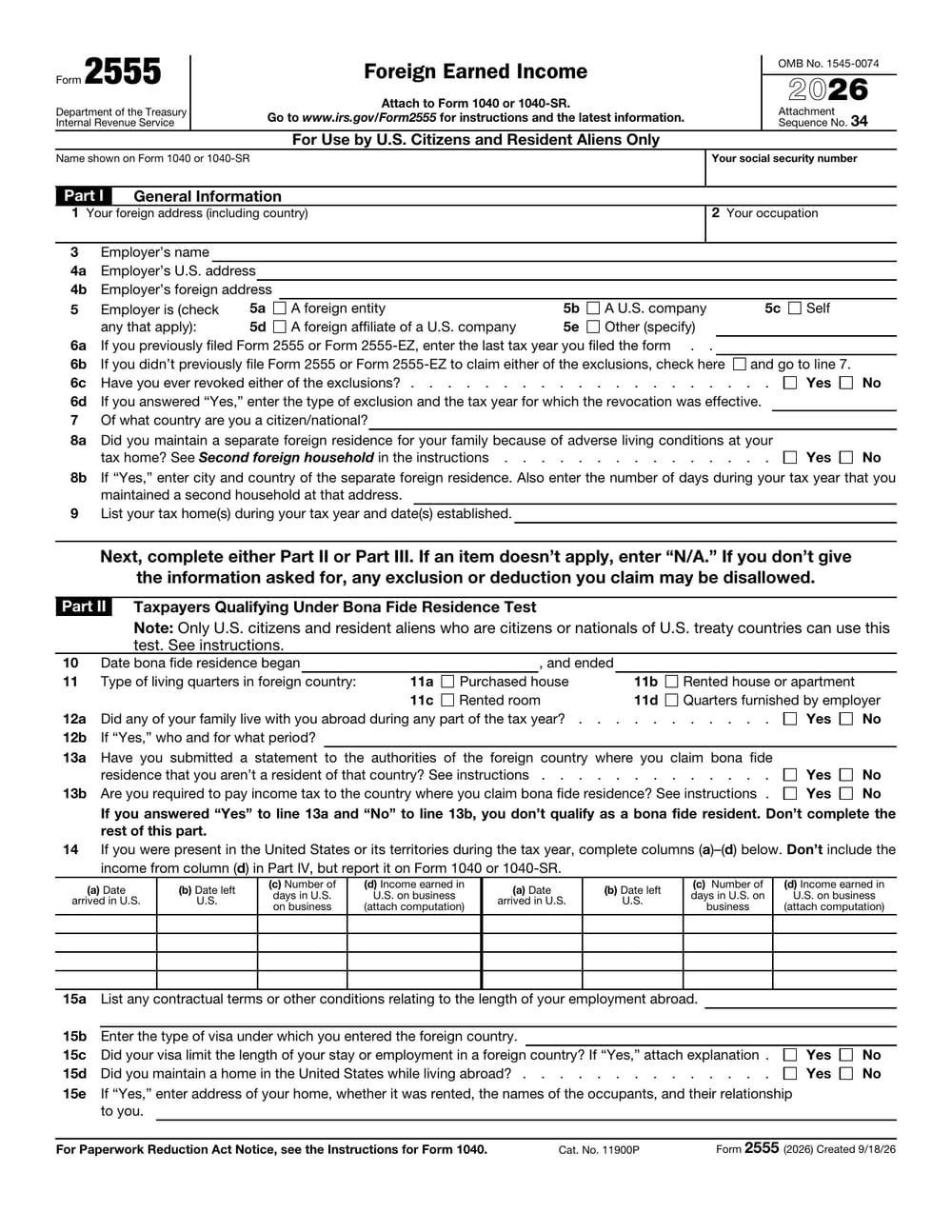
Download Form 2555 (PDF) · Instructions for Form 2555 (PDF)
Local copies for convenience, downloaded from IRS.gov on November 14, 2026. Always confirm you have the current revision at irs.gov/form2555 before filing.
Part I: General information (lines 1–9)
Your foreign address, occupation, employer details, the last year you filed Form 2555 (line 6a) or a box confirming you never filed it (line 6b), any prior revocation, your citizenship, and your tax home and the date you established it (line 9). The questions about earlier filings and revocations matter because the IRS uses them to track the five-year rule discussed below. If you've filed Form 2555 before, enter the last year accurately.
Parts II and III: The qualifying test
Complete one, as described above.
Part IV: Foreign earned income (lines 19–26)
This is where you list all the foreign earned income you received in 2026 for services performed abroad during your qualifying period. The 2026 form's line labels are:
- Line 19: Total wages, salaries, bonuses, commissions, etc.
- Line 20: Allowable share of income for personal services performed, (a) in a business or profession, (b) in a partnership.
- Line 21: Noncash income at market value: (a) home (lodging), (b) meals, (c) car, (d) other property or facilities.
- Line 22: Allowances, reimbursements, or expenses paid on your behalf: (a) cost of living and overseas differential, (b) family, (c) education, (d) home leave, (e) quarters, (f) any other purpose; (g) is the total.
- Line 23: Other foreign earned income.
- Line 24: Add lines 19 through 21d, line 22g, and line 23.
- Line 25: Meals and lodging included on line 24 that are excludable under IRC §119. Meals qualify only if furnished for your employer's convenience on the business premises; lodging must also be something you're required to accept as a condition of your employment.
- Line 26: Line 24 minus line 25. This carries to line 27.
Three timing and sourcing rules affect what goes here:
- Income is earned in the year you do the work, not the year you're paid. A bonus is allocated across the period it covers, by months worked in each year (IRS "Figuring the FEIE").
- There's a year-end payroll exception for cash-basis filers. If your employer's regular payroll period includes December 31, lasts no more than 16 days, and you're paid on the normal schedule before the end of the next payroll period, that paycheck is attributed entirely to the year you receive it (Treas. Reg. §1.911-3(e)(3)). So a paycheck for December 16–31, 2026, paid on January 1, 2027, counts as 2027 foreign earned income, even though the work was done in 2026.
- Late money can't be excluded. Pay received after the end of the tax year following the year you did the work isn't eligible (IRC §911(b)(1)(B)(iv)).
For self-employed people, line 20 has its own rule. If capital isn't a material income-producing factor in your business (for example, when your income comes from your own services rather than from equipment, inventory, or other capital), your entire gross income from the business counts as earned income. If both personal services and capital are material factors, only a reasonable allowance for your services counts, capped at 30% of your net profit after the employer-equivalent portion of self-employment tax (2025 Form 2555 instructions).
Part V: All taxpayers (line 27)
Line 27 repeats the amount from line 26. Then the form asks whether you're claiming the housing exclusion or deduction. If yes, go to Part VI. If no, skip to Part VII.
Part VI: Housing exclusion and/or deduction (lines 28–36)
You figure housing before the income exclusion, because the income exclusion is capped at your foreign earned income minus any housing exclusion (IRS "Figuring the FEIE"). The lines:
- Line 28: Qualified housing expenses for the tax year. These include rent, utilities other than telephone charges, and real and personal property insurance, among other items. They do not include the cost of buying or improving a house, mortgage principal, depreciation, deductible interest and taxes, domestic labor, pay TV, or furniture (2026 Form 2555 instructions). Only count expenses for the part of the year you qualify.
- Line 29a: The location where you incurred housing expenses.
- Line 29b: Your limit on housing expenses. For most locations in 2026, it's $39,870 for a full year, or $109.23 per qualifying day. If your city is listed in Notice 2026-25, use the higher figure there instead.
- Line 30: The smaller of line 28 or line 29b.
- Line 31: Number of days in your qualifying period that fall within 2026.
- Line 32: $58.26 times the days on line 31. If line 31 is 365, enter $21,264.
- Line 33: Line 30 minus line 32. If zero or less, stop: you have no housing benefit.
- Line 34: Employer-provided amounts.
- Line 35: Line 34 divided by line 27, as a decimal rounded to at least three places.
- Line 36: Housing exclusion: line 33 times line 35, but no more than line 34.
Line 34 trips people up. "Employer-provided amounts" isn't just your housing allowance. The instructions define it as any amount your employer paid or incurred on your behalf that is foreign earned income included in your gross income, and they list wages, the fair market value of in-kind compensation, and rent paid directly to your landlord as examples. For a typical salaried employee whose entire foreign earned income comes from an employer, line 34 equals line 27, line 35 is 1.000, and the whole housing amount on line 33 becomes an exclusion. If you're entirely self-employed, the instructions tell you to skip lines 34 and 35, enter zero on line 36, and use Part IX instead.
High-cost cities. Notice 2026-25, effective for tax years beginning on or after January 1, 2026, replaces the $39,870 cap with higher limits in listed locations. A few examples from the notice's table (full year / per day):
| Location (as listed in Notice 2026-25) | Full-year limit | Daily limit |
|---|---|---|
| France: Garches, Paris, Sevres, Suresnes, and Versailles | $73,600 | $201.64 |
| France: Lyon | $40,700 | $111.51 |
| United Kingdom: London | $68,600 | $187.95 |
| United Kingdom: all cities not otherwise listed | $44,200 | $121.10 |
Check the full table in the notice for your city. One useful rule from Section 4: if the 2026 limit for your location is higher than the 2025 limit in Notice 2025-16, you can apply the 2026 limit to your 2025 housing expenses. If you're still preparing or amending a 2025 return for a high-cost city, compare the two notices.
Living in Paris, London, or another high-cost city on the list? Your real housing limit can be nearly double the standard $39,870 — using the wrong figure means leaving real exclusion on the table. Ask TaxLatitude to find your city's exact limit →
Second household. If your spouse and dependents lived in a separate foreign home because conditions at your tax home were dangerous, unhealthful, or otherwise adverse, you can include the expenses of that second household (2026 Form 2555 instructions; IRC §911(c)(3)(B)(ii)).
Part VII: Foreign earned income exclusion (lines 37–42)
- Line 37: Maximum exclusion. Enter $132,900.
- Line 38: If you completed Part VI, enter the number from line 31. Otherwise, enter the number of days in your qualifying period that fall within 2026.
- Line 39: If line 38 equals the number of days in your tax year (usually 365), enter 1.000. Otherwise, divide line 38 by the days in the year and enter a decimal rounded to at least three places.
- Line 40: Line 37 times line 39.
- Line 41: Line 27 minus line 36.
- Line 42: Your foreign earned income exclusion: the smaller of line 40 or line 41.
Line 38 is a count of days in your qualifying period that fall in the tax year. It is not the number of full days you were physically abroad. Under the physical presence test, the IRS has explained that the days you can claim are based on the total number of days in the year that fall within your chosen 12-month period.
Part VIII: Totals (lines 43–45)
- Line 43: Add lines 36 and 42.
- Line 44: Deductions allowed in figuring your adjusted gross income that are allocable to the excluded income. You can't deduct expenses that relate to income you've excluded (IRC §911(d)(6)). For self-employed filers, this is where the part of your deductible self-employment tax that relates to excluded income goes. The IRS states that the exclusion is reduced by the pro rata share of your business expenses and self-employment tax deduction.
- Line 45: Line 43 minus line 44. Enter it on Schedule 1 (Form 1040), line 8d, where it reduces your other income.
Part IX: Housing deduction (lines 46–50)
Complete this part only if line 33 is more than line 36 and line 27 is more than line 43. In practice, that means self-employed people (and people with both employment and self-employment income) whose housing costs weren't fully covered by the exclusion.
- Line 46: Line 33 minus line 36.
- Line 47: Line 27 minus line 43.
- Line 48: The smaller of line 46 or line 47.
- Line 49: Housing deduction carryover from 2025.
- Line 50: Add lines 48 and 49. Enter it on Schedule 1 (Form 1040), line 24j.
The housing deduction can't exceed your foreign earned income minus your exclusions. Anything that doesn't fit carries over one year only: IRC §911(c)(4) allows the excess "for the succeeding taxable year (and only for the succeeding taxable year)." Like the exclusion, the housing deduction reduces regular income tax but not self-employment tax (IRS foreign housing page).
Worked example: a salaried employee in Paris
Emily is a single U.S. citizen working as a product manager for a French company in Paris. She moved there in 2023, rents an apartment, and plans to stay indefinitely. She spent 12 days visiting family in the U.S. in 2026. She qualifies as a bona fide resident for all of 2026, so she completes Part II. (She would also pass the physical presence test, but she only needs one.)
Her 2026 figures, converted to U.S. dollars:
- Base salary: $162,000
- Housing ("quarters") allowance from her employer, paid in cash with her salary: $18,000
- Rent: $46,800 ($3,900 a month); utilities, excluding telephone charges: $4,200; renter's insurance: $600
- No other income, no itemized deductions.
Form 2555, line by line
| Line | Description | Amount |
|---|---|---|
| Part IV: Foreign earned income | ||
| 19 | Wages, salaries, bonuses | $162,000 |
| 22e | Quarters allowance | $18,000 |
| 22g | Total allowances (22a–22f) | $18,000 |
| 24 | Lines 19–21d + 22g + 23 | $180,000 |
| 25 | Excludable meals and lodging | $0 |
| 26 | Line 24 − line 25 | $180,000 |
| Part V | ||
| 27 | Amount from line 26 | $180,000 |
| Part VI: Housing | ||
| 28 | Qualified housing expenses ($46,800 + $4,200 + $600) | $51,600 |
| 29a | Location | Paris, France |
| 29b | Limit on housing expenses (Notice 2026-25, Paris area) | $73,600 |
| 30 | Smaller of line 28 or 29b | $51,600 |
| 31 | Qualifying days in 2026 | 365 |
| 32 | Base housing amount (365 days) | $21,264 |
| 33 | Line 30 − line 32 | $30,336 |
| 34 | Employer-provided amounts (all her pay comes from her employer) | $180,000 |
| 35 | Line 34 ÷ line 27 | 1.000 |
| 36 | Housing exclusion (line 33 × line 35) | $30,336 |
| Part VII: Income exclusion | ||
| 37 | Maximum exclusion | $132,900 |
| 38 | Days from line 31 | 365 |
| 39 | Full year | 1.000 |
| 40 | Line 37 × line 39 | $132,900 |
| 41 | Line 27 − line 36 | $149,664 |
| 42 | Foreign earned income exclusion (smaller of 40 or 41) | $132,900 |
| Part VIII: Totals | ||
| 43 | Line 36 + line 42 | $163,236 |
| 44 | Allocable deductions | $0 |
| 45 | Total exclusion, to Schedule 1, line 8d | $163,236 |
Notice that the housing allowance and the housing exclusion are unrelated numbers. Emily's $18,000 allowance is simply part of her foreign earned income on line 22e. Her housing exclusion of $30,336 comes from her actual qualified expenses minus the base amount, and it's fully excludable because all of her pay is employer-provided.
Paris's higher limit matters here. Emily's $51,600 in expenses is above the standard $39,870 cap. If she lived in a city without an adjusted limit, line 30 would drop to $39,870, line 33 to $18,606, and her housing exclusion would be $11,730 smaller. Always check the city table before using the default.
Carrying the result to Form 1040
Emily reports her full $180,000 of wages as income on Form 1040. The $163,236 from line 45 goes on Schedule 1, line 8d, as a negative amount, which brings her adjusted gross income down to $16,764. After the 2026 standard deduction for a single filer, $16,100 (IR-2025-103), her taxable income is $664.
You might expect the tax on $664 to be about $66, at the 10% rate. It isn't. IRC §911(f) requires the "stacking" method: tax is computed on taxable income plus the excluded amount, and then the tax on the excluded amount alone is subtracted. The excluded income isn't taxed, but it pushes the rest of your income into the brackets it would have reached anyway. Line 45 of Form 2555 tells you to use the Foreign Earned Income Tax Worksheet in the Form 1040 instructions for this.
Using the 2026 rates for single filers (10% up to $12,400; 12% over $12,400; 22% over $50,400; 24% over $105,700, per IR-2025-103):
| Step | Amount |
|---|---|
| Taxable income (Form 1040) | $664 |
| Plus excluded amount (Form 2555, line 45) | $163,236 |
| Total | $163,900 |
| Tax on $163,900 | $31,934.00 |
| Tax on $163,236 | $31,774.64 |
| Regular tax (difference) | $159.36 |
Emily's $664 of taxable income is taxed at 24%, not 10%. For someone with income well above the exclusion, the stacking rule is the reason the remaining income is often taxed at a higher rate than people expect.
A partial-year example: arriving mid-year
Jake, also single, flies from New York and lands in Lisbon on the morning of July 15, 2026. He starts an open-ended job there on July 16, which is also his first full day in Portugal. He goes home for three weeks over the holidays (December 18 through January 7). He can't use the bona fide residence test for his 2026 return yet, because his residence hasn't included a full tax year. He plans to use the physical presence test with a 12-month window starting July 16, 2026.
Why not start the window earlier to pick up more 2026 days? Because the qualifying period is the time during which you meet the tax home test and one of the two presence tests (2026 Form 2555 instructions). Jake's tax home moves to Lisbon only when his job there begins, so days before July 16 can't be part of his qualifying period.
- Days in his qualifying period that fall in 2026 (July 16–December 31): 169. That goes on line 38 (and line 31 if he claims housing), even though he was in the U.S. for part of that time.
- Line 39: 169 ÷ 365 = 0.463 (rounded to three places).
- Line 40: $132,900 × 0.463 = $61,532.70.
- If he claims housing, his line 32 base amount is $58.26 × 169 = $9,845.94. Lisbon is listed in Notice 2026-25 (with Alverca) at $44,800 for a full year, or $122.74 per day, so his expense limit on line 29b is $122.74 × 169 = $20,743.06 rather than the standard $109.23 per day.
The catch is timing. Counting full days and subtracting his holiday trip, Jake reaches 330 full days on July 1, 2027, after the June 15, 2027 automatic deadline. He can file Form 2350 before the due date to ask for an extension to about 30 days after that date, then file with Form 2555. Alternatively, he could file on time without the exclusion, pay the tax, and amend once he qualifies.
How Form 2555 fits with the rest of your return
Where the numbers go
- All your worldwide income, including the foreign wages you plan to exclude, is reported on Form 1040 first.
- Form 2555, line 45 (exclusions) goes to Schedule 1, line 8d, as a negative number.
- Form 2555, line 50 (housing deduction) goes to Schedule 1, line 24j, as an adjustment to income.
- Your tax on Form 1040, line 16 is figured with the Foreign Earned Income Tax Worksheet. If you're subject to the alternative minimum tax, Form 6251 has its own version of the worksheet.
- Foreign taxes your employer withheld and paid to the foreign government do not go on Form 1040, line 25 as U.S. withholding. The 2026 instructions say this directly.
Benefits you give up
Claiming either exclusion or the housing deduction means you can't take the earned income credit or the additional child tax credit (the refundable part of the child tax credit) for that year. Special rules apply when figuring an IRA deduction (Form 2555 instructions; see Pub. 590-A). For families with children, losing the refundable credit is a real cost to weigh against the exclusion.
Married couples
If both spouses work abroad and each qualifies, each can claim a separate exclusion, so together a couple could exclude up to $265,800 for 2026 (two times $132,900). The IRS's "Figuring the FEIE" page confirms each spouse can claim it. Each spouse completes their own Form 2555, and the regulations require spouses to compute their amounts separately whether they file jointly or separately (Treas. Reg. §1.911-5).
Self-employed: the exclusion is only half the picture
If you're self-employed abroad, the exclusion can wipe out income tax on your net profit, but self-employment tax is computed as though the exclusion didn't exist (IRC §1402(a)(11)). The IRS's housing page says the same about the housing exclusion and deduction. So a self-employed person abroad can owe Social Security and Medicare tax on Schedule SE even after excluding all of their net profit from income tax.
The exception is a totalization agreement. Under IRC §1401(c), U.S. self-employment tax doesn't apply to self-employment income that, under a social security agreement with another country, is subject only to that country's system. Whether that applies to you depends on the specific agreement between the U.S. and your country, so check its terms before assuming either way.
Form 2555 and the foreign tax credit: one dollar, one benefit
The foreign tax credit (Form 1116) and the exclusion are both meant to prevent double taxation, and the law won't let you use both on the same dollar of income. IRC §911(d)(6) disallows any deduction, exclusion, or credit "properly allocable to or chargeable against amounts excluded from gross income." The Form 2555 instructions apply this to foreign taxes: you can't take a credit or deduction for foreign income taxes paid or accrued on excluded income.
That doesn't mean you have to choose one for your whole return. You can exclude part of your income and claim a credit for foreign taxes on the rest. What you lose is the share of foreign tax that relates to the excluded income. Treas. Reg. §1.911-6(c)(1) sets the formula: multiply the foreign tax on your foreign earned income by a fraction whose numerator is the amount you excluded (minus related deductible expenses) and whose denominator is your foreign earned income (minus the same expenses).
Running Emily's numbers both ways
Assume for illustration that Emily's French income tax for 2026 comes to $30,000. (We're not estimating French tax here; it's an assumed figure to show the mechanics.)
Option A: Form 2555, plus a credit on the remaining income. Of her $30,000 in French tax, $30,000 × $163,236 ÷ $180,000 = $27,206 is tied to excluded income and disallowed. The remaining $2,794 can be claimed on Form 1116 against the U.S. tax on her non-excluded income. Since her U.S. tax after the exclusion is about $159, the credit can offset it, leaving $0 of U.S. income tax. The unused remainder may carry over, subject to the credit limitation.
Option B: No Form 2555, foreign tax credit only. Her taxable income is $180,000 − $16,100 = $163,900, and her U.S. tax before credits is $31,934. With $30,000 of French tax available as a credit (all of her income is foreign-source, so the limitation doesn't cut it down here), she still owes about $1,934.
Here the exclusion wins. But change one assumption. If Emily's foreign tax were $45,000 instead, both options would bring her 2026 U.S. income tax to $0. The difference is what's left over. Under Option B, she'd have about $13,066 of unused foreign tax. Unused foreign taxes can generally be carried back one year and forward ten (IRC §904(c); IRS FTC carryback and carryover practice unit). Under Option A, $40,809 of the $45,000 would be disallowed permanently because it's tied to excluded income, leaving only about $4,032 that could carry over.
How to choose
There's no universal answer, but the pattern is consistent:
- The exclusion tends to win when you live in a low-tax or no-tax country or, more generally, when the foreign tax on your earnings is lower than the U.S. tax would be.
- The foreign tax credit tends to win when your foreign tax rate is higher than your U.S. rate, when you have children and want the refundable child tax credit, or when you expect to move to a lower-tax foreign country and could use carryovers there. (Carryovers only offset U.S. tax on foreign-source income, so they're of little use if you move back to the U.S. and earn U.S.-source income.)
- Earning above the limit often points to a mix: exclusion for the first $132,900 plus housing, credit for taxes on the excess. Because of the stacking rule and the disallowance fraction, run both versions before you decide.
Whatever you choose, think about future years, because of the revocation rule below.
Election and revocation: the five-year rule
Once you choose the exclusion, the choice applies to that year and every later year until you revoke it (IRC §911(e)(1)). You don't have to revoke it in years when you have no foreign earned income. The election simply sits there (Form 2555 instructions).
To revoke, you attach a statement to your return (or amended return) for the first year you don't want the exclusion. After that, you can't elect it again until the sixth tax year after the year the revocation took effect, unless the IRS consents (IRC §911(e)(2); Treas. Reg. §1.911-7(b)(1)). Each exclusion is a separate election, and each must be revoked separately.
The bigger trap is revoking without meaning to. In Rev. Rul. 90-77, the IRS ruled that a taxpayer who has an election in effect but claims a foreign tax credit on foreign earned income that was eligible for the exclusion is treated as having revoked the election, even without filing a revocation statement. Good-faith arithmetic errors in figuring the excludable amount don't count as revocations. IRS letter rulings follow the same approach. In PLR 202303010, for example, a taxpayer who switched from the exclusion to the credit had to ask the IRS for consent before re-electing the exclusion within the five-year window.
Permission is possible. To re-elect within the five years, you request a ruling from the IRS. The regulation lists relevant factors, including a period of U.S. residence, a move between foreign countries with different tax rates, a substantial change in the foreign country's tax laws, and a change of employer (Treas. Reg. §1.911-7(b)(2)). But a ruling request takes time and isn't guaranteed, so treat a switch to the credit as a decision you may be stuck with for several years.
Late or forgotten elections
If you didn't claim the exclusion on time, you may still be able to. Under Treas. Reg. §1.911-7(a)(2)(i), the election can be made on:
- a timely filed return, including extensions;
- an amended return for a year where the original was filed on time;
- an original return filed within one year after its due date; or
- a later return, if you owe no federal income tax after the exclusion, or if you owe tax but file before the IRS discovers that you didn't make the election.
For the last category, you write "Filed Pursuant to Section 1.911-7(a)(2)(i)(D)" at the top of the first page of Form 1040.
Common mistakes on Form 2555
1. Expecting the exclusion to eliminate self-employment tax
It doesn't. IRC §1402(a)(11) turns the exclusion off for self-employment tax. A freelancer with $90,000 of net profit can exclude it from income tax and still owe self-employment tax on Schedule SE, unless a totalization agreement assigns them to the foreign country's social security system.
2. Miscounting days for the physical presence test
The usual errors: counting the arrival day, counting days spent partly in the U.S. (other than a U.S. transit of under 24 hours between two foreign points) or in long transit over international waters, using a January–December window when a different 12-month window would qualify, and forgetting that a vacation in the U.S. costs days just as much as a business trip. Keep a travel log with dates and times, and keep boarding passes or passport stamps that back it up.
3. Revoking the exclusion without realizing it
Switching to the foreign tax credit on income that was eligible for exclusion counts as a revocation under Rev. Rul. 90-77. That locks you out for five tax years without IRS consent. Run the numbers for future years, not just the current one, before you switch.
4. Using last year's numbers
The exclusion is $132,900 for 2026 and $130,000 for 2025. The base housing amount and standard housing limit move with it, and the city limits change every year. Using the wrong year's notice can overstate or understate your housing exclusion.
5. Putting only the housing allowance on line 34
Line 34 is all employer-provided foreign earned income, not just the housing allowance. Entering only the allowance makes the line 35 ratio too small and shrinks your housing exclusion for no reason.
6. Excluding income that doesn't qualify
Pensions, Social Security, investment income, U.S. government pay, pay for days worked in the U.S., and pay received after the year following the year you earned it are all ineligible. On the form, U.S. business days and the income for them belong in columns (e) and (f) of line 18, not in the excludable total.
7. Forgetting that the remaining income is taxed at higher rates
Because of the stacking rule in IRC §911(f), income above the exclusion is taxed at the rate it would have faced if nothing were excluded. Don't estimate your remaining tax from the bottom bracket.
8. Telling the foreign country you're not a resident, then claiming bona fide residence
If you filed a nonresidence statement with the foreign tax authorities and they accepted it (or haven't ruled yet), you aren't a bona fide resident of that country for U.S. purposes. You may still qualify under the physical presence test, but not under Part II.
9. Reporting foreign withholding as U.S. withholding
Foreign tax withheld from your paycheck doesn't go on Form 1040, line 25. It's a foreign tax that may be creditable on Form 1116, subject to the disallowance for excluded income.
10. Not filing because the income is under the limit
The exclusion only exists if you file a return reporting the income and claiming it. The IRS has said that even if your foreign earnings are below the exclusion threshold, you still must file a U.S. income tax return.
If you are weighing whether to file this yourself, use software, or hire a preparer once you have confirmed your eligibility, see our comparison of expat tax software, CPA firms and a cheaper first step.
FAQ
Do I have to file Form 2555 if all my income is below $132,900?
If you want the exclusion, yes. The exclusion is an election you make on the form; it's not automatic. Without Form 2555, your foreign wages stay fully in your taxable income. The IRS also says that earnings below the exclusion threshold don't remove the need to file a U.S. return.
Can my spouse and I both claim the exclusion?
Yes, if each of you has foreign earned income and each qualifies. Each spouse files a separate Form 2555 and computes their own exclusion, up to $132,900 each for 2026, even on a joint return.
I moved abroad in the middle of 2026. Can I claim anything for 2026?
Usually, yes, but prorated. Your maximum exclusion is $132,900 times the days in your qualifying period that fall in 2026, divided by 365. If you won't meet the physical presence or bona fide residence test until after your return is due, file Form 2350 before the due date to get more time.
Can I use Form 2555 and the foreign tax credit in the same year?
Yes, on different income. You can't credit foreign taxes on income you excluded; that share of the foreign tax is disallowed under Treas. Reg. §1.911-6(c). You can credit foreign taxes on income above the exclusion, and on income the exclusion doesn't cover, such as investment income.
I never claimed the exclusion on past returns. Is it too late?
Not necessarily. The election can be made on an amended return for a year you filed on time, on an original return filed within a year of its due date, or later if you owe no tax after the exclusion or file before the IRS discovers you didn't claim it. See Treas. Reg. §1.911-7(a)(2)(i).
Does the housing exclusion apply if my employer pays my rent directly?
Yes. The Form 2555 instructions list rent your employer pays directly to your landlord as an employer-provided amount, so it's part of your foreign earned income in Part IV and counts on line 34. And because the statute defines housing expenses as those paid or incurred "by or on behalf of" you (IRC §911(c)(3)(A)), that rent also belongs in your qualified housing expenses on line 28.
Sources
- IRS, Form 2555 (2026), Foreign Earned Income (posted November 5, 2026): https://www.irs.gov/pub/irs-pdf/f2555.pdf
- IRS, Instructions for Form 2555 (2026) (posted November 5, 2026): https://www.irs.gov/pub/irs-pdf/i2555.pdf
- IRS, Instructions for Form 2555 (2025), as filed with OMB: https://omb.report/icr/202509-1545-010/doc/162637900
- IRS, Form 2555 (2025): https://www.irs.gov/pub/irs-prior/f2555--2025.pdf
- IRS, About Form 2555: https://www.irs.gov/form2555
- IRS, Figuring the foreign earned income exclusion: https://www.irs.gov/individuals/international-taxpayers/figuring-the-foreign-earned-income-exclusion
- IRS, Foreign earned income exclusion – Physical presence test: https://www.irs.gov/individuals/international-taxpayers/foreign-earned-income-exclusion-physical-presence-test
- IRS, Foreign earned income exclusion – Bona fide residence test: https://www.irs.gov/individuals/international-taxpayers/foreign-earned-income-exclusion-bona-fide-residence-test
- IRS, Foreign earned income exclusion – What is foreign earned income: https://www.irs.gov/individuals/international-taxpayers/foreign-earned-income-exclusion-what-is-foreign-earned-income
- IRS, Foreign housing exclusion or deduction: https://www.irs.gov/individuals/international-taxpayers/foreign-housing-exclusion-or-deduction
- IRS, Extension of time to file in order to qualify for the foreign earned income exclusion: https://www.irs.gov/individuals/international-taxpayers/extension-to-claim-foreign-earned-income-exclusion
- IRS, Form 2350: https://www.irs.gov/pub/irs-pdf/f2350.pdf
- 26 U.S.C. §119, Meals or lodging furnished for the convenience of the employer: https://www.law.cornell.edu/uscode/text/26/119
- IRS, Foreign Earned Income Exclusion 2016 (filing even when below the threshold; counting days in the 12-month period): https://www.irs.gov/newsroom/foreign-earned-income-exclusion-2016
- IRS, Notice 2026-25, Determination of Housing Cost Amounts Eligible for Exclusion or Deduction for 2026: https://www.irs.gov/pub/irs-drop/n-26-25.pdf
- IRS, IR-2025-103, IRS releases tax inflation adjustments for tax year 2026: https://www.irs.gov/newsroom/irs-releases-tax-inflation-adjustments-for-tax-year-2026-including-amendments-from-the-one-big-beautiful-bill
- IRS, Rev. Proc. 2025-32: https://www.irs.gov/pub/irs-drop/rp-25-32.pdf
- IRS, Instructions for Form 1040 (Foreign Earned Income Tax Worksheet, line 16): https://www.irs.gov/instructions/i1040gi
- IRS, International Practice Unit, IRC §911 Election and Revocation (citing Rev. Rul. 90-77, 1990-2 C.B. 183): https://www.irs.gov/pub/int_practice_units/JTOCUC_09_6_5_08.PDF
- IRS, International Practice Unit, Foreign Tax Credit Carryback and Carryover: https://www.irs.gov/pub/fatca/int_practice_units/ftc_carryback_and_carryover.pdf
- IRS, PLR 202303010 (re-election after revocation by claiming the foreign tax credit): https://www.irs.gov/pub/irs-wd/202303010.pdf
- 26 U.S.C. §911, Citizens or residents of the United States living abroad: https://www.law.cornell.edu/uscode/text/26/911
- 26 U.S.C. §1401 (rate of self-employment tax; totalization agreements, subsection (c)): https://www.law.cornell.edu/uscode/text/26/1401
- 26 U.S.C. §1402, Definitions (net earnings from self-employment, (a)(11)): https://www.law.cornell.edu/uscode/text/26/1402
- 26 U.S.C. §904 (foreign tax credit limitation and carryovers, subsection (c)): https://www.law.cornell.edu/uscode/text/26/904
- Treas. Reg. §1.911-3, Determination of amount of foreign earned income to be excluded (year-end payroll rule, (e)(3)): https://www.law.cornell.edu/cfr/text/26/1.911-3
- Treas. Reg. §1.911-5, Special rules for married couples: https://www.law.cornell.edu/cfr/text/26/1.911-5
- Treas. Reg. §1.911-6, Disallowance of deductions, exclusions, and credits: https://www.law.cornell.edu/cfr/text/26/1.911-6
- Treas. Reg. §1.911-7, Procedural rules: https://www.law.cornell.edu/cfr/text/26/1.911-7
This article explains how Form 2555 works. It isn't tax advice for your situation. If your case involves self-employment, a mid-year move, high foreign taxes, or a past revocation, consider having a qualified expat tax professional review your return.