Research date: November 5, 2026. Every figure, statute citation and calculation below is stated and verified as of that date. This article is general information, not tax or legal advice, and does not recommend for or against holding any specific investment.
Key takeaways
- Almost every foreign index fund or ETF is a PFIC for US tax purposes — by design, not by accident. A typical fund's income and assets are nearly 100% passive, far past the 75%/50% thresholds in §1297, so it meets both tests virtually every year it exists.
- The default tax regime costs roughly 3.2x what the same gain would cost in a US-domiciled fund. In the worked example, a $19,343.03 gain over 10 years produces about $9,372 in tax (48.5%), versus $2,901.45 (15%) in a US fund.
- "Once a PFIC, always a PFIC" — even if the fund later stops meeting the tests. The only way out of an existing holding's built-in gain is a "purging" election that itself triggers the same punitive tax.
- The QEF election — the most favorable treatment — depends entirely on the fund cooperating, and most don't. It requires the fund to issue a PFIC Annual Information Statement every year; most foreign fund managers never produce one.
- Simply holding the shares can require a Form 8621 every year — no sale, no distribution needed. A de minimis exception exists only if total PFIC holdings stay at or under $25,000 ($50,000 filing jointly) with no triggering event that year.
- Holding five foreign funds means filing five separate Form 8621s — one per PFIC, every year the filing requirement applies.
A US citizen or green card holder who lives in London, Frankfurt, Singapore or Sydney and puts savings into a local index fund is doing exactly what a local bank, pension provider or financial adviser would recommend. Under US tax law, that fund is almost always a Passive Foreign Investment Company, or PFIC. The PFIC rules were written in 1986 to stop US investors from parking money in offshore funds and deferring tax. They make no exception for an American who simply lives abroad and buys what everyone around them buys.
The consequences are concrete. When a PFIC is sold, the default rules tax the gain as if it had been earned evenly over every day it was held, at the highest US income tax rate in force in each of those years, and then add interest as though the investor had paid each year's tax late. In the worked example below, a $20,000 fund that grows at an ordinary 7% a year for ten years produces a US bill of about $9,372 on a $19,343.03 gain, about 48.5%. The same gain in a US-domiciled fund would owe $2,901.45 at the 15% long-term capital gains rate.
On top of the tax, each PFIC requires its own annual information return, Form 8621, for which the IRS's own burden estimate is roughly 49 hours per form, including recordkeeping. And a required Form 8621 that is never filed can leave the statute of limitations on the whole tax return open. This guide explains each of those rules from the statute, the regulations and the IRS's own instructions, so that a reader can judge whether their own investments are affected. For a shorter, FAQ-style reference, see TaxLatitude's PFIC guide.
What is a PFIC? Two tests in IRC §1297
The 75% income test and the 50% asset test
The definition is in Internal Revenue Code §1297(a). A foreign corporation is a PFIC for a tax year if it meets either of two tests:
- The income test. 75 percent or more of its gross income for the year is passive income.
- The asset test. On average, at least 50 percent of the assets it holds during the year produce passive income or are held to produce passive income.
The IRS restates both tests in the same terms in the Instructions for Form 8621.
"Passive income" is defined in §1297(b)(1) by cross-reference: it is income "of a kind that would be foreign personal holding company income" under §954(c). In practice that means dividends, interest, and gains from selling securities and similar property. The final Treasury regulations issued in 2021 (T.D. 9936, 86 Fed. Reg. 4516) keep that definition at Treas. Reg. §1.1297-1(c). For a fund that is publicly traded, assets are measured by value (§1297(e)).
The statute does carve out some income. §1297(b)(2) excludes, among other things, certain active banking and insurance income. None of those exclusions describes a fund that simply holds a portfolio of shares and bonds.
Why almost every foreign fund meets both tests
A pooled investment fund exists to hold securities. Its income consists of dividends, interest and gains on securities, which are all passive under §954(c). Its assets are securities and cash, which are also passive. A typical equity or bond fund will therefore show passive income close to 100% of gross income, against a 75% threshold, and passive assets close to 100% of total assets, against a 50% threshold. The fund does not land near the line. It meets both tests, and so qualifies as a PFIC, by a wide margin, every year, by design.
The tax preparation firm Greenback Expat Tax Services (secondary source) summarises the practical result: "most non-U.S. mutual funds, ETFs, UCITS funds, unit trusts, and other pooled investment vehicles are classified as [PFICs]" (Greenback, "Are My Foreign Mutual Funds Considered PFICs?"). The international tax law firm Golding & Golding (secondary source) reaches the same conclusion for foreign mutual funds, unit trusts and ETFs (Golding & Golding). H&R Block's own expat tax guidance (secondary source) gives the same rule of thumb in consumer-facing terms: a US-domiciled fund such as Vanguard is generally not a PFIC, while a fund opened with a non-US manager generally is (H&R Block, "PFIC & Foreign Mutual Fund Reporting Requirements").
A natural objection is that many European and Commonwealth funds are not legally companies. A UK unit trust is a trust, and a Luxembourg FCP is a contractual arrangement. US tax law classifies entities by its own rules, not by the label they carry at home. Under Treas. Reg. §301.7701-4(c)(1), an "investment trust" is not treated as a trust for US purposes if "there is a power under the trust agreement to vary the investment of the certificate holders." An actively or index-managed fund whose manager buys and sells holdings has exactly that power. It is treated as a business entity, and a foreign business entity whose investors all have limited liability is by default classified as a corporation under the entity-classification regulations (Treas. Reg. §301.7701-3). That brings it within §1297, which applies to any "foreign corporation."
A US-domiciled fund is outside the rules entirely
Because §1297 applies only to foreign corporations, a fund organized in the United States cannot be a PFIC. A US-organized mutual fund or ETF is a domestic entity for tax purposes, not a foreign corporation. Greenback (secondary source) puts the test simply: if a fund is US-registered, "it is not a PFIC regardless of where you hold it" (Greenback).
What matters is where the fund is domiciled, not where it trades or where the brokerage account sits. A US-domiciled ETF bought through a Swiss broker is not a PFIC. An Irish-domiciled ETF bought through a US broker is.
This is also why Americans in Europe hold so many PFICs. US-domiciled ETFs are generally unavailable to retail investors in the European Economic Area because they do not publish the PRIIPs Key Information Document that EU rules require. Local investors are steered into UCITS funds, which are domiciled in Ireland, Luxembourg and other EU states (TaxesForExpats, "UCITS ETF: withholding tax, PFIC rules, and US estate tax" (secondary source)).
Once a PFIC, always a PFIC
PFIC status attaches to the investor's shares, not just to the fund in a given year. Under §1298(b)(1), stock is treated as PFIC stock if the corporation was a PFIC (and not a qualified electing fund) at any time during the taxpayer's holding period. That remains true even if the corporation later stops meeting the tests. For a fund investor, the practical way out is a "purging" election that treats the shares as sold, which itself triggers the tax described next.
The statute has two narrow exceptions, a start-up exception in §1298(b)(2) and a change-of-business exception in §1298(b)(3). Both require the corporation not to be a PFIC in either of the following two years. They were written for operating companies in transition, and a fund that goes on holding securities cannot meet them.
How the default regime taxes a PFIC: IRC §1291 step by step
Unless one of the elections described later is in place, a PFIC is a "section 1291 fund." §1291 applies to two kinds of event: an excess distribution, and gain on a disposition, meaning a sale, redemption or other transfer. Under §1291(a)(2), gain on a disposition is taxed "in the same manner as if such gain were an excess distribution."
Step 1: identify the excess distribution or the gain
An excess distribution is the part of the year's distributions that exceeds 125% of the average distributions received in the three preceding years, or over the holding period if that is shorter (§1291(b)(2)(A)). Distributions within that 125% cushion are taxed as ordinary dividends in the year received. They are not "qualified dividends" eligible for the lower capital gains rates, because §1(h)(11)(C)(iii) excludes dividends from a corporation that is a PFIC in the year of the distribution or the year before. No part of a distribution in the first year of the holding period counts as an excess distribution (§1291(b)(2)(B)).
An accumulating fund reinvests its income and pays no distributions. For that kind of fund, the only excess distribution is the gain when the shares are sold.
A sale is not the only trigger. Under §1298(b)(6), using PFIC stock as security for a loan is treated as a disposition. The Form 8621 instructions say the same: stock of a section 1291 fund "is considered disposed of if it is sold, transferred, or pledged" (Instructions for Form 8621).
Step 2: spread the amount over every day of the holding period
The amount "shall be allocated ratably to each day in the taxpayer's holding period for the stock" (§1291(a)(1)(A)). The Form 8621 instructions make this mechanical: divide the excess distribution or gain "by the number of days in your holding period" (Instructions for Form 8621).
This is the first point at which the PFIC rules depart from normal capital gains treatment. A gain that was in fact earned mostly in the last two years of a rising market is treated as if it had been earned in equal daily slices since the day of purchase.
Step 3: the current-year slice is ordinary income
The slices allocated to the year of sale, and to any days before the fund became a PFIC, are included in that year's income as ordinary income (§1291(a)(1)(B)). They are taxed at the investor's normal marginal rate, not at capital gains rates.
Step 4: every earlier slice is taxed at that year's top rate
For each earlier year in which the fund was a PFIC, the allocated slice is not added to income. Instead, a "deferred tax amount" is calculated and added directly to the current year's tax (§1291(a)(1)(C)).
That tax is computed by multiplying each year's slice "by the highest rate of tax in effect for such taxable year under section 1 or 11" (§1291(c)(2)). For individuals, the rate table in the Form 8621 instructions shows 39.6% for 2013–2017 and 37% for 2018–2025. The 37% top rate in §1(j) no longer has a sunset date, because Pub. L. 119-21 (2025) struck the "before January 1, 2026" limit, as shown in the Cornell amendment notes.
The investor's actual bracket in those years does not matter. A teacher in the 22% bracket pays 37% on each prior-year slice, exactly as a top earner would. Because the deferred tax is added to tax rather than to income, deductions and personal allowances do not reduce it.
Step 5: interest on each year's tax, as if it had been paid late
The deferred tax amount also includes interest (§1291(c)(1)). For each prior year, interest runs from that year's return due date to the due date of the return for the year of sale, using "the rates and method applicable under section 6621 for underpayments of tax" (§1291(c)(3)(A)). Both dates are determined "without regard to extensions" (§1291(c)(3)(B)).
The underpayment rate is the federal short-term rate plus three percentage points, reset every quarter (§6621(a)(2)). It compounds daily (§6622). The IRS publishes each quarter's rate on its Quarterly interest rates page.
The interest is not deductible for an individual. §1291(c)(1) treats it as interest under §6601, which is interest on an underpayment of tax. Temp. Treas. Reg. §1.163-9T(b)(2)(i)(A) classifies interest on underpayments of individual income tax as non-deductible personal interest "regardless of the source of the income generating the tax liability."
Step 6: the restrictions that follow
Four further rules make the regime harsher.
- Losses. The Form 8621 instructions state that a "loss realized on the disposition of stock of a section 1291 fund is not taken into account under section 1291" (Instructions for Form 8621). The 1992 proposed regulations go further and say such a loss "is not recognized" (Prop. Treas. Reg. §1.1291-3(a), as quoted by Phil Hodgen, HodgenLaw PC (secondary source)). A gain in one PFIC therefore cannot simply be netted against a loss in another under §1291.
- Foreign tax credits. Foreign withholding tax on a distribution follows the same daily allocation. Taxes allocated to a prior year can reduce only that year's deferred tax, not below zero, and the instructions state that "no carryover of any unused excess distribution taxes is allowed" (§1291(g); Instructions for Form 8621).
- No step-up at death. Inherited investments normally take a basis equal to market value at death under §1014, which wipes out the built-in gain. §1291(e) cancels that step-up for PFIC stock. The one exception is where the person who died was a nonresident alien throughout their holding period.
- Non-recognition transfers. Where a transfer would otherwise not trigger tax, §1291(f) allows regulations to require the gain to be recognized "notwithstanding any provision of law."
One more point about the law itself. The detailed rules for computing excess distributions are in regulations Treasury proposed on 1 April 1992 (57 Fed. Reg. 11024) and has never finalized. The 1998 Treasury decision T.D. 8750 still refers to them as proposed. Taxpayers and the IRS generally follow them, and the Form 8621 instructions track them.
A worked example: $20,000 in a foreign index fund for ten years
The example is deliberately ordinary. An American living abroad invests $20,000 in an accumulating global index fund domiciled outside the United States. The fund pays no distributions. It grows at 7% a year, and the investor sells everything at the end of 2025.
The assumptions
- Purchase: 4 January 2016, $20,000.
- Growth: 7% a year for ten years. $20,000 × 1.07¹⁰ = $39,343.03.
- Sale: 31 December 2025, for $39,343.03.
- Gain: $39,343.03 − $20,000 = $19,343.03.
- PFIC status: the fund is a PFIC throughout, so there are no pre-PFIC days.
- Holding period: begins the day after purchase and includes the day of sale, the usual IRS convention for counting holding periods (Rev. Rul. 66-7, 1966-1 C.B. 188), so it runs from 5 January 2016 to 31 December 2025.
- Investor's rate: the 24% bracket in 2025.
- Foreign tax: none creditable. If the country of residence taxed the gain, a foreign tax credit could reduce the bill, within the limits of §1291(g).
7% is a conservative figure for this period. Vanguard's factsheet for its FTSE All-World UCITS ETF reports a 10-year annualized benchmark return of 12.35% in US dollars to 30 September 2026 (Vanguard factsheet). A real investor in a global fund over these years would probably have a larger gain, and as shown below, the PFIC bill rises in exact proportion to the gain.
Days held and the amount per day
From 5 January 2016 to 31 December 2025 inclusive is 3,649 days:
- 362 days in 2016 (a leap year, less the first four days of January);
- 366 days in 2020 and 2024;
- 365 days in each of the other seven years.
The gain per day is $19,343.03 ÷ 3,649 = $5.3009.
Each year's share is that figure multiplied by the days in the year. 2016 receives 362 × $5.3009 = $1,918.93. Each 365-day year receives $1,934.83. Each 366-day year receives $1,940.13.
The tax on each earlier year
The 2016 and 2017 slices are taxed at that period's top rate of 39.6%:
- 2016: $1,918.93 × 39.6% = $759.90
- 2017: $1,934.83 × 39.6% = $766.19
The slices for 2018 through 2024 are taxed at 37%:
- each 365-day year: $1,934.83 × 37% = $715.89
- 2020 and 2024: $1,940.13 × 37% = $717.85
Added together, the deferred tax for 2016–2024 is $6,541.23.
The interest on each year's tax
The 2016 tax of $759.90 is treated as if it had been due with the 2016 return. That due date is not always 15 April. Under §1291(c)(3)(B), the due date is determined "without regard to extensions" — but a COVID-19 filing-deadline postponement issued under §7508A is not an "extension" in that sense. An extension (under §6081, Form 4868) is something a taxpayer requests, and it never stops interest from running. A §7508A postponement is different: the IRS itself moves the due date, and Notice 2020-23 says in terms that the postponed period "is disregarded in the calculation of any interest, penalty, or addition to tax" — interest on a 2019 federal income tax liability did not start running until 16 July 2020, not 16 April 2020. This article therefore uses the real due date for each year, including the two that were postponed:
- 18 April 2017 for the 2016 return;
- 17 April 2018 for 2017;
- 15 April 2019 for 2018;
- 15 July 2020 for 2019 (the COVID-19 postponement);
- 17 May 2021 for 2020 (a second postponement, Notice 2021-21, using the same §7508A "disregarded" language);
- 18 April 2022 for 2021;
- 18 April 2023 for 2022;
- 15 April for 2023 and 2024.
Interest then runs from each of those dates to 15 April 2026, the due date of the 2025 return.
Over those years the IRS underpayment rate moved through every published quarterly rate from 3% to 8%, according to the IRS quarterly rate table:
- 4% from April 2017 through March 2018;
- 5–6% from April 2018 through June 2020;
- 3% from July 2020 through March 2022;
- 4%, 5% and then 6% over the rest of 2022;
- 7–8% in 2023–2024;
- 7% in 2025 and the first quarter of 2026;
- 6% for the first two weeks of April 2026.
Compounded daily at the rate in force each day, the interest on the 2016 slice is $477.83, about 63% of the tax itself. The 2019 and 2020 slices carry noticeably less interest than a naive "15 April every year" calculation would suggest, because their real due dates were three and five weeks later.
The later the year, the shorter the interest period. The 2024 tax of $717.85 accrues interest for only one year, from 15 April 2025 to 15 April 2026, mostly at 7%. That produces $51.75.
The full computation is in this table. Figures are rounded to the cent; the underlying daily compounding means a different rate-boundary assumption can shift the total by a few cents, so the totals below are also given rounded to the nearest dollar.
| Year | Days | Gain allocated | Rate | Tax | Due date | Interest to 15 Apr 2026 |
|---|---|---|---|---|---|---|
| 2016 | 362 | $1,918.93 | 39.6% | $759.90 | 18 Apr 2017 | $477.83 |
| 2017 | 365 | $1,934.83 | 39.6% | $766.19 | 17 Apr 2018 | $432.47 |
| 2018 | 365 | $1,934.83 | 37% | $715.89 | 15 Apr 2019 | $346.71 |
| 2019 | 365 | $1,934.83 | 37% | $715.89 | 15 Jul 2020 | $280.97 |
| 2020 | 366 | $1,940.13 | 37% | $717.85 | 17 May 2021 | $256.95 |
| 2021 | 365 | $1,934.83 | 37% | $715.89 | 18 Apr 2022 | $229.33 |
| 2022 | 365 | $1,934.83 | 37% | $715.89 | 18 Apr 2023 | $177.54 |
| 2023 | 365 | $1,934.83 | 37% | $715.89 | 15 Apr 2024 | $113.03 |
| 2024 | 366 | $1,940.13 | 37% | $717.85 | 15 Apr 2025 | $51.75 |
| 2025 (year of sale) | 365 | $1,934.83 | 24% (own bracket) | $464.36 | — | none |
| Total | 3,649 | $19,343.03 | $7,005.59 (incl. 2025) | ≈$2,367 |
The interest for all nine prior years adds up to about $2,367.
The current-year slice
The 2025 slice of $1,934.83 is ordinary income on the 2025 return. At the investor's 24% marginal rate it costs $464.36. An investor in the 32% bracket would pay $619.15 instead.
The total, and the comparison
The bill under the default regime is:
| Component | Amount |
|---|---|
| Deferred tax on 2016–2024 | $6,541.23 |
| Interest on that tax | ≈$2,367 |
| Tax on the 2025 slice | $464.36 |
| Total | ≈$9,372 |
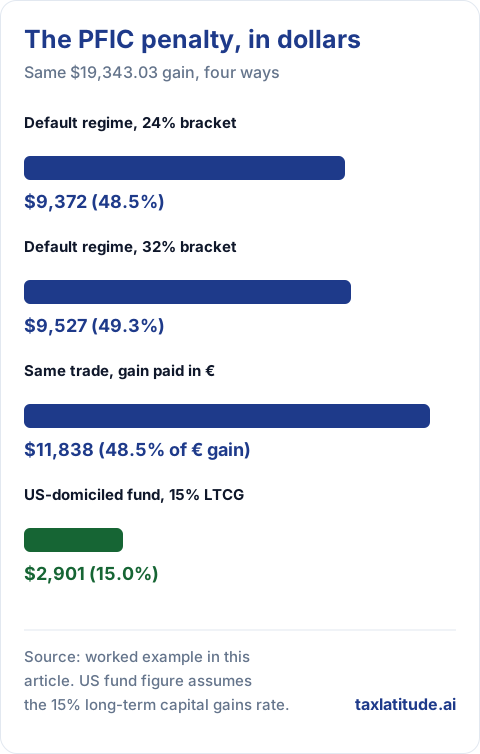
That is 48.5% of the $19,343.03 gain. In the 32% bracket the total is about $9,527, or 49.3%.
Now suppose the same investor had bought a US-domiciled ETF tracking the same index. The gain would have been a long-term capital gain. For 2025, the 15% rate applies to single filers with taxable income between $48,351 and $533,400, and to joint filers between $96,701 and $600,050 — the zero-rate ceiling and 15%-rate ceiling for each filing status, directly from the IRS's own inflation-adjustment tables (Rev. Proc. 2024-40, §1(h), §1(j)(5), published in Internal Revenue Bulletin 2024-45).
At 15%, the tax on $19,343.03 is $2,901.45. The PFIC regime therefore costs about $6,471 more, roughly 3.2 times as much.
Holding a foreign index fund or ETF yourself? The real number depends on your purchase dates, your bracket in each of those years, and whether the fund ever issued a PFIC Annual Information Statement — none of which a general article can know. Ask TaxLatitude to work through your own numbers →
The comparison simplifies one point. A US fund must distribute its income each year, so the US investor would have paid some tax along the way on dividends, mostly at the same 15% qualified-dividend rate. That changes when the tax is paid on part of the return, not the order of magnitude of the gap.
Even the highest possible long-term capital gains rate does not close the gap. That rate is 20% plus the 3.8% net investment income tax, which would come to $4,603.64.
The net investment income tax does not change the comparison for most expats. It applies only above $200,000 of modified adjusted gross income for a single filer and $250,000 for a joint filer, thresholds that "are not indexed for inflation" (IRS, Questions and Answers on the Net Investment Income Tax). It also cannot be reduced by foreign tax credits (same source). Where it does apply, Treasury regulations include gain treated as an excess distribution in net investment income (Treas. Reg. §1.1411-10(c)(2)(i)). So it would fall on the gain under both regimes.
Why the 48.5% figure travels
Every step in the computation is proportional to the gain. Doubling the gain doubles every slice, every year's tax and every year's interest. The effective rate of about 48.5% therefore depends only on the dates, the rate schedule and the investor's current bracket, not on the amount invested.
The same ten-year window would cost roughly half the gain whether the investment was $5,000 or $500,000, apart from any change in the investor's own bracket on the small current-year slice and, for large gains, the net investment income tax discussed above. A longer holding period would generally push the figure higher, because the earliest slices accumulate interest for longer. The top rate itself was lower before 2013: the rate table in the Form 8621 instructions shows 35% for 2003–2012. For longer periods, the decisive variable is the extra interest, not the rate.
The same investment in euros
Most expats hold funds in a local currency, which adds a currency effect. The Form 8621 instructions now require amounts reported in Part V in a foreign currency to be converted to US dollars (Instructions for Form 8621, Rev. December 2025, "What's New").
Suppose the investment had been €20,000 on the same dates, growing at the same 7%:
- Purchase. The European Central Bank's own reference-rate series shows 1.0898 dollars per euro on 4 January 2016 (ECB euro reference exchange rates). The US dollar cost is €20,000 × 1.0898 = $21,796.00.
- Sale. The ECB's rate on 31 December 2025 was 1.1750 (ECB euro reference exchange rates). The fund ends at €39,343.03, worth €39,343.03 × 1.1750 = $46,228.06.
- Gain. The gain in euros is €19,343.03, but the gain for US purposes is $46,228.06 − $21,796.00 = $24,432.06. The euro's rise against the dollar is taxed as part of the PFIC gain.
- Result. Running the same computation, with the same real due dates for 2019 and 2020, gives deferred tax of $8,262.19, interest of about $2,989 and current-year tax of $586.53, a total of about $11,838. A US long-term capital gain at 15% would owe $3,664.81 — the PFIC regime costs roughly $8,173 more here.
The two elections, and why they rarely rescue an existing holding
The Code offers two elections that replace the §1291 regime. Both are real, and both are much harder to use than their descriptions suggest.
Mark-to-market (§1296): no interest charge, but ordinary rates every year
Under the mark-to-market election in §1296, an investor includes in income each year the amount by which the fund's year-end value exceeds their adjusted basis. That is a tax on an unrealized, paper gain. If the value falls, the investor may deduct the decline, but only up to the "unreversed inclusions," meaning the net mark-to-market gains already taxed in earlier years (§1296(a), (d)).
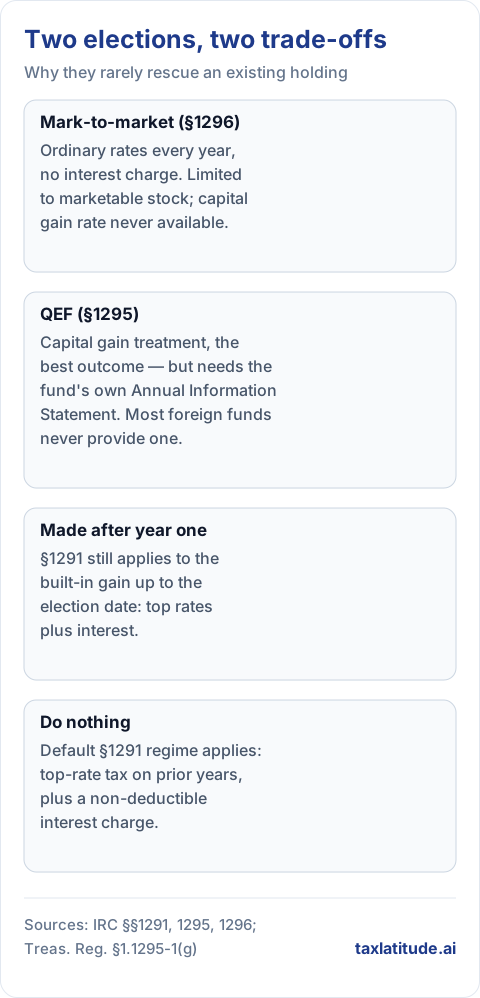
Both the annual inclusions and any gain on sale "shall be treated as ordinary income" (§1296(c)(1)(A)). While the election is in force, §1291 does not apply (§1291(d)(1)). That means no daily allocation, no top-rate tax and no interest charge.
The trade-off is plain.
- Benefits. The investor pays tax at their own marginal rate rather than the top rate, and pays no interest.
- Costs. The tax is due every year whether or not anything was sold, and the long-term capital gains rate is never available, however long the fund is held.
- Losses. A fall in value is deductible each year only up to the gains already taxed under the election (Treas. Reg. §1.1296-1(c)(3)). A fall below the original cost produces no annual deduction. On a sale, a loss up to those earlier inclusions is ordinary; any loss beyond them falls under the general loss rules (§1.1296-1(c)(4)).
- Revocation. Once made, the election continues until the stock stops being marketable or the IRS consents to revocation (§1296(k)).
The election is available only for "marketable stock" (§1296(e)). Under Treas. Reg. §1.1296-2, stock is marketable if it is "regularly traded" on a qualifying exchange. "Regularly traded" means traded in more than de minimis quantities on at least 15 days in each calendar quarter.
A foreign exchange qualifies if a government authority regulates or supervises it, it has enforced listing, disclosure and surveillance rules designed to prevent fraud and manipulation, and its rules "effectively promote active trading of listed stocks." The IRS publishes no list of qualifying foreign exchanges. No IRS ruling found for this article says in terms that UCITS ETFs are marketable stock. Even so, a UCITS ETF listed on a major government-regulated exchange such as the London Stock Exchange, Xetra or Euronext, and trading on most business days, should generally qualify under the regulation's tests. Thinly traded share classes need to be checked quarter by quarter.
Funds that are not listed have a second route. Treas. Reg. §1.1296-2(d) treats an open-ended fund redeemable at net asset value as marketable stock if eight conditions are all met:
- more than 100 unrelated shareholders in the class;
- availability to the general public at net asset value, with a minimum initial investment of no more than $10,000;
- prices published at least weekly in a widely available medium the fund does not control;
- annual audited financial statements that are made public;
- supervision by a foreign government as an investment company;
- no senior securities beyond de minimis debt;
- at least 90% passive income;
- at least 90% passive assets.
The most important limit is timing. Under §1296(j), if the election is made after the first year the investor held the fund, §1291 still applies in the first election year. In effect, the built-in gain up to that point is taxed under the default regime, with top rates and interest. The Form 8621 instructions note that a shareholder "may be required to complete Part V, rather than Part IV, in the first year" of a late mark-to-market election (Instructions for Form 8621).
For someone who discovers in year ten that they hold a PFIC, mark-to-market stops the damage from growing, but it does not undo what has already accrued.
The qualified electing fund election (§1295): the best treatment, rarely available
A qualified electing fund, or QEF, election under §1295 treats the fund somewhat like a US partnership. Each year the investor includes their pro rata share of the fund's ordinary earnings as ordinary income, and their share of its net capital gain as long-term capital gain (§1293(a)). Basis rises by the amounts taxed. Later distributions of those amounts are not taxed again (§1293(c), (d)). Capital gain character survives, and there is no interest charge. Of the three regimes, this is the most favorable.
The election depends entirely on the fund. For every year the election applies, "the PFIC must provide the shareholders with a PFIC Annual Information Statement" (Instructions for Form 8621). Under Treas. Reg. §1.1295-1(g), the statement must be signed by the PFIC or its authorized representative, and must state one of the following:
- the shareholder's share of the fund's ordinary earnings and net capital gain;
- enough information for the shareholder to compute those figures;
- that the fund has let the shareholder examine its books in order to compute them.
It must also include a commitment to let the shareholder inspect the fund's records to verify the amounts under US tax principles (T.D. 8750, text of §1.1295-1T(g)). An alternative form of documentation is allowed only in "rare and unusual circumstances," through a private letter ruling and a closing agreement between the IRS and the PFIC itself (same source).
As the attorney Phil Hodgen (secondary source) puts it: "If you do not receive the statement, you cannot make the election" (Hodgen Law).
Producing that statement means computing the fund's earnings and profits and net capital gain under US tax rules (§1293(e)), a separate exercise from its local accounts. Greenback (secondary source) describes the statement as "a voluntary accommodation for U.S. shareholders, and most non-U.S. fund managers do not produce it" (Greenback, "What Is a PFIC Annual Information Statement"). TaxesForExpats (secondary source) says the same of UCITS ETFs specifically: "Most UCITS ETFs do not provide this information" (TaxesForExpats). No regulator or industry body publishes a figure for what share of foreign funds actually issue the statement.
The visible exceptions are in Canada, where a large US-citizen population gives fund managers a commercial reason to prepare US tax data. BlackRock Canada says PFIC statements are "expected to be available" for the Canadian iShares funds on its list, posted around 31 March each year, and notes that "Canadian mutual fund trusts (including exchange-traded funds) and mutual fund corporations are considered PFICs" (BlackRock Canada, PFIC statements). CI Global Asset Management publishes a signed annual statement in the form the regulation requires (CI 2025 PFIC Annual Information Statement). An investor anywhere else should assume no statement exists unless the fund confirms one in writing.
Late elections do not erase the past
Both elections work cleanly only from the first year of ownership. A QEF election gives full QEF treatment only if the fund was a QEF for every year of the investor's holding period (§1291(d)(1)). Otherwise the investor can "purge" the earlier non-QEF years with a deemed-sale election under §1291(d)(2)(A), which recognizes gain "as if he sold such stock" on the first day of the QEF year. Because a sale of PFIC stock is a §1291 disposition, the purge itself triggers the excess-distribution tax and interest on all gain to that date.
Retroactive QEF elections are possible only in narrow cases under Treas. Reg. §1.1295-3, as summarized in the Form 8621 instructions. One case is a protective statement filed in the first year, which requires that the shareholder "reasonably believed" the company was not a PFIC. The other is an IRS consent requested before the issue is raised on audit.
In PLR 201411001, the IRS granted consent where several conditions were met:
- the taxpayers had reasonably relied on a qualified tax professional;
- they paid an amount under a closing agreement so that the government was not prejudiced;
- they had obtained an annual information statement from the fund.
A private letter ruling binds only the taxpayer who requested it.
Form 8621 instructions: who must file, and how often
Who must file
The statutory basis is §1298(f), added by the HIRE Act in 2010: "each United States person who is a shareholder of a passive foreign investment company shall file an annual report containing such information as the Secretary may require." The current form and instructions are both Rev. December 2025 (Form 8621; Instructions).
The instructions require a direct or indirect PFIC shareholder to file for each tax year in which the shareholder:
- "Receives certain direct or indirect distributions from a PFIC,"
- "Recognizes gain on a direct or indirect disposition of PFIC stock,"
- "Is reporting information with respect to a Qualified Electing Fund (QEF) or section 1296 mark-to-market election,"
- "Is making an election reportable in Part II of the form," or
- "Is required to file an annual report pursuant to section 1298(f)."
The fifth item means that simply holding the shares can require a filing. No sale and no distribution are needed.
"A separate Form 8621 must be filed for each PFIC in which stock is held directly or indirectly" (Instructions; see also Treas. Reg. §1.1298-1(e)). Someone with five foreign funds files five forms a year.
The form is attached to the income tax return. A shareholder who is not required to file a return must still send Form 8621 on its own to the IRS in Ogden, Utah (same instructions). The annual-report requirement applies to tax years ending on or after 31 December 2013 (Treas. Reg. §1.1298-1(c)(9), (h)).
The exceptions, precisely
The main relief is a de minimis exception in Treas. Reg. §1.1298-1(c)(2). No annual report is required for a §1291 fund in a year when all three of these conditions hold:
- Value. The total value of all PFIC stock the shareholder owns is $25,000 or less on the last day of the tax year, or $5,000 or less for a fund owned only indirectly. Joint filers have a combined threshold of $50,000.
- No triggering event. The shareholder had no excess distribution and no gain treated as one during the year.
- No QEF election applies to the fund.
The threshold is measured across all PFICs together, not fund by fund. The instructions specify that QEF and mark-to-market stock count toward it. The exception disappears in the year a fund is sold at a gain, so even a small holding requires a Form 8621 in the year of sale (Instructions). Shareholders may rely on account statements issued at least annually to value their holdings, unless they have reason to know the statements are inaccurate.
Not sure your holdings actually cross $25,000 ($50,000 if filing jointly)? The threshold counts every PFIC you hold together, not fund by fund. Ask TaxLatitude to help you add it up across accounts →
Other exceptions are narrower:
- US tax-favored accounts. PFICs held inside US tax-exempt accounts and plans, such as IRAs, 401(a) plans, 403(b) and 457(b) plans, and 529 accounts, are excluded (§1.1298-1(c)(1)). Foreign accounts are not on that list.
- Treaty pensions. Under §1.1298-1(c)(4), no filing is needed for PFICs held through a plan that a US income tax treaty treats as a foreign pension fund, where the plan's income is taxed to the member only when paid out. Without a treaty provision of that kind, the exception does not apply.
- Other cases. Further exceptions cover treaty dual residents who file as nonresidents with Form 8833, holdings of 30 days or less, and certain US-territory residents (§1.1298-1(c)(5), (7), (8)).
What the form actually computes
The form has six parts (Instructions):
- Part I summarizes the holding: shares, acquisition date, year-end value and which regime applies.
- Part II contains the elections, lettered A through H, including QEF, mark-to-market, and the deemed-sale and deemed-dividend purging elections.
- Part III computes QEF inclusions.
- Part IV computes mark-to-market gain or loss.
- Part V carries out the §1291 computation shown in the worked example. It covers the 125% test against three prior years of distributions, the allocation of the excess or gain across every day held, the top-rate tax for each prior year, the per-year foreign tax credit limitation, and the §6621 interest.
- Part VI tracks earlier deferral elections under §1294.
The Rev. December 2025 revision added a currency-code field and a requirement to convert foreign-currency amounts to dollars. The deferred tax is reported on Form 1040 with the notation "1291TAX," and the interest on Schedule 2 (same source).
Preparing Part V for one fund requires the purchase date of every lot, including reinvested dividends and regular contributions, every distribution in the prior three years, and the sale dates and proceeds. A fund bought through monthly savings over ten years has 120 separate lots, each with its own holding period.
The IRS's own Paperwork Reduction Act notice in the instructions estimates the burden at 16 hours 58 minutes for recordkeeping, 11 hours 24 minutes for learning about the law or the form, and 20 hours 34 minutes for preparing and sending it. That totals about 49 hours per form, per PFIC, per year (Instructions for Form 8621, Paperwork Reduction Act Notice).
Penalties, Form 8938 and the FBAR
No section of the Code imposes a specific dollar penalty for failing to file Form 8621. §1298(f) has no penalty clause, unlike the penalty provisions for Form 5471 or Form 8938. The exposure comes instead from the tax and interest themselves, the ordinary accuracy and late-payment penalties on that tax, and the statute of limitations rule described in the next section.
Form 8621 also interacts with Form 8938, the statement of specified foreign financial assets:
- A PFIC reported on Form 8621 does not need to be listed again on Form 8938.
- Its value still counts toward the Form 8938 filing threshold, and the filer must state how many Forms 8621 were filed (Instructions for Form 8938).
- If no Form 8621 was filed, the duplicate-reporting relief on Form 8938 is not available.
- The FBAR (FinCEN Form 114) is a separate obligation. "Filing Form 8938 does not relieve you of the requirement to file" it (same source).
IRC §6501(c)(8): an unfiled Form 8621 can leave the whole return open
The IRS normally has three years after a return is filed to assess additional tax (§6501(a)). §6501(c)(8)(A) overrides that rule when required foreign information is missing:
In the case of any information which is required to be reported to the Secretary pursuant to an election under section 1295(b) or under section 1298(f), 6038, 6038A, 6038B, 6038D, 6046, 6046A, or 6048, the time for assessment of any tax imposed by this title with respect to any tax return, event, or period to which such information relates shall not expire before the date which is 3 years after the date on which the Secretary is furnished the information required to be reported under such section.
§1298(f) is the Form 8621 requirement. The Form 8621 regulation makes the link explicit: for a failure to report, the assessment period is extended under §6501(c)(8) (Treas. Reg. §1.1298-1(d)).
The words "tax return" were inserted by the HIRE Act, Pub. L. 111-147 §513, in March 2010, and the IRS reads them broadly. In Chief Counsel Advice 201147030, the IRS Office of Chief Counsel concluded that for years covered by the 2010 amendment, the extended period applies to the entire tax return, not only to the items connected to the missing information. The IRS's own international training material, an LB&I International Practice Unit, says the same. It states that the HIRE Act amended the provision "to keep the entire tax return open, unless the failure to file the information return was due to reasonable cause," and that "the statute of limitations on the individual's return does not start to run until the information return is filed" (IRS Practice Unit INT-C-115). Both documents state the IRS's position: the Chief Counsel Advice cannot be cited as precedent, and the Practice Unit describes itself as "not an official pronouncement of law." No reported court decision has yet applied §6501(c)(8) specifically to an unfiled Form 8621; the published case law on the whole-return reading of this provision concerns other international information returns. The IRS's reading is the position every major practitioner guide assumes, and it follows directly from the statute's plain "tax return" language, but it has not been tested in court on these facts.
There is one statutory limit. §6501(c)(8)(B) provides that if the failure "is due to reasonable cause and not willful neglect," the extension applies "only to the item or items related to such failure." That subparagraph was added by Pub. L. 111-226, §218 (August 2010), effective as if it had been part of the HIRE Act (§6501 amendment notes). The burden of showing reasonable cause falls on the taxpayer.
In practice this means the following:
- No clock. For any year in which a required Form 8621 was not filed, the normal three-year clock never starts. The IRS can assess additional tax for that year until three years after the missing form is finally furnished. If the form is never filed, there is no end date.
- Whole-return scope. Without reasonable cause, the open period covers any tax on that return, not just the PFIC. A self-employment income question or a disputed deduction from that year remains open as well.
- Reasonable cause narrows, but does not close. With reasonable cause, only the PFIC items stay open. They still stay open until the form is filed.
- Year by year. The rule operates separately for each year a form was missing. Because the plain annual-holding report applies from tax years ending on or after 31 December 2013, an investor who has held foreign funds for a decade may have a decade of returns in this position.
- IRS procedure. The Internal Revenue Manual at IRM 25.6.23 lists §6501(c)(8) among the provisions an examiner may rely on to keep an otherwise-expired year open.
Filing the missing form starts the three-year clock. That is the main reason late compliance, rather than continued silence, is the practical way to bring the exposure to an end.
How Americans abroad end up holding PFICs without knowing it
The common pattern is that a product is ordinary, or even tax-favored, in the country where the person lives. US law does not recognize the local wrapper, so it looks through to the pooled foreign funds inside, and those funds are PFICs.
A workplace pension invested in local funds
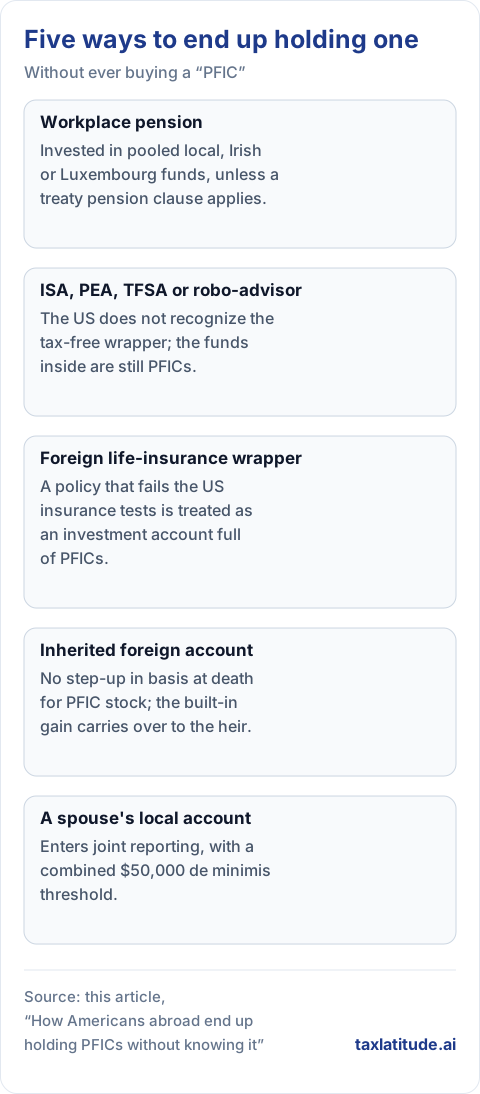
Employer pensions abroad usually invest members' money in pooled funds domiciled in that country or in Ireland or Luxembourg. The only Form 8621 exception for foreign pensions is the treaty exception in Treas. Reg. §1.1298-1(c)(4). It requires a US income tax treaty that treats the plan as a pension fund and taxes its income to the member only when paid out.
The US–UK treaty is the best-known example. Its pension article (Article 18) can defer US tax on income that builds up inside a qualifying UK scheme until benefits are paid out, subject to conditions that depend on the type of scheme and the member's circumstances. Practitioners writing in The Tax Adviser note that where the plan holds foreign mutual funds, "PFIC rules may apply" (Vercelli & Scarlat, The Tax Adviser, May 2020 (secondary source)).
Three limits apply:
- Where no treaty provision covers the plan, the underlying funds face the ordinary PFIC analysis.
- The regulation removes only the filing requirement. Whether a treaty pension clause also defers the §1291 tax itself is a question the regulation does not answer.
- A separate IRS procedure, Rev. Proc. 2020-17 (summarized in the Instructions for Form 3520-A), relieves certain foreign retirement trusts from foreign-trust reporting on Forms 3520 and 3520-A. It expressly does not affect Form 8938 or FBAR obligations, and it says nothing about Form 8621.
Australian superannuation is a known unresolved case. No IRS guidance classifies it, and practitioner commentary is inconsistent on whether a fund is an employer trust, a grantor trust, or a holder of reportable PFICs. The law firm Golding & Golding (secondary source), for example, says a super fund may need Form 8621 "pending the investment type" (Golding & Golding). This is not just one firm's reading: the Association of Superannuation Funds of Australia's submission to the Australian Treasury's tax treaty consultation names the PFIC treatment of superannuation, and the current US–Australia treaty's complete silence on superannuation, as unresolved problems for dual-resident Americans (secondary source, industry body submission to a government consultation) (ASFA submission, Treasury Tax Treaty Program Consultation). Anyone with significant superannuation should treat the question as open and get advice specific to their fund.
A local tax-free savings wrapper or robo-advisor
A UK ISA, a French PEA, a Canadian TFSA and similar accounts shelter investment returns from local tax. They have no status in US law. Greenback (secondary source) states that "The US does not recognize ISAs or GIAs as tax-exempt accounts," and that funds inside them "may be considered Passive Foreign Investment Companies" (Greenback FAQ). Cross-border wealth managers who advise US citizens in the UK make the same point. MASECO Private Wealth (secondary source) writes that while an ISA holding cash or individual shares stays attractive, nearly everything inside a typical UK stocks-and-shares ISA is a PFIC, so "the yearly PFIC reporting can cost more than the UK tax savings" (MASECO Private Wealth, "Can Americans invest in UK ISAs?"). The accountancy firm Moore Kingston Smith (secondary source) advises US taxpayers in the UK on the same point directly (Moore Kingston Smith, "US tax on UK ISAs"). The Form 8621 exception for tax-favored accounts in §1.1298-1(c)(1) lists only US accounts such as IRAs and 529 plans.
A robo-advisor or managed portfolio outside the United States usually builds its portfolios from several locally available ETFs. Each one is a separate PFIC, and each needs its own Form 8621 once the de minimis exception no longer applies.
A foreign life-insurance "investment wrapper"
Unit-linked policies, French assurance-vie, and private placement life insurance from Switzerland or Luxembourg are sold as insurance but work largely as investment accounts.
For US purposes a policy is life insurance only if it is insurance under local law and passes either the cash value accumulation test or the guideline premium and cash value corridor tests of §7702(a). A policy that fails is taxed each year on its "income on the contract" as ordinary income (§7702(g)).
Hodgen (secondary source) warns that with some foreign policies "you are treated (by the U.S. tax system) as owning an investment account full of assets," including mutual funds that are PFICs. He adds that on death the estate is treated as having sold the PFICs inside the policy (Hodgen, "Foreign life insurance and Americans abroad"). The result depends heavily on the specific contract.
An inherited foreign brokerage account
An heir who inherits foreign funds from a US citizen or resident does not get the usual basis step-up at death. §1291(e) reduces the stepped-up basis back to the decedent's basis. The heir takes over the built-in gain along with the funds, and that gain is then subject to the PFIC regime.
The step-up survives only if the decedent was a nonresident alien throughout their holding period. An inheritance from a parent who was never a US person keeps the step-up, but the heir then holds PFICs from that day on.
A spouse's locally opened account
Many Americans abroad are married to non-Americans whose savings are in local funds. Those holdings enter the US person's reporting when the couple files jointly or owns accounts jointly, or through the attribution rules of §1298(a) for holdings through trusts and partnerships.
The joint-return de minimis threshold is $50,000 combined, and it is lost for a fund in any year that fund makes an excess distribution or is sold at a gain (§1.1298-1(c)(2)).
Joint filing also affects the catch-up route. Under the Streamlined Foreign Offshore Procedures, "for joint return filers, both spouses must meet the applicable non-residency requirement" (IRS, U.S. taxpayers residing outside the United States).
What to do if you think you hold a PFIC
Check where each fund is domiciled
The fastest screen is the fund's ISIN, the 12-character International Securities Identification Number printed on broker statements and fund factsheets. For equity-type instruments, which include fund shares, the two-letter prefix reflects the country where the issuer is registered or domiciled (ANNA, ISIN FAQ).
- "US" on a fund means a US-domiciled fund, which cannot be a PFIC. One caution: American Depositary Receipts also carry US ISINs, but they represent shares of a foreign company, which can itself be a PFIC.
- IE, LU, GB, FR, DE, CH, AU, CA, JP or another country code on a fund or ETF means a foreign fund that should be presumed to be a PFIC.
- XS or XA–XD prefixes, and structured notes, need closer review because the prefix does not reliably show where the issuer is domiciled.
Use the ISIN rather than the exchange. An Irish-domiciled ETF trading in London carries an IE prefix.
For anything held through a pension, insurance policy or savings wrapper, ask the provider for the list of underlying funds with their ISINs, because the wrapper itself is not the PFIC.
Then ask each fund manager in writing:
- Where is the fund legally organized and domiciled?
- Is it registered as an investment company in the United States?
- Does it issue a PFIC Annual Information Statement under Treas. Reg. §1.1295-1(g), and for which years?
Assemble the records for each fund
A fund-by-fund review needs, for each holding:
- the prospectus or key information document, to confirm the legal form and domicile;
- the date and amount of every purchase, including reinvested distributions and regular contributions;
- every distribution by date and amount;
- every sale or redemption, with dates and proceeds;
- the year-end value for each year, which is needed for the de minimis test, for mark-to-market and for Form 8938 and FBAR values;
- the exchange rates for each of those dates;
- the full holding period back to the first purchase, since the §1291 computation spreads gain over every day held.
Choose a catch-up route
The IRS's page of options for taxpayers with undisclosed foreign financial assets currently lists three paths: the Criminal Investigation Voluntary Disclosure Practice, the Streamlined Filing Compliance Procedures, and the Delinquent International Information Return Submission Procedures. The IRS states in the Internal Revenue Manual that the streamlined procedures "can be changed or terminated at any time" (IRM 4.63.3). Check the current pages before acting.
Streamlined Foreign Offshore Procedures are for non-willful taxpayers living abroad. "Non-willful" means "negligence, inadvertence, or mistake or conduct that is the result of a good faith misunderstanding of the requirements of the law." For a US citizen or green card holder, the non-residency test is met if, in any one of the three most recent years whose due date has passed, the person had no US abode and was physically outside the United States for at least 330 full days. The taxpayer must:
- file delinquent or amended returns for the three most recent years "with all required information returns," which would include Forms 8621;
- file six years of FBARs;
- sign and submit Form 14653;
- pay all tax and interest.
No failure-to-file, failure-to-pay, accuracy-related, information-return or FBAR penalties apply, unless an examination finds fraud or a willful FBAR violation. Penalties already assessed before the submission are not refunded. The submission is paper only, and returns are marked "Streamlined Foreign Offshore" in red (IRS, U.S. taxpayers residing outside the United States).
Streamlined Domestic Offshore Procedures apply to non-willful taxpayers who fail the non-residency test and have already filed returns for the three most recent years. They file amended returns only, with Form 14654, and pay a 5% penalty on the highest year-end value of the foreign assets that should have been reported. The IRS page for this program lists Form 8621 among the information returns that may be required (IRS, U.S. taxpayers residing in the United States).
Delinquent International Information Return Submission Procedures are for taxpayers who need to file late information returns, are not under examination or investigation, and have not been contacted by the IRS about them. Late returns are attached to an amended return with a reasonable cause statement. The IRS warns that penalties may still be assessed during processing without considering the statement (IRS, DIIRSP). Because unreported PFIC sales usually involve unpaid tax, not just a missing form, this route alone is often a poor fit.
Voluntary Disclosure Practice is the IRS Criminal Investigation process for willful noncompliance. It requires Form 14457 and does not guarantee immunity (IRS, CI Voluntary Disclosure Practice). On 22 December 2025 the IRS proposed a new penalty framework in IR-2025-124, with comments due by 22 March 2026. The CI page describes the proposed terms:
- a disclosure period that is generally the most recent six years;
- a 20% accuracy-related penalty per year on amended returns;
- penalties of up to $10,000 per international information return per year.
Under IR-2025-124, the new framework takes effect six months after final terms are published. As of November 2026, the IRS's own VDP page still describes the updated framework as a proposal in the public comment period, which closed 22 March 2026, with no final terms yet published. Anyone in this category needs a lawyer, not a blog article.
Relief Procedures for Certain Former Citizens cover people who gave up citizenship after 18 March 2010, with net worth under $2 million and total tax of $25,000 or less over the relevant six years. Their conduct must also have been non-willful. Eligible filers owe neither penalties nor tax for those years (IRS, Relief Procedures for Certain Former Citizens).
Filing amended returns with Forms 8621 outside any of these programs is also possible. In that case the ordinary penalty rules apply, without the waivers set out on the streamlined pages.
Two cautions apply to any route. First, the streamlined procedures cover three years of returns, while §6501(c)(8) operates year by year. The Internal Revenue Manual says streamlined returns "will be processed like any other returns" and that each submission is screened to set its assessment statute date (IRM 4.63.3.17), but no published rule says that earlier years with missing Forms 8621 are formally closed. Second, if a fund does issue annual information statements, a retroactive QEF election may be worth exploring under Treas. Reg. §1.1295-3. That generally means a private letter ruling request and a user fee, and it must be made before the IRS raises PFIC status on audit (PLR 201411001).
What no general article can tell you
The worked example above shows how the rules work and roughly how large the effect is on an ordinary investment. It cannot tell any particular reader what they owe. That answer depends on facts this article does not have:
- the fund's legal form, domicile and distribution history;
- whether it issues PFIC Annual Information Statements, and from which year;
- whether its shares are marketable stock;
- every purchase date and amount, and the holding period of each lot;
- the exchange rates on each of those dates;
- the country of residence, and whether its taxes produce creditable foreign tax;
- whether a treaty covers a pension;
- the investor's bracket in the year of sale;
- whether any Forms 8621 were filed in the past.
Two people holding the same fund can owe very different amounts. The only way to know is to run the computation on the actual records, fund by fund.
Frequently asked questions
What is PFIC tax?
It is not a separate tax with its own rate. Under the default regime of §1291, a gain on selling a PFIC, or an "excess distribution" from one, is spread evenly over every day it was held, and the portion allocated to each earlier year is taxed at the highest ordinary income tax rate in force that year, plus a non-deductible interest charge for the delay. In the worked example above, that pushes the effective rate on a $19,343.03 gain to about 48.5%, against 15% in a US-domiciled fund.
What is Form 8621 used for?
Form 8621 is the annual information return required by §1298(f) for "each United States person who is a shareholder of a passive foreign investment company." It is used to report distributions, gains on disposition, QEF or mark-to-market elections, and, in many cases, simply to satisfy the annual reporting requirement even when nothing was sold or distributed that year.
Who must file Form 8621?
Per the current instructions, a direct or indirect PFIC shareholder must file for any tax year in which they receive a distribution from the PFIC, recognize gain on disposing of PFIC stock, report a QEF or mark-to-market election, make another election reportable on the form, or are otherwise required to file an annual report under §1298(f) — that last trigger alone means simply holding the shares can require a filing, with no sale and no distribution.
What is PFIC income?
The term covers two different things the rules ask about. First, whether a fund counts as a PFIC turns on its income: under the income test of §1297(a), a foreign corporation is a PFIC if 75% or more of its gross income for the year is passive (dividends, interest, and gains from selling securities and similar property). Second, once a fund is a PFIC, the income a US shareholder reports from it depends on the regime chosen: ordinary income and an interest charge under the §1291 default, a pro-rata share of the fund's own earnings under a QEF election, or annual mark-to-market gains under §1296.
Is there a single PFIC tax rate?
No. The default §1291 regime taxes the gain at the highest ordinary rate in force in each year of the holding period, not at one fixed percentage, and adds a non-deductible interest charge on top. The combined effect depends on the holding period and the rates in force during it — in the worked example above it comes to about 48.5% of the gain, more than three times the US-domiciled fund's 15% long-term capital gains rate on the same numbers.
Do I need a separate Form 8621 for each fund I hold?
Yes. The instructions state that "a separate Form 8621 must be filed for each PFIC in which stock is held directly or indirectly." Someone holding five foreign funds files five forms every year the filing requirement applies.
Sources
Primary sources (accessed November 5, 2026)
- Internal Revenue Code §1297(a)
- Instructions for Form 8621
- §954(c)
- T.D. 9936, 86 Fed. Reg. 4516
- Treas. Reg. §301.7701-4(c)(1)
- Treas. Reg. §301.7701-3
- §1298(b)(1)
- §1291
- §1(h)(11)(C)(iii)
- §6621(a)(2)
- §6622
- Quarterly interest rates
- Temp. Treas. Reg. §1.163-9T(b)(2)(i)(A)
- T.D. 8750
- §7508A
- Notice 2020-23
- Notice 2021-21
- Rev. Proc. 2024-40, §1(h), §1(j)(5), published in Internal Revenue Bulletin 2024-45
- IRS, Questions and Answers on the Net Investment Income Tax
- Treas. Reg. §1.1411-10(c)(2)(i)
- ECB euro reference exchange rates
- ECB euro reference exchange rates
- §1296
- Treas. Reg. §1.1296-1(c)(3)
- Treas. Reg. §1.1296-2
- §1295
- §1293(a)
- PLR 201411001
- Form 8621
- Treas. Reg. §1.1298-1(e)
- Instructions for Form 8938
- §6501(a)
- Chief Counsel Advice 201147030
- IRS Practice Unit INT-C-115
- Internal Revenue Manual at IRM 25.6.23
- Instructions for Form 3520-A
- §7702(a)
- IRS, U.S. taxpayers residing outside the United States
- ANNA, ISIN FAQ
- options for taxpayers with undisclosed foreign financial assets
- IRM 4.63.3
- IRS, U.S. taxpayers residing in the United States
- IRS, DIIRSP
- IRS, CI Voluntary Disclosure Practice
- IR-2025-124
- IRS, Relief Procedures for Certain Former Citizens
Secondary sources
- Greenback, "Are My Foreign Mutual Funds Considered PFICs?" (secondary source)
- Golding & Golding (secondary source)
- H&R Block, "PFIC & Foreign Mutual Fund Reporting Requirements" (secondary source)
- TaxesForExpats, "UCITS ETF: withholding tax, PFIC rules, and US estate tax" (secondary source)
- Phil Hodgen, HodgenLaw PC (secondary source)
- Vanguard factsheet (secondary source)
- Hodgen Law (secondary source)
- Greenback, "What Is a PFIC Annual Information Statement" (secondary source)
- BlackRock Canada, PFIC statements (secondary source)
- CI 2025 PFIC Annual Information Statement (secondary source)
- Vercelli & Scarlat, The Tax Adviser, May 2020 (secondary source)
- Golding & Golding (secondary source)
- ASFA submission, Treasury Tax Treaty Program Consultation (secondary source)
- Greenback FAQ (secondary source)
- MASECO Private Wealth, "Can Americans invest in UK ISAs?" (secondary source)
- Moore Kingston Smith, "US tax on UK ISAs" (secondary source)
- Hodgen, "Foreign life insurance and Americans abroad" (secondary source)
This article explains US federal tax law as of November 2026 and is not tax advice for any individual situation. Anyone who holds foreign funds should have their own holdings reviewed by a qualified US international tax professional before deciding what to file.