Foreign mutual funds, UCITS funds, foreign-listed ETFs and many foreign investment wrappers are passive foreign investment companies (PFICs) under US tax law. This guide explains when Form 8621 is required, how the three PFIC tax regimes work, what each part of the December 2025 form asks for, and what a missed filing really costs. It includes two fully worked numerical examples.
Key takeaways
- A foreign corporation is a PFIC if either 75% or more of its gross income is passive or at least 50% of its assets (on average over the year) produce or are held to produce passive income (IRC §1297(a)). Almost every foreign-domiciled investment fund meets one or both tests.
- Form 8621 is required for each PFIC, not for each brokerage account (Reg. §1.1298-1(e)). A diversified foreign portfolio of 15 funds can mean 15 Forms 8621 every year.
- Unless you make an election, PFIC gains and large distributions fall under the default §1291 "excess distribution" regime. Gain is spread over your holding period. The portions allocated to earlier years are taxed at the highest individual rate for each of those years (37% for 2018 through 2025), and an interest charge is added at the IRS underpayment rate, compounded daily (§1291). In this guide's first worked example, a $150,000 gain on a fund held for seven years costs $65,153 in tax and interest, against $22,500 at a 15% long-term capital gain rate.
- The two alternatives are the qualified electing fund (QEF) election, which needs an annual information statement from the fund that most foreign funds do not provide, and the mark-to-market (MTM) election, which is available only for "marketable stock".
- The annual §1298(f) filing has a small-holding exception: $25,000 or less of PFIC stock on the last day of the year, $50,000 or less on a joint return. There is no higher threshold for Americans living abroad. That higher threshold belongs to Form 8938, not Form 8621. The exception also disappears in any year with an excess distribution or a gain on disposition, and it does not apply once a QEF election has been made (Reg. §1.1298-1(c)(2)).
- Form 8621 has no per-form dollar penalty, unlike Forms 5471, 8865 and 8938. The real consequences are the tax itself, the accuracy-related penalty on unreported PFIC income, and §6501(c)(8). Under §6501(c)(8), until the required information is furnished, the time to assess tax stays open for the whole return, or only for the related items if the failure was due to reasonable cause.
- Form 8621 is attached to your Form 1040 and is due with it, including extensions. If you have no return to file, you send it on its own to the IRS service center in Ogden, Utah.
What a PFIC is, and why it catches Americans abroad
Form 8621, Information Return by a Shareholder of a Passive Foreign Investment Company or Qualified Electing Fund, is the form a US person uses to report holdings in a passive foreign investment company, make the elections available for that holding, and compute the tax on distributions from and sales of it. Unlike most of the international information returns covered on this site, Form 8621 is also a tax computation form. Part V works out an additional tax and an interest charge that go straight onto your Form 1040. Before looking at the form, you need to know whether you hold a PFIC at all. For most Americans abroad who invest locally, the answer is yes.
The two statutory tests
Under IRC §1297(a), a foreign corporation is a PFIC for a taxable year if it meets either of two tests:
- The income test. 75 percent or more of the corporation's gross income for the taxable year is passive income (§1297(a)(1)). "Passive income" generally means income of a kind that would be foreign personal holding company income under §954(c): dividends, interest, most rents and royalties, annuities, and net gains from selling property that produces that kind of income (§1297(b)(1)). There are narrow exceptions, for example for income from the active conduct of a banking business or of an insurance business by a qualifying insurance corporation (§1297(b)(2)).
- The asset test. The average percentage of assets held during the taxable year that produce passive income, or are held to produce it, is at least 50 percent (§1297(a)(2)). Publicly traded corporations measure assets by value. A non-publicly-traded CFC uses adjusted basis, and other non-publicly-traded corporations may elect adjusted basis (§1297(e)). The regulations measure the average using quarterly measuring dates unless an alternative measuring period is used (Reg. §1.1297-1(d)).
The tests are independent. A company that fails the income test can still be a PFIC under the asset test, and the reverse is also true. A foreign corporation that owns at least 25% by value of another corporation is treated as holding its share of that corporation's assets and receiving its share of that corporation's income (§1297(c)), so a holding company is tested on what sits underneath it.
Two further rules matter for individual investors:
- "Once a PFIC, always a PFIC." If a foreign corporation was a PFIC (and not a QEF) at any time during your holding period, your shares stay PFIC shares even in years when the company no longer meets either test, unless you make a purging election (§1298(b)(1); Reg. §1.1298-3).
- Corporation means corporation for US tax purposes. The test applies to entities that US tax law classifies as foreign corporations. A fund organized as a contractual arrangement or trust abroad can still be a corporation for US purposes under the entity classification rules. The local legal form does not settle the question.
Why ordinary foreign investments are PFICs
A pooled investment fund exists to hold shares, bonds and cash. Its income is dividends, interest and investment gains, and its assets are investment assets. A typical fund therefore meets both tests by a wide margin, every year. What decides whether the fund is a PFIC for you is not its strategy but its domicile. A fund organized in the United States is a regulated investment company and is not a foreign corporation. The same strategy, packaged in a fund domiciled in Ireland, Luxembourg, the United Kingdom, Canada, Australia, Singapore or anywhere else outside the US, is a foreign corporation (or treated as one) that holds passive assets.
In practice, PFICs held by Americans abroad usually fall into these groups:
- Locally sold mutual funds and unit trusts, including those sold by banks with a current account, and funds in employer savings plans that are not themselves treaty-protected pension arrangements.
- UCITS funds and UCITS ETFs, including Irish- and Luxembourg-domiciled index ETFs listed in London, Amsterdam, Frankfurt or Milan. Accumulating share classes are a special trap. They never distribute, so nothing in your account statement prompts you to think about tax until you sell, and by then the default §1291 rules have been running for years.
- Non-US-domiciled ETFs that track US indexes. A London-listed ETF tracking the S&P 500 is still a foreign fund. What it owns does not change where it is domiciled.
- Money market funds and "cash" sweep funds of foreign banks and brokers.
- Foreign insurance and investment wrappers. Unit-linked life policies, investment bonds and similar products may hold PFIC fund units. Depending on how US law classifies the wrapper, you may be treated as owning the underlying funds directly, or the wrapper or its issuer may itself need PFIC analysis. This is fact-specific and needs professional review.
- Funds inside foreign pension and retirement arrangements that do not have a treaty or statutory deferral. See "Filing thresholds and exceptions" below for the narrow pension filing exception.
- Foreign holding companies, investment trusts, REIT-like vehicles and start-ups with mostly cash. An early-stage foreign company that has raised money but not yet earned much operating income can meet the asset test.
A single foreign brokerage account can hold dozens of PFICs. Each fund, and in some cases each separate class of shares (§1298(b)(4) allows separate classes to be treated as separate corporations under regulations), is a separate PFIC with its own Form 8621 (Reg. §1.1298-1(e)(1)). The account is reported on the FBAR and, above the thresholds, on Form 8938. Neither of those forms replaces Form 8621.
For the conceptual background on why the PFIC rules exist (Congress's 1986 response to US investors deferring tax through offshore funds), see our thematic PFIC explainer and our blog article on the PFIC trap. This guide concentrates on the form.
PFIC versus CFC: the overlap rule
A foreign company you control through an operating business is normally a controlled foreign corporation (CFC), reported on Form 5471 and taxed under subpart F and the tested-income rules. A CFC can also meet the PFIC tests, for example a holding company that mostly owns cash and portfolio investments. §1297(d) prevents double coverage. A corporation is not treated as a PFIC with respect to a shareholder during the "qualified portion" of that shareholder's holding period, which is the part after December 31, 1997, during which the shareholder is a United States shareholder under §951(b) (10% by vote or value) and the corporation is a CFC.
Three limits to this rule matter in practice:
- It protects only US shareholders of the CFC. A US person who owns, say, 3% of a CFC is not a §951(b) US shareholder, gets no protection under §1297(d), and is subject to the PFIC rules if the CFC meets either PFIC test.
- It does not erase earlier PFIC years. If the stock was PFIC stock before the qualified portion began and no purging election is made, the PFIC taint continues (§1297(d)(3)(B)). The Form 8621 elections F and G exist for this situation.
- It does not apply to option holders unless the stock is actually owned by a non-exempt US shareholder (§1297(d)(4)).
If you own a foreign operating company, start with our Form 5471 guide. Form 8621 becomes relevant when you own less than 10%, or the company falls out of CFC status, or the company is a passive holding vehicle.
Who must file Form 8621, and what triggers it
The statutory requirement
§1298(f) requires each United States person who is a shareholder of a PFIC to file an annual report containing the information the Secretary requires, except as the Secretary provides otherwise. The regulations under §1298(f) (Reg. §1.1298-1) designate Form 8621 as that report and apply to shareholders' taxable years ending on or after December 31, 2013 (§1.1298-1(c)(9) and (h)). Before that, Form 8621 was generally required only in years with a distribution, a disposition, an election, or QEF or mark-to-market income to report.
"United States person" includes every US citizen, wherever they live, and every green card holder until that status ends for tax purposes. A nonresident alien spouse is not a US person and has no Form 8621 obligation. Spouses who file jointly can file one Form 8621 per PFIC that either or both of them own (§1.1298-1(e)(2)), and the Part I line 1 checkbox shows joint ownership with a spouse.
The five filing triggers
The December 2025 instructions say a US person who is a direct or indirect shareholder of a PFIC files Form 8621 for any tax year in which the person:
- receives certain direct or indirect distributions from a PFIC;
- recognizes gain on a direct or indirect disposition of PFIC stock;
- is reporting information with respect to a QEF or §1296 mark-to-market election, meaning that a QEF inclusion or an MTM inclusion or deduction arises;
- is making an election reportable in Part II of the form; or
- is required to file an annual report under §1298(f).
Triggers 1 to 4 are the "event" triggers that existed before 2013. Trigger 5 is the standalone annual report. Its practical effect is that simply holding a PFIC at any time during the year requires a Form 8621, even in a year with no distribution, no sale and no election, unless an exception described in "Filing thresholds and exceptions" below applies.
One form can do several jobs. The regulations let you file a single Form 8621 for a PFIC that contains the §1298(f) annual information together with any elections and computations (§1.1298-1(f)). For example, a shareholder with a mark-to-market election files one form completing Part I and Part IV.
"Disposition" is broad. The instructions treat stock as disposed of when it is sold, transferred, or pledged. Pledging PFIC shares as collateral for a loan can therefore trigger the §1291 rules even though nothing is sold.
Indirect shareholders
You can be a shareholder of a PFIC you never bought directly. Under §1298(a) and Reg. §1.1291-1(b)(8), a US person is treated as owning PFIC stock that is owned:
- through a non-PFIC foreign corporation, if the US person owns 50% or more in value of that corporation, in proportion to the value owned (§1298(a)(2)(A));
- through another PFIC, with no 50% threshold. A shareholder of a PFIC is treated as owning a proportionate share of any PFIC that PFIC owns (§1298(a)(2)(B)). A foreign "fund of funds" therefore makes you an indirect shareholder of every PFIC in its portfolio;
- through a partnership, estate or trust, proportionately (§1298(a)(3)); and
- through options, to the extent the regulations provide (§1298(a)(4)).
Distributions to, and dispositions by, the entity that actually holds the stock can be treated as distributions to, or dispositions by, the indirect US shareholder (§1298(b)(5)). Fund-of-fund turnover can generate §1291 events for you even if you never sell your own units.
Do you hold a foreign "fund of funds" or a diversified investment wrapper? You can be an indirect shareholder of every PFIC inside it — with a separate Form 8621 obligation for each one — even if you never bought those underlying funds yourself. Ask TaxLatitude to help you map what's actually inside →
Two reporting rules sort out who in a chain actually files:
- Indirect ownership through foreign entities. The general rule in §1.1298-1(b)(1) requires filing by a US person who owns PFIC stock directly, or indirectly through one or more foreign entities. If you hold a PFIC through a foreign partnership or a foreign holding company, the filing obligation is yours.
- Indirect ownership through US persons. If your indirect ownership runs through another US person, such as a domestic partnership, an S corporation or a domestic estate, you generally file only if you are treated as receiving an excess distribution, recognize gain treated as an excess distribution, have a QEF or MTM inclusion, or must report the status of a §1294 election (§1.1298-1(b)(2)). Even then, QEF and MTM inclusions are excused if another shareholder in the chain timely files Form 8621 for the PFIC. That carve-out does not apply to a QEF inclusion from a PFIC held through a domestic partnership or S corporation that has not itself made the QEF election (§1.1298-1(b)(2)(ii)). A domestic partnership or S corporation is not treated as a PFIC shareholder for tax purposes but is treated as one for information reporting, including the §1298(f) annual report (Reg. §1.1291-1), and the instructions add that an interest holder must file if the entity fails to file, or if the interest holder must recognize income under §1291.
Two further points complete the picture. Holding PFIC stock through a US tax-exempt or tax-deferred account (an IRA, a 401(k) or 403(b) plan, a 457(b) plan, a 529, 530 or 529A account, or a §501(c) organization) means you are not treated as a shareholder at all, so no Form 8621 is needed for those holdings. A US beneficiary of a foreign nongrantor trust or estate generally does not complete Part I for PFIC stock held by the trust or estate unless the beneficiary made a QEF or MTM election or is treated as receiving an excess distribution or recognizing gain.
The three PFIC tax regimes: §1291, QEF and mark-to-market
Every PFIC holding is taxed under one of three regimes, or under a mix of them if an election was made late. The regime determines what you compute on Form 8621 each year and which part of the form you complete.
3.1 The default: the §1291 "excess distribution" regime
If you have made no QEF or mark-to-market election, the PFIC is a "section 1291 fund" for you. Nothing is taxed while you simply hold it. Tax arises only when you receive an excess distribution or dispose of the stock at a gain. When it does, §1291 treats the income as if it had been earned evenly over your whole holding period and charges you for the deferral.
Step 1: Identify the excess distribution
An excess distribution is the part of the year's total distributions on a share that exceeds 125 percent of the average distributions you received in the three preceding taxable years, or over your holding period before the current year if that is shorter (§1291(b)(2)(A)). Prior-year excess distributions count in that average only to the extent they were included in gross income under §1291(a)(1)(B). There is no excess distribution in the year your holding period begins (§1291(b)(2)(B)). Determinations are made share by share, but shares with the same holding period can be grouped into blocks (§1291(b)(3)(A)). Distributions are annualized if you held the stock for only part of the year (§1291(b)(3)(C)).
A short illustration. A fund paid you $2,000 in each of the three preceding years and pays $5,000 this year. The three-year average is $2,000, and 125% of that is $2,500. The first $2,500 of this year's distribution is a non-excess distribution, taxed under the ordinary dividend rules. Because a PFIC is excluded from "qualified foreign corporation" status (§1(h)(11)(C)(iii)), that dividend is not qualified dividend income and is taxed at ordinary rates. The remaining $2,500 is an excess distribution and goes through steps 2 to 4.
Gain on a disposition is treated entirely as an excess distribution (§1291(a)(2)). The 125% cushion does not apply to sales. A loss on disposition is not taken into account under §1291, and you do not complete line 16 for it.
Currency matters. If the distributions are in a foreign currency, the 125% test is run in that currency and the resulting excess distribution is translated into dollars (§1291(b)(3)(E)). The December 2025 form now asks you to enter the three-letter currency code above line 15a and to report the dollar amount of the excess distribution on new line 15e(2).
Step 2: Allocate ratably to each day of the holding period
The excess distribution (or the gain) is allocated ratably to each day in your holding period for the stock (§1291(a)(1)(A)). The holding period is determined under §1223. For a distribution it ends on the distribution date, and if you previously had a mark-to-market election it begins after the last MTM year (§1291(a)(3)(A)). In practice you divide the amount by the number of days in the holding period and add up the daily amounts falling in each tax year. Form 8621 line 16a requires an attached statement showing this allocation for each share or block of shares.
Step 3: Tax the pieces
- Amounts allocated to the current year, and to any pre-PFIC period in your holding period (any part of the holding period before the first day of the company's first tax year beginning after 1986 in which it was a PFIC), are included in your current-year gross income as ordinary income (§1291(a)(1)(B)). This is line 16b of the form. Even the current-year piece of a gain is ordinary income, not capital gain.
- Amounts allocated to each earlier PFIC year are not included in income at all. Instead, each is multiplied by the highest rate of tax in effect for that year under §1 (individuals) or §11 (corporations), regardless of your actual bracket that year (§1291(c)(2)). The sum is the "aggregate increase in taxes", entered on line 16c and added to your current-year tax (§1291(a)(1)(C)). The instructions list the top individual rates: 37% for 2018 through 2025, 39.6% for 2013 through 2017, and 35% for 2003 through 2012, with earlier years also listed.
- Foreign taxes on the excess distribution can reduce the increase in tax for the year to which they are allocated, but not below zero, and with no carryover of any unused amount (§1291(g); line 16d).
Step 4: Add the interest charge
Interest is charged on each year's increase in tax for the period from the due date of the return for that earlier year to the due date of the return for the year of the distribution or disposition. "Due date" means the date prescribed by law, determined without regard to extensions (§1291(c)(3)). The interest is computed "by using the rates and method applicable under section 6621 for underpayments of tax". That means:
- the underpayment rate under §6621(a)(2), which is the federal short-term rate plus 3 percentage points, reset every calendar quarter. It is not the applicable federal rate, and it is not an annual rate fixed at the start of the holding period;
- compounded daily under §6622: the annual rate is divided by 365 (366 in a leap year) and compounded each day (Reg. §301.6622-1), and the IRS publishes the daily-compounding factors in Rev. Proc. 95-17. The instructions point to Rev. Rul. 2024-18 for the historical rate table, and the IRS's quarterly interest rates page lists the rates by quarter.
For Americans abroad, note that the June 15 automatic extension does not move the "due date" used here. Interest on each prior-year increase starts at April 15 of the following year (for calendar-year individuals) and runs to April 15 of the year after the excess distribution, whatever extension you actually use. The interest is entered on line 16f. For an individual, it is personal interest and is not deductible (Reg. §1.163-9T(b)(2)(i)(B)).
The deferred tax goes on Form 1040, line 16 (check box 3 and enter "1291TAX"). The interest goes on Schedule 2 (Form 1040), line 17p. The current-year ordinary income goes on the "other income" line. Worked example 1 below runs all four steps with real numbers.
Other §1291 consequences worth knowing
- No capital gain rate, ever. Under §1291 a PFIC gain is never long-term capital gain, however long you held the fund.
- Non-recognition transfers can be taxable. §1291(f) allows regulations to require gain recognition on transfers that would otherwise be tax-free. Gifts and transfers to trusts should be checked before they happen.
- Pledges count as dispositions, as noted in section 2.
3.2 The qualified electing fund (QEF) election under §1295
A QEF election turns the PFIC into something close to a pass-through. Under §1293(a), each year you include in gross income:
- as ordinary income, your pro rata share of the fund's ordinary earnings, which means its earnings and profits minus its net capital gain (§1293(e)(1)); and
- as long-term capital gain, your pro rata share of the fund's net capital gain, which cannot exceed the fund's earnings and profits (§1293(e)(2)).
The inclusion is for your tax year in which or with which the fund's tax year ends (§1293(a)(2)). Your basis rises by the amounts included (§1293(d)(1)). Later distributions of previously taxed earnings are not taxed again and reduce basis (§1293(c), (d)(2)). If the QEF election has applied for every year of your holding period in which the fund was a PFIC (a "pedigreed" QEF), §1291 does not apply at all (§1291(d)(1)). When you sell, the gain is capital gain under the normal rules, long-term if you held the stock more than a year. There is no interest charge.
Points to understand about QEF treatment:
- Losses do not pass through. If the fund has a loss for the year, you include nothing, but you do not deduct anything either. The loss eventually shows up only in a lower sale price.
- The ordinary earnings inclusion is not a qualified dividend. It is taxed at ordinary rates. The net capital gain inclusion keeps capital gain character. Under Reg. §1.1293-1(a)(2) the fund may report it by §1(h) rate category, as an amount subject to the highest capital gain rate, or it may simply report everything as ordinary earnings.
- Tax without cash. Accumulating funds pay nothing out, so you pay tax each year from other funds. §1294 allows an election (Election B on the form) to extend the time to pay tax on undistributed QEF earnings, but interest accrues and the extension ends on a distribution, a disposition or a change in the fund's status. Election B is not available for amounts that are includible under §951. Part VI of the form tracks outstanding §1294 elections.
- Individuals get no indirect foreign tax credit. The deemed-paid credit for taxes the fund itself paid is available only to a domestic corporation that meets the 10% ownership requirement (§1293(f)).
The practical obstacle: the PFIC Annual Information Statement
A QEF election is valid only if the fund gives you, for each of its years ending in your tax year, a PFIC Annual Information Statement. The statement must show either your pro rata share of the fund's ordinary earnings and net capital gain, or enough information for you to calculate them. Its other required content is set out in Reg. §1.1295-1(g). Where you hold through an intermediary, an Annual Intermediary Statement can substitute. Some hedge funds and private equity vehicles marketed to US investors provide these statements. The overwhelming majority of retail funds sold outside the US do not, because computing US earnings and profits for a fund with no US marketing makes no commercial sense to the manager. Without a statement, there is no QEF election. Ask the fund manager in writing before you assume one is available.
Timing, and what a late election costs
The QEF election (Election A) is made separately for each PFIC on Form 8621, by the due date of your return, including extensions, for the first tax year to which the election is to apply. Only the first US person in the ownership chain makes it. A domestic partnership, S corporation or estate makes it at the entity level. If you make the election in the first year of your holding period in which the fund is a PFIC, the fund is a pedigreed QEF and you are entirely outside §1291.
If you make it in a later year, the fund is an unpedigreed QEF. You are then subject to both regimes. §1293 applies from the election year onward, and §1291 still applies to distributions and dispositions because of the earlier non-QEF years (§1291(d)(1); Reg. §1.1291-9(j)(2)(iii)). To end the §1291 exposure you must make a purging election under §1291(d)(2):
- Deemed sale election (Election D). You are treated as selling the stock at fair market value on the first day of the first QEF year (the "qualification date"). The gain is taxed under §1291, with the full interest charge. Your basis is stepped up by the gain, and your holding period restarts on that date (§1291(d)(2)(A), (C)). Under the instructions, the election is made with the original return for the year that includes the qualification date or by amended return within 3 years. In practice this is the only purging route for ordinary retail funds.
- Deemed dividend election (Election E). This is available only if the PFIC is also a CFC. Your share of post-1986 earnings and profits is treated as a dividend and taxed as an excess distribution (§1291(d)(2)(B); Reg. §1.1291-9). Retail funds are almost never CFCs, so this election is rarely relevant to them.
A truly retroactive QEF election, treated as made in the first year, is possible only in narrow cases under Reg. §1.1295-3. One route is a protective statement filed in the first affected year because you reasonably believed the company was not a PFIC. That route requires you to extend the assessment period for the affected years. The other is a consent request under §1.1295-3(f), which requires that you reasonably relied on a competent tax professional, that the government's interests are not prejudiced, and that you make the request before the PFIC issue is raised on audit. Neither route helps someone who simply never heard of PFICs and has no fund statement.
3.3 The mark-to-market (MTM) election under §1296
If the PFIC stock is marketable stock, you can elect under §1296 to be taxed each year on the change in value:
- If the fair market value at the close of your tax year exceeds your adjusted basis, you include the excess in income as ordinary income (§1296(a)(1), (c)(1)(A)).
- If adjusted basis exceeds value, you deduct the lesser of that excess or your unreversed inclusions, meaning the MTM gains included in prior years minus the MTM deductions already taken (§1296(a)(2), (d)). The deduction is an ordinary loss, deductible in computing adjusted gross income (§1296(c)(1)(B)). Losses beyond unreversed inclusions are not deductible each year.
- Basis moves up and down with the inclusions and deductions (§1296(b)). Gain on a sale is ordinary income. A loss on sale is ordinary up to the unreversed inclusions, and any excess follows the general loss rules (§1296(c)(1); Reg. §1.1296-1(c)(4)(ii)).
- There is no interest charge for the years the election is in effect.
What counts as "marketable stock"
Under §1296(e) and Reg. §1.1296-2, marketable stock is PFIC stock that is:
- regularly traded on a qualified exchange or other market. This means a US national securities exchange, the national market system, or a foreign exchange that is regulated by a governmental authority, has trading volume, listing, disclosure and surveillance rules designed to prevent fraud and protect investors, and effectively promotes active trading. "Regularly traded" means traded, other than in de minimis quantities, on at least 15 days during each calendar quarter (§1.1296-2(b), (c)). Many UCITS ETFs listed on major European exchanges will meet this test, but it must be checked share class by share class.
- stock of a foreign fund comparable to a regulated investment company that is redeemable at net asset value, if it meets all of the conditions in §1.1296-2(d)(1) for the class you hold throughout the year. The class must have more than 100 unrelated shareholders. It must be readily available for purchase by the general public at NAV with a minimum initial investment of no more than $10,000. Its price must be published at least weekly in a widely available medium the issuer does not control. The fund must have annual independently audited financial statements made public, must be supervised as an investment company by a foreign government, and must have no senior securities beyond de minimis debt. At least 90% of its gross income must be passive, and at least 90% of its assets must be passive. This rule can bring some non-listed retail funds within MTM, but each condition has to be documented.
Timing and the first-year trap
The MTM election (Election C) is made on Form 8621 by the due date, including extensions, of the return for the first year the stock is to be marked to market (§1.1296-1(h)). It continues for later years unless revoked with consent or terminated, for example because the stock stops being marketable. It applies to one foreign corporation at a time.
The election does not wipe out past deferral for free. If you make it after your holding period began and the fund was not a pedigreed QEF for every earlier PFIC year, then for the first election year §1291 applies to any distributions and dispositions and to the MTM gain itself, as if that gain were gain on a disposition (§1296(j)(1)). The first year's mark-to-market gain is therefore spread back over the holding period and taxed at the top historical rates with interest. From the next year onward, your §1291 holding period restarts after the last MTM year (§1291(a)(3)(A)(ii); §1.1296-1(f)), and the old deferral is purged. Put precisely, an MTM election purges the §1291 taint going forward at the price of a one-time §1291 computation on the first year's gain.
Thinking about switching an existing PFIC holding to mark-to-market? The first election year still gets taxed under the full §1291 regime with interest — the election only stops the damage from growing, it doesn't erase what's already built up. Ask TaxLatitude to model both outcomes before you elect →
One more point for heirs. If an MTM election was in effect when the shareholder died, the heir takes the decedent's adjusted basis immediately before death, or the §1014 fair-market-value basis if that is lower, instead of the usual step-up (§1296(i)).
3.4 The three regimes side by side
| Feature | §1291 excess distribution (default) | QEF election (§1295) | Mark-to-market election (§1296) |
|---|---|---|---|
| How it applies | Automatically, if no election is made | Election A on Form 8621, by the extended due date for the first year it applies; separate election per PFIC | Election C on Form 8621, by the extended due date for the first MTM year; separate election per foreign corporation |
| Availability | Always | Only if the fund provides a PFIC Annual Information Statement (Reg. §1.1295-1(g)) | Only for marketable stock: regularly traded on a qualified exchange, or a qualifying NAV-redeemable foreign fund (Reg. §1.1296-2) |
| Annual computation | None while you just hold. On an excess distribution or a gain: allocate to each day of the holding period; current-year and pre-PFIC portions are income; earlier PFIC-year portions are taxed at the top rate for each year, plus interest | Include your pro rata share of the fund's ordinary earnings and net capital gain each year; basis increases by the inclusions | Include year-end value minus basis as income; deduct declines only up to unreversed inclusions; basis adjusts each year |
| Character of income | Ordinary (non-excess distributions are non-qualified dividends) | Ordinary earnings: ordinary. Net capital gain: long-term capital gain. Sale gain: capital gain | Ordinary income and ordinary loss (loss limited to unreversed inclusions) |
| Interest charge | Yes, at the §6621 underpayment rate, compounded daily, on every prior-year increase in tax | No, for a pedigreed QEF. An unpedigreed QEF keeps §1291 exposure unless purged; §1294 deferral accrues interest | No, after the first election year. In the first year, §1291 (with interest) applies to the MTM gain unless the fund was a pedigreed QEF (§1296(j)) |
| Losses | Loss on sale is outside §1291 and treated under the general rules | Fund losses do not pass through | Deductible only up to unreversed inclusions; excess loss on sale under the general rules |
| Form 8621 parts | Part I and Part V | Parts I, II (election year) and III; Part VI if §1294 is used | Parts I, II (election year) and IV |
| Practical availability for a typical foreign brokerage holding | The regime that applies to most retail holdings, often without the investor knowing | Rarely available. Most foreign retail funds do not issue the statement | Often available for exchange-listed UCITS ETFs and some listed investment companies. Sometimes available for non-listed funds meeting all of Reg. §1.1296-2(d)'s conditions. The first election year is usually costly if the holding is not new |
Filing thresholds and exceptions
The exceptions below come from Reg. §1.1298-1(b) and (c) and the December 2025 instructions. Read them with one structural point in mind. Almost all of them excuse only the §1298(f) annual report, which the instructions now describe as the obligation to complete Part I. If no other trigger applies, that means no Form 8621 at all for that PFIC that year. But none of them excuses a Form 8621 that is required because you actually received an excess distribution, recognized a gain on disposition, have a QEF or MTM inclusion, or are making an election. Once a taxable §1291 event occurs, there is no small-amount exception, either for the form or for the tax.
| Exception | Exact conditions | What it does not cover | Authority |
|---|---|---|---|
| Aggregate value de minimis | On the last day of your tax year, the value of all PFIC stock you own directly or indirectly is $25,000 or less ($50,000 or less for both spouses combined on a joint return), and you are not treated as receiving an excess distribution from, or recognizing gain on a disposition of, the particular §1291 fund during the year, and no QEF election under §1295 has been made for it. The aggregate includes QEF, §1291 and MTM stock. It excludes stock owned through another US person that is itself a shareholder, stock owned through another PFIC, and stock marked to market under a provision other than §1296. You may rely on periodic account statements provided at least annually unless you know or have reason to know they are not a reasonable estimate | Any year with an excess distribution or a gain on sale. Any QEF stock. MTM stock, because the MTM inclusion is itself a filing trigger. There is no higher threshold for taxpayers living abroad: the $25,000/$50,000 figures apply to everyone | Reg. §1.1298-1(c)(2)(i)–(iv) |
| Indirect holding of $5,000 or less | For PFIC stock you own indirectly through another PFIC: on the last day of the year, the value of your proportionate share of that particular §1291 fund is $5,000 or less, with the same no-excess-distribution, no-gain and no-QEF conditions | Directly held stock; any year with an excess distribution or gain | Reg. §1.1298-1(c)(2)(i)(A)(2) |
| Already reported by another person in the chain | An indirect shareholder who holds through one or more US persons files only if treated as receiving an excess distribution, recognizing gain treated as an excess distribution, having a QEF or MTM inclusion, or needing to report a §1294 election. QEF and MTM inclusions are excused if another shareholder in the chain timely files Form 8621 for the PFIC | Indirect ownership through foreign entities only: the first US person in the chain files. The QEF relief does not apply to a QEF inclusion from a PFIC held through a domestic partnership or S corporation that has not itself made the QEF election. The interest holder must also file if the pass-through entity fails to file | Reg. §1.1298-1(b)(1)–(2); instructions |
| Foreign pension funds (treaty) | You are a member, beneficiary or participant of a plan treated as a foreign pension fund under a US income tax treaty, and under that treaty the fund's income may be taxed as your income only when and to the extent it is paid to you or for your benefit | Plans whose treaty has no such "taxed only on distribution" rule; plans in countries with no US treaty; non-pension investment wrappers. Whether a given plan qualifies depends on the specific treaty article, the saving clause and its exceptions, and where you and the plan are resident | Reg. §1.1298-1(c)(4); instructions |
| US tax-exempt and tax-deferred accounts | PFIC stock held through a §401(a), §501(c) or §501(d) organization or account, a §403(b) or §457(b) plan, an IRA or individual retirement annuity (§7701(a)(37)), a §529 or §530 program, or a §529A ABLE program. The holder is not treated as a PFIC shareholder | Foreign pension accounts, which are not US IRAs and need their own analysis | Reg. §1.1298-1(c)(1); instructions |
| Stock marked to market under another provision | PFIC stock marked to market under a Code provision other than §1296, such as §475 for dealers and electing traders, if the coordination rules of §1.1296-1(i)(2) and (3) do not apply | Ordinary investors, who are not under §475 | Reg. §1.1298-1(c)(3) |
| Short-term ownership | You acquired the §1291 fund in the year or the preceding year, held it for 30 days or less in total during the period beginning 29 days before the first day of your tax year and ending 29 days after its close, and had no excess distribution or gain | Any longer holding; any gain on sale | Reg. §1.1298-1(c)(7) |
| Dual-resident taxpayers | A dual-resident taxpayer treated as a nonresident alien for computing US tax under Reg. §301.7701(b)-7, who meets that regulation's filing conditions (Form 1040-NR with Form 8833 where required) | US citizens, who cannot be nonresident aliens under a treaty tie-breaker | Reg. §1.1298-1(c)(5) |
| Certain US territory residents | Bona fide residents of Guam, the Northern Mariana Islands or the US Virgin Islands who are not required to file a US income tax return for the year | Americans living in foreign countries | Reg. §1.1298-1(c)(8) |
| Beneficiaries of foreign nongrantor trusts and estates | A US beneficiary of a foreign nongrantor trust or estate does not complete Part I for the trust's or estate's PFIC stock unless the beneficiary made a QEF or MTM election or is treated as receiving an excess distribution or recognizing gain | Distributions from the trust that carry out a PFIC excess distribution | Reg. §1.1298-1(b)(3); instructions |
| Years ending before December 31, 2013 | No §1298(f) annual report for those years | Event-based filings in those years (distributions, dispositions, elections) | Reg. §1.1298-1(c)(9) |
Common misreading 1: the "higher threshold abroad". Americans abroad are used to higher thresholds on Form 8938: more than $200,000 on the last day of the year or more than $300,000 at any time for a single filer living abroad, and $400,000/$600,000 for joint filers (IRS comparison of Form 8938 and FBAR). Form 8621 has no equivalent. The $25,000/$50,000 de minimis figures in Reg. §1.1298-1(c)(2) apply wherever you live, and neither the regulation nor the December 2025 instructions provide a presence-abroad variant.
Common misreading 2: "under $25,000 means no tax". The de minimis rule is a filing exception for the annual information report. It is not an exemption from tax. If you sell a $20,000 PFIC holding at a gain, that gain is an excess distribution taxed under §1291 with interest, and you must file Form 8621 to report it.
Common misreading 3: "the threshold is per fund". The $25,000 is tested against the aggregate value of all your directly and indirectly held PFIC stock on the last day of the year, not fund by fund. Ten funds worth $5,000 each put you at $50,000, over the single-filer limit, so every one of them needs a form.
Foreign pensions in practice. The clearest example of a qualifying treaty rule is Article XVIII(7) of the US–Canada treaty for RRSPs, RRIFs and similar Canadian plans. Under Rev. Proc. 2014-55, "eligible individuals" are treated as having elected deferral automatically, and US tax on undistributed plan income is deferred until distribution. A Canadian mutual fund held inside such a plan is then generally treated as covered by the §1.1298-1(c)(4) exception, because the treaty defers US tax on the plan's income until it is distributed. Other treaties contain pension articles worded differently, and many countries have no treaty with the US at all. Most US treaties also have a saving clause that preserves the US right to tax its own citizens as if the treaty did not exist, subject to listed exceptions (IRS: tax treaties can affect your income tax). Do not assume the exception applies to a plan just because it is called a pension. And note that the exception covers the funds inside a qualifying plan. If the plan does not qualify, each fund inside it can be a separate PFIC.
The form, part by part
The current form is Form 8621 (Rev. December 2025), OMB No. 1545-1002, Attachment Sequence No. 621. It has a page-1 header and six parts:
Form 8621 (Rev. December 2025)
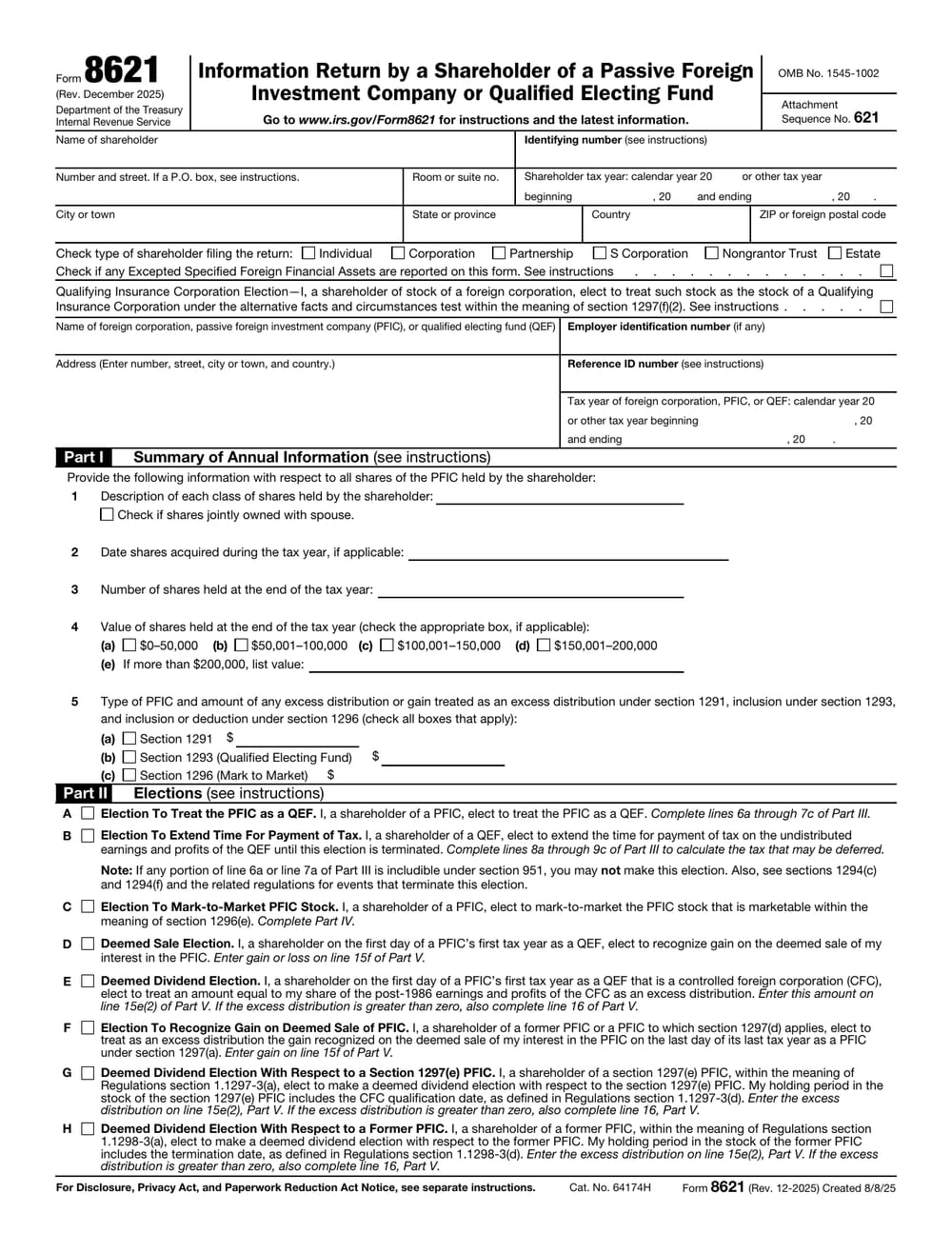
Download Form 8621 (PDF) · Instructions for Form 8621 (PDF)
Local copies for convenience, downloaded from IRS.gov on November 14, 2026. Always confirm you have the current revision at irs.gov/form8621 before filing.
| Part | Title / content | Who completes it |
|---|---|---|
| Header | Shareholder and PFIC identification; type of shareholder; Excepted Specified Foreign Financial Assets box; Qualifying Insurance Corporation election box | Every filer |
| Part I | Summary of Annual Information (the §1298(f) report) | Every filer unless an exception in section 4 applies |
| Part II | Elections A through H | Filers making an election this year |
| Part III | Income From a Qualified Electing Fund (lines 6a–9c) | QEF shareholders |
| Part IV | Gain or (Loss) From Mark-to-Market Election (lines 10a–14c) | MTM shareholders |
| Part V | Distributions From and Dispositions of Stock of a Section 1291 Fund (lines 15a–16f) | §1291 fund shareholders with a distribution or disposition, and certain purging elections |
| Part VI | Status of Prior Year Section 1294 Elections and Termination of Section 1294 Elections (lines 17–26) | QEF shareholders with outstanding §1294 elections |
Older guides and software screens sometimes describe the parts differently. The numbering above is the current form's, and it is the numbering the IRS instructions follow. In particular, the §1291 computation is Part V, not Part IV, and the elections sit in their own Part II, separate from the QEF and MTM computations.
The page-1 header
- Shareholder information: name, identifying number (your SSN or ITIN), address (a foreign address is entered in the city/province/country/postal code fields), and your tax year.
- Type of shareholder: Individual, Corporation, Partnership, S Corporation, Nongrantor Trust or Estate.
- Excepted Specified Foreign Financial Assets box. This box flags that the PFIC reported on this Form 8621 is a specified foreign financial asset you are not reporting separately on Form 8938, under the duplicative-reporting rule. See "How Form 8621 interacts with your other filings" below.
- Qualifying Insurance Corporation election box. This is for a shareholder electing to treat a foreign insurer as a qualifying insurance corporation under the alternative facts-and-circumstances test of §1297(f)(2). That filer completes only the identifying information.
- PFIC information: name and address of the foreign corporation, PFIC or QEF; its EIN if it has one; a reference ID number; and its tax year.
Reference ID numbers. Most foreign funds have no EIN. If you do not enter an EIN, you must enter a reference ID number. It must be alphanumeric, with no special characters or spaces, and no longer than 50 characters. You must use the same number for the same PFIC every year, and you cannot reuse a retired number for a different entity. If the number changes because of a merger, an acquisition or a Form 8832 classification election, the instructions require you to correlate the new number with the old one in the first year the new number is used. Many filers build the reference ID from the fund's ISIN, which is a 12-character alphanumeric code, so it is unique and stable. This is what distinguishes one pooled-fund holding from another in IRS records when you file dozens of nearly identical forms.
Part I: Summary of Annual Information
- Line 1: describe each class of shares you hold, with a checkbox for shares owned jointly with your spouse.
- Line 2: the date shares were acquired during the year, if any.
- Line 3: the number of shares held at the end of the year.
- Line 4: the value of the shares at year-end, by range: (a) $0–50,000; (b) $50,001–100,000; (c) $100,001–150,000; (d) $150,001–200,000; (e) more than $200,000, in which case you state the value. You may rely on periodic account statements provided at least annually unless you know or have reason to know they are not a reasonable estimate.
- Line 5: the type of PFIC and the amounts for the year: (a) the §1291 excess distribution or gain treated as an excess distribution; (b) the §1293 inclusion (QEF); (c) the §1296 inclusion or deduction (MTM).
Part II: Elections
| Election | What it does | Where the numbers go |
|---|---|---|
| A. Election to treat the PFIC as a QEF | QEF treatment under §1295 from this year | Part III |
| B. Election to extend time for payment of tax | §1294 deferral of tax on undistributed QEF earnings; not available if any part of line 6a or 7a is includible under §951 | Part III, lines 8a–9c; Part VI later |
| C. Election to mark-to-market PFIC stock | §1296 MTM treatment for marketable stock | Part IV |
| D. Deemed sale election | Purges §1291 when an unpedigreed QEF begins (§1291(d)(2)(A)) | Gain on line 15f, Part V |
| E. Deemed dividend election | Purges §1291 for a QEF that is a CFC (§1291(d)(2)(B)) | Line 15e(2), and line 16 if positive |
| F. Election to recognize gain on deemed sale of PFIC | Purging for a former PFIC, or for a PFIC that becomes protected by the CFC overlap rule (§1297(d); Regs. §1.1297-3, §1.1298-3) | Gain on line 15f, Part V |
| G. Deemed dividend election with respect to a section 1297(e) PFIC | For a US shareholder of a CFC that is also a PFIC (Reg. §1.1297-3) | Line 15e(2), and line 16 if positive |
| H. Deemed dividend election with respect to a former PFIC | For a former PFIC that was a CFC in its last PFIC year (Reg. §1.1298-3) | Line 15e(2), and line 16 if positive |
Part III: Income from a qualified electing fund
All QEF shareholders complete lines 6a through 7c. Those making Election B also complete lines 8a through 9c.
- Lines 6a–6c: your pro rata share of the fund's ordinary earnings from the PFIC Annual Information Statement (6a), less any portion includible under §951 or excludable under §1293(g) (6b), giving the amount included as ordinary income (6c). Individuals report line 6c as other income on Schedule 1 (Form 1040), line 8z.
- Lines 7a–7c: the same three steps for your pro rata share of the fund's net capital gain. Line 7c is a net long-term capital gain, reported in Part II of Schedule D following the Schedule D instructions. Parts of it may belong on different lines depending on the rate categories the fund reports.
- Lines 8a–9c (Election B only): lines 8a–8e compute the undistributed earnings eligible for §1294 deferral. Lines 9a–9c compare your total tax with and without the line 8e amount, and the difference is the tax you can defer.
Part IV: Gain or (loss) from mark-to-market election
- Lines 10a–10c: fair market value at year-end, adjusted basis, and the difference. A gain is ordinary income on the other income line of your return.
- Lines 11–12: if line 10c is a loss, the deduction is limited to unreversed inclusions, and the allowable ordinary loss is reported on the other income line.
- Lines 13a–13c: for a disposition during the year, the amount realized, adjusted basis, and gain or loss. A gain is ordinary income.
- Lines 14a–14c: for a loss on disposition, unreversed inclusions (14a), the ordinary loss up to that amount (14b), and any excess loss (14c), which is subject to the general loss rules under Reg. §1.1296-1(c)(4)(ii).
Part V: Distributions from and dispositions of stock of a §1291 fund
Complete a separate Part V for each excess distribution and each disposition. Complete lines 15a–15e separately for each block of shares with the same holding period. The December 2025 revision added two items to this part.
- Currency code (new): above line 15a, enter the three-letter currency code of the amounts on lines 15a–15e(1). Excess distributions are generally determined in US dollars at the spot rate on the distribution date. If all the relevant distributions were in one foreign currency, the computation is done in that currency and each ratable portion is translated at the spot rate on the date it is treated as distributed (§1291(b)(3)(E); Prop. Reg. §1.1291-2(d)(4)).
- Line 15a: total distributions on the stock for the year. If your holding period began this year, there is no excess distribution. Skip 15b–15e, and if you did not dispose of the stock, stop.
- Line 15b: total distributions for the three preceding years, reduced by the portions that were excess distributions and not included in income.
- Line 15c: line 15b divided by 3, or by the number of preceding years in the holding period if fewer.
- Line 15d: line 15c multiplied by 125%.
- Line 15e(1): line 15a minus line 15d. If more than zero, this is the excess distribution. The lesser of line 15a and line 15d is the non-excess distribution, taxed under the §301 dividend rules (Form 1040, line 3b, and Schedule B if required). It is not a qualified dividend.
- Line 15e(2) (new): the line 15e(1) amount in US dollars.
- Line 15f: gain or loss on the disposition of the stock. A gain is an excess distribution and requires line 16. A loss is not taken into account under §1291.
- Line 16a: attach a statement for each excess distribution and disposition showing your holding period for each share or block, and the allocation to each day.
- Line 16b: the total allocated to the current year and to pre-PFIC years. This is ordinary income on the other income line.
- Line 16c: the aggregate increases in tax for the prior PFIC years in the holding period. For each year, multiply the amount allocated to it by the highest §1 (or §11) rate for that year.
- Line 16d: the foreign tax credit against those increases. You must elect to claim the credit for the current year. The taxes are apportioned between excess and non-excess portions, and the credit cannot reduce any year's increase below zero.
- Line 16e: line 16c minus line 16d, the "additional tax". Individuals include it on Form 1040, line 16, check box 3 and enter "1291TAX".
- Line 16f: the interest on each net increase in tax under §1291(c)(3), using the §6621 underpayment rates. Individuals include it on Schedule 2 (Form 1040), line 17p.
Part VI: Status of prior-year §1294 elections
For each outstanding §1294 election (other than the current year's), lines 17–20 report the tax year of the election, the undistributed earnings it relates to, the deferred tax, and the interest accrued to the filing date. Lines 21–24 report an event that terminated an election this year, the earnings distributed or deemed distributed, and the deferred tax and accrued interest now due. Individuals report the deferred tax on Schedule 2 (Form 1040), line 17z ("1294DT"), and the interest on Schedule 2, line 17q. Lines 25–26 carry forward balances after a partial termination.
The multiple-PFIC mechanics
- One form per PFIC, per year. If you hold ten foreign funds and none of the exceptions applies, you file ten Forms 8621 with your return (Reg. §1.1298-1(e)(1)). Joint filers may file one form per PFIC covering both spouses' interests (§1.1298-1(e)(2)).
- Multiple blocks in one PFIC. Monthly savings plans and dividend reinvestment create many blocks with different holding periods. Part V's lines 15a–15e are completed per block with the same holding period, and the line 16a statement allocates each block's excess distribution over its own holding period. A sale of a long-held regular-investment fund can therefore require dozens of separate allocation schedules on one Form 8621.
- Chains of PFICs. Where you are an indirect shareholder through a chain, you report each PFIC in the chain on its own form, subject to the indirect-holding exceptions in section 4.
- Keep the reference ID stable. The IRS matches multi-year §1291 computations, QEF basis, MTM unreversed inclusions and §1294 balances by PFIC. Changing identifiers from year to year makes your filings harder to reconcile, both for the IRS and for you.
Filing deadline for Americans abroad
Form 8621 has no deadline of its own. It is attached to the income tax return for the year to which it relates and is due when that return is due, including extensions (Reg. §1.1298-1(d)). It is filed at the service center where that return is filed. For a calendar-year individual living abroad, the dates work as follows (Publication 54):
| Situation | Return and Form 8621 due | How | Interest on unpaid tax runs from |
|---|---|---|---|
| Regular due date | April 15 | No action | April 15 |
| Automatic 2-month extension: on the regular due date you live outside the US and Puerto Rico and your main place of business or post of duty is also outside them (or you are in military service on duty outside them) | June 15 | Attach a statement to the return explaining which situation qualifies you | April 15 |
| Form 4868 extension | October 15 | File Form 4868 by June 15 (if relying on the 2-month extension) or by April 15, checking the out-of-the-country box where applicable | April 15 |
| Additional discretionary 2-month extension for taxpayers out of the country | December 15 | Send the IRS a letter explaining why you need the extra time, by October 15. The IRS writes only if it denies the request. Not available if you have an approved Form 2350 extension | April 15 |
| Form 2350 (waiting to meet the bona fide residence or physical presence test) | Generally 30 days after the date you expect to qualify | File Form 2350 by the return's due date | April 15 |
Three points are specific to Form 8621:
- Extensions move the filing date, not the §1291 interest computation. The §1291 interest on line 16f is computed to the due date of the return for the year of the excess distribution, determined without regard to extensions (§1291(c)(3)). That is April 15 for a calendar-year individual. Ordinary underpayment interest under §6601 then runs on any of that tax you have not paid by April 15.
- Elections are tied to the extended due date of a timely return. A QEF election (Election A) or MTM election (Election C) made on a Form 8621 attached to a late-filed return is not timely. For a QEF, the cost of missing the window is permanent, because the fund stays unpedigreed unless you pay for a purging election. For MTM, a later election triggers the first-year §1291 computation (see section 3). If you are considering either election for a new holding, file on time, even if that means using the June 15 or October 15 date.
- No return required? File Form 8621 anyway. If you must file Form 8621 but are not required to file an income tax return, for example because your income is below the filing threshold, the regulations require you to file Form 8621 separately (§1.1298-1(d)). The instructions direct it to the Department of the Treasury, Internal Revenue Service Center, Ogden, UT 84201-0201.
Penalties and the open statute of limitations
There is no flat Form 8621 penalty
This is where Form 8621 differs most from the other forms covered on this site. Forms 5471 and 8865 carry a basic penalty of $10,000 per form per year, with continuation penalties after an IRS notice (and, for unreported contributions on Form 8865, a penalty based on the value of the property). Form 8938 carries the §6038D penalty of $10,000 plus up to $50,000 more. §1298(f) contains no penalty provision, and the Code imposes no per-form civil penalty for failing to file Form 8621. The December 2025 instructions contain no penalty section. The only penalty language is the generic Privacy Act and Paperwork Reduction Act notice, which says that failing to file when required, or providing fraudulent information, may result in penalties and criminal prosecution. That notice cites §§6001, 6011, 6012(a) and 6109 as the authority for collecting the information.
That does not make a missing Form 8621 harmless. The consequences come from four other places.
1. The statute of limitations stays open: §6501(c)(8)
Normally the IRS has three years after you file a return to assess additional tax (§6501(a)). §6501(c)(8)(A) overrides this for information that must be reported "pursuant to an election under section 1295(b) or under section 1298(f), 6038, 6038A, 6038B, 6038D, 6046, 6046A, or 6048". Form 8621 is covered twice by that list: as the §1298(f) annual report, and as the vehicle for the information a QEF shareholder must report under §1295(b). If that information is not furnished, the time to assess any tax imposed by the Code with respect to any tax return, event or period to which the information relates does not expire until three years after the IRS is furnished the information. The regulations under §1298(f) confirm that a failure to report the required information extends the assessment period under §6501(c)(8) (Reg. §1.1298-1(d)).
§6501(c)(8)(B) then limits the extension where the failure was due to reasonable cause and not willful neglect. In that case the extended period applies only to the item or items related to the failure.
Readers of our Form 5471, 8865 and 8938 guides sometimes ask whether the PFIC mechanics are harsher, for example whether a missing Form 8621 keeps the whole return open even when there was reasonable cause. Under the statute as it stands on the research date, they are not harsher. The mechanics are the same.
- Without reasonable cause, a missing or incomplete Form 8621 keeps the assessment period open for the whole return for that year, every item on it and not just the PFIC items, until three years after the information is furnished.
- With reasonable cause, only the related items stay open, and everything else on the return closes on the normal schedule.
- The split is the same one that applies to Forms 5471, 8865, 8938 and 3520 under §6501(c)(8), because §1298(f) and §1295(b) sit in the same statutory list. There is no PFIC-specific rule that keeps the whole return open regardless of reasonable cause.
Two practical observations follow. First, because Form 8621 is so often missed for years at a time, the open period can stretch back to the first year a required form was missing, as far back as the 2013 tax year for the annual report requirement. Second, the reasonable-cause question is decided on the facts. Filing complete, correct Forms 8621 as soon as you discover the problem is what starts the three-year clock running again.
Separately, the six-year assessment period of §6501(e)(1)(A) applies if you omit more than 25% of the gross income stated on the return, or if you omit more than $5,000 of gross income attributable to assets for which information reporting is required under §6038D (or would be, ignoring the dollar threshold and the duplicative-reporting exceptions). A foreign fund held outside a financial account is such an asset.
2. The tax and interest themselves
An unreported excess distribution or disposition gain means unpaid §1291 deferred tax and unpaid §1291 interest. An unreported QEF or MTM inclusion means unpaid income tax. Underpayment interest under §6601 then runs on the unpaid amounts from the original due date. For a long-held fund sold years ago, this is often the largest number in a remediation.
3. The accuracy-related penalty: §6662
If PFIC income is left off your return, the resulting underpayment is exposed to the 20% accuracy-related penalty under §6662 for negligence or disregard of rules, or for a substantial understatement of income tax. This is an income tax problem, not an information-return problem. The rate rises to 40% for the portion of an underpayment attributable to an undisclosed foreign financial asset understatement. That means an understatement attributable to a transaction involving an asset for which information was required under §6038, §6038B, §6038D, §6046A or §6048 but was not provided (§6662(j)). §1298(f) is not in that list. But a PFIC is usually also a specified foreign financial asset, and if you also failed to report it, or the account that holds it, on a required Form 8938, the 40% rate can apply to the PFIC-related understatement. Where there is fraud, §6663 replaces §6662 with a 75% civil fraud penalty.
4. Lost elections
QEF and MTM elections must be made on a timely filed return, as explained in sections 3 and 6. A taxpayer who never filed Form 8621 has, by definition, made neither election, and is in §1291 for every year the fund was held. Late QEF relief under Reg. §1.1295-3 is narrow. Making a late MTM election triggers the first-year §1291 computation under §1296(j). The cost of non-filing is therefore partly which tax regime you are left with.
Related penalties that often travel with a missing Form 8621
- Form 8938: $10,000 per year, plus up to $50,000 more after an IRS notice (§6038D(d)), if the account or fund should have been on Form 8938 and was not.
- FBAR: civil penalties under 31 U.S.C. §5321, adjusted annually for inflation, if the foreign account holding the funds was not reported. See our FBAR guide.
- Failure-to-file and failure-to-pay additions under §6651 if the return itself was late or the tax was unpaid.
Worked example 1: the §1291 excess-distribution trap
This example uses hypothetical facts and real rules. The tax rates, interest rates and computation method are the ones in force for the years shown, as cited. The investor and the fund are invented.
Facts
- Dana is a US citizen who has lived abroad since 2017. She files as single.
- On January 2, 2019, through a local broker, she invests $100,000 in the US-dollar accumulating share class of an Irish-domiciled UCITS global equity index fund. The fund is a PFIC (section 1). It never pays a distribution, so all of its return is reinvested.
- The fund issues no PFIC Annual Information Statement, so a QEF election is impossible. Dana does not make a mark-to-market election. She files a Part I-only Form 8621 for the fund each year from 2019 to 2024, which is correct because her holding is over $25,000 and no other exception applies. The fund is therefore a §1291 fund for her for the entire holding period.
- On December 31, 2025, she sells the whole holding for $250,000. Her gain is $150,000.
- Her other 2025 taxable income is $120,000. That places her in the 24% bracket for a single filer, which runs from $103,350 to $197,300 in 2025, and in the 15% long-term capital gain bracket, which applies up to $533,400 of taxable income (Rev. Proc. 2024-40, §2.01 and §2.03).
- Simplifying assumptions: no foreign tax is payable on the gain (so line 16d is zero); the 3.8% net investment income tax is set aside in both examples (PFIC income has its own NIIT rules in Reg. §1.1411-10); amounts are shown to the cent so you can follow the arithmetic, although the form can be completed in whole dollars.
Step 1: Identify the excess distribution (Part V, lines 15a–15f)
The fund made no distributions, so line 15a is zero and there is no excess distribution from distributions. The currency code above line 15a is "USD". The sale produces a gain on line 15f of $250,000 − $100,000 = $150,000. Under §1291(a)(2), the whole gain is treated as an excess distribution, with no 125% cushion.
Step 2: Allocate the gain over the holding period (line 16a statement)
Under §1223, Dana's holding period begins the day after purchase, January 3, 2019, and ends on the day of sale, December 31, 2025. That is 2,555 days: 363 days in 2019, 366 in 2020, 365 in each of 2021, 2022 and 2023, 366 in 2024, and 365 in 2025. The gain per day is $150,000 ÷ 2,555 = $58.7084.
| Tax year | Days in holding period | Gain allocated | Treatment |
|---|---|---|---|
| 2019 | 363 | $21,311.15 | Prior PFIC year: deferred tax at 37% plus interest |
| 2020 | 366 | $21,487.28 | Prior PFIC year: deferred tax at 37% plus interest |
| 2021 | 365 | $21,428.57 | Prior PFIC year: deferred tax at 37% plus interest |
| 2022 | 365 | $21,428.57 | Prior PFIC year: deferred tax at 37% plus interest |
| 2023 | 365 | $21,428.57 | Prior PFIC year: deferred tax at 37% plus interest |
| 2024 | 366 | $21,487.28 | Prior PFIC year: deferred tax at 37% plus interest |
| 2025 | 365 | $21,428.57 | Current year: ordinary income (line 16b) |
| Total | 2,555 | $150,000.00 |
Step 3: Tax the pieces (lines 16b–16e)
Current year (line 16b). The $21,428.57 allocated to 2025 is ordinary income on the other income line of Dana's 2025 return. Added to her $120,000 of other taxable income, it stays within the 24% bracket, so it adds 24% × $21,428.57 = $5,142.86 to her regular tax.
Prior years (line 16c). The amounts allocated to 2019 through 2024 are not included in her income at all. Each is multiplied by the highest individual rate in effect for that year, which is 37% for every year from 2018 through 2025 according to the instructions. That rate applies even though Dana was actually a 24% taxpayer in each of those years.
| Year | Gain allocated | Highest §1 rate for the year | Increase in tax |
|---|---|---|---|
| 2019 | $21,311.15 | 37% | $7,885.13 |
| 2020 | $21,487.28 | 37% | $7,950.29 |
| 2021 | $21,428.57 | 37% | $7,928.57 |
| 2022 | $21,428.57 | 37% | $7,928.57 |
| 2023 | $21,428.57 | 37% | $7,928.57 |
| 2024 | $21,487.28 | 37% | $7,950.29 |
| Total (line 16c) | $128,571.43 | $47,571.43 |
With no foreign tax, line 16d is zero and line 16e is $47,571.43. Dana includes this on Form 1040, line 16, checks box 3 and enters "1291TAX".
Step 4: The interest charge (line 16f)
Each year's increase in tax bears interest from the due date of that year's return (April 15 of the following year, without extensions) to the due date of the 2025 return, April 15, 2026, also without extensions (§1291(c)(3)). The interest is computed at the §6621 noncorporate underpayment rate for each calendar quarter, compounded daily under §6622. Each day's interest uses that quarter's annual rate divided by the number of days in the calendar year (366 in 2020 and 2024). The rates that apply over these periods, from the IRS quarterly interest rate table, are:
| Year | Q1 (Jan–Mar) | Q2 (Apr–Jun) | Q3 (Jul–Sep) | Q4 (Oct–Dec) |
|---|---|---|---|---|
| 2020 | 5% | 5% | 3% | 3% |
| 2021 | 3% | 3% | 3% | 3% |
| 2022 | 3% | 4% | 5% | 6% |
| 2023 | 7% | 7% | 7% | 8% |
| 2024 | 8% | 8% | 8% | 8% |
| 2025 | 7% | 7% | 7% | 7% |
| 2026 | 7% | 6% (Rev. Rul. 2026-5) | — | — |
| Year of allocation | Increase in tax | Interest period | Interest, compounded daily |
|---|---|---|---|
| 2019 | $7,885.13 | Apr 15, 2020 – Apr 15, 2026 | $3,223.87 |
| 2020 | $7,950.29 | Apr 15, 2021 – Apr 15, 2026 | $2,875.08 |
| 2021 | $7,928.57 | Apr 15, 2022 – Apr 15, 2026 | $2,543.87 |
| 2022 | $7,928.57 | Apr 15, 2023 – Apr 15, 2026 | $1,971.68 |
| 2023 | $7,928.57 | Apr 15, 2024 – Apr 15, 2026 | $1,251.31 |
| 2024 | $7,950.29 | Apr 15, 2025 – Apr 15, 2026 | $572.90 |
| Total (line 16f) | $47,571.43 | $12,438.71 |
Take the 2019 line as a check on the method. $7,885.13 accrues interest at 5% for the rest of the second quarter of 2020, at 3% from July 2020 through March 2022, rising through 4%, 5% and 6% during 2022, at 7% for most of 2023, at 8% from October 2023 through December 2024, at 7% through March 2026, and at 6% for April 1–15, 2026. Compounded daily over those six years, that comes to $3,223.87, about 41% of the underlying tax. The total interest of $12,438.71 goes on Schedule 2 (Form 1040), line 17p. It is nondeductible personal interest.
Dates used here are the statutory April 15 due dates under §6072(a). Special postponements, such as the 2020 COVID-19 postponement, and weekend or holiday roll-overs are not modelled. They would move the figures by a few dollars at most and should be considered in a real computation.
The result
| Component | Form 8621 line / Form 1040 destination | Amount |
|---|---|---|
| Tax on the current-year portion ($21,428.57 at 24%) | Line 16b → other income; regular tax | $5,142.86 |
| Deferred tax on prior-year portions (37%) | Line 16e → Form 1040, line 16, box 3 "1291TAX" | $47,571.43 |
| Interest on deferred tax | Line 16f → Schedule 2, line 17p | $12,438.71 |
| Total US tax and interest on the gain | $65,153.00 | |
| Effective rate on the $150,000 gain | 43.4% | |
| For comparison: the same gain as long-term capital gain at Dana's 15% rate | $22,500.00 | |
| For comparison: at the 20% maximum long-term capital gain rate | $30,000.00 | |
| Extra cost of §1291 versus 15% long-term capital gain | $42,653.00 |
The extra $42,653 breaks down into three distinct penalties built into §1291:
- Loss of capital gain character: $13,500. The whole $150,000 is taxed as if it were ordinary income, at 24% instead of 15%: 9 percentage points × $150,000.
- The top-rate rule: $16,714.29. The $128,571.43 allocated to prior years is taxed at 37% rather than Dana's actual 24%: 13 percentage points × $128,571.43.
- The interest charge: $12,438.71.
$22,500 + $13,500 + $16,714.29 + $12,438.71 = $65,153.00. The interest grows with the holding period and with interest rates. The top-rate penalty grows with the gap between your actual bracket and 37%. Investors in lower brackets therefore suffer proportionally more. A taxpayer in the 0% long-term capital gain bracket gets no benefit from that bracket at all under §1291.
Dana's 2025 Form 8621, in summary
- Header: Individual; the fund's name and address; no EIN, so a reference ID (for example, the share class ISIN); fund tax year.
- Part I: line 1, the accumulating USD share class; line 3, zero shares at year-end; line 4, box (a); line 5(a), $150,000.
- Part V: currency code USD; line 15a, 0, so lines 15b–15e show no excess distribution; line 15f, $150,000; line 16a, the allocation statement above; line 16b, $21,428.57; line 16c, $47,571.43; line 16d, 0; line 16e, $47,571.43; line 16f, $12,438.71, with the interest computation attached.
Worked example 2: the same fund with a timely QEF election
Facts
Everything is the same as in Example 1, with one change. For this example, assume the fund does provide a PFIC Annual Information Statement every year, and Dana makes a QEF election (Election A) on a timely Form 8621 with her 2019 return, the first year of her holding period. The fund is therefore a pedigreed QEF, and §1291 never applies (§1291(d)(1)). As before, she is in the 24% bracket and the 15% long-term capital gain bracket in every year from 2019 to 2025. The 24% bracket existed in every one of those years under the post-2017 rate schedule.
We assume the market value of Dana's holding fell during 2022 and stood at $145,000 at the end of that year; the other year-end values do not affect the computation. The fund's statements report Dana's pro rata shares of its ordinary earnings and net capital gain as follows. These figures are hypothetical, but they are realistic for an equity index fund whose return is mostly unrealized appreciation.
| Year | Ordinary earnings (Part III, line 6c) | Net capital gain (line 7c) | US tax: 24% on ordinary, 15% on capital gain | Adjusted basis at year-end (§1293(d)) |
|---|---|---|---|---|
| 2019 | $1,900 | $1,200 | $636 | $103,100 |
| 2020 | $2,100 | $2,500 | $879 | $107,700 |
| 2021 | $2,300 | $3,000 | $1,002 | $113,000 |
| 2022 | $2,500 | $0 | $600 | $115,500 |
| 2023 | $2,600 | $1,000 | $774 | $119,100 |
| 2024 | $2,900 | $2,800 | $1,116 | $124,800 |
| 2025 | $3,300 | $3,500 | $1,317 | $131,600 |
| Total | $17,600 | $14,000 | $6,324 |
In 2022 the fund realized no net capital gain. The fall in value that year produces no deduction for Dana, because QEF losses do not pass through. Her ordinary earnings inclusion is still taxable.
The sale
Dana sells on December 31, 2025, for $250,000. Her adjusted basis is the $100,000 cost plus $31,600 of cumulative inclusions = $131,600. Her gain is $118,400. Because the fund was a pedigreed QEF, this is long-term capital gain, reported on Form 8949 and Schedule D, and taxed at 15%: $17,760. There is no Part V, no allocation and no interest.
| Regime | Total US tax and interest on the $150,000 economic gain | Effective rate |
|---|---|---|
| §1291 default (Example 1) | $65,153.00 | 43.4% |
| Pedigreed QEF (Example 2): $6,324 over 2019–2025 + $17,760 on sale | $24,084.00 | 16.1% |
| Hypothetical: entire gain taxed once as long-term capital gain at 15% | $22,500.00 | 15.0% |
The QEF election saves Dana $41,069 compared with the default regime. It costs $1,584 more than a pure capital gain outcome. That $1,584 is the 9-point difference between her 24% ordinary rate and her 15% capital gain rate on the $17,600 of ordinary earnings ($17,600 × 9% = $1,584). The trade-off is timing. Dana pays $6,324 of tax over the holding period with no cash distributions to fund it, instead of paying all the tax on sale. That is a modest cost of capital, and it is far smaller than the §1291 interest charge, which runs at the underpayment rate on tax computed at the top rate on every prior-year portion of the gain.
Under QEF treatment, Dana's annual Forms 8621 complete Part I and Part III each year, plus Part II (Election A) in 2019. Line 6c goes on Schedule 1, line 8z, and line 7c on Schedule D. Dana must keep every annual information statement. They are the evidence for her basis, and the IRS can invalidate a QEF election if the records cannot be produced on request.
What a late QEF election would have cost instead
Suppose Dana discovered the PFIC rules only in 2023 and the fund began providing annual statements that year. A QEF election for 2023 alone would make the fund an unpedigreed QEF. Both §1293 and §1291 would then apply, and her eventual sale gain would still be partly subject to §1291. To clear the earlier years, she would make the deemed sale election (Election D) with the 2023 election. She would be treated as selling the holding on January 1, 2023, the qualification date, at its value then, which we have assumed was $145,000. The $45,000 deemed gain is taxed under §1291 over a holding period running from January 3, 2019, to January 1, 2023. On the rates above, that comes to roughly $16,600 of deferred tax plus about $2,500 of interest, payable with the 2023 return, before any QEF tax for 2023 onward. After that, her basis would be $145,000, her holding period would restart, and the fund would be a pedigreed QEF from 2023. The deemed dividend alternative (Election E) is not available to her, because the fund is not a CFC.
How Form 8621 interacts with your other filings
Form 8938 (FATCA)
- Funds held in a foreign financial account. If your PFICs sit in a foreign brokerage or custodial account, Form 8938 reports the account, and you do not separately report the assets held in it (Form 8938 instructions; IRS Form 8938 Q&A). Form 8621 does not report the account, so filing Forms 8621 for the funds does not take the account off Form 8938.
- Funds held outside a financial account. Fund units registered directly with a foreign fund manager or transfer agent are "other specified foreign financial assets". If such a PFIC is reported on a timely filed Form 8621, you do not have to report it again on Form 8938 (Reg. §1.6038D-7(a)(1)). You must still state in Part IV of Form 8938 the number of Forms 8621 filed that report excepted assets (Reg. §1.6038D-4(a)(10)). You must also include the PFIC's value in determining whether you meet the Form 8938 threshold (Reg. §1.6038D-2). The Excepted Specified Foreign Financial Assets box on page 1 of Form 8621 is the matching flag.
- The exception depends on the Form 8621 being timely. A Form 8621 you never filed cannot excuse Form 8938 reporting. That is how an unfiled Form 8621 can also become a Form 8938 failure, with the §6038D penalty and the 40% accuracy-related rate in §6662(j).
For thresholds and mechanics, see our Form 8938 guide.
FBAR (FinCEN Form 114)
The FBAR reports foreign financial accounts, not individual securities. A foreign brokerage or custodial account holding PFICs is a reportable securities account, and the funds inside it are not listed separately. But fund units held directly with a foreign fund are reportable too, because the regulation treats an account with a mutual fund or similar pooled fund that issues shares to the general public, with regular net asset value determination and regular redemptions, as an "other financial account" (31 CFR §1010.350(c)(2) and (c)(3)(iv)(A); the IRS comparison chart likewise lists foreign mutual funds as reportable). Either way, the FBAR is required if your foreign accounts together exceed $10,000 at any time during the calendar year. The FBAR is filed electronically with FinCEN, separately from your tax return. None of Form 8621, Form 8938 or the FBAR substitutes for the others. See our FBAR guide.
Form 1116 (foreign tax credit)
- Category. QEF inclusions are passive income for foreign tax credit purposes (§904(d)(2)(B)(ii); Reg. §1.904-4(b)(2)(i)(B)). Other PFIC income, including dividends, §1291 amounts and gains, is generally passive category income too, because it is of a kind that is foreign personal holding company income. It is subject to the high-taxed income exception, which moves passive income taxed abroad at more than the top US rate into the general category (§904(d)(2)(F)). The look-through exception in §904(d)(3)(H) applies only where the PFIC is also a CFC and you are a US shareholder.
- Withholding on distributions. Foreign tax withheld on a distribution is split between the non-excess portion, which is credited on Form 1116 in the normal way, and the excess portion. For the excess portion, the taxes allocated to the current year and pre-PFIC years go on Form 1116, and the taxes allocated to earlier PFIC years reduce those years' increases in tax on Form 8621 line 16d, but not below zero and with no carryover (§1291(g)). Credit you lose because a year's increase is too small to absorb it is lost permanently.
- No indirect credit for individuals. Taxes the fund itself paid, for example withholding on dividends it received, are not creditable by an individual QEF shareholder. §1293(f) gives the deemed-paid credit only to qualifying domestic corporations.
- Source. MTM inclusions and deductions are sourced as if they were gain or loss on a sale of the stock (§1296(c)(2)). The stock-sale sourcing rules therefore decide how much of the inclusion is foreign source, which in turn limits the credit available against it.
- Timing mismatches. Your country of residence may tax an accumulating fund annually on deemed income, on distribution, or only on sale, while the US taxes it on a different schedule under the regime you are in. The foreign tax and the US income may fall in different years and different categories, which can strand credits. Plan the regime choice with the foreign tax schedule in mind.
See our Form 1116 guide for the separate-category and carryover mechanics.
Form 2555 (foreign earned income exclusion)
The exclusion applies only to foreign earned income, meaning pay for personal services (§911(b), (d)(2)). PFIC income is investment income and cannot be excluded. Under §911(f), excluded earned income still counts in setting the tax rate on your other income, so claiming the exclusion can push the ordinary PFIC income on line 16b into a higher bracket. It does not affect the line 16c rate, which is always the top rate. See our Form 2555 guide.
Form 5471, Form 8865 and Form 3520
- A PFIC held through a foreign partnership is reported by you as an indirect shareholder on Form 8621, in addition to any Form 8865 obligation for the partnership.
- A foreign company you control is generally a CFC. If you are a §951(b) US shareholder, §1297(d) keeps the PFIC rules from applying during the qualified portion of your holding period. Form 5471 is the primary form, and Elections F and G on Form 8621 deal with earlier PFIC years.
- PFICs held by a foreign trust can create Form 3520 and Form 3520-A obligations as well as Form 8621 obligations for the owner or beneficiaries, depending on the trust's classification.
Our existing PFIC content
This guide is about the form. For the policy background, the history of the 1986 rules, and the broader planning question of how to avoid accumulating PFICs in the first place, see our thematic PFIC explainer and the PFIC trap article on our blog.
Options if you have missed Forms 8621
The IRS lists three routes for US taxpayers with undisclosed foreign financial assets: the IRS Criminal Investigation Voluntary Disclosure Practice, the Streamlined Filing Compliance Procedures, and the delinquent international information return submission procedures (IRS: options available). Which one fits depends on whether you also have unreported income, whether the IRS has already contacted you, and whether your conduct was non-willful.
| Route | When it fits | What you file | Penalty treatment |
|---|---|---|---|
| Delinquent international information return submission procedures | You are not under civil examination or criminal investigation, the IRS has not contacted you about the missing returns, and the only problem is missing information returns. For Form 8621 this means years in which you held PFICs but had no excess distribution, no disposition gain and no unreported QEF or MTM income: Part I-only years | The delinquent Forms 8621, attached to an amended return (Form 1040-X) and filed under the amended-return instructions, with a reasonable cause statement if you are asserting one | The IRS says penalties may be assessed under existing procedures and that reasonable cause statements may not be considered before assessment. Because there is no Form 8621 penalty, the main effect is to furnish the information and start the three-year §6501(c)(8) clock. Any related Form 8938 penalty exposure remains |
| Streamlined Foreign Offshore Procedures | You also failed to report income from foreign financial assets (for example, PFIC gains or excess distributions), your conduct was non-willful, you are not under examination, and you meet the non-residency requirement. For a US citizen or green card holder, that means that in at least one of the three most recent years whose return due date has passed, you had no US abode and were physically outside the US for at least 330 full days | Delinquent or amended returns for the three most recent years whose due date has passed, with all required information returns (including every Form 8621), marked "Streamlined Foreign Offshore"; full payment of tax and interest; Form 14653 certification with a narrative statement of facts; delinquent FBARs for the six most recent years, filed electronically | Eligible taxpayers who comply are not subject to failure-to-file, failure-to-pay or accuracy-related penalties, information return penalties or FBAR penalties |
| Reasonable cause, outside any program | You can show ordinary business care and prudence, for example reliance on a competent adviser who was given all the facts | Correct returns and forms, with a detailed statement | Matters mainly for §6662 relief and for limiting §6501(c)(8) to the related items under §6501(c)(8)(B) |
| IRS Criminal Investigation Voluntary Disclosure Practice | Willful non-compliance only | Form 14457 preclearance and application | Out of scope for this guide. Get specialist legal advice before taking any step |
The PFIC-specific wrinkle: rebuilding the computations
Choosing a procedure is only half the work. With PFICs, the larger job is often reconstructing the numbers.
- Every sale and every excess distribution in the covered years needs a full §1291 computation, going back to the original purchase date of every block of shares, not just to the start of the three-year Streamlined period. A fund bought in 2010 and sold in 2024 has its gain allocated over 2010–2024, with top-rate increases and interest for every one of those years.
- You need historical data: purchase dates and prices for each block, reinvestments, distributions in the three years before each distribution year, corporate actions, share class conversions and fund mergers. Foreign brokers often keep online records for only a few years. Request statements early.
- Elections cannot be made retroactively just because you are fixing old years. A QEF election attached to a Streamlined return for a year long past is not timely. Relief under Reg. §1.1295-3 is narrow, and the MTM first-year rule in §1296(j) applies to a late MTM election.
- No PFIC shortcut in Streamlined. The IRS's 2014 Offshore Voluntary Disclosure Program offered an optional, non-statutory method for computing PFIC gain and loss in its FAQ 10, because taxpayers often lacked basis and holding-period records (IRM 4.63.3.8). That method belonged to the OVDP, which no longer accepts new submissions. The current Streamlined Foreign Offshore Procedures pages and FAQs contain no equivalent simplified PFIC method. Plan for statutory computations.
- Forward-looking choices. As you come into compliance, decide what to do with the remaining PFICs. You can keep them under §1291, make an MTM election for marketable holdings (accepting the first-year §1291 computation), sell, or reinvest through US-domiciled funds. Each choice interacts with your country of residence's taxes, and US-domiciled funds can bring their own foreign tax costs.
If you are weighing whether this needs a specialist international tax firm or just a focused answer on your specific fund, see our guide on when PFIC reporting actually needs a law firm.
Common mistakes
- Not realizing an ordinary fund is a PFIC. A bank's balanced fund, a UCITS index ETF, a money market fund or a "global equity" savings plan is a PFIC if it is domiciled outside the US, whatever it invests in. A London-listed S&P 500 tracker is a foreign fund. The question is where the fund is domiciled, not what it owns.
- Treating a brokerage account as one PFIC. The account is reported once on the FBAR and Form 8938. Form 8621 is filed for each fund in it (Reg. §1.1298-1(e)(1)). Twelve funds means twelve forms, each with its own reference ID and, when sold, its own Part V and allocation statement.
- Confusing the $25,000/$50,000 exception with a tax exemption. The de minimis rule only excuses the annual Part I report, and only in a year with no excess distribution and no gain. A sale of a $15,000 fund at a gain is fully taxable under §1291 and must be reported on Form 8621.
- Applying the Form 8938 "living abroad" thresholds to Form 8621. Form 8621 has no presence-abroad threshold. The $25,000 ($50,000 joint) aggregate test applies to everyone, and it counts all PFIC stock you own on the last day of the year, not fund by fund.
- Believing the FEIE or a tax treaty shelters PFIC gains. The foreign earned income exclusion covers only earned income. Most treaties' saving clauses preserve the US right to tax its citizens, and treaties do not switch off §1291. Foreign tax paid on a PFIC gain can help through the foreign tax credit, within the line 16d limits, but no treaty turns an excess distribution into capital gain.
- Missing the QEF window. A QEF election must be made on a timely return for the first year it applies. If it is not made in the first PFIC year of your holding period, the fund is unpedigreed, and §1291 continues to apply unless you pay for a deemed sale (Election D). "I'll elect next year" is a decision to accept §1291 on everything that accrues in the meantime.
- Assuming an MTM election starts clean. In the first MTM year for a fund you already held, §1296(j) runs that year's mark-to-market gain through §1291, with the top rate and interest. Only after that does annual ordinary-income MTM treatment apply.
- Reporting a PFIC sale as a capital gain on Schedule D. Under §1291, the gain is never capital gain. The current-year portion is ordinary income on the other income line, the earlier-year portions generate "1291TAX" on Form 1040 line 16, and the interest goes on Schedule 2 line 17p. Reporting the sale on Form 8949 at 15% understates tax, and the understatement is exposed to the §6662 penalty.
- Forgetting that a pledge is a disposition. Using foreign fund units as collateral for a mortgage or margin loan can trigger §1291 on the pledged shares, according to the instructions' definition of disposition.
- Assuming a treaty-protected pension shields everything inside it. The Reg. §1.1298-1(c)(4) exception applies only where the treaty taxes the pension's income to you only when it is paid out. A plan that does not meet that test can leave each fund inside it as a separate PFIC. Conversely, where a plan does qualify, as eligible Canadian RRSPs and RRIFs generally do under the treaty and Rev. Proc. 2014-55, filing Forms 8621 for each fund inside it is generally unnecessary.
- Losing the records that make the computation possible. §1291 needs purchase dates and prices for every block, and distribution history for the three prior years. QEF needs every annual information statement. MTM needs a running record of unreversed inclusions. Without these records, years of filings become reconstructions.
- Not using the same reference ID every year. The instructions require consistency and prohibit reusing retired numbers. Inconsistent identifiers make it hard for the IRS, and for your future preparer, to match basis, unreversed inclusions and §1294 balances to the right fund.
Frequently asked questions
Do I need to file Form 8621 if my foreign funds are worth less than $25,000?
Possibly not, but only in a quiet year. If the total value of all your PFIC stock on the last day of the tax year is $25,000 or less ($50,000 or less for both spouses on a joint return), you received no excess distribution, you recognized no gain on a disposition, and you have not made a QEF election, the annual §1298(f) report is excused (Reg. §1.1298-1(c)(2)). If you sold any of the funds at a gain or received an excess distribution, you must file Form 8621 for that fund and pay the §1291 tax, however small the holding. The thresholds are the same for Americans living abroad as for those living in the US.
Is there a penalty for not filing Form 8621?
There is no per-form dollar penalty like the $10,000 penalties for Forms 5471, 8865 and 8938. The consequences come from elsewhere. Under §6501(c)(8), the time for the IRS to assess tax for the year stays open until three years after the information is furnished. That applies to the whole return, unless the failure was due to reasonable cause, in which case only the related items stay open. Any PFIC tax and interest that went unreported is still owed, with underpayment interest. The 20% accuracy-related penalty under §6662 can apply to the unreported income, rising to 40% where an asset that should have been on Form 8938 was not disclosed. And without a timely form, you will have made no QEF or mark-to-market election.
How is the interest on a PFIC excess distribution calculated?
For each earlier year in your holding period, the gain or excess distribution allocated to that year is multiplied by the highest individual tax rate for that year (37% for 2018 through 2025). Interest then runs on each of those amounts from the original due date of that year's return to the original due date of the return for the year of the sale or distribution, both determined without extensions. The rate is the IRS underpayment rate under §6621, which is the federal short-term rate plus 3 percentage points, set quarterly and compounded daily (§1291(c)(3)). It is not the applicable federal rate. For individuals the interest is reported on Schedule 2 (Form 1040), line 17p, and is not deductible.
Can I make a QEF election for a foreign fund I already own?
You can make it for the current year if the fund provides a PFIC Annual Information Statement, but a QEF election made after the first year of your holding period in which the fund was a PFIC leaves the fund "unpedigreed". You stay exposed to §1291 for the earlier years unless you also make a purging election. For an ordinary fund that means the deemed sale election (Election D), which treats you as selling at fair market value on the first day of the QEF year and taxes that gain under §1291 with interest. A truly retroactive QEF election is available only under the narrow protective-statement and consent rules of Reg. §1.1295-3.
Do I need a separate Form 8621 for each fund in my brokerage account?
Yes. The regulations require a separate Form 8621 for each PFIC (Reg. §1.1298-1(e)(1)). Spouses filing jointly may file one form per PFIC covering both their interests (§1.1298-1(e)(2)). If the fund has no EIN, each form needs a unique reference ID number of up to 50 alphanumeric characters, used consistently from year to year. The brokerage account itself is reported on the FBAR and, above the thresholds, on Form 8938. Neither form replaces Form 8621.
Can I use the mark-to-market election for a UCITS ETF?
Often, yes. The election is available for "marketable stock". That includes stock regularly traded, meaning traded other than in de minimis quantities on at least 15 days each calendar quarter, on a qualified exchange, which can be a regulated foreign exchange with investor-protection and active-trading rules (Reg. §1.1296-2(b), (c)). Certain non-listed funds redeemable at net asset value also qualify, if they meet all eight conditions in Reg. §1.1296-2(d). Each year's increase in value is ordinary income. Declines are deductible only up to earlier MTM inclusions. If you make the election after you bought the fund, the first election year's gain is taxed under §1291 with interest (§1296(j)), and the deferral is purged only after that.
Sources
All sources were accessed and checked on November 10, 2026. Primary sources are official government publications, statutes, regulations and IRS guidance. Secondary sources are commentary by third parties, labeled as such, and used only for context.
Primary sources: IRS forms, instructions and publications
- IRS, Instructions for Form 8621 (Rev. December 2025), including What's New (Part V currency code and line 15e(2)), Who Must File, the exceptions, Part I–VI line instructions, the highest-rate table for line 16c, the reporting destinations for lines 16e and 16f, reference ID numbers, and When and Where To File. PDF version: i8621.pdf.
- IRS, Form 8621 (Rev. December 2025), and the About Form 8621 page.
- IRS, Publication 54, Tax Guide for U.S. Citizens and Resident Aliens Abroad (Rev. December 2025): automatic 2-month extension, Form 4868, the discretionary December 15 extension, Form 2350.
- IRS, Instructions for Form 8938; Basic questions and answers on Form 8938; Comparison of Form 8938 and FBAR requirements.
- IRS, Quarterly interest rates (2017–2026 underpayment rates).
- IRS, Tax treaties can affect your income tax (saving clause).
Primary sources: Internal Revenue Code (Cornell LII)
- §1291: excess distributions, ratable allocation, highest-rate rule, interest computation, purging elections, foreign tax credit.
- §1293: QEF inclusions, basis adjustments, ordinary earnings, the 10% corporate shareholder credit.
- Part VI of subchapter P (§§1291–1298), including §1294 (deferral election) and §1295 (QEF election).
- §1296: mark-to-market election, unreversed inclusions, marketable stock, first-year coordination with §1291, decedents.
- §1297: PFIC definition, income and asset tests, 25% look-through, CFC overlap rule.
- §1298: attribution, once-a-PFIC rule, separate classes, indirect dispositions, annual reporting under §1298(f).
- §1(h)(11)(C)(iii): PFIC dividends excluded from qualified dividend income.
- §904(d): passive category income, inclusion of §1293 amounts, high-taxed income, look-through.
- §911: foreign earned income exclusion and the §911(f) stacking rule.
- §6501: §6501(c)(8)(A) and (B), and §6501(e)(1).
- §6621 and §6622: underpayment rate and daily compounding.
- §6662: accuracy-related penalty, including §6662(j).
- §6038D: Form 8938 reporting and penalties.
Primary sources: Treasury regulations (Cornell LII)
- Reg. §1.1298-1: §1298(f) annual reporting, exceptions, time and manner of filing, separate report for each PFIC, §6501(c)(8) cross-reference.
- Reg. §1.1291-1: definitions of shareholder and indirect shareholder; coordination with mark-to-market rules.
- Reg. §1.1291-9: deemed dividend election; pedigreed and unpedigreed QEFs.
- Reg. §1.1293-1: QEF net capital gain reporting.
- Reg. §1.1295-1: QEF election and the PFIC Annual Information Statement.
- Reg. §1.1295-3: retroactive QEF elections.
- Reg. §1.1296-1 and Reg. §1.1296-2: mark-to-market election and the definition of marketable stock.
- Reg. §1.1297-1, §1.1297-3 and §1.1298-3: PFIC tests and purging elections for §1297(e) PFICs and former PFICs.
- Reg. §1.163-9T: §1291 interest is personal interest.
- Reg. §1.904-4: passive category income includes §1293 inclusions.
- Reg. §1.1411-10: net investment income tax for CFCs and PFICs.
- Reg. §1.6038D-2, §1.6038D-4 and §1.6038D-7: Form 8938 aggregate value, Part IV counts and the duplicative-reporting exception.
- Reg. §301.6622-1: daily compounding of interest (365/366-day divisor).
- 31 CFR §1010.350: FBAR reporting, including accounts with foreign mutual funds.
Primary sources: IRS guidance and compliance procedures
- Rev. Rul. 2024-18 (interest rates, fourth quarter 2024, with historical table), cited in the Form 8621 instructions; Rev. Rul. 2025-22 (first quarter 2026: 7%); Rev. Rul. 2026-5 (second quarter 2026: 6%).
- Rev. Proc. 2024-40: 2025 tax rate tables and capital gain rate thresholds.
- Rev. Proc. 2014-55: Canadian retirement plans and the Article XVIII(7) deferral election.
- IRS, Options available for U.S. taxpayers with undisclosed foreign financial assets.
- IRS, U.S. taxpayers residing outside the United States (Streamlined Foreign Offshore Procedures) and the Streamlined Foreign Offshore FAQs.
- IRS, Delinquent international information return submission procedures.
- IRS, IRS Criminal Investigation Voluntary Disclosure Practice.
- IRS, Internal Revenue Manual 4.63.3, including 4.63.3.8 (PFIC issues and the 2014 OVDP FAQ 10 method), revision dated April 21, 2025.
Secondary sources (commentary, for context only)
- KPMG, Rev. Rul. 2024-18: Interest rates remain same for fourth quarter 2024 (summary of the revenue ruling).
- Taxes for Expats, Form 8621 guide, for the IRS posting dates of the December 2025 form (November 26, 2025) and instructions (January 13, 2026). Not relied on for any rule.
This article is general information about US PFIC reporting rules, not tax or legal advice for your situation. It is based on the Instructions for Form 8621 (Rev. December 2025) and the Internal Revenue Code, Treasury regulations and IRS guidance in force as of November 10, 2026. Form 8621 and its instructions are not revised every year, and the rates, thresholds and interest-rate tables in this guide change over time, so check IRS.gov/Form8621 for changes before you rely on any detail for a later return.