Scope: this guide covers the People's Republic of China on the mainland only (country code CN), including Beijing, Shanghai, Shenzhen and Guangzhou. Hong Kong SAR, Macao SAR and Taiwan have separate tax systems and are not covered here.
Key takeaways
- You still file a US return. US citizens and green card holders living in mainland China report their worldwide income to the IRS every year, using the foreign earned income exclusion ($130,000 for 2025; $132,900 for 2026) or the foreign tax credit to avoid double tax.
- A US–China income tax treaty exists. It was signed in Beijing on April 30, 1984, and took effect January 1, 1987. Its saving clause lets the United States tax its citizens as if the treaty did not exist. The IRS states the treaty does not apply to Hong Kong.
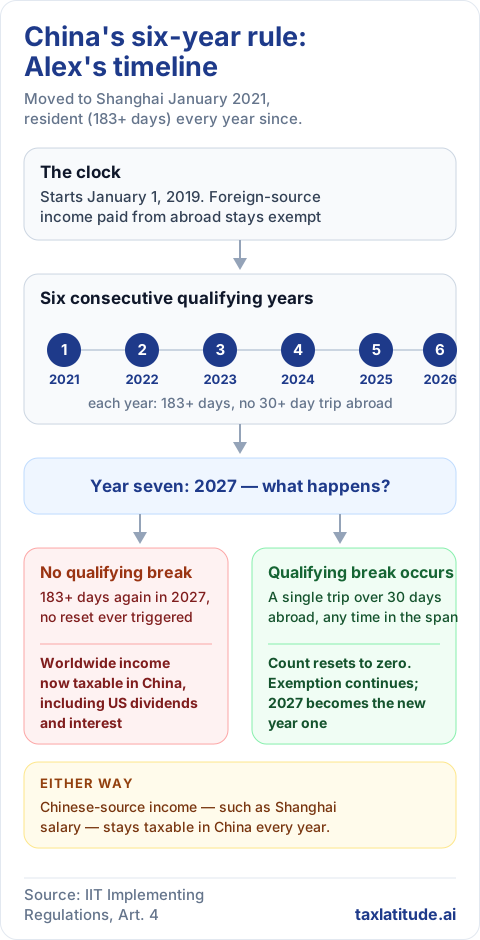
- China taxes residents on a 183-day test, with a "six-year rule" for foreigners. A foreigner without a Chinese domicile who spends 183 days or more in a year is a resident. Foreign-source income paid from abroad stays exempt until six consecutive qualifying years have passed, counted from January 1, 2019. A year under 183 days, or one trip outside the mainland of more than 30 consecutive days, resets the count.
- There is no US–China totalization agreement. China is absent from the Social Security Administration's list of 31 agreement countries (revised September 17, 2026). Since October 15, 2011, China has required most foreign employees to join its social insurance system.
- FATCA in China is unfinished. China agreed to a Model 1 agreement "in substance" on June 26, 2014, but the agreement had not been signed as of June 30, 2026. Your own FBAR and Form 8938 duties are unaffected.
- China is not under general US sanctions. What applies are targeted measures: a ban on trading securities of listed military-linked companies (NS-CMIC), the outbound investment rules in force since January 2, 2025, export controls (including limits on US persons supporting advanced chip fabs), and customs rules under the Uyghur Forced Labor Prevention Act.
- Currency controls are permanent. Individuals face a $50,000-per-year facilitation quota for converting currency, a rule in place since 2007.
- Chinese enforcement is tightening. Since 2025, tax bureaus have used CRS data to chase residents' undeclared overseas income. Since September 1, 2026, dividends that foreign-invested enterprises pay to foreign individuals are taxed at 20%.
Do Americans living in China still file US taxes?
Yes. US citizens and resident aliens (including green card holders) are taxed on worldwide income no matter where they live, and moving to Shanghai or Beijing does not change that. The IRS says the filing rules are generally the same at home or abroad (IRS, US citizens and resident aliens abroad).
Deadlines. A calendar-year Form 1040 is due April 15. If your tax home and abode are outside the United States on that date, you get an automatic two-month extension to June 15, but interest on unpaid tax still runs from April 15. Form 4868 extends filing to October 15 (IRS, automatic 2-month extension; IRS extensions FAQ).
The two main relief tools.
- Foreign earned income exclusion (Form 2555). It excludes up to $130,000 of foreign wages or self-employment income for tax year 2025 and $132,900 for tax year 2026, if you meet the bona fide residence or physical presence test. Housing costs above a base amount can also be excluded, generally capped at 30% of the exclusion (IRS, figuring the FEIE).
- Foreign tax credit (Form 1116). It credits Chinese individual income tax (IIT) against US tax on the same income. Treaty Article 22(2) commits the United States to allow this credit to its residents and citizens, but only "in accordance with" US law, so the ordinary Code limits apply.
Which tool works better depends on your numbers. China's annual rates on resident "comprehensive income" (wages and similar) run from 3% to 45%, with the top rate above RMB 960,000 (Horizons Q&A via Mondaq; BDO China Tax Facts). Where the Chinese tax on your wages exceeds the US tax on them, the credit can wipe out the US tax on those wages, while the exclusion stops at its dollar cap. Nothing here replaces advice on your own return.
Information returns still apply. Even if you owe no US tax, you may have to file the FBAR, Form 8938, Form 8621, or Form 5471. They are covered under "Which US forms apply to accounts and assets in China?" below.
When does China treat you as a tax resident, and what does it tax?
Under the Individual Income Tax (IIT) Law in force since January 1, 2019, you are a Chinese tax resident if you have a domicile in China, or if you have no domicile but spend an aggregate of 183 days or more in China in a calendar year. Residents are taxed on worldwide income; non-residents only on China-source income (Chambers International Tax 2026, China chapter). For most Americans, the key question is how the six-year rule softens that worldwide reach. Our residency tool covers China's domestic test in detail.
The 183-day test
- Counting days. A day counts only if you spend a full 24 hours in mainland China. Arrival and departure days usually do not count (MOF/STA Announcement [2019] No. 34, official English text; Rödl & Partner).
- Below 183 days. You are a non-resident and are taxed only on China-source income. If you are in China 90 days or fewer in the year, China-source pay from an employer outside China that is not borne by a Chinese establishment can be exempt (Implementing Regulations, Art. 5). The treaty's 183-day test in Article 14(2) can also protect short assignments for a US employer.
What is the six-year rule for foreigners without a domicile?
Article 4 of the IIT Implementing Regulations exempts income sourced outside China and paid by an overseas entity or individual while you have not yet completed six consecutive years of 183-day residence. You must file a record with the tax bureau to claim it (Implementing Regulations, Art. 4). Three details are often misread:
- The exemption is narrow. Foreign-source income paid or borne by a Chinese entity is taxable from your first resident year (Dezan Shira guide). China-source income, such as Chinese salary for work done in China, is always taxable.
- The clock started January 1, 2019. Years spent in China before 2019 do not count, so 2025 was the earliest year anyone could hit worldwide taxation (China Briefing).
- The clock resets. A year with fewer than 183 days, or a single trip outside the mainland of more than 30 consecutive days, restarts the count (China Briefing, 2024 highlights).
Example. Alex, a US citizen, moves to Shanghai for a local job in January 2021. Alex spends at least 183 days in China every year and never leaves for more than 30 days in a row.
| Year | Six-year count | Foreign-source income paid from abroad (e.g., US brokerage dividends) |
|---|---|---|
| 2021–2026 | Years 1–6 | Exempt in China, if the record-filing is made |
| 2027 | Count complete | Taxable in China if Alex is again resident (183+ days) in 2027; worldwide income reported |
| 2027 (alternative) | Reset by a 35-day trip home in 2026 | Exempt again; 2027 becomes year 1 |
Alex's Shanghai salary is taxable in China in every year of the table. The United States taxes all of it too, subject to the foreign tax credit or exclusion.
Tracking your six-year clock in China? A single trip of more than 30 consecutive days outside the mainland resets it to year one — but your US tax bill on that same income doesn't reset with it. Check where your six-year count actually stands →
What about former Chinese citizens and "domicile"?
Domicile is a separate test from day counting. Local tax bureaus normally treat a person with a Chinese household registration (hukou) as resident by default (WealthBriefing). A 2026 report says MOF/STA Announcement [2026] No. 21 (July 24, 2026) allows people holding foreign nationality or permanent residency whose main economic interests remain in China to be treated as domiciled (China Briefing). The primary text of that announcement was not part of this guide's research. Naturalized Americans who kept close ties to China should get advice before relying on the six-year rule.
Filing, credits, and anti-avoidance rules
- Annual reconciliation. Residents settle IIT on comprehensive income between March 1 and June 30 of the following year, and must also report overseas income in that window (Chambers; China Briefing).
- Chinese foreign tax credit. China credits foreign tax on foreign-source income, capped at the Chinese tax due on that income (BDO; treaty Art. 22(1)).
- Individual anti-avoidance and CFC rules. IIT Law Article 8, in force since 2019, lets tax bureaus adjust non-arm's-length deals, controlled foreign company arrangements in low-tax places, and arrangements lacking a reasonable business purpose (PwC Worldwide Tax Summaries). An offshore company majority-owned by Chinese residents in a jurisdiction taxing at under half the Chinese corporate rate can have its retained profits attributed to those residents (HKICPA A Plus). These rules reach a US citizen only once that person is a Chinese resident taxable on the income concerned.
- Tighter enforcement. Since the 2024 tax year, bureaus have used CRS account data to pursue residents' unreported overseas income. In January 2026 the State Taxation Administration urged residents to self-review overseas income for 2022–2024 (Chambers; China Briefing).
- Expatriate allowances. Tax-free treatment of housing, children's education, and language-training allowances for foreign individuals runs through December 31, 2027, as an alternative to the standard itemized deductions (MOF/STA Announcement [2023] No. 29).
Is there a US–China tax treaty?
Yes. The Agreement for the Avoidance of Double Taxation and the Prevention of Tax Evasion with Respect to Taxes on Income was signed in Beijing on April 30, 1984, together with a protocol and an exchange of notes. A second protocol followed on May 10, 1986, and the treaty took effect January 1, 1987 (treaty text and protocols; TaxesForExpats). It has 28 articles. No protocol or amendment after 1986 surfaced while researching this guide. The IRS treaty file directory holds two China documents, the 1984 treaty text and the 1984 Treasury technical explanation, and its most recent uploads (through May 5, 2026) include nothing for China (IRS treaty files). The IRS China tax treaty documents page is the place to confirm that before relying on it.
It does not cover Hong Kong. IRS Publication 901 states that the US–China treaty does not apply to Hong Kong (IRS Pub. 901, Sept. 2016 revision). On the Chinese side, Article 2 lists the taxes covered as of 1984, starting with the individual income tax.
US-China Convention (1984), already consolidated with both 1984 and 1986 Protocols
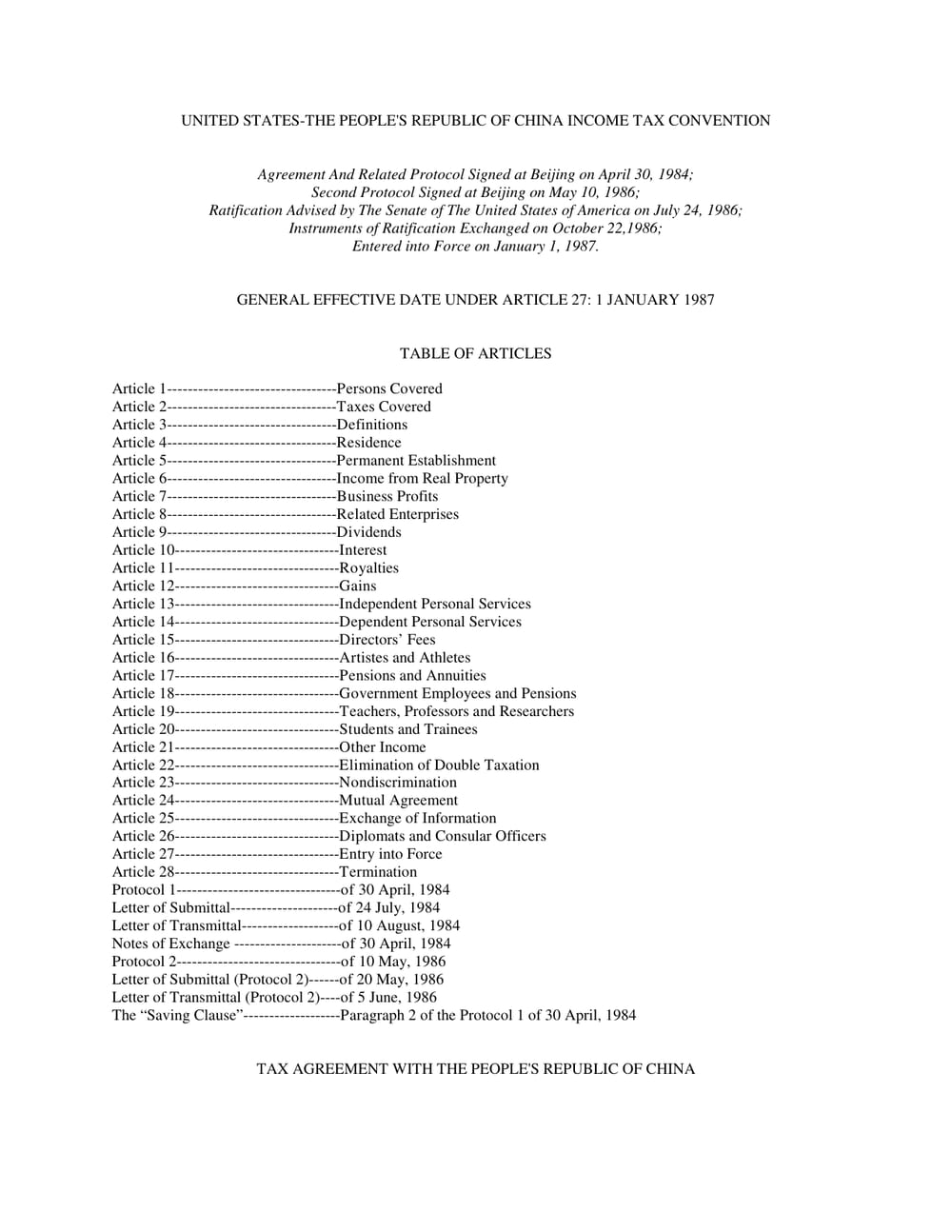
Download the Convention (PDF, 20 pages)
Local copy for convenience, downloaded from IRS.gov on November 14, 2026. This single PDF already includes both the original 1984 protocol and the 1986 second protocol — no amendment has been published since. Always confirm at the IRS's own China tax treaty documents page before relying on it.
What does the saving clause say?
Paragraph 2 of the 1984 Protocol has two sentences (IRS memorandum 201438020, Aug. 1, 2014):
- On citizens: "Notwithstanding any provision of the Agreement, the United States may tax its citizens." The sentence lists no exceptions.
- On US residents: the United States may tax its residents (as determined under Article 4), except as provided in Article 8(2), Article 17(2), and Articles 18, 19, 20, 22, 23, 24, and 26.
In practice, a US citizen cannot use the treaty to reduce US tax on Chinese income. The foreign tax credit still works, because it comes from the Internal Revenue Code itself. Green card holders who are US residents under Article 4 keep the listed exceptions. Article 4(2) has no fixed tie-breaker for people resident in both countries; the two tax authorities decide by consultation. A green card holder who claims treaty non-residence can face immigration and US tax consequences, so get advice first.
Provisions most relevant to individuals
| Article | Topic | What it provides |
|---|---|---|
| 9 | Dividends | Source-country tax capped at 10% of the gross dividend for the beneficial owner |
| 10 | Interest | Source-country tax capped at 10% |
| 11 | Royalties | Source-country tax capped at 10% (TaxesForExpats) |
| 12 | Gains | Shares of companies holding mainly real property, and 25% participations, may be taxed where the company is resident |
| 14(2) | Employment income | Pay for work in the other country stays taxable only at home if you are there 183 days or fewer in the calendar year, the employer is not resident there, and no local establishment bears the cost |
| 17(1) | Private pensions | Taxable only in the recipient's country of residence |
| 17(2) | Social security | Payments under a government social security system or public welfare plan are taxable only in the paying country |
| 19 | Teachers and researchers | Exemption for up to three years for qualifying visitors (IRS memorandum) |
| 20 | Students and trainees | Exempts maintenance payments and up to $5,000 a year of personal-services income |
| 22 | Double tax relief | Each country credits the other's tax; China caps its credit at the Chinese tax on that income |
| 24 | Mutual agreement | Lets you ask the tax authorities to resolve treaty disputes |
Two practical notes follow from the table. First, Article 17(2) means US Social Security benefits paid to an American living in China should be taxed only by the United States. Second, Article 9 now matters to Americans living in the United States who own shares of a Chinese foreign-invested enterprise. China ended its domestic dividend exemption for foreign individuals on September 1, 2026, so the 10% treaty cap has become relevant (Garrigues). This guide does not cover the Chinese-side procedures for claiming that treaty rate.
How do you avoid paying tax twice?
For most Americans in mainland China, double taxation is avoided through US domestic law (the exclusion or the credit), not through the treaty, because the saving clause blocks most treaty relief for citizens. The right approach depends on the type of income.
| Income | China | United States | Usual relief |
|---|---|---|---|
| Salary for work done in China | Taxable as China-source income | Taxable | Foreign earned income exclusion (Form 2555) or foreign tax credit (Form 1116); you cannot use both on the same dollars |
| US dividends and interest, before you complete six resident years | Exempt if paid from abroad and record-filed (Implementing Regulations Art. 4) | Taxable | None needed in China |
| US dividends and interest, after six resident years | Taxable as worldwide income | Taxable | China credits US tax only up to its own tax on that income (Art. 22(1)) |
| Chinese dividends, interest, rent | Taxable in China | Taxable | US foreign tax credit, generally in the passive category |
| US Social Security benefits | Taxable only in the US under Art. 17(2) | Taxable | Treaty allocation |
| Self-employment income | Taxable as China-source income | Income tax plus US self-employment tax | The exclusion and the credit do not reduce self-employment tax |
Sources: Implementing Regulations, Art. 4; treaty text; IRS, figuring the FEIE; IRS Schedule SE instructions.
The hardest overlap. Once a foreigner passes the six-year mark, China taxes US-source investment income too. China's credit for US tax is capped at Chinese tax on that income, and the US foreign tax credit is generally limited to foreign-source income. Whether any re-sourcing rule restores full relief in that case remains an open question here; put it to a cross-border adviser.
Watch for these points:
- Exclusion versus credit. Wages you exclude cannot also generate a credit, so excluding wages that China taxed heavily leaves that Chinese tax unused. Run the numbers both ways before choosing — see our guide on FEIE vs Foreign Tax Credit for the general mechanics.
- Timing. China's tax year is the calendar year, like the US year. Annual Chinese reconciliation runs March 1 to June 30, so the final Chinese figure may arrive after the US June 15 automatic extension date. File Form 4868 if you need time.
- Social security taxes. No treaty or credit removes the overlap between US self-employment tax and Chinese social insurance, because there is no totalization agreement (next section).
Social security: is there a totalization agreement with China?
No. For how a totalization agreement normally works and why its absence matters most to the self-employed, see our dedicated guide. The Social Security Administration's list of agreements in force, revised September 17, 2026, names 31 countries, from Australia to Uruguay, with Romania the latest (in force September 1, 2026). China is not on it (SSA POMS GN 01701.005). The social security agreements China has implemented, as listed by China Briefing, cover Germany, Korea, Denmark, Canada, Finland, Switzerland, the Netherlands, Spain, Luxembourg, Japan, and Serbia; the United States is not among them (China Briefing).
What China requires. Since October 15, 2011, foreigners legally employed in China must join the Chinese social insurance system, unless a bilateral agreement exempts them (Interim Measures, MOHRSS Order No. 16; RSM China). Local enforcement and contribution bases vary by city.
What the United States requires.
- Employees of an American employer working in China generally remain subject to US Social Security and Medicare (FICA) tax (IRS Nationwide Tax Forum materials). With no agreement, contributions can be due in both countries on the same pay.
- Employees of a Chinese employer are generally outside US FICA, so they build no US Social Security credits from that work.
- The self-employed owe US self-employment tax on net earnings, and the foreign earned income exclusion cannot reduce it (IRS Schedule SE instructions).
Leaving the Chinese system. Under Article 5 of the Interim Measures, a foreigner who leaves before retirement age keeps the individual account by default, or can apply in writing to close it and receive the balance in a lump sum (Shanghai government FAQ). Exactly what the payout includes depends on local rules. How the IRS treats that payout is a point this guide could not settle; ask a preparer before you file.
Which US forms apply to accounts and assets in China?
The same US information returns apply in China as anywhere else; what differs is that Chinese banks are not yet reporting to the IRS, so the burden of accurate disclosure sits with you.
| Form | Who files | Threshold | Where |
|---|---|---|---|
| FinCEN Form 114 (FBAR) | US persons with an interest in, or signature authority over, foreign financial accounts | Aggregate value above $10,000 at any time in the year | FinCEN BSA E-Filing; due April 15, automatic extension to October 15 (FinCEN FBAR help) |
| Form 8938 | Specified individuals with specified foreign financial assets | Living abroad: over $200,000 at year-end or $300,000 at any time (single); $400,000 / $600,000 (joint) | With Form 1040 (IRS, Section 6038D regulations) |
| Form 8621 | Direct or indirect shareholders of a PFIC | Separate form per fund; annual report can be skipped if aggregate PFIC value is $25,000 or less ($50,000 joint) and no distributions, gains, or elections | With Form 1040 (IRS Form 8621; regulations summary) |
| Form 5471 | Officers, directors, and 10%+ US shareholders of foreign corporations | Depends on filer category | With Form 1040 (Greenback summary of IRS categories) |
| Form 3520 | Recipients of large foreign gifts or bequests | $100,000 or more from a foreign individual in a year | Separate filing (IRS, gifts from a foreign person) |
Form 8938 penalties start at $10,000 for failure to file, with up to $50,000 more after an IRS notice and a 40% penalty on understatements tied to undisclosed assets (IRS).
How does FATCA affect Chinese banks?
For how FATCA works in general, see our dedicated guide. China reached a Model 1 intergovernmental agreement "in substance" with the United States on June 26, 2014 (KPMG China). Under Model 1, banks report to their own government, which passes data to the IRS. As of June 30, 2026, the agreement had not been signed, and financial institutions in China had not started implementing FATCA (PwC Worldwide Tax Summaries). How individual Chinese banks handle US customers in the meantime is not something any authoritative source addresses directly. Either way, your FBAR and Form 8938 obligations do not depend on what your bank does.
How does CRS differ from FATCA reciprocity?
For the mechanics of CRS itself, see our dedicated guide. China signed the CRS Multilateral Competent Authority Agreement in December 2015, put due diligence rules in place through SAT Announcement [2017] No. 14 (effective July 1, 2017), and made its first exchange in September 2018 (International Tax Review; Alvarez & Marsal). The United States does not participate in CRS (International Tax Review). So CRS and FATCA run in parallel: neither feeds the other, and no reciprocal US–China account exchange operates under either. Two consequences follow:
- Chinese banks report non-residents' accounts under CRS, not accounts of Chinese tax-resident individuals (Conventus Law).
- If you are a Chinese tax resident with accounts in other CRS-participating jurisdictions, China may receive data on them. US accounts are not exchanged through CRS.
What's the PFIC risk for Chinese funds and QDII products?
A foreign corporation is a PFIC if 75% or more of its gross income is passive or 50% or more of its assets produce passive income. Most foreign pooled funds meet one of those tests (NSKT Global). Without elections, PFIC gains and large distributions are taxed at the highest ordinary rate plus an interest charge.
For China specifically, two points remain open. Under the Securities Investment Fund Law, a Chinese public fund is not a legal entity; practitioners describe it as closest to a trust (Chambers Investment Funds 2025, King & Wood Mallesons). PFIC status first requires the vehicle to be a foreign corporation for US tax purposes, and this guide's research turned up no IRS ruling or guidance classifying Chinese contractual funds, QDII funds, or bank wealth-management products. The prudent default is to treat any mainland fund, including a QDII fund that invests overseas, as a likely PFIC and have its classification reviewed before investing. A QDII fund holding US-listed stocks is still a Chinese vehicle, so owning it is not the same as owning the underlying US shares.
Holding a QDII fund because it invests in US stocks? It's still a Chinese vehicle for US tax purposes — likely a PFIC requiring its own Form 8621, not a way to hold US shares directly. Get your Chinese fund's PFIC status reviewed →
What applies if you own or manage a Chinese company?
If you own 10% or more of a Chinese company, or serve as an officer or director when a US person crosses that line, Form 5471 can apply (Greenback summary of IRS categories). A Chinese company more than 50% owned by US shareholders is a controlled foreign corporation, which brings US anti-deferral rules into play. Chinese CFC rules, described under "When does China treat you as a tax resident," are separate and reach only Chinese residents.
Unsettled point: payment apps. Whether balances held in Chinese mobile payment wallets count as foreign financial accounts for FBAR or Form 8938 is not settled by any source checked for this guide. Raise it with your preparer rather than assuming either answer.
What US restrictions actually apply to China?
Mainland China is not subject to comprehensive US economic sanctions. Living, working, banking, paying Chinese tax, and ordinary commerce there are not prohibited for Americans. The US measures that exist are targeted at named companies, technology sectors, or imported goods. The four below are the ones most likely to touch an individual or a small business; each is described as of November 2, 2026. Separately, specific Chinese persons can appear on OFAC's SDN list under other programs, so screen counterparties.
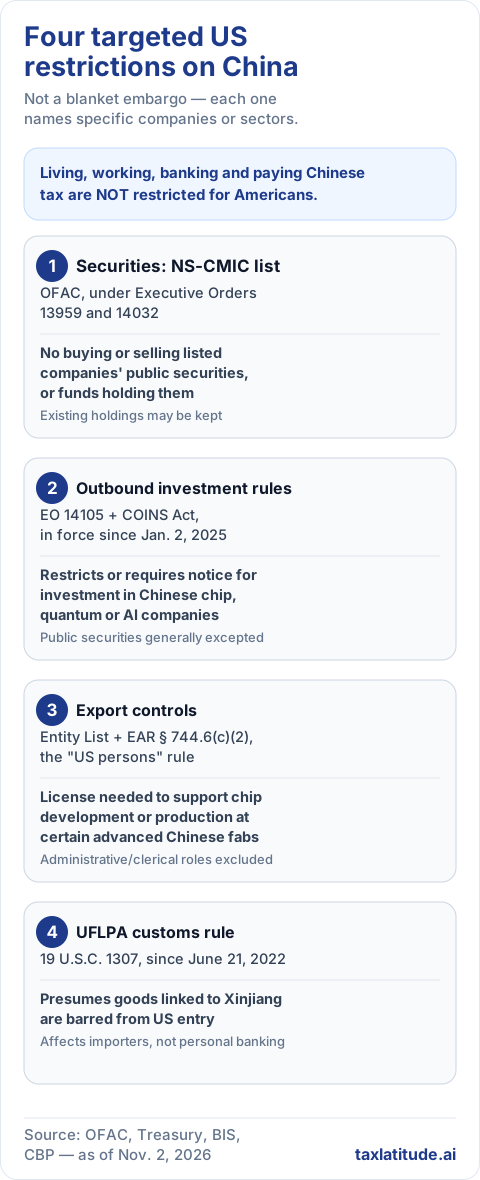
1. Securities of listed military-industrial companies (NS-CMIC)
- Legal basis. Executive Order 13959 (November 12, 2020), as amended by Executive Order 14032 (June 3, 2021), and the Chinese Military-Industrial Complex Sanctions Regulations, 31 CFR Part 586 (issued February 15, 2022) (OFAC program page).
- What is banned. US persons may not purchase or sell publicly traded securities of companies on the Non-SDN Chinese Military-Industrial Complex Companies List, on any exchange. The ban also covers derivatives and US or foreign funds, ETFs, and mutual funds that hold those securities, whatever the fund's percentage (OFAC FAQs 859–861, 898).
- What is not banned. You may keep securities you already hold, and cash dividends may be received; reinvesting dividends counts as a prohibited purchase. Buying goods or services from a listed company is outside the program (OFAC FAQs 905, 1046, 1047). It is not an asset freeze: the NS-CMIC list does not impose full blocking sanctions (Baker McKenzie).
- Scope limits. Only companies named on the list are covered; OFAC's 50 percent rule does not extend the ban to unlisted subsidiaries (FAQ 857). Newly listed companies face the ban 60 days after listing, with 365 days for divestment trades (FAQ 899).
- Status. OFAC's official archive of list changes holds NS-CMIC change files for 2021 only, and its program page gives December 16, 2021 as the last list update. OFAC's recent-actions page for October 13–29, 2026 shows no NS-CMIC action; the October 19, 2026 designations there were under a different authority (the Protecting American Intellectual Property Act). The Defense Department's separate Section 1260H list of "Chinese military companies" was updated on June 10, 2026; it does not itself ban securities trading, but listed firms may be added to NS-CMIC later (Morrison Foerster). Check the live list before trading.
- Why it matters in China. An American buying a Chinese mutual fund through a local bank app could breach the fund rule if the fund holds a listed company's shares.
Buying Chinese mutual funds through a local bank app? If the fund holds shares of a company on the OFAC NS-CMIC list, your purchase can breach the ban — whatever share of the fund those holdings make up. Screen your fund before you buy →
2. Outbound investment rules (Executive Order 14105 and the COINS Act)
- What is in force. Executive Order 14105 (August 9, 2023) led to Treasury's Outbound Investment Security Program at 31 CFR Part 850, effective January 2, 2025. It prohibits some investments, and requires notice within 30 days of closing for others, in companies tied to a "country of concern" that work in semiconductors and microelectronics, quantum information technologies, or artificial intelligence (Akin Gump; King & Spalding). The rule's own definition of that country covers the PRC including the Hong Kong and Macao SARs; that is a definition in this US rule, not a statement about tax systems.
- Individuals are covered. US persons include US citizens and green card holders wherever they live.
- Common exceptions. Publicly traded securities, US-registered mutual funds and ETFs, small or contractually limited LP interests, and employee equity compensation are excepted. Passive exceptions fall away if you receive rights beyond standard minority protections (King & Spalding).
- In practice. Buying listed A-shares on an exchange is excepted. Writing an angel check to a Shenzhen AI or chip-design startup may be prohibited or notifiable. Stock options from a Chinese employer fall within the employee-compensation exception.
- What is changing. The COINS Act, enacted December 18, 2025, in the FY2026 National Defense Authorization Act, put the program into statute. Treasury proposed implementing rules on October 22, 2026; comments close December 7, 2026. The proposal would add hypersonics, high-performance computing, and biotechnology, prohibit investment in "super intelligence" development, and add a $50,000 de minimis exception. Until a final rule takes effect, only Part 850 applies (Simpson Thacher; King & Spalding).
3. Export controls: the Entity List and the "US persons" rule
- Entity List. Exports, re-exports, and in-country transfers of items subject to the Export Administration Regulations (EAR) to listed parties need a license. This mainly binds companies, but an employee who ships, transfers, or authorizes such items is part of the transaction.
- The rule that reaches individuals' jobs. Since October 2022, EAR § 744.6(c)(2) requires a license for US persons (citizens, green card holders, and others) to "support" the development or production of integrated circuits at certain advanced fabrication facilities in China, even with items not otherwise subject to the EAR. BIS guidance says the restriction does not extend to administrative or clerical work, and recommends due diligence on the facility; advisory opinions are available (BIS FAQ; JD Supra summary of BIS guidance). Engineers and executives at Chinese chip companies should get export-control advice before accepting or continuing a role.
- The Affiliates Rule. From September 29, 2025, BIS extended Entity List restrictions to companies 50% or more owned by listed parties. BIS suspended that rule from November 10, 2025, through November 9, 2026, and the suspension rule reinstates it on November 10, 2026, absent an extension (Federal Register, Nov. 12, 2025). On September 23, 2026, the Treasury Secretary announced a two-month extension of the underlying US–China arrangement to January 10, 2027, which is expected to extend the suspension. As of November 2, 2026, no BIS notice in the Federal Register formalizing it turned up in this guide's research; law-firm alerts through late October 2026 say the same. Without such a notice before November 10, the suspension rule as published brings the Affiliates Rule back on November 10, 2026 (Miller Canfield; Pillsbury). Check the Federal Register for the current status.
4. Import restrictions: the Uyghur Forced Labor Prevention Act
This is a customs rule, not a financial sanction. Since June 21, 2022, US Customs and Border Protection presumes that goods mined, produced, or manufactured wholly or partly in the Xinjiang Uyghur Autonomous Region, or by entities on the UFLPA Entity List, are barred from entry under 19 U.S.C. 1307. The importer can rebut the presumption only with clear and convincing evidence (Global Trade & Sanctions Law). The list was last updated in a notice published October 29, 2026, which added three entities and brings the total to 190 (Federal Register public inspection 2026-22094). The law matters to Americans running or sourcing for businesses that import into the United States; it does not restrict personal banking, employment, or travel.
What are China's currency controls (SAFE)?
China's foreign exchange controls are a permanent, long-standing part of its financial system, administered by the State Administration of Foreign Exchange (SAFE). They are not an emergency measure, and you should plan around them for as long as you hold money in China. For how this compares to currency controls elsewhere, see our currency controls world map.
The annual quota. Under the Measures for the Administration of Individual Foreign Exchange and their Detailed Rules, SAFE set an annual quota of $50,000 per person for individual foreign currency purchases (raised from $20,000) and for individual sales of foreign currency (SAFE Q&A, January 2007). The quota runs per calendar year, January 1 to December 31, and is not transferable between people (ICBC; Standard Chartered China). When SAFE tightened scrutiny from January 1, 2017, it kept the $50,000 figure unchanged (South China Morning Post).
How it applies to foreigners.
- Bringing money in (foreign currency to RMB). Foreign individuals have a $50,000 annual settlement quota. Above it, you must show the conversion serves a current-account purpose, such as rent, living costs, medical bills, or tuition, with documents. A single conversion above $50,000 must be paid straight to the payee's RMB account (HSBC China guide for non-mainland individuals, effective May 31, 2025).
- Taking money out (RMB to foreign currency). To convert Chinese salary, you normally show an employment contract, an employer income statement, and a tax payment certificate (HSBC guide). Banks' public descriptions disagree on whether the $50,000 figure also caps foreigners' purchases: HSBC's guide applies one shared quota, while HSBC's and Standard Chartered's rate pages list no purchase quota for non-domestic individuals (HSBC China; Standard Chartered China). Confirm with your own bank.
- Permanent residents. Holders of a Foreign Permanent Resident ID Card can use it for the annual quota (SAFE, 2017) and are treated as Chinese residents for balance-of-payments reporting.
Consequences of breaking the rules. Under the tightened rules from 2017, violators can be placed on a watch list, denied quota for three years, and investigated for money laundering (Business Standard). Borrowing a friend's or relative's quota is a known risk; the quota is not transferable.
Tax link. Because outbound conversion of earnings depends on proof of tax paid, Chinese IIT compliance is also what keeps your money movable. On the US side, report Chinese accounts in US dollars on the FBAR and Form 8938 whether or not the funds can be freely moved.
Local considerations
Employment
- Withholding. Chinese employers withhold IIT monthly, and residents settle the year in the March 1–June 30 reconciliation.
- Expatriate allowances. Until December 31, 2027, foreign employees may choose tax-free housing, children's education, and language-training allowances instead of the standard itemized deductions, but not both (MOF/STA Announcement [2023] No. 29). Under US rules, an employer-paid allowance is generally still income on your Form 1040; the foreign housing exclusion may offset part of it.
- Social insurance. Expect mandatory enrollment (see the Social Security section above).
- Export controls. If your employer is in advanced semiconductors, review the export-control rules under "US restrictions that actually apply to China" before you start.
Running a business
- US classification of Chinese companies. A PRC Gufen Youxian Gongsi (joint-stock limited company) is always a corporation for US tax purposes (26 CFR 301.7701-2(b)(8)). A Youxian Gongsi (limited liability company) is an eligible entity that defaults to corporate treatment but can elect otherwise on Form 8832 (TSCPA Tax). That choice drives whether you file Form 5471 or Form 8858, and how profits reach your US return.
- Dividends to foreign owners. Since September 1, 2026, dividends a foreign-invested enterprise pays to foreign individuals bear 20% Chinese IIT, ending an exemption that dated from 1994; the company withholds it (China Briefing; BDO). For a US citizen, that tax can become a US foreign tax credit.
- Outbound investment rules apply if a US person invests in, or directs investment into, Chinese companies in covered technology sectors (see "US restrictions that actually apply to China").
Real estate
Rental income from a mainland property is taxable in China and reportable in the United States, with the Chinese tax creditable. Gains on sale are reportable in the United States in dollars. Rules on whether and how foreigners may buy homes differ by city and are outside the scope of this guide.
Mainland China or Hong Kong?
Americans weighing the two should treat them as separate tax jurisdictions. Facts on the mainland side are covered throughout this guide; the comparison below is limited to points relevant to that choice.
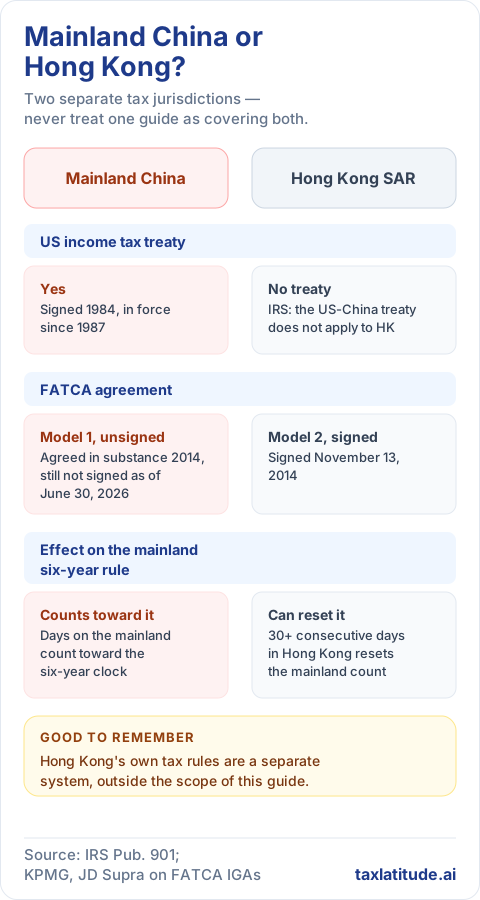
| Question | Mainland China | Hong Kong SAR |
|---|---|---|
| US income tax treaty | Yes, signed 1984 | No; the IRS says the US–China treaty does not apply (IRS Pub. 901) |
| FATCA agreement | Model 1 agreed in substance in 2014, unsigned | Model 2, signed November 13, 2014 (JD Supra) |
| Effect on the six-year rule | Days on the mainland count | Time in Hong Kong is time outside the mainland, so a stay there of more than 30 consecutive days resets the count |
Hong Kong's own tax rules are outside the scope of this guide.
What happens when leaving China?
A clean exit means settling Chinese tax before you go, deciding what to do with your social insurance account, and planning how the money gets out.
On the Chinese side
- Settle the year's IIT. A non-domiciled individual leaving before the normal March–June window can complete the annual filing before departure (Boardroom; MS Advisory). Failure to file the annual return can bring penalties of RMB 2,000 to 10,000 (BDO).
- Social insurance. Keep the individual account for a possible return, or apply in writing to close it and take the balance as a lump sum (Shanghai government FAQ).
- Housing fund. Balances can be withdrawn on exit; several cities process this online (China Briefing).
- Moving money out. Converting final salary, bonuses, or sale proceeds into foreign currency requires proof of source and tax paid. Unused RMB from an earlier exchange can be reconverted with an exchange slip issued within the past 24 months (HSBC China guide).
- Former Chinese citizens. IIT Law Article 10 requires tax clearance before cancelling a Chinese household registration on emigration (International Tax Review).
On the US side
- Foreign earned income exclusion in the move year. The exclusion is prorated by qualifying days. Leaving mid-year can make the bona fide residence test hard to meet; the physical presence test (330 full days abroad in 12 consecutive months) is the alternative (IRS).
- Selling Chinese funds. Sales of PFIC holdings can trigger excess-distribution tax and interest charges. Model the US result before you sell.
- Check NS-CMIC exposure before selling. If a fund you hold owns securities of a listed military-industrial company, selling it after the divestment window may itself be prohibited without OFAC authorization (OFAC FAQs 861, 1046).
- Accounts left behind. Any Chinese account you keep stays on your FBAR and, above the thresholds, Form 8938. The Form 8938 thresholds fall to the domestic levels once you no longer qualify as living abroad (IRS).
Mistakes Americans commonly make
- Treating Hong Kong and mainland rules as interchangeable. The 1984 treaty, SAFE's quota, and the six-year rule are mainland features. Advice written for Hong Kong does not carry over, and the reverse is also true.
- Assuming the treaty lowers US tax for citizens. The saving clause lets the United States tax citizens notwithstanding the treaty. Relief comes from the exclusion and the credit.
- Reading the six-year rule as "no Chinese tax for six years." Chinese salary is taxable from day one. Only foreign-source income paid from abroad is exempt, and only with the record-filing.
- Losing track of the clock. Counting years before 2019, forgetting that days under 24 hours do not count, or not noticing that 2025 was the first year anyone could reach worldwide taxation.
- Buying Chinese mutual funds or QDII products without a PFIC review. Each fund can require its own Form 8621 and punitive tax on sale.
- Buying funds that hold NS-CMIC securities. The ban covers funds and ETFs holding listed companies, whatever the percentage.
- Skipping the FBAR because the Chinese bank "doesn't report." Chinese banks have not implemented FATCA, but your filing duty is independent of theirs.
- Choosing the exclusion by habit. With Chinese rates up to 45%, the foreign tax credit can leave you better off; compare both methods each year.
- Ignoring social security overlap. There is no totalization agreement, so self-employed Americans can owe US self-employment tax on top of Chinese contributions.
- Investing in a Chinese tech startup without screening it. Angel and venture investments in chips, quantum, or AI companies can be prohibited or notifiable under the outbound rules.
- Using someone else's currency quota. The quota is personal and not transferable; violations can cost you three years of access.
- Leaving without settling Chinese tax. Failing to file the annual return can bring penalties of RMB 2,000 to 10,000.
Checklist
Every year
- File Form 1040 by April 15, or by June 15 with the automatic extension for those abroad (interest runs from April 15)
- Choose between Form 2555 and Form 1116 based on your Chinese tax paid
- File the FBAR if your non-US accounts together exceeded $10,000 at any time
- Check Form 8938 thresholds ($200,000 / $300,000 single abroad; $400,000 / $600,000 joint)
- File Form 8621 for each Chinese fund, including QDII funds, unless the small-holding exception applies
- File Form 5471 or 8858 for Chinese companies you own or manage, as applicable
- Complete China's annual IIT reconciliation between March 1 and June 30
- Make the record-filing for the six-year exemption on foreign-source income, if you rely on it
Keep running records of
- Days in mainland China, counting only full 24-hour days
- Every trip outside the mainland longer than 30 consecutive days
- Chinese tax payment certificates (needed for the foreign tax credit and for converting RMB)
- Your annual currency conversions against the $50,000 quota
Before investing or taking a job
- Screen securities and funds against the OFAC NS-CMIC list
- Screen private investments in chip, quantum, or AI companies under 31 CFR Part 850
- Get export-control advice before working on chip development or production at a Chinese fab
- Ask for a PFIC review before buying any mainland fund
Before leaving
- Settle Chinese IIT for the departure year
- Decide whether to keep or close the social insurance account; withdraw the housing fund
- Gather tax certificates and contracts needed to convert and remit RMB
- Check NS-CMIC and PFIC consequences before selling Chinese funds
Frequently asked questions
Do I owe US tax if I already pay Chinese tax on my salary? You must still file. Whether you owe anything depends on the exclusion or credit you claim; because China's rates on wages reach 45%, the credit can reduce US income tax on those wages substantially, sometimes to zero.
Does the US–China treaty cover Hong Kong? No. The IRS says it does not apply to Hong Kong, and there is no separate US–Hong Kong income tax treaty.
I have lived in Beijing since 2018. Am I taxed on my US investment income in China? Years before 2019 do not count. If you spent 183 days or more in China in each of 2019 through 2024 and never left for more than 30 consecutive days, 2025 was your first year of worldwide taxation in China, if you were again a resident that year. One qualifying break in any year resets the count.
Will my Chinese bank report me to the IRS? Not under FATCA at present. China's Model 1 agreement, reached in substance in 2014, was still unsigned as of June 30, 2026, and Chinese institutions had not implemented FATCA. That does not change your own reporting duties.
Does China exchange my account data with the United States under CRS? No. China exchanges under CRS, but the United States is not a CRS participant. The two systems are separate.
Are Chinese mutual funds PFICs? Probably, for most of them, although the IRS has not published guidance on Chinese contractual funds or QDII products as far as this guide's research found. Treat them as likely PFICs and get a classification review before buying.
Can I buy Chinese stocks as an American? Generally yes. Publicly traded securities are excepted from the outbound investment rules. The main limit is the NS-CMIC list: US persons may not buy or sell securities of listed companies, or funds holding them.
Is China under US sanctions like Russia? No. There is no comprehensive embargo on mainland China. The measures are targeted: listed securities, specific technology investments, export controls, and certain imports.
Can I work for a Chinese semiconductor company? Possibly, but get export-control advice first. A license may be needed for US persons supporting chip development or production at certain advanced fabs; purely administrative or clerical roles fall outside that restriction under BIS guidance.
Is there a totalization agreement so I pay social security in only one country? No. China is not on the SSA's list of 31 agreement countries, so double contributions are possible.
How much money can I convert each year? The individual facilitation quota is $50,000 per calendar year. Larger conversions need documents showing a legitimate current-account purpose, and converting salary out of RMB requires proof of tax paid.
Do I need to tell the IRS about money my parents in China give me? If gifts or bequests from foreign individuals total $100,000 or more in a year, Form 3520 is generally required. It is a reporting form; the gift itself is usually not taxable to you. The penalty for filing late is steep even though no tax is owed; see our Form 3520 penalty guide for how it is calculated and how to fix a missed filing.
When was the US–China tax treaty signed, and is it still in force? The Agreement for the Avoidance of Double Taxation and the Prevention of Tax Evasion with Respect to Taxes on Income was signed in Beijing on April 30, 1984, with a second protocol on May 10, 1986, and took effect January 1, 1987. It has 28 articles, and no protocol or amendment after 1986 surfaced while researching this guide.
Can I use the US–China treaty to reduce my US tax as a citizen living in China? Generally no. The 1984 Protocol's saving clause lets the United States tax its citizens notwithstanding the treaty, with no exceptions listed. US residents (including green card holders under Article 4) keep a short list of exceptions, but a US citizen cannot use the treaty itself to cut US tax on Chinese income. The foreign tax credit still works, because it comes from the Internal Revenue Code rather than the treaty.
When should you hire a professional?
A salaried American with a Chinese bank account and a US brokerage account can often handle the US side with good software and care. Bring in professionals, ideally a US preparer experienced with China plus a Chinese tax adviser, in these situations:
- You are approaching or past the six-year mark, or you have foreign-source income paid by a Chinese entity.
- You hold Chinese funds, QDII products, or bank wealth-management products that may be PFICs.
- You own, or are an officer of, a Chinese company, or receive dividends from a foreign-invested enterprise.
- You are self-employed in China and face both US self-employment tax and Chinese social insurance.
- You are a green card holder considering a treaty residence claim, or a former Chinese citizen whose domicile status is unclear.
- You invest privately in Chinese technology companies, where the outbound investment rules may require a filing or prohibit the deal.
- You work in semiconductors or hold a technical role at a company that may be on the Entity List.
- You are behind on FBAR, Form 8938, or Chinese overseas-income reporting. Both the IRS and Chinese bureaus offer paths to correct past filings — see our guide on the Streamlined Filing Compliance Procedures for the US side — and outcomes are usually better when you act before being contacted.
This guide is general information, not tax or legal advice for your situation.
Sources
All sources were consulted on November 2, 2026. Primary and official sources are listed first in each group.
| Source | URL | Used for |
|---|---|---|
| US–China income tax agreement, protocols, and exchange of notes (text reproduction) | incorporations.io | Treaty text, signing and effective dates |
| IRS, China tax treaty documents | irs.gov | Current treaty document index |
| IRS memorandum 201438020 (Articles 19 and 20, saving clause text) | irs.gov | Saving clause exact text |
| IRS Publication 901 (Sept. 2016 rev.), "does not apply to Hong Kong" | bard.edu | Hong Kong exclusion confirmation |
| IRS, US citizens and resident aliens abroad | irs.gov | Worldwide filing requirement |
| IRS, automatic 2-month extension | irs.gov | Filing deadlines |
| IRS, extensions FAQ | irs.gov | Form 4868 extension |
| IRS, figuring the foreign earned income exclusion | irs.gov | FEIE rules and limits |
| IRS, Section 6038D regulations explanation (Form 8938) | irs.gov | Form 8938 thresholds and penalties |
| IRS, About Form 8621 | irs.gov | PFIC reporting |
| IRS, Schedule SE instructions | irs.gov | Self-employment tax |
| IRS, gifts from a foreign person | irs.gov | Form 3520 foreign gift reporting |
| IRS Nationwide Tax Forum, social security of US individuals abroad | irs.gov | FICA rules abroad |
| FinCEN, FBAR help | bsaefiling.fincen.treas.gov | FBAR filing mechanics |
| 26 CFR 301.7701-2 (per se corporations) | law.cornell.edu | Entity classification |
| TaxesForExpats, US–China treaty guide | taxesforexpats.com | Treaty article summary |
| JD Supra, PFIC regulations summary | jdsupra.com | PFIC regulatory background |
| NSKT Global, foreign mutual funds and PFIC | nsktglobal.com | PFIC test thresholds |
| Greenback, Form 5471 categories | greenbacktaxservices.com | Form 5471 filer categories |
| TSCPA Tax, Form 8832 and foreign entities | tscpatax.com | Entity classification election |
| IIT Law Implementing Regulations (2018), Arts. 4–5 | lexiscn.com | Six-year rule, 90-day exemption |
| MOF/STA Announcement [2023] No. 29 (foreign individuals' allowances) | fgk.chinatax.gov.cn | Expatriate allowance rules |
| MOF/STA Announcement No. 34 of 2019, official English text | fgk.chinatax.gov.cn | 183-day counting rule |
| Chambers International Tax 2026, China chapter | chambers.com | Residency test overview |
| PwC Worldwide Tax Summaries, China individual other issues | taxsummaries.pwc.com | Anti-avoidance and CFC rules |
| PwC Worldwide Tax Summaries, China corporate other issues (FATCA status) | taxsummaries.pwc.com | FATCA implementation status |
| China Briefing, six-year rule clarified | china-briefing.com | Six-year rule start date |
| China Briefing, six-year rule 2024 highlights | china-briefing.com | Reset conditions |
| China Briefing, annual IIT reconciliation | china-briefing.com | Filing window |
| China Briefing, CRS enforcement | china-briefing.com | Enforcement trend |
| China Briefing, offshore tax planning and 2026 announcements | china-briefing.com | Domicile announcement |
| China Briefing, dividend tax for foreign individuals | china-briefing.com | Dividend exemption repeal |
| BDO, dividend exemption abolished | bdo.global | Dividend exemption repeal |
| Garrigues, dividend exemption repeal | garrigues.com | Dividend exemption repeal |
| BDO, China Tax Facts for Expatriates | bdo.global | IIT rate table, penalties |
| Horizons Q&A via Mondaq, IIT rates | mondaq.com | IIT rate bands |
| Rödl & Partner, day counting | roedl.com | 183-day counting rule |
| Dezan Shira, foreign-source income paid by Chinese entities | dezshira.com | Six-year rule narrow exemption |
| WealthBriefing, hukou and residence | wealthbriefing.com | Domicile and hukou |
| HKICPA A Plus, individual CFC rules | hkicpa.org.hk | CFC attribution rules |
| International Tax Review, IIT Law Article 10 tax clearance | internationaltaxreview.com | Exit tax clearance rule |
| Boardroom, filing before departure | boardroomlimited.com | Departure-year filing |
| MS Advisory, filing before departure | msadvisory.com | Departure-year filing |
| Chambers Investment Funds 2025 (King & Wood Mallesons), public fund legal form | chambers.com | Chinese fund legal structure |
| KPMG China, FATCA agreement in substance (July 2014) | kpmg.com | FATCA agreement-in-substance date |
| International Tax Review, China CRS due diligence measures | internationaltaxreview.com | CRS due diligence rules |
| Alvarez & Marsal, Announcement 14 | alvarezandmarsal.com | CRS implementation |
| Conventus Law, CRS effective July 1, 2017 | conventuslaw.com | CRS effective date |
| International Tax Review, CRS in China | internationaltaxreview.com | US non-participation in CRS |
| JD Supra, Hong Kong Model 2 agreement | jdsupra.com | Hong Kong FATCA comparison |
| SSA POMS GN 01701.005 (rev. September 17, 2026) | secure.ssa.gov | Totalization agreement list |
| Interim Measures for Participation in Social Insurance of Foreigners Employed in China (2011) | sinoblawg.com | Mandatory social insurance rule |
| Shanghai government FAQ, social insurance withdrawal | shanghai.gov.cn | Account closure on departure |
| RSM China, foreign employees and social insurance | rsm.global | Local enforcement variation |
| China Briefing, social insurance exemptions | china-briefing.com | China's bilateral agreement list |
| China Briefing, leaving a job in China | china-briefing.com | Housing fund withdrawal |
| OFAC, Chinese Military Companies Sanctions program | ofac.treasury.gov | NS-CMIC legal basis |
| OFAC, Chinese Military-Industrial Complex FAQs | ofac.treasury.gov | NS-CMIC scope and exceptions |
| Baker McKenzie, 1260H list and NS-CMIC | bakermckenzie.com | NS-CMIC blocking status |
| Morrison Foerster, 1260H list update (June 2026) | mofo.com | DoD 1260H list status |
| King & Spalding, COINS Act proposed rule | kslaw.com | Outbound investment proposed rule |
| Simpson Thacher, COINS Act proposed rule | stblaw.com | Outbound investment proposed rule |
| Akin Gump, COINS Act enactment | akingump.com | COINS Act enactment date |
| Federal Register, Affiliates Rule suspension (Nov. 12, 2025) | federalregister.gov | Affiliates Rule suspension text |
| Miller Canfield, Affiliates Rule suspension extension | millercanfield.com | Affiliates Rule status |
| Pillsbury, Affiliates Rule | pillsburylaw.com | Affiliates Rule status |
| BIS, advanced computing and semiconductor FAQs | bis.gov | Export control scope for individuals |
| JD Supra, BIS guidance on US persons | jdsupra.com | Export control scope for individuals |
| Federal Register public inspection 2026-22094 (UFLPA Entity List, Oct. 29, 2026) | federalregister.gov | UFLPA list update |
| Global Trade & Sanctions Law, UFLPA implementation | globaltradeandsanctionslaw.com | UFLPA legal mechanics |
| SAFE Q&A on individual foreign exchange (January 2007) | safe.gov.cn | Annual quota origin |
| SAFE, foreign permanent resident ID card (2017) | safe.gov.cn | Permanent resident quota rule |
| HSBC China, foreign exchange guide for non-mainland individuals | hsbc.com.cn | Conversion documentation rules |
| HSBC China, foreign exchange page | hsbc.com.cn | Quota scope for foreigners |
| ICBC, personal foreign exchange settlement | icbc.com.cn | Quota non-transferability |
| Standard Chartered China, risk alerts | sc.com | Quota non-transferability |
| Standard Chartered China, CNY conversion | sc.com | Quota scope for foreigners |
| South China Morning Post, 2017 scrutiny | scmp.com | 2017 quota tightening |
| Business Standard, 2017 enforcement | business-standard.com | Enforcement consequences |