Research date: November 7, 2026. Every figure, statute citation and treaty reference below is stated and verified as of that date. This article is general information, not tax or legal advice.
Key takeaways
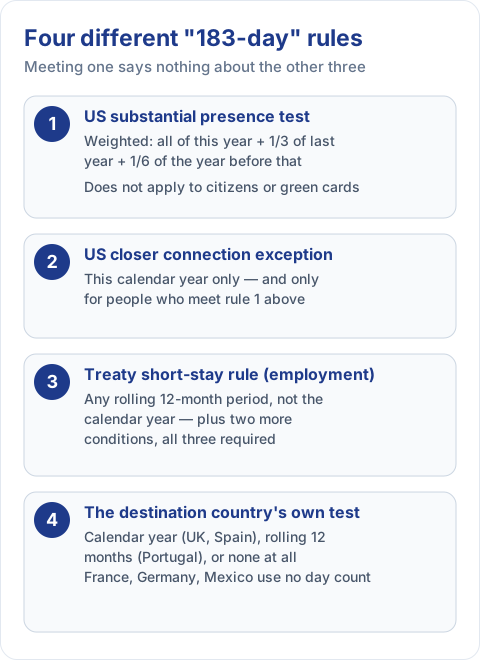
- "183 days" is not one rule — it's a label for at least four different, incompatible tests, each with its own counting window: the US substantial presence test, the closer connection exception, the treaty short-stay rule, and each destination country's own residency test.
- The US substantial presence test blends three years, not one. This year's days count in full, last year's at one-third, the year before at one-sixth; reach 183 on that blended total (plus at least 31 days this year) and you're a US resident.
- Staying under 183 days abroad is not automatically safe. France, Germany and Mexico can make you a tax resident with no day count at all — a household, a dwelling kept for ongoing use, or your center of vital interests can be enough on its own.
- The saving clause means a treaty never protects a US citizen from US tax — only from the other country's tax — so relief from the IRS side still has to come from the FEIE, the foreign tax credit, or the treaty's double-tax relief article.
- Leaving the US doesn't automatically end state residency. New York can treat you as a statutory resident for keeping a place of abode and spending over 183 days in-state; California requires clearing a 546-day safe harbor.
- The FEIE's physical presence test is a different count entirely — 330 full days abroad (midnight to midnight) in any 12 consecutive months, with zero partial credit for falling even a few days short.
"Stay under 183 days and you're fine." It is probably the single most repeated piece of tax advice among Americans living, working or traveling abroad, and it is also one of the most dangerous half-truths on the subject. "183 days" is not a rule. It is a number that shows up, with a different meaning and a different counting method, in at least four separate legal tests — two in US federal residency law, one in US treaties, and one used (with real variation) by other countries for their own residency tests — and several US states borrow the same number again. Meeting one of them tells you nothing about the others. In most destinations the day count is also only one route to residency among several: in France and Germany a home, a family or a center of economic interests can make you resident whatever your day count, and Mexico does not count days at all.
This article lays the four rules side by side, with the counting window and the consequence of each, flags the other day counts that catch US expats out, and links to our longer articles on digital nomad tax and dual tax residency for the full detail behind each one.
Four rules, one number
| Rule | Who it tests | Counting window | Below the threshold |
|---|---|---|---|
| US substantial presence test | Non-citizens without a green card | Weighted over three years: all days this year, 1/3 of last year, 1/6 of the year before — plus at least 31 days this year | Not a US resident under this test (citizenship and green cards are separate routes) |
| US closer connection exception | Non-citizens who meet the test above but spent fewer than 183 days in the US this year | This calendar year only | Can be treated as a nonresident if the other conditions hold and Form 8840 is filed on time |
| Treaty short-stay rule (employment income) | Employees resident in one treaty country who work temporarily in the other | Any rolling 12-month period, not the calendar year | Pay may be taxable only in the country of residence — only if two other conditions also hold, and never for a US citizen (the saving clause keeps US tax in place) |
| Foreign countries' own residency tests | Anyone physically present there | Varies: calendar year (Spain), UK tax year (April 6–April 5), rolling 12 months (Portugal), six months possibly straddling two years (Germany), none at all (Mexico) | Varies by country — in most, a home, family or economic ties can make you resident regardless of days |
Four different tests, four different clocks, four different consequences for failing or passing. Meeting the US substantial presence threshold does not change what France thinks of you, and staying under a foreign country's 183 days does not change what the IRS thinks of you. Each one has to be checked on its own.
What is the US substantial presence test?
Citizens never reach this test: worldwide income is taxed wherever a citizen lives, days spent anywhere are irrelevant for residency itself — though not for everything else, see "Other day counts" below. Green card holders are US tax residents under 26 U.S.C. § 7701(b)(1)(A)(i) for as long as the card has not been formally surrendered or revoked, however long they live abroad. One nuance worth knowing: a long-term green card holder (held in at least 8 of the last 15 tax years) who uses a treaty tie-breaker to be taxed as a nonresident is treated as having expatriated for tax purposes, which can trigger the exit tax — a trap the IRS confirmed applies only to long-term residents, not every green card holder, in Chief Counsel Advice 202501011. See our exit tax guide for what the covered-expatriate tests actually require. Our dual tax residency article covers this route, and the three US routes to residency, in full.
Everyone else runs into the actual day-count rule, and it is not what the "183 days" shorthand suggests: the substantial presence test weighs three years at once, not one. This year's days count in full, last year's at one-third, and the year before that at one-sixth; reach 183 on that blended total — it does not have to be exceeded — with at least 31 days this year, and the formula makes you a US resident. A handful of narrow exceptions keep days from counting at all: foreign-government personnel, certain students and teachers on F, J, M or Q visas, professional athletes at charitable events, and days you could not leave the US because of a medical condition that arose there.
What is the closer connection exception?
A narrower escape hatch exists under § 7701(b)(3)(B) and Treas. Reg. § 301.7701(b)-2, but only for people who already clear the three-year formula above. It takes three things at once, this calendar year specifically: a day count that stays under 183, a foreign tax home kept for the entire year, and ties abroad that outweigh whatever is left in the US. Clear all three and Form 8840 lets you file as a nonresident anyway — but it has to be filed on time, and late filing can cost you the exception. The door also shuts the moment any step toward a green card, even one still pending or filed by an employer or relative on your behalf, enters the picture. If you spent 183 days or more in the US this year, this exception is not available at all; only a treaty tie-breaker can help from there.
What is the treaty short-stay rule for employment income?
This one answers a narrower question than residency: not who you are for tax purposes, but whether one specific paycheck gets taxed where you worked, and it speaks only to employees. Article 14(2) of the 2016 US Model treaty ties the day count to any rolling twelve-month period, not the calendar year — though some older treaties, like the US–Barbados treaty, still count by calendar year — and the count is only one of three conditions, alongside who employs you and whether that employer has a taxable presence in the country where you worked. Several countries also apply an "economic employer" reading: if a local entity effectively bears your salary cost, it can count as your employer even though your contract is with the US company, and the exemption is lost. All three conditions have to hold at once; there is no credit for clearing two out of three.
Two limits matter even when all three conditions hold. First, the treaty's saving clause means this rule can shield a US citizen from the other country's tax, never from US tax — relief on the US side still comes from the foreign earned income exclusion, the foreign tax credit, or the treaty's double-tax relief article. Second, it does not cover the self-employed, whose income instead turns on whether they have a taxable presence in the country, not how many days they spent there. Social security sits outside this rule entirely: it runs on totalization agreements, whose detached-worker exemption typically lasts up to five years. Our article on digital nomad tax covers all three conditions and what an employer-of-record arrangement changes.
What is the destination country's own residency test?
This is the version most people actually mean by "183 days," and it is the least consistent of the four. Even among countries that use a day count, the clock runs differently, and the count is rarely the only route to residency: the UK measures its own tax year, April 6 to April 5, under the statutory residence test (and its separate ties test can make a recent leaver resident on as few as 16 days), Spain measures the calendar year under article 9 of Ley 35/2006 and also looks at where your economic interests or family sit, and Portugal measures the same 183 over a rolling twelve months, not January to December, under article 16 of the Código do IRS. Canada deems anyone who sojourns there 183 days or more in a calendar year to be resident under a statutory rule, paragraph 250(1)(a) of the Income Tax Act — distinct from the court-built "ordinarily resident" test, which can apply on far fewer days through residential ties, as the CRA's Income Tax Folio S5-F1-C1 explains.
Three major destinations put ties ahead of the day count. In France, a household, main job, or center of economic interests in France settles the question under article 4 B of the Code général des impôts (BOI-IR-CHAMP-10) — family living there can be enough on its own, even for someone who works abroad most of the year; more than six months in France is only treated as an indicator, not an absolute rule, and applies only once the household test is inconclusive. Germany makes you resident if you keep a dwelling there for ongoing use, under AO § 8, with no day count required — and separately, more than six months there (which can straddle two calendar years) creates a "habitual abode" on its own. Mexico, under article 9 of the Código Fiscal de la Federación, looks at where your home is, or your center of vital interests — chiefly whether more than half your income comes from Mexican sources — if you keep homes in two countries. There is nothing to count.
Keeping a household, a dwelling or close ties in France, Germany or Mexico even while under 183 days? Whether that makes you a local tax resident depends on facts specific to your situation, not a day count. Ask TaxLatitude to check your own residency risk →
Our dual tax residency article walks through seven countries' tests in full, and the free tax residency tool runs each one against its primary text.
Other day counts that catch US expats out
- The foreign earned income exclusion. The physical presence test requires 330 full days abroad during any 12 consecutive months — a full day runs midnight to midnight, so travel days usually don't count, and a few days short fails the test entirely, with no partial credit. Our FEIE vs. foreign tax credit guide compares it with the alternative.
- US state residency. Leaving the US does not end it automatically. New York treats you as a statutory resident if you keep a place of abode there for substantially all of the year and spend more than 183 days in the state, any part of a day counting as a full day. California's domicile-based test can reach residents working abroad unless they clear a 546-day safe harbor under FTB Publication 1031, with its own strict conditions. California, New York, Virginia, New Mexico and South Carolina are often cited as the hardest states to leave — see our state taxes after moving abroad guide for the general picture.
- Capital gains of nonresident aliens. Under § 871(a)(2), a nonresident alien present in the US for 183 days or more in a year owes a flat 30% on net US-source capital gains — a fifth US "183-day rule," with the opposite effect of the one most people expect.
- The Schengen 90/180 rule. It is an immigration rule, not a tax test, counted differently from any rule above — though its border records can still be used as evidence of where you actually were.
Moved abroad but still have ties to California, New York or another hard-to-leave state? Ending state residency takes specific affirmative steps — not just time spent away — and the test varies a lot by state. Ask TaxLatitude what your state still expects from you →
Common mistakes
- Treating "183 days" as one rule. It is a label attached to at least four tax tests and several more day counts elsewhere, each with its own window and its own consequence.
- Assuming a day count under 183 is always safe. France, Germany and Mexico can make you resident with no day count at all, and Spain, Portugal, the UK and Canada all have tie-based routes alongside their day counts.
- Using the calendar year everywhere. Portugal, most modern treaties and the FEIE physical presence test all use a rolling twelve-month period that does not reset on January 1.
- Relying on a treaty to escape US tax as a citizen. The saving clause preserves US taxation of citizens; the treaty helps with the other country's tax, not with US residency.
- Confusing the Schengen 90/180 count with any tax test. It is an immigration rule that answers a different question than any of the rules above.
- Meeting two of the treaty's three conditions and assuming that's enough. The short-stay exception requires all three; failing one removes it entirely.
- Filing Form 8840 late, or not at all. The closer connection exception has to be claimed on time; it is not applied automatically.
Before you rely on any day count
- Identify which rule actually applies to your situation — your US status, whether you are an employee or self-employed, and the specific destination country.
- Check that country's own domestic test first, including its non-day routes; a day count only protects you where the local law relies on it alone.
- If a treaty applies, read the actual employment article, not a summary — our guide to reading a US tax treaty walks through how — and remember the saving clause if you are a US citizen.
- Before leaving the US, check whether your state will still treat you as a resident, and what it takes to end that status.
- Keep a day log with evidence — boarding passes, entry stamps — for every country, every trip. None of these rules can be proven after the fact without records.
- Consult a qualified US cross-border tax adviser, and a local adviser for the destination country, before relying on any single number.
A note on scope: this article is general information, not tax or legal advice. It summarizes rules already covered in more depth in our articles on digital nomad tax and dual tax residency, as published by official sources we read on November 7, 2026, and rules change. It does not cover every country or every treaty. Check the current text of the law or treaty in question, and speak to a qualified professional about your own facts.
FAQ: the 183-day rule and US residency
Does staying under 183 days always keep me safe from being a tax resident abroad?
No. Several major destinations do not rely on a day count at all, or treat it as only one route among several. France can treat you as resident based on your household or center of economic interests even if you worked abroad most of the year. Germany makes you resident the moment you keep a dwelling there for ongoing use, with no day count required. Mexico looks at where your home or center of vital interests sits. Spain, Portugal, the UK and Canada all pair a day count with separate ties-based tests that can catch you well under 183 days.
What exactly is the US substantial presence test, and is it the same as "183 days"?
Not quite. The test weighs three years at once: this year's days count in full, last year's at one-third, and the year before that at one-sixth. You meet it once that blended total reaches 183, with at least 31 days physically in the US this year — it is a formula applied across three years, not a single year's day count.
Can a tax treaty stop the United States from taxing me as a citizen living abroad?
No. The saving clause in nearly every US treaty lets the United States keep taxing its citizens on worldwide income regardless of the treaty. A treaty's short-stay or residency provisions can reduce or eliminate the other country's tax, but relief from US tax comes separately from the foreign earned income exclusion, the foreign tax credit, or the treaty's double-tax relief article.
If I move abroad, does my US state residency end automatically?
No. States apply their own rules on top of, and independent from, any federal or foreign test. New York can treat you as a statutory resident if you keep a place of abode there and spend more than 183 days in the state, with any part of a day counting as a full day. California's domicile-based test can still reach you unless you clear a 546-day safe harbor under its own strict conditions. Ending state residency generally takes affirmative steps, not just time spent abroad.
Is the 183-day rule the same as the FEIE's physical presence test?
No, they answer different questions. The rules above test tax residency, or where a specific paycheck is taxed. The foreign earned income exclusion's physical presence test instead requires 330 full days abroad, midnight to midnight, within any 12 consecutive months, and it governs whether income can be excluded, not residency. Falling even a few days short fails the test entirely, with no partial credit.
Is the Schengen 90/180-day rule a tax rule?
No. It is an immigration rule that limits how long non-EU travelers can stay in the Schengen area, counted on its own rolling 180-day window, separate from every tax test above. It does not determine tax residency anywhere, though the border-crossing records tied to it can still be used as evidence of where you actually were when a tax test is being checked.
Sources
Primary sources (accessed November 7, 2026)
- IRS, U.S. Citizens and Resident Aliens Abroad.
- IRS, Substantial Presence Test.
- IRS, About Form 8840.
- IRS, Foreign Earned Income Exclusion – Physical Presence Test.
- IRS Office of Chief Counsel, Chief Counsel Advice 202501011 (released January 3, 2025).
- 26 U.S.C. § 7701 and § 871, via Cornell Law School, Legal Information Institute (§ 871).
- Treas. Reg. § 301.7701(b)-2, via Cornell Law School, Legal Information Institute.
- US Department of the Treasury, 2016 United States Model Income Tax Convention (Articles 1, 4 and 14).
- California Franchise Tax Board, Publication 1031, Guidelines for Determining Resident Status.
- New York State Department of Taxation and Finance, Frequently Asked Questions about Filing Requirements, Residency, and Telecommuting.
- UK Government, Finance Act 2013, Schedule 45 (Statutory Residence Test).
- Boletín Oficial del Estado (Spain), Ley 35/2006, artículo 9.
- Portuguese Tax and Customs Authority, Código do IRS, artigo 16.
- Canada Revenue Agency, Income Tax Folio S5-F1-C1.
- French tax administration, BOI-IR-CHAMP-10.
- Germany, Abgabenordnung (AO) § 8.
A note on method: this article synthesizes and compares rules already researched, sourced and published in our articles on digital nomad tax and dual tax residency, cross-checked against the primary sources above on November 7, 2026, including a round of independent verification against official and authoritative secondary sources. It does not cover every country, treaty or state. Read the current text of the statute, regulation or treaty before you rely on anything here.