Americans in Taiwan still file a full US return every year, and as of November 2, 2026 there is still no US-Taiwan income tax treaty or agreement in force. The House-passed relief bill (H.R. 33) is stuck in the Senate Finance Committee. Until that changes, you avoid double taxation the same way Americans in any no-treaty country do: the foreign earned income exclusion, the foreign tax credit, and careful planning around Taiwan's own minimum tax.
Scope. This guide covers Taiwan only: the jurisdiction administered from Taipei, comprising Taiwan, Penghu, Kinmen and Matsu. It does not cover mainland China (the People's Republic of China), the Hong Kong SAR or the Macau SAR. Each of those is a separate tax jurisdiction, with its own income tax laws, its own FATCA arrangement and, in mainland China's case, a full US tax treaty. Rules that apply in one of them do not carry over to Taiwan. TaxLatitude covers each in its own guide.
What this guide is not. This is a tax and compliance guide. Where Taiwan's diplomatic position affects how a tax mechanism works, such as why there is no ordinary treaty, we state that as a legal fact and go no further.
Figures below are for tax year 2025 (returns filed in 2026) unless marked 2026. Anything still changing carries an "as of" date. The research for this guide was done on November 2, 2026.
Key takeaways
- You still file with the IRS. US citizens and green card holders report worldwide income wherever they live. Living in Taiwan gives you an automatic extension to June 15 to file, but not to pay.
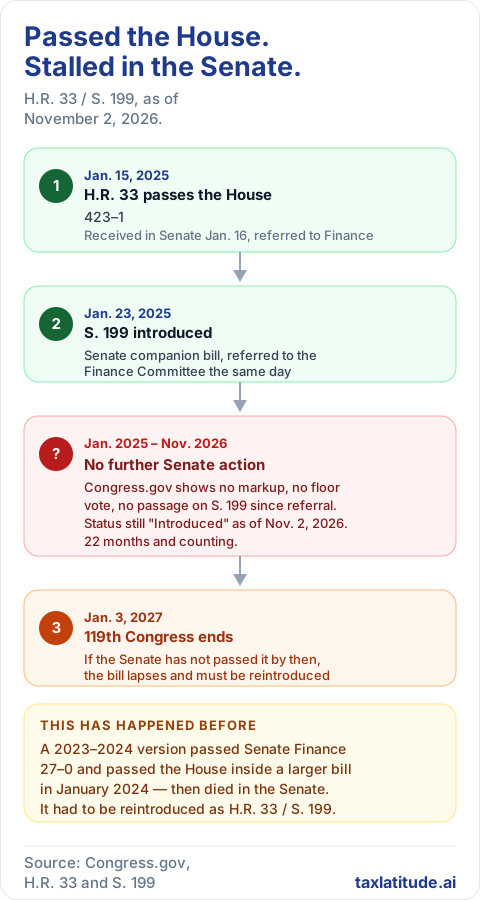
- No treaty, and no agreement yet. H.R. 33 passed the House 423–1 on January 15, 2025. Its Senate companion, S. 199, has had no recorded action since it was referred to the Finance Committee on January 23, 2025 (as of November 2, 2026). If the Senate does not act before the 119th Congress ends in early January 2027, both bills lapse. Even if enacted, the bill's US-side benefits exclude US citizens and green card holders.
- Taiwan's regular income tax is source-based. Residents (generally 183+ days for foreigners) pay 5%–40% on Taiwan-source income only. Foreign income, including US-source income, is reached only through the Income Basic Tax (Taiwan's AMT), and only above NT$1 million of foreign income and NT$7.5 million of total basic income.
- The FEIE and foreign tax credit do the work. The 2026 exclusion is $132,900 ($130,000 for 2025). Higher earners often do better with the foreign tax credit, because Taiwan's top rate of 40% exceeds the top US rate.
- No totalization agreement. Self-employed Americans owe US self-employment tax on top of Taiwan's National Health Insurance. Some employees pay into both systems.
- FATCA reaches your Taiwan accounts. Taiwan's Model 2 agreement was signed on December 22, 2016, and Taiwanese banks report US account holders directly to the IRS. FBAR, Form 8938 and, for Taiwanese funds and ETFs, Form 8621 are the forms people most often miss.
Do Americans living in Taiwan still file US taxes?
Yes. The United States taxes its citizens and green card holders on worldwide income no matter where they live. The IRS says they have the same filing requirements as Americans living in the US. Moving to Taipei, Kaohsiung or Kinmen changes how much you owe, not whether you file.
This applies equally to dual US-Taiwanese citizens. Holding a Republic of China passport or household registration does not end US filing obligations. Only formal renunciation of US citizenship, or formal abandonment of a green card, does that (see Leaving Taiwan).
Deadlines for Americans in Taiwan
| Item | Deadline | Notes |
|---|---|---|
| Form 1040 (regular) | April 15 | Interest on unpaid tax runs from April 15 |
| Form 1040 (living abroad) | June 15 | Automatic two-month extension if your tax home and abode are outside the US; attach a statement |
| Form 1040 (extended) | October 15 | File Form 4868 by the June deadline |
| FBAR (FinCEN Form 114) | April 15 | Automatic extension to October 15, no request needed |
| Taiwan individual return | May 1–31 | For the prior calendar year; moved to the next business day when May 31 falls on a weekend |
Sources: IRS IR-2025-39; NATP; National Taxation Bureau, via Regfollower.
The June 15 date is an extension to file, not to pay. The IRS charges interest on any balance from April 15. This matters for Americans in Taiwan because the two calendars clash. Taiwan's return for the same year isn't due until May 31, so you may not know your final Taiwan tax when the US payment is due. Estimate conservatively and pay by April 15.
Do I have to file if I owe nothing?
Usually yes. The filing threshold is based on gross income before the foreign earned income exclusion. The IRS notes that the exclusion only applies if you file a return reporting the income. Self-employed Americans must file once net self-employment earnings reach $400, even if the FEIE wipes out their income tax.
Behind on filing?
Many Americans in Taiwan, especially dual citizens raised there, learn of their US obligations late. The IRS Streamlined Foreign Offshore Procedures let non-willful filers catch up with three years of returns and six years of FBARs, generally without penalties. Use them before the IRS contacts you, because eligibility ends once an examination begins (TaxesForExpats, secondary).
When does Taiwan treat you as a tax resident, and what does it tax?
A US citizen without Taiwan household registration becomes a Taiwan tax resident after 183 days in Taiwan in a calendar year. Dual US-Taiwanese citizens with household registration face a much lower bar. Either way, Taiwan's regular income tax applies mainly to Taiwan-source income. Foreign income comes in only through the separate Income Basic Tax, covered in its own section below.
What are the residency tests?
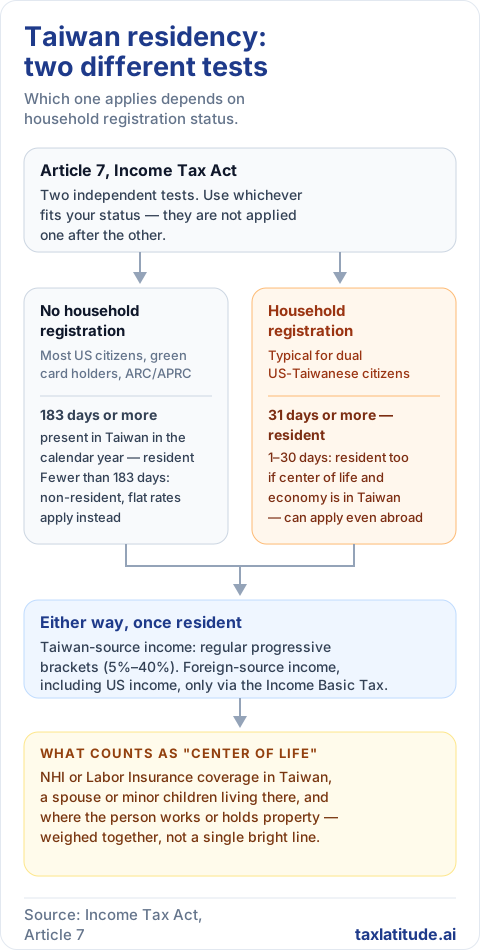
Article 7 of Taiwan's Income Tax Act sets two independent tests. You apply the one that fits your status; they are not applied in sequence.
| Your situation | You are a resident if... | Source |
|---|---|---|
| No household registration (most US citizens and green card holders, including ARC and APRC holders) | You are present 183 days or more in the calendar year | PwC |
| Household registration in Taiwan (typical for dual US-Taiwanese citizens) | You are present 31 days or more, or 1–30 days with your center of life and economy in Taiwan | Ministry of Finance rule effective 2013, via Kaizen CPA |
The "center of life" test weighs things like NHI or Labor Insurance coverage in Taiwan, whether your spouse or minor children live there, and where you work and hold property. PwC's summary lists the same factors (PwC, last reviewed August 20, 2026).
Three practical points follow:
- Days are counted per calendar year. There is no rolling 12-month period. Days before your job starts and days on return trips all count (KPMG).
- Dual citizens can be residents with very little time in Taiwan. A dual citizen who keeps household registration and spends a month a year visiting family can be a full Taiwan resident.
- Taiwan's immigration and tax records are linked. The tax authority can check your entry and exit dates directly.
What about non-residents?
If you are in Taiwan fewer than 183 days (and have no household registration), you are a non-resident.
- 90 days or fewer: salary paid by a Taiwan entity is withheld at 18%; salary paid and borne by a foreign employer for work in Taiwan is generally exempt.
- 91 to 182 days: Taiwan-source salary is taxed at a flat 18%, wherever it is paid, and you must file.
- Other non-resident rates: generally 20% on most other Taiwan-source income and 21% on dividends.
What are the resident tax rates?
Residents pay progressive tax on net Taiwan-source income after exemptions and deductions. Taiwan uses a "progressive difference" method: tax = taxable income × rate − difference.
| Net taxable income, tax year 2025 (filed May 2026), NT$ | Rate | Progressive difference, NT$ |
|---|---|---|
| 0 – 590,000 | 5% | 0 |
| 590,001 – 1,330,000 | 12% | 41,300 |
| 1,330,001 – 2,660,000 | 20% | 147,700 |
| 2,660,001 – 4,980,000 | 30% | 413,700 |
| Over 4,980,000 | 40% | 911,700 |
Source: PwC, last reviewed August 20, 2026.
For tax year 2026 (filed May 2027), the Ministry of Finance raised the bracket thresholds to NT$610,000, NT$1,380,000, NT$2,770,000 and NT$5,190,000 (Bloomberg Tax; figures confirmed in Ramco's payroll summary, a secondary source).
| Main allowances, NT$ | 2025 | 2026 |
|---|---|---|
| Personal exemption, per person | 97,000 | 101,000 |
| Standard deduction, single | 131,000 | 136,000 |
| Standard deduction, married filing jointly | 262,000 | 272,000 |
| Special deduction for salary income | 218,000 | 227,000 |
Sources: 2025 from Taipei Times and TaxesForExpats (secondary); 2026 from Bloomberg Tax, reporting the Ministry of Finance announcement of November 27, 2025.
What does a resident pay tax on?
- Taiwan salary and business income, at the rates above.
- Taiwan dividends. Residents choose between adding dividends to income with an 8.5% credit (capped at NT$80,000 per household) or a separate flat 28% rate (Lee and Li).
- Gains on Taiwan-listed shares are currently not subject to Taiwan income tax (TaxesForExpats, secondary). They are still fully taxable in the US.
- Gains on Taiwan real estate fall under the separate house and land transaction income tax (see Local considerations).
- Foreign income, including US wages, US dividends and gains on US brokerage accounts, is outside the regular income tax. It is reached only through the Income Basic Tax, and only above high thresholds.
That last point surprises many Americans. A Taiwan resident whose only income is US-source investment income can owe no Taiwan regular income tax at all.
What about Gold Card holders?
Foreign special professionals with an Employment Gold Card who meet the 183-day test and earn over NT$3 million in salary can exclude half of the salary above NT$3 million, for up to five years (KPMG). You must apply when filing, including on a departure return. Excluding salary in Taiwan raises your US tax, because it reduces the Taiwan tax available for your US foreign tax credit.
Is there a US-Taiwan tax agreement?
No. As of November 2, 2026, there is no US-Taiwan income tax treaty and no substitute agreement in force. The bill that would create one passed the House in January 2025 and has not moved in the Senate since. Even if it became law tomorrow, it would change little for most Americans who live in Taiwan, for reasons explained below.
Why is there no ordinary treaty?
The United States makes tax treaties as Article II treaties: the executive branch signs them and the Senate gives advice and consent to ratification. The United States does not have formal diplomatic relations with Taiwan, so that route is unavailable. The bill's own findings say so directly: Taiwan's unique status prevents an Article II tax treaty. Since the late 1970s, relations have been carried out through the American Institute in Taiwan (AIT) on the US side and the Taipei Economic and Cultural Representative Office in the United States (TECRO) on Taiwan's side (KPMG).
The 1984 US-China income tax treaty does not cover residents of Taiwan, as members of Congress noted during the House debate (Rep. Betty McCollum, statement for the record). Taiwan is now the largest US trading partner without a tax agreement (RSM).
How does Taiwan solve the same problem with other countries: representative-office agreements?
Taiwan has a large network of income tax agreements despite having formal diplomatic relations with few of its partners. Most are signed not between governments but between each side's representative offices. In substance they work like ordinary OECD-model treaties: residence tie-breakers, reduced withholding, permanent establishment rules and a mutual agreement procedure.
Two current examples show the form:
- The UK agreement is formally between the "Taipei Representative Office in the United Kingdom" and the "British Office" in Taipei. A protocol amending it took effect in 2022 (Ministry of Finance notice, via Orbitax).
- The renewed Singapore agreement is between the "Taipei Representative Office in Singapore" and the "Singapore Trade Office in Taipei." It was signed on December 31, 2025, entered into force on February 13, 2026, and applies from January 1, 2027 (Ministry of Finance).
PwC counts 36 effective comprehensive agreements as of July 31, 2026, plus 13 shipping and air transport agreements (PwC). The 36th, with Tuvalu, entered into force on June 11, 2026 (Orbitax). The United States is not on the list.
An AIT–TECRO agreement is the natural US equivalent, and the mechanism already exists for other subjects. The FATCA agreement (see below) was signed by AIT and TECRO, and so were the February 2026 Agreement on Reciprocal Trade and the January 2026 investment memorandum (Federal Register). The pending legislation is designed to give such a tax agreement legal force inside the United States.
What is the pending legislation: H.R. 33 and S. 199?
The House bill and its Senate companion are identical in design and have two parts.
Title I, the United States-Taiwan Expedited Double-Tax Relief Act, would add a new section 894A to the Internal Revenue Code. It writes treaty-like benefits directly into US law for "qualified residents of Taiwan" with US-source income. According to RSM's summary (RSM, March 11, 2025), it would:
- cut US withholding on interest and royalties from 30% to 10%, and on dividends to 15% (10% for qualifying corporate shareholders);
- tax Taiwanese businesses on US business profits only if they have a US permanent establishment;
- exempt wages of qualified Taiwan residents for short-term US work, tracking the US Model treaty;
- add residency tie-breaker rules for dual residents.
These benefits switch on only after the US determines that Taiwan gives reciprocal benefits to US persons (Thomson Reuters).
Title II, the United States-Taiwan Tax Agreement Authorization Act, would authorize the President to negotiate a fuller tax agreement with Taiwan, with consultation and approval procedures in Congress (S. 199 text). On Taiwan's side, any such agreement would also need to complete Taiwan's own approval process under its treaty law, as its other agreements do (Ministry of Finance).
Status as of November 2, 2026
| Date | Event | Source |
|---|---|---|
| Sept. 30, 2026 | Practitioner tracker reports S. 199 still pending in Senate Finance; no Senate passage | TaxesForExpats (secondary) |
| July 10, 2026 | Taiwan's representative in Washington says he hopes the Senate will pass the bill this year | CNA |
| June 18, 2026 | Taiwan's president urges a visiting House delegation to speed up the legislation | FAPA (advocacy group) |
| June 17, 2026 | US analysts tell CNA progress is unlikely before the November 2026 midterms | CNA |
| Jan. 23, 2025 | S. 199 introduced by Senate Finance and Foreign Relations leaders; referred to Finance. Congress.gov shows no later action | Congress.gov |
| Jan. 16, 2025 | H.R. 33 received in the Senate and referred to Finance | Congress.gov |
| Jan. 15, 2025 | H.R. 33 passes the House, 423–1 | Senate Finance Committee |
| Oct. 29, 2024 | Treasury announces AIT–TECRO negotiations on a comprehensive tax agreement | KPMG |
| 2023–2024 (118th Congress) | Senate Finance approves an earlier version 27–0 (Sept. 2023); House passes it inside a larger tax bill (Jan. 2024); it dies in the Senate | KPMG; Deloitte |
No report of Senate floor action, Senate passage or signature after September 30, 2026 turned up while researching this guide. Congress.gov still lists S. 199 as "Introduced." The 119th Congress ends on January 3, 2027. Bills that have not passed both chambers by then lapse and must be reintroduced, which is what happened to the 2023–2024 version. On the negotiating track, Taiwan's finance minister said in early 2026 that working-level talks continue and would speed up once the Senate acts (Taisounds). No negotiated text has been published.
What would the bill do and not do for Americans living in Taiwan?
Set expectations carefully here. The bill is mainly about Taiwanese residents and companies earning income in the United States.
- The US-side benefits exclude you. Proposed section 894A(c)(1)(B) excludes "United States persons," which covers US citizens and green card holders. It works like the saving clause in every US treaty (RSM). A US citizen in Taipei would still pay normal US tax on US dividends.
- The reciprocal Taiwan-side relief mostly goes to US residents. Taiwan's matching cuts would lower Taiwan withholding on payments to residents of the United States. A US citizen who is a Taiwan tax resident is taxed by Taiwan as a resident, not through withholding.
- Where it could help you: a future comprehensive AIT–TECRO agreement could add a mutual agreement procedure, clearer residency tie-breakers and possibly totalization-style rules for some workers. None of that is drafted publicly yet.
If you are an American who moves back to the US while holding Taiwanese investments, Taiwan's reciprocal relief could lower Taiwan's 21% dividend withholding on you. That is the group most likely to benefit directly.
How do you avoid paying tax twice?
Without a treaty, you rely entirely on US domestic law: the foreign earned income exclusion (FEIE), the foreign housing exclusion and the foreign tax credit (FTC). For most salaried Americans in Taiwan, one of these brings US tax on Taiwan wages to zero or close to it. The gaps are on investment income, self-employment tax and Taiwan's minimum tax.
What is the foreign earned income exclusion (Form 2555)?
You can exclude foreign earned income (wages, salary, self-employment income from work done in Taiwan) up to $130,000 for 2025 and $132,900 for 2026 per qualifying person (IRS; Rev. Proc. 2025-32 via KPMG). To qualify you need a tax home in Taiwan and must pass either:
- the bona fide residence test (resident of Taiwan for a full calendar year), or
- the physical presence test (330 full days outside the US in any 12-month period).
The foreign housing exclusion can add more. For 2026, qualified housing expenses generally count only above a base amount of $21,264, and only up to a cap of 30% of the FEIE, or $39,870. The usual maximum housing exclusion is therefore $18,606 (Don't Mess With Taxes, secondary). The IRS allows higher caps for certain high-cost cities. Check the current Form 2555 instructions for whether Taipei qualifies in your year.
Limits to know:
- The FEIE does not cover investment income, pensions or US-source income.
- It does not reduce self-employment tax.
- Income above the exclusion is taxed at the rate that would apply if the excluded income were included (the "stacking" rule).
- You cannot claim a foreign tax credit for Taiwan tax paid on excluded income.
What is the foreign tax credit (Form 1116)?
The FTC gives you a dollar-for-dollar credit for Taiwan income tax paid on foreign-source income, up to the US tax on that income. Unused credits carry back one year and forward ten.
For Americans in Taiwan, the FTC is often the better choice at higher incomes. Taiwan's resident rates reach 30% above NT$2.66 million (about US$85,000 at recent exchange rates) and 40% above NT$4.98 million. At those levels, Taiwan tax often exceeds the US tax on the same wages. The FTC then wipes out US tax on the wages and builds up excess credits.
The FTC also keeps your income "in" for other purposes. That helps if you want to contribute to an IRA or claim the refundable portion of the child tax credit.
Choosing between them
| Situation | Usually better | Why |
|---|---|---|
| Taiwan salary under the FEIE cap, modest Taiwan tax | FEIE | Simple; excludes income regardless of Taiwan tax paid |
| Taiwan salary in the 30%–40% Taiwan brackets | FTC | Taiwan tax often exceeds US tax; excess credits carry forward |
| Gold Card holder using the 50% Taiwan exclusion | Run both | Lower Taiwan tax means fewer credits; FEIE may win |
| Want IRA contributions or refundable child credit | FTC | Excluded income cannot support these |
| Self-employed | Either, plus SE tax | Neither removes US self-employment tax |
Revoking the FEIE after choosing it locks you out for five years unless the IRS consents. Model several years before you switch.
Where does double taxation still happen?
- US-source investment income. The US taxes it first, and you cannot take a US credit for foreign tax on US-source income. If Taiwan's Income Basic Tax reaches the same income, relief has to come from Taiwan's side. The section on Taiwan's Income Basic Tax explains how.
- Taiwan stock gains. Taiwan doesn't currently tax gains on listed shares, so there is no Taiwan tax to credit. You pay full US capital gains tax.
- Taiwanese funds and ETFs. Most are PFICs, taxed punitively in the US no matter what Taiwan charges (see Which US forms apply).
- Self-employment tax. Without a totalization agreement, nothing offsets US self-employment tax (next section).
- Timing and currency. Taiwan's calendar-year return is due May 31, after the US payment date of April 15. Convert Taiwan tax to dollars at the rate the IRS rules require. Many people use the yearly average rate for taxes paid through withholding, but the rules differ for accrual-basis and cash-basis taxpayers.
What about dividends from Taiwanese companies?
If you are a Taiwan resident, Taiwan dividends are taxed under the resident 8.5% credit or 28% option. If you are a non-resident, Taiwan withholds 21%. Either way, the Taiwan tax is generally creditable against US tax on the dividend, which is foreign-source passive income. Without a treaty, Taiwanese dividends generally do not count as "qualified dividends" in the US unless the shares are readily tradable on an established US market, such as an ADR. They are taxed at ordinary US rates.
Social security: is there a totalization agreement with Taiwan?
No. The Social Security Administration lists 30 agreements in force, and Taiwan is not one of them (SSA, checked November 2, 2026). Totalization agreements, like tax treaties, are concluded with foreign governments, so the same diplomatic obstacle applies. Neither the pending bill nor any announced AIT–TECRO talks address social security.
Without an agreement, each system applies its own coverage rules, and you can owe both.
Who pays what
| Your situation | US Social Security / Medicare | Taiwan social insurance |
|---|---|---|
| Employed by a Taiwanese employer | Generally not owed on wages from a foreign employer | Labor Insurance and NHI through your employer |
| Employed by a US employer, working in Taiwan | FICA generally still owed | Taiwan coverage can also apply if you are employed in Taiwan; check with your employer. Dual contributions are possible |
| Self-employed or freelance in Taiwan | US self-employment tax of 15.3% on 92.35% of net earnings, up to the wage base for the Social Security part; the FEIE does not reduce it | NHI enrollment once you meet residence rules (see Local considerations) |
| Owner-employee of your own Taiwan company | Usually none on salary from a foreign corporation, unless it is treated as a US employer | Labor Insurance and NHI through the company |
Self-employed Americans feel this most. A freelance English teacher, designer or consultant in Taipei can use the FEIE to eliminate US income tax and still owe roughly 15% of net profit in US self-employment tax.
Freelancing or consulting in Taiwan? The FEIE can bring your US income tax to zero, but it does nothing for the 15.3% US self-employment tax — and without a totalization agreement, there's no certificate of coverage to get out of it. See what you actually owe →
Unlike residents of agreement countries, they cannot get a certificate of coverage to exempt them.What are Taiwan's programs?
Taiwan's main programs are Labor Insurance, National Health Insurance and the Labor Pension (new system) (PwC).
- Labor Insurance: KPMG's guide gives a total rate of 11.5% of insured salary for foreign nationals, capped at an insured salary of NT$45,800 a month, split between employer, employee and government (KPMG).
- NHI: a 5.17% premium on insured salary, shared 60/30/10 among employer, employee and government, with an insured salary cap of NT$313,000 a month (KPMG; Go Global, secondary). A 2.11% supplementary premium applies to large bonuses and some other income (PwC).
- Labor Pension: employers must contribute at least 6% of monthly wages to an individual account for covered workers. PwC states that foreign individuals generally cannot join, but the Ministry of Labor confirms that APRC (permanent residency) holders have been covered since May 17, 2019 (Ministry of Labor). A 2025 amendment to the foreign professionals law reportedly opens the system to foreign professionals without APRC (FWNews, secondary). Confirm the implementation date with the Bureau of Labor Insurance before relying on it.
How does the US treat Taiwan contributions and benefits?
Taiwan Labor Insurance and NHI premiums you pay are not creditable foreign income taxes. A future Taiwan pension paid to a US citizen is taxable in the US, and with no treaty there is no special rule for it. A Labor Pension individual account may raise foreign trust or PFIC questions. Practitioners take different views, so get advice if your balance is significant.
The US Social Security benefit rules that once cut benefits for people with foreign pensions (the Windfall Elimination Provision) were repealed by the Social Security Fairness Act, signed on January 5, 2025 (SSA). A Taiwan Labor Insurance pension therefore no longer reduces a US Social Security benefit.
Which US forms apply to accounts and assets in Taiwan?
The information returns, not the income tax, are where Americans in Taiwan most often get into trouble. Penalties for missing them apply even when you owe no tax. Taiwanese banks and brokers know who their US customers are, because of FATCA.
What is Taiwan's FATCA agreement with the US?
On December 22, 2016, AIT and TECRO signed an agreement to implement FATCA, with Treasury and the IRS on one side and Taiwan's Financial Supervisory Commission on the other (AIT press release). It follows the Model 2 form, under which Taiwanese financial institutions register with the IRS and report US accounts directly, with account-holder consent (Regfollower; PwC).
A correction to a common claim. Many guides describe Taiwan's FATCA agreement as "in force." As of November 2, 2026, Treasury's official FATCA list shows Taiwan as "Signed", Model 2, not "In Force." Its footnote says the parties are AIT and TECRO, consistent with the Taiwan Relations Act (Treasury FATCA page). By contrast, Hong Kong's Model 2 agreement is listed as in force since July 6, 2016. Treasury also lists Taiwan as treated as having an agreement in effect from June 30, 2014. In practice Taiwanese banks do FATCA due diligence and reporting. For you, the difference doesn't matter: assume the IRS can see your Taiwan accounts.
Banks will ask US customers for a Form W-9 and consent to report. Refusing doesn't stop the reporting; it gets you reported as a "recalcitrant" account, and may get your account restricted.
The forms
| Form | Who files | Threshold or trigger | Penalty exposure |
|---|---|---|---|
| FBAR (FinCEN Form 114) | US persons with a financial interest in or signature authority over foreign accounts | Combined maximum balances over $10,000 at any time in the year | Steep civil penalties; higher for willful failures |
| Form 8938 | US persons with specified foreign financial assets, filed with Form 1040 | Living abroad: over $200,000 at year-end or $300,000 at any time (single); $400,000 / $600,000 (joint) | $10,000 and up |
| Form 8621 | Shareholders of a PFIC (most Taiwanese mutual funds and ETFs) | Generally each PFIC, each year, with limited exceptions | Statute of limitations stays open for the whole return |
| Form 5471 | US officers, directors and 10%+ shareholders of a foreign corporation, including a Taiwan company limited | Ownership or officer/director role | $10,000 per form per year and up |
| Form 8865 | US persons with interests in foreign partnerships | Ownership thresholds | $10,000 and up |
| Form 8858 | Owners of foreign disregarded entities or branches | Ownership | $10,000 and up |
| Form 3520 / 3520-A | Gifts or inheritances from foreign persons; foreign trusts | Gifts from foreign individuals over $100,000 in a year; any foreign trust transaction | Greater of $10,000 or 35% for most trust failures; 5% of the gift per month, up to 25%, for gifts |
| Form 8833 | Treaty-based return positions | Not applicable to Taiwan, because there is no treaty | — |
Sources: FBAR and Form 8938 thresholds from IRS IR-2025-39, Journal of Accountancy and Greenback (secondary); Form 8621 from IRS.
Penalty amounts: IRS international information reporting penalties.
What counts in Taiwan?
- Reportable for FBAR and generally for Form 8938: bank accounts, including Chunghwa Post savings accounts; brokerage accounts; investment-linked and cash-value life insurance policies, which Taiwanese banks sell widely; and accounts you sign on for an employer or a family member.
- Watch for signature authority. Dual citizens are often joint holders or signatories on parents' accounts. That alone triggers an FBAR.
- Labor Pension individual accounts and NHI are not bank accounts in the ordinary sense. Practitioners differ on reporting the Labor Pension account; many disclose it on Form 8938 as a foreign pension interest to be safe.
What's the PFIC problem with Taiwanese funds?
A foreign corporation is a PFIC if 75% or more of its income is passive, or 50% or more of its assets produce passive income. Almost every non-US mutual fund or ETF meets one test. That includes popular Taiwan-listed ETFs such as the Yuanta Taiwan 50 (0050) and high-dividend ETFs. Under the default PFIC rules, gains and "excess distributions" are taxed at the top ordinary rate with an interest charge, and losses can't offset other gains. The mark-to-market election softens this for listed ETFs. QEF elections are rarely available, because Taiwanese issuers seldom provide the annual statements needed.
For most Americans in Taiwan, the practical answer is to hold US-domiciled funds through a US broker that accepts Taiwan addresses, and to own individual Taiwan shares directly rather than through Taiwanese funds. Individual operating companies such as TSMC are generally not PFICs.
What is Taiwan's Income Basic Tax (AMT), and what are its CFC and PEM rules?
The Income Basic Tax is the one part of Taiwan's system that reaches a resident's foreign income, including US-source income. It catches only fairly wealthy residents, but for them it creates the most awkward US-Taiwan overlap. Taiwan's individual CFC rules, in force since January 1, 2023, feed into the same tax. Taiwan's PEM rules are written into law but, contrary to some summaries, have not taken effect as of November 2, 2026.
How does the Income Basic Tax work?
The tax is imposed under the Income Basic Tax Act (所得基本稅額條例, also called the AMT Act). For individuals it works like this (PwC, last reviewed August 20, 2026):
- Start with regular net taxable income.
- Add back certain items: some insurance payouts, certain private fund gains, non-cash donations, deductions for some start-up investments, foreign-source income, and CFC income.
- Foreign-source income is added only if the year's total is NT$1 million or more, and the IBT only applies if total basic income exceeds NT$7.5 million.
- Basic tax = (basic income − NT$7.5 million) × 20%.
- If basic tax exceeds regular income tax, you pay the difference on top of regular tax.
The NT$7.5 million exemption applies for both 2025 and 2026. The Ministry of Finance left it unchanged for 2026 because inflation had not reached the 10% adjustment trigger (Bloomberg Tax, December 2, 2025; Orbitax).
Foreign income has never been part of Taiwan's pre-filled tax data, so you must report it yourself (Kaizen CPA, secondary). Kaizen's published cases show the National Taxation Bureau reassessing residents who netted foreign losses incorrectly.
Why does this matter for Americans: the credit runs the wrong way?
For a US citizen living in Taiwan, the overlap works like this:
- The US taxes your US-source dividends, interest and gains first. These are US-source, so the US foreign tax credit cannot offset Taiwan's IBT on them. A US credit only covers foreign tax on foreign-source income, and there is no treaty to re-source the income.
- Taiwan's IBT can then tax the same income. For the IBT, US-source income is "foreign-source."
- Relief has to come from Taiwan. Taiwan lets you credit foreign income tax paid on that foreign-source income against the IBT, "with certain limitations" (PwC). KPMG notes that foreign tax credits are available in Taiwan only against the basic tax (KPMG).
The result: if your US tax on the income is lower than the extra Taiwan IBT it generates, you pay the difference to Taiwan. US long-term capital gains taxed at 15% against a 20% IBT rate is the typical case. Expect the bureau to ask for proof of US tax paid, such as your Form 1040 and IRS account transcripts. Confirm the exact documents with your local office.
Non-US foreign income works differently. Japanese or European dividends, say, are foreign-source for US purposes. Any Taiwan IBT on them is a foreign tax on foreign-source income, generally creditable on your US Form 1116 in the passive category.
A simplified example (tax year 2025)
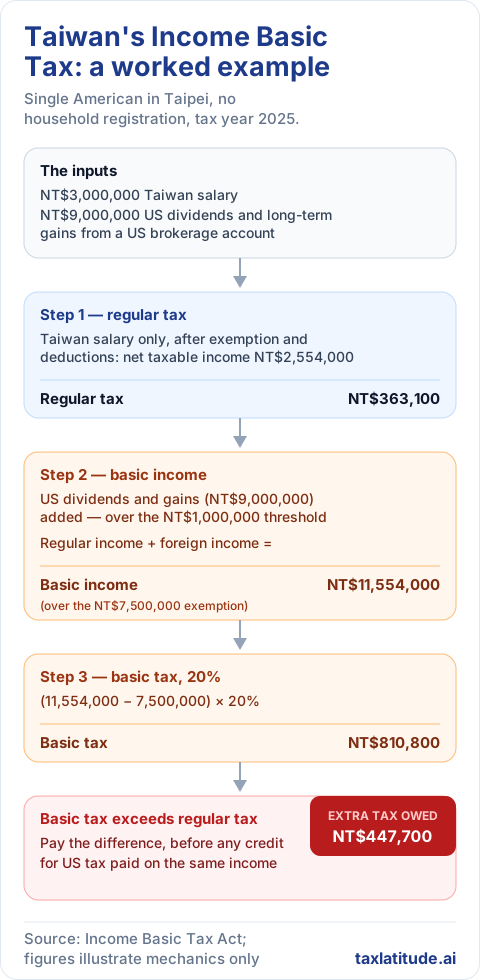
A single American living in Taipei with no household registration earns NT$3 million of Taiwan salary. She also has NT$9 million (about US$285,000) of US dividends and long-term gains from a US brokerage account. All other items are ignored.
| Step | NT$ |
|---|---|
| Taiwan salary | 3,000,000 |
| Less: exemption 97,000, standard deduction 131,000, salary deduction 218,000 | (446,000) |
| Regular net taxable income | 2,554,000 |
| Regular tax (20% × 2,554,000 − 147,700) | 363,100 |
| Add foreign-source income (over NT$1 million) | 9,000,000 |
| Basic income | 11,554,000 |
| Basic tax ((11,554,000 − 7,500,000) × 20%) | 810,800 |
| Extra Taiwan tax before foreign tax credit (810,800 − 363,100) | 447,700 |
The NT$447,700 (about US$14,000) is owed unless her US tax on the same income can be credited under Taiwan's limitation rules. With roughly US$43,000 of US tax at 15% on the investment income, a credit could eliminate most or all of it. Without the credit, or with poor documentation, she pays both. This illustrates the mechanics only; it is not a full calculation.
Realizing a big US capital gain while living in Taiwan? Above NT$1 million of foreign income and NT$7.5 million of basic income, Taiwan's Income Basic Tax can tax it too — in this guide's own example, that's an extra NT$447,700 (~$14,000) unless the US tax is properly credited. Check your own numbers before you sell →
Planning points:
- Watch the NT$1 million line. Harvesting large US gains in one year can push you over it. Spreading them out may keep foreign income under NT$1 million in some years.
- Time big events around residency. Gains realized in a year you are not a Taiwan resident never enter the IBT. Many Americans sell concentrated positions in the year before arriving or the year after leaving.
- Keep proof of US tax for every year you are an IBT filer.
What are Taiwan's CFC rules for individuals (in force since January 1, 2023)?
Taiwan's individual CFC regime is in Article 12-1 of the Income Basic Tax Act and took effect January 1, 2023, first applying to 2023 returns filed in May 2024 (Lee and Li). In outline:
- Who: a Taiwan-resident individual who, with related parties, holds 50% or more of, or has significant influence over, a company in a low-tax jurisdiction; and who, with a spouse and relatives within the second degree, directly holds 10% or more at year-end (Lee and Li).
- What: your share of the CFC's current-year earnings is treated as foreign-source income and added to basic income for the IBT, whether or not it is distributed. Later distributions of the same earnings are not taxed again.
- Low-tax jurisdictions: the Ministry of Finance published a reference list on December 13, 2022 (Lee and Li). Jurisdictions that tax only domestic-source income can qualify, so a Hong Kong holding company should be checked.
- Exemptions: CFCs with real local operations (a fixed place of business and employees doing substantive business), and a de minimis rule for low aggregate CFC earnings (Lee and Li).
- Foreigners are covered too. The Ministry of Finance has reminded foreign nationals who are residents under the 183-day test to apply the CFC rules (Regfollower).
An American resident in Taiwan who owns a BVI, Cayman or Hong Kong holding company can be caught by both countries' CFC regimes:
- Taiwan: the CFC's earnings flow into the IBT, subject to the NT$7.5 million exemption.
- US: Form 5471, Subpart F income, and from 2026 "net CFC tested income" (formerly GILTI).
The two systems measure income differently and do not coordinate, so model both before setting up an offshore holding structure.
Is place of effective management (PEM) in effect yet?
Article 43-4 of the Income Tax Act (2016) and regulations issued in May 2017 would treat a foreign company as a Taiwan tax resident if all three of these are in Taiwan:
- its key decision-makers or the place where they decide;
- its books and board or shareholder records;
- its main operating activities.
The company would then pay Taiwan's 20% corporate tax on worldwide income (PwC; JETRO).
Status correction. Some summaries say the CFC and PEM rules both started in 2023. Only the CFC rules did. As of PwC's review of August 20, 2026, the PEM mechanism "has yet to take effect" (PwC), and JETRO reported the same in January 2026. The Ministry of Finance has not announced a start date.
Why it still matters: many Americans in Taiwan run a US LLC or corporation from their Taipei apartment. If PEM is activated, a foreign company whose decisions, records and operations are all in Taiwan could become a Taiwan-resident company. Keep an eye on this if your business fits that description.
What is the US side of owning a Taiwan company?
If you own 10% or more of a Taiwan company (股份有限公司 or 有限公司), US rules apply regardless of Taiwan's:
- Form 5471 every year as a US shareholder, officer or director.
- Subpart F and net CFC tested income (NCTI). For tax years beginning after December 31, 2025, GILTI was renamed NCTI. The section 250 deduction for corporate shareholders dropped to 40%, and the QBAI exclusion was repealed (Bloomberg Law; National Law Review).
- High-tax exclusion. Income taxed above 18.9% (90% of the 21% US corporate rate) can be excluded by election, and the threshold is unchanged for 2026 (Greenback, secondary). Taiwan's corporate rate is 20% (PwC). Many ordinary Taiwan operating companies can therefore use the election, but the test uses US-computed income, so check each year.
- Section 962 election lets an individual be taxed like a corporation on CFC inclusions, with indirect credits for Taiwan corporate tax.
Local considerations (employment, running a business, real estate)
What happens if you work for a Taiwanese employer?
Your employer withholds Taiwan income tax monthly, enrolls you in Labor Insurance and NHI, and, if you are covered, contributes at least 6% of wages to a Labor Pension account. You still file a Taiwan return in May if you are a resident, or a departure return if you leave mid-year.
On the US side, wages from a Taiwanese employer usually carry no US Social Security tax. Your choice is FEIE or FTC (see How do you avoid paying tax twice?). Keep your Taiwan withholding statements (扣繳憑單) and the Taiwan assessment. These support your Form 1116 if you claim credits.
Two details:
- Year-end and Lunar New Year bonuses are Taiwan salary, and a bonus above four times your monthly insured salary can trigger the 2.11% NHI supplementary premium (PwC).
- Equity compensation from a Taiwanese employer is Taiwan-source salary when it vests or is exercised, and is generally US taxable as compensation at the same time. Taiwan and the US may value or time it differently, so keep grant documents.
What about National Health Insurance?
NHI enrollment is mandatory for eligible foreign residents, not optional:
- Employed ARC holders are enrolled from the first day of work, with no waiting period (Gold Card office; Expat Focus, secondary).
- Non-employed ARC holders, including the self-employed and dependents, must enroll after six months of residence. One trip abroad of under 30 days is allowed, with those days not counted (National Chung Hsing University, citing the NHI Act enforcement rules).
- Failing to enroll when required can bring fines (Taipei Medical University).
For US tax, NHI premiums are not income taxes and cannot be credited. They may count as medical expenses if you itemize, which few Americans abroad do. Otherwise NHI coverage has no effect on your US return.
What happens if you freelance or run a business?
- Sole proprietors and freelancers. As a Taiwan resident you report professional or business income on your Taiwan return. You owe US income tax (subject to FEIE or FTC) and US self-employment tax on net earnings. You can't escape the SE tax without a totalization agreement. Make quarterly US estimated payments.
- Taiwan company (有限公司). It pays 20% corporate income tax (PwC). Owning it triggers Form 5471 and the CFC regime described above. Salary it pays you generally carries no US self-employment tax. The salary is taxed in Taiwan and in the US, where the FEIE or foreign tax credit applies. Dividends it pays you are also taxed in both countries, with a US credit for the Taiwan tax on them.
- US LLC run from Taiwan. For US purposes a single-member LLC is usually disregarded, so its income is your self-employment income. Taiwan may treat it as a foreign company. If Taiwan ever activates PEM, management from Taiwan becomes a live issue. Taiwanese clients paying a foreign entity may also withhold Taiwan tax on service fees. Get advice before setting up this structure.
- Gold Card and work permits. Your immigration status matters for tax incentives and NHI timing, so keep it consistent with how you work.
What about real estate: the house and land transaction income tax?
Sales of Taiwan property bought after January 1, 2016 fall under the integrated house and land tax. It was tightened as "House and Land Tax 2.0" for sales from July 1, 2021 (PwC). The tax is on net gain, at rates set by residency and holding period:
| Holding period | Taiwan tax resident | Non-resident |
|---|---|---|
| 2 years or less | 45% | 45% |
| Over 2 to 5 years | 35% | 35% |
| Over 5 to 10 years | 20% | 35% |
| Over 10 years | 15% | 35% |
| Qualifying self-use residence | Gain up to NT$4 million exempt; 10% above | Not available |
Sources: TaxesForExpats and Expat Focus (secondary); non-resident rates confirmed by a National Taxation Bureau release via Regfollower; self-use rule from Lee and Li.
Points for Americans:
- Residency at the time of sale matters a lot. An American who leaves Taiwan and then sells a ten-year-old apartment pays 35% as a non-resident instead of 15%. Selling before you stop being resident can save 20 percentage points.
Thinking about selling Taiwan real estate after you leave? Non-residents pay 35% on property held over 5 years, versus 15% for residents who've held it more than a decade — timing the sale around your residency status can be worth 20 percentage points. Plan the timing of your sale →
- The self-use exemption has conditions: household registration at the property, owner-occupancy for six years, no rental or business use, and once every six years (Lee and Li). Many foreign residents without household registration cannot meet them.
- Non-residents must file and pay within 30 days after title transfer is registered (Vocus, secondary).
- On the US side the gain is taxable, measured in dollars. Currency movement alone can create a US gain or loss that differs from the Taiwan gain. The house and land tax is an income tax on the gain and is generally creditable on Form 1116. The US home-sale exclusion (section 121, up to $250,000 or $500,000) applies to a Taiwan main home that meets the two-of-five-year test, even when Taiwan's exemption doesn't.
- A mortgage in NT dollars can produce a taxable US currency gain when you pay it off if the dollar has strengthened. This often surprises people.
Annual holding taxes are modest: land value tax of 1% to 5.5% of assessed value and house tax of 1% to 4.8% for non-commercial buildings (PwC). These are property taxes, not income taxes, so they are not creditable. Under current US law, foreign property tax on a personal home is generally not deductible; on a rental property it is a deductible expense.
What about estate and gift tax?
Taiwan levies estate and gift taxes at 10%, 15% and 20%. The estate exemption is NT$13.33 million and the annual gift exemption NT$2.44 million per donor (PwC, last reviewed August 20, 2026). There is no US-Taiwan estate tax treaty (TaxesForExpats, secondary). A US citizen's worldwide estate is also subject to US estate tax, with a basic exclusion of $15 million in 2026 (W1M, secondary). In practice Taiwan's lower exemption makes Taiwan estate tax the more likely of the two for most families. Large gifts or inheritances from Taiwanese relatives to a US person also trigger Form 3520, with a penalty that applies even though no tax is owed on the gift.
What happens when leaving Taiwan?
Moving out of Taiwan is mainly a Taiwan compliance event: a departure return and payment before you go. On the US side, simply moving away from Taiwan, whether back to the US or on to another country, has no exit tax. The US expatriation tax applies only if you give up US citizenship or end long-term green card status.
What do you need to do in Taiwan before you go?
- Departure return. A foreign resident leaving Taiwan for good, or leaving mid-year without returning that year, must file and pay the current year's tax before departure (KPMG; National Taxation Bureau, via Regfollower). BDO's guide puts the deadline at 10 days before departure (BDO).
- Exit restrictions. If you leave owing tax, the tax authority can ask immigration to stop you at departure (KPMG).
- Gold Card incentive. Claim the 50% salary exclusion on the departure return, or you may lose it (Vialto).
- Residency in your last year. If your days in Taiwan in the departure year fall below 183, and you have no household registration, you are a non-resident for that year. Non-resident rates apply to that year's Taiwan income: 18% on salary, with no exemptions or deductions. This can make a mid-year departure more expensive than expected.
- Dual citizens with household registration stay potential residents under the 31-day test while registration remains, even if they live abroad. If you are genuinely moving, deal with your household registration status and keep evidence that your center of life has moved.
- Property. Selling Taiwan real estate after you become a non-resident moves you to the 45%/35% non-resident rates (see Local considerations).
- NHI. Coverage ends when your ARC ends. Long absences raise separate suspension rules, so tell NHI.
There is no Taiwan exit tax on unrealized gains for individuals who leave.
What changes and what doesn't change in the United States?
- Moving back to the US ends FEIE eligibility from your move date, and the exclusion is prorated in the move year. Foreign tax credits for Taiwan tax already paid can still be used.
- Your Taiwan accounts remain reportable on FBAR and Form 8938 (at the lower US-resident thresholds once you live in the US) for as long as you keep them.
- Taiwanese PFIC holdings stay subject to PFIC rules. Selling before you leave doesn't change the US treatment, but it can simplify your life.
- State tax. Some US states, such as California, may treat you as resident again from your move, and some may argue you never stopped being one. Check your state's rules.
When do Form 8854 and the expatriation tax apply?
The exit tax under section 877A and Form 8854 apply only to:
- US citizens who renounce or relinquish citizenship, and
- long-term residents (green card holders in 8 of the last 15 years) who give up green card status.
They do not apply to an American who simply moves from Taiwan to another country.
If you do expatriate, you are a "covered expatriate" if you meet any one of three tests:
- net worth of $2 million or more;
- average annual net US income tax over the prior five years above a threshold, which is $211,000 for 2026 (Barrett Tax Law, secondary);
- failure to certify five years of US tax compliance on Form 8854.
Covered expatriates are taxed as if they sold their worldwide assets the day before expatriating, above an inflation-adjusted exclusion. Dual US-Taiwanese citizens may qualify for a narrow exception to the first two tests if they were born dual citizens and meet residency limits. Renunciation takes place at AIT in Taipei. Our exit tax tool estimates exposure.
Mistakes Americans commonly make in Taiwan
- Assuming a treaty exists, or that one passed. Headlines about the House vote in January 2025 led many people to think the matter was settled. As of November 2, 2026 nothing has been enacted. Even if the bill passes, its US benefits exclude US citizens and green card holders.
- Treating Taiwan like mainland China or Hong Kong. The US-China treaty, Hong Kong's FATCA status, and mainland China's individual income tax rules don't apply in Taiwan. Forms, rates and residency tests are all different.
- Stopping US filing because the FEIE covers everything. The exclusion only works if you file and claim it. Missing returns also put Streamlined eligibility and FBAR penalty relief at risk.
- Forgetting self-employment tax. Freelancers often assume the FEIE wipes out all US tax. It doesn't touch the 15.3% SE tax, and Taiwan's lack of a totalization agreement means there is no way out.
- Buying Taiwanese funds and ETFs. 0050 and similar funds are almost always PFICs. Reporting them late or not at all brings punitive tax and a return that stays open to audit indefinitely.
- Ignoring the Income Basic Tax on US investments. Wealthier residents often assume Taiwan never taxes foreign income. Above NT$1 million of foreign income and NT$7.5 million of basic income, it does, and the foreign tax credit has to be claimed in Taiwan.
- Dual citizens miscounting Taiwan residency. With household registration, 31 days in Taiwan can make you a resident. That brings in the IBT, CFC rules and Taiwan filing.
- Missing FBARs on family accounts. Signature authority over a parent's or spouse's Taiwan account, or joint ownership, triggers FBAR reporting.
- Selling Taiwan property after becoming non-resident. Non-residents pay 35% even after ten years, compared with 15% for residents.
- Leaving without a departure return. It can lead to fines and a stop at the airport, and it wastes incentives like the Gold Card exclusion.
- Mixing up the June 15 date. It extends the time to file. Interest on unpaid US tax still runs from April 15.
- Assuming Taiwan's PEM rules already apply, or will never apply. They are not in force, but running a foreign company entirely from Taiwan is the scenario they target.
Checklist
When you arrive
- Work out which Taiwan residency test applies to you: 183 days, or 31 days if you have household registration.
- Get your ARC (or confirm household registration) and enroll in NHI on time.
- Give your Taiwan bank and broker a Form W-9; expect FATCA reporting.
- Review any Taiwanese funds or ETFs you're offered for PFIC exposure before buying.
- Decide when to realize large US gains, given Taiwan's NT$1 million foreign income threshold.
Every year
- Pay estimated US tax by April 15, even if you file in June.
- File Form 1040 by June 15 (attach the abroad statement), or extend to October 15.
- Choose the FEIE (Form 2555) or FTC (Form 1116) and keep the choice consistent.
- Pay US self-employment tax (Schedule SE) if self-employed.
- File the FBAR if combined foreign balances exceed $10,000.
- File Form 8938 if over the living-abroad thresholds.
- File Form 8621 for each PFIC; Form 5471 for any foreign company you own or manage.
- File the Taiwan return May 1–31; include foreign and CFC income for the Income Basic Tax if over the thresholds.
- Keep Taiwan withholding statements, the Taiwan assessment, and proof of US tax paid.
Before you leave
- File and pay the Taiwan departure return before you go.
- Consider selling Taiwan property while still a resident.
- Claim any Gold Card exclusion on the departure return.
- Settle your household registration status if you are a dual citizen.
- Plan your final-year FEIE proration and the state residency effects of moving back to the US.
Watch list (as of November 2, 2026)
- Senate action on S. 199 / H.R. 33 before the 119th Congress ends on January 3, 2027; otherwise reintroduction in 2027.
- Any published AIT–TECRO tax agreement text.
- A start date for Taiwan's PEM rules.
- Implementation of Labor Pension coverage for foreign professionals without APRC.
Frequently asked questions
Is there a US-Taiwan tax treaty? No. Because the US has no diplomatic relations with Taiwan, an ordinary Senate-ratified treaty isn't possible. As of November 2, 2026, no substitute agreement is in force either.
Did the US-Taiwan double-tax relief bill become law? No. H.R. 33 passed the House 423–1 on January 15, 2025. Its Senate companion, S. 199, has stayed in the Finance Committee since January 23, 2025. Unless it passes both chambers before the 119th Congress ends on January 3, 2027, it will have to be reintroduced.
Would the bill help me as an American living in Taiwan? Very little. Its US tax benefits exclude US citizens and green card holders, and Taiwan's matching relief would mostly benefit residents of the US.
Does Taiwan tax my US salary, dividends or brokerage gains? Not under the regular income tax, which taxes Taiwan-source income. Foreign income enters only through the Income Basic Tax, and only if it totals NT$1 million or more in the year and your basic income exceeds NT$7.5 million.
How many days make me a Taiwan tax resident? 183 days in a calendar year if you have no household registration. With household registration, 31 days, or fewer if your center of life is in Taiwan.
Should I use the FEIE or the foreign tax credit? The FEIE ($132,900 for 2026) suits moderate salaries with modest Taiwan tax. The foreign tax credit usually wins once your Taiwan income reaches the 30%–40% brackets, or if you want IRA contributions or the refundable child tax credit.
Do I pay US Social Security tax as a freelancer in Taiwan? Yes. There is no US-Taiwan totalization agreement, so self-employed Americans owe US self-employment tax on net earnings, even when the FEIE eliminates their income tax.
Can I invest in Taiwanese ETFs like 0050? You can, but they are almost always PFICs. They need Form 8621 each year and face punitive US tax unless you make a mark-to-market election. Many Americans hold US-domiciled funds and individual Taiwan shares instead.
Will my Taiwan bank report me to the IRS? Yes. AIT and TECRO signed a Model 2 FATCA agreement on December 22, 2016. Treasury lists it as "Signed" rather than "In Force," but Taiwanese banks do FATCA reporting in practice.
Have Taiwan's PEM rules started? No. Taiwan's individual CFC rules took effect January 1, 2023, but the PEM rules, though legislated in 2016, had not taken effect as of August 2026, and no start date has been announced.
What tax do I pay selling a Taiwan apartment? The house and land transaction income tax: 15%–45% for residents depending on how long you held the property, with a self-use break, or 45%/35% for non-residents. The gain is also taxable in the US, with a credit for the Taiwan tax.
Do I owe the US exit tax when I leave Taiwan? No. Form 8854 and the expatriation tax apply only when you renounce US citizenship or give up long-term green card status, not when you move.
When should you hire a professional?
A salaried American in Taiwan with a Taiwan bank account and a US brokerage account can often handle both returns alone, or with a basic expat preparer. Get qualified help, ideally someone who works on both US and Taiwan returns or a US preparer who coordinates with a Taiwan CPA, if any of these apply:
- You may owe Taiwan's Income Basic Tax. That means foreign income near or above NT$1 million and basic income near NT$7.5 million. Claiming the Taiwan credit for US tax needs careful documentation.
- You own or manage a company: a Taiwan company, an offshore holding company (BVI, Cayman, Hong Kong) or a US entity run from Taiwan. You face Form 5471, NCTI, Taiwan CFC rules and possible future PEM exposure.
- You hold Taiwanese funds, ETFs or investment-linked insurance, so PFIC elections and catch-up filings are needed.
- You are a dual citizen with household registration whose Taiwan residency is unclear, or who has never filed US returns and needs the Streamlined procedures.
- You are buying or selling Taiwan property, especially around a change of residency.
- You are self-employed and want to structure your work to manage self-employment tax and NHI.
- You are considering renouncing US citizenship or giving up a green card, which requires covered-expatriate testing on Form 8854.
- You are moving to or from Taiwan mid-year, with departure returns, non-resident rates, FEIE proration and state residency all in play.
Ask any adviser whether they have filed Taiwan IBT returns with US tax credits, and whether they track the S. 199 legislation. Both questions quickly show whether they know this specific corridor.
This guide is general information, not tax or legal advice for your situation.
Sources
Research was done on November 2, 2026. Entries marked "secondary" are law firm, practitioner, advocacy or general media summaries. Unmarked entries are government bodies and public institutions, Big Four and other major accounting firms, professional tax news services, and Taiwan's national news agency (CNA).
| Source | URL | Used for |
|---|---|---|
| IRS, Tax Tip 2023-36 | irs.gov | Americans abroad have the same filing duties |
| IRS, IR-2025-39 | content.govdelivery.com | June 15 extension, interest from April 15, FBAR dates |
| IRS, Figuring the FEIE | irs.gov | FEIE amounts for 2025/2026; must file to claim |
| IRS, Form 8621 | irs.gov | PFIC reporting |
| IRS, International information reporting penalties | irs.gov | Penalties for Forms 5471 and 3520 |
| KPMG, Rev. Proc. 2025-32 summary | kpmg.com | 2026 FEIE of $132,900 |
| US Treasury, FATCA page | home.treasury.gov | Taiwan IGA status "Signed," Model 2; Hong Kong comparison |
| AIT, press release PR-1671E | web-archive-2017.ait.org.tw | FATCA agreement signed December 22, 2016 |
| SSA, Status of totalization agreements | ssa.gov | 30 agreements in force; Taiwan not listed |
| SSA, Legislative bulletin 118-13 | ssa.gov | WEP repeal signed January 5, 2025 |
| Congress.gov, H.R. 33 | congress.gov | Latest action: referred to Senate Finance January 16, 2025 |
| Congress.gov, H.R. 33 text | congress.gov | Findings on Taiwan's status; structure of the bill |
| Congress.gov, S. 199 actions | congress.gov | Only action: introduced January 23, 2025 |
| Congress.gov, S. 199 text | congress.gov | Title II authorization of a tax agreement |
| Senate Finance Committee release, January 23, 2025 | finance.senate.gov | S. 199 introduction; House vote 423–1 |
| Federal Register 2026-10571 | federalregister.gov | AIT–TECRO trade agreement and investment memorandum (2026) |
| Taiwan Ministry of Finance, House passage release | mof.gov.tw | Taiwan's view of the bill; approval under Taiwan's treaty law |
| Taiwan Ministry of Finance, Singapore agreement | mof.gov.tw | Representative-office agreement example; dates |
| Ministry of Labor (Taiwan) | english.mol.gov.tw | Labor Pension coverage for APRC holders from May 17, 2019 |
| Taiwan Gold Card office | goldcard.nat.gov.tw | NHI from the first day of employment |
| National Chung Hsing University | clc.nchu.edu.tw | NHI six-month rule for non-employed ARC holders |
| Taipei Medical University | oge.tmu.edu.tw | Fines for failing to enroll in NHI |
| CNA, July 11, 2026 | cna.com.tw | Taiwan representative's hopes for Senate passage |
| CNA, June 18, 2026 | cna.com.tw | Analysts' view of the midterm timing |
| PwC, Taiwan individual residence | taxsummaries.pwc.com | Residency tests; center of life factors |
| PwC, Taiwan taxes on personal income | taxsummaries.pwc.com | 2025 brackets, non-resident rates, IBT mechanics and credit |
| PwC, Taiwan individual other taxes | taxsummaries.pwc.com | Social insurance, NHI supplementary premium, property, estate and gift tax |
| PwC, Taiwan corporate significant developments | taxsummaries.pwc.com | CFC in force; PEM not in effect; 36 agreements; House and Land Tax 2.0 |
| PwC, Taiwan corporate income tax | taxsummaries.pwc.com | 20% corporate rate |
| PwC, Taiwan corporate other issues | taxsummaries.pwc.com | Model 2 IGA signed December 2016 |
| KPMG, Taxation of International Executives: Taiwan | assets.kpmg.com | Day counting, non-residents, departure, social insurance, Gold Card, credit only against IBT |
| KPMG, GMS Flash Alert 2023-183 | kpmg.com | AIT/TECRO background; Senate Finance 27–0 vote |
| KPMG, Treasury announcement, October 29, 2024 | kpmg.com | AIT–TECRO tax agreement negotiations |
| Deloitte, Tax News & Views, January 17, 2025 | dhub.deloitte.com | Bill's fate in the 118th Congress |
| RSM, House passes US-Taiwan Expedited Double-Tax Relief Act | rsmus.com | Bill provisions; saving clause; Taiwan as largest partner without a treaty |
| Thomson Reuters | tax.thomsonreuters.com | Reciprocity condition |
| Bloomberg Tax, 2026 brackets | news.bloomberglaw.com | 2026 bracket thresholds |
| Bloomberg Tax, 2026 exemptions | news.bgov.com | 2026 exemption and deductions |
| Bloomberg Tax, 2026 IBT amounts | news.bloombergtax.com | NT$7.5 million IBT exemption unchanged for 2026 |
| Bloomberg Law, OBBBA international changes | news.bloomberglaw.com | GILTI renamed NCTI |
| National Law Review (secondary) | natlawreview.com | Section 250 deduction 40% |
| JETRO | jetro.go.jp | PEM not in effect as of January 2026 |
| Lee and Li (secondary) | leeandli.com | Individual CFC rules from January 1, 2023 |
| Lee and Li (secondary) | leeandli.com | CFC ownership tests |
| Lee and Li (secondary) | leeandli.com | Low-tax reference list, December 13, 2022 |
| Lee and Li (secondary) | leeandli.com | CFC substance exemption |
| Lee and Li (secondary) | mx3.leeandli.com | Dividend 8.5% credit / 28% option |
| Lee and Li (secondary) | leeandli.com | Self-use residence rules |
| Kaizen CPA (secondary) | kaizencpa.com | 31-day household registration rule |
| Kaizen CPA (secondary) | kaizencpa.com | Reporting foreign income for the IBT |
| Orbitax (secondary) | wpqa.orbitax.com | UK agreement parties and protocol |
| Orbitax (secondary) | orbitax.com | Tuvalu agreement in force June 11, 2026 |
| Orbitax (secondary) | orbitax.com | 2026 IBT amounts unchanged |
| Regfollower (secondary) | regfollower.com | Taiwan filing period |
| Regfollower (secondary) | regfollower.com | Model 2 mechanics |
| Regfollower (secondary) | regfollower.com | CFC reminder to foreign residents |
| Regfollower (secondary) | regfollower.com | Non-resident house and land tax rates |
| Regfollower (secondary) | regfollower.com | File and pay before departure |
| Taipei Times (secondary) | taipeitimes.com | 2025 exemption and deduction amounts |
| Taisounds (secondary) | taisounds.com | Finance minister on working-level talks |
| FAPA (secondary, advocacy) | fapa.org | June 2026 call for passage |
| TaxesForExpats (secondary) | taxesforexpats.com | S. 199 status as of September 30, 2026 |
| TaxesForExpats (secondary) | taxesforexpats.com | 2025 allowances; listed share gains; property rates; no estate treaty |
| TaxesForExpats (secondary) | taxesforexpats.com | Streamlined Foreign Offshore Procedures |
| Ramco (secondary) | ramco.com | Cross-check of 2026 brackets |
| Don't Mess With Taxes (secondary) | dontmesswithtaxes.com | 2026 housing exclusion limits |
| Journal of Accountancy (secondary) | journalofaccountancy.com | Form 8938 living-abroad thresholds |
| Greenback (secondary) | greenbacktaxservices.com | Form 8938 thresholds |
| Greenback (secondary) | greenbacktaxservices.com | 18.9% high-tax exclusion unchanged for 2026 |
| NATP (secondary) | natptax.com | Extension mechanics |
| Go Global (secondary) | goglobal.com | NHI 60/30/10 split |
| FWNews (secondary) | fwnews.com.tw | 2025 Labor Pension amendment for foreign professionals |
| Expat Focus (secondary) | expatfocus.com | NHI enrollment timing |
| Expat Focus (secondary) | expatfocus.com | Property gains tax rates |
| Vocus (secondary) | vocus.cc | Non-resident 30-day filing for property sales |
| BDO (secondary) | global-tst2.bdo.global | 10-day departure filing |
| Vialto (secondary) | vialtopartners.com | Gold Card claim on departure return |
| W1M (secondary) | w1m.com | 2026 US estate exclusion |
| Barrett Tax Law (secondary) | barretttaxlaw.com | 2026 covered expatriate tax threshold |
| Rep. Betty McCollum, statement on H.R. 33 | mccollum.house.gov | US-China treaty does not cover Taiwan residents |