Form 8854 is the statement every former U.S. citizen and every former long-term green card holder files with the IRS. It does three jobs at once. It reports your expatriation. It decides whether you are a "covered expatriate" subject to the exit tax under §877A. And, if you are covered, it is where the exit tax is computed and, if you choose, deferred.
Key takeaways
- You're a "covered expatriate" if you meet just one of three tests. Average annual net income tax above $211,000 for the five prior years (2026 figure), net worth of $2,000,000 or more, or an inability to certify five years of tax compliance.
- If covered, the exit tax treats all your property as sold the day before expatriation — but the first $910,000 of mark-to-market gain is excluded (2026 figure, up from $890,000 in 2025).
- Use the figures for your actual expatriation year, not the year you file. Someone who renounced in December 2025 still uses the 2025 numbers, $206,000 and $890,000, even when filing the return in 2026.
- Green card holders face this exactly like renouncing citizens once they meet the long-term resident test — and they are the group most often missed.
- Form 8854 has two different modes. An initial statement, filed once by every expatriate whether or not they're covered (it's literally how you prove you're not), and an annual statement, filed only if you deferred the exit tax, have eligible deferred compensation, or are a beneficiary of a nongrantor trust.
- Missing the form costs a flat $10,000 penalty under §6039G(c) — separate from, and regardless of, whether you actually owed any exit tax at all.
Key figures at a glance
For a 2026 expatriation, you are covered if your average annual net income tax for 2021–2025 is more than $211,000, or your net worth is $2,000,000 or more, or you cannot certify five years of tax compliance. If covered, the first $910,000 of mark-to-market gain is excluded.
| Item | 2025 expatriation | 2026 expatriation | Indexed? | Primary source |
|---|---|---|---|---|
| Average annual net income tax test (5 prior years) | more than $206,000 | more than $211,000 | Yes (statutory base $124,000) | §877(a)(2)(A); Rev. Proc. 2024-40 §2.37; Rev. Proc. 2025-32 §4.37 |
| Net worth test | $2,000,000 or more | $2,000,000 or more | No | §877(a)(2)(B) |
| Five-year compliance certification | Required | Required | Not a dollar test | §877(a)(2)(C) |
| Exclusion of mark-to-market gain | $890,000 | $910,000 | Yes (statutory base $600,000) | §877A(a)(3); Rev. Proc. 2024-40 §2.38; Rev. Proc. 2025-32 §4.38 |
| §2801 annual amount (gifts/bequests to U.S. recipients) | $19,000 | $19,000 | Yes | Instructions for Form 708; Rev. Proc. 2025-32 §4.42 |
| Penalty for not filing Form 8854 | $10,000 | $10,000 | No | §6039G(c) |
The net worth threshold is written into the statute and is not indexed. Inflation keeps raising the other two figures, so the net worth test catches more people every year. The 2026 figures also appear in the IRS's draft 2026 Instructions for Form 8854 (dated August 18, 2026, not yet final).
Don't reuse old numbers. Each figure belongs to the calendar year of your expatriation date, not to the year you file. A person who renounced in December 2025 uses $206,000 and $890,000 even when filing in 2026.
The legal basis: four Code sections working together
Form 8854 sits where four sections of the Internal Revenue Code meet. Each does one job.
| Section | What it does | Where it shows up on Form 8854 |
|---|---|---|
| §877A | The exit tax. All property of a covered expatriate is treated as sold for fair market value on the day before the expatriation date. It also sets special rules for deferred compensation, tax-deferred accounts and nongrantor trusts, and allows a deferral election. Applies to expatriations on or after June 17, 2008. | Part II, Sections C and D; Part III |
| §877(a)(2) | The three tests. Section 877A(g)(1)(A) defines a covered expatriate as an expatriate who meets subparagraph (A), (B) or (C) of §877(a)(2). The rest of §877 (the old 10-year "alternative tax") does not apply to post-2008 expatriates. | Part II, Section A, lines 1, 2 and 7 |
| §6039G | The reporting duty. Any individual to whom §877(b) or §877A applies must file a statement "for such taxable year" with TIN, foreign address, residence and citizenship, and income, assets and liabilities. It carries the $10,000 penalty. | The whole form; the signature |
| §7701(a)(50) with §877A(g)(4) | The timing rule. You don't stop being a U.S. citizen for tax purposes before the date your citizenship is treated as relinquished under §877A(g)(4). | Part I, line 5 (expatriation date) |
Initial statement versus annual statement
Form 8854 is one form with two modes. You choose the mode on Part I, line 4.
- Initial statement (Parts I and II). Filed once, for the tax year that includes your expatriation date. Every expatriate files it, covered or not. Being "not covered" doesn't excuse you from filing. Filing is how you prove you are not covered.
- Annual statement (Parts I and III). Filed every later year, but only if you expatriated in an earlier year and you (1) elected to defer the exit tax, (2) have an eligible deferred compensation item, or (3) are a beneficiary of a nongrantor trust. Those are the three items the 2025 instructions list.
A frequent mix-up: specified tax-deferred accounts never trigger annual filing. IRAs, 529 plans, Coverdell accounts, HSAs, Archer MSAs and ABLE accounts are treated as fully distributed the day before expatriation (§877A(e)). Nothing is left to report later. The annual duty comes only from deferral elections, eligible deferred compensation and nongrantor trust interests.
Pre-2008 expatriates. Anyone who expatriated before June 17, 2008 and still has an annual reporting duty under the old §877 uses the 2018 Form 8854, crossing out "2018" and writing the current year. That is what the 2025 instructions say. The rest of this guide covers post-June 16, 2008 expatriations only.
Who is an "expatriate": citizens and long-term residents
Section 877A(g)(2) names two groups. The first is any U.S. citizen who relinquishes citizenship. The second is any long-term resident who stops being a lawful permanent resident. Green card holders are taxed exactly like renouncing citizens once they meet the long-term test. They are the group most often missed.
2.1 Citizens: when citizenship ends for tax purposes
Under §877A(g)(4), citizenship is treated as relinquished on the earliest of four dates:
- The date you renounce before a U.S. diplomatic or consular officer, provided a Certificate of Loss of Nationality (CLN) is later issued. (For the current cost of this step, see our renunciation fee article.)
- The date you give the State Department a signed statement of voluntary relinquishment confirming an expatriating act, again only if a CLN is later issued.
- The date the State Department issues the CLN.
- The date a U.S. court cancels a naturalized citizen's certificate of naturalization.
In practice, for a renunciation at a consulate, the date of the oath usually becomes the expatriation date once the CLN arrives. You remain a U.S. taxpayer until then, whatever your passport status under immigration law (§7701(a)(50)).
2.2 Long-term residents: the "8 of 15" test
A long-term resident is a non-citizen who was a lawful permanent resident in at least 8 taxable years during the 15-taxable-year period ending with the year residency ends (§877(e)(2), cross-referenced by §877A(g)(5)).
One carve-out matters for dual residents. A year does not count if you were treated as a resident of a treaty country under a U.S. tax treaty and did not waive the treaty's benefits.
The 8 years need not be consecutive, and the statute counts taxable years, not full years of status. The common reading, which we share, is that a year counts if you were a permanent resident at any point in it. On that reading, a green card received in late 2019 and surrendered in early 2026 covers 8 taxable years (2019 through 2026), even though barely six calendar years passed. Count carefully before you file Form I-407.
2.3 When long-term residency ends
The 2025 Instructions for Form 8854 list the events that end residency. The earliest one controls:
- you file Form I-407 with a consular or immigration officer;
- a final administrative order of abandonment is issued (or a final judicial order, if appealed);
- a final order of removal is issued; or
- for a dual resident: you begin to be treated as a resident of a treaty country under the treaty, you do not waive the treaty benefits, and you notify the IRS.
Leaving the U.S. is not enough. In Topsnik v. Commissioner, 146 T.C. No. 1 (2016), the taxpayer had held a green card since 1977 and claimed to live in Germany. The Tax Court found he was not a German resident under the treaty and remained a U.S. resident until he filed Form I-407 on November 20, 2010. That was his expatriation date, as a long-term resident. He had never filed Form 8854 and had not filed all required returns, so he could not have certified compliance. The court held he was a covered expatriate and taxed the deemed sale of his right to future installment payments (valued at $1,373,374, basis $189,388).
Think you stopped being a long-term resident when you left the US? In Topsnik, the taxpayer believed he'd left in 1977 — the Tax Court held he stayed a US resident until he actually filed Form I-407 in 2010, triggering the exit tax on a deemed sale decades later. Ask TaxLatitude when your own residency actually ended →
2.4 Two rules that help immigrants (former green card holders and naturalized citizens)
- Basis step-up. For computing §877A gain only, property you held on the date you first became a U.S. resident gets a basis of at least its fair market value on that date (§877A(h)(2)). Notice 2009-85 §3.D says the IRS intends to exclude U.S. real property interests and U.S. trade or business property from this rule. You may elect out, irrevocably, property by property.
- Pre-residence pensions. The deferred compensation rules do not apply to the extent a deferred compensation item is attributable to services performed outside the United States while you were neither a citizen nor a resident (§877A(d)(5)). A home-country pension earned before you moved to the U.S. is largely outside these rules.
Who is a "covered expatriate": the three tests
You are a covered expatriate if you meet any one of the three tests in §877(a)(2). We checked the wording against the current statute on Cornell LII.
Test A: average annual net income tax
The statute asks whether your "average annual net income tax (as defined in section 38(c)(1))" for the 5 taxable years ending before the expatriation date is greater than $124,000. That base amount is indexed for loss of citizenship after 2004, rounded to the nearest $1,000. The indexed figure is $206,000 for 2025 (Rev. Proc. 2024-40) and $211,000 for 2026 (Rev. Proc. 2025-32 §4.37).
- It is a liability test, not a payment test. It looks at tax owed after the foreign tax credit, not at the balance due on your return.
- The form operationalizes it: for each year, total tax less foreign tax credit. For 2024 that is Form 1040 line 24 minus Schedule 3 line 1, per the 2025 instructions.
- Equal to the threshold is not "greater than". $211,000 exactly does not trigger the test for 2026.
- Expats using the foreign earned income exclusion or the foreign tax credit often show little or no net tax, so this test rarely catches them on its own.
Test B: net worth of $2 million or more
Your net worth on the expatriation date must be $2,000,000 or more. The statute fixes that figure and does not index it. Note the comparison is "or more": exactly $2,000,000 triggers the test.
Net worth is measured broadly. According to the instructions, you count all property that would be subject to gift tax if transferred just before expatriation, ignoring certain exclusions, valued under gift tax (§2512) principles. That includes your share of jointly owned property, retirement accounts and pensions at present value, deferred compensation (including stock options), and certain trust interests. Good-faith estimates are allowed; formal appraisals are not required.
Test C: five-year compliance certification
The third test is met if you "fail to certify under penalty of perjury" that you met the requirements of the Internal Revenue Code for the 5 preceding taxable years, or fail to submit evidence of compliance the IRS may require. The certification is made on Form 8854, Part II, Section A, line 7. Notice 2009-85 adds that it must be on a Form 8854 filed by the due date of the return for the year that includes the day before expatriation.
The 2025 instructions describe what you are certifying: all federal tax obligations for the 5 years. That means income tax, employment tax, gift tax and information returns, plus payment of all tax, interest and penalties. Checking "No", or leaving line 7 blank, makes you subject to §877A "regardless of your income or net worth".
The trap: covered without being rich
Tests A and B are about wealth. Test C is about paperwork, and it has no size threshold. One gap in the five preceding years is enough. Examples include an unfiled Form 1040, a missing Form 8938 or Form 8621, or an unpaid balance. Any of these means you cannot truthfully check "Yes" on line 7. Then you are a covered expatriate even with $300,000 to your name and no U.S. tax due in any year.
Think covered-expatriate status is only about wealth? Test C has no size threshold — one unfiled Form 1040 or missing Form 8938 in the prior five years is enough, even with a modest estate and zero U.S. tax owed. Ask TaxLatitude to check your five-year compliance picture →
Not filing Form 8854 at all has the same result. In Topsnik, the Tax Court treated the taxpayer as a covered expatriate because he had never filed Form 8854 and, having not filed all required returns, could not have made the certification.
For a modest estate, the mark-to-market gain is often below the $910,000 exclusion, so the visible exit tax can be zero. The damage comes from the other consequences of being covered:
- the present value of foreign pensions and other ineligible deferred compensation is taxed as if received the day before expatriation (section 5 below);
- IRAs, 529 plans and HSAs are treated as fully distributed;
- every later gift or bequest from you to a U.S. citizen or resident becomes subject to the 40% §2801 tax, for life (section 8 below).
Fix it before you sign, not after. Bring the five years into compliance before you file Form 8854, so that line 7 can truthfully say "Yes". Example 2 below shows the cost of not doing so.
There are two IRS paths for people who are behind.
- Relief Procedures for Certain Former Citizens (IRS page, last updated September 1, 2026; no termination date announced). Former citizens who expatriated after March 18, 2010 can file 6 years of returns (the expatriation year plus the 5 before), owe nothing, and avoid covered status. Conditions: no filing history as a U.S. citizen or resident; not above the §877(a)(2)(A) threshold; net worth under $2,000,000 both at expatriation and at submission; aggregate tax liability of $25,000 or less for the 6 years; non-willful conduct. Long-term residents cannot use it. Neither can anyone who has ever filed as a U.S. person, except a good-faith Form 1040-NR filer.
- FAQ 24 and FAQ 25 on the same IRS page. These cover people who were otherwise compliant but filed Form 8854 late, or who need to amend returns for omitted income. They file the late Form 8854 marked "FAQ 24" or "FAQ 25" with a reasonable-cause statement. FAQ 24 requires tax compliance for the 5 prior years, tax liability at or below the threshold, and net worth under $2,000,000.
Everyone else typically comes into compliance through the Streamlined Filing Compliance Procedures before signing Form 8854.
The two exceptions, and what they don't cover
Section 877A(g)(1)(B) removes two groups from Tests A and B. It does not remove them from Test C. The 2025 instructions spell this out: these people remain covered unless they file Form 8854 and certify compliance.
| Exception | Exact conditions (§877A(g)(1)(B)) | Form 8854 lines |
|---|---|---|
| (i) Dual citizen from birth | You became at birth a citizen of the U.S. and of another country; and on the expatriation date you continue to be a citizen of, and are taxed as a resident of, that other country; and you were a U.S. resident for not more than 10 taxable years during the 15-taxable-year period ending with the year of expatriation. | Part II, Section A, lines 4 and 5 |
| (ii) Minor | You relinquish citizenship before age 18½; and you were a U.S. resident for not more than 10 taxable years before the date of relinquishment. | Part II, Section A, line 6 |
Points to verify, not assume:
- "At birth" is literal. Citizenship of the other country acquired later, by naturalization or marriage, does not qualify, even if it is now your only other nationality.
- "Taxed as a resident" of the same country. If you hold citizenship of country X but live and pay tax in country Y, the exception fails.
- "Resident" means U.S. tax resident. It is determined under the substantial presence test (Pub. 519, ch. 1), as the instructions direct. For a citizen, that means counting days of physical presence in the U.S., not looking at your passport.
- Neither exception helps with Test C. An accidental American with a clean dual-citizen profile who misses one year of filings is still covered. Example 2 is built on exactly that case.
- Only citizens get these exceptions. Long-term residents have no equivalent; the nearest thing is the rule that treaty-resident years don't count toward the 8 of 15.
How the exit tax is computed
If you are covered, §877A sorts your worldwide assets into the categories below. Each has its own rule, and only the first (the deemed sale) gets the exclusion.
| Category | Statutory rule | When taxed | Exclusion applies? | Form 8854 line |
|---|---|---|---|---|
| Everything else (stocks, funds, real estate, business interests, crypto, cash, art) | Deemed sold at FMV on the day before expatriation (§877A(a)) | Year of expatriation, unless deferral elected | Yes | Section C, line 2 |
| Deferred compensation: eligible | 30% withholding on each taxable payment (§877A(d)(1)) | When paid | No | Section C, line 1a |
| Deferred compensation: ineligible (incl. most foreign pensions) | Present value treated as received the day before expatriation (§877A(d)(2)) | Year of expatriation | No | Section C, line 1b |
| Specified tax-deferred accounts (IRA except SEP/SIMPLE, 529, 529A ABLE, Coverdell, HSA, Archer MSA) | Entire interest treated as distributed the day before expatriation (§877A(e)) | Year of expatriation | No | Section C, line 1c |
| Interest in a nongrantor trust | 30% withholding on the taxable portion of each distribution (§877A(f)) | When distributed | No | Section C, line 1d |
5.1 The deemed sale
- What is "property". Per Notice 2009-85 §3.A, you are treated as owning whatever would be in your gross estate for U.S. estate tax purposes if you had died the day before expatriation as a U.S. citizen or resident. That includes your share of joint property and some trust interests.
- Value. Fair market value on the day before the expatriation date, under estate tax valuation principles.
- Gains and losses. Gain is recognized "notwithstanding any other provision" of the Code. Losses count as otherwise allowed, but the wash-sale rule of §1091 does not apply (§877A(a)(2)). Personal-use losses (a car, your home) are still not deductible.
- Character. The deemed sale keeps each asset's normal character. A long-held stock gives long-term capital gain; depreciated rental property can produce unrecaptured §1250 gain.
- PFICs. Notice 2009-85 does not single them out. In our reading, the deemed sale is a disposition, so gain on non-U.S. funds you hold without a QEF or mark-to-market election is computed under the excess-distribution rules of §1291, not as capital gain. See our Form 8621 guide and confirm with your preparer.
5.2 The exclusion and how to allocate it
The amount includible because of the deemed sale is reduced, but not below zero, by the exclusion: $890,000 for 2025 and $910,000 for 2026 (§877A(a)(3); Rev. Proc. 2025-32 §4.38). The exclusion is not a deduction on the total. You allocate it to each gain asset in proportion to its built-in gain, per the 2025 instructions and Notice 2009-85 §3.B:
Exclusion allocated to asset i = Exclusion × (gain of asset i ÷ sum of gains of all gain assets).
- Loss assets get no allocation. Their losses are reported in full, separately.
- If total gains are below the exclusion, the exclusion is limited to total gains. No asset can receive more exclusion than its own gain.
- You get one exclusion per lifetime, used whether or not you also elect deferral.
- After the deemed sale, the asset's basis is adjusted by the gain or loss taken into account, without regard to the exclusion (Notice 2009-85 §3.C).
- The IRS's own illustration ("Xavier", 2025 instructions): Asset A has a $1,800,000 gain and Asset B a $200,000 gain. After allocating $890,000, the gains are $999,000 and $111,000. Asset C's $300,000 loss is reported in full.
5.3 Deferred compensation: eligible versus ineligible
A deferred compensation item includes an interest in a U.S. qualified plan or similar arrangement, any interest in a foreign pension plan or similar retirement arrangement, other deferred compensation, and certain service-related property (§877A(d)(4)).
- Eligible (§877A(d)(3)): the payor is a U.S. person (or a non-U.S. person that elects to be treated as one). You also notify the payor of your covered status on Form W-8CE, and you irrevocably waive any treaty reduction in withholding (on Form 8854, line 1a). Consequence: no tax at expatriation, but the payor withholds 30% of every taxable payment you receive after expatriation.
- Ineligible: everything else. That usually includes foreign employer pensions and similar foreign retirement arrangements. Consequence: the present value of your accrued benefit is taxed as ordinary income on your final return. For a defined contribution plan, the present value is the account balance. No early-distribution penalty applies, and later payments are adjusted so you are not taxed twice in the U.S.
- Form W-8CE timing: give it to the payor or trustee by the earlier of the day before the first post-expatriation distribution or 30 days after expatriation.
Have a foreign employer pension you've never touched? If it's "ineligible" deferred compensation — true of most foreign pensions — its entire present value is taxed as ordinary income the day before you expatriate, whether or not you ever receive a payment. Ask TaxLatitude whether your pension counts as eligible or not →
5.4 Specified tax-deferred accounts
Your entire interest in each account is treated as distributed the day before expatriation. It is taxable as ordinary income to the extent it would be on an actual distribution. No 10% early-distribution penalty applies. Roth balances that would come out tax-free still count as distributed, but they produce little or no tax.
5.5 Nongrantor trusts
If you were a beneficiary of a nongrantor trust on the day before expatriation, the trustee must withhold 30% of the taxable portion of each later distribution to you (§877A(f)). If the trust distributes appreciated property, the trust itself recognizes gain as if it had sold the property to you. The 2025 instructions allow an alternative: elect to treat your entire interest as received now, but only with an IRS letter ruling (box on line 1d). For foreign trusts, see our Form 3520-A guide.
5.6 The deferral election (§877A(b))
You can defer the tax on any deemed-sold asset until the return due date for the year you actually dispose of it. The deadline is no later than the due date for the year of your death, or earlier if the security becomes inadequate.
- The election is made asset by asset and is irrevocable.
- You must provide adequate security (a bond or other security the IRS accepts, such as a letter of credit). You must also waive any treaty right that would block assessment or collection, and appoint a U.S. agent.
- Interest runs from the original due date as if no election had been made.
- Checking "Yes" on Section D, line 1 makes the treaty waiver. Each later year, you report the deferred assets on Part III, line 1, until disposed of.
- The 2025 instructions say you no longer have to contact the IRS to arrange security in advance. You do still have to contact the IRS to pay when you dispose of a deferred asset.
Form 8854, line by line (2025 form)
The current Form 8854 has three Parts, and the substance sits in Part II's four Sections. Some older guides describe a form with Parts IV and V. They reflect earlier revisions: the 2015 form, for example, had a Part IV and a separate income schedule. Pre-June 17, 2008 expatriates with annual §877 duties still use the 2018 form. Here is where each topic lives on the current form:
Form 8854 (2025)
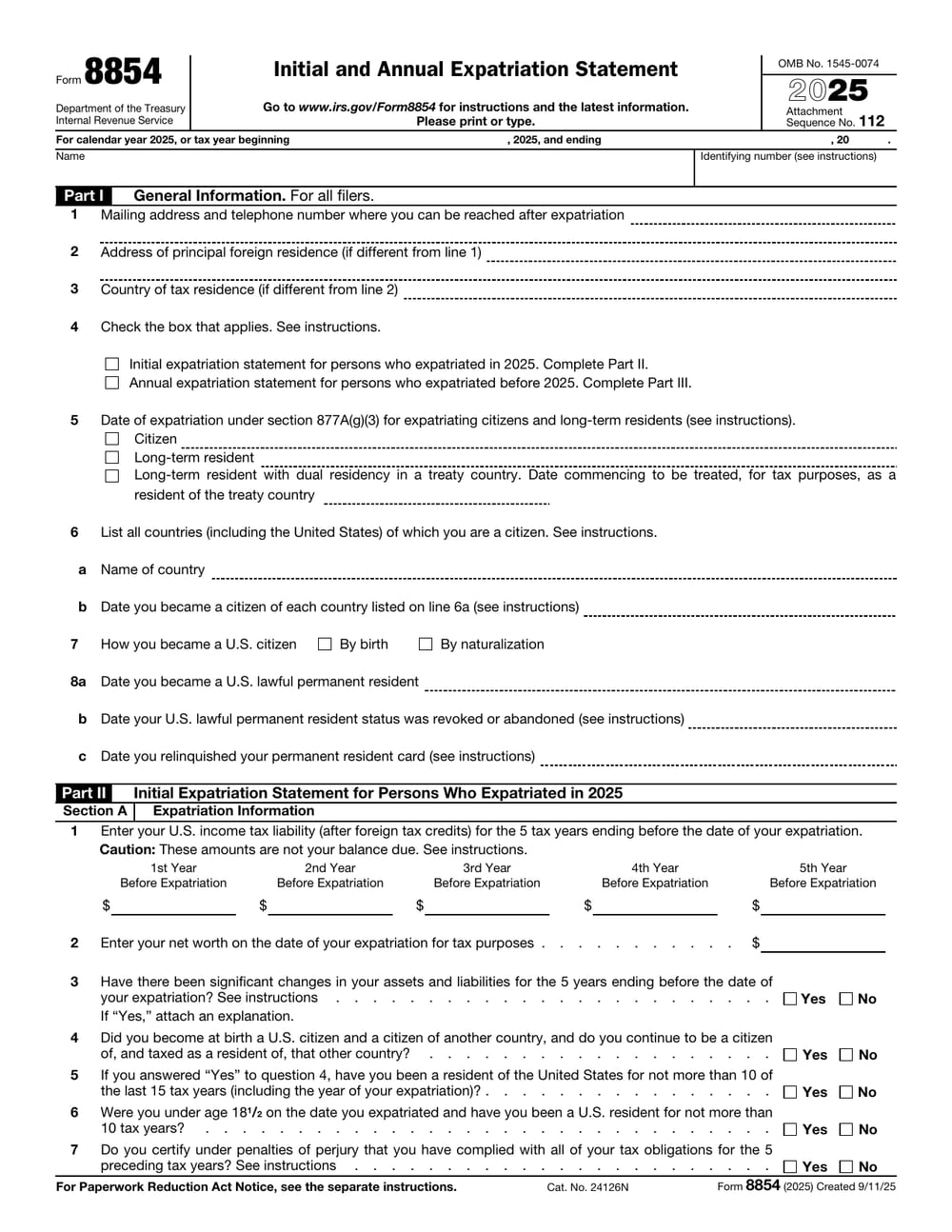
Download Form 8854 (PDF) · Instructions for Form 8854 (PDF)
Local copies for convenience, downloaded from IRS.gov on November 14, 2026. Always confirm you have the current revision at irs.gov/form8854 before filing.
| You're looking for… | Where it is on the 2025 form |
|---|---|
| Identity, addresses, expatriation date, citizenships, green card dates | Part I, lines 1–8c |
| The tax-liability, net-worth and certification tests | Part II, Section A, lines 1, 2, 7 |
| The dual-citizen and minor exceptions | Part II, Section A, lines 4–6 |
| Balance sheet at fair market value and basis | Part II, Section B, lines 1–25 |
| Mark-to-market computation, exclusion allocation, deferred comp, IRAs, trusts | Part II, Section C |
| Deferral election and computation of deferrable tax | Part II, Section D |
| Later-year reporting of deferred assets, eligible deferred comp, trust distributions | Part III |
All line descriptions below are from the 2025 Form 8854 and its instructions. Report amounts in U.S. dollars.
Part I: General information (every filer)
| Line | What it asks | Practical notes |
|---|---|---|
| Top | Name and identifying number (SSN or ITIN) | Use the same SSN you used as a U.S. person. |
| 1 | Mailing address and phone after expatriation | Use a street address; a P.O. box only if no street delivery. |
| 2 | Principal foreign residence (if different from line 1) | Street, city, province, country. |
| 3 | Country of tax residence (if different from line 2) | This is what the dual-citizen exception relies on. |
| 4 | Initial or annual statement | Initial = expatriated during the form year (Part II). Annual = expatriated earlier (Part III). |
| 5 | Expatriation date under §877A(g)(3), and status: citizen, long-term resident, or long-term resident with treaty dual residency (with the date treaty residence began) | Citizens: the earliest §877A(g)(4) date, usually the renunciation oath. Green card holders: the I-407 date or another termination event. |
| 6a / 6b | All countries of citizenship (including the U.S.) and the date each was acquired | Line 6b dates support (or defeat) the "at birth" condition. |
| 7 | How you became a U.S. citizen (birth or naturalization) | Former citizens only. Naturalized citizens may be able to use the §877A(h)(2) basis step-up. |
| 8a–8c | Date you became a permanent resident; date status was revoked or abandoned; date you surrendered the card | Former long-term residents only. These dates drive the 8-of-15 count. |
Part II, Section A: Expatriation information (initial filers)
| Line | What it asks | Practical notes |
|---|---|---|
| 1 | Your U.S. income tax liability, after foreign tax credits, for each of the 5 tax years before expatriation | Total tax minus foreign tax credit (for 2024: Form 1040 line 24 minus Schedule 3 line 1). The form notes these are not balances due. Average the five; compare to $206,000 (2025) or $211,000 (2026). |
| 2 | Net worth on the expatriation date | Taken from Section B, line 25. Compare to $2,000,000. |
| 3 | Did your assets and liabilities change significantly in the 5 years before expatriation? | Added in 2024. If "Yes", attach an explanation. If net worth was $2 million or more during those 5 years but is lower on the expatriation date, the instructions require a statement. Expect questions about pre-expatriation gifts. |
| 4 | Born a U.S. citizen and a citizen of another country, and still a citizen of and taxed as a resident of that country? | Dual-citizen exception, part 1. |
| 5 | If "Yes" on line 4: a U.S. resident for no more than 10 of the last 15 tax years, including the expatriation year? | Dual-citizen exception, part 2. Use the substantial presence test. |
| 6 | Under 18½ on the expatriation date and a U.S. resident for no more than 10 tax years? | Minor exception. |
| 7 | Do you certify, under penalties of perjury, compliance with all federal tax obligations for the 5 preceding tax years? | Test C. "No" or blank = covered expatriate, whatever lines 1–6 say. |
Do you need Section C? The form tells you to skip it, because you are not covered, in three cases. (1) Average tax on line 1 is not more than the threshold, net worth is under $2 million, and line 7 is "Yes". (2) Lines 4, 5 and 7 are all "Yes". (3) Lines 6 and 7 are both "Yes". In every case, line 7 must be "Yes".
Part II, Section B: Balance sheet (initial filers)
Everyone who files an initial statement completes the balance sheet, covered or not. It is how the IRS checks line 2. Column (a) is fair market value and column (b) is U.S. adjusted basis, both as of the expatriation date; liabilities have one amount column. Lines 6 and 7 are reported at present value.
| Line | Item | Notes |
|---|---|---|
| 1 | Cash, including bank deposits | All accounts worldwide, converted to USD. |
| 2 | Marketable stock and securities of U.S. companies | |
| 3 | Marketable stock and securities of foreign companies | Foreign mutual funds and ETFs usually go here (and are usually PFICs). |
| 4 | Nonmarketable stock and securities of U.S. companies | |
| 5 | Nonmarketable stock and securities of foreign companies | |
| 5a / 5b | Separately: foreign stock that would be CFC stock if you were still a U.S. person, with each company's name, address and EIN | Line 5a is not added again in line 20. See our Form 5471 guide. |
| 6 | Pensions and similar retirement arrangements (U.S. and foreign) | Present value. IRAs and foreign pensions both count toward net worth. |
| 7 | Deferred compensation, including stock options | Present value. |
| 8 | Partnership interests | Attach a statement listing each partnership. |
| 9 | Assets held in trust | Attach a statement. |
| 10 | Beneficial interests in trusts not reported on line 9 | Valued under Notice 97-19 principles, per the instructions. |
| 11 / 12 | Intangibles used in / outside the U.S. | |
| 13 / 14 | Loans to U.S. persons / to foreign persons | |
| 15 / 16 | Real property in the U.S. / outside the U.S. | Gross value here; mortgages go on line 22. |
| 17 / 18 | Business property in the U.S. / outside the U.S. | |
| 19 | Other assets | Attach a statement (crypto, art, vehicles, collectibles). |
| 20 | Total assets | Lines 1–5 and 6–19, excluding 5a. |
| 21 | Installment obligations | |
| 22 | Mortgages, etc. | |
| 23 | Other liabilities | Attach a statement. |
| 24 | Total liabilities | Lines 21–23. |
| 25 | Net worth | Line 20 minus line 24, column (a). Carry to Section A, line 2. |
Part II, Section C: Property owned on the date of expatriation (covered expatriates)
Line 1 (items not subject to the deemed sale). Attach a statement identifying each item checked, with its value as of the day before expatriation.
| Line | Question | If "Yes" |
|---|---|---|
| 1a | Do you have eligible deferred compensation items? | Checking "Yes" irrevocably waives treaty withholding reductions for those items. Give Form W-8CE to each payor. Attach the required statement. |
| 1b | Do you have ineligible deferred compensation items? | Include the present value of each in income on your return for the expatriation year. |
| 1c | Do you have an interest in a specified tax-deferred account? | Include the entire interest in income for the expatriation year. |
| 1d | Are you a beneficiary of a nongrantor trust? | Attach the waiver statement for each trust. Check the extra box only if you elect under §877A(f)(4)(B) with an IRS letter ruling. |
Line 2 (deemed sale), one row per property:
| Column | Content |
|---|---|
| (a) | Description of property (everything that would be in your gross estate, except the line 1 items) |
| (b) | Fair market value on the day before expatriation |
| (c) | Cost or other basis. Write "(h)(2)" next to the entry if you elect out of the step-up to residency-date value. |
| (d) | Gain or loss: (b) minus (c) |
| (e) | Gain after allocating the exclusion. Gain assets only, pro rata; attach the allocation schedule. |
| (f) | Form or schedule where you report it (e.g., Form 8949, Schedule D, Form 4797) |
| (g) | Tax deferred on this property (only if you elect deferral; attach the computation) |
Line 3: totals of columns (d) and (e). Line 4: total of column (g), carried to Section D, line 5.
Part II, Section D: Deferral of tax
| Line | What it asks |
|---|---|
| 1 | Do you elect to defer tax under §877A(b)? "Yes" irrevocably waives treaty rights that would prevent assessment or collection. If "No", report gains and losses on your return and stop here. |
| 2 | Tax you would have reported on Form 1040 line 24 for the part of the year through the day before expatriation, including the §877A amounts (hypothetical return no. 1) |
| 3 | Same tax computed without the amounts attributable to §877A(a) (hypothetical return no. 2; attach both computations) |
| 4 | Line 2 minus line 3: the tax eligible for deferral |
| 5 | Tax you elect to defer (from Section C, line 4). Deferring on every asset: use line 4. Deferring on some: the column (g) allocation. On Form 1040 or 1040-NR, enter it in brackets to the left of line 24, labeled "EXP". |
Part III: Annual statement (later years)
| Line | What it asks |
|---|---|
| 1 | For each deferred asset: (a) description, (b) mark-to-market gain or loss from the prior Form 8854, (c) tax deferred, (d) date of disposition if disposed of this year. On disposition, report the gain and pay the deferred tax plus interest by that year's return due date. |
| 2 | Distributions of eligible deferred compensation received this year: amount of each and tax withheld at source. |
| 3 | Distributions from a nongrantor trust received this year: amount of each and tax withheld. Don't check "Yes" if you previously elected to treat your entire trust interest as received. |
Signature. The form is invalid unless signed. A paid preparer must sign and include a PTIN. Your signature is also the line 7 certification, made under penalties of perjury.
When and where to file
The initial Form 8854 is due with the income tax return for the year that includes your expatriation date, by that return's due date including extensions. A June 2026 renunciation means a Form 8854 filed with the 2026 return in 2027.
The return for the expatriation year is usually a dual-status return. You are a U.S. person through the day before expatriation and a nonresident afterwards. The IRS's relief-procedures page describes the package: Form 1040-NR, with a Form 1040 reporting worldwide income through the expatriation date, plus Form 8854 and any required information returns, such as Form 8938. Deemed-sale gains, deemed IRA distributions and ineligible deferred compensation all fall in the U.S.-person part of the year.
| Situation | What to do (2025 instructions) |
|---|---|
| Initial statement, return required | Attach Form 8854 to Form 1040, 1040-SR or 1040-NR for the expatriation year; file by the return's due date (with extensions). |
| Annual statement, return required | Attach the original to the return, and send a copy marked "Copy" to the IRS address below by the same date. |
| No income tax return required | Send Form 8854 alone to the address below by the date the return would have been due (with extensions). |
| Deferral election | Send the original tax deferral agreement request, marked "Original", with Form 8854 for the expatriation year; attach a copy marked "Copy" to the return. |
Mailing address (2025 instructions; the 2026 draft keeps it and notes that the address printed in Notice 2009-85 is no longer valid):
Internal Revenue Service, 3651 S IH35, MS 4301 AUSC, Austin, TX 78741
Typical dates for expats. A calendar-year individual's return is due April 15, with an automatic 2-month extension to June 15 if living abroad, and an extension to October 15 on Form 4868. Form 8854 follows the return. If you are relying on the certification (Test C), these dates are your real deadline. Notice 2009-85 requires the certification on a Form 8854 filed by the return due date.
Form W-8CE has its own clock: by the earlier of the day before the first distribution or 30 days after expatriation.
Penalties, and the §2801 tax on your U.S. heirs
8.1 The §6039G penalty
Under §6039G(c), anyone required to file who doesn't file on time, omits required information, or includes incorrect information pays a $10,000 penalty, unless the failure was due to reasonable cause and not willful neglect. The 2025 instructions apply it for each year a required Form 8854 is missing, incomplete or wrong. That includes the annual statements in Part III.
The $10,000 is usually the smaller problem. A missing Form 8854 is also a missing certification, which makes you a covered expatriate under Test C, as in Topsnik. That status can cost far more than the penalty. Once the deadline has passed, the IRS's late-filing path (FAQ 24) is open only to people who were otherwise compliant and under both dollar thresholds.
Other consequences to keep in view:
- The name is published. Under §6039G(d), the State Department sends the IRS copies of approved CLNs, immigration authorities report revoked or abandoned green cards, and Treasury publishes the names of people losing citizenship in the Federal Register within 30 days after each quarter.
- Deferred tax. If the security you gave becomes inadequate, deferred tax becomes due (§877A(b)(3)).
8.2 Section 2801: the tax that follows covered expatriates forever
Being covered changes how your future gifts and bequests are taxed in the U.S. Section 2801 taxes a U.S. citizen or resident who receives a covered gift or bequest from a covered expatriate. It also applies to a domestic trust receiving one, and to U.S. beneficiaries of distributions from a foreign trust funded by one.
- Rate: the highest estate tax rate in §2001(c) on the date of receipt, which is 40% per the Form 708 instructions (Rev. December 2025).
- Annual amount: only covered gifts and bequests above the §2801(c) amount, $19,000 for 2025 and 2026 (Rev. Proc. 2025-32 §4.42), are taxed.
- Foreign tax credit: the tax is reduced by any gift or estate tax paid to a foreign country on the same transfer (§2801(d)).
- Exclusions: transfers already reported on a timely U.S. gift or estate tax return, and transfers that would qualify for the marital or charitable deduction, are not covered gifts.
- Regulations and form: final regulations (T.D. 10027, January 2025) apply to gifts and bequests received on or after January 1, 2025. The recipient reports them on Form 708. Under the Form 708 instructions, the return is due on the 15th day of the 18th month after the year of receipt, so June 15, 2027 for 2025 receipts. A 6-month extension to file (Form 7004) does not extend the time to pay.
- Burden on the recipient: the recipient must determine whether the donor is a covered expatriate. If a living donor who may have expatriated doesn't authorize disclosure of the relevant tax information (Form 8821), the donor is treated as a covered expatriate unless the recipient can document otherwise.
This is why Test C matters even with no exit tax due. A covered expatriate's U.S.-citizen children pay 40% on what they inherit above the annual amount, possibly decades later. For the trust side, see our Form 3520-A guide, where we first flagged §2801.
Secondary context: commentators (for example BDO) report that the IRS released the final Form 708 in January 2026, after the tax had been on hold since 2008 for lack of regulations and a form.
Worked example 1: covered by the net worth test
Result: Dana is a covered expatriate with $2,800,000 of net worth. Her federal income tax for the expatriation year is $102,269.25, of which $28,500 is attributable to the deemed sale. NIIT, if it applies, adds $7,220.
Facts. Dana is a U.S. citizen by birth, single, retired, living in Portugal. She renounces on March 10, 2026; the CLN is issued later, so her expatriation date is March 10, 2026 and the deemed sale is on March 9, 2026. Her average net income tax for 2021–2025 was $60,000, under the $211,000 test, and she is fully compliant. She is not a dual citizen from birth. All values are in USD on March 9, 2026.
Simplifying assumptions, so every number can be checked by hand: no other income in the U.S.-person part of 2026; no deductions; no foreign tax credit; 2026 single-filer rates from Rev. Proc. 2025-32 §§4.01 and 4.03; all securities held in a U.S. brokerage account (no PFICs); the Portuguese apartment is a non-rented second home (no depreciation).
Step 1: balance sheet and the three tests
| Asset or liability | FMV (col. a) | Basis (col. b) | Section B line |
|---|---|---|---|
| U.S. stock portfolio | $1,400,000 | $500,000 | 2 |
| U.S.-listed bond ETF | $150,000 | $250,000 | 2 |
| Apartment in Portugal | $900,000 | $600,000 | 16 |
| Bank cash | $250,000 | $250,000 | 1 |
| Traditional IRA | $300,000 | 6 | |
| Mortgage on the apartment | ($200,000) | 22 | |
| Net worth (line 25) | $2,800,000 |
- Test A: $60,000 average ≤ $211,000. Not met.
- Test B: $2,800,000 ≥ $2,000,000. Met. Dana is a covered expatriate.
- Test C: line 7 "Yes". Not met, but it doesn't matter. One test is enough.
Step 2: deemed sale (Section C, line 2) and the $910,000 exclusion
Total built-in gain on gain assets: $900,000 + $300,000 = $1,200,000.
| Property | (b) FMV | (c) Basis | (d) Gain/loss | Exclusion allocated | (e) Gain after exclusion |
|---|---|---|---|---|---|
| U.S. stocks | $1,400,000 | $500,000 | $900,000 | 910,000 × 900/1,200 = $682,500 | $217,500 |
| Portugal apartment | $900,000 | $600,000 | $300,000 | 910,000 × 300/1,200 = $227,500 | $72,500 |
| Bond ETF | $150,000 | $250,000 | ($100,000) | none (loss asset) | ($100,000) |
| Cash | $250,000 | $250,000 | $0 | none | $0 |
| Line 3 totals | $1,100,000 | $910,000 | $190,000 |
Net long-term capital gain reported on Form 8949/Schedule D: $217,500 + $72,500 − $100,000 = $190,000. The mortgage does not reduce the gain; it only affects net worth.
Step 3: the IRA (Section C, line 1c)
The $300,000 IRA is treated as fully distributed on March 9, 2026: $300,000 of ordinary income, with no 10% early-distribution tax. The exclusion does not apply to it.
Step 4: tax on the U.S.-person part of 2026
Taxable income = $300,000 ordinary + $190,000 long-term gain = $490,000.
Ordinary income first, on the 2026 single schedule (35% bracket starts at $256,225, base tax $58,448):
$58,448 + 0.35 × ($300,000 − $256,225) = $58,448 + $15,321.25 = $73,769.25.
The gain stacks on top, from $300,000 to $490,000. The 0% band ends at $49,450, below the start, and the 15% band runs to $545,500, above the end. So the whole gain is taxed at 15%:
0.15 × $190,000 = $28,500.
| Line | Amount |
|---|---|
| Tax on ordinary income (IRA) | $73,769.25 |
| Tax on net long-term gain (deemed sale) | $28,500.00 |
| Regular income tax (Form 1040 line 24 portion) | $102,269.25 |
| Net investment income tax, 3.8% × lesser of $190,000 NII or ($490,000 − $200,000) | $7,220.00 |
The NIIT line is shown separately on purpose. The IRA distribution is excluded from net investment income by §1411(c)(5). We found no regulation that specifically addresses §877A gains under §1411. Because the deemed sale occurs while Dana is still a U.S. citizen, the conservative approach is to include it. Confirm with your preparer.
Step 5: what deferral would look like (Section D)
| Line | Computation | Amount |
|---|---|---|
| 2 | Tax with §877A(a) amounts | $102,269.25 |
| 3 | Tax without §877A(a) amounts (IRA income only) | $73,769.25 |
| 4 | Tax eligible for deferral (line 2 − line 3) | $28,500.00 |
The IRA tax ($73,769.25) cannot be deferred, because the IRA is a §877A(e) item, not a §877A(a) deemed sale. Deferring the $28,500 would require a bond or letter of credit, a treaty waiver, and interest at the underpayment rate. For many people that cost exceeds the benefit.
Step 6: sanity checks
- Without the exclusion, the net gain would be $1,100,000. The 15% band holds only $245,500 of it ($545,500 − $300,000); the remaining $854,500 is taxed at 20%. That is $36,825 + $170,900 = $207,725 instead of $28,500. The exclusion saved $179,225.
- New basis after the deemed sale is the March 9, 2026 value ($1,400,000 for the stocks; $900,000 for the apartment), because the adjustment ignores the exclusion (Notice 2009-85 §3.C).
- Portugal may tax the apartment gain only when it is actually sold. Any U.S. credit for that later foreign tax is a timing problem to plan before renouncing.
- If Dana had given $800,001 away before renouncing to bring net worth under $2 million, Section A line 3 would require her to explain the change. Gifts to non-spouses above the annual exclusion also require Form 709.
Worked example 2: covered because of one missing return
Result: Claire has $650,000 of net worth and owes no exit tax on her assets. Yet one unfiled year makes her covered. That costs her $16,712 now on her German pension and exposes her U.S. daughter to a $192,400 §2801 tax later. If she files the missing year before she signs Form 8854, both amounts drop to $0.
Facts. Claire was born in Chicago in 1985 to German parents, so she has been a U.S. and German citizen since birth. She has lived and been taxed in Germany since age 6. She has not been a U.S. tax resident in any of the last 15 years. She renounces on January 9, 2026 (deemed sale on January 8, 2026). She filed U.S. returns for 2021, 2022, 2024 and 2025, all showing $0 tax after the foreign earned income exclusion and foreign tax credit. She never filed for 2023. Her daughter, a U.S. citizen, lives in Boston.
Simplifying assumptions: we ignore her small January 2026 salary; no deductions; 2026 single rates; she holds no PFICs.
Step 1: the three tests, and the exceptions
| Line | Answer | Effect |
|---|---|---|
| Section A, line 1 (average tax 2021–2025) | $0 | Test A not met |
| Section A, line 2 (net worth) | $650,000 | Test B not met |
| Line 4 (dual citizen at birth, still German citizen, taxed as German resident) | Yes | Exception (i) available for Tests A and B |
| Line 5 (U.S. resident ≤ 10 of last 15 years) | Yes | |
| Line 7 (5-year compliance certification) | Cannot truthfully check "Yes": 2023 is unfiled | Test C met: covered expatriate |
Exactly as the form's skip rule says, "Yes" on lines 4 and 5 is not enough without "Yes" on line 7. The dual-citizen exception protects against Tests A and B only.
Step 2: what being covered costs her
| Asset | Value Jan. 8, 2026 | Basis | §877A treatment | Taxable amount |
|---|---|---|---|---|
| Apartment in Munich | $400,000 | $280,000 | Deemed sale: $120,000 gain, fully covered by the $910,000 exclusion | $0 |
| Bank savings | $150,000 | $150,000 | Deemed sale, no gain | $0 |
| German employer pension (present value) | $100,000 | Ineligible deferred compensation: German payor, so it cannot be "eligible" (§877A(d)(3)); present value taxed as received (§877A(d)(2)) | $100,000 ordinary income | |
| Net worth | $650,000 |
The pension exception in §877A(d)(5) does not help. It covers only services performed abroad while not a U.S. citizen or resident, and Claire was a citizen throughout.
Tax on $100,000 of ordinary income (2026 single schedule, 22% bracket starting at $50,400 with base tax $5,800):
$5,800 + 0.22 × ($100,000 − $50,400) = $5,800 + $10,912 = $16,712.
No foreign tax credit offsets it, because Germany levies no tax on a deemed U.S. inclusion. When the pension is actually paid years later, Germany taxes it. The U.S. does not tax it again, but Claire, no longer a U.S. person, gets no U.S. credit for that German tax either.
Step 3: the lifetime tail under §2801
Suppose Claire dies and her daughter inherits $500,000. Using the 2026 figures for illustration (the annual amount is indexed after 2026):
0.40 × ($500,000 − $19,000) = $192,400.
The daughter files Form 708 and pays $192,400, reduced by any German inheritance tax paid on the same bequest (§2801(d)).
Step 4: the counterfactual
| Claire files 2023 before signing Form 8854 | Claire signs with 2023 still unfiled | |
|---|---|---|
| Line 7 | "Yes" | Cannot be "Yes" |
| Status | Not covered (lines 4, 5, 7 all "Yes") | Covered (Test C) |
| U.S. tax on pension at expatriation | $0 | $16,712 |
| §2801 tax on a $500,000 bequest to her daughter | $0 | $192,400 (before foreign credit) |
| Section C | Skipped | Required |
Step 5: how Claire can still fix it
- Not the Relief Procedures for Certain Former Citizens. They require no prior filing history as a U.S. citizen, and Claire filed 4 returns.
- FAQ 24 doesn't help her either. It is for people who were already compliant and only filed Form 8854 late.
- What works: file the 2023 return (and any FBARs and information returns for the period) and pay any tax and interest before filing Form 8854. Then she can certify truthfully. Under Notice 2009-85 the certification is due with Form 8854 by the 2026 return's due date, so she still has time if she acts before then. For a non-willful expat this is normally done through the Streamlined Foreign Offshore Procedures. Readers who have not yet renounced should finish it before the consulate appointment.
Strictly, §877(a)(2)(C) refers to the requirements of "this title", Title 26. The FBAR is a Title 31 filing. In practice, file the FBARs anyway: the IRS compliance programs require them, and a missing FBAR invites scrutiny of the whole file.
Common mistakes
- Thinking Form 8854 is only for the wealthy. Every expatriate files an initial statement. Not filing is itself what makes many modest filers covered (Test C).
- Signing line 7 before the five years are clean. A certification under penalties of perjury that isn't true creates a bigger problem than the one it hides. Fix the gaps first.
- Assuming the dual-citizen exception covers everything. It removes Tests A and B only. Line 7 still has to be "Yes".
- Treating a green card as gone when you moved away. Residency ends with Form I-407, a final abandonment or removal order, or a properly claimed treaty tie-breaker, not with a plane ticket (Topsnik).
- Miscounting long-term residency. Treaty-resident years where you claimed treaty benefits don't count; partial years generally do.
- Using last year's numbers. The thresholds and exclusion follow the year of the expatriation date: $206,000/$890,000 for 2025; $211,000/$910,000 for 2026.
- Netting the exclusion against total gain. The exclusion is allocated pro rata to gain assets only; losses are reported in full, separately.
- Forgetting foreign pensions. A foreign employer pension or similar foreign retirement arrangement is usually an ineligible deferred compensation item, taxed at present value on the final return.
- Expecting annual Form 8854 filings for IRAs. Specified tax-deferred accounts are deemed distributed once, at expatriation. Annual filing comes only from deferral elections, eligible deferred compensation and nongrantor trust interests.
- Missing Form W-8CE. It is due within 30 days of expatriation (or before the first distribution, if earlier). Without it, an item can't be eligible deferred compensation.
- Leaving the balance sheet blank because "I'm not covered". Section B is how the IRS verifies line 2. Complete it.
- Overlooking PFICs in the deemed sale. Foreign funds without QEF or mark-to-market elections can turn a capital gain into an excess distribution taxed at top rates plus interest.
- Ignoring §2801 because the exit tax is zero. U.S. heirs and U.S. trusts pay 40% on covered gifts and bequests, forever.
FAQ
Do I file Form 8854 if I'm clearly not a covered expatriate?
Yes. The initial statement (Parts I and II, Sections A and B) is required of every citizen who relinquishes and every long-term resident who ends residency. Filing it with "Yes" on line 7 is what keeps you uncovered.
I renounced years ago and never filed Form 8854. Is it too late?
Not necessarily. If you were otherwise compliant, with tax at or below the threshold and net worth under $2 million, the IRS's FAQ 24 lets you file the late form with a reasonable-cause statement. If you never filed U.S. returns at all and expatriated after March 18, 2010, look at the Relief Procedures for Certain Former Citizens. Otherwise you will likely need to catch up on returns first.
Does a green card holder with fewer than 8 taxable years need to file?
No Form 8854 is required, because you are not a long-term resident and so not an "expatriate" under §877A. You still file the usual return for the year you leave, often a dual-status return. Count taxable years carefully: partial years generally count.
Which exchange rate do I use?
The form asks for U.S. dollars. Value foreign assets in dollars at the relevant date: the expatriation date for Section B, the day before for Section C. Basis is generally your historical cost in dollars. Use a consistent, documented rate source.
Is my home taxed under the deemed sale?
Yes. Your residence is property in your gross estate, so it is deemed sold like any other asset, and the §877A exclusion applies to its gain. We found no IRS guidance confirming that the separate §121 home-sale exclusion ($250,000 single) also applies to a deemed sale. Some practitioners therefore advise an actual sale before expatriating when §121 matters (secondary: CCBJ). Get advice on your facts.
Can I avoid being covered by giving assets away first?
Gifts can reduce net worth, but Section A line 3 asks about significant changes in the 5 prior years. If net worth was $2 million or more during that period, the instructions require a statement. Gifts above the annual exclusion also require Form 709 and may use lifetime exemption.
My spouse is also renouncing. Do we file one Form 8854?
No. Each expatriate files his or her own Form 8854, applies the tests individually (each counting his or her share of joint property), and gets his or her own exclusion.
What happens if I later move back to the U.S.?
During any period after expatriation in which you are again taxed as a U.S. citizen or resident, you are not treated as covered for the 30% deferred-compensation withholding, the nongrantor-trust withholding or §2801 (§877A(g)(1)(C)). The exit tax already paid is not refunded.
Where do I estimate my numbers?
Our free exit tax tool runs the three tests and the exclusion allocation. Our Italy case study works one complete fact pattern.
Sources
All sources were opened and checked on November 10, 2026. Primary sources are statutes, regulations, official IRS publications and court decisions. Secondary sources are third-party commentary, labeled as such and used only for context.
Primary sources: statutes
- 26 U.S.C. §877A, Tax responsibilities of expatriation (GovInfo)
- 26 U.S.C. §877, Expatriation to avoid tax, incl. §877(a)(2) and (e) (Cornell LII)
- 26 U.S.C. §6039G, Information on individuals losing United States citizenship (Cornell LII)
- 26 U.S.C. §2801, Imposition of tax (gifts and bequests from expatriates) (Cornell LII)
Primary sources: IRS forms, instructions and guidance
- Form 8854 (2025), Initial and Annual Expatriation Statement
- Instructions for Form 8854 (2025), dated September 15, 2025 (HTML version)
- Draft Instructions for Form 8854 (2026), dated August 18, 2026 (draft, not for filing)
- Form 8854 (2015), for the older layout
- Rev. Proc. 2025-32, Internal Revenue Bulletin 2025-45, §§4.01, 4.03, 4.37, 4.38, 4.42 (2026 figures)
- Rev. Proc. 2024-40, §§2.37, 2.38 (2025 figures)
- Notice 2009-85, Guidance for Expatriates Under Section 877A (2009-45 I.R.B.)
- Relief Procedures for Certain Former Citizens and FAQs, last updated September 1, 2026
- Instructions for Form 708 (Rev. December 2025), dated January 16, 2026
Primary sources: case law
- Topsnik v. Commissioner, 146 T.C. No. 1 (2016), Docket No. 2482-14, filed January 20, 2016
- Topsnik v. Commissioner, 143 T.C. 240 (2014) (earlier years for the same taxpayer; referenced in the 2016 opinion, not separately reviewed)
Secondary sources (commentary, for context only)
- BDO, New Form 708 filing obligation begins with 2025 transfers: release of the final Form 708 in January 2026
- The Tax Adviser, Final regs address taxes on gifts to taxpayers from ex-U.S. citizens, residents: T.D. 10027 reference
- Journal of Accountancy, Taxpayer expatriation and installment sale: summary of Topsnik (146 T.C. No. 1)
- Corporate Counsel Business Journal, Exit tax three years after introduction of Section 877A: §121 planning point
This article is general information about U.S. expatriation reporting and the exit tax, not tax or legal advice for your situation. Expatriation is permanent and the exit tax can be large; work with a qualified U.S. tax professional before you renounce or file Form I-407. It is based on the 2025 Form 8854 and instructions and the Internal Revenue Code, Treasury regulations and IRS guidance in force as of November 10, 2026. The dollar thresholds and the exclusion amount are indexed annually and follow the calendar year of your expatriation date, not the year you file, so check IRS.gov/Form8854 for the current figures before you rely on any detail for a later expatriation.