Research date: November 6, 2026. Every figure, statute citation and case cited below is stated and verified as of that date. This article is general information, not tax or legal advice.
Key takeaways
- The US and Eritrea are the only two countries that tax citizens on worldwide income no matter where they live — a rule the Supreme Court upheld in 1924, which makes "accidental" citizenship a trap: it attaches automatically at birth on US soil, nothing to file or sign.
- A single "US indicia" on a bank file — even just a birthplace — is enough to trigger FATCA. Every foreign bank must search for it and report the account or face a 30% US withholding tax on its own American income; many banks simply close the account instead.
- Renouncing citizenship isn't free, and the fee swung wildly. The consular fee was $450 from 2010-2014, jumped 422% to $2,350 in 2014, and only returned to $450 (effective April 13, 2026) after three lawsuits spanning six years.
- A net worth above $2 million can also trigger a separate exit tax on renunciation — a different cost from the consular fee itself.
- The legal fight has moved to the EU's top court. Belgium's Market Court referred 13 questions about FATCA's compatibility with EU data protection law to the CJEU in December 2025 (case C-804/25); a ruling against the mechanism would reach every EU member state's FATCA agreement.
- Temporary IRS relief lets banks keep reporting accidental Americans without a US taxpayer ID — currently Notice 2024-78, covering 2025 through 2027 — a stopgap that keeps getting renewed rather than a permanent fix.
Boris Johnson was born in New York City in 1964 because his father happened to be studying economics at Columbia at the time. The family moved back to the UK in 1969, when he was about five. He grew up British, became a journalist and the mayor of London, and for most of that time gave almost no thought to the fact that, under US law, he had never stopped being American. He had bought a house in Islington in 1999 for £470,000 and sold it a decade later, in 2009, for £1.2 million. Under UK law the gain was not taxable at all, because it was his primary residence. Under US law it was, and years later, as mayor, he found himself facing an American capital-gains bill on the sale. "No is the answer. I think it's absolutely outrageous. Why should I? I haven't lived in the United States since I was five years old," he said on NPR's Diane Rehm Show in November 2014, asked whether he would pay it. He eventually did; by January 2015 a spokesman was saying only that "the Mayor won't be saying anything more on the subject. The matter has been dealt with." In 2016 he renounced his US citizenship, confirmed on the US Treasury's published list of expatriates. He is, by a wide margin, the most famous member of a group with an official-sounding name and an almost total absence of public faces: the accidental Americans.
Why does a US birthplace make you a US citizen?
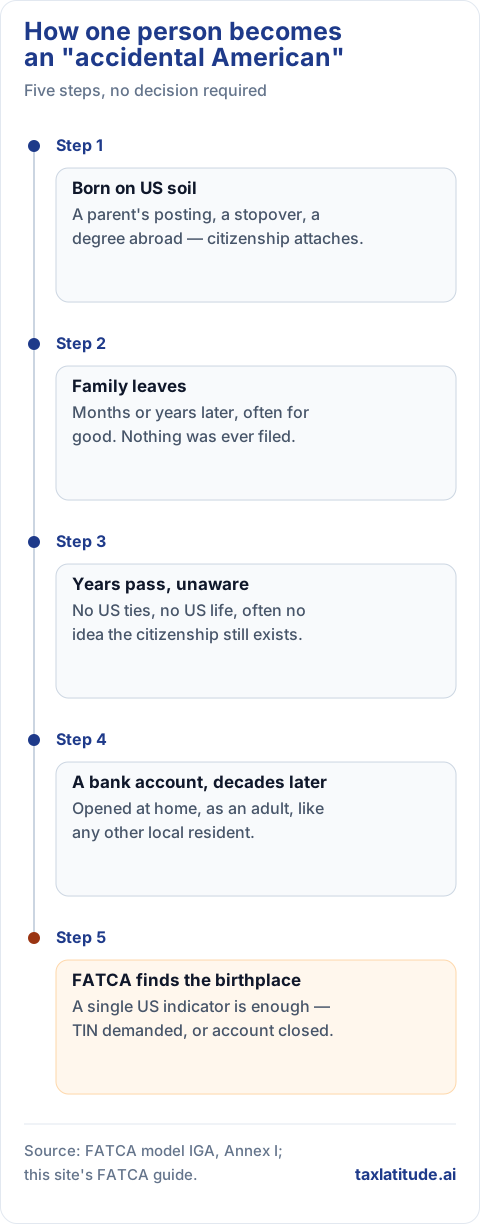
The United States is one of only two countries in the world — the other is Eritrea — that taxes its citizens on their worldwide income no matter where they live, a principle the Supreme Court upheld in 1924 in Cook v. Tait and that this site's FATCA guide covers in full. Citizenship itself is just as automatically acquired. Anyone born on US soil is a US citizen at birth under the Fourteenth Amendment's citizenship clause, regardless of their parents' nationality or how long the family stayed. A French couple on a posting in Houston, a German graduate student finishing a degree in Boston, a Canadian family on a stopover that turned into an unplanned early delivery — none of them have to want American citizenship for their child to get it. Nothing has to be filed, signed or claimed. It simply attaches, and it does not expire when the family leaves three months, or three years, later.
Most people in this position never think about it again, often because they never knew in the first place. A US birth certificate packed away in a drawer in Lyon or Munich does not come with a warning label explaining that its holder owes the IRS an annual tax return for the rest of their life, and faces US citizenship-based obligations their non-American neighbors and even their own siblings born a year earlier or later in a different country do not share. The label "accidental American" was coined for exactly this: citizenship acquired by the accident of a birthplace, not by residence, upbringing, language, or any adult decision to claim it.
How did a US birthplace become a banking problem?
For decades this was a theoretical liability. The IRS had no practical way to find Americans living quietly abroad, and most accidental Americans had no idea they were supposed to be filing. That changed with the Foreign Account Tax Compliance Act (FATCA), enacted in 2010 in response to a Swiss banking-secrecy scandal and described in full in this site's FATCA guide. FATCA does not require the IRS to go looking for accidental Americans. It requires every foreign bank in the world to go looking instead, by searching account records for a defined list of "US indicia" — a US place of birth is one of them — and reporting any match, or refusing the business, on pain of a 30% US withholding tax on the bank's own American income.
A US passport or a green card is an obvious indicator. A US birthplace on an old passport or an ID card is just as much of one, and it is often the only connection an accidental American has ever had to the country. To the bank's compliance software, there is no difference between the two. Once flagged, the customer is asked to either prove they are not American — not always simple, since proving a negative about citizenship can itself require US paperwork — or to supply a US taxpayer identification number (TIN) and start filing US returns, FBARs and, above certain thresholds, Form 8938. Many banks, facing a compliance cost for a customer who often holds a modest account and brings in little business, choose a third option: close the account, decline the mortgage application, or refuse to open a new one in the first place. The European Parliament documented exactly this pattern in a 2018 resolution, describing European citizens — the large majority of them owing no US tax at all — locked out of ordinary banking services in their own country of residence because of an accident of birth decades earlier.
Just found out a US birthplace makes you an "indicia" at your own bank? Whether you actually owe anything, and which IRS compliance program fits your specific filing history, depends on facts no general article can know. Ask TaxLatitude what applies to your situation →
The absurdity compounds on itself. An accidental American who never applied for a Social Security number has no TIN to give the bank, because applying for one means engaging with the same US citizenship the person may never have wanted or known about. Faced with the prospect of mass account closures across Europe, the IRS has repeatedly granted temporary relief letting banks keep reporting without a TIN, most recently through Notice 2024-78, which covers calendar years 2025 through 2027. It is, as this site's FATCA guide puts it, a temporary fix that keeps getting renewed rather than a resolution.
An organized fight, and a price tag for leaving
In France, where the Association puts the number of accidental Americans in the tens of thousands, the response has been organized rather than individual. Fabien Lehagre, who discovered his own unwanted US citizenship as an adult, founded the Association des Américains Accidentels in 2017. The group has spent the years since fighting on every front it can find: French courts, US federal courts, and now the European Union's top court.
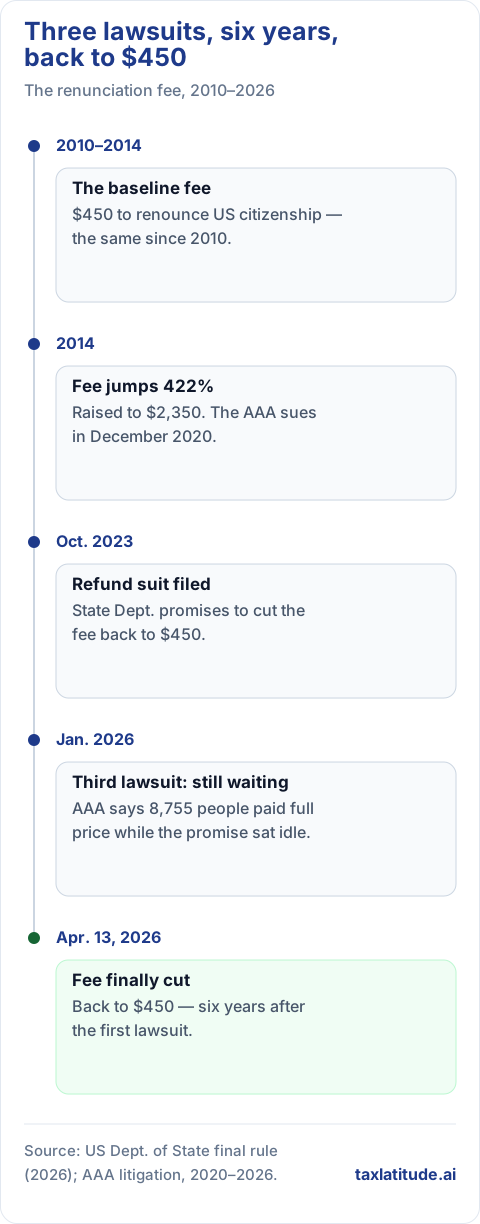
The most direct fight is over what it costs to stop being American. Renouncing citizenship is not free. Beyond certifying five years of US tax compliance under Section 877(a)(2)(C), and beyond a possible exit tax for anyone with a net worth above $2 million (covered in detail in TaxLatitude's guide to the US exit tax and in this site's article on what actually decides that cost), the US State Department charges a consular fee simply to process the paperwork. That fee sat at $450 from 2010 to 2014. An interim rule published August 28, 2014 raised it to $2,350, a 422% increase the State Department justified by pointing to the administrative cost of processing a renunciation; outside commentators at the time called it the highest fee of its kind charged anywhere in the world.
Net worth near or above $2 million and thinking about renouncing? The consular fee is $450 — the exit tax is the number that actually matters, and it depends on your specific assets and compliance history. Ask TaxLatitude to estimate what renouncing would cost you →
The Association sued over that fee in December 2020, in L'Association des Américains Accidentels v. United States Department of State (No. 1:20-cv-03573, D.D.C.), arguing the fee violated the First, Fifth and Eighth Amendments and effectively forced people to remain citizens against their will. That lawsuit worked: on January 6, 2023, in that same case, the State Department notified the court it intended to lower the fee back to $450. A separate, second suit followed in October 2023 — after the government had already announced its intention to cut the fee, not before — a proposed class action brought by four former citizens living in France, Germany and Singapore, seeking refunds on behalf of an estimated 30,000-plus people who had already paid the $2,350 fee, on the theory that the gap between $2,350 and the State Department's own stated cost estimate made the overcharge unlawful.
It took until 2026 to actually happen, and only after a third lawsuit. The Association went back to the same federal court in January 2026, in a new case (No. 1:26-cv-00021), accusing the State Department of having "slow-walked" the rollout of its own announced fee cut for more than two years. By the Association's count, at least 8,755 people paid the full $2,350 fee after the government had already said publicly it intended to reduce it — more than $20 million collected, by that count, at a fee the government itself had conceded was too high. The State Department's final rule cutting the fee back to $450 took effect on April 13, 2026. Lehagre called it "a historic victory" after what by then had been a six-year legal fight. Whether the January 2026 lawsuit over the delay itself still has anything left to resolve is, as of this writing, an open question; we found no public ruling on it.
Losing in Paris, now trying Europe's top court
The Association's oldest fight, and so far its least successful one, was never about the fee at all. It was about whether the underlying data transfer — a French bank handing an accidental American's account details to the French tax authority, which forwards them automatically to the IRS every year under France's FATCA intergovernmental agreement — is lawful in the first place. The Association challenged that agreement before France's highest administrative court, the Conseil d'État, which rejected the challenge on July 19, 2019 (CE, n° 424216).
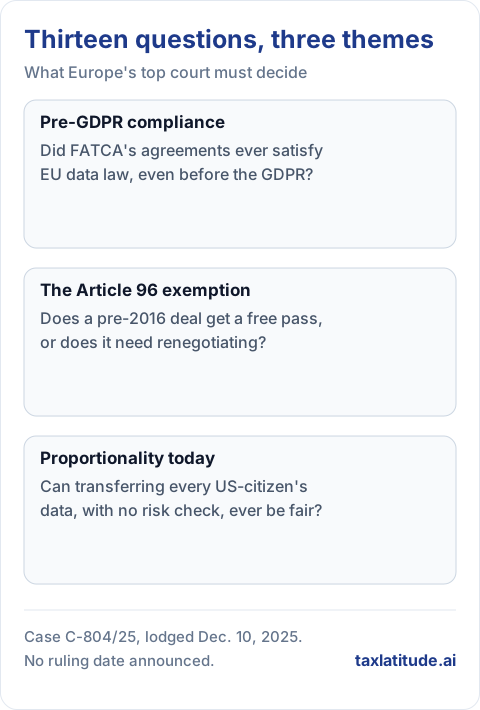
The fight has since moved to Belgium, and from there to the European Union's top court. Belgium's data protection authority ruled in May 2023 that the automatic, bulk transfer of banking data on people who overwhelmingly owe no US tax was disproportionate and violated the General Data Protection Regulation. That decision was overturned on procedural grounds on appeal, but the authority ruled on the merits again on April 24, 2025, reaching the same conclusion and giving Belgium's tax administration until April 24, 2026 to bring its FATCA transfers into compliance. On December 4, 2025, Belgium's Market Court — the appellate court that handles this kind of regulatory case — went a step further and referred the dispute to the Court of Justice of the European Union, asking it to resolve thirteen distinct legal questions about whether FATCA-style automatic transfers are compatible with EU data protection law at all. The case, registered as C-804/25, was lodged at the CJEU on December 10, 2025. It names the Belgian state as appellant and the Belgian data protection authority as respondent, with the Association of Accidental Americans and an individual complainant intervening in support of the challenge.
The thirteen questions cluster around three themes: whether the original FATCA agreements ever satisfied EU data protection law in the first place, even the pre-GDPR version that applied when they were signed; whether Article 96 of the GDPR, which grandfathers in international agreements concluded before the regulation took effect, actually shields FATCA from the GDPR's proportionality and data-minimization requirements, or whether those agreements needed to be renegotiated once the GDPR arrived; and whether automatic, blanket transfers covering every US-citizen accountholder without any individualized risk assessment can ever be proportionate, regardless of what agreement authorizes them. No hearing date or decision timeline has been announced. If the Court rules against the transfers, the consequences would not stop at Belgium: every EU member state's FATCA intergovernmental agreement works the same way, so a ruling against the mechanism itself could force a renegotiation across the entire bloc. If it rules for FATCA, the accidental Americans' last major legal avenue in Europe closes.
Why do so few accidental Americans have a name?
Unlike Boris Johnson, almost none of the people this actually affects are public about it. The individual complainant in the Belgian case before the CJEU is not named in the official record. The four plaintiffs in the 2023 US refund suit are not named in the public reporting on the case either. This is not an accident of journalism. Many accidental Americans spend years trying to establish, quietly, that they owe the IRS nothing — and the last thing most of them want is a public record tying their name to a US citizenship they are actively trying to shed, in a filing system where getting it wrong can mean penalties. The silence is itself a feature of the story, not a gap in it: a French association alone puts its potential membership in the tens of thousands, organized enough to fund litigation up to the EU's highest court, and almost entirely invisible by name.
What should you do if you just found out you're one of them?
If a bank has just asked you to confirm you are not a US citizen, or you have realized that a US birthplace on an old document makes you one whether you ever wanted it or not, the mechanics are covered in detail in TaxLatitude's FATCA guide: what counts as US indicia, the Form 8938 and FBAR thresholds, and what a bank can and cannot legally do when it finds one. Catching up on unfiled returns, FBARs and Form 8938 without overpaying in penalties generally means choosing the right IRS compliance program for your situation — the wrong choice can expose you to penalties the right one would have avoided — and that choice depends on facts a general article cannot know: how many years you have missed, whether you have any US income, whether you have ever filed before. If renunciation is the end goal, the exit tax guide and the article on what actually decides your cost of leaving cover what happens after the consular fee, which for most accidental Americans with no real ties to the US is the much smaller part of the bill. None of this is a substitute for advice from a professional who can see your specific filing history before you commit to a path that, once taken, is difficult to reverse.
FAQ: accidental Americans and FATCA
What is an "accidental American"?
Someone who holds US citizenship purely by accident of birth — typically born on US soil while a parent was studying, working or passing through — and has no other meaningful connection to the country: no residence, no US upbringing, often no awareness the citizenship exists. Citizenship attaches automatically at birth under the Fourteenth Amendment, with nothing to file, sign or claim, and it does not expire when the family leaves.
Does the United States tax citizens who have never lived there?
Yes. The United States and Eritrea are the only two countries that tax citizens on worldwide income no matter where they live, a principle the Supreme Court upheld in 1924 in Cook v. Tait. An accidental American owes the same citizenship-based filing obligations as any other American, regardless of how briefly they were ever in the country.
Why do accidental Americans have trouble opening or keeping bank accounts abroad?
FATCA requires every foreign bank to search account records for "US indicia," including a US place of birth, and report any match or face a 30% US withholding tax on the bank's own American income. Facing that compliance cost for a customer who often brings in little business, many banks simply close the account, decline a mortgage application, or refuse to open a new account in the first place.
How much does it cost to renounce US citizenship?
The State Department's consular fee was $450 from 2010 to 2014, then rose 422% to $2,350 in 2014. After three lawsuits brought by the Association des Américains Accidentels over six years, the fee returned to $450, effective April 13, 2026. Renunciation can also trigger a separate US exit tax for anyone with a net worth above $2 million, which is a different cost from the consular fee itself.
Is the automatic transfer of bank data to the IRS under FATCA being legally challenged?
Yes, in Europe. France's Conseil d'État rejected a challenge to the practice in 2019, but Belgium's Market Court referred 13 legal questions about FATCA's compatibility with EU data protection law to the Court of Justice of the European Union in December 2025 (case C-804/25). No hearing date or ruling has been announced; a ruling against the transfer mechanism would reach every EU member state's FATCA agreement, not just Belgium's.
I just found out a US birthplace makes me a US citizen. What should I do first?
Start with what counts as US indicia, the Form 8938 and FBAR thresholds, and what a bank can and cannot legally do, covered in TaxLatitude's FATCA guide. Catching up on unfiled returns without overpaying in penalties means choosing the right IRS compliance program for your specific facts — how many years were missed, whether you have US income, whether you have ever filed before — so have a qualified US international tax professional review your situation before committing to a path that is difficult to reverse.
Sources
Primary sources (accessed November 6, 2026)
- 26 U.S.C. §877 (Cornell LII)
- IRS Notice 2024-78
- European Parliament, 2018 resolution on the adverse effects of FATCA on EU citizens
- Belgian Data Protection Authority, "FATCA: the Market Court refers 13 preliminary questions to the CJEU" (Dec. 4, 2025)
- US Dept. of State, Final Rule on CLN fees, 91 Fed. Reg. (March 13, 2026)
Secondary sources
- NPR/Maine Public, "London's Mayor Calls U.S. Tax Bill 'Outrageous'" (Nov. 22, 2014) (secondary source)
- HuffPost UK, "Boris Johnson Agrees To Pay 'Outrageous' US Tax Bill" (Jan. 22, 2015) (secondary source)
- Global News, "Boris Johnson has renounced his US citizenship" (Feb. 2017) (secondary source)
- Bloomberg Tax, "Accidental Americans Sue Over Fee to Renounce U.S. Citizenship" (secondary source)
- Brussels Times, "'Accidental' Americans sue US over 'exorbitant' citizenship renunciation fee" (Oct. 2023) (secondary source)
- Law360, case page for L'Association des Américains Accidentels v. United States Department of State, No. 1:26-cv-00021 (D.D.C., filed Jan. 6, 2026) (secondary source)
- Connexion France, "'Accidental' Americans in France welcome lower fee to give up citizenship" (secondary source)
- PPC Land, "CJEU takes on FATCA: EU's top court to rule on banking data sent to the US" (secondary source)
- Mayer Brown, "EU Court of Justice to Examine GDPR Compliance of FATCA-Related Bank Data Transfers" (secondary source)
- TaxLatitude, FATCA guide (secondary source, this site)
This article explains the legal and policy landscape as of November 2026 and is not tax or legal advice for any individual situation. Anyone who may be a US citizen through birthplace, and anyone weighing renunciation, should have their specific facts reviewed by a qualified US international tax professional before deciding what to do.