Key takeaways
All facts below were checked against the sources listed in the Sources section on November 1, 2026. Ukraine is a country at war under martial law, not a country under international sanctions, and the US rules that apply to it differ in important ways from the rules for Russia.
- US filing obligations do not stop because of the war. US citizens and green card holders living in Ukraine file the same Form 1040 as everyone else. The foreign earned income exclusion for tax year 2026 is $132,900 per person (IRS).
- A US–Ukraine income tax treaty is in force. It has applied since June 5, 2000, and replaced the 1973 US–USSR treaty (US Treasury). Its saving clause still lets the US tax its citizens, but the treaty guarantees a foreign tax credit and exempts Ukrainian state pensions from US tax.
- There is no US–Ukraine totalization (Social Security) agreement. Ukraine does not appear on the Social Security Administration's list of agreements in force, as of September 17, 2026 (SSA POMS GN 01701.005).
- FATCA reporting works normally. A Model 1 intergovernmental agreement has been in force since November 18, 2019 (US Treasury FATCA page), and Ukrainian banks had a July 1, 2026 deadline to file their latest reports (SUD.UA, May 28, 2026).
- Wartime rules are local and dated. Martial law has been extended to January 29, 2027. The National Bank of Ukraine (NBU) still caps currency purchases and transfers abroad, but it raised several limits on August 11, 2026. US territorial sanctions cover only Crimea and the so-called "DNR" and "LNR" areas, not Ukraine as a whole.
Do Americans living in Ukraine still file US taxes?
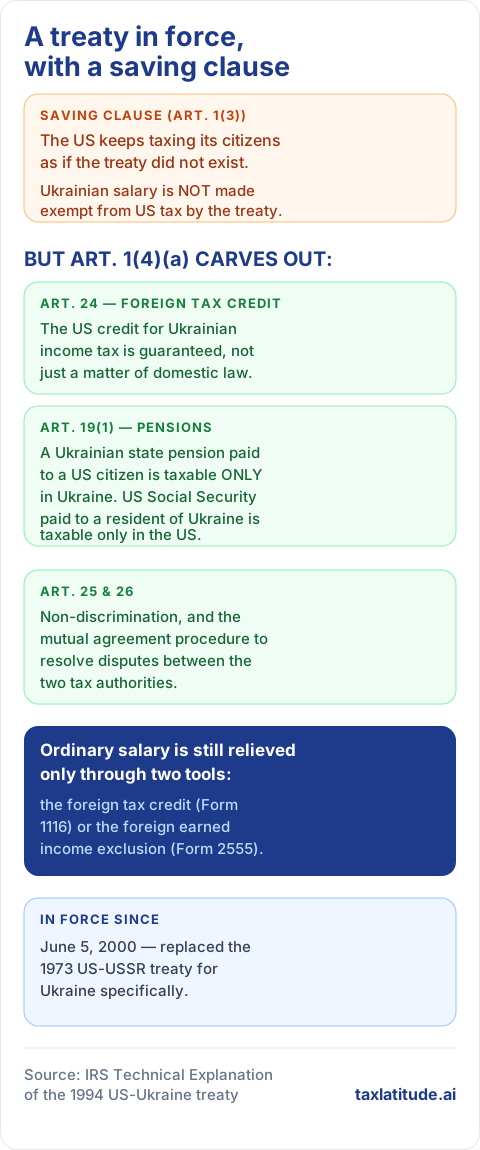
Yes. The United States taxes its citizens and green card holders on worldwide income wherever they live, and neither the war nor martial law in Ukraine changes that. The US–Ukraine treaty confirms it: its saving clause (Article 1, paragraph 3) preserves the US right to tax its own citizens under domestic law (IRS Technical Explanation of the 1994 treaty).
Deadlines. The regular deadline is April 15. Americans whose tax home and residence are outside the US get an automatic two-month extension to June 15 to file, and can extend to October 15 with Form 4868 (IRS on automatic extensions). Interest still runs on any tax paid after April 15.
The exclusion must be claimed. The foreign earned income exclusion is not automatic. The IRS states that it applies only if you file a return that reports the income and claim it on Form 2555 (IRS). The limit is $130,000 for tax year 2025 and $132,900 for tax year 2026 (same source; Rev. Proc. 2025-32 summary, KPMG).
War-related waiver of the time tests. To claim the exclusion, you normally need either 330 full days abroad in 12 consecutive months or a full tax year of bona fide residence. Under Internal Revenue Code section 911(d)(4), the IRS waives those minimums for people forced to leave a country because of war or civil unrest. Ukraine has been on the waiver list every year since the full-scale invasion:
| Tax year | Revenue Procedure | Ukraine: departure on or after | Source |
|---|---|---|---|
| 2025 | Rev. Proc. 2026-16 | January 1, 2025 | KPMG Flash Alert 2026-058 (March 5, 2026) |
| 2024 | Rev. Proc. 2025-17 | January 13, 2024 | KPMG Flash Alert 2025-055 (March 7, 2025) |
| 2023 | Listed, per KPMG | Date not shown in the source reviewed | KPMG Flash Alert 2025-055 |
| 2022 | Rev. Proc. 2023-19 | February 12, 2022 | Accounting Today |
The waiver only helps someone who could reasonably have been expected to meet the test had they not been forced out, and who left on or after the listed date. The 2026 list (for tax year 2026) will not be published until early 2027, so whether Ukraine stays on it is still an open question.
When does Ukraine treat you as a tax resident, and what does it tax?
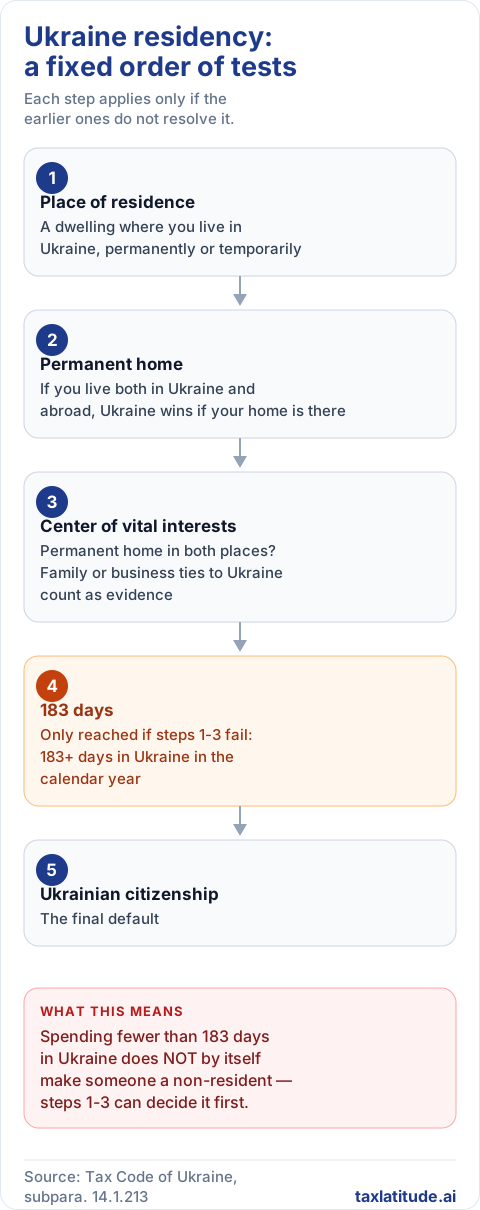
Ukraine taxes its residents on worldwide income and non-residents on Ukrainian-source income only (PwC Worldwide Tax Summaries, reviewed July 18, 2025). Residency is decided under subparagraph 14.1.213 of the Tax Code of Ukraine, which applies its tests in a fixed order (OECD residency sheet for Ukraine; State Tax Service, December 27, 2021):
- Place of residence in Ukraine. A dwelling where you live, permanently or temporarily.
- Permanent home. If you live both in Ukraine and abroad, you are resident if your permanent home is in Ukraine.
- Center of vital interests. If you have permanent homes in both, Ukraine wins where your personal or economic ties are closer. The tax service treats a family member's permanent residence or a business registration in Ukraine as sufficient, though not the only, evidence.
- 183 days. Only if the earlier tests fail: at least 183 days in Ukraine in the calendar year, counting arrival and departure days.
- Ukrainian citizenship. The final default.
The 183-day count comes fourth, not first. Spending fewer than 183 days in Ukraine does not by itself make someone a non-resident, as Ukrainian practitioners have long pointed out (Sayenko Kharenko via Mondaq). An American with a Ukrainian spouse and an apartment in Kyiv may be resident even after long stays abroad.
Main rates in 2026. Personal income tax (PIT) is a flat 18%. On top of it, a military levy of 5% has applied to most individual income since December 1, 2024 (State Tax Service; PwC).
| Income type | PIT | Military levy | Source |
|---|---|---|---|
| Salary, foreign income, interest, most other income | 18% | 5% | State Tax Service |
| Dividends from foreign companies | 9% | 5% | PwC; CMS |
| Dividends from Ukrainian corporate-tax payers | 5% | 5% | CMS |
| Sole proprietor (FOP), single tax group 3 | 5% of revenue (3% + VAT) | 1% of revenue | State Tax Service; Raiffeisen Bank |
Residents who receive foreign income, including US salary, must file an annual property and income declaration by May 1 of the following year (State Tax Service). Residents who control a foreign company, such as a US corporation, also file a controlled foreign company (CFC) report with that declaration; the 2025 report was due May 1, 2026 (Komersant).
A point for US–Ukrainian dual nationals. The Tax Code still says that a Ukrainian citizen who holds another citizenship "contrary to the law" is treated as a Ukrainian citizen with no right to credit taxes paid abroad (State Tax Service, 2021; Tax Code text, Art. 14). Since January 16, 2026, Law No. 4502-IX has allowed Ukrainians to hold US citizenship legally, with the US on the Cabinet's approved list (dev.ua; sense.ua). Whether that removes the credit denial for every dual national, including those who became US citizens before 2026, has not, to our knowledge, been clarified in official guidance. For now, it remains an open point in Ukrainian practice.
A US citizen who's also a Ukrainian national? Ukraine's Tax Code can deny the foreign tax credit to dual citizens who held citizenship "contrary to the law" — and whether the 2026 legalization clears that for citizens who naturalized earlier is still unresolved. Check where you stand →
Is there a US–Ukraine tax treaty?
Yes. The Convention for the Avoidance of Double Taxation between the United States and Ukraine was signed in 1994, received Senate advice and consent in 1995, and entered into force on June 5, 2000 (US Treasury press release LS-685). It replaced, for Ukraine, the 1973 income tax convention with the Soviet Union, which still applies to several other former Soviet republics (same source). According to Treasury, it took effect for withholding taxes on amounts paid on or after August 1, 2000, and for other taxes in taxable years beginning on or after January 1, 2001.
The treaty is sometimes assumed not to exist, partly because older regional guidance still refers to the 1973 USSR treaty. That treaty has not applied between the United States and Ukraine since the new convention took effect.
US-Ukraine Convention (1994), already consolidated with its related Protocol
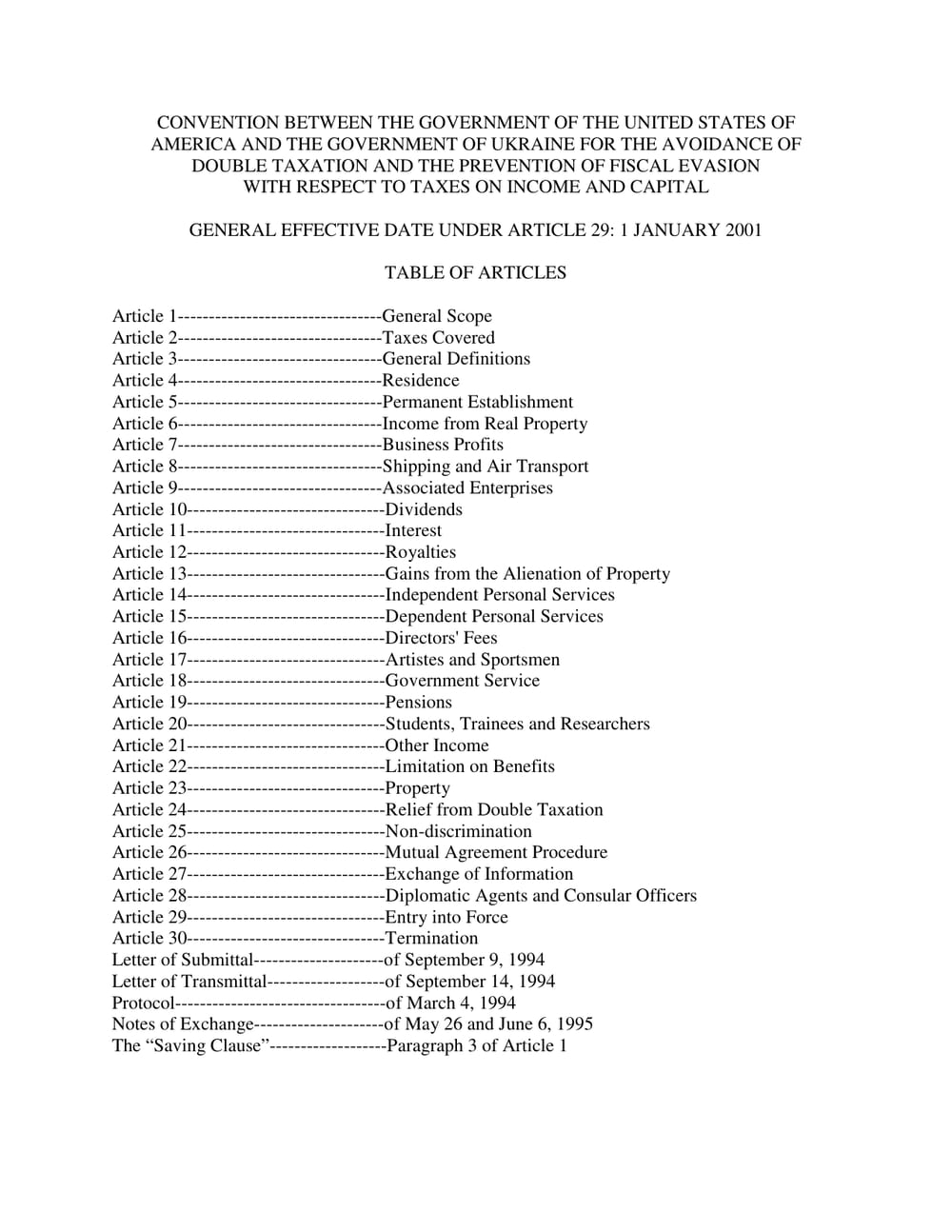
Download the Convention (PDF, 30 pages)
Local copy for convenience, downloaded from IRS.gov on November 14, 2026. This PDF already folds in the related 1994 Protocol — it replaces, for Ukraine specifically, the 1973 USSR convention mentioned above, which has not applied since this convention took effect. See the IRS's own Ukraine tax treaty documents page for the full set.
Provisions that matter most to Americans in Ukraine, from the IRS Technical Explanation:
| Topic | Treaty article | What it does |
|---|---|---|
| Saving clause | Art. 1(3) | The US keeps the right to tax its citizens as if the treaty did not exist |
| Benefits kept by US citizens | Art. 1(4)(a) | Foreign tax credit guarantee (Art. 24), exemption of social security payments (Art. 19(1)), non-discrimination (Art. 25), mutual agreement procedure (Art. 26) |
| Dual residence tie-breaker | Art. 4(2) | Permanent home, then center of vital interests, then habitual abode, then citizenship, then the two tax authorities |
| Dividends | Art. 10 | Source-country tax capped at 5% (qualifying corporate holdings) or 15% |
| Interest | Art. 11 | Exempt from source-country tax for a beneficial owner resident in the other country |
| Royalties | Art. 12 | Source-country tax capped at 10% |
| Real estate gains | Art. 13 | Taxable where the property is located |
| Private pensions and social security | Art. 19 | Private pensions taxed by the country of residence; social security and public pensions taxed only by the paying country |
| Relief from double taxation | Art. 24 | The US gives a foreign tax credit for Ukrainian income tax, subject to US limits |
Two consequences flow from the saving clause. A US citizen resident in Ukraine cannot use the treaty to make Ukrainian salary exempt from US tax; relief comes through the foreign tax credit or the exclusion instead. But Article 19(1) is an exception to the saving clause, so a Ukrainian state pension paid to a US citizen is taxable only in Ukraine, and US Social Security paid to a US citizen living in Ukraine is taxable only in the US.
In the other direction, a US resident who receives Ukrainian-source dividends or royalties must prove US residence to have the treaty rate withheld in Ukraine; the State Tax Service has clarified which US residence certificates Ukrainian payers may accept (Orbitax, 2018 consultation).
How do you avoid paying tax twice?
Relief works differently on each side, and each side has its own paperwork.
On the US return, the two main tools are:
- Foreign earned income exclusion (Form 2555). Excludes up to $132,900 of foreign earned income for 2026 (wages or self-employment income for work physically done abroad). It does not cover dividends, interest, capital gains, pensions or most rental income (Taxes for Expats).
- Foreign tax credit (Form 1116). A dollar-for-dollar credit for Ukrainian income tax, subject to the US limitation rules. Article 24 of the treaty guarantees the credit and survives the saving clause (IRS Technical Explanation).
See our guide on FEIE vs Foreign Tax Credit for how the two generally compare. The same dollar of income cannot be both excluded and used to generate a credit. With Ukrainian PIT at 18% plus a 5% levy on salary, the comparison between the two methods depends on income level, family situation and any US-source income, and the answer varies from one taxpayer to the next.
Whether the military levy is creditable in the US is uncertain. The treaty and its protocol name the Ukrainian taxes covered when it was signed in the 1990s; the military levy was introduced much later. The IRS has issued no ruling on the levy identified for this guide
Paying Ukraine's 5% military levy on top of regular income tax? The treaty's foreign tax credit guarantee predates the levy, and the IRS has never ruled on whether it's creditable at all. Get a position on your specific tax mix →
, so its treatment depends on the general US rules for creditable foreign taxes.On the Ukrainian return, a resident can reduce Ukrainian tax by tax paid abroad only if four conditions are met (PwC; State Tax Service; 7eminar, 2026):
- A tax treaty with the other country is in force. The US qualifies.
- The taxpayer obtains a certificate from the foreign tax authority showing the tax paid and the taxable base.
- The certificate is legalized or apostilled, unless a treaty says otherwise.
- The credit does not exceed the Ukrainian PIT on the same income. PwC notes that no credit is allowed against the military levy.
In practice, this means US federal tax paid on income Ukraine also taxes can reduce Ukrainian PIT, but the 5% levy is still due in Ukraine. Getting a qualifying certificate from the IRS can take time; the gap between paying US tax and documenting it for Ukraine is a common source of double payment. A Ukrainian legal commentary has called for bank documents to be accepted instead, but the certificate requirement still applied as of this guide's date (EBA).
Social security: is there a totalization agreement with Ukraine?
No. See our guide on how a totalization agreement normally works, and why the self-employed feel its absence most. The Social Security Administration's operations manual lists 31 countries with agreements in force as of September 17, 2026, from Australia to Uruguay, with Romania the most recent (effective September 1, 2026). Ukraine is not among them (SSA POMS GN 01701.005). Nor is there any public trace of a signed agreement awaiting ratification.
Without an agreement, nothing assigns a worker to one system or the other, so both countries' rules apply in full:
- Self-employed Americans. US self-employment tax applies to net earnings even when income tax is eliminated by the exclusion, because Form 2555 does not reduce self-employment tax. A Ukrainian sole proprietor (FOP) also pays Ukraine's unified social contribution (USC), at least 22% of the minimum wage, or UAH 1,902.34 a month in 2026 (112.ua). Neither payment is credited against the other.
Self-employed as a FOP in Ukraine? You can owe US self-employment tax and Ukraine's unified social contribution at the same time — with no totalization agreement, neither payment offsets the other. See your real combined cost →
- Employees of Ukrainian employers. Ukraine's employer-paid USC is 22% of gross pay; employees pay none of it (PwC via Teamed). US Social Security tax generally does not apply to wages from a foreign employer for work done abroad.
- Employees of US employers working in Ukraine. US FICA usually continues for an American employer. Whether Ukrainian USC is also due depends on how the arrangement is structured locally, and that question falls outside what this guide could confirm.
- Benefits. Credits earned in Ukraine cannot be combined with US credits to qualify for a US benefit, because combining credits is exactly what a totalization agreement would allow.
Income tax on social security benefits is covered by Article 19 of the income tax treaty (see the treaty section above), not by any totalization rule.
Which US forms apply to accounts and assets in Ukraine?
Ukrainian banks report US account holders to the IRS through Ukraine's State Tax Service. The Model 1 intergovernmental agreement was signed on February 7, 2017 (Baker McKenzie via USUBC), ratified on October 29, 2019 and in force since November 18, 2019 (EY tax alert, September 2020; US Treasury). Reporting has continued through the war: Ukraine's Finance Ministry updated its FATCA reporting order effective February 10, 2026 (DTKT), and financial agents had to file by July 1, 2026 (Bloomberg Tax, June 1, 2026). Through this channel, the IRS receives data on Ukrainian accounts held by US persons.
| Form | What triggers it | Threshold or rule | Source |
|---|---|---|---|
| FinCEN 114 (FBAR) | Signature authority or financial interest in Ukrainian accounts, including hryvnia, FX, deposit and brokerage accounts | Aggregate maximum balance over $10,000 at any time in the year; due April 15, automatic extension to October 15 | Taxes for Expats; CountryTaxCalc |
| Form 8938 | Specified foreign financial assets, including accounts, Ukrainian securities and interests in foreign entities | Living abroad: over $200,000 at year-end or $300,000 at any time (single); $400,000 / $600,000 (joint) | Greenback; Pro Tax Consulting |
| Form 3520 | Gifts or inheritances from a Ukrainian relative or estate | Over $100,000 in a year from nonresident aliens or foreign estates, aggregating related donors | IRS; Form 3520 instructions |
| Form 5471 | Ownership or control of a Ukrainian company, such as a TOV (limited liability company) | Filing categories depend on ownership percentage and control | IRS, About Form 5471 |
| Form 8621 | Shares in Ukrainian investment funds or other passive foreign investment companies | Annual filing rules apply to most PFIC holdings | IRS, About Form 8621 |
| Schedule C and Schedule SE | Ukrainian sole proprietorship (FOP) activity | A FOP is not a separate legal entity, so its income is reported directly | See the Social Security section above |
| Schedule E | Rental income from Ukrainian property | Reported in US dollars; depreciation follows US rules for foreign property | IRS Publication 527 |
A few Ukraine-specific points:
- Domestic government bonds (OVDP). Popular with Ukrainian savers, these produce interest that is reportable on the US return, and the bonds count toward FBAR and Form 8938 when held through a Ukrainian bank or broker.
- Hryvnia conversion. Amounts must be reported in US dollars. The hryvnia has moved sharply since 2022, so the exchange rate used for each item matters for gains on property and deposits.
- Joint accounts with family. A US person who can sign on a parent's or spouse's Ukrainian account generally has an FBAR obligation for it, even if none of the money is theirs (My Expat Taxes).
What do martial law and currency controls mean for Americans?
Current as of November 1, 2026. This section changes more often than any other in the guide.
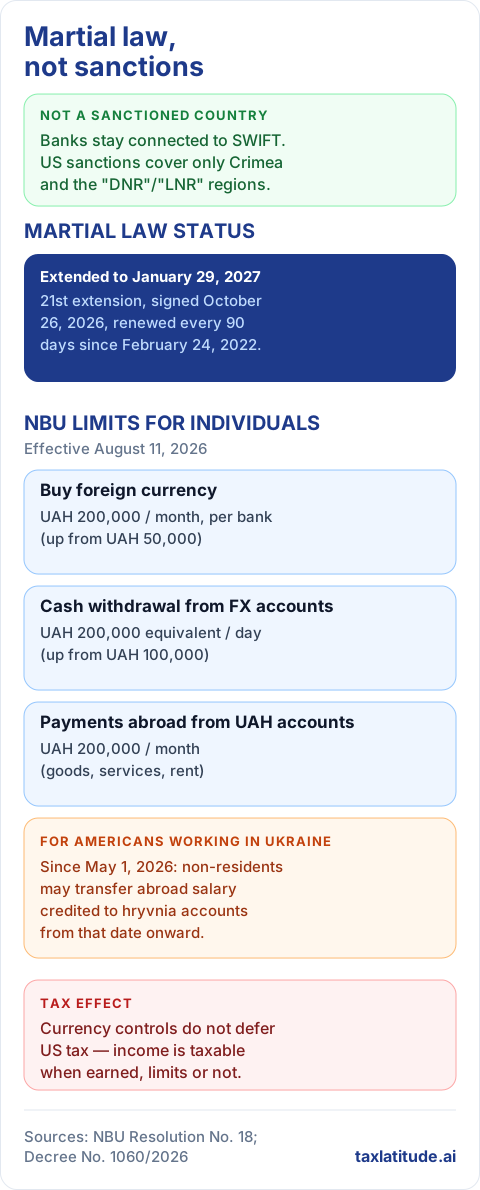
Ukraine is under martial law, but it is not a sanctioned country. Its banks remain connected to international payment systems, and the National Bank of Ukraine's August 2026 changes expressly cover payments abroad made via SWIFT (Impacta Law, August 2026). The constraints Americans meet are Ukrainian wartime rules, plus US sanctions that cover only the occupied areas.
What is the current state of martial law?
Martial law has applied since February 24, 2022 and is renewed every 90 days. On October 26, 2026, President Zelensky signed the 21st extension, which runs from October 31, 2026 to January 29, 2027 (Decree No. 1060/2026) (Censor.NET; Ukrainian News). Many tax and currency rules are written to last "until martial law ends," so the next renewal date is worth tracking.
What are the NBU currency controls?
The controls come from NBU Resolution No. 18 of February 24, 2022, which the NBU has loosened in stages. The latest package for individuals took effect on August 11, 2026 (Kinstellar via AmCham Ukraine, August 18, 2026):
| Operation (individuals) | Limit from August 11, 2026 | Previous limit |
|---|---|---|
| Buying non-cash foreign currency, banking metals and foreign securities | UAH 200,000 per month, per bank (aggregate) | UAH 50,000 (currency only) |
| Cash withdrawals from FX accounts, in Ukraine or abroad | UAH 200,000 equivalent per day | UAH 100,000 |
| Cash withdrawals from hryvnia accounts | UAH 100,000 per day | Unchanged |
| Payments abroad from hryvnia accounts for goods, services or rent | UAH 200,000 per month | UAH 100,000 |
| Transfers from FX accounts abroad for goods and services | UAH 200,000 per month | New permission |
| Rent and accommodation abroad from FX accounts | UAH 500,000 per month | Narrower scope before |
For Americans who work in Ukraine, an April 2026 change matters more. Since May 1, 2026, non-resident individuals may transfer abroad the salaries and civil-contract fees credited to their hryvnia accounts from that date onward (Imagine Lawyers; Lexology). Balances credited earlier are not covered by these summaries.
Although the published summaries cover the limits above, they leave several points open, including the treatment of transfers to an individual's own accounts abroad and the repatriation of dividends by companies. On these, the current text of Resolution No. 18 and the bank's own compliance team are the reference. Most permitted operations still require proof of the source of funds.
Tax effect. Currency controls do not defer US tax. Income is taxable in the US when earned, even if NBU limits slow its transfer out of Ukraine. The foreign tax credit and exclusion rules apply in the normal way.
Is there IRS relief for the war?
No Ukraine-specific IRS postponement of filing or payment deadlines turned up on IRS.gov or in professional commentary reviewed for this guide. The two standard relief mechanisms compare as follows:
- Postponements under section 7508A. This authority covers federally declared disasters and also "terroristic or military actions" abroad, which section 692(c)(2) defines by reference to actions directed against the United States or any of its allies (Tax Notes, IRS notice text). The IRS has used it for an event outside the US: Notice 2024-72 postponed deadlines for taxpayers affected by the terroristic action in Israel (IRS Notice 2024-72), and Notice 2025-53 extended that relief after a new Treasury determination on September 30, 2025 (Current Federal Tax Developments). Relief requires such a determination and a published notice; postponements are not available simply because a disaster or military action has occurred (Rev. Proc. 2018-58). For the war in Ukraine, neither IRS.gov nor the tax press shows an equivalent determination or notice.
- Combat zone relief (section 7508) gives at least 180 days after leaving a combat zone (IRS), but it is limited to members of the US armed forces and eligible support personnel. Designated combat zones are the Afghanistan area, the Kosovo area and the Arabian Peninsula, according to IRS Publication 3 as summarized by TaxAct; Ukraine is not among them.
The relief that does exist is the annual foreign earned income exclusion waiver for people who left Ukraine (see above). Americans abroad also keep the automatic June 15 filing date and the October 15 extension.
What are the OFAC sanctions on occupied areas?
US sanctions apply only to specific regions, not to Ukraine as a whole:
- Crimea, under Executive Order 13685 of December 19, 2014 (Mott Foundation summary).
- The so-called "Donetsk People's Republic" and "Luhansk People's Republic" regions ("Covered Regions"), under Executive Order 14065 of February 21, 2022. OFAC states that the order does not cover the entire Donetsk and Luhansk oblasts, and that US persons may rely on vetted third-party information such as postal codes and maps to locate the boundary (OFAC FAQ 1009, updated May 5, 2022).
- Kherson and Zaporizhzhia oblasts. The Treasury Secretary may add other regions, but OFAC's published guidance still names only the "DNR" and "LNR" regions, and no determination adding these oblasts has been identified.
In the Covered Regions, and under similar rules in Crimea, US persons wherever located may not make new investments, import goods, services or technology from the region, export them to it, or approve or facilitate a foreign person's transaction that would be prohibited for a US person (OFAC FAQ 1006, March 2, 2022). OFAC issued general licenses alongside the order, including for telecommunications and the work of humanitarian and international organizations (Thompson Hine). For an American who holds property, a bank account or a business interest in Crimea or the Covered Regions, ordinary transactions such as selling, renting out or investing in that asset may require a license. Sanctions compliance is separate from tax; the property and income still have to be reported on the US return.
What about exit restrictions and the day count?
This is not a tax rule, but it affects residence tests. Since February 2022, most Ukrainian men aged 18 to 60 have been barred from leaving the country without a legal exception (Komersant). Since August 28, 2025, men aged 18 to 22 inclusive may cross freely; for men aged 23 to 60 the restrictions were unchanged as of May 13, 2026 (Kyiv Post; Nakordoni, citing the State Border Guard Service).
A man who holds both US and Ukrainian citizenship is treated in Ukraine as a Ukrainian citizen only, even under the 2026 multiple-citizenship law (Pravdop). A US passport does not, on its own, create an exit exception. Two consequences for tax:
- Ukraine. Days spent in Ukraine count toward residency, and a planned departure that cannot happen can turn a non-resident year into a resident one.
- United States. Time stuck in Ukraine counts as time abroad, which helps meet the physical presence test for the exclusion.
Ukrainian wartime tax measures still in force
| Measure | Status as of November 1, 2026 | Source |
|---|---|---|
| Military levy at 5% for individuals | In force; bill No. 15110, adopted April 7, 2026 and signed that month, keeps current rates for three years after the year martial law ends | Komersant |
| Moratorium on tax audits | Lifted by Law No. 3453-IX, in force December 8, 2023 | KMP Law |
| Temporary release from tax obligations for war-damaged businesses | Still available to legal entities and sole proprietors who document their inability to comply; 7,214 taxpayers had used it by August 2025 (Cabinet of Ministers), and NV Business later reported 11,214 | NV Business |
| 5% PIT on rental income (instead of 18%) | Adopted June 9, 2026 as Law No. 4903-IX (draft No. 15111-d) (Deloitte Ukraine); signed and officially published; according to the State Tax Service, the 5% rate took effect on October 23, 2026, earlier than the January 1, 2027 date reported at adoption (State Tax Service, October 23, 2026); the 5% levy still applies | UNN |
| Special regime for digital-platform income | Same law. From January 1, 2027, platforms withhold 10% PIT on eligible income up to 834 minimum wages a year (UAH 7,211,598 for 2026) and 23% on the excess or when the conditions are not met, with no military levy on top; occasional sales of personal items up to EUR 2,000 a year are exempt (State Tax Service, October 23, 2026; Lexology) | PwC Ukraine, July 6, 2026 |
| VAT for larger sole proprietors | Proposed for January 1, 2027 with a UAH 4 million threshold; no adopted law located | Komersant |
What are the local considerations: business, real estate and employment?
Employment
A Ukrainian employer withholds 18% PIT and the 5% military levy from salary and pays a 22% unified social contribution on top (State Tax Service; Teamed, citing PwC). On the US return, that PIT is a candidate for the foreign tax credit; the levy's US treatment is the open question discussed above.
An American resident in Ukraine who works remotely for a US employer usually receives pay with no Ukrainian withholding. In that case the income is foreign income for Ukrainian purposes and goes on the annual declaration due May 1 (State Tax Service). For US purposes the same salary is foreign earned income, because the work is physically done in Ukraine, even though the employer is American.
IT sector: Diia City. Companies that join the Diia City regime can pay employees and "gig specialists" with 5% PIT instead of 18%, plus the 5% military levy, if they meet headcount and pay conditions (SUD.UA, June 18, 2026). A lower Ukrainian tax means a smaller foreign tax credit, which can leave residual US tax for someone who relies on the credit rather than the exclusion.
Self-employment and business
- Sole proprietor (FOP). Most freelancers register as a FOP under the simplified system. Group 3 pays a 5% single tax on revenue (3% if registered for VAT) and a 1% military levy, plus the minimum USC; group 3's 2026 revenue ceiling is UAH 10,091,049 (Raiffeisen Bank; State Tax Service). For the US, a FOP is the individual, so the income goes on Schedule C and is subject to US self-employment tax (see the Social Security section above). Whether the single tax, which is levied on revenue rather than net income, qualifies for the US foreign tax credit is uncertain under the US rules for creditable taxes; the IRS has not addressed it specifically.
- Ukrainian company (TOV). An American owner typically files Form 5471, and the company's income may be picked up under the US controlled foreign corporation rules even before dividends are paid. Dividends from a Ukrainian corporate-tax payer to an individual bear 5% PIT plus the levy in Ukraine (CMS); for a shareholder resident in the US, the treaty caps Ukrainian tax on such dividends at 15% (see the treaty section above).
- US company owned by a Ukrainian resident. Ukraine's own CFC rules can require a report on a US corporation controlled by a Ukrainian resident, with the 2025 report due May 1, 2026 (Komersant). How Ukraine treats a single-member US LLC under these rules is a gap in the publicly available guidance.
Real estate
Ukrainian tax on a sale by an individual is levied on the proceeds, under the State Tax Service's 2026 summary (State Tax Service) and PwC (PwC):
| Sale of residential property | Resident seller | Non-resident seller |
|---|---|---|
| First sale in the year, owned more than 3 years (not inherited) | 0% | 0% in principle, but PwC notes the tax authorities may dispute the exemption for non-residents |
| Second sale in the year, or owned less than 3 years | 5% PIT + 5% levy | 18% PIT + 5% levy |
| Third and later sales in the year | 18% PIT + 5% levy | 18% PIT + 5% levy |
In the US, the sale is taxed on the gain in dollars, computed from the dollar cost at purchase and the dollar proceeds at sale. A sale that is tax-free in Ukraine can still produce US tax, and the reverse is also possible: after the hryvnia's fall, a property can show a hryvnia gain and a dollar loss. The treaty lets Ukraine tax gains on Ukrainian real estate (Article 13), and the US then credits Ukrainian tax, within its limits.
Rental income was taxed at 18% PIT plus the 5% levy until Law No. 4903-IX cut the PIT rate to 5%. The State Tax Service says the cut took effect on October 23, 2026 (State Tax Service), although reports at adoption gave January 1, 2027. Its notice does not say how the new rate applies to rent received earlier in 2026. The levy is unchanged (UNN). In the US, rents go on Schedule E. US depreciation rules apply whatever Ukraine allows.
What happens when leaving Ukraine?
Leaving Ukraine does not end Ukrainian tax residency automatically. Because the Tax Code tests place of residence, permanent home and center of vital interests before it counts days, someone who keeps a registered address, an apartment or close family in Ukraine can remain resident after moving away (Mind.ua). Ukrainian lawyers quoted there warn that the State Tax Service may keep treating such people as residents even after 183 days abroad. A certificate of tax residence from the new country, and the tie-breaker in that country's treaty with Ukraine, are the usual ways to settle the question.
Points that typically come up on departure:
- US exclusion in the departure year. Someone who leaves Ukraine mid-year may fall short of the 330-day or full-year test. If the IRS lists Ukraine for that year, the section 911(d)(4) waiver can rescue the exclusion for the period abroad (see above).
- Selling or keeping property. Ukraine's sale rules (see above) depend on the seller's residency in the year of sale, so the timing of a sale relative to a change of residence affects the Ukrainian rate.
- Moving money out. NBU limits apply to the funds, not to the person. Large balances may take several months to move within monthly limits.
- Ukrainian accounts left open. They remain reportable on the FBAR and Form 8938 for as long as they exist, whatever the balance's origin.
- No Ukrainian exit tax for individuals is described in the Tax Code summaries consulted. On the US side, the expatriation tax rules (Form 8854) apply only to Americans who renounce citizenship or long-term green card holders who give up their status, not to people who simply move — our exit tax tool estimates exposure.
Mistakes Americans commonly make
- Assuming there is no treaty. The US–Ukraine treaty has been in force since June 5, 2000. Guides that treat Ukraine like Russia, or that cite the 1973 USSR treaty, are out of date for Ukraine.
- Treating Ukraine as a sanctioned country. Outside Crimea and the Covered Regions, ordinary banking, employment and investment in Ukraine are not restricted by US sanctions. The real constraints are NBU currency limits.
- Skipping the return because the exclusion covers everything. The exclusion only exists if a return is filed and Form 2555 attached (IRS).
- Forgetting self-employment tax. Without a totalization agreement, a US citizen working as a FOP can owe US self-employment tax as well as Ukrainian USC.
- Missing FBARs on family accounts. Signature authority on a parent's or spouse's Ukrainian account is enough to trigger the FBAR.
- Not reporting OVDP interest or hryvnia deposit interest. Ukrainian bank reporting under FATCA makes these visible to the IRS.
- Ignoring Ukrainian residency after moving. Keeping a home or family in Ukraine can keep you resident there, with a May 1 declaration due on worldwide income.
- Expecting to credit US tax in Ukraine without paperwork. Ukraine requires a certificate from the IRS, legalized or apostilled, and never credits anything against the 5% military levy.
- Assuming a US passport allows a dual national to leave. Ukraine treats dual nationals as Ukrainian citizens for border purposes; men aged 23 to 60 still need a legal exception to exit.
- Overlooking Ukraine's CFC report. A Ukrainian resident who controls a US company may owe a Ukrainian CFC report alongside the annual declaration.
Checklist
A reference list of the filings and documents this guide covers. Which items apply depends on each person's facts.
United States
- Form 1040 by April 15, or June 15 under the automatic extension for those abroad, or October 15 with Form 4868
- Form 2555 if claiming the foreign earned income exclusion ($132,900 for 2026)
- Form 1116 if claiming a credit for Ukrainian income tax
- FinCEN 114 (FBAR) if Ukrainian and other foreign accounts exceed $10,000 combined at any time
- Form 8938 if foreign assets exceed the living-abroad thresholds
- Form 3520 for gifts or inheritances from Ukrainian relatives over $100,000 in the year
- Form 5471 for interests in a Ukrainian company; Form 8621 for Ukrainian funds
- Schedule SE for FOP or other self-employment income
- Check whether the section 911(d)(4) waiver applies, if Ukraine was left during a listed year
Ukraine (if resident)
- Annual property and income declaration by May 1, including all foreign income
- IRS certificate of tax paid, legalized or apostilled, to claim a Ukrainian credit for US tax
- CFC report for any controlled foreign company, filed with the declaration
- FOP single-tax returns and USC payments, if registered
Wartime items to recheck before each filing season
- Current martial law end date (now January 29, 2027)
- Current NBU limits under Resolution No. 18
- Whether property or accounts are in Crimea or the OFAC Covered Regions
- Whether Ukraine appears on the IRS list for the section 911(d)(4) waiver for the year
Frequently asked questions
Is Ukraine under US sanctions? No. US territorial sanctions apply to Crimea and to the so-called "DNR" and "LNR" regions, not to the rest of Ukraine (OFAC FAQ 1009). Broad US sanctions programs target Russia and Belarus, not Ukraine.
Does the IRS give Americans in Ukraine extra time because of the war? No Ukraine-specific postponement has been announced, although the IRS has used the same legal authority for Israel (see above). Americans abroad already get an automatic extension to June 15, and the IRS has waived the exclusion's time tests for people who left Ukraine in each of tax years 2022 through 2025.
Does the treaty exempt my Ukrainian salary from US tax? No. The saving clause lets the US tax its citizens as if the treaty did not exist. Relief comes from the exclusion or the foreign tax credit.
Is my Ukrainian state pension taxable in the US? Under Article 19(1) of the treaty, social security and public pensions are taxable only by the paying country, and that rule applies to US citizens despite the saving clause (IRS Technical Explanation).
Do I pay into both Social Security systems? Possibly. With no totalization agreement, nothing prevents both countries' contributions from applying, which most often affects the self-employed.
Will my Ukrainian bank tell the IRS about my account? Yes. Under the FATCA agreement in force since November 18, 2019, Ukrainian financial institutions report accounts of US persons through the State Tax Service, and that reporting continued in 2026.
I am a man with US and Ukrainian citizenship. Can I leave Ukraine? If aged 18 to 22, generally yes since August 2025. From age 23 to 60, a legal exception is still needed, and a US passport alone is not one (Nakordoni).
Can I get dollars out of Ukraine? Within limits. Since August 11, 2026 individuals can buy up to UAH 200,000 of foreign currency a month per bank, and non-residents can transfer abroad salary credited since May 1, 2026.
I own an apartment in occupied Donetsk. What do I report? The asset and any income stay reportable on the US return. Separately, OFAC rules may restrict selling, renting or investing in it if it lies in a Covered Region.
When should you hire a professional?
This guide is general information, not legal or tax advice, and TaxLatitude is neither a law firm nor an accounting firm. Some situations involve rules that remain unresolved in the public sources reviewed here, or that change quickly under martial law. Professional help is generally worth considering when:
- Both countries claim you as a resident, and the treaty tie-breaker or a residence certificate is needed to settle it. Our tie-breaker tool walks through the order for the US-Ukraine treaty.
- You hold dual US–Ukrainian citizenship and pay tax in both countries, given the unresolved question of Ukraine's foreign tax credit denial for dual nationals (see above).
- You run a FOP or own a TOV, where US self-employment tax, Form 5471, CFC rules and the creditability of the single tax and the military levy all interact.
- You own property or accounts in Crimea or the Covered Regions, which raise OFAC licensing questions that a sanctions lawyer, not a tax preparer, typically handles.
- You need to move large sums out of Ukraine within NBU limits, or repatriate dividends from a Ukrainian company.
- You have unfiled US returns or FBARs for years spent in Ukraine. The IRS has formal procedures for catching up, and the right one depends on facts best reviewed by a US practitioner.
Useful credentials to look for: a US-licensed CPA, enrolled agent or tax attorney for the US side, and a Ukrainian tax adviser or attorney (advokat) for the Ukrainian declaration and currency rules.
Sources
Accessed and checked November 1, 2026. Dates in parentheses are the publication or last-update dates shown by the source, where one was given.
| Source | URL | Used for |
|---|---|---|
| US Treasury, press release LS-685: US–Ukraine income tax treaty enters into force | home.treasury.gov | Treaty effective date (June 5, 2000) |
| IRS, Technical Explanation of the 1994 US–Ukraine income tax convention | irs.gov | Treaty article provisions |
| US Treasury, FATCA intergovernmental agreements list | home.treasury.gov | FATCA IGA status |
| SSA, POMS GN 01701.005, Totalization agreements in force | secure.ssa.gov | Totalization agreement list (as of Sept. 17, 2026) |
| IRS, Figuring the foreign earned income exclusion | irs.gov | FEIE rules and 2026 limit |
| IRS, Extensions for taxpayers abroad, in combat zones and disaster areas | irs.gov | Filing deadlines, combat zone relief |
| IRS, Large gifts or bequests from foreign persons | irs.gov | Form 3520 threshold |
| IRS, Instructions for Form 3520 (2025) | eitc.irs.gov | Form 3520 rules |
| IRS, About Form 5471 | irs.gov | Foreign corporation reporting |
| IRS, About Form 8621 | irs.gov | PFIC reporting |
| IRS, Publication 527, Residential Rental Property | irs.gov | Rental property depreciation |
| IRS, Treasury Decision 8911 on combat zone and disaster relief | irs.gov | Section 7508A background |
| IRS, Notice 2024-72, relief for taxpayers affected by the terroristic action in Israel | irs.gov | Comparable relief precedent |
| IRS, Rev. Proc. 2018-58 on postponed acts under sections 7508 and 7508A | ncsha.org | Postponement mechanism rules |
| OFAC, FAQ 1006 on Executive Order 14065 | ofac.treasury.gov | Covered Regions sanctions scope |
| OFAC, FAQ 1009 on the scope of the Covered Regions | ofac.treasury.gov | Covered Regions boundary |
| State Tax Service, residency criteria and dual citizenship | tax.gov.ua | Residency test order, dual-national credit rule |
| State Tax Service, military levy rates for 2026 | tax.gov.ua | PIT and military levy rates |
| State Tax Service, taxation of foreign income and credit for foreign tax | tax.gov.ua | Foreign tax credit conditions |
| State Tax Service, annual declaration of foreign income | tax.gov.ua | May 1 declaration deadline |
| State Tax Service, taxation of property sales | tax.gov.ua | Real estate sale rates |
| State Tax Service, Law No. 4903-IX published: when its provisions take effect | tax.gov.ua | Rental income rate cut effective date |
| Cabinet of Ministers of Ukraine, 7,214 war-affected taxpayers granted temporary tax relief | kmu.gov.ua | Wartime tax relief uptake |
| OECD, Ukraine tax residency information sheet | search.oecd.org | Residency test summary |
| Tax Code of Ukraine, Article 14 (consolidated text) | ibuhgalter.net | Dual citizenship credit rule |
| KPMG, GMS Flash Alert 2026-058 on Rev. Proc. 2026-16 | kpmg.com | 2025 FEIE waiver date |
| KPMG, GMS Flash Alert 2025-055 on Rev. Proc. 2025-17 | kpmg.com | 2024 and 2023 FEIE waiver dates |
| KPMG, TaxNewsFlash 2025-297 on Rev. Proc. 2025-32 | kpmg.com | 2026 FEIE limit |
| Accounting Today, Rev. Proc. 2023-19 and Ukraine | accountingtoday.com | 2022 FEIE waiver date |
| Tax Notes, text of the IRS notice on relief for the terroristic action in Israel | taxnotes.com | Section 7508A legal text |
| Current Federal Tax Developments, IRS Notice 2025-53 | currentfederaltaxdevelopments.com | Israel relief extension |
| PwC Worldwide Tax Summaries, Ukraine: taxes on personal income | taxsummaries.pwc.com | Resident/non-resident taxation |
| PwC Worldwide Tax Summaries, Ukraine: income determination | taxsummaries.pwc.com | Dividend rates, property sale rates |
| PwC Worldwide Tax Summaries, Ukraine: foreign tax relief and tax treaties | taxsummaries.pwc.com | Foreign tax credit conditions |
| PwC Worldwide Tax Summaries, Ukraine: individual overview | taxsummaries.pwc.com | Dividend rates |
| PwC Ukraine, Draft Law No. 15111-d on digital platforms | pwc.com | Digital-platform income regime |
| Deloitte Ukraine, new law on digital platforms (Law No. 4903-IX) | deloitte.com | Law adoption date |
| Lexology, Rada adopts law on taxing digital-platform income | lexology.com | Digital-platform withholding rates |
| CMS, Ukraine country tax guide | cms.law | Dividend rates |
| Kinstellar via AmCham Ukraine, NBU easing of August 10, 2026 | chamber.ua | NBU currency limit table |
| Impacta Law, NBU easing of August 2026 | impactalaw.com | SWIFT connectivity confirmation |
| Imagine Lawyers, NBU Resolution of April 23, 2026 | imaginelawyers.com | Non-resident salary transfer rule |
| Lexology, NBU eases selected foreign currency restrictions | lexology.com | Non-resident salary transfer rule |
| EY Ukraine, FATCA agreement in force | chamber.ua | FATCA IGA ratification date |
| Baker McKenzie via USUBC, FATCA IGA signed | usubc.org | FATCA IGA signing date |
| KMP Law, cancellation of the tax audit moratorium | kmp.ua | Audit moratorium status |
| Sayenko Kharenko via Mondaq, tax residency when moving abroad | mondaq.com | 183-day test practice |
| Thompson Hine, EO 14065 and general licenses | thompsonhinesmartrade.com | OFAC general licenses |
| Mott Foundation, summary of Russia/Ukraine-related sanctions | mott.org | Crimea sanctions background |
| Orbitax, Ukraine residence certification under the US treaty | orbitax.com | US residence certificate acceptance |
| EBA, foreign tax certificates | new.eba.com.ua | Certificate requirement commentary |
| Pravdop, dual and multiple citizenship in Ukraine | pravdop.com | Dual nationality rules |
| Raiffeisen Bank Ukraine, FOP single tax checklist for 2026 | raiffeisen.ua | FOP rates and thresholds |
| Teamed, Ukraine tax and payroll | teamed.global | Employer USC rate |
| Taxes for Expats, foreign earned income exclusion | taxesforexpats.com | FEIE scope |
| Taxes for Expats, FATCA reporting and Form 8938 | taxesforexpats.com | FBAR reporting scope |
| Greenback Tax Services, Form 8938 | greenbacktaxservices.com | Form 8938 thresholds |
| Pro Tax Consulting, how to file Form 8938 | protaxconsulting.com | Form 8938 thresholds |
| CountryTaxCalc, FBAR and FATCA reporting guide 2026 | countrytaxcalc.com | FBAR deadline |
| My Expat Taxes, Form 8938 vs FBAR | myexpattaxes.com | Joint/family account FBAR rule |
| TaxAct, combat zone designation | support.taxact.com | Designated combat zones list |
| Censor.NET, martial law extended to January 29, 2027 | censor.net | Martial law extension date |
| Ukrainian News, Rada extends martial law to January 29, 2027 | ukranews.com | Martial law extension date |
| Bloomberg Tax, Ukraine CRS and FATCA reporting deadline | news.bloomberglaw.com | FATCA reporting deadline |
| SUD.UA, FATCA and CRS reports due July 1 | sud.ua | FATCA reporting deadline |
| DTKT, new FATCA reporting rules | news.dtkt.ua | FATCA reporting order update |
| SUD.UA, Diia City benefits for startups | sud.ua | Diia City tax rates |
| Komersant, military levy extended after martial law | komersant.ua | Military levy duration |
| Komersant, CFC reporting deadlines for 2026 | komersant.ua | CFC report deadline |
| Komersant, the tax package split into several bills | komersant.ua | VAT proposal status |
| Komersant, men under 22 allowed to travel abroad | komersant.ua | Exit restriction history |
| UNN, Rada votes to cut PIT on rental income to 5% | unn.ua | Rental income rate cut |
| NV Business, temporary release from tax obligations for war-affected businesses | english.nv.ua | Wartime relief uptake figures |
| Kyiv Post, border traffic after easing for under-22s | kyivpost.com | Exit restriction easing |
| Nakordoni, border rules for men aged 18–22 | nakordoni.eu | Exit restriction current status |
| Mind.ua, involuntary residents and taxes abroad | mind.ua | Residency after departure |
| dev.ua, multiple citizenship law in force | dev.ua | Dual citizenship law effective date |
| sense.ua, Cabinet list of dual citizenship countries | sense.ua | US on approved dual-citizenship list |
| 112.ua, FOP payments in February 2026 | 112.ua | USC minimum amount |
| 7eminar, crediting foreign taxes in 2026 | 7eminar.ua | Foreign tax credit conditions |