A foreign bank or tax office asks for proof that you are a U.S. resident before it will apply a lower treaty withholding rate, and the IRS's answer to that request is Form 6166, requested on Form 8802. Living abroad, filing Form 2555, or being behind on U.S. returns can each stand in the way of getting one.
Key takeaways
- No filed return, no certificate. The IRS generally issues Form 6166 only if you filed the required U.S. income tax return for the period it is certifying, or can document that you weren't required to file. For a year whose return isn't due yet, it means the most recent return that was due. If you are behind on U.S. filings, you have to catch up first (Form 8802 instructions, Rev. October 2026).
- Living abroad works against you. Many U.S. treaties treat a U.S. citizen or green card holder as a U.S. resident only if they have a substantial presence, permanent home, or habitual abode in the United States. If you filed Form 2555 or are a dual resident, you generally must attach a statement and evidence explaining why you should be certified for that treaty.
- Form 6166 goes to the source country, not your home country. You use it to claim reduced withholding in the country where the income arises. If you are a tax resident of France, French dividends are domestic income to France, and a U.S. certificate won't change how France taxes you as a resident.
- Fees went up on October 1, 2026. The fee is now $105 per application for individuals and $230 for non-individuals (previously $85 and $185). It is charged per Form 8802, not per country or year, and is nonrefundable (IRS user fee fact sheet).
- The IRS asks for 45 days of lead time, but plan for more. You also can't file early: a current-year request postmarked before December 1 of the prior year is sent back. That means a 2027 certificate can't be requested before December 1, 2026. Waits have varied a lot in recent years (see Processing times).
- Individuals can now apply online. Since September 28, 2025, individuals (not businesses) can file Form 8802 through the IRS's mobile-friendly forms, which require an IRS Online Account (About Form 8802).
What Form 6166 is, and why foreign countries ask for it
Form 6166 is a computer-generated letter on U.S. Department of the Treasury letterhead. It certifies that a named person or entity was a U.S. resident for U.S. income tax purposes during a specific certification year. You never fill it out yourself. You apply for it on Form 8802, Application for United States Residency Certification, and the IRS Philadelphia Accounts Management Center sends the letter back. Form 8802 is the only way to request one (IRS: Form 6166).
Countries usually withhold tax at their domestic rate on dividends, interest, royalties, and pensions paid to non-residents. A tax treaty with the United States can lower that rate or remove it, but only for a resident of the United States as the treaty defines the term. Many treaty partners won't take the recipient's word for it and require the IRS to confirm U.S. residency. Form 6166 is that confirmation (Form 8802 instructions).
Three limits are worth knowing:
- It certifies U.S. residency under U.S. law, and nothing more. For a fiscally transparent entity, it certifies that the entity filed any required information return and that its owners filed as U.S. residents. Whether you qualify for a particular treaty article (for example, under a limitation-on-benefits clause) is decided by the paying country.
- It is not proof that U.S. tax was paid. You can't use Form 6166 to support a foreign tax credit. You also can't credit foreign tax that a treaty reduced or eliminated. If a foreign country refunds tax after you've already claimed a credit for it, you may need to amend your U.S. return.
- It can also support a VAT exemption. For VAT, the IRS certifies only your U.S. federal income tax status. It doesn't confirm that you meet the foreign country's other VAT requirements (IRS: Form 6166).
Who needs one, and who can get one
Form 6166 is for anyone the IRS treats as a U.S. resident who receives income from a treaty country that requires proof of U.S. residency. In practice, three groups of Americans with ties abroad run into it.
- Americans living in the United States (including those who recently moved back) with foreign-source income. Examples are dividends from a French company, Japanese royalties, or German capital income. This is the simplest case.
- Americans abroad who are still U.S. residents under the treaty. For example, an employee on a temporary assignment who keeps a permanent home in the United States, or a dual resident whose treaty tie-breaker points to the U.S.
- Americans living in a third country who receive income from a treaty country. Whether this works depends on the source country's treaty. France, for example, treats a U.S. citizen or green card holder who lives in a third country as a U.S. resident only if that person has a substantial presence in the U.S., or has their permanent home or habitual abode in the U.S. rather than in the third country (Treasury Technical Explanation, U.S.–France treaty, Article 4).
The statement required from Americans who live abroad
The Form 8802 instructions set special rules for dual residents, bona fide residents of U.S. territories, and green card holders or citizens who filed Form 2555. Applicants in these groups must attach a statement and documentation explaining why they should be certified as U.S. residents for the treaty in question. The instructions explain why: many treaties deny benefits to citizens and green card holders who lack a substantial presence, permanent home, or habitual abode in the U.S. during the year. A dual resident's request may be denied unless they show they are a U.S. resident under the treaty's tie-breaker.
Not sure you can show you are a U.S. resident under the specific treaty you need? The substantial-presence, permanent-home and habitual-abode tests turn on your actual living arrangements, not just your citizenship. Ask TaxLatitude to help build your residence statement →
There is an exception. A citizen or green card holder doesn't need the extra statement when requesting certification only for Bangladesh, Bulgaria, Cyprus, Hungary, Iceland, India, Kazakhstan, Malta, New Zealand, Russia, South Africa, Sri Lanka, or Ukraine, as long as that country isn't their country of residence (Form 8802 instructions). Note that the same instructions report the termination of the Hungary treaty (for withholding taxes, effective January 1, 2024) and a partial suspension of the Russia treaty, so being on this list doesn't mean treaty benefits are available.
Individuals who file, or plan to file, Form 1116 claiming a foreign tax credit of more than $5,000, or a credit for any amount of foreign earned income, must also provide evidence. They need to show U.S. residence and that the foreign tax wasn't imposed because they were a resident of the foreign country. If the return is already filed, a copy goes with it. Without this evidence, the request may be denied. This affects many expats who pay local tax on their wages.
Eligibility by type of applicant
| Applicant | Who or what is certified | Typical attachment |
|---|---|---|
| U.S. citizen | The individual | Residence statement if living abroad or a Form 2555 filer |
| Green card holder | The individual | Copy of Form I-551 (or a USCIS statement) if recently arrived and no return filed yet |
| Resident alien under the substantial presence test | The individual | Copy of Form I-94 and the date of any status change |
| F-1, J-1, M-1, Q-1 student or teacher filing Form 1040 | The individual | Statement explaining why Form 1040 was filed |
| Dual-status alien | The individual, for the U.S.-resident period only | Dates of U.S. residence (YYYYMMDD) |
| C corporation | The corporation | No specific attachment; based on its Form 1120 filing |
| Partnership / multi-member LLC | The partners (not the partnership) | Each partner's name and TIN, plus authorizations such as Form 8821 |
| S corporation | The shareholders | Each shareholder's name, TIN, and authorization |
| Single-member LLC (disregarded entity) | The single owner | Owner details on line 6; Form 8832 or a signed owner statement |
| Grantor or simple trust | Owners or beneficiaries | Foreign grantor trusts: Form 3520-A |
| Domestic complex trust | The trust itself | — |
| Estate | The estate, based on the decedent | Proof of executor or administrator status |
| Employee benefit plan / IRA | The plan or IRA | Plans: signed Form 5500, or a determination letter or penalties-of-perjury statement. IRAs: the holder or trustee applies (no Form 5500) |
Source: Form 8802 instructions, Rev. October 2026.
Who is generally not eligible
For the period in question, the IRS generally won't certify:
- anyone who didn't file a required U.S. return
- anyone who filed as a nonresident (Forms 1040-NR, 1040-NR-EZ, 1120-F, 1120-FSC, or a U.S. territory return)
- a dual-resident individual who determined under a treaty tie-breaker that they are not a U.S. resident (Regulations section 301.7701(b)-7)
- a U.S.-organized fiscally transparent entity with no U.S. partners, beneficiaries, or owners
- a non-U.S. exempt organization
- an employee benefit plan trust in its first year, unless a qualified custodian bank administers it
How to file Form 8802
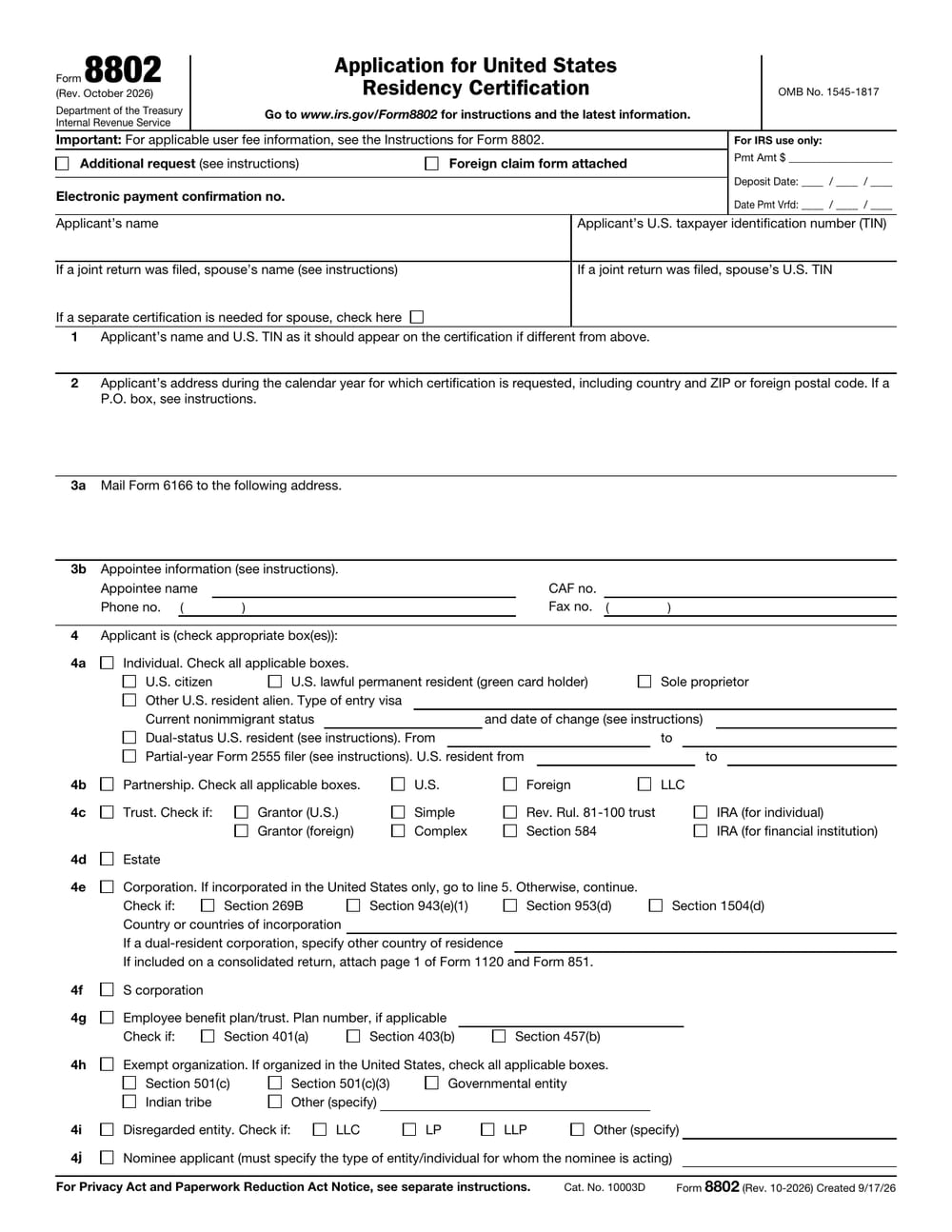
The current form is the October 2026 revision of Form 8802, used with the instructions of the same revision date. One application can cover several countries and several years for the same applicant. For several years, you attach a statement listing each country, year, and number of certificates. The exception is the 3-year procedure for estates, benefit plans, and exempt organizations, which needs one form per year. Because the fee is charged per application, the IRS encourages you to put every request on a single form (Form 8802 instructions).
Form 8802 (Rev. October 2026)
Download Form 8802 (PDF) · Instructions for Form 8802 (PDF)
Local copies for convenience, downloaded from IRS.gov on November 14, 2026. Always confirm you have the current revision at irs.gov/form8802 before filing.
Information the form asks for
- The applicant's name and U.S. taxpayer identification number (SSN, ITIN, or EIN). For a joint return, the spouse's name and TIN exactly as they appear on that return.
- The applicant's address during the certification year, and a separate address for mailing Form 6166. This can be a foreign address. For express delivery abroad, you must supply a prepaid DHL label and envelope or box. For express delivery within the U.S., you supply a prepaid UPS or FedEx label.
- An optional appointee, such as your tax preparer, with the authorization the instructions require.
- Your applicant type: U.S. citizen, green card holder, other resident alien, dual-status resident, partial-year Form 2555 filer, partnership, trust, and so on.
- The return you filed for the base period, or, if you weren't required to file, a statement explaining why (line 5 and Table 1).
- The calendar years to be certified (line 7) and the tax period the certification is based on (line 8, in YYYYMM format).
- The purpose, either an income tax treaty or VAT (line 9). An application with no purpose is sent back for you to complete.
- Any required penalties-of-perjury statements from Table 2 (line 10 or an attachment). These are mandatory for a current-year request: you must state that you are a U.S. resident and will remain one for the rest of the year.
- On the page 3 worksheet, the number of Forms 6166 you want for each country (line 11).
- Signatures. An unsigned or undated Form 8802 isn't considered complete. For married couples, both spouses sign. A parent signs for a minor child.
Paying the fee
| Applicant | Fee per Form 8802, postmarked on or after Oct. 1, 2026 | Previous fee |
|---|---|---|
| Individual | $105 | $85 |
| Non-individual (corporation, partnership, trust, estate, plan) | $230 | $185 |
The fee covers one application, regardless of how many countries or years it includes. A partnership, S corporation, or grantor trust pays one $230 fee for every Form 6166 issued under its EIN. A custodian pays separately for each account holder. The fee is nonrefundable, except for overpayments caused by a mathematical error. Applications postmarked before October 1, 2026, were charged the old fees (IRS user fee fact sheet).
Pay on Pay.gov by searching "IRS Certs," using a bank account (ACH) or a debit or credit card. Since September 29, 2024, Pay.gov has required you to upload a copy of your Form 8802 with the payment, as a single PDF of no more than 15 MB. That upload only validates the payment: the IRS says applications uploaded to Pay.gov are not processed. You still have to send the complete form, with the e-payment confirmation number entered on page 1, by one of the routes below (IRS: Form 6166).
Whether checks are still accepted is unclear. The October 2024 instructions allowed a U.S.-dollar check or money order payable to the United States Treasury. The IRS page on additional certification requests (updated September 30, 2026) still has a "Payment by check or money order" heading with the Philadelphia addresses. The October 2026 instructions, however, ask taxpayers to pay electronically whenever possible and describe only electronic payment. If you plan to pay by check, confirm it's still accepted before mailing.
Three ways to submit
| Route | Who can use it | Details |
|---|---|---|
| Online (mobile-friendly form) | Individuals only, since Sept. 28, 2025 | Requires an IRS Online Account. If a second signer has an ITIN, the form must be mailed instead (IRS mobile-friendly forms; About Form 8802) |
| Fax | All applicants who paid on Pay.gov | 877-824-9110 (toll-free, U.S. only) or 304-707-9792 (from inside or outside the U.S.). Up to 10 Forms 8802 and 100 pages per fax, with a cover sheet showing the page count |
| All applicants | Department of the Treasury, Internal Revenue Service, Philadelphia, PA 19255-0625. By private delivery service: Internal Revenue Service, 2970 Market Street, BLN# 3-E08.123, Philadelphia, PA 19104-5016 |
Fax and mail details: Form 8802 instructions, Rev. October 2026. For questions, the IRS residency line is 267-941-1000 (not toll-free); choose the U.S. residency option.
The filing-compliance condition: why being behind blocks you
Form 6166 is based on your filing record, not just your status. Under the instructions, an applicant is generally eligible if at least one of these is true (Form 8802 instructions):
- They filed an appropriate income tax return for the period (for an individual, Form 1040).
- For a year whose return isn't due yet, they filed the most recent return that was due.
- They weren't required to file for the period, and they provide the documentation listed in Table 1. For an individual, that means proof of income and a written statement explaining why no return was required. For a U.S. citizen, that statement must be made under penalties of perjury.
An applicant who didn't file a required U.S. return for the period is generally not eligible.
Which return the IRS looks at
Line 8 asks for the tax period of the latest return that was required to be filed, including extensions. The instructions give this example: a Form 1040 filer who requests a 2026 certificate on January 1, 2026, enters 202412 (the 2024 return), because the 2025 return isn't due yet. For a current-year certificate, the IRS relies on that latest return plus your penalties-of-perjury statement that you are, and will remain, a U.S. resident for the year.
If your return is filed but not yet processed
If the IRS hasn't posted your return yet, it will ask for a signed copy of your most recent return. Since April 2024, the IRS has made permanent a procedure first tested in 2022: you send only the return itself, without forms, schedules, or attachments. To save time, you can send that signed copy with the application and write "COPY – do not process" on it. By doing so, you confirm you already filed a return with identical information (IRS: New process for Form 8802).
Why this catches expats
Many Americans abroad learn about their U.S. filing obligation late, sometimes only when a foreign bank or payer asks for proof of U.S. residency. Until the relevant returns are filed and on record, the IRS has no basis to certify them. In practice, catching up comes first. Non-willful filers living abroad often use the Streamlined Foreign Offshore Procedures. Whether that's the right route for you depends on your facts; this article doesn't assess eligibility.
Two uncertainties deserve mention. First, the instructions describe the requirement in terms of income tax returns. They don't say whether a missing FBAR (FinCEN Form 114) or a missing information return such as Form 8938 affects a Form 6166 request, so we don't draw a conclusion either way. Second, how the IRS weighs a residency statement from an American abroad isn't spelled out beyond the general rule that the request may be denied without evidence. Practitioners' experiences vary.
Behind on a few years of U.S. returns and need a certificate now? The IRS checks the latest return that was due before it will certify you, so catching up usually comes first. Ask TaxLatitude how to sequence your filings and your application →
Processing times: what the IRS says and what applicants report
The IRS tells applicants to send Form 8802, with full payment, at least 45 days before the date they need to submit Form 6166. It says it will contact you after 30 days if processing will be delayed (IRS: Additional certification requests). That figure has been in the instructions for years. Actual waits have varied much more.
| Period | Reported wait | Source and reliability |
|---|---|---|
| November 2026 | The IRS was working applications received in October 2026 | Official: IRS processing status page, updated Nov. 6, 2026 |
| 2025 | 3 to 5 months, in several self-reported accounts | Unofficial: comments in a forum thread hosted by a commercial IRS call-assistance service. Not verifiable; some posts promote paid services |
| September 2022 | About 15 weeks | Official at the time: IRS operations page (archived copy) |
How to read these numbers:
- The processing-status page shows the month of receipt the IRS is working on. It doesn't tell you when a letter will arrive. Mail to a foreign address adds transit time.
- The current figure is better than in recent years, but conditions change. Reporting in early 2026 described large staff losses at the IRS in 2025 and growing correspondence backlogs (Bloomberg Tax). Check the status page right before you apply instead of relying on any fixed number, including the ones in this article.
- Practitioners disagree on how much buffer to build in. Some guides suggest planning for at least two months (Beancount.io). The IRS figure is 45 days. If a foreign payment or refund deadline is close, the gap between those numbers matters.
- The earliest date to apply is fixed. For a current-year certificate, a request postmarked before December 1 of the prior year is returned. A 2027 certificate can be requested starting December 1, 2026.
Special cases
The rules below come from the Form 8802 instructions (Rev. October 2026) unless another source is cited. Where the instructions say nothing, we say so.
First year of U.S. residence
New arrivals often have no U.S. return on file yet. A green card holder attaches a copy of Form I-551, or a USCIS statement with the required details. Someone who is a resident under the substantial presence test attaches Form I-94 and enters the date their status changed (YYYYMMDD). A current-year request also needs the Table 2 penalties-of-perjury statement that you are, and will remain, a U.S. resident for the year.
The year you leave (or return to) the United States
- Partial-year Form 2555 filers check the dedicated box. For each year in the request, they enter the start and end dates (YYYYMMDD) of the period they were a U.S. resident.
- Dual-status aliens enter their period of U.S. residence for each year. Certification covers only that period.
- U.S. citizens and green card holders remain U.S. persons for U.S. tax purposes after moving abroad, but the residence statement described earlier still applies. Being eligible for the certificate doesn't mean the source country will accept you as a U.S. resident under its treaty.
Couples where only one spouse is American
If you filed jointly, for example after electing to treat a nonresident spouse as a U.S. resident, enter the spouse's name and TIN exactly as they appear on the return. Both spouses sign. If the second signer has an ITIN, the online form can't be used and the application must be mailed (IRS mobile-friendly forms).
The instructions don't say how the IRS treats a request covering a nonresident-alien spouse, or how a source country will view that spouse's treaty residence. The non-American spouse may be a resident of another country under its law and the treaty. Get advice on this point before you apply.
Married to a non-U.S. spouse and need a certificate that covers them too? The instructions don't say how the IRS treats a nonresident-alien spouse's request, or how the source country will view that spouse's treaty residence. Ask TaxLatitude to walk through your specific situation →
If the couple files separately, the U.S. spouse's application rests on their own return, since certification is based on the return filed.
LLCs and companies owned by Americans abroad
- Single-member LLC (disregarded entity). The LLC itself isn't certified. Form 6166 certifies that its single owner filed as a U.S. resident. The owner's information goes on line 6, and if the owner never filed Form 8832, a penalties-of-perjury statement goes on line 10. The owner's personal residence rules therefore apply: an owner who lives abroad faces the same statement requirement as any other American abroad.
- Multi-member LLC taxed as a partnership. Certification is issued to the partners, who must themselves be U.S. residents. A U.S. entity with no U.S. partners isn't eligible.
- S corporation. Certification is issued to the shareholders.
- LLC or corporation taxed as a C corporation. The entity is certified on the basis of its own return, such as Form 1120. The source country may also apply a limitation-on-benefits clause, which Form 6166 doesn't address.
Source countries don't always agree with the U.S. on how to treat transparent entities. France's tax guidance (BOFiP) requires a Form 6166 in the name of a U.S. partnership claiming treaty benefits, and asks LLCs and S corporations for additional proof of their transparent status (BOFiP, BOI-INT-CVB-USA-10-20-40). In Germany, the treatment of dividends paid to an S corporation's U.S. shareholders has been litigated up to Germany's Federal Fiscal Court (Bundesfinanzhof), which ruled in the shareholders' favor (Ebner Stolz summary). Hybrid structures are an area where professional advice is particularly useful.
Minors
A parent signs the child's name, followed by "By (your signature), parent for minor child." If the child's income was reported on the parent's return using Form 8814, a signed copy of Form 8814 is attached.
If your request is returned, denied, or delayed
Returned as incomplete
The IRS sends applications back, or doesn't process them, in several common situations (Form 8802 instructions):
- no e-payment confirmation number on page 1
- no purpose checked on line 9
- no signature and date from someone with authority to sign
- a request for a country that has no income tax treaty with the U.S.
- a current-year request postmarked before December 1 of the prior year
A returned application can be fixed and sent again. Because the fee is nonrefundable, check the form before you send it.
Denied on residency grounds
If the IRS isn't satisfied that you were a U.S. resident, the fix depends on the reason:
- Missing return. File it, wait for it to post (or include a signed copy), then reapply.
- Living abroad. Provide the statement and evidence of U.S. residence under the specific treaty.
- Filed as a nonresident, or claimed a treaty tie-breaker in favor of another country. Under the instructions you are generally not eligible for that period.
A new application means a new fee.
U.S. competent authority assistance
If you believe a specific treaty article entitles you to benefits that were denied, you can ask for competent authority assistance under Revenue Procedure 2015-40. This includes cases where the IRS denied Form 6166. The limits are significant:
- The IRS accepts a residency issue only if it requires consultation with the foreign competent authority. The U.S. competent authority doesn't decide residency on its own.
- Requests can't involve a country with no income tax treaty.
- Requests go to Washington, D.C., not to the Form 8802 address.
The IRS also lists competent authority relief as the option if you're facing double taxation and believe you are a U.S. resident for treaty purposes (IRS: Form 6166).
Delayed
- Call the residency line. The IRS says it will contact you after 30 days if there's a delay. If you haven't heard anything, call 267-941-1000 (not toll-free) and choose the U.S. residency option.
- Watch your mail. Forms 6166 issued between July 29 and November 13, 2024, had incorrect signatures. The IRS mailed replacements automatically, and no action was needed (IRS: Additional certification requests).
- Use the refund route if the payment date passes. Many countries, including the three examples below, let you claim reduced withholding after the fact. If the payer withholds at the full rate because your certificate hasn't arrived, you can usually file a refund claim within the source country's deadline. See the country examples below.
Prior years and extra copies
- Prior years. You can request certification for any number of prior years, in addition to the current year. This is useful for refund claims on income received in earlier years.
- Extra copies. For more Forms 6166 covering the same tax period, check the "Additional request" box on page 1. You must file within 12 months of your most recent certification, and your tax information must not have changed. A new user fee applies.
Using Form 6166 once you have it
Form 6166 is rarely enough on its own. The source country usually has its own claim form, and the U.S. certificate serves as the proof-of-residence part of it. Unless told otherwise, you send Form 6166 to the foreign withholding agent (the bank, company, or pension payer) or to the foreign tax office. The IRS can date-stamp some countries' claim forms, but only where it has an agreement with that country. If there's no agreement, it mails the form back unprocessed. Call 267-941-1000 to ask which countries qualify (Form 8802 instructions).
The examples below assume you are a U.S. resident receiving income from France, Japan, or Germany. If you live in one of these countries and are taxed there as a resident, its domestic-source income is taxed under its resident rules, and these procedures don't apply to it.
| Country | Local form | How Form 6166 fits | Timing |
|---|---|---|---|
| France | Form 5000 (attestation de résidence), plus Form 5001 for dividends, 5002 for interest, or 5003 for royalties | Box IV is normally certified by the foreign tax administration. If that administration issues its own residence certificate, you may skip box IV and attach the certificate instead | To get the treaty rate at source, the form must reach the account keeper before payment. Otherwise, claim a refund by Dec. 31 of the second year after payment, unless the treaty sets a different deadline |
| Japan | Application Form for Income Tax Convention (Form 1 for dividends), plus Form 17, the limitation-on-benefits attachment, which applies because the U.S.–Japan treaty has such an article | Attach the original residency certificate, or show it to the withholding agent. It must have been issued within one year before submission | File through the payer by the day before the first payment. Later: refund claim with Form 11 |
| Germany | BZSt refund or exemption application, filed through the BZSt online portal (BOP) | Upload a certificate of residence with the German tax certificate. For royalty and similar withholding (section 50a), the BZSt says U.S. applicants need only a separate Form 6166 | Refund claims within four years after the end of the year the income accrued, unless the treaty allows longer |
Sources: France: impots.gouv.fr, Form 5000 and Form 5000 notice. Japan: National Tax Agency. Germany: BZSt refund procedure and BZSt withholding tax relief.
Some country-specific details:
- France. You file one Form 5000 per type of income and per paying institution. The notice doesn't name Form 6166, but it does allow a residence certificate issued by the authorities of your country of residence in place of the box IV stamp, and Form 6166 is the U.S. document of that kind, although the notice doesn't say so explicitly. French guidance on U.S. partnerships refers to Form 6166 by name (BOFiP). Banks and payers sometimes have their own document requirements, so ask your payer what it accepts.
- Japan. A Form 6166 for the right year can still be refused if it was issued more than a year before you submit it. Time your request to match the payment date.
- Germany. The BZSt pages aren't fully consistent. The section 50a page describes paper forms, while the capital income pages require filing through the online portal. The capital income refund page doesn't mention Form 6166 by name. A tax certificate from a foreign custodian bank isn't enough: Germany requires one issued by the German paying agent. Check the current BZSt guidance for your type of income before you file.
- Apostilles. The IRS pages we reviewed don't address apostilles. Some foreign payers or authorities ask for one, so ask the party requesting the certificate.
Common mistakes
- Applying before your U.S. filings are current. The IRS checks the latest return that was due. Catch up first, then apply.
- Asking for a certificate to use in the country where you live. Form 6166 is for claiming treaty benefits in a source country where you are a non-resident.
- Leaving out the residence statement as an American abroad. If you filed Form 2555 or are a dual resident, attach the statement and evidence unless the 13-country exception applies.
- Mailing too early. A current-year request postmarked before December 1 of the prior year is returned.
- Treating the Pay.gov upload as your filing. The upload only validates the payment. You still mail, fax, or (individuals only) submit the full form online, with the confirmation number on page 1.
- Filing one Form 8802 per country or year. Each application costs $105 or $230. Combine every country and year on one application where you can.
- Getting line 8 wrong. Enter the latest return required to have been filed, including extensions, in YYYYMM format.
- Missing signatures. Both spouses sign for a joint return. Entities need someone with authority to sign, as listed in Table 3 of the instructions.
- Not including a copy of a recently filed return. If your return may not be posted yet, include a signed copy marked "COPY – do not process."
- Using Form 6166 to support a foreign tax credit. It doesn't prove U.S. tax was paid. If a foreign country later refunds tax you already credited, you may need to amend your U.S. return.
- Ignoring the source country's own rules. Japan's one-year validity, France's one form per payer and income type, and Germany's portal and tax-certificate requirements can each derail a claim, even with a valid Form 6166.
- Forgetting the courier label. For express delivery to a foreign address, the IRS requires a prepaid DHL label and packaging.
FAQ
I'm a U.S. citizen living in France and I file Form 1040 with Form 2555. Can I get a Form 6166?
You can apply, but you must attach a statement and evidence explaining why you should be treated as a U.S. resident for the treaty you're invoking. Many treaties don't treat citizens living abroad as U.S. residents without a substantial presence, permanent home, or habitual abode in the U.S. If you're a French tax resident, France will tax you as one regardless of the certificate.
How much does it cost?
For applications postmarked on or after October 1, 2026, it's $105 per Form 8802 for individuals and $230 for non-individuals. The fee is per application, not per country or year, and is nonrefundable (IRS user fee fact sheet).
How long does it take?
The IRS asks for at least 45 days. In November 2026, its status page showed applications received in October 2026 being worked. Waits of several months were reported in earlier years. Check the processing status page before you apply.
Can I apply online?
Individuals can, through the IRS mobile-friendly form, with an IRS Online Account. Businesses must fax or mail (About Form 8802).
Can one application cover several countries and years?
Yes. On the worksheet you list how many Forms 6166 you need for each country, and you can include prior years.
How long is a Form 6166 valid?
It certifies residency for the years it lists. How recent it must be is up to the receiving country: Japan, for example, accepts only certificates issued within the year before submission (NTA).
Does the IRS check whether I filed my FBARs?
The Form 8802 instructions describe the eligibility test in terms of income tax returns and don't mention FBARs. We found no official statement either way.
Can my tax preparer apply for me?
The form has a section for an appointee. The instructions require the appropriate authorization. For partnerships and S corporations, they mention authorizations such as Form 8821 for the partners or shareholders.
My return is filed but the IRS hasn't processed it. What should I do?
Include a signed copy of the return, without schedules or attachments, marked "COPY – do not process" (IRS: New process for Form 8802).
Can I use Form 6166 to claim a foreign tax credit?
No. It certifies residency, not payment of U.S. tax.
Sources
All sources were accessed and checked on November 12, 2026. Primary sources are official government publications, statutes, regulations and administrative guidance. Secondary sources are commentary or self-reported accounts by third parties, used only for context and labeled as such.
Primary sources: IRS forms, instructions and guidance
- IRS, Instructions for Form 8802 (Rev. October 2026)
- IRS, Instructions for Form 8802 (Rev. October 2024, HTML; source for the check/money order rule)
- IRS, Form 8802 user fee fact sheet
- IRS, About Form 8802
- IRS, Form 6166 – Certification of U.S. tax residency
- IRS, Form 8802 – Additional certification requests
- IRS, Certification of U.S. residency for tax treaty purposes
- IRS, New process with respect to Form 8802
- IRS, Processing status for tax forms
- IRS, Mobile-friendly forms
- IRS, operations page, archived copy (2022 processing time)
- IRS, U.S. taxpayers residing outside the United States (Streamlined Foreign Offshore Procedures)
- Treasury, Technical Explanation of the U.S.–France income tax treaty
Foreign tax authorities
- France, impots.gouv.fr, Form 5000 residence certificate
- France, impots.gouv.fr, Form 5000 notice
- France, BOFiP, BOI-INT-CVB-USA-10-20-40 (U.S. partnerships)
- Japan, National Tax Agency, Application Form for Income Tax Convention, common items
- Germany, BZSt, refund procedure under section 50d(1) EStG
- Germany, BZSt, withholding tax relief under section 50a EStG
Secondary and unofficial sources
- Bloomberg Tax, Report on IRS staffing and correspondence backlogs (Jan. 2, 2026) (secondary)
- Beancount.io, Form 6166 and Form 8802 guide (May 2026) (secondary)
- Claimyr, forum thread on Form 6166 wait times (self-reported, unverified)
- Ebner Stolz, summary of the German Federal Fiscal Court (BFH) ruling on S-corporation dividends (secondary)
This article is general information about U.S. tax residency certification, not tax or legal advice for your situation. It is based on the Instructions for Form 8802 (Rev. October 2026) and related IRS guidance in force as of November 12, 2026, so check IRS.gov/Form8802 for changes before you rely on any detail for a later application.