Key takeaways
- You still file a US return. US citizens and green card holders are taxed on worldwide income wherever they live. Living in Russia, or being unable to bank normally there, does not change the filing, FBAR or Form 8938 rules (IRS; IRS comparison of Form 8938 and FBAR).
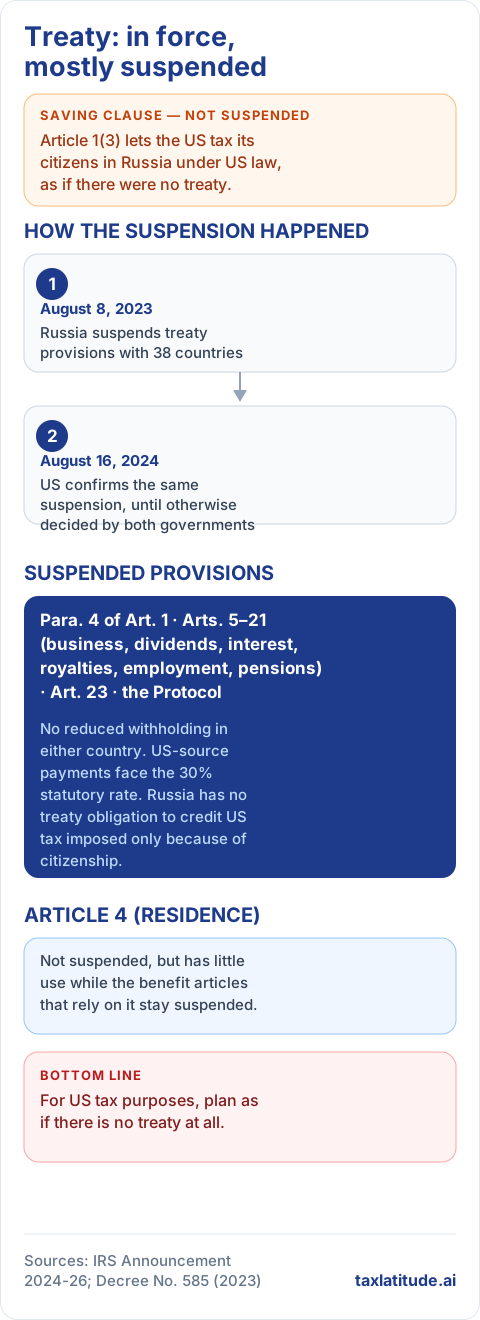
- The 1992 US–Russia tax treaty is still in force on paper, but most of it is suspended. Russia suspended paragraph 4 of Article 1, Articles 5–21 and 23, and the Protocol from August 8, 2023. The United States confirmed the same suspension effective August 16, 2024, "until otherwise decided by the two governments" (IRS Announcement 2024-26). In practice, US citizens living in Russia should plan as if no treaty applies.
- Double-tax relief now comes almost entirely from US domestic law. The foreign earned income exclusion ($132,900 for 2026) and the foreign tax credit are unaffected by the suspension. Whether Russia will credit US tax against Russian tax is less settled (see the treaty section below).
- Sanctions are a separate layer on top of tax. US persons must treat accounts at blocked Russian banks as blocked, generally may not make "new investment" in Russia, and face Russian capital controls aimed at "unfriendly" nationals (OFAC FAQ 1080; Bank of Russia, June 1, 2026). See the sanctions section below, current as of November 1, 2026.
- There is no US–Russia totalization agreement. Self-employed Americans in Russia generally still owe US self-employment tax, and the FEIE does not reduce it.
Do Americans living in Russia still file US taxes?
Yes. The United States taxes its citizens and resident aliens (green card holders) on worldwide income, regardless of where they live. Moving to Russia does not end that obligation, and neither does the partial suspension of the tax treaty.
What this means in practice
- Filing is required even when no tax is due. The IRS notes that a filing requirement generally applies even if the foreign earned income exclusion or the foreign tax credit reduces or eliminates US tax, and that these benefits are available only if a return is filed (IRS, IR-2021-122).
- Income thresholds. For 2026, the standard deduction is $16,100 for single filers and $32,200 for married couples filing jointly, per Rev. Proc. 2025-32 as summarized by Greenback Tax Services. Gross income at or above your threshold generally triggers a filing requirement. Self-employed filers have a separate, much lower threshold for self-employment tax; check the current Form 1040 instructions.
- Deadlines. US citizens and resident aliens whose tax home and abode are outside the United States on April 15 get an automatic 2-month extension to June 15. To use it, you attach a statement explaining why you qualify (IRS). You can request a further extension to October 15 with Form 4868. Interest on unpaid tax still runs from April 15.
- FBAR deadline. FinCEN Form 114 is due April 15, with an automatic extension to October 15 that requires no request (FinCEN).
- Dollars only. Income, expenses and payments must be reported and paid in US dollars (IRS).
Paying the IRS from Russia is harder than filing. The IRS accepts international wires only if your foreign bank has a banking relationship with a US bank (IRS). The State Department says Russia's removal from SWIFT has made transfers to and from the United States impossible, and that US-issued credit and debit cards do not work in Russia (State Department, updated November 7, 2024). Most Americans in Russia therefore rely on a US bank account and IRS Direct Pay, which requires a US routing number (IRS Publication 6147).
When does Russia treat you as a tax resident, and what does it tax?
Russia uses a physical-presence test. Under Article 207(2) of the Russian Tax Code, you are a Russian tax resident if you are actually present in Russia for at least 183 calendar days within 12 consecutive months (Federal Tax Service of Russia). Citizenship and visa type do not decide tax residency. Employers check your status each time they pay you, and your status for the full calendar year is fixed on December 31.
Residents are taxed on worldwide income. Non-residents are taxed only on Russian-source income, generally at a flat 30% with no deductions (Expatica).
Personal income tax (NDFL) rates for residents, 2025 and 2026
| Annual income (main tax base) | Rate on that portion |
|---|---|
| Up to RUB 2.4 million | 13% |
| RUB 2.4–5 million | 15% |
| RUB 5–20 million | 18% |
| RUB 20–50 million | 20% |
| Over RUB 50 million | 22% |
Source: Federal Law No. 176-FZ of July 12, 2024, as summarized by Expatica and Tax Atlas (updated January 28, 2026).
Other rates to know
- Investment income and property sales (a separate base) of residents are taxed at 13% up to RUB 2.4 million and 15% above that, not on the five-step scale; non-residents generally pay 30% (Federal Tax Service, March 2, 2026).
- Non-residents pay 15% on dividends from Russian companies (Tax Atlas).
- Some non-residents use the resident scale. Since 2024, remote employees of Russian employers are taxed on the resident scale regardless of residency (wiki.private.law). Employment income of foreign highly qualified specialists (HQS) is also taxed on the progressive scale; their other income is taxed at the non-resident rate (nalog-nalog.ru).
Filing in Russia. The tax year is the calendar year. Where a return (Form 3-NDFL) is required, it is due April 30, and tax is payable by July 15 of the following year (Federal Tax Service). Employers withhold tax on wages.
Currency residency is a separate status. Russian citizens and foreigners with a Russian permanent residence permit (vid na zhitelstvo) are Russian "currency residents." They must notify the tax authority about foreign accounts, including US accounts, and file an annual report on movements of funds by June 1. Those who spent more than 183 days outside Russia in the year are exempt from the annual report (wiki.private.law; Bellerage). A US citizen holding only a temporary permit is not a currency resident on this definition.
Is there a US–Russia tax treaty?
On paper, yes; in practice, mostly no. The income tax convention signed June 17, 1992 has not been terminated, but both governments have suspended most of its operative provisions. EY notes that the treaty "remains in force until terminated" under Article 28 (EY, June 28, 2024). The IRS treaty page, last reviewed November 26, 2025, states that withholding agents may not accept treaty claims for payments made on or after August 16, 2024 (IRS).
US-Russia Convention (1992), already consolidated with its related Protocol — text unchanged, but most of it is currently suspended
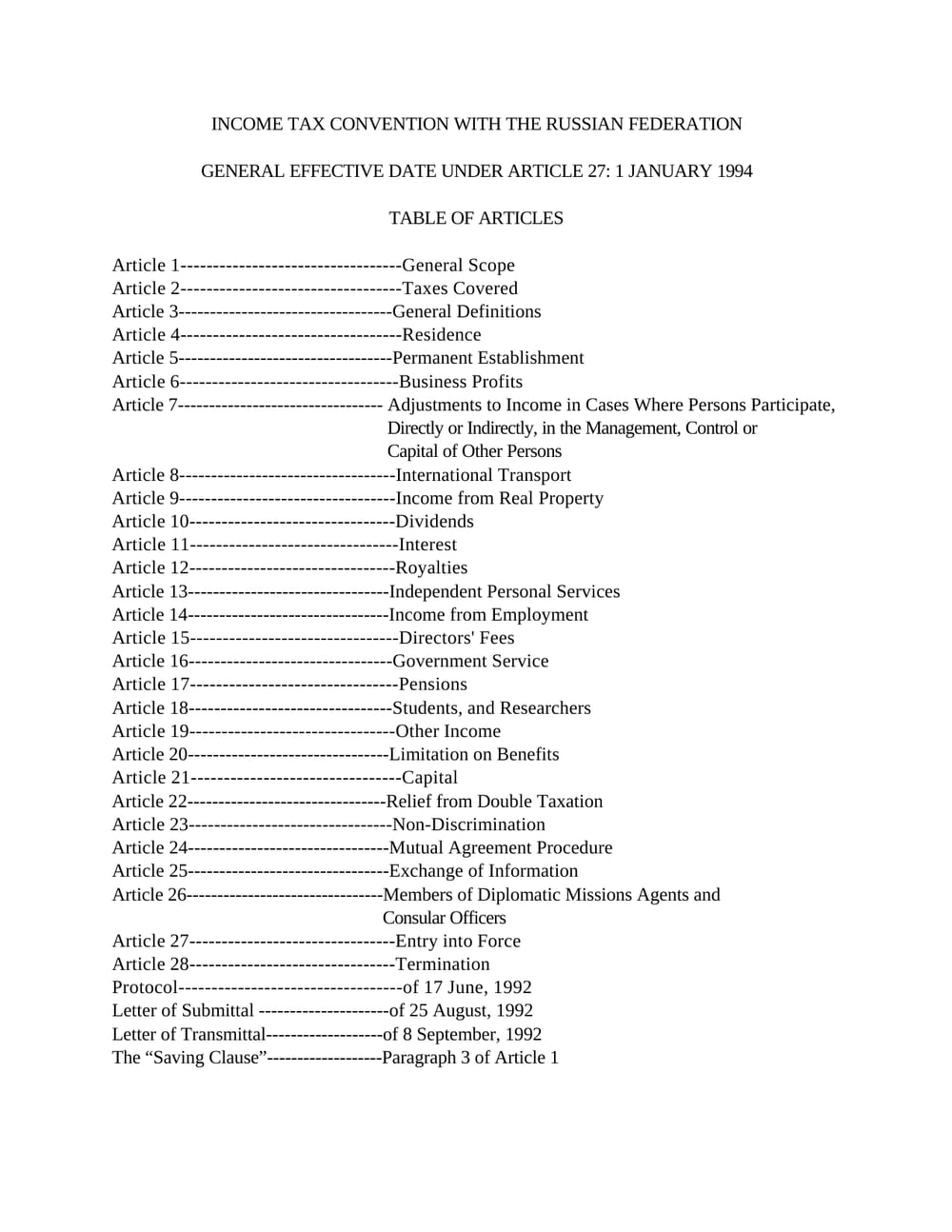
Download the Convention (PDF, 27 pages)
Local copy for convenience, downloaded from IRS.gov on November 14, 2026. This is the full legal text as signed in 1992, already folding in its related Protocol — it has not been amended or terminated, but as explained above, both governments suspended most of its operative articles (5–21, 23, and the Protocol) effective August 16, 2024. See the IRS's own Russia tax treaty documents page and Announcement 2024-26 for the current status.
How the suspension happened
| Date | Event | Source |
|---|---|---|
| June 17, 2024 → August 16, 2024 | US formal notice dated June 17, 2024; US suspension takes effect August 16, 2024 for withholding and other taxes, "until otherwise decided by the two governments" | IRS Announcement 2024-26; Treasury press release |
| December 28, 2023 | IRS Notice 2024-11 removes Russia from the treaty list used for "qualified foreign corporation" status, for dividends paid on or after January 1, 2023 | EY |
| December 19, 2023 | Russia entrenches the suspension in Federal Law No. 598-FZ | EY; wiki.private.law |
| August 8, 2023 | Presidential Decree No. 585 suspends provisions of treaties with 38 "unfriendly" states, effective on publication; Russia notifies the US the same day | EPAM; KPMG |
| April 5, 2022 | US Treasury suspends exchange of tax information with Russia | EY Global Tax News |
The Russian text of the decree is published on the Kremlin's legal portal and reproduced by v2b.ru. This guide relies on IRS, Treasury and Big Four summaries for the article list, which all match.
What is suspended, and what it means for a US citizen living in Russia
| Treaty provision | Status | Practical effect |
|---|---|---|
| Art. 1(3): saving clause (each country may tax its own residents and citizens as if there were no treaty) | Not suspended | The US keeps taxing citizens in Russia under US domestic law, as it always did |
| Art. 1(4): exceptions to the saving clause (Arts. 7(2), 17(b), 22, 23, 24 for citizens and residents) | Suspended | US citizens lose the treaty benefits that normally override the saving clause, including the treaty foreign tax credit and social security rule |
| Art. 4: residence and tie-breaker rules | Not suspended | Remains formally in place, but has little use while the benefit articles are suspended |
| Arts. 5–21: permanent establishment, business profits, dividends, interest, royalties, employment, pensions (Art. 17), students (Art. 18), other income | Suspended | No reduced withholding in either country; US-source payments to Russian residents face the 30% statutory rate (EY) |
| Art. 22: relief from double taxation | Not listed as suspended, but effectively inoperative for US citizens and residents | EY and RSM conclude it falls away because Art. 1(4) is suspended (EY; RSM) |
| Art. 23: non-discrimination | Suspended | No treaty protection |
| Protocol, including para. 8(a) (Russia credits US tax imposed only because of citizenship) | Suspended | Russia has no treaty obligation to credit US citizenship-based tax |
| Arts. 24–28: mutual agreement, exchange of information, diplomats, entry into force, termination | Not suspended | Information exchange was separately halted by the US in 2022 |
Article 4's tie-breaker rules remain formally in force even though the benefit articles are suspended. Our tie-breaker tool walks through the order for the US-Russia treaty, including this current suspension status.
Confused about whether the US-Russia treaty still protects you? Most of it has been suspended since August 2024 — the saving clause and a handful of procedural articles are all that remain, so double-tax relief now depends almost entirely on the FEIE and the foreign tax credit. See which US domestic rules actually apply to you →
Pensions. Article 17 (pensions and social security) is suspended in full. Under the treaty text, private pensions were taxable only in the country of residence, and US Social Security only in the United States. Neither rule now applies; each country applies its domestic law. How Russia currently taxes US Social Security or US retirement-plan distributions received by its residents is not settled in any authoritative guidance available today. Treat this as an open question for a Russian adviser.
Will Russia credit US tax? This is the most uncertain point. Under Article 232(1) of the Russian Tax Code, an individual resident may credit foreign tax only if a treaty provides for it (LT in Focus). The Russian Ministry of Finance wrote on October 3, 2025 (Letter No. 03-04-07/96092) that treaty articles eliminating double taxation remain in force, so a credit is possible in principle, applied using the treaty provisions still operating (ppt.ru). One practitioner wiki, however, reported that as of August 2026 there was no official guidance on how this applies to the US pair specifically (wiki.private.law, updated October 19, 2026). Two cautions apply. The letter is general and names no country. For the US pair, the Protocol is suspended, including paragraph 8(a) on crediting US tax imposed solely because of citizenship. A Russian credit for US tax on non-US-source income therefore looks especially doubtful, and the primary sources available do not resolve the point one way or the other.
Bottom line. For US tax purposes, plan as if there is no treaty. Relief from double tax comes from the US Internal Revenue Code. The highest risk of genuine double taxation is on US-source income (US dividends, US rental income, US pensions) received while you are a Russian tax resident, because whether Russia will credit US tax in this situation remains an open question.
Receiving US dividends, rent, or pension income while living in Russia? With the treaty credit suspended, whether Russia will credit your US tax on that income is still an open question — this is where genuine double taxation is most likely. Check your exposure on US-source income →
How do you avoid paying tax twice?
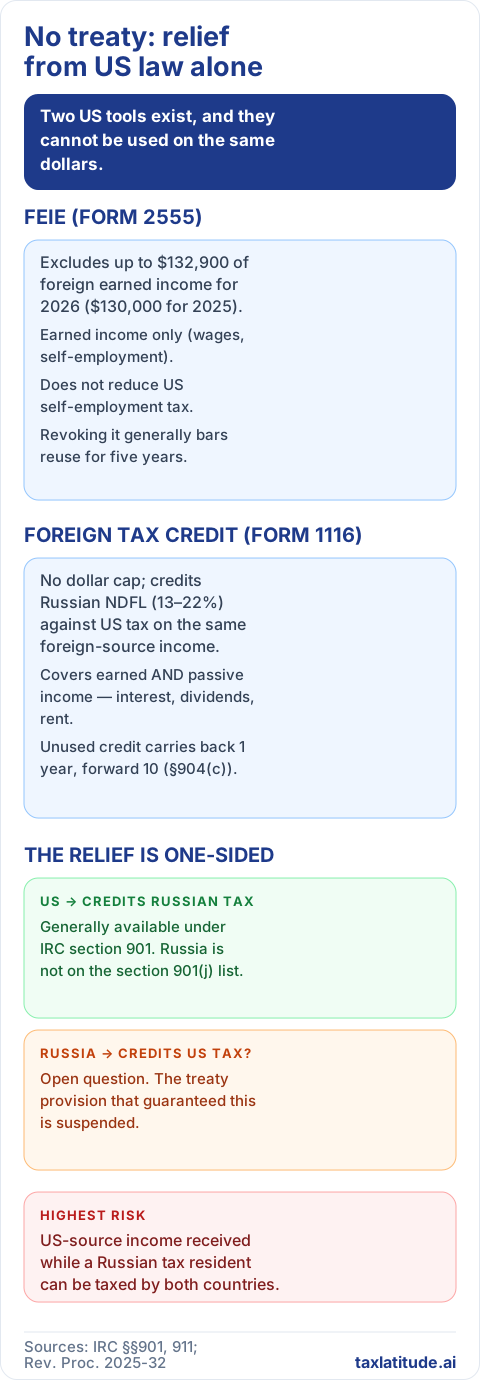
With the treaty suspended, US citizens in Russia rely on two tools in the Internal Revenue Code: the foreign earned income exclusion (FEIE, section 911) and the foreign tax credit (FTC, section 901). Neither depends on a treaty, so the suspension does not remove them. See our guide on FEIE vs Foreign Tax Credit for how the two generally compare.
| Foreign earned income exclusion (Form 2555) | Foreign tax credit (Form 1116) | |
|---|---|---|
| What it does | Excludes foreign earned income from US income tax, up to a cap | Credits Russian income tax paid against US tax on the same foreign-source income |
| 2026 limit | $132,900 per qualifying person ($130,000 for 2025) (KPMG on Rev. Proc. 2025-32) | No dollar cap; limited to the US tax on foreign-source income in each category |
| Who qualifies | Tax home abroad plus the bona fide residence test or the physical presence test (330 full days abroad in 12 consecutive months), IRC §911(d)(1) | Anyone who pays or accrues a creditable foreign income tax |
| Income covered | Earned income only (wages, self-employment) | Earned and passive foreign-source income, such as Russian interest, dividends and rent |
| Self-employment tax | Not reduced (nation.ly) | Not reduced |
| Typical fit | Wage earners below the cap, especially where Russian tax (13–22%) is lower than the US rate | Income above the FEIE cap, passive Russian income, or higher earners |
Points specific to Russia
- Russian NDFL is an income tax, so it is generally creditable. The section 901(j) list of countries whose taxes cannot be credited does not currently include Russia, and the IRS revenue rulings on 901(j) and 911(d)(8) reviewed for this guide do not list it either (Rev. Rul. 2005-3).
- Legislation to watch. The HONOR Act (S. 327, 119th Congress) would add Russia to section 901(j) and deny the credit for Russian taxes. It passed the Senate on March 10, 2026. A House companion (H.R. 9764) was introduced on July 16, 2026, with no further action recorded since. It is not law as of November 1, 2026. Check its status before filing, since enactment would change this section.
- Russian dividends are no longer "qualified" through the treaty route. IRS Notice 2024-11 removed Russia from the treaty list used for qualified-foreign-corporation status, for dividends paid on or after January 1, 2023 (EY). Unless another test applies, such dividends are taxed at ordinary US rates.
- US-source income is the weak spot. The FTC generally cannot offset US tax on US-source income, and Russia's obligation to credit US tax on residents now rests on uncertain ground. US dividends, US rent and US retirement distributions received while you are a Russian tax resident can therefore be taxed by both countries.
- Choosing and switching. You can use the FEIE on wages and the FTC on other income, but no credit is allowed for Russian tax on income you excluded. If you revoke the FEIE election, you generally cannot elect it again for five years without IRS consent (IRC §911(e)(2)). Model both before you choose.
- Exchange rates. Convert rubles to dollars consistently. Use the transaction-date rate, or the IRS yearly average rate where permitted. Ruble volatility since 2022 makes this choice matter.
Social security: is there a totalization agreement with Russia?
No. See our guide on how a totalization agreement normally works, and why the self-employed feel its absence most. The Social Security Administration's list of totalization agreements in force (revised September 17, 2026) has 31 countries, from Australia to Uruguay; Romania is the newest, effective September 1, 2026. Russia is not on it (SSA POMS GN 01701.005).
What that means
- Self-employed Americans in Russia generally owe US self-employment tax (Social Security and Medicare) on their net earnings, even if the FEIE eliminates their income tax. The FEIE does not reduce self-employment tax (nation.ly). Russia may also impose its own contributions on the same activity, and no agreement assigns coverage to one country.
Self-employed in Russia? The FEIE doesn't reduce your US self-employment tax, and with no totalization agreement between the two countries, Russia can tax the same earnings too. Work out what you actually owe →
- Employees of Russian employers are generally in the Russian social insurance system through employer contributions. US Social Security tax generally does not apply to a US citizen working abroad for a foreign employer, unless the employer is a US company or a foreign affiliate covered by a section 3121(l) agreement. Check your employment structure.
- No combined credits. Without an agreement, Russian work periods cannot be added to US credits to qualify for US benefits.
- The treaty's pension article is suspended (Article 17, including 17(b) on social security benefits).
Can you receive US Social Security in Russia? Russia is not on SSA's restricted-payment list. That list names Cuba and North Korea (Treasury restrictions), plus Azerbaijan, Belarus, Kazakhstan, Kyrgyzstan, Tajikistan, Turkmenistan and Uzbekistan (SSA POMS VB 01201.015, revised August 21, 2026). SSA's procedures allow payments to beneficiaries in Russia (SSA POMS RS 02650.260). Getting the money is a separate issue. Given the banking situation described below, beneficiaries typically keep payments in a US bank account. Whether SSA currently delivers payments directly to Russian banks is unclear from the agency's published procedures.
Which US forms apply to accounts and assets in Russia?
The reporting rules are domestic US law and apply in full to Russian accounts, whether or not your bank reports you. Neither the treaty suspension nor sanctions remove them.
| Form | Who files | Threshold for someone living abroad | Filed with |
|---|---|---|---|
| FinCEN Form 114 (FBAR) | US persons with a financial interest in, or signature authority over, foreign financial accounts | Aggregate maximum value over $10,000 at any time in the year | FinCEN, by April 15 (automatic extension to October 15) (FinCEN) |
| Form 8938 (FATCA statement) | Specified individuals required to file a return | Single or married filing separately: over $200,000 on the last day of the year or over $300,000 at any time. Married filing jointly: over $400,000 or $600,000 (IRS; IRS comparison chart) | IRS, with Form 1040 |
| Form 8621 (PFIC) | Shareholders of a passive foreign investment company, such as most non-US mutual funds and ETFs | Filing triggers set out in the instructions (rev. December 2025) (IRS) | IRS, with Form 1040 |
| Form 5471 / Form 8865 | US persons who own or control certain foreign corporations or partnerships, such as a Russian OOO | Ownership tests in the instructions | IRS, with Form 1040 |
| Form 3520 | Recipients of large gifts or bequests from foreign persons, and owners or beneficiaries of foreign trusts | Gifts from a foreign individual over $100,000 in a year (IRC §6039F) | IRS, separately |
Filing Form 8938 does not replace the FBAR; many people file both (IRS).
Accounts at sanctioned Russian banks. OFAC requires US persons to treat accounts at blocked Russian banks as blocked property and to file blocking reports (see the sanctions section below). Neither FinCEN nor the IRS has published guidance exempting such accounts from FBAR or Form 8938 reporting. Treat them as reportable unless an adviser concludes otherwise.
Does Russia have a FATCA agreement (IGA) with the United States? No. Negotiations were close in early 2014. Treasury then said it had "suspended negotiations with Russia on a FATCA agreement" after the annexation of Crimea (WealthBriefing, June 30, 2014). Russia has never signed an IGA.
How Russian banks are supposed to comply without an IGA. Federal Law No. 173-FZ of June 28, 2014 created the framework (Federal Tax Service of Russia; White & Case):
- Russian financial institutions may register directly with the IRS as foreign financial institutions. More than 500 had registered by June 2014 (The Moscow Times).
- They may send a client's data to a foreign tax authority only with the client's consent (TASS). They must notify the Bank of Russia, Rosfinmonitoring and the tax service before sending, and Rosfinmonitoring can prohibit a transfer (JD Supra; The Moscow Times).
- Banks may refuse service to clients who will not provide information or consent.
Does that channel still work in practice? The evidence available does not settle the question either way. No IRS, Treasury, Bank of Russia or Big Four source dated after February 2022 addresses whether Russian banks continue to send FATCA reports to the IRS. Separately, the US suspended government-to-government exchange of tax information with Russia on April 5, 2022 (EY). Exclusion from SWIFT affects payments, not reporting, so it does not by itself answer the question. Your own FBAR and Form 8938 obligations are the same either way.
Russian investment funds are a double trap. Russian mutual funds (PIFs) and exchange-traded funds are likely PFICs, with punitive default US tax treatment. Separately, OFAC says US persons may not purchase new or existing debt or equity securities issued by an entity in Russia (McDermott on OFAC FAQ 1054). Holding pre-2022 positions, and selling them to non-US persons, is treated differently from buying (see the sanctions section below).
Sanctions and the current treaty uncertainty
Current as of November 1, 2026. This section describes a situation that changes often, sometimes weekly. Every statement carries a source and a date. Check each source again before you act; anything here may already be out of date.
Treaty status at a glance
- In force on paper; most provisions suspended by both sides. Russia suspended them from August 8, 2023 (Decree No. 585). The US followed on August 16, 2024, "until otherwise decided by the two governments" (IRS Announcement 2024-26). The IRS treaty page was last reviewed November 26, 2025 (IRS).
- No reinstatement found. Neither government has announced talks to restore the suspended articles. A practitioner summary updated October 19, 2026 reports no change in the US position since August 2024 (wiki.private.law).
- Open questions: whether Russia will credit US tax for Russian residents, and whether Congress will deny US credits for Russian tax (the HONOR Act, discussed above).
What US sanctions reach an ordinary American?
US sanctions bind "US persons" wherever they live, so they apply to a US citizen living in Moscow. These are the rules most likely to affect a private individual, as opposed to a company or a designated person.
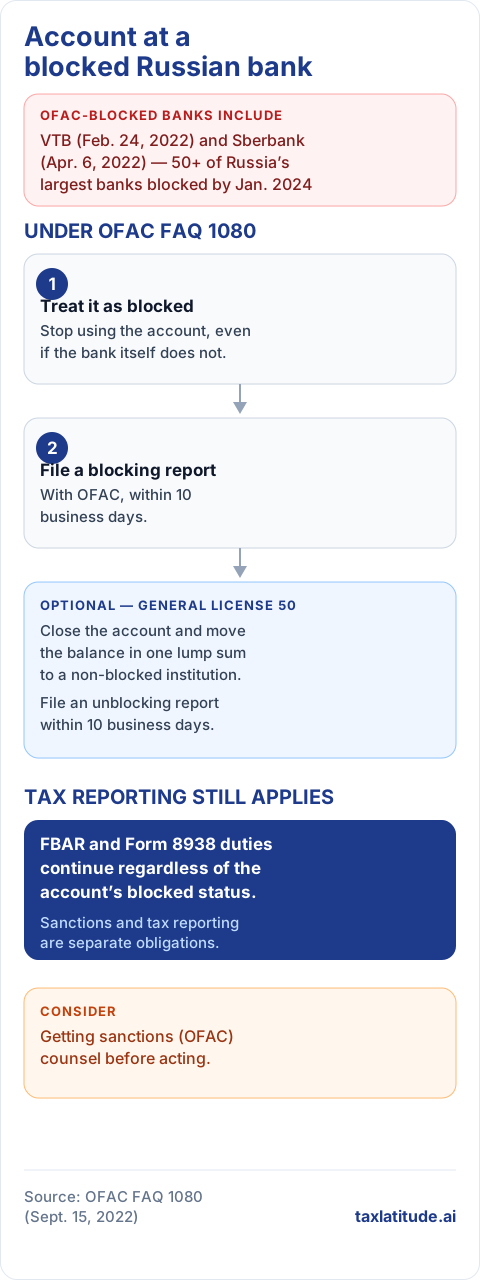
- Accounts at blocked banks. OFAC has blocked many Russian banks, including VTB (February 24, 2022) and Sberbank (April 6, 2022) (Treasury; Willkie). By January 2024, more than 50 of Russia's largest banks were blocked (Debevoise). Under OFAC FAQ 1080, a US person with an account at a blocked bank must treat it as blocked property and stop using it even if the bank does not, file a blocking report with OFAC within 10 business days, and may optionally use General License 50, which lets individuals close the account and move the balance in a lump sum to a non-blocked institution, followed by an unblocking report within 10 business days.
- Everyday living: not a full embargo, but read the licenses precisely. Russia sanctions prohibit specific activities; ordinary personal transactions with non-blocked Russian persons are not generally prohibited. Two licenses matter. General License 19 is narrower than its title suggests. It lifts only the Executive Order 14068 ban on US-dollar banknotes (section 1(a)(iv)), so US individuals in Russia may use dollar cash for personal maintenance such as rent, utilities, taxes and fees. It does not authorize dealings with blocked persons or anything else prohibited under the Russia sanctions regulations. General License 13S authorizes certain administrative payments, such as taxes and fees, that Directive 4 would otherwise prohibit. Directive 4 restricts dealings with Russia's Central Bank, National Wealth Fund and Ministry of Finance. GL 13S was reissued on October 8, 2026 and now runs to January 9, 2027 (OFAC program page; Sanctions Expert).
- Personal remittances. OFAC says personal, non-commercial remittances are not the target of Russia sanctions. Non-sanctioned banks and money services businesses may process them (OFAC FAQ 1202). GL 18 covers personal remittances in US dollar banknotes (OFAC).
- "New investment" ban. Executive Order 14071 (April 6, 2022) prohibits new investment in Russia by US persons, wherever located. OFAC's examples include buying real estate in Russia "other than for noncommercial, personal use" (Davis Polk). They also include buying new or existing Russian debt or equity securities (FAQ 1054). Maintaining a pre-2022 investment is not "new investment," and selling to a non-US person is allowed (Vedder Price).
- Services bans. US persons may not provide accounting, trust and corporate formation, or management consulting services to persons in Russia (from May 8, 2022). This also applies to IT consultancy and certain design software from September 12, 2024 (Arnold & Porter; modeldiplomat.com). This matters for Americans working as freelancers or consultants in Russia.
- Third-country banks. Executive Order 14114 (December 22, 2023) exposes non-US banks to secondary sanctions for supporting Russia's military-industrial base (Debevoise). Some banks in third countries have since closed Russia-linked accounts. Expect extra scrutiny of any account with a Russian address.
- Latest change, September–October 2026. The Graham Sanctioning Russia and Iran Act of 2026 was signed on September 18, 2026. On October 16, 2026, an Executive Order implemented it but waived nearly all of its Russia-related sanctions and tariffs, with no end date. Sanctions under earlier Executive Orders, such as EO 14024, are unaffected (Mondaq, October 19, 2026; King & Spalding). The summaries of the Act consulted for this guide do not mention tax provisions (FTC or FEIE); only its full statutory text would settle the point with certainty. OFAC also issued narrow licenses in October 2026, for example GL 135 on Russian diesel (OFAC program page). None of these changes the rules above for individuals. They do show that the regime is in flux.
What Russian countermeasures hit Americans?
Russia classifies the United States as "unfriendly." Several Russian rules apply to US nationals who are currency non-residents, meaning they hold no Russian citizenship and no permanent residence permit. That status is different from tax residency. For how this compares to currency controls elsewhere, see our currency controls world map.
- Transfers abroad. From June 8 through December 7, 2026, non-resident individuals from unfriendly countries who work in Russia may transfer abroad only up to their wages. Those who do not work in Russia may not transfer funds abroad at all (Bank of Russia, June 1, 2026). Watch for a renewal decision before December 7, 2026.
- Brokerage accounts. Transfers abroad from brokerage and trust-management accounts of unfriendly non-residents were suspended for another six months from October 1, 2026 (Bank of Russia, September 24, 2026).
- Bank deposits. Decree No. 377 of June 1, 2026 extends Russia's "foreign creditor" regime to bank deposits. Where a bank's monthly payments to foreign creditors exceed RUB 10 million, the money goes to a restricted ruble "Type C" account. Funds there can be used mainly for taxes, fees and transfers to other Type C accounts. According to B1, Russian residence permit holders are not "foreign creditors," and the threshold's scope is unclear, so banks apply it conservatively (B1, July 3, 2026).
What official guidance exists for Americans in Russia?
- State Department. Russia is at Level 4, "Do Not Travel"; the advisory was most recently reissued on December 29, 2025, according to a feed of State Department advisories and press coverage at the time. A travel-insurance advisory guide updated August 18, 2026 still listed that date (relief.unboundmedicine.com). The advisory page itself was not accessible at the time of writing. The State Department's page for US citizens in Russia, updated November 7, 2024, says US-issued cards will not work in Russia and transfers to and from the US are impossible because of SWIFT removal. It also notes that non-residents may have difficulty withdrawing foreign currency. Citizens can email moscowACS@state.gov (State Department).
- IRS and Treasury. Beyond Announcement 2024-26, the treaty page and general guidance on paying from abroad, this guide found no IRS or Treasury guidance specific to Americans in Russia on filing, payment or banking difficulties. Treasury's practical guidance for individuals comes from OFAC's FAQs and general licenses cited above.
What to watch
| Item | Why it matters | Where to check |
|---|---|---|
| Bank of Russia transfer limits after December 7, 2026 | Decides whether you can move money out of Russia | cbr.ru |
| HONOR Act (S. 327) | Passed the Senate March 10, 2026; would deny US credits for Russian tax if enacted | congress.gov |
| Russian guidance on crediting US tax | Decides whether US-source income is taxed twice | Russian Ministry of Finance letters |
| Any lifting of US Executive Orders | Would change the bank, investment and services rules above | OFAC Russia program page |
| Treaty reinstatement | Requires a decision by both governments | IRS Russia treaty page |
Local considerations
Three situations come up most often: working for a Russian employer, running a business, and owning property. Sanctions questions overlap with tax questions in each.
Employment
- Russian employers act as tax agents and withhold NDFL from wages. The rate depends on your status on each payment date, then is trued up for the year.
- Foreign highly qualified specialists (HQS) and remote employees of Russian employers are taxed on the resident scale on their employment income even if they are non-residents.
- On the US side, Russian wages are foreign earned income for the FEIE, and Russian NDFL on them is creditable on Form 1116.
- If you work in Russia but are paid by a US employer, check two things. First, whether US Social Security still applies to you. Second, whether your presence creates a taxable presence for the employer: with Article 5 suspended, Russian domestic permanent-establishment rules apply (RSM).
Running a business
- Sanctions come first. Forming or capitalizing a new Russian company is likely to be "new investment," which EO 14071 prohibits for US persons. OFAC defines investment as committing capital or other assets to generate returns or appreciation (Locke Lord on FAQ 1049). Providing accounting, corporate formation, management consulting or IT consultancy services to persons in Russia is also prohibited. Get sanctions advice before starting.
- Existing businesses. Maintaining a pre-April 6, 2022 investment is generally permitted; expanding it may not be (Covington).
- US reporting. A US person who owns or controls a Russian company may have Form 5471 obligations, and possibly US anti-deferral income (Subpart F or GILTI). These rules are complex; see the professional-help section below.
- Russian self-employment regimes. Russia offers special regimes, including a professional-income tax on turnover (Expatica). Which of these regimes are open to US citizens is a question for a Russian adviser; it is not addressed in the sources used here.
Real estate
- Buying. Under OFAC guidance, buying Russian real estate is prohibited "new investment" unless it is for noncommercial, personal use, such as your own home (Davis Polk). Buying a rental property is therefore a sanctions problem as well as a tax one.
- Selling: Russian tax. Since January 1, 2019, gains on property owned for at least the minimum holding period are exempt for both residents and non-residents. The period is generally 5 years, or 3 years for property acquired before January 1, 2016 and in certain other cases (Van Rhijn Legal). If you sell earlier, residents pay 13% up to RUB 2.4 million and 15% above that, after deductions (Federal Tax Service, March 2, 2026). Non-residents pay 30% without those deductions (Konsu Group).
- Selling: US tax. The gain is reportable on your US return in dollars. If the home was your main home, you may be able to use the section 121 exclusion. Russian tax paid may be creditable. A sale that is tax-free in Russia after the holding period can still be taxable in the US.
- Getting the proceeds out. Currency non-residents from unfriendly countries who do not work in Russia currently may not transfer funds abroad. Plan any sale with this in mind.
- Annual property tax. Russia levies an annual property tax on individuals (Realting). It is not an income tax, so it does not qualify for the foreign tax credit. Current US law sharply limits deductions for foreign real property taxes, so check the rules for your tax year before claiming one.
What happens when leaving Russia?
Leaving changes your Russian tax status, your access to money held in Russia and some of your US calculations. The order of steps matters more than usual because of capital controls.
Russian side
- Tax residency follows your days. If you spend fewer than 183 days in Russia in the 12-month test period, you become a non-resident. Russian-source income is then taxed at 30% (15% on dividends), without deductions. Your status for the year is fixed on December 31, so tax withheld at resident rates earlier in the year may be recalculated (Federal Tax Service; wiki.private.law).
- Moving money out before you stop working. A US currency non-resident who works in Russia may currently transfer abroad up to the amount of their wages. One who no longer works in Russia may not transfer funds abroad at all (Bank of Russia, June 1, 2026). In practice, this makes the timing of the last paycheck and of transfers critical.
- Selling property. The 5-year (or 3-year) holding period exemption applies to non-residents too. Selling before the period ends after you become a non-resident means a 30% rate without deductions.
- Permanent residence permit holders remain Russian currency residents with foreign-account reporting duties. The annual report exemption applies if you spend more than 183 days abroad in the year.
- Dual US–Russian citizens. Russia requires citizens to notify the authorities of a foreign citizenship or permanent residence permit within 60 days. Failing to notify is a crime under Article 330.2 of the Criminal Code, punishable by a fine of up to RUB 200,000 or up to 400 hours of compulsory labor (wiki.private.law; IMI Daily). This is not a tax rule, but it often comes up when people leave or return.
US side
- Part-year FEIE. In the year you move, the exclusion is prorated to the qualifying days. Check whether you still meet the bona fide residence or physical presence test for the period abroad (Form 2555 instructions).
- Foreign tax credits. Unused Russian tax credits can generally be carried back one year and forward ten under section 904(c), so keep Russian tax records.
- Closing accounts. Report the accounts on the FBAR and Form 8938 for every year they were open, including the year you close them. For accounts at blocked banks, OFAC General License 50 allows closing the account and a lump-sum transfer to a non-blocked institution, with an unblocking report (OFAC FAQ 1080).
- Renouncing US citizenship is a separate decision, with its own tax filing (Form 8854) and possible exit tax — our exit tax tool estimates exposure. The State Department fee was reduced to $450 effective April 13, 2026 (Expat US Tax). Whether US Embassy Moscow currently offers loss-of-nationality appointments is unclear; the embassy has operated with sharply reduced consular services since 2021 (JD Supra / Ogletree).
Mistakes Americans commonly make in Russia
- Claiming treaty benefits that no longer exist. Using Article 17 (pensions), Article 14 (employment), the Protocol's credit rule or Form 8833 positions based on the Russia treaty after the suspension dates.
- Assuming no filing is needed because the bank cannot report. Your FBAR and Form 8938 obligations do not depend on whether a Russian bank sends FATCA data.
- Leaving accounts at sanctioned banks unreported to OFAC. Using an account at a blocked bank, or skipping the blocking report, is a sanctions issue separate from tax.
- Buying Russian securities, funds or rental property. These are likely prohibited "new investment" for US persons. Russian funds are also likely PFICs.
- Forgetting self-employment tax. The FEIE does not reduce it, and there is no totalization agreement.
- Ignoring US-source income. US dividends, rent or pension income received while a Russian tax resident can be taxed twice now that the treaty credit is suspended.
- Mixing up tax residency and currency residency. The 183-day test drives Russian income tax. A Russian permanent residence permit or citizenship drives foreign-account reporting and capital-control treatment.
- Leaving Russia before moving money. Unfriendly-country non-residents who stop working in Russia currently cannot transfer funds abroad.
- Paying the IRS late because transfers fail. Wires from Russia to the US are very hard to make. Keep a funded US account so you can pay by Direct Pay.
- Relying on old or general guides. Many expat guides still describe the treaty as fully in force. Check the date on anything you read.
Checklist
Every year
- Count your days in Russia and confirm your Russian tax residency status (183 days in 12 consecutive months).
- File Form 1040 by June 15 with the statement for the automatic extension, or extend to October 15 with Form 4868.
- Choose between FEIE (Form 2555) and FTC (Form 1116) for your Russian wages; model both.
- File the FBAR (FinCEN 114) if your foreign accounts together exceeded $10,000 at any time.
- Check the Form 8938 thresholds ($200,000 / $300,000 single; $400,000 / $600,000 joint, for filers abroad).
- File Form 8621 for any PFIC, such as a Russian mutual fund.
- Pay self-employment tax on net self-employment earnings (Schedule SE).
- File a Russian 3-NDFL return if required (April 30) and pay by July 15.
- If you hold a Russian permanent residence permit, notify the tax authority of foreign accounts and file the annual cash-flow report by June 1 unless exempt.
- Keep a funded US bank account for IRS payments.
Sanctions and banking
- List every Russian account and check each bank against OFAC's SDN list.
- For accounts at blocked banks: stop using them, file a blocking report within 10 business days, and consider closing under General License 50.
- Before any purchase of Russian property, securities or a business interest, confirm it is not prohibited "new investment."
- If you provide professional services to people in Russia, check them against the OFAC services bans.
- Recheck the Bank of Russia transfer rules before each major transfer; the current period ends December 7, 2026.
Before leaving Russia
- Move funds you need abroad while you are still working in Russia.
- Time any property sale around the 5-year (or 3-year) holding period.
- Close or document Russian accounts and keep statements for your FBAR.
- Keep Russian tax payment records for foreign tax credit carryovers.
Frequently asked questions
Is the US–Russia tax treaty canceled? No. It has not been terminated, but paragraph 4 of Article 1, Articles 5–21 and 23, and the Protocol are suspended. Russia's suspension began August 8, 2023 and the US suspension August 16, 2024 (IRS Announcement 2024-26).
Can I still use the foreign earned income exclusion while living in Russia? Yes, if you meet the tax-home and residence or presence tests. The FEIE is domestic US law and does not depend on the treaty. The 2026 limit is $132,900 (KPMG).
Can I claim a US credit for Russian income tax? Generally yes, under section 901. Russia is not on the section 901(j) list as far as the available guidance shows. A bill that passed the Senate on March 10, 2026 (S. 327) would change that if the House also passes it and it is signed.
Will Russia tax my US Social Security or US pension? Authoritative sources do not settle this. The treaty article that assigned taxing rights (Article 17) is suspended, so each country now applies its own law. Ask a Russian tax adviser before relying on any answer.
Does my Russian bank report me to the IRS? Russia has no FATCA agreement. Russian law lets banks report with the client's consent, but no recent source confirms whether that channel is still active today. Either way, it does not change your own reporting duties.
I have an account at Sberbank or VTB. What should I do? Both banks are blocked by OFAC. US persons must treat such accounts as blocked, file a blocking report, and may close them under General License 50 (OFAC FAQ 1080). Consider getting sanctions advice.
Can I pay my rent and Russian taxes despite sanctions? Generally yes, as long as no blocked person is involved, which includes paying through a blocked bank. Russia sanctions are not a full embargo. General License 19 additionally lets US individuals in Russia use US-dollar cash for personal maintenance, such as rent, utilities, taxes and fees. General License 13S (through January 9, 2027) covers certain tax and fee payments to the Russian government that Directive 4 would otherwise restrict (OFAC GL 19).
Can I buy an apartment in Moscow? Buying for your own noncommercial, personal use is outside OFAC's examples of prohibited new investment; buying to rent out is not (Davis Polk). Payment mechanics and Russian approvals may still be obstacles.
How do I pay the IRS from Russia? Usually from a US bank account through IRS Direct Pay or your IRS Online Account. International wires require a foreign bank with a US banking relationship, which Russian banks generally lack after SWIFT removal (IRS; State Department).
I am a dual US–Russian citizen. Does Russia treat me differently? Russia treats you as a Russian citizen. That makes you a Russian currency resident with foreign-account reporting duties, and you must notify the authorities of your US citizenship. It also generally takes you outside the rules aimed at "unfriendly" foreign nationals, though not every edge case has been checked here.
When should you hire a professional?
A straightforward case can often be handled with good software and this guide: Russian wages under the FEIE cap, a couple of bank accounts, no US-source income. Get help in any of these situations, because Russia combines a suspended treaty, sanctions and capital controls in a way few other countries do.
| Situation | Type of adviser |
|---|---|
| Income above the FEIE cap, or a mix of FEIE and FTC | US tax preparer experienced with expat returns (CPA, enrolled agent or tax attorney) |
| US-source income (dividends, rent, pensions) while a Russian tax resident | US expat tax adviser and a Russian tax adviser, since Russia's credit position is unsettled |
| Accounts at blocked banks, missed blocking reports, or any planned Russian investment | US sanctions (OFAC) counsel |
| Owning or starting a Russian company, or providing professional services to people in Russia | US sanctions counsel plus a US international tax adviser (Form 5471, Subpart F / GILTI) |
| Selling Russian real estate or moving large sums out of Russia | Russian tax and currency-control lawyer, plus a US tax adviser for the gain |
| Missed FBARs, Forms 8938 or returns in past years | US tax attorney or CPA familiar with IRS voluntary compliance options |
| Considering renouncing US citizenship | US tax adviser for Form 8854 and exit-tax analysis |
How to check credentials. Verify a CPA through the state board of accountancy, an enrolled agent through the IRS, and an attorney through the state bar. Ask any adviser directly whether they have handled Russia cases since the 2024 treaty suspension.
Sources
Accessed November 1, 2026. Dates in parentheses are publication or last-review dates where the source states one.
| Source | URL | Used for |
|---|---|---|
| IRS, Announcement 2024-26 | irs.gov/pub/irs-drop/a-24-26.pdf | Treaty suspension, effective date (June 2024) |
| IRS, Russia – Tax treaty documents | irs.gov/node/3863 | Current treaty status (reviewed Nov. 26, 2025) |
| IRS, US–Russia Income Tax Convention (1992) | irs.gov/pub/irs-trty/russia.pdf | Treaty text |
| US Treasury, Notification of Suspension of the 1992 Tax Convention with Russia | home.treasury.gov | US suspension notice (June 17, 2024) |
| IRS, Automatic 2-month extension for citizens abroad | irs.gov/node/2470 | Filing deadlines |
| IRS, IR-2021-122 | content.govdelivery.com | Filing requirement reminder (June 2, 2021) |
| IRS, Foreign electronic payments | irs.gov | Paying the IRS from abroad |
| IRS, Publication 6147 | irs.gov/pub/irs-pdf/p6147c.pdf | IRS Direct Pay |
| IRS, Comparison of Form 8938 and FBAR requirements | irs.gov | Reporting thresholds |
| IRS, Explanation of section 6038D regulations | irs.gov | Form 8938 thresholds |
| IRS, About Form 8621 | irs.gov/form8621 | PFIC reporting |
| Treasury, Rev. Rul. 2005-3 | home.treasury.gov | Section 901(j)/911(d)(8) country lists |
| FinCEN, Due date for FBARs | fincen.gov | FBAR deadline |
| OFAC, FAQ 1080 | ofac.treasury.gov | Blocked bank accounts (Sept. 15, 2022) |
| OFAC, FAQ 1202 | ofac.treasury.gov | Personal remittances |
| OFAC, General License 19 | ofac.treasury.gov | US-dollar cash for personal maintenance (March 11, 2022) |
| OFAC, General License 18 | ofac.treasury.gov | Personal remittances license |
| OFAC, Russian Harmful Foreign Activities Sanctions program page | ofac.treasury.gov | Current sanctions program status |
| US Treasury, Sanctions announcement of February 24, 2022 | home.treasury.gov | VTB blocking |
| US Department of State, Information for US citizens in Russia | travel.state.gov | Banking/SWIFT guidance (updated Nov. 7, 2024) |
| Social Security Administration, POMS GN 01701.005, totalization agreements | secure.ssa.gov | Totalization agreement list (revised Sept. 17, 2026) |
| Social Security Administration, POMS VB 01201.015, restricted countries | secure.ssa.gov | SSA restricted-payment list (revised Aug. 21, 2026) |
| Social Security Administration, POMS RS 02650.260, payments to beneficiaries in Russia | secure.ssa.gov | SSA payment procedures |
| US Congress, S. 327, HONOR Act (119th Congress) | congress.gov | Pending legislation on FTC for Russian tax |
| Presidential Decree No. 585 of August 8, 2023 | v2b.ru | Russian suspension decree text |
| Bank of Russia, Restrictions on cross-border transfers for individuals from unfriendly countries | cbr.ru | Transfer limits (June 1, 2026) |
| Bank of Russia, Restrictions on brokerage and trust-management accounts | cbr.ru | Brokerage transfer restrictions (Sept. 24, 2026) |
| Federal Tax Service, Tax residency explainer | nalog.gov.ru | 183-day residency test |
| Federal Tax Service, Rates on property-sale income above RUB 2.4 million | nalog.gov.ru | Property-sale and investment-income rates (March 2, 2026) |
| Federal Tax Service, Calculating NDFL on a 2025 property sale | nalog.gov.ru | 3-NDFL filing deadlines |
| Federal Tax Service, Federal Law 173-FZ (FATCA framework) | nalog.gov.ru | Russian FATCA compliance framework |
| EY, US Treasury suspends key provisions of US–Russia tax treaty | ey.com | Treaty suspension analysis (June 28, 2024) |
| EY Global Tax News, 2024-1294 | globaltaxnews.ey.com | Treaty suspension analysis (June 28, 2024) |
| KPMG, GMS Flash Alert 2024-129 | kpmg.com | Decree No. 585 scope (June 18, 2024) |
| KPMG, Rev. Proc. 2025-32 inflation adjustments | kpmg.com | 2026 FEIE limit, standard deduction (Oct. 9, 2025) |
| RSM, United States suspends income tax treaty with Russia | rsmus.com | Treaty suspension, permanent establishment (July 12, 2024) |
| EPAM, Decree on suspension of treaties with 38 countries | epam.ru | Decree No. 585 scope (Aug. 10, 2023) |
| B1, Foreign citizens' deposits | b1.ru | Type C account regime (July 3, 2026) |
| Delret (LT in Focus), Suspension of tax treaties | storage.delret.ru | Russian foreign tax credit rules |
| Debevoise & Plimpton, EO 14114 secondary sanctions | debevoise.com | Secondary sanctions on third-country banks (Jan. 10, 2024) |
| Davis Polk, Guidance on new-investment and services bans | davispolk.com | New-investment and real-estate guidance (June 27, 2022) |
| Arnold & Porter, OFAC guidance on Russia-related prohibitions | arnoldporter.com | Services bans (June 2022) |
| Covington, New-investment guidance | covingtonblogs.com | Existing-business guidance (June 2022) |
| Locke Lord, OFAC Russia-related sanctions update | lockelord.com | New-investment definition (June 2022) |
| Vedder Price, OFAC FAQs on Russian investment prohibitions | vedderprice.com | Pre-2022 investment treatment (June 2022) |
| McDermott Will & Emery, OFAC restrictions on new investment | mcdermottlaw.com | Securities purchase ban (June 2022) |
| Willkie Farr & Gallagher, State of play: US sanctions against Russia | willkie.com | Bank blocking timeline (April 2022) |
| White & Case, Legal framework for FATCA in Russia | whitecase.com | Federal Law 173-FZ (2014) |
| Mondaq, Weekly Sanctions Update: October 19, 2026 | mondaq.com | Graham Act implementation |
| JD Supra, Russian law restricts compliance with foreign requests | jdsupra.com | FATCA consent/notification rules |
| JD Supra / Ogletree, US Embassy Moscow reduces consular services | jdsupra.com | Consular services since 2021 |
| Van Rhijn Legal, Real estate in Russia: a seller's perspective | vanrhijnlegal.com | Property holding-period exemption |
| Konsu Group, Sale of real estate by a foreigner | konsugroup.com | Non-resident property sale rate |
| wiki.private.law, Suspension of tax treaties by Russia; Loss of Russian tax residency; Foreign account reporting; Citizenship notification rules | wiki.private.law | Practitioner summaries (used where no primary source was available) |
| ppt.ru, Ministry of Finance position on foreign tax credits | ppt.ru | Letter of October 3, 2025 on FTC |
| nalog-nalog.ru, NDFL for highly qualified specialists | nalog-nalog.ru | HQS tax rate |
| Expatica, Guide to taxes in Russia | expatica.com | NDFL rate table, non-resident rates |
| Tax Atlas, Russia tax rates | taxatlas.io | NDFL rate table (updated Jan. 28, 2026) |
| Bellerage, Cash-flow reports on foreign bank accounts | bellerage.com | Currency residency reporting |
| Greenback Tax Services, 2026 inflation adjustments | greenbacktaxservices.com | 2026 standard deduction |
| nation.ly, Foreign earned income exclusion | nation.ly | FEIE and self-employment tax |
| Expat US Tax, Renounce US citizenship | expatustax.com | Renunciation fee (updated March 16, 2026) |
| IMI Daily, Countries that make you report a second citizenship | imidaily.com | Dual-citizenship notification rule |
| Realting, Buying property in Russia | realting.com | Annual property tax |
| modeldiplomat.com, EO 14071 glossary | modeldiplomat.com | Services ban scope |
| WealthBriefing, Russia authorises bill allowing compliance with FATCA | wealthbriefing.com | FATCA IGA negotiation history (June 30, 2014) |
| The Moscow Times, Putin signs last-minute law to satisfy FATCA; Russian banks to help US tax service | themoscowtimes.com | Federal Law 173-FZ registration numbers |
| TASS, Upper house approves banks reporting to IRS with consent | tass.com | Client-consent reporting rule (June 2014) |
| King & Spalding, President Trump implements and waives new sanctions and tariffs under the Graham Act | kslaw.com | October 2026 Executive Order waivers |
| Sanctions Expert, Major developments, October 5–9, 2026 | sanctionsexpert.com | GL 13S reissuance |