Americans in Cambodia still file a full US return every year they meet the filing threshold, and as of November 2, 2026 there is still no US-Cambodia income tax treaty. The United States taxes citizens and green card holders on worldwide income no matter where they live; moving to Phnom Penh or Siem Reap changes how much you owe, not whether you file.
Research date. November 2, 2026. Rates, thresholds and effective dates below are stated as of that date.
Key takeaways
- US citizens and green card holders living in Cambodia still file a US return every year they meet the normal filing threshold. Moving to Cambodia does not end US tax obligations (IRS).
- There is no US-Cambodia income tax treaty as of November 2, 2026 (IRS). Double taxation is handled with US domestic tools only: the foreign earned income exclusion (up to $132,900 for 2026) and the foreign tax credit (IRS; IRS).
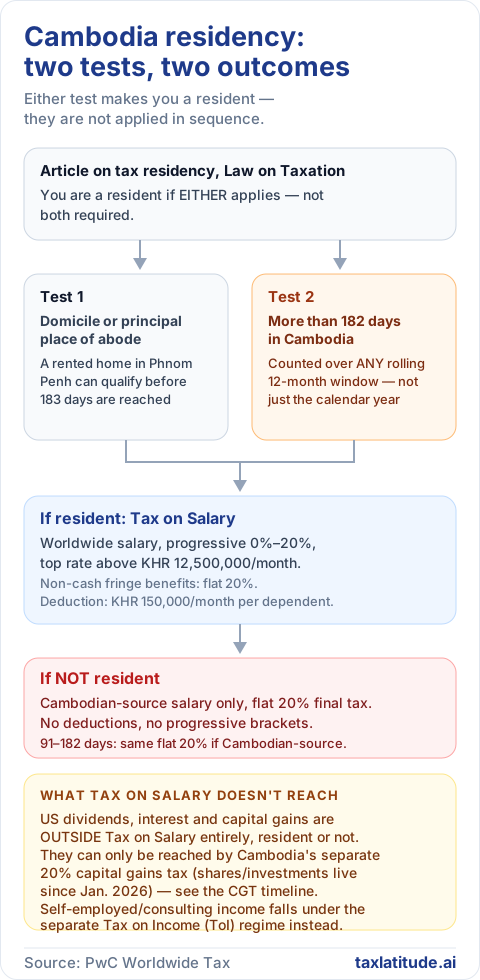
- Cambodia treats you as a tax resident if your domicile or principal place of abode is in Cambodia, or if you are present for more than 182 days in any 12-month period (PwC). Residents pay Tax on Salary on worldwide salary at 0% to 20%; non-residents pay a flat 20% on Cambodian-source salary (PwC).
- Cambodia's 20% capital gains tax is live for shares, other investment assets, leases, goodwill, intellectual property and foreign currency gains realized from January 1, 2026. Real estate gains are deferred to January 1, 2027 (Rajah & Tann Asia, secondary; KPMG Cambodia). The earlier CGT rule (Prakas 496) taxed Cambodian residents on gains from assets located abroad as well as in Cambodia (KPMG Cambodia); check how the current rule (Prakas 1130) applies to you before selling US assets.
- There is no US-Cambodia Social Security totalization agreement. The US has 31 agreements in force, and Cambodia is not among them (SSA). Some Americans can end up paying into both US Social Security and Cambodia's NSSF.
- The US-Cambodia FATCA agreement (Model 1) has been in force since December 23, 2016, so Cambodian banks report US account holders (US Treasury). FBAR and Form 8938 rules apply in full.
- Foreigners cannot own land in Cambodia. They can own condominium units on the first floor or above in registered co-owned buildings, within a 70% foreign-ownership cap per building (DFDL, secondary; Realestate.com.kh, secondary).
Do Americans living in Cambodia still file US taxes?
Yes. The United States taxes its citizens and green card holders on worldwide income wherever they live. If your gross income meets the filing threshold for your filing status, you file Form 1040 even if every dollar was earned in Cambodia and even if you end up owing nothing (IRS).
Living abroad changes the deadlines, not the obligation:
- If your tax home and residence are outside the United States on the regular due date, you get an automatic two-month extension to June 15 to file and pay. Interest still runs on any tax owed from April 15 (IRS).
- You can extend further to October 15 with Form 4868 (IRS).
- The FBAR (FinCEN Form 114) is due April 15 with an automatic extension to October 15 (IRS).
The foreign earned income exclusion and the foreign tax credit are elections made on a filed return. If you don't file, you can't claim them (IRS).
When does Cambodia treat you as a tax resident, and what does it tax?
What is the residency test?
Under Cambodia's rules, you are a resident if either applies (PwC):
- Your domicile or principal place of abode is in Cambodia, or
- You are present in Cambodia for more than 182 days in any 12-month period.
The 182-day count runs over any 12-month window, not only the calendar year. A long-stay visa holder who rents a home in Phnom Penh can be a resident under the first test before reaching 183 days.
The governing law is the Law on Taxation promulgated by Royal Kram NS/RKM/0523/004, effective May 16, 2023, which replaced the 1997 Law on Taxation and its 2003 amendments (KPMG Cambodia). No later law replacing it has turned up as of November 2, 2026. Our tax residency tool quotes the relevant articles directly.
Tax on Salary (employees)
Cambodia has no single personal income tax. Employment income falls under Tax on Salary (ToS), withheld monthly by the employer (PwC).
Resident monthly ToS rates, as of November 2, 2026 (PwC; VDB Loi, secondary):
| Monthly salary (KHR) | Rate |
|---|---|
| 0 to 1,500,000 | 0% |
| 1,500,001 to 2,000,000 | 5% |
| 2,000,001 to 8,500,000 | 10% |
| 8,500,001 to 12,500,000 | 15% |
| Over 12,500,000 | 20% |
Other points:
- Residents are taxed on worldwide salary. Non-residents are taxed only on Cambodian-source salary, at a flat 20% final tax (PwC).
- A resident can reduce the ToS base by KHR 150,000 per month for each dependent child or spouse (PwC). DFDL's worked examples describe the spouse rebate as applying to a non-working spouse ("housewife") (DFDL, secondary).
- Fringe benefits (housing, cars for private use, school fees and similar) are taxed at a flat 20% (PwC).
- Employees do not file an annual ToS return (PwC). The employer files and pays monthly: by the 25th of the following month through the GDT e-filing system, or by the 20th where paper filing is still allowed (PwC; KPMG Cambodia). NSSF contributions are due by the 15th of the following month (KPMG Cambodia).
Remote workers paid from the US. PwC's summary says residents are taxed on worldwide salary (PwC). No published GDT guidance addresses how a resident employee of a foreign employer with no Cambodian presence declares and pays ToS. If this is your situation, get local advice before assuming no Cambodian tax is due.
Tax on Income (self-employed, sole proprietors, consultants)
General consulting income is outside ToS and falls under the Tax on Income (ToI) regime instead (PwC). Physical persons, sole proprietorships and partners in partnerships that are not legal persons pay annual ToI at progressive rates set by Sub-Decree 196, effective January 1, 2023 (VDB Loi, secondary; DFDL, secondary):
| Annual taxable income (KHR) | Rate |
|---|---|
| 0 to 18,000,000 | 0% |
| 18,000,001 to 24,000,000 | 5% |
| 24,000,001 to 102,000,000 | 10% |
| 102,000,001 to 150,000,000 | 15% |
| Over 150,000,000 | 20% |
No later table replacing Sub-Decree 196 has surfaced as of November 2, 2026, though an official English version on the GDT site proved elusive, so confirm the current table with a Cambodian adviser.
Withholding on investment and rental income
Cambodian payers withhold tax on several payments to residents, as of November 2, 2026 (PwC):
- Interest: 15%. This rate does not apply to interest paid to Cambodian banks and financial institutions (PwC). Interest that Cambodian banks pay on deposits has its own lower rates, for example 4% on non-fixed-term deposits in a 2018 practitioner summary (VDB Loi, secondary).
- Royalties: 15%
- Services, unless the provider is a registered taxpayer issuing a valid VAT invoice: 15%
- Rent of movable or immovable property: 10%
Payments of Cambodian-source income to non-residents are generally subject to 14% withholding (PwC).
Capital gains
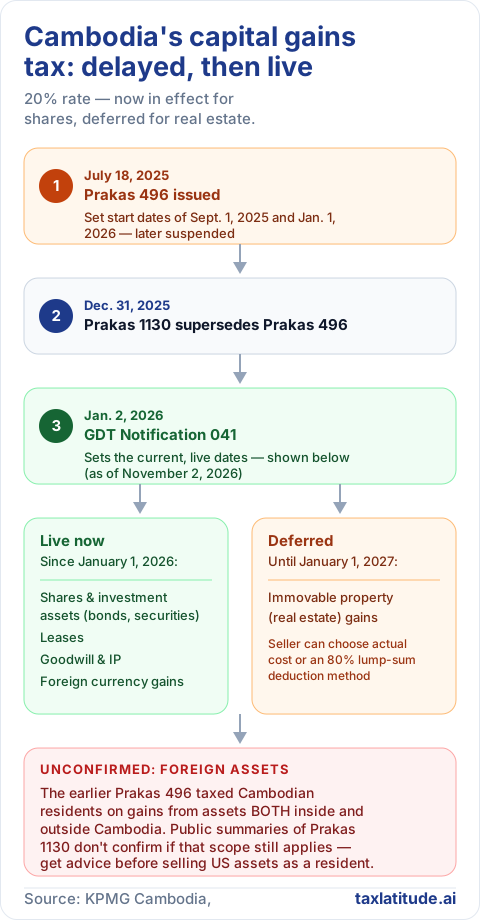
Cambodia's capital gains tax (CGT) is 20% (KPMG Cambodia; KPMG Cambodia). Its rollout has been delayed several times:
- Prakas 496 (July 18, 2025) set start dates of September 1, 2025 and January 1, 2026; those dates were suspended (KPMG Cambodia; KPMG TaxNewsFlash).
- Prakas 1130 (December 31, 2025) superseded Prakas 496 (KPMG Cambodia).
- GDT Notification 041 (January 2, 2026) set the current dates: gains on leases, investment assets (shares, bonds, securities), goodwill, intellectual property and foreign currency are taxable from January 1, 2026. Gains on immovable property are taxable from January 1, 2027 (Rajah & Tann Asia, secondary).
- For immovable property, the seller can choose actual cost or a lump-sum method that deducts 80% of the sale proceeds (KPMG Cambodia).
- Taxpayers registered under the self-assessment regime (VAT-registered) report capital gains under ToI rather than under the separate CGT (KPMG Cambodia; KPMG Cambodia).
Foreign assets. Prakas 496 covered gains realized by resident individuals on assets located both inside and outside Cambodia, and gains realized by non-residents on Cambodian assets only (KPMG Cambodia; Rajah & Tann Asia, secondary). It allowed a credit for foreign tax paid on a foreign asset, limited to the lower of the foreign tax or the Cambodian CGT due (Andersen Cambodia, secondary). KPMG's summary of Prakas 1130 does not say whether that scope changed (KPMG Cambodia). Until you have confirmed the current position, assume that a Cambodian resident who sells US stocks, funds or a US house may have a Cambodian CGT question, and get advice before the sale.
Property taxes
- Tax on Immovable Property: 0.1% a year on the assessed value above KHR 100 million (PwC).
- Stamp tax on transfers of land, buildings and vehicles: 4%. Transfers of company shares: 0.1% (PwC).
Cambodia has no inheritance or estate tax (TaxAtlas, secondary). Certain family transfers of property have stamp-tax relief thresholds (Deloitte Cambodia).
Is there a US-Cambodia tax treaty?
No. Cambodia does not appear on the IRS or Treasury lists of US income tax treaties as of November 2, 2026 (IRS), and no announced US-Cambodia negotiation turned up.
No public statement explains why. There is no diplomatic-recognition obstacle of the kind that blocks a US-Taiwan treaty; the two governments signed a FATCA agreement in 2015 (US Treasury). The likelier reason is priority. Cambodia's own treaty program has focused mainly on Asian trading partners. Its treaties in force are with Turkey, Macao, Korea, Malaysia, Hong Kong, Vietnam, Indonesia, Brunei, Thailand, China and Singapore (General Department of Taxation). Its announced negotiation list has included Japan, Myanmar, Morocco, the UAE, France and Qatar, not the United States (WTO Center Vietnam, secondary).
Status of Cambodia's newer treaties, as of November 2, 2026:
| Partner | Signed | Status |
|---|---|---|
| Laos | December 4, 2024 | Approved by Cabinet; approved by Cambodia's National Assembly on November 28, 2025. No confirmation that instruments have been exchanged, or that it is in force, has surfaced. (KPMG TaxNewsFlash; Regfollower, secondary) |
| Philippines | February 11, 2025 | Approved by Cambodia's Senate on December 5, 2025. Philippine Senate concurred (Resolution No. 628) and the Philippines ratified it in September 2026. The Philippine Department of Finance described it on October 2, 2026 as closer to entry into force, not in force. (Philippine Information Agency; Regfollower, secondary) |
| Myanmar | September 11, 2026 | Approved by Myanmar's parliament on October 14, 2026; enters into force after exchange of ratification instruments. (Regfollower, secondary) |
| Singapore (Second Protocol) | November 2, 2023 | Protocol in force since March 6, 2026. (Ministry of Finance Singapore) |
None of these treaties helps a US citizen with US tax. Cambodia's treaties can matter if you also receive income from one of these countries, for example a Singapore or Thai source.
How do you avoid paying tax twice?
Without a treaty, you use two US tools: the foreign earned income exclusion (FEIE) and the foreign tax credit (FTC). Most Americans in Cambodia use one or both.
Foreign earned income exclusion (Form 2555)
- For 2026, you can exclude up to $132,900 of foreign earned income per qualifying person (IRS).
- You qualify through the bona fide residence test or the physical presence test (330 full days in a foreign country or countries during 12 consecutive months) (IRS; CPA Practice Advisor, secondary).
- A foreign housing exclusion or deduction can add to this. The housing limit is generally 30% of the maximum exclusion (IRS). For 2026 the base housing amount is $21,264, and IRS Notice 2026-25 sets location-specific limits (CPA Practice Advisor, secondary).
- The FEIE covers earned income only: salary, bonuses, self-employment income. It does not cover interest, dividends, rent, capital gains or pensions (IRS).
- The FEIE does not reduce US self-employment tax (IRS).
Cambodian Tax on Salary reaches its 20% top rate above KHR 12,500,000 a month (PwC). For many full-time salaries, the Cambodian tax is therefore equal to or higher than the US federal tax on the same income. In that case the foreign tax credit alone can wipe out US tax on the salary, with no $132,900 ceiling, and leave unused credits to carry forward. Model both methods before choosing. If you claim the FEIE and later revoke it, you generally cannot claim it again for five tax years without IRS approval (IRS).
Foreign tax credit (Form 1116)
The FTC gives a dollar-for-dollar credit against US tax for foreign income taxes you paid, limited to the US tax on your foreign-source income in each category (IRS). Points specific to Cambodia:
- Tax on Salary withheld from your pay is the main creditable tax for employees.
- You cannot take an FTC on income you excluded under the FEIE (IRS).
- Unused credits can be carried back one year and forward ten years (IRS).
- Minimum tax (1% of turnover) is a tax on gross receipts, not net income. Whether it is a creditable foreign income tax under current US regulations is doubtful. A business owner who pays it should get it analyzed before claiming it.
- Employer-paid fringe benefits tax. The 20% fringe benefits tax is charged on amounts the employer provides (PwC). Whether you can credit a tax your employer paid depends on who bears it legally. Get advice before claiming it.
How does the 10% rule affect capital gains?
This matters for the new Cambodian CGT. Under IRC section 865, a US citizen's gain on selling personal property (shares, for example) is generally US-source, even when the citizen lives abroad, unless the citizen's tax home is outside the US and a foreign income tax of at least 10% of the gain is paid on it. When both conditions are met, the gain can be treated as foreign-source, which makes room for a US foreign tax credit (26 U.S.C. § 865).
Cambodia's CGT rate is 20% (KPMG Cambodia). If Cambodia taxes your gain on, say, a sale of US-listed shares while you are a Cambodian resident, the 10% threshold can be met and you may be able to credit the Cambodian tax against US tax. If Cambodia does not tax the gain, the gain stays US-source and US tax applies in the normal way. Gains on real estate are sourced where the property is, so a gain on a Phnom Penh condo is foreign-source (26 U.S.C. § 865).
Selling US-listed shares while a Cambodian tax resident? Under §865, the gain stays US-source unless Cambodia actually taxes it at 10% or more of the gain — only then does Cambodia's new 20% CGT open the door to a US foreign tax credit. Check whether your sale clears the 10% threshold →
Social security: is there a totalization agreement with Cambodia?
No. As of November 2, 2026, the US has totalization agreements in force with 31 countries, the most recent being Romania (effective September 1, 2026). Cambodia is not on the list (SSA; SSA).
What this means:
- Self-employed Americans in Cambodia owe US self-employment tax of 15.3% on 92.35% of net self-employment earnings, once net earnings reach $400, whether or not they claim the FEIE (IRS).
- Employees of a Cambodian employer are generally covered by Cambodia's National Social Security Fund (NSSF), and their wages from a foreign employer are generally outside US Social Security (IRS). Employers must register each worker with the NSSF within three days of the start of work (NSSF).
- Employees of an American employer sent to Cambodia generally stay in US Social Security (IRS). If they are also registered with the NSSF, they may pay into both systems, and no agreement removes the overlap.
Working for a US employer while registered with Cambodia's NSSF? With no US-Cambodia totalization agreement, you can end up paying into both US Social Security and the NSSF at once, with nothing to remove the overlap. Find out if you're paying into both systems →
NSSF contributions, as of November 2, 2026:
- Occupational risk: 0.8% of wages, paid by the employer (PwC).
- Health care: 2.6% of wages, paid entirely by the employer. It was originally split 1.3% each between employer and employee; the employer has borne the full cost since January 1, 2018 (PwC; Mercans, secondary).
- Pension: contributions began October 1, 2022 (Tilleke & Gibbins, secondary). For the first five years (to September 2027) the total rate is 4%, split 2% employer and 2% employee. It rises to 8% in years six to ten, with further increases every ten years after that (PwC).
- Wage cap: the 2022 pension rules capped the monthly wage used for contributions at KHR 1,200,000 (Mercer, secondary; BDO, secondary).
- Old-age pension: requires NSSF registration, age 60 or older, and at least 12 months of contributions. Members who do not qualify receive an old-age allowance instead (PwC).
NSSF officials have said foreign workers must take part in the pension scheme. A lump-sum refund for foreigners who leave was reported as under discussion, not adopted (Cambodia Investment Review, secondary). No confirmation that a refund rule exists has turned up as of November 2, 2026.
IRS Publication 514 bars a foreign tax credit for social security taxes paid to a country that has a totalization agreement with the US (IRS Publication 514). Cambodia has none, so that rule does not block a credit for the employee share of NSSF contributions. Whether the employee share qualifies as a creditable income tax is a separate, technical question for your preparer. The amounts are small because of the wage cap.
Which US forms apply to accounts and assets in Cambodia?
| Form | When it applies |
|---|---|
| FinCEN Form 114 (FBAR) | Aggregate balance of foreign financial accounts exceeded $10,000 at any time during the year. Cambodian bank accounts (USD or KHR) and brokerage accounts count. (IRS) |
| Form 8938 | Specified foreign financial assets above the threshold. For taxpayers living abroad: more than $200,000 on the last day of the year or $300,000 at any time (single); $400,000 / $600,000 (married filing jointly). (IRS) |
| Form 2555 | To claim the FEIE and housing exclusion or deduction. (IRS) |
| Form 1116 | To claim the foreign tax credit. (IRS) |
| Form 5471 | You are an officer, director or shareholder of a Cambodian company in the situations the form covers, including owning 10% or more. Most Americans who set up a Cambodian private limited company will file it. (IRS) |
| Form 8992 | Your share of net CFC tested income (NCTI, formerly GILTI) if you own 10% or more of a controlled foreign corporation. (EY Tax News, secondary) |
| Form 8865 | You hold an interest in a foreign partnership in the situations the form covers. (IRS) |
| Form 8621 | You hold shares in a passive foreign investment company (PFIC), which includes most non-US pooled funds. (IRS) |
| Form 8854 | You give up citizenship or a long-term green card. (IRS) |
FATCA. The US-Cambodia intergovernmental agreement was signed September 14, 2015 and is listed by Treasury as a Model 1 agreement in force since December 23, 2016. Cambodia has been treated as having an IGA in effect since November 30, 2014 (US Treasury). Cambodian financial institutions report accounts held by US persons to the Cambodian authorities, who pass the data to the IRS. Your bank may ask you for a Form W-9.
The signed text follows the nonreciprocal form of the Model 1 agreement (often called Model 1B). Treasury's table labels it simply "Model 1" (US Treasury).
PFIC risk. Any pooled investment vehicle organized outside the US, in Cambodia or elsewhere, is likely to be a PFIC. PFIC rules are punitive when no election is made, and each fund generally needs its own Form 8621 (IRS; see our Form 8621 guide). Americans in Cambodia are better off holding US-domiciled funds through a US brokerage that still accepts their foreign address.
Cambodia-specific mechanisms: QIP incentives and the minimum tax
Two Cambodian business rules interact with US tax in ways that catch American business owners.
Qualified Investment Projects (QIP)
The Law on Investment (Royal Kram NS/RKM/1021/014, October 15, 2021) lets approved investment projects register as QIPs with the Council for the Development of Cambodia (KPMG Cambodia). A QIP chooses one of two basic incentive packages (Rajah & Tann, secondary; BDO, secondary):
- Option 1 – income tax exemption for three to nine years depending on sector, starting when the project first earns income. After the exemption ends, the QIP pays 25% of the normal income tax for two years, 50% for the next two, and 75% for the last two. During the exemption period it is also exempt from monthly prepayment of tax on income.
- Option 2 – special depreciation under the tax law, plus a deduction of up to 200% of certain expenses for up to nine years.
The US angle: a Cambodian company is a controlled foreign corporation (CFC) if US shareholders, each owning 10% or more, together own more than 50% of it. Starting with tax years beginning after December 31, 2025, the GILTI regime is called net CFC tested income (NCTI), and the 10% return on tangible assets is no longer excluded (EY Tax News, secondary). An American who owns 10% or more of a CFC generally includes their share of its tested income on their US return each year, whether or not any cash is distributed. Without a section 962 election, an individual pays ordinary rates on that inclusion and gets no credit for Cambodian corporate tax (EY Tax News, secondary). A QIP that pays little or no Cambodian tax during its holiday can therefore produce current US tax for its American owner.
Own 10% or more of a Cambodian company with a QIP tax holiday? The holiday shields Cambodian tax, not US tax — net CFC tested income still lands on your US return every year, holiday or not. See what your QIP actually saves you →
Cambodia itself has no controlled foreign company rules (PwC).
Minimum tax
Taxpayers that do not keep proper accounting records pay a minimum tax of 1% of annual turnover, inclusive of all taxes except VAT, if that is higher than their tax on income. It applies even in a loss year (Deloitte; PwC). Taxpayers whose accounting records meet GDT requirements are exempt (PwC). Under the 2017 rules, enterprises seeking the exemption needed audited financial statements, and the GDT was to review their records every two years (Deloitte Cambodia).
For a US owner, the 1% minimum tax may not be creditable (see the foreign tax credit section above), and keeping proper books is the main way to avoid it.
Local considerations
Working in Cambodia
- Foreign employees need a work permit and employment card from the Ministry of Labour and Vocational Training, renewed every year. Employers must apply for a foreign employee quota each year (Tilleke & Gibbins, secondary; Andersen Cambodia, secondary).
- Your employer withholds Tax on Salary monthly and registers you with the NSSF (NSSF; PwC).
- If you are a resident with salary from abroad, see the remote worker note under Tax on Salary.
Running a business
- A sole proprietorship or consulting practice reports under ToI at the annual progressive rates above (VDB Loi, secondary).
- A Cambodian company pays tax on income at a standard 20% rate (Deloitte) and is subject to the minimum tax rules. Dividends paid to resident shareholders are not taxable (Deloitte).
- Selling shares in a Cambodian company has been subject to 20% CGT since January 1, 2026 (Rajah & Tann Asia, secondary), and to 0.1% stamp tax (PwC). For non-resident sellers, the CGT rules also apply a 14% withholding tax on retained earnings attributable to the shares sold (KPMG Cambodia).
- An American owner files Form 5471 and, from 2026, Form 8992 for NCTI (see above).
Real estate
Cambodia's rules for foreign buyers are unusual:
- Foreigners cannot own land, whether directly or through a foreign-owned company (Emerhub, secondary). A Cambodian company can own land only if Cambodian citizens or Cambodian companies hold at least 51% of its shares (Tilleke & Gibbins, secondary).
- The 2010 Law on Providing Foreigners with Ownership Rights in Private Units of Co-owned Buildings (promulgated May 24, 2010) allows foreigners to own private units from the first floor up. Ground-floor and underground units are excluded (DFDL, secondary).
- A sub-decree caps foreign ownership at 70% of the total surface of all private units in the building (DFDL, secondary; Realestate.com.kh, secondary).
- Buildings within 30 km of a land border are excluded (The Cambodia Daily, secondary).
- The building must be registered as a co-owned building and the unit must carry its own strata title. Confirm the title before paying a deposit.
- Arrangements where a Cambodian nominee holds land for a foreigner carry legal risk. They are outside the scope of this guide; take legal advice before using one.
Tax costs on property:
- 4% stamp tax on transfer, legally payable by the buyer, though the parties can agree otherwise (PwC; Multilaw, secondary).
- 0.1% annual Tax on Immovable Property above KHR 100 million (PwC).
- 10% withholding on rent paid by a registered taxpayer (PwC). If your tenant is an individual, nobody withholds; owners who are not self-assessment taxpayers are subject to a 10% tax on property rental and pay it themselves (Belt and Road tax portal, secondary).
- 20% CGT on gains from January 1, 2027 (Rajah & Tann Asia, secondary).
On the US side, report rental income on Schedule E. Foreign residential rental property placed in service after 2017 is depreciated over 30 years under the alternative depreciation system (IRS Publication 527). Report the sale on Form 8949 / Schedule D. The FEIE never covers rent or property gains.
Leaving Cambodia
- Cambodian residency ends when you no longer have your principal place of abode in Cambodia and are not present for more than 182 days in a 12-month period (PwC). Any Cambodian-source salary paid after that is taxed at the 20% non-resident flat rate (PwC).
- No Cambodian exit tax on individuals. No rule taxes an individual on unrealized gains on departure, and no published requirement for an individual tax clearance before leaving has turned up. Confirm with your employer, which handles final ToS and NSSF filings.
- Selling property later. As a non-resident you remain subject to Cambodian CGT on Cambodian assets, including real estate sold on or after January 1, 2027 (Rajah & Tann Asia, secondary; KPMG Cambodia), and the 14% withholding regime on Cambodian-source payments (PwC).
- NSSF. If you leave before qualifying for a pension, you may only get the old-age allowance, and a refund mechanism for foreigners has not been confirmed (PwC; Cambodia Investment Review, secondary).
- US side. Your FEIE ends on the date you stop meeting the bona fide residence or physical presence test. The exclusion for your departure year is prorated (IRS). Any Cambodian accounts you keep open stay reportable on the FBAR and Form 8938 in each year the thresholds are met (IRS; IRS).
- Renouncing US citizenship while in Cambodia does not undo past filing duties. You must certify five years of compliance on Form 8854. You can be a "covered expatriate" subject to exit tax if your net worth is $2 million or more, your average annual net income tax over five years exceeds the inflation-adjusted threshold ($211,000 for 2026 (ProTax Consulting, secondary)), or you cannot certify compliance (IRS). Our exit tax tool estimates exposure.
Mistakes Americans commonly make in Cambodia
- Stopping US filings after moving. The obligation continues. A late return can still claim the FEIE in some cases, but only under stricter conditions (IRS; IRS).
- Assuming a treaty exists. None does, so there are no treaty rates or tie-breaker rules (IRS).
- Ignoring the 182-day rule's rolling window. Residency is tested over any 12-month period, not only January to December (PwC).
- Selling US shares without checking Cambodian CGT. Under Prakas 496, Cambodian residents were taxed on gains on foreign assets (KPMG Cambodia). Check the current Prakas 1130 position before a large sale.
- Claiming the FEIE and the FTC on the same income (IRS).
- Forgetting self-employment tax. The FEIE does not remove it, and there is no totalization agreement to remove it (IRS; SSA).
- Treating a QIP tax holiday as tax-free for the owner. NCTI can bring the profit into US taxable income each year (EY Tax News, secondary).
- Skipping Form 5471 for a Cambodian company. Late or missing forms carry penalties (IRS).
- Buying a ground-floor shophouse or land in your own name. Foreigners cannot hold title to these (DFDL, secondary; Emerhub, secondary).
- Leaving KHR or USD accounts off the FBAR. Cambodian banks report US holders under FATCA (US Treasury; IRS).
- Buying non-US funds without understanding PFIC reporting (IRS).
Checklist
Before or soon after moving
- Confirm whether you will be a Cambodian resident (domicile or abode test, and 182-day rolling count) (PwC)
- Decide between FEIE and FTC for salary; model both (IRS; IRS)
- Get a work permit and employment card, and confirm NSSF registration (NSSF; Tilleke & Gibbins, secondary)
- Ask your employer whether you stay in US Social Security, the NSSF, or both (SSA; IRS)
- Keep a US brokerage that accepts your foreign address; avoid non-US funds (IRS)
Every year
- File Form 1040 by June 15 (automatic extension for those abroad), or by October 15 with Form 4868 (IRS)
- File the FBAR if foreign accounts exceeded $10,000 in total at any time (IRS)
- Check Form 8938 thresholds for taxpayers living abroad (IRS)
- Keep Cambodian payslips and ToS certificates for any FTC claim (IRS)
- Track days in Cambodia and days outside the US
- If you own a Cambodian company: Form 5471, Form 8992, NCTI analysis, minimum tax position (IRS; EY Tax News, secondary; PwC)
- If you sold shares or other capital assets: check Cambodian CGT (from January 1, 2026) and the US sourcing rule (26 U.S.C. § 865; Rajah & Tann Asia, secondary)
Before buying or selling property
- Confirm strata title, the floor level and the building's foreign quota (DFDL, secondary)
- Budget 4% stamp tax (buyer) and the annual 0.1% property tax (PwC)
- For sales from January 1, 2027, plan for 20% CGT and compare actual cost with the 80% lump-sum method (Rajah & Tann Asia, secondary; KPMG Cambodia)
Frequently asked questions
Do I have to file US taxes if I earn everything in Cambodia? Yes, if your income meets the filing threshold. You may owe nothing after the FEIE or FTC, but you still file (IRS; IRS).
Is there a US-Cambodia tax treaty? No, as of November 2, 2026. Cambodia is not on the IRS treaty list (IRS).
How many days can I spend in Cambodia before I become a tax resident? Being present for more than 182 days in any 12-month period makes you a resident. You can also become a resident sooner if Cambodia is your domicile or principal place of abode (PwC).
What is the top Cambodian tax rate on salary? 20%. It applies to monthly salary over KHR 12,500,000 for residents, and to all Cambodian-source salary for non-residents (PwC).
I work remotely for a US company while living in Cambodia. Do I owe Cambodian tax? Cambodian residents are taxed on worldwide salary. No published GDT procedure covers residents paid by a foreign employer with no Cambodian presence. Get local advice, and keep records of your days and your pay.
Can I use the FEIE in Cambodia? Yes, if you meet the bona fide residence or physical presence test. The 2026 maximum is $132,900 (IRS).
Does Cambodia tax my US stock sales? Cambodia's 20% CGT has applied to investment assets since January 1, 2026. The earlier rule taxed residents on foreign-located assets too. Public summaries don't confirm how the current Prakas 1130 treats foreign assets, so get advice before a large sale.
If Cambodia taxes my gain, can I credit that tax in the US? Often, yes. If your tax home is outside the US and you pay foreign tax of at least 10% of the gain, the gain can be foreign-source under IRC section 865, which allows a foreign tax credit, subject to the usual limits (26 U.S.C. § 865; IRS).
Is there a totalization agreement? Will I pay Social Security twice? There is no agreement. The self-employed pay US self-employment tax. An employee of a US employer who is also registered with the NSSF can pay into both systems.
Can I buy property in Cambodia as an American? You can own a condominium unit on the first floor or above in a registered co-owned building, within the 70% foreign cap and outside 30 km border zones. You cannot own land.
Will my Cambodian bank report me to the IRS? Yes. The FATCA agreement has been in force since December 23, 2016 (US Treasury).
Does a QIP tax holiday reduce my US tax? Not necessarily. If you own a controlled foreign corporation, low Cambodian tax can mean a larger NCTI inclusion on your US return.
When should you hire a professional?
Some Americans in Cambodia can handle their own returns. You are a straightforward case if you are an employee of a Cambodian employer, with salary under the FEIE limit, a few bank accounts, and no Cambodian company or property. Get professional help if any of these apply:
- You own a Cambodian company or a QIP. Form 5471, NCTI, a possible section 962 election, and the minimum tax analysis all interact.
- You plan to sell shares, a business or, from 2027, real estate. Cambodian CGT is new, its rules have been issued in several versions since 2020 (KPMG TaxNewsFlash), and the treatment of foreign assets under Prakas 1130 is not clear from public summaries (KPMG Cambodia).
- You are a resident paid from abroad. The Cambodian procedure is not published.
- You pay into both US Social Security and the NSSF.
- You hold non-US funds, or you are behind on FBARs or US returns. The IRS has streamlined procedures for non-willful cases (IRS), and an adviser can tell you whether you qualify.
- You have a dispute with the GDT. Cambodia does not publish tax court decisions. Disputes go through an administrative tax arbitration committee whose decisions are not published. There is no public case law to tell you how the GDT has treated a position before. A Cambodian adviser who deals with the GDT regularly is the only practical guide to current practice.
Look for advisers on each side: a US preparer who handles expatriate returns, and a Cambodian tax firm for ToS, ToI, CGT and NSSF questions.
This guide is general information, not tax or legal advice for your situation.
Sources
Research was done on November 2, 2026. Entries marked "secondary" are law firm, practitioner or news summaries used as a cross-check. Unmarked entries are government bodies, Big Four accounting firms, and primary legal/statutory text.
| Source | Used for |
|---|---|
| IRS, Tax Tip | US citizens abroad must file; June 15 extension; Form 4868 |
| IRS / US Treasury | No US-Cambodia income tax treaty |
| IRS | FEIE $132,900 for 2026; housing limit; revocation rules |
| IRS | Foreign tax credit mechanics, carryback/carryforward |
| IRS | Self-employment tax 15.3%; FEIE does not reduce it |
| SSA POMS GN 01701.005 | 31 totalization agreements in force; Cambodia absent |
| US Treasury, FATCA | Cambodia IGA Model 1, in force 12-23-2016 |
| IRS | FBAR $10,000 threshold and deadlines |
| 26 U.S.C. § 865 | Source of gain on personal property, 10% foreign tax rule |
| PwC Worldwide Tax Summaries | Cambodia residency test |
| PwC | ToS rates, worldwide vs source, non-resident 20% |
| KPMG Cambodia | Law on Taxation NS/RKM/0523/004, effective May 16 2023 |
| VDB Loi (secondary) | Sub-Decree 196 ToI and ToS tables |
| PwC | KHR 150,000 monthly dependent deduction |
| Rajah & Tann Asia (secondary) | GDT Notification 041, CGT effective dates |
| KPMG Cambodia | Prakas 1130 supersedes Prakas 496 |
| KPMG Cambodia | 20% CGT; Prakas 496 scope |
| PwC | Resident/non-resident withholding rates |
| PwC | Tax on Immovable Property; stamp tax |
| General Department of Taxation | Cambodia's DTAs in force |
| WTO Center Vietnam (secondary) | Cambodia's treaty negotiation list |
| KPMG TaxNewsFlash | Cabinet approval of Laos/Philippines/Singapore treaties |
| Regfollower (secondary) | Laos treaty National Assembly approval |
| Philippine Information Agency | Philippines treaty status |
| Regfollower (secondary) | Philippines ratification, Cambodian Senate approval |
| Regfollower (secondary) | Myanmar treaty signed and approved |
| DFDL (secondary) | Foreign ownership of co-owned buildings |
| Realestate.com.kh (secondary) | Sub-Decree 70% foreign ownership cap |
| NSSF, Prakas 168 | Employers register workers within 3 days |
| PwC | NSSF rates, pension eligibility |
| Tilleke & Gibbins (secondary) | Pension contributions began October 1 2022 |
| Mercer (secondary) | Contribution wage cap |
| BDO (secondary) | Wage cap cross-check |
| Cambodia Investment Review (secondary) | Foreign workers and NSSF pension; refund discussion |
| DFDL (secondary) | Spouse rebate examples |
| PwC | Monthly ToS filing; no annual employee return |
| DFDL (secondary) | Sub-Decree 196 effective January 1 2023 |
| KPMG TaxNewsFlash | Suspension of Prakas 496 start dates |
| Rajah & Tann Asia (secondary) | Prakas 496: residents taxed on assets in/outside Cambodia |
| Andersen Cambodia (secondary) | Prakas 496 foreign tax credit cap |
| TaxAtlas (secondary) | No inheritance or estate tax |
| Deloitte Cambodia | Stamp tax relief thresholds |
| Ministry of Finance Singapore | Singapore-Cambodia Second Protocol in force |
| CPA Practice Advisor (secondary) | 330-day test; 2026 housing base |
| SSA | Romania totalization agreement |
| IRS | Form 8938 thresholds abroad |
| IRS | Form 5471 filing categories and penalties |
| EY Tax News | GILTI renamed NCTI; QBAI exclusion removed |
| IRS | Form 8865 |
| IRS | PFIC reporting on Form 8621 |
| IRS | Expatriation tax, Form 8854, covered expatriate tests |
| KPMG Cambodia | Law on Investment NS/RKM/1021/014 |
| Rajah & Tann (secondary) | QIP Option 1 and Option 2 details |
| BDO (secondary) | QIP incentives cross-check |
| PwC | No CFC rules in Cambodia |
| Deloitte | Minimum tax 1% of turnover |
| PwC | Minimum tax exemption for proper accounting records |
| Deloitte Cambodia | Audit requirement for minimum tax exemption |
| Tilleke & Gibbins (secondary) | Work permits and employment cards |
| Andersen Cambodia (secondary) | Annual foreign employee quota |
| Deloitte | Corporate tax 20%; dividends to residents not taxable |
| Emerhub (secondary) | Foreigners cannot own land |
| Tilleke & Gibbins (secondary) | Land-owning company must be 51% Cambodian |
| The Cambodia Daily (secondary) | 30 km land border exclusion |
| Multilaw (secondary) | Stamp duty payable by buyer |
| ProTax Consulting (secondary) | 2026 covered expatriate threshold $211,000 |
| IRS Publication 527 | Foreign rental property 30-year ADS |
| IRS | Streamlined filing compliance procedures |
| VDB Loi (secondary) | Bank deposit interest withholding, 2018 |
| Mercans (secondary) | NSSF health care contribution 2.6% |
| IRS Publication 514 | No FTC for social security tax in a totalization country |
| KPMG Cambodia | Monthly e-filing and NSSF deadlines |
| Belt and Road tax portal (secondary) | 10% tax on property rental for non-self-assessment owners |
| IRS | US Social Security coverage abroad |